

1. Mini Griot or Chicken Sandwiches
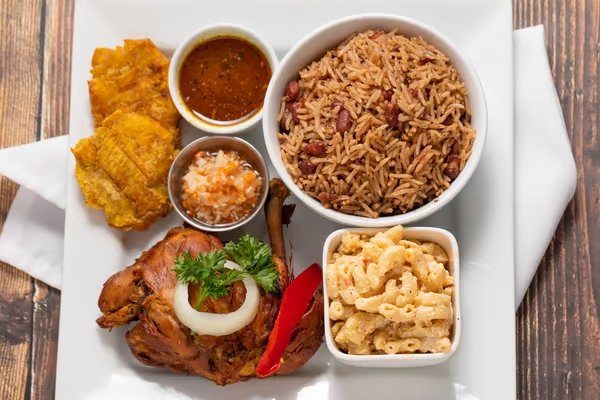
Griot is marinated, crispy porka classic! For an easy-to-eat version, make small sandwiches with bread.
Are you a parent? Are your children already going to school? Don’t say anything, I know! Every morning, it’s the same question: "What’s in their lunch today?" You want it to be tasty, balanced, and, above all, for your child to enjoy what they’re eating.
Here are 5 simple and delicious ideas to treat your child at school.
Read the article in :
Griot is marinated, crispy porka classic! For an easy-to-eat version, make small sandwiches with bread.
Small, well-seasoned meatballs served with crispy fries and a touch of vegetables (diced peas or carrots) for a complete and balanced meal.
Nothing beats an assortment of local fruits to bring freshness and vitamins! Mango, pineapple, melon, or papaya, cut into chunks for easy eating.
Slices of ripe banana wrapped in thin strips of grilled chicken. A perfect balance of sweet and savory that will delight little gourmands!
If your child enjoys traditional dishes, a small portion of sticky rice with red peas and chunks of fried or grilled fish is a delicious option.

Facebook : https://www.facebook.com/haitiwonderland
Youtube : https://www.youtube.com/@haitiwonderland
Instagram : https://www.instagram.com/haitiwonderland/
Twitter : https://twitter.com/haitiwonderland
Linkedin : https://www.linkedin.com/in/haitiwonderland/
The Haitian Creole language, spoken by nearly 12 million people, is much more than just a means of communication. It embodies the history, culture, and identity of Haiti. But where does this unique language come from? This article explores its origins, evolution, and central role in Haitian society.
Originally from Bainet and raised in Petit-Goâve, Haiti, Emmanuel Joseph embodies one of the rising figures of the Haitian intelligentsia. A jurist, ethicist, and Ph.D. candidate in philosophy at the University of Sherbrooke (Canada), his journey reflects a rigorous commitment to justice, human rights, and critical thinking. Local Roots, Global Outlook Educated in Haiti’s public and religious schools, Emmanuel Joseph began his intellectual path at the Apostolic School of Petit-Goâve, then excelled at the Lycée Faustin Soulouque. His grades, consistently between 8 and 9 out of 10, demonstrated remarkable discipline and rigor from an early age. His university education began at the Faculty of Ethnology (FE) and the Faculty of Law and Economics (FDSE) of the State University of Haiti, where he earned his bachelor’s degree in November 2013. His academic profile sharpened in Canada, especially at the University of Quebec in Rimouski (UQAR), where he completed a master’s degree in philosophy/ethics in 2020, before pursuing a Ph.D. at the University of Sherbrooke, focusing on a broad yet fundamental theme: humanitarian action as experience.
Subscribe to our newsletter to stay informed of all our activities and news on Haiti.
Haiti, this Caribbean island with a rich historical past and generous nature, reveals one of its most precious treasures: Labadee. Nestled less than 10 km northwest of Cap-Haitien, Labadee stands like a seaside pearl, offering its visitors an exquisite experience combining relaxation, adventure and cultural discovery.
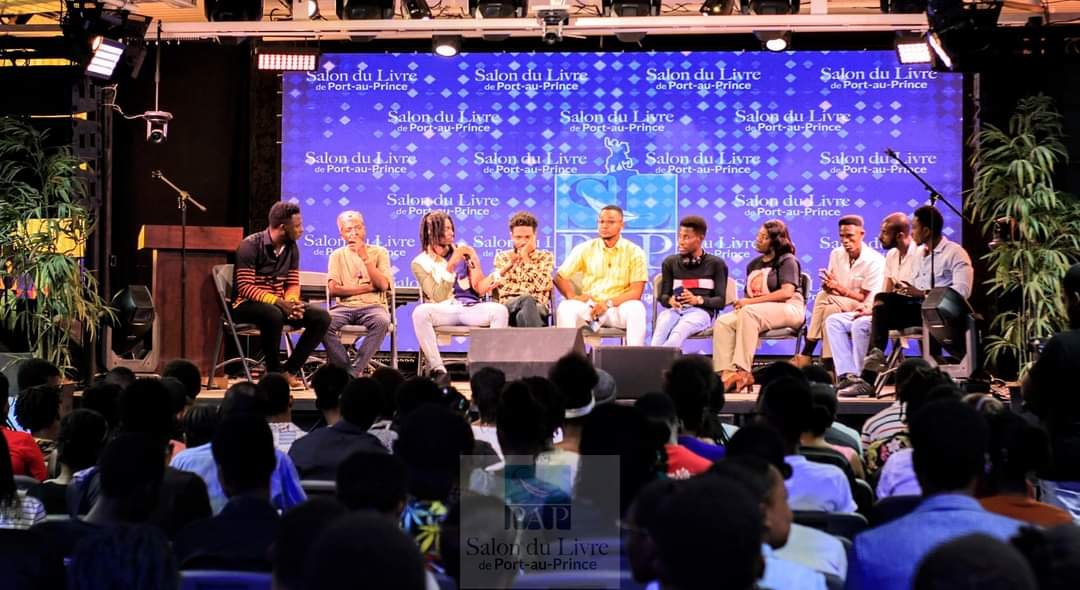
Living in Prose and Poetry is an artistic and cultural event organized by the cultural organization Salon de Livre de Port-au-Prince (OCSLPAP) with the aim of bringing together young artists from the Haitian capital to exhibit them to a large audience . This edition will take place on Saturday July 27, 2024, at the pyépoudré cultural center, located at number 332 on the Route de Bourne. This year the organizers announce their mission is to bring together talents from various categories of arts, always with the aim of helping them to become familiar with each other, and to help create a solid link between them and the Haitian public. . The categories targeted by the organizers for this second edition are young poets, slammers, comedians, rappers, dancers, singers, painters, and writers who have already published at least one work. Living in prose and poetry will also be an opportunity to encourage Haitian youth to think. The first part of the event will be devoted to a discussion around a text by the famous Haitian writer Louis Philippe Dalembert, entitled The Other Face of the Sea. It is a novel which carefully addresses the subject of immigration and detachment that goes with it in the immigrant’s skin. It is a book that speaks openly to the reality of the Haitian people today. It has already been announced that this first part will be moderated by the journalist and literary critic Carl Pierrecq who works for the short story writer, and moderation will be provided by Pierre Marie, a young sociology student at the Faculty of Human Sciences (FASCH). After a largely successful first edition which took place in May 2023 in the premises of the municipal library of Delmas, the organizers of living in prose and poetry say they are determined and have made the promise for this year to deliver to the public port-au -princien, a cultural event of exceptional scale for the second outing. Once again, this will be the perfect opportunity to celebrate the great richness of Haitian culture through the organs of our young talents. Given the difficult context, manifested by the almost daily situation of insecurity which has prevailed for some time, in a good part of Port-au-Prince, the announcement of this event comes as a fresh breath of oxygen, scattered throughout the within the lungs of the city. It is yet another opportunity to remind through this artistic festivity that even in times of deep unrest, art will remain an indispensable light, because even in times of crisis, the latter and the artist (its channel of diffusion) will become refuges, sources of comfort and appeasement for all human souls.
May 18 is an emblematic date in Haiti, marked by the celebration of the Flag and University Days. This day commemorates the creation of the Haitian flag and highlights the importance of education and universities in the country. The history and meaning of this day are deeply rooted in Haitian national identity.
The night of February 17, 2024 will remain engraved in the memories of music lovers in Jacmel, Haiti, thanks to a breathtaking show which took place at the Alliance Française. This remarkable event, part of the prestigious Jacmel Jazz Festival calendar, offered spectators an exceptional musical experience with its Acoustic Revival program.

First black nation to free itself from slavery and gain independence from France in 1804 and influenced other liberation movements around the world, inspiring struggles for freedom and equality.

Haïti is blessed with spectacular natural landscapes, including white sand beaches, mountains and rich biodiversity.

Haïti has a rich historical heritage, including sites like the Citadelle Laferrière and the Sans-Souci Palace, listed as UNESCO World Heritage Sites.

Haïti has a rich and diverse culture, influenced by African, European and indigenous elements. Haitian music, dance, art and cuisine are celebrated around the world.