Unity is Strength or Liberty - Equality - Fraternity: What is Haiti’s true national motto?
Haiti has two mottos: "Unity is Strength" on its coat of arms and "Liberty-Equality-Fraternity" in its 1987 Constitution. Find out which one is official.
Confusion has persisted for decades in the Haitian collective imagination: what is the true official motto of the Republic of Haiti? While "Unity is Strength" proudly adorns the national coat of arms, the 1987 Constitution proclaims "Liberty - Equality - Fraternity." Immersed in this symbolic duality, it reflects the complex identity of the first independent Black Republic.
Two Mottos, One Nation: The Haitian Paradox
If you ask a Haitian about their country’s motto, chances are they will answer without hesitation: "Unity is Strength." This historic phrase, engraved on the national coat of arms and taught from generation to generation, is an integral part of Haiti’s patriotic DNA. Yet, legally speaking, the answer is quite different.
According to Article 4 of the 1987 Constitution of the Republic of Haiti, the fundamental text that currently governs the country, the official national motto is: "Liberty - Equality - Fraternity." This direct borrowing from the French republican motto may seem surprising for a country that fiercely fought France for its independence in 1804.
Strength in Unity: A Legend Inscribed in the Arms of the Republic
Although it is not the constitutional motto, "Strength in Unity" nevertheless occupies a central place in Haitian national symbols. This phrase appears explicitly in the official description of the coat of arms of the Republic, as established by the Constitution:
The Arms of the Republic consist of a palm tree surmounted by the cap of liberty and, shading with its palms, a trophy of arms with the legend: Strength in Unity.
This inscription is not insignificant. It appears on the national flag, in the center of the white square separating the blue and red bands. Every Haitian grows up contemplating this motto on the emblem flown in institutions, schools, and official ceremonies.
Why this symbolic duality?
The coexistence of these two mottos reveals the historical and ideological tensions that have plagued Haïti for more than two centuries.
The revolutionary legacy of "Strength in Unity"
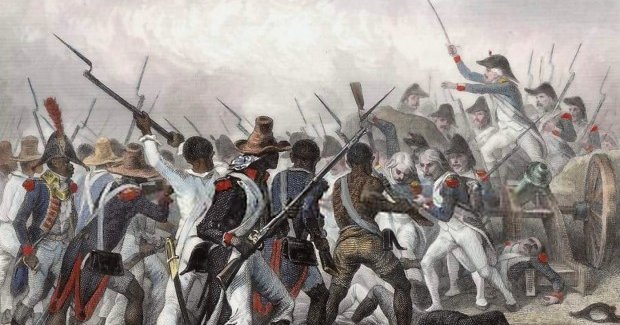
"Strength in Unity" has its roots in the Haitian Revolution (1791-1804). This maxim embodied the crucial message that independence leaders wanted to convey: only the unity of rebellious slaves, beyond divisions of color and origin, could defeat the French colonial armies.
This motto reflects Haiti’s unique history, the only successful slave revolt in world history. It reminds us that Haitian freedom was not granted, but rather won through the sacred union of the oppressed.
The constitutional shift towards "Liberty - Equality - Fraternity"
The adoption of "Liberty - Equality - Fraternity" in the 1987 Constitution marks a symbolic turning point. This constitution, drafted after the fall of the Duvalier dictatorship, sought to anchor Haïti in the universal values of human rights and democracy.
The choice of the French motto can be interpreted as a desire to reinstate itself in the international republican community and the legacy of the Enlightenment, while turning the page on the years of dictatorship.
Which motto legally prevails?
From a strictly legal perspective, "Liberty - Equality - Fraternity" is the official national motto of Haiti, as it is explicitly designated as such in the Constitution, the country’s supreme text.
However, "Unity is Strength" retains a special status: it is the official legend of the coat of arms of the Republic, also enshrined in the Constitution. It is therefore not an "unofficial" motto, but rather a heraldic motto, distinct from the national motto.
In the hearts of Haitians: "Unity is Strength" remains essential.
Despite constitutional clarity, the social and cultural reality overwhelmingly favors "Unity is Strength." This phrase resonates deeply with Haitian historical identity. It evokes resistance, solidarity in the face of adversity, and the glorious legacy of ancestors who have broken their chains.
For many Haitians, "Liberty - Equality - Fraternity" seems like a foreign import, while "Unity is Strength" is their own. It is this motto that is sung, celebrated, and brandished during moments of national unity.
Two Mottos, One Dream
Whether it is called "Unity is Strength" or "Liberty - Equality - Fraternity," the Haitian motto embodies the aspirations of a people who paid the price in blood for their freedom.
Perhaps Haiti’s true motto, ultimately, is not to be found in legal texts, but in the hearts of every Haitian who continues to believe, against all odds, in the possibility of a better future, built on the values of unity, freedom, and human dignity.
And you, which motto do you think best embodies the spirit of Haiti? Share your opinion in the comments!