Haiti’s Mottos Explained: "Unity Makes Strength" and "Liberty - Equality - Fraternity" DemystifiedHaiti’s Mottos Explained: Unity Makes Strength and Liberty - Equality - Fraternity Demystified
Haiti’s Mottos Explained: "Unity Makes Strength" and "Liberty - Equality - Fraternity" Demystified
Discover the profound meaning of Haiti's mottoes: "Unity is Strength" and "Liberty-Equality-Fraternity." History, symbols, and legacy of the first free Black republic.
Haiti, the world’s first independent Black nation, carries within it two powerful mottos that tell the extraordinary story of its struggle for freedom. These phrases, engraved in the heart of every Haitian, are not mere words: they embody the fundamental values of a nation born from the most audacious revolution in modern history.
"Unity Makes Strength": The Motto Inscribed on the Coat of Arms of the Republic
"Unity Makes Strength" appears on the Coat of Arms of the Republic of Haiti, at the center of the national flag. This motto appears on a trophy of arms shaded by the fronds of a palm tree, itself surmounted by the cap of liberty, a universal symbol of emancipation.
This maxim was not chosen by chance. It recalls a crucial moment in Haitian history: the union of different revolutionary forces that defeated the Napoleonic army in 1804. Former slaves, freedmen, mulattoes, and blacks gathered under a single banner to win their independence.
In the post-revolutionary context, "Unity is Strength" represented a vital call for national cohesion. The new country had to overcome the internal divisions inherited from the colonial system: divisions of color, class, and region. This motto reminded us that only unity could guarantee the survival of the young nation in the face of external threats.
Even today, this phrase remains relevant. It invites Haitians to transcend their differences to build a better future together. In a country facing considerable economic, political, and social challenges, the call for national unity remains critically relevant.
The Symbolism of the Trophy of Arms
The trophy of arms on which the motto appears includes cannons, cannonballs, flags, and drums. These military elements recall the armed victory over oppression, but also the vigilance necessary to preserve hard-won freedom. The palm kernel that shades these arms symbolizes the Haitian land itself, generous and protective.
"Liberty - Equality - Fraternity": The Constitutional National Motto
According to Article 4 of the 1987 Constitution of the Republic of Haiti, the national motto is "Liberty - Equality - Fraternity." This formulation, famous worldwide as that of the French Republic, takes on a particular significance in the Haitian context.
Haiti: The First Nation to Truly Embody These Values
While this motto was born with the French Revolution of 1789, it was Haïti that truly embodied it for the first time in world history. While revolutionary France maintained slavery in its colonies, Haitian revolutionaries definitively abolished this abominable institution and proclaimed universal equality among all citizens.
Liberty: Haïti won its freedom by force of arms, becoming the first independent Black republic in 1804. This freedom was not a gift, but a conquest won at the price of blood.
Equality: The Haitian Constitution of 1805 proclaimed that all Haitians, regardless of their color, would henceforth be called "black," thus symbolically abolishing the racial distinctions that had divided colonial society.
Fraternity: The Haitian Revolution created a nation where former slaves and freedmen had to learn to live together as brothers, transcending the hierarchies imposed by the colonial system.
The Haitian Revolution and its motto have inspired numerous emancipation movements around the world. From slave revolts in the Caribbean to abolitionist movements in North America, the Haitian example demonstrated that freedom was possible and that equality was not just an abstract philosophical concept.
Two Complementary Mottos: A Coherent Message
Although Haïti has two distinct mottos, they are not contradictory but complementary. "Unity Makes Strength" inscribed on the coat of arms of the Republic represents the means to achieve the ideals expressed by "Liberty - Equality - Fraternity."
National unity is the path; the three republican values are the destination. Together, these mottos form a political and moral program for the Haitian nation.
A heritage to preserve and pass on
These mottoes are not mere symbolic ornaments. They constitute the moral and philosophical foundation of the Haitian nation. Each generation has the responsibility to understand them, bring them to life, and pass them on to future generations.
In a world where the values of liberty, equality, and fraternity are still far from universally respected, Haïti carries a message of hope and resistance that transcends its borders.
The Haitian Flag: Living Symbol of National Mottoes
Official Description
The emblem of the Haitian Nation follows a precise description established by the Constitution:
- Two strips of fabric of equal dimensions: one blue at the top, one red at the bottom, placed horizontally.
- In the center, on a square of white fabric, are the Arms of the Republic.
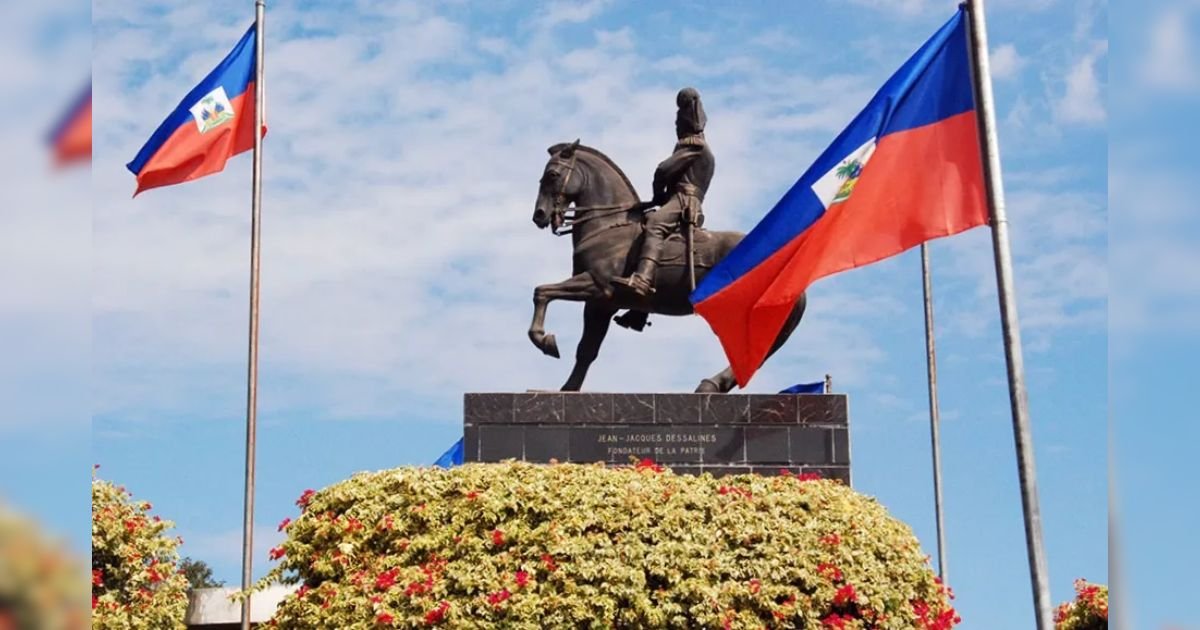
- These arms include the palm tree topped with the cap of liberty, shading with its palms a trophy of arms with the legend "Unity is Strength"
The Symbolism of the Colors
The blue and red come from the French tricolor flag, from which Jean-Jacques Dessalines is said to have torn off the white stripe during the Congress of Arcahaie in 1803, thus symbolically rejecting white colonial domination. The blue represents Black people and the red represents Mulatto people, two groups that were to unite to defeat the oppressor.
The white square in the center bears the coat of arms of the Republic and creates a visual contrast that highlights the motto "Unity is Strength," constantly reminding Haitians of the importance of their national cohesion.
Living Mottos for Haiti’s Future
Haiti’s mottoes are not relics of the past, but guides for the future. "Unity is Strength" and "Liberty - Equality - Fraternity" remind Haitians of the values that enabled their ancestors to accomplish the impossible: defeat the largest army in the world and found the first free Black republic.
These mottoes invite every citizen to contribute to building a united, free, egalitarian, and fraternal Haiti. They constitute a precious heritage that each generation must embrace and bring to life in its own time.
Understanding these mottoes is understanding the soul of Haiti. It means connecting with a unique history, with universal values won through courage and sacrifice. It also means taking responsibility for passing this legacy on to future generations, so that the flame of freedom lit by the heroes of 1804 never goes out.
Share
About the Author
Appolon Guy Alain
Appolon Guy Alain
Full Stack Developer, Créatif, expérimenté, passionné des nouvelles technologies et de l’art.
First black nation to free itself from slavery and gain independence from France in 1804 and influenced other liberation movements around the world, inspiring struggles for freedom and equality.
Natural beauty
Haïti is blessed with spectacular natural landscapes, including white sand beaches, mountains and rich biodiversity.
Heritage
Haïti has a rich historical heritage, including sites like the Citadelle Laferrière and the Sans-Souci Palace, listed as UNESCO World Heritage Sites.
Culture
Haïti has a rich and diverse culture, influenced by African, European and indigenous elements. Haitian music, dance, art and cuisine are celebrated around the world.