contact@haitiwonderland.com+509 36184317

Discover

Shopping Cart

What is the real name of Haïti throughout history?

What is the real name of Haïti throughout history?

Haiti, a land rich in history and culture, has had several names over the centuries, each reflecting a significant period in its evolution. These names reveal the changing identity of the island, from pre-Columbian times to today. Let’s discover together the different names that this emblematic territory has had and their meaning.

Ayiti: the original name of the Taino

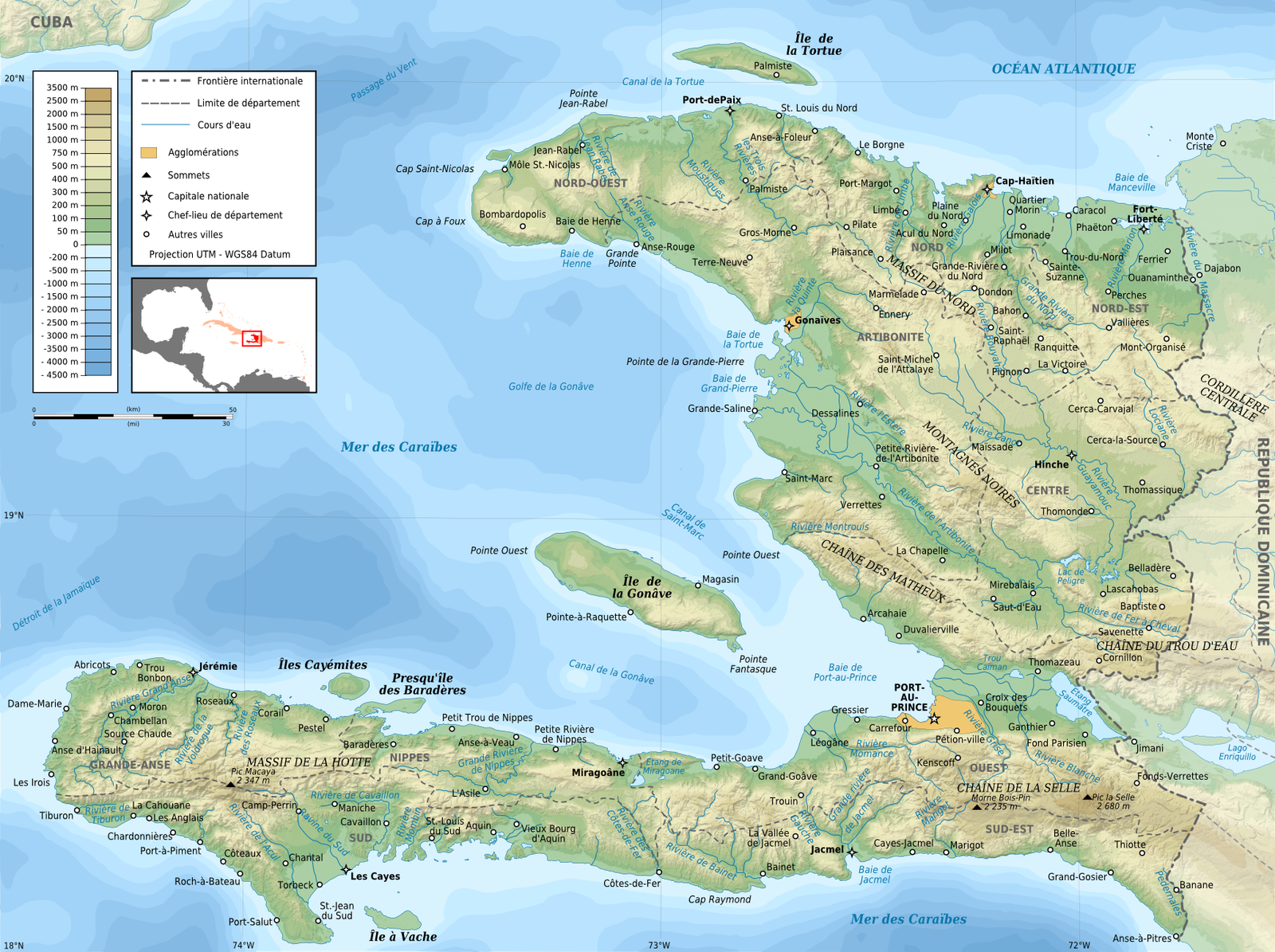
Before the arrival of the Europeans, the indigenous inhabitants of the island, the Taino, called their land “Ayiti”, a word in their language meaning “land of high mountains” or “mountainous country”.

- A geographical description: This name reflected the topography of the island, marked by its imposing mountain ranges and lush nature.
- A rooted identity: For the Taino, “Ayiti” represented much more than a place; it was a symbol of their spiritual connection to the land and their way of life in harmony with nature.

This name, deeply rooted in the Taíno culture, is the first known name of the island.

Hispaniola: the era of Spanish colonization

In 1492, Christopher Columbus landed on the island and named it Hispaniola (or “La Española” in Spanish), which means “Little Spain”.

- A new chapter: This name reflected the Spanish intention of making the island an extension of their empire in America.
- A political division: Under Spanish rule, the island was divided into several territories, marking the beginning of a colonial control that would last for several centuries.

Hispaniola still remains the official name of the island in some international contexts, although each nation that composes it has its own identity.

Saint-Domingue: The French Legacy

In the 17th century, the French took control of the western part of the island, which they named Saint-Domingue.

- A symbol of prosperity: Saint-Domingue became one of the richest colonies of the French empire, thanks to the exploitation of sugar, coffee and indigo plantations.
- A place of suffering: This wealth was based on the forced labor of hundreds of thousands of African slaves, making Saint-Domingue a theater of struggles for freedom.

The name Saint-Domingue is associated with a period of economic greatness, but also of deep inequality and oppression.

Haiti: A return to roots after independence

On January 1, 1804, after a fierce struggle for freedom, the Republic of Haïti was proclaimed, marking a historic turning point.

- A tribute to ancestors: The name “Haiti” was chosen to honor the Tainos and their original name for the island, “Ayiti.”
- A symbol of freedom: By abandoning the colonial name, Haitian leaders affirmed their independence and their break with the oppressive past.

Today, Haïti remains the official name of the world’s first independent black republic.

A legacy of names, a wealth of identity

The different names that Haïti has borne over the centuries bear witness to its turbulent history and resilience.

- Ayiti: A land of mountains and spirituality.
- Hispaniola: A point of contact between the New and Old Worlds.
- Santo Domingo: A rich and tragic colony.
- Haiti: A free and proud nation.

Each name embodies a facet of Haiti’s history, which has preserved its identity despite challenges.

Haiti: An Inspiring History

Haiti’s evolving names reflect a constant quest for independence and dignity. Today, the word “Haiti” represents not only a country, but also a global symbol of resilience and freedom.

What is your connection to the name “Haiti” and the history it carries? Share your thoughts and celebrate with us this land with a unique past and promising future.

Share
About the Author
Appolon Guy Alain
Appolon Guy Alain
Appolon Guy Alain

Full Stack Developer, Créatif, expérimenté, passionné des nouvelles technologies et de l’art.

See other articles from Appolon Guy Alain
Leave a comment

Recently Posted

Timoun se Moun: A poetry competition to promote children’s rights in Haiti

A wounded country. Bent under the weight of a multidimensional crisis. Widespread violence. Hope slammed shut. A sacrificed generation. Children are increasingly threatened. They are increasingly confronted with all forms of vulnerability that hinder their overall development. ACTIF is launching the second edition of the "Timoun se Moun" poetry competition. A citizen initiative in which the organization uses writing as a springboard to build what life deprives Haitian children of. Pain can be turned into gold. For ACTIF (Community Action for Transformation and Formal Integration), poetry is a philosopher’s stone. Not only for this organization, but also for all those who believe that writing can help rekindle the stars. Faced with this urgent need for action, this is "an initiative to raise awareness, denounce, and affirm loud and clear that every child matters, every child deserves protection, hope, and a future," reads the competition’s descriptive document. So what do you intend to do with your human light? Through this competition, participants have the opportunity to engage in an act of resistance, like a cry of conscience to raise the voice of broken childhoods. Open from May 18 to June 18, "Timoun se Moun" is open to all Haitians living in the country and aged 18 and over. Texts must be submitted in Creole. Behind this initiative, ACTIF intends, on the one hand, to affirm our cultural and linguistic identity, and on the other, to enrich our Creole literature, promote it, and encourage creativity in our vernacular. The text must not exceed 500 words. The format chosen is PDF, Times New Roman font, size 12, and 1.5 line spacing. This competition aims to offer a touch of affection to these children who are the first victims of the country’s descent into hell. To evaluate the literary quality and essence of the submitted texts, a jury is composed of Ruthza Paul, Douglas Zamor, and Darly Renois. The former is a physician and winner of the first edition of this competition. The other two work in the fields of sociology, psychology, and literature. In addition to the "Jury Prize: 15,000 HTG + books + certificate" and "Audience Prize: 5,000 HTG + certificate + books" prizes, the best texts will be included in an anthology to be published by Éditions Répérages. It should be noted that there will be one winner for each prize. This initiative reflects ACTIF’s commitment to honoring authors who embrace the cause of underprivileged children while enriching Haiti’s literary heritage. This competition extends a helping hand to all those who believe that through poetry, one can transform one’s life into a masterpiece. At the same time, it offers the opportunity to contribute to ACTIF’s child protection program. Each participant may submit a single text. It must be sent by email to the following address: actifkonkoupwezi@gmail.com. The partial results will be published on June 30, 2025, and the final results on July 18, 2025. For more information, visit ACTIF at the following address: 18 Rue Desdunes, Imp. Thoby, Mahotière 79, Carrefour, Haiti, or contact the organization at the following number: (+509) 38 44 57 57. More than just a contest, ACTIF invites you to say No. No to forgetting. No to passivity. No to violence against children and the violation of their rights.


Newsletter

Subscribe to our newsletter to stay informed of all our activities and news on Haiti.

Recently Posted

History

History

First black nation to free itself from slavery and gain independence from France in 1804 and influenced other liberation movements around the world, inspiring struggles for freedom and equality.

Natural beauty

Natural beauty

Haïti is blessed with spectacular natural landscapes, including white sand beaches, mountains and rich biodiversity.

Heritage

Heritage

Haïti has a rich historical heritage, including sites like the Citadelle Laferrière and the Sans-Souci Palace, listed as UNESCO World Heritage Sites.

Culture

Culture

Haïti has a rich and diverse culture, influenced by African, European and indigenous elements. Haitian music, dance, art and cuisine are celebrated around the world.

  • +
    • Post