contact@haitiwonderland.com+509 36184317

Discover

Shopping Cart

Letter to My Favorite Author: An Initiative by CSimon Publishing and the Port-au-Prince Book Fair

Letter to My Favorite Author: An Initiative by CSimon Publishing and the Port-au-Prince Book Fair

The "Letter to My Favorite Author" contest is a joint initiative by CSmon Publishing, a publishing house based in Virginia, USA, and the Port-au-Prince Book Fair. The contest aims to create a platform where young literature enthusiasts can express their affection and admiration for the authors who have impacted their lives through a letter dedicated to them. This letter can be written in Haitian Creole or French by any young person aged 18 to 30 living in Haiti. The author to whom the letter is addressed can be Haitian or foreign, and even from the medieval period.

The contest began on January 27, with registration closing on that date, and will continue until April 15, when the prizes will be awarded. The awards, which are 75,000 gourdes for the winner, 50,000 gourdes for the second place, and 25,000 gourdes for third place, will be presented during the event "Living in Prose and Poetry," organized annually by the Port-au-Prince Book Fair, to be held in 2025 at the French Institute in Haiti.

A Contest Serving Youth and Literary Culture

The initiative seeks to encourage young people to understand the value of books and invite them to appreciate the impact of authors on their personal and intellectual lives. Through this action, the contest allows participants not only to pay tribute to their favorite authors but also to affirm their commitment to preserving and promoting literary culture. Additionally, this contest is a wonderful opportunity to discover new emerging talents in the literary field, contributing to the building of the Haitian literary world of tomorrow.

See as well

Haïti
Haïti
Haïti

Contest Stages

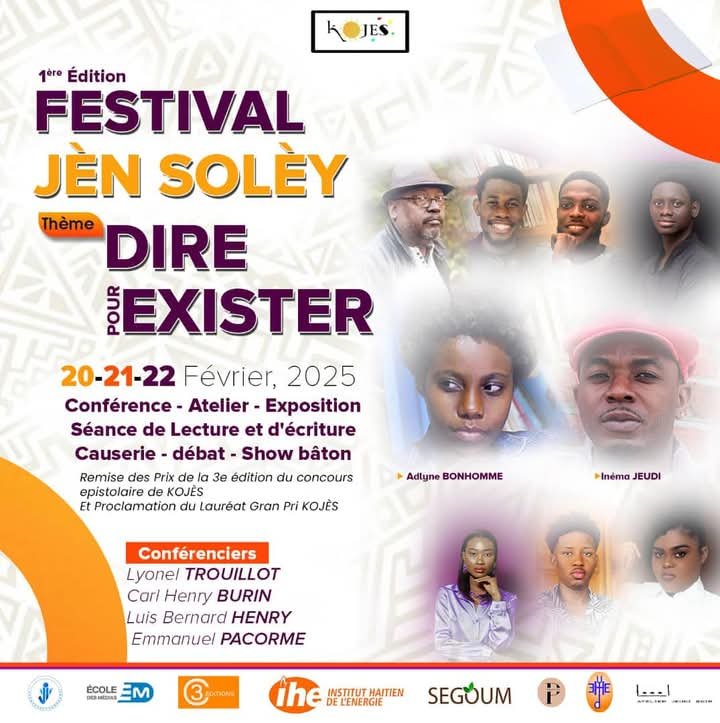
The "Letter to My Favorite Author" contest proceeds in several stages to select the best texts. The first phase involves receiving participants’ letters. The first thirty candidates who express their interest are invited to submit their letters to the Pyepoudré Cultural Center, located on Bourdon Road, from February 4 to 8, 2025. These letters will then undergo a rigorous selection process conducted by a competent jury, consisting of Evens Dossous, poet Adlyne Bonhomme, Marc Exavier, and presided over by Moïse François. After a first round of corrections and careful evaluation, the top ten texts will be selected and publicly announced.

Haïti
Haïti
Haïti

Audiovisual Recording of Selected Texts and Public Voting

Once the ten letters are selected, the authors will be invited to record their works in audiovisual format. The recordings will be done with the technical support of the organizing committee, ensuring professional-quality videos. These recordings will then be published on the various platforms of the Port-au-Prince Book Fair and open to public judgment. This moment is important, as the public will have the chance to discover budding literary talents and support them through voting.

Haïti
Haïti
Haïti

Reducing the List to Five Finalists

After the voting, the list will be reduced to five finalists. Among these finalists, three winners will be selected, and an official announcement will be made to announce the three grand winners of the contest. The winners will receive their awards on April 15, 2025, at the French Institute in Haiti. Thus, this contest will give each participant hope for recognition of their love for literature, while encouraging the emergence of new literary voices.

A Well-Deserved Tribute

Authors, whether contemporary or classical, play a crucial role in the evolution of societies by offering, through their works, reflections on the human condition, culture, and the history of humanity. Their influence is profound and should be categorized as one of the most valuable. It is essential to grant them the recognition and affection they truly deserve, whether they are still biologically alive or remain alive through their works. By paying tribute to them through this contest, CSmon Publishing and the Port-au-Prince Book Fair pay a vibrant tribute to literature itself and its transformative power. Specifically, CSmon Publishing demonstrates its commitment to Haitian literature and its global development. By financing the contest in large part, it shows its desire to invest in youth and the emergence of new voices within Haitian literature, thus contributing to enriching our literary heritage and encouraging the literary voices of tomorrow.

Share
About the Author
Moise Francois
Moise Francois
Moise Francois

Journalist editor, poet and apprentice lawyer.

See other articles from Moise Francois
Makenson Cajuste

Malheureusement, les conditions sont données après le dépôt du texte. On a beau demander les conditions, mais aucune réponse n'a été donnée à cet effet. On n'avait pas mentionné l'âge d'éligibilité avant. C'est domage que j'ai déjà dépose mon texte alors que j'ai plus que l'âge exigé. Dans ce cas, je me demande si je dois reprendre mon texte ?

February 04, 2025 - 03:21:40 PM
Witchel Tcheetto VILMÉ

Bon bagay,bon travay nou pap lage

February 04, 2025 - 03:25:56 PM
Dr Cherlin SIMON

Ansanm nap batay poun gen yon loy edikasyon Nan peyi nou

February 04, 2025 - 07:53:31 PM
Leave a comment

Recently Posted

Haiti: Carnival and Rara: Crossed Perspectives on Culture and Haitian Identity

In our tradition, carnival represents an essential cultural activity. Indeed, for the holding of it this year, the State had drawn from the public treasury not only a huge sum but also a strong concentration of law enforcement to ensure the protection and security of carnival-goers in the area. metropolitan. Despite numerous criticisms and concerns expressed by certain media on the one hand, then on the other hand by the democratic opposition. While it is true that in Port au Prince these concerns had had a no less valuable consequence on the progress of this festivity. It is no less true that this was the case in other provincial towns, as proof in the southeast department the authorities did not record anything as an element of accident or incident during the progress of the carnival unlike Port au Prince. Certainly, socio/economic problems are increasingly worrying, nevertheless what makes us what we are today, a free and independent people is none other than our exceptionality. This deeply expresses our intrinsic characteristic in relation to people. In fact, historically we are a people who laugh and cry, smile and irritate, dance and hit the system, sing and fight so well that "grenadya alaso sa ki mouri zafè ya yo" is the most emblematic song of the slaves for the conquest of our freedom. We do not intend to claim that those who expressed their disagreement with the carnival are showing a historical deficit. However, we leave in the shadows a fundamental question: why is carnival taken care of by the State while the rara is like an abandoned child? The rara is not only a simple cultural tradition but, above all, it is the heritage of our valiant warriors who bravely fought the French expeditionary army, the most powerful of the time. While, this mass cultural, she is still marginalized by state authorities. It is emphasized that social cohesion is the dead point of carnival. On the other hand, this is the strong point of rara. As proof, the Thursday of the Dead in our Voudouesque tradition which represents the opening ceremony for the rara bands is the blatant testimony of this social cohesion. And, in fact, there were circles of people who took divergent directions to attend the opening ceremony of their rara bands. For this opening ceremony the atmosphere was a taste of carnival in terms of color. On the side of Croix Hilaire, for the title champion Ratyèfè full force band, the color of his club was very diverse, a long dress of apricot yellow, mauve white, then white scarf. In terms of performance, this band had completely proven its champion skills thanks to its arsenal of musicians who were not in their testing phase. To tell the truth, they performed their note with surgical precision as a doctor-surgeon in his surgical procedure. The synchronization between the musicians, the instruments and then the fans form a whole and harmonize perfectly well. This band not only has the magic of words and verbs, it seems that they also have the magic to thrill even the most reluctant fans. Moreover, his performance for this dead Thursday was a challenge for his rivals this weekend to the extent that their performances were less good. On the symbol side of light, Grap Kenèp was the wonder of the Thursday evening of the dead. His club dressed in the appropriate color for this evening, purple scarf, purple jersey, then white “kolan”. In a symbolic way, this marriage of color represents Baron in Haitian Vodou. Without a doubt, it was the most beautiful symbolic representation of the evening. In terms of performance, returning from the cemetery we felt a very strong warmth of jubilation, elation, and playfulness for a completely balanced performance. As far as Chenn Tamarin is concerned, it was already 2 a.m. when our team met him, it was a less good performance than what we were accustomed to. On the symbolic side it leaves something to be desired. His news was that he had his own media. Petit-Goave/Culture and Society

Newsletter

Subscribe to our newsletter to stay informed of all our activities and news on Haiti.

Haiti: The Center department, one of the departments most resistant to natural earthquakes

The Center department, commonly called Plateau Central, is one of the ten (10) departments of Haïti most robust in the face of certain natural phenomena. Before becoming one of the ten (10) departments of Haiti, the Center department was part of the Great North. It is renowned for its natural landscapes, its biosphere climate and its resistance to certain natural phenomena. In addition to its natural productions such as corn, millet and livestock, the Center department is also known for its high mountains which constitute a robust defense against certain natural phenomena such as earthquakes and floods. Composed mainly of high mountains, the department of Charlemagne Peralte and Benoît Batravil is the only one of the ten (10) not to have an outlet to the sea. However, its inhabitants take advantage of the vast rivers, rivers and lakes which cross it . With an area of ​​3,487 km², the population of the Center department is estimated at 678,626 according to a study carried out in 2009. On this same area, the department is divided into four (4) districts and twelve (12) communes. Bordered to the east by the Dominican Republic, the Center department connects other departments of the country such as Nord and Artibonite, and connects the two countries of the island through border areas like Balladère, Hinche and Cerca Carvajal. In the Center department, there are sites that could attract tourists for their natural beauty. In Saut d’Eau, there is the Saut d’Eau waterfall, in Hinche we find the Zim basin, the Péligre lake, the Péligre hydroelectric dam, the Artibonite river, and the Deux river (2 ) Rooms in Thomonde, more precisely in "El Manni", not far from the communal section of Caille-Epin. Thanks to its strong mountains and its natural climate, the Center department remains one of the most resistant departments in the event of an earthquake in Haiti.

Recently Posted

History

History

First black nation to free itself from slavery and gain independence from France in 1804 and influenced other liberation movements around the world, inspiring struggles for freedom and equality.

Natural beauty

Natural beauty

Haïti is blessed with spectacular natural landscapes, including white sand beaches, mountains and rich biodiversity.

Heritage

Heritage

Haïti has a rich historical heritage, including sites like the Citadelle Laferrière and the Sans-Souci Palace, listed as UNESCO World Heritage Sites.

Culture

Culture

Haïti has a rich and diverse culture, influenced by African, European and indigenous elements. Haitian music, dance, art and cuisine are celebrated around the world.

  • +
    • Post