contact@haitiwonderland.com+509 36184317

Discover

Shopping Cart

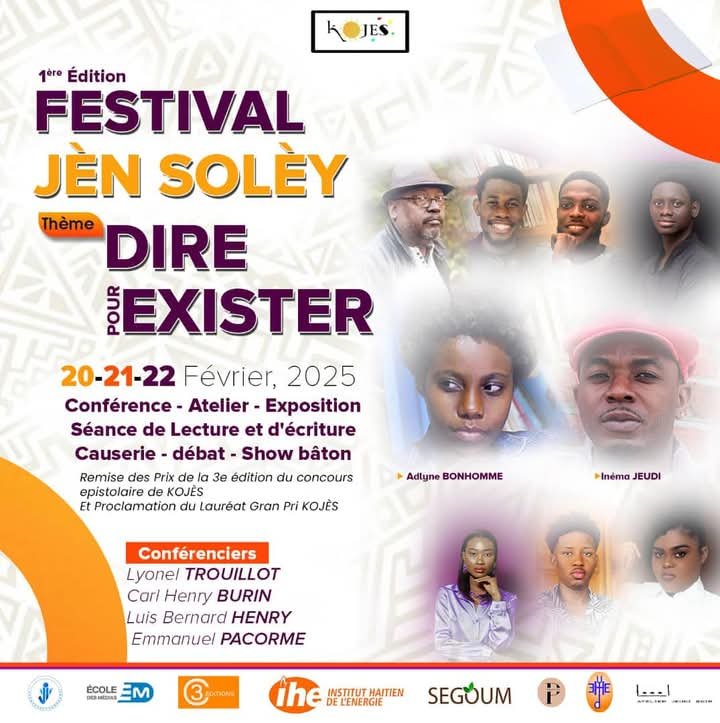
The KOJES Jèn Soley Festival: A Place for Cultural Exchange and Encounters

The KOJES Jèn Soley Festival: A Place for Cultural Exchange and Encounters

KOJES is a non-profit youth association founded in November 2020 in Cité Soleil, the largest slum in Haïti and the Caribbean. From its inception, KOJES has been committed to promoting education, culture, and training through various initiatives. One of its flagship projects is a space for social and cultural debate that has allowed many young people to meet and discuss social issues. Although the clashes that resumed in Cité Soleil in September 2022 temporarily halted this section, KOJES was able to recover by launching the KOJES letter-writing competition, aimed at reestablishing this precious connection between young people through literature. Today, the association is embarking on a new challenge with the Jèn Soley Festival, which will take place from September 20 to 22, 2025, under the evocative theme: "Saying to Exist." Among the guests participating in this festival are the renowned Lyonel Trouillot, the talented poet Carl Henry Burrin, the young slam poet Pacôme Emmanuel, the novelist Louis Bernard Henry, the poet Inima Jeudi, and the young poet Adlyne Bonhomme.

Haïti
Haïti
Haïti

Why another literary festival in the Haitian cultural landscape?

"In a constantly evolving cultural environment, there is always room for new initiatives," writer Litainé Laguerre, coordinator of the association, told us. He also affirmed that the KOJES 2025 Festival aims to create a space for encounters and sharing around literature, while emphasizing the importance of artistic expression in a society in crisis. "This festival is distinguished not only by its commitment to including writers from diverse regions, but also by the launch of the Gran Pri KOJES, an award designed to honor a writer for their complete work. This event will highlight the importance of Haitian literature in an increasingly difficult context, while providing a platform for young talent," he concluded.

See as well

Haïti
Haïti
Haïti

An investment in art despite the challenges

Organizing a large-scale event in a context as uncertain as Haiti’s is a major challenge. However, KOJES firmly believes that art and culture are essential to human life. Despite the successive crises affecting the country, the association wanted to provide a space where everyone can express themselves through dance, writing, reading, and drawing workshops, particularly for the children of Cité Soleil. The festival thus becomes an act of cultural resistance, a way of demonstrating that, even in adversity, culture can and must survive.

Call for Public Collaboration

KOJES invites the public to actively participate in the festival, not as mere spectators, but as collaborators. The goal is to create a collective dynamic where every voice counts. The public, essential to the success of the event, is invited to be at the heart of this gathering, to exchange, discuss, and get involved in the association’s cultural project.

The literary and philosophical club of Galette-Chambon reveals its second edition: a journey to the heart of books

The literary and philosophical club of Galette-Chambon reveals its second edition: a journey to the heart of books

In an atmosphere of madness, at the Auditorium Saint Jean Marie Vianney de Galette-Chambon, where the laughs broke out, the music resounded, and the talents were dismented, started the second edition of the reading competition, around the theme "Ann Li pou n chanje peyi n ». This initiative, organized by the literary and philosophical club of Galette Chambon (CLPGACH) on Friday 06 October 2024, was marked by an overflowing passion within the public. The spectators came for several reasons: to support the applicants and live their presentations. The works, as "thus spoke of the uncle", "the vocation of the elite" of Jean Price Mars, "the ten black men" of Etzer vilary and "the courage to live in Haïti in the 21st century" of Hérold Toussaint, present innovative arguments linked to the societal context. They intertwine with folklore, Haitian culture, sociology and anthropology. These books are given to the applicants for a period of 15 days. Back, they come with their summaries and, after each presentation, in turn, reveal new perspectives on burning questions and delicate themes from works, while taking into account the concepts learned in public speaking. In this arena where the verve and the verb clash as well as logic, conviction, precision and clarity, it is a question of "saying all in a few words". The judgments are based on three criteria: the methodology concerning the substance and the form of the work; The eloquence which concerns verbal and non -verbal discourse (micro management, good pronunciation, etc.); And finally, an essential criterion: understanding. This is to assess whether the applicant has controlled the work. Questions can be asked without ignoring the context in which he lives. In addition, assistants have the opportunity to vote for the applicant who charmed them the most. This vote is precious at a higher level. Note that this vote can be made not only face -to -face but also online on our Facebook page CLPGACH. In addition, the public has always changed well through this trip to the universe of regional authors. The latter weave the frame and make vital the very repertoire of the competition vital, made up of impactful works such as "the price of irresponsibility" of Montuma Murat, "the return to citizen responsibility" written by Jean Jacquesson Thelucier and "Courage to live in Haïti in the 21st century "Professor Hérold Toussaint, to name a few. Although they died, some writers still live at the heart of our situation through their inheritance. Among them, it is necessary to quote: "the vocation of the elite" of Doctor Jean Price Mars, "the ten black men" of Etzer Villaire and "the Governor of the dew" by Jacques Roumain, as well as so many others . For this literary event to be moving and meets expectations for this second edition, many sacrifices are necessary on the part of the staff as well as the public which never leaves us alone. In this sense, we would like to thank them and call all those wishing to support this event. Indeed, if this competition is a solution found to advance together towards a common goal, its success depends on everyone’s commitment. About two years ago, the security climate in the area was not conducive to the completion of the competition. Although it is not yet ideal today, it is time to triumph over obscurantism and fight the dictatorship of ambient ignorance.


Haïti
Haïti
Haïti

Festival Supporters

The first edition of the KOJES 2025 Festival benefits from the support of several institutions such as the Haitian Energy Institute, C3 Éditions, Atelier Jeudi Soir, Éditions de l’Université d’État d’Haïti, Segoum, Éditions Pwotra haitiwonderland, and the École des Médias. Despite the current economic and political difficulties, KOJES remains optimistic about the success of this event and hopes that more institutions will join the initiative in future editions.

In short, this Festival led by KOJES is not a gesture too many in a Port-au-Prince plagued by all sorts of ills. It aims to offer a measure of healing to the major wounds that plague the city. It is yet another demonstration of the true power of words in a hostile environment; it is also a testament to the resilience of young people determined to promote culture and their clear boldness in favor of literature as a factor in creating life. They clearly believe that art is a serious means with the power to offer everyone the opportunity to use words to affirm their existence.

Pity or the work of an old soul crushed under the weight of an absinthe-flavored existence

Pity or the work of an old soul crushed under the weight of an absinthe-flavored existence

The word crisis carries an infinite number of meanings. No intention of revealing them all this afternoon. However, a few clarifications are necessary. A kid whose parents do not have enough money at Christmas to buy her a Little Black Mermaid doll has a fit and locks herself in her room without touching her meals for the day. A boy whose dog was suddenly poisoned by a neighbor in revenge or shot after contracting rabies, losing a faithful friend overnight, enters into crisis. Finally, a society in the grip of all sorts of mutations and whose leaders are weak, perhaps prolonged in a deep crisis. In the first case, the young girl sulks to attract the attention of her parents in order to feel appreciated by children her age at school or in the neighborhood. Today, thirty minutes of negotiations can be enough to find a lasting solution. In my day, a few well-aimed belt blows would have overcome this whim. But, humanity evolves, they say. In the second case, this boy can find his smile again after a few weeks. He needs a little attention and, probably, another dog. As Stendhal would say, only passion triumphs over passion. In the last case, this society led by inepts is shaken to its deep foundations. Its institutions can disintegrate one by one. The vital forces dissolve in no time. This situation creates a societal tsunami that destroys all life within this community. It is indeed a crisis. The crisis from this point of view constitutes an alarming, desperate situation in the existence of a community where nothing is going well. Chaos reigns supreme. The very essence of life disappears. The individual can take precedence over the community. Everyone tries to solve their problems without worrying about others. The closest neighbor is relegated light years away from you. How can we turn to creation? How can we continue to conceive of otherness? How can the artist absorb this great collective disarray as a source of motivation? These are the questions I must answer. An artist sees and feels what ordinary mortals cannot even imagine in a thousand-year life. He creates to denounce, when his conscience as a human being is revolted. He exalts heroes or the homeland according to his feelings. He sings the beauty of an irresistible, captivating or ugly resplendent woman. He can also use the ambient desolation to give meaning to life. Creating in literature as in the arts in general does not depend on the situation. The act of creation depends on the creator’s disposition. Events paralyze some and galvanize others. Creating is enjoyable. Everyone therefore enjoys according to their own whim. Writing opens the way to change. The writer takes a different look at the world. By embedding himself in reality, he embellishes it, makes it better or hideous depending on the message he intends to share. All things considered, with him, life is never fixed. Writing is putting the world in a jar to travel the universe. The artist broods over his work in all weathers. Oswald Durand was delighted to see Choucoune’s beautiful body from his secret observatory. Musset, on the other hand, was in pain writing his October night. As for Dany Laferrière, in exile, he described the horrors of the Duvalier dictatorship and the carefree attitude of the young girls in his neighborhood in this violent and dangerous world. Ultimately, the writer lives in a society with values ​​that he shares or not. They condition his existence or have no hold on him. In many ways, the surrounding world serves as his laboratory. He carries out his experiments there. He casts a new, worn, disillusioned, melancholic, violent, bitter look at the world depending on his mood. Pitié is the work of an old soul crushed under the weight of an existence that tastes of absinthe. Young Mike Bernard Michel lives by expedients and lies. The hands of life fall on him with indescribable violence. Misfortune embraces him day and night. Should we give up? Musset liked to say: "Man is an apprentice, pain is his master. And no one knows himself until he has suffered." The artist must produce under all skies. Such is his vocation. Incompetents in power, legal or highway bandits, the high cost of living, unemployment, heartaches are all subjects of concern for him. If it is true that a hungry belly has no ears, the fact remains that it keeps the brain awake. What am I saying, it stimulates it to the point of creating timeless works. Mr. Pitié, you have a bright future ahead of you. Work of Jean Rony Charles, the book is available from Éditions Repérage.

Share
About the Author
Moise Francois
Moise Francois
Moise Francois

Journalist editor, poet and apprentice lawyer.

See other articles from Moise Francois
Leave a comment

Recently Posted

Newsletter

Subscribe to our newsletter to stay informed of all our activities and news on Haiti.

Haiti: Is buying votes to be elected a form of corruption or political strategy?

The democratic political system requires the active participation of citizens in the management of the city. Everyone freely expresses their opinion for harmonious management of society. Generally the choices are made from the organization of free and honest elections. However, sometimes candidates use diverted means to achieve their ends. Can we consider this act as a form of corruption or a political strategy? In a democratic society, the organization of elections at regular intervals is an imperative. Managers are generally elected by the majority of voters, which ensures them a certain legitimacy within the framework of government management. Today, more and more, around the world, the elections are controlled by economic power. This sector gives a lot of silver to candidates who often buy the media services in order to have certain visibility through mass communication means (radio, VAT, Internet, etc.) and do without constraints Many very expensive trips, which require enormous capital. By the way, the possibility that a candidate with low financial means of being elected is increasingly reduced in Western societies. Despite everything, it is illegal to buy the votes of the voters. It is an act of corruption that should lead to criminal sanctions. No society can tolerate this practice which could hamper the degeneration of the democratic system and, consequently, of the electorate system. Civil society and human rights organizations must be vigilant in order to avoid these harmful drifts in the democratic system. In fact, the temptation to bribe the voters in order to access elective positions must be denounced as an act of corruption. In doing so, will lead to political dissenting between duty, and law, because citizens are called upon to freely choose the leaders of the city. Ultimately, the organization of the elections must be the fruit of consensus between the various groups of the social system. Managers must be chosen according to their ability to provide adequate answers to the problems of the company. They can still benefit from powerful financial means from other partners. But, giving voters directly money is a condemnable detective act which reduces the autonomy of action and thinking of voters. In this sense, the latter’s vote must reflect the desire to choose or build a fair, fair and favorable company.

Recently Posted

History

History

First black nation to free itself from slavery and gain independence from France in 1804 and influenced other liberation movements around the world, inspiring struggles for freedom and equality.

Natural beauty

Natural beauty

Haïti is blessed with spectacular natural landscapes, including white sand beaches, mountains and rich biodiversity.

Heritage

Heritage

Haïti has a rich historical heritage, including sites like the Citadelle Laferrière and the Sans-Souci Palace, listed as UNESCO World Heritage Sites.

Culture

Culture

Haïti has a rich and diverse culture, influenced by African, European and indigenous elements. Haitian music, dance, art and cuisine are celebrated around the world.

  • +
    • Post