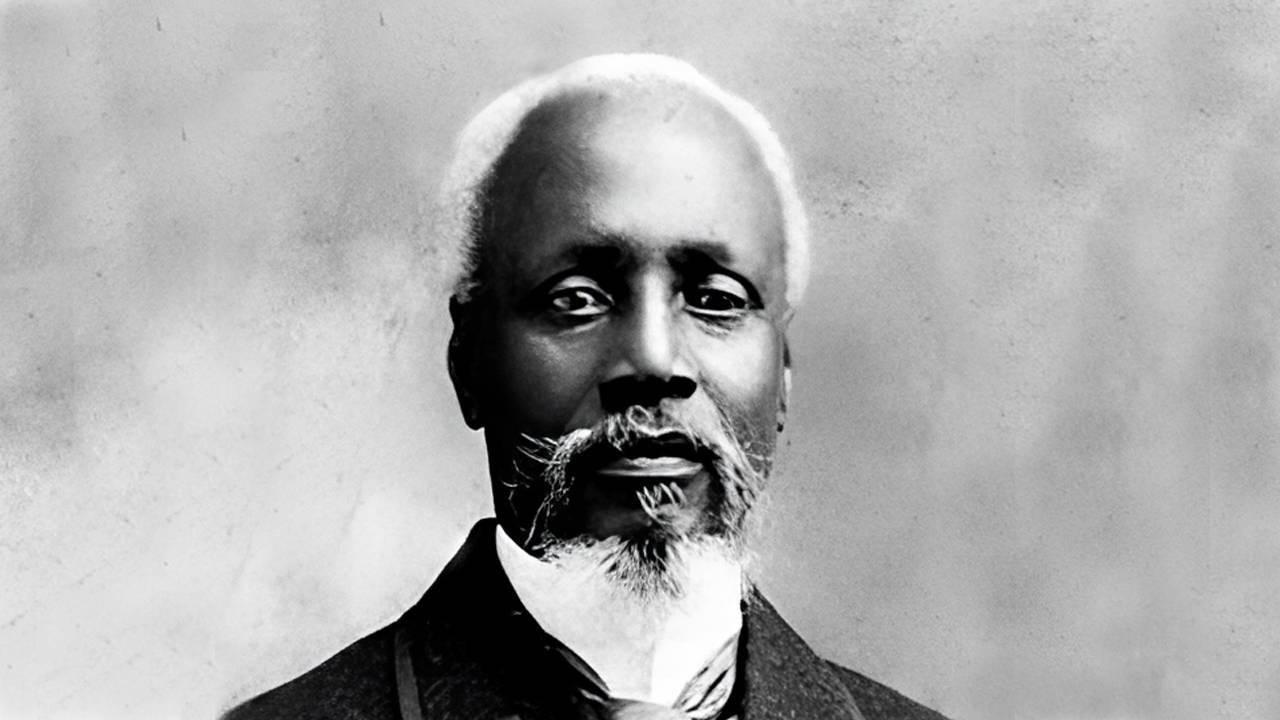
Anténor Firmin, the genius of the 19th century Haitian
Joseph-Auguste Anténor Firmin was born on October 28, 1850 in Cap-Haïtien, in a Haïti recently emancipated from the colonial yoke, he died on September 19, 1911 at the age of 60 in exile. He is undoubtedly one of the most emblematic intellectual figures of his time. His life, marked by an exceptional career in the political, literary and diplomatic fields, illustrates the genius of a Haitian intellectual whose contributions have left an indelible mark on history.
Firmin grew up in Cap-Haïtien, in the city of the very famous King Henry Christophe, from a modest family, he studied at the Phillippe Guerrier high school and became a teacher at only 17 years old. His curious and critical mind animated his youth, and led him to get involved in the life of his hometown. His ability to juggle different tasks and get involved in various aspects of public life, marks him as a "jack of all trades".
Firmin is recognized for his exceptional contribution in several areas of Haitian national life. In politics, he fought for the stabilization and modernization of Haïti during the turbulence of the 19th century. He also stands out as a fervent defender of human rights and racial equality. His most notable contribution to this subject is probably his work "De l’égalité des races humaines" (1885), a fundamental text that challenges the racist theories of the time. This book is a bold statement affirming the fundamental equality of all races and represents a courageous act against the persistent racial prejudices of his time and those before.
The confrontation with Gobineau
Anténor Firmin does not hesitate to confront influential racist figures such as Joseph Arthur de Gobineau, whose theories on racial hierarchy were widely accepted. In his work, Firmin demonstrates that racial prejudices have no scientific basis but are unjust social constructs. This intellectual confrontation is not only a fight for scientific truth but also an act of resistance for the dignity and equality of Black people.
Firmin meets all the necessary conditions to conduct effective governance, to get Haïti out of the chaos in which it had been plunged since the assassination of Jean Jacques Dessalines in 1806. Unfortunately for him, and for the Haitian nation, the life of any illustrious man is characterized by exploits, accompanied by their share of failure. Despite his significant achievements, Firmin had to face significant challenges in his political career.
Several electoral failures, including one against Nord Alexis, the famous "Tonton nò" (ignorant old man), reflect the extent to which the brilliant mind of this man was able to face the challenges that the Haitian political world represents. And as a minister and politician, he encountered major obstacles in his attempts at reform and modernization. His efforts to establish a stable government, combat corruption (the great enemy of national development), and promote progress are often thwarted by internal conflicts, supported internationally, and significant political resistance.
In the Dessalines tradition
Anténor Firmin, in many ways, is a continuation of Jean-Jacques Dessalines, the father of the Haitian nation. Where Dessalines played a crucial role in Haiti’s independence, Firmin contributed to the intellectual and political affirmation of the country throughout the world. Both men embody a spirit of resistance and an aspiration for a more just society. Their legacies continue to inspire future generations, in Haïti and beyond.
Anténor Firmin already foresaw the turbulent 20th century that would face both the Haitian elite and its popular masses. Indeed, he predicted an American intervention in Haïti decades before 1915, which in fact took place. In his book L’effort dans le mal, he declared the following: "Man, I can disappear, without seeing the dawn of a better day dawn on the national horizon. However, even after my death, one of two things will be necessary: either Haïti falls under foreign domination, or it resolutely adopts the principles in the name of which I have always fought and struggled. Because, in the twentieth century, and in the Western hemisphere, no people can live indefinitely under tyranny, in injustice, ignorance and misery."
The exile
Exile is a subject present in almost all of the great Haitian minds. Firmin, despite the greatness of his mind, was no exception to this rule, but took advantage of it to educate himself and build a solid intellectual reputation for the benefit of Haiti. In 1883, he was sent as Haiti’s representative to the centennial celebrations of Simón Bolívar. He refused a ministerial position under the presidency of Lysius Félicité Salomon, and went into exile in Saint-Thomas and then in Paris. In France, he met Louis-Joseph Janvier and became a member of the Société d’anthropologie de Paris in 1884 at his side. His diplomatic career took a turn in 1889 when he was appointed Minister of Finance and Foreign Relations under President Florvil Hyppolite, although he left this position in 1891 to return to France. In 1900, he was appointed Haitian ambassador to France, thus consolidating his role as Haiti’s international representative.
The Antillan League and Antillanism.
In 1910, Firmin published "Letters from Saint-Thomas", in which he explored the idea of an "Antillan League". This concept was part of Antillanism, a political movement aimed at creating a federation of the Caribbean islands to defend themselves against Spanish colonialism and American imperialism. A great friend of José Martí, Firmin, through his writings and actions, sought to promote regional solidarity in the face of external challenges.
In short, Anténor Firmin is a central figure in the Haitian intellectual world, whose contribution transcends the boundaries of politics, literature and diplomacy. His commitment to racial equality, his courage in the face of opposition, and his immense intellectual legacy are testament to his unique place in Haitian history and that of all other black people around the world. Firmin’s genius lies in his ability to combine deep convictions and diverse skills to fight injustice and promote a more equitable vision of the world. Firmin remained, through his ideas, a spirit that stood firm against all forms of racial injustice.
Très bel article sur une figure encore trop méconnue hors d’Haïti. Anténor Firmin avait une avance intellectuelle impressionnante pour son époque, et son travail contre les théories raciales reste d’une modernité frappante aujourd’hui. On oublie souvent qu’Haïti a produit certains des plus grands penseurs du monde noir. Pour ceux qui veulent approfondir son parcours et son héritage : https://yekri.com/auteurs/antenor-firmin
First black nation to free itself from slavery and gain independence from France in 1804 and influenced other liberation movements around the world, inspiring struggles for freedom and equality.
Natural beauty
Haïti is blessed with spectacular natural landscapes, including white sand beaches, mountains and rich biodiversity.
Heritage
Haïti has a rich historical heritage, including sites like the Citadelle Laferrière and the Sans-Souci Palace, listed as UNESCO World Heritage Sites.
Culture
Haïti has a rich and diverse culture, influenced by African, European and indigenous elements. Haitian music, dance, art and cuisine are celebrated around the world.








































Très bel article sur une figure encore trop méconnue hors d’Haïti. Anténor Firmin avait une avance intellectuelle impressionnante pour son époque, et son travail contre les théories raciales reste d’une modernité frappante aujourd’hui. On oublie souvent qu’Haïti a produit certains des plus grands penseurs du monde noir. Pour ceux qui veulent approfondir son parcours et son héritage : https://yekri.com/auteurs/antenor-firmin
May 07, 2026 - 05:53:25 PM