contact@haitiwonderland.com+509 36184317

Discover

Shopping Cart

Frankétienne, the Nobel Prize Winner

Frankétienne, the Nobel Prize Winner

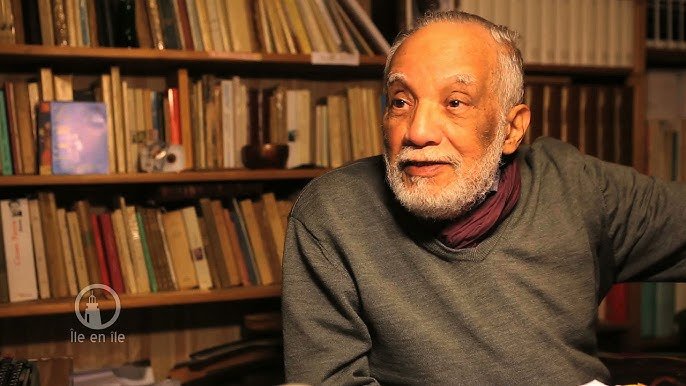
Frankétienne is the stage name of the man who officially bore the name Jean-Pierre Basilic Dantor. He was born in the Artibonite department of Haïti on April 12, 1936. His father, who did not recognize him at birth, was, according to his own account, an American industrialist who had come to do business in Haiti, and his mother was an Artibonite farmer. This makes Frank a similar case to the great Jamaican artist Bob Marley, who had a typical story, in addition to the fact that both men made their country known abroad and left their mark on their land from within through their art. Frank died on Thursday, February 20, 2025, in Delmas, his home town for decades. He was about to celebrate his 89th birthday.

Haïti
Haïti
Haïti

The Child King

Frankétienne spent very little time in Ravine Sèche (his hometown) after his birth. His mother fled Haitian provincial poverty to settle with the little boy in the famous Bel-Air neighborhood of Port-au-Prince, one of the most vibrant and vibrant of its time. This neighborhood would mark little Frank’s life, and he would be influenced by its creativity and dynamism to this day. Moreover, Frankétienne recounts growing up under the banners of freedom and in unparalleled joy in this neighborhood where Port-au-Prince was born. In Bel-Air, he tells himself, his mulatto skin made him a popular white boy in this very working-class neighborhood, densely populated by blacks.

See as well

Haïti
Haïti
Haïti

Sacred Monster

Frankétienne recounts entering literature through the front door of reading. And this great love of reading came to him in the monumental aftermath of a vast failure. Little Frank, having just arrived from Ravine Sèche, was asked his name by a Catholic nun, and he didn’t know what to answer. He stood in front of a room, taking refuge in a shameful silence to defend himself against this ignorance. This episode would push little Frank toward books, to the point of loving them to the end.
Today, Frankétienne is honored by UNESCO, which has just created a literary prize in his honor for his literary creativity. He is one of the most prolific authors of his time, with more than 30 written works, a considerably diverse body of work consisting of plays, poetry, novels, and essays. Among his most famous works, works that have left their mark on the Haitian imagination, we can cite Dézafi, Pèlentèt, Foukifoura, L’ultravocal, and Les affres d’un défi.

Haïti
Haïti
Haïti

A Creator of Universes

Frankétienne’s life was marked by his immense creative spirit. He was one of the greatest creators of worlds, an unparalleled inventor, pursuing the greatest in history in this field. He is one of the founders of a literary movement called Spiraliste, alongside Jean-Claude Charles and René Philoctète. But far beyond literature, for the man who was Minister of Culture under the presidency of Nesly François Manigat, creation and life are two inseparable sides of the same coin. This is why, alongside this richly literary life, in which he is simultaneously a poet, novelist, playwright, and essayist, he is also a painter, singer, and drummer. With so much, it seems impossible not to leave a mark on his country and his era.

The literary and philosophical club of Galette-Chambon reveals its second edition: a journey to the heart of books

The literary and philosophical club of Galette-Chambon reveals its second edition: a journey to the heart of books

In an atmosphere of madness, at the Auditorium Saint Jean Marie Vianney de Galette-Chambon, where the laughs broke out, the music resounded, and the talents were dismented, started the second edition of the reading competition, around the theme "Ann Li pou n chanje peyi n ». This initiative, organized by the literary and philosophical club of Galette Chambon (CLPGACH) on Friday 06 October 2024, was marked by an overflowing passion within the public. The spectators came for several reasons: to support the applicants and live their presentations. The works, as "thus spoke of the uncle", "the vocation of the elite" of Jean Price Mars, "the ten black men" of Etzer vilary and "the courage to live in Haïti in the 21st century" of Hérold Toussaint, present innovative arguments linked to the societal context. They intertwine with folklore, Haitian culture, sociology and anthropology. These books are given to the applicants for a period of 15 days. Back, they come with their summaries and, after each presentation, in turn, reveal new perspectives on burning questions and delicate themes from works, while taking into account the concepts learned in public speaking. In this arena where the verve and the verb clash as well as logic, conviction, precision and clarity, it is a question of "saying all in a few words". The judgments are based on three criteria: the methodology concerning the substance and the form of the work; The eloquence which concerns verbal and non -verbal discourse (micro management, good pronunciation, etc.); And finally, an essential criterion: understanding. This is to assess whether the applicant has controlled the work. Questions can be asked without ignoring the context in which he lives. In addition, assistants have the opportunity to vote for the applicant who charmed them the most. This vote is precious at a higher level. Note that this vote can be made not only face -to -face but also online on our Facebook page CLPGACH. In addition, the public has always changed well through this trip to the universe of regional authors. The latter weave the frame and make vital the very repertoire of the competition vital, made up of impactful works such as "the price of irresponsibility" of Montuma Murat, "the return to citizen responsibility" written by Jean Jacquesson Thelucier and "Courage to live in Haïti in the 21st century "Professor Hérold Toussaint, to name a few. Although they died, some writers still live at the heart of our situation through their inheritance. Among them, it is necessary to quote: "the vocation of the elite" of Doctor Jean Price Mars, "the ten black men" of Etzer Villaire and "the Governor of the dew" by Jacques Roumain, as well as so many others . For this literary event to be moving and meets expectations for this second edition, many sacrifices are necessary on the part of the staff as well as the public which never leaves us alone. In this sense, we would like to thank them and call all those wishing to support this event. Indeed, if this competition is a solution found to advance together towards a common goal, its success depends on everyone’s commitment. About two years ago, the security climate in the area was not conducive to the completion of the competition. Although it is not yet ideal today, it is time to triumph over obscurantism and fight the dictatorship of ambient ignorance.

Haïti
Haïti
Haïti

A Lover of Haiti

Frank remained a great defender of Haitian culture until the end of his life, elevated to the rank of permanent ambassador of this culture by the Haitian Ministry of Culture and Communication. But Frank wasn’t limited to culture. A graduate of the École Normale Supérieure of the State University of Haiti, he used this pretext to invest in education, notably by creating a school in his eternal neighborhood of Bel-Air. Frank demonstrated how much he loved his country with this feat. Because when you love your country, you don’t steal it, but rather you build schools within it for the education of its children. Moreover, those who love their country defend it and enhance its name. Frank had the courage to use his art to free his country from the ferocious and very costly dictatorship of the Duvalier regime. And the other great proof of his love for his country is the fact that he remained inhabited there until the end, even though he had more than enough means to continue his life in any major country in the world. A straightforward way of saying that when you love your country, you’re even willing to let yourself die in it. We can only salute this man’s courage. Port-au-Prince is the most dangerous city in 2024, according to some foreign experts; you flee a city like that if you have the means. Staying there to die, when you bear the name Frankétienne, is a proof of immeasurable love.

Haïti
Haïti
Haïti

Frank, the Thirsty for Greatness

Frankétienne aptly captures the marvelous side of the Haitian sun. He was a man who knew he was equal to the rest of the world and who set out to chase the stars. Frank said he was waiting for his Nobel Prize in Literature, because he rightly felt he was worthy of it, and waited patiently for this title from his residence in Delmas 31, telling himself he was a man who had built enough and left his mark on his time for that. If Bob Dylan, the wonderful American singer of his time, etc., received this Nobel Prize, why not Frank? For both were born men and very early on took possession of their right to become creators. Both took art seriously from the beginning of their youth. If Frank is the product of a small country, he told himself, at least his creation is the equal of that of any man. And nothing less.

This wonderful man strove, despite any false, demeaning tendency of his current country, to be a Man in the immediate lineage of his ancestors. To be a worthy successor in the great pride of Dessalin, Louvertur, and Christophe. And to extend into the great past figures like Louis-Joseph Janvier, Jean Price-Mars, Anténor Firmin, or Demesvar Delorme. Frank is a great symbol of rebellion against the baseness and mediocrity of our current Haiti, Frank has always been. A symbol of a wonderful scandal, stitched together from the wounds of this country brought low from the head. If only in this sense, this man, we must rely on the example of his life when we seek to honor him. His life and the great legacy he left behind should be held up as a model for all children around the world.

Share
About the Author
Moise Francois
Moise Francois
Moise Francois

Journalist editor, poet and apprentice lawyer.

See other articles from Moise Francois
Leave a comment

Recently Posted

Newsletter

Subscribe to our newsletter to stay informed of all our activities and news on Haiti.

Haïti / Fort Saint-Joseph: Historical Vestige of the Resistance

Located in the Bay of Cap-Haitien, Fort Saint-Joseph stands like a silent guardian of Haiti’s tumultuous history. Built in two stages, in 1748 and 1774, this defensive work was once a crucial element of the city’s protection system against French colonial assaults. Alongside other forts such as Picolet and Magny, its mission was to control maritime passages and defend Haitian sovereignty. However, its history is not limited to its defensive function. In 1802, then under the control of General Henry Christophe, the fort became the scene of a heroic act of resistance. Faced with the French expeditionary army, Christophe ordered the destruction of the powder magazine and the entrance gate to the fort, thus rendering it temporarily unusable. This courageous gesture, although tactical, left indelible scars on the very structure of the fort, testifying to the fierce clashes between French colonial forces and Haitian resistance fighters. These historic marks, still visible today, offer a window into the country’s tumultuous past. They allow visitors and historians to interpret the fierce struggles that forged Haitian identity. Fort Saint-Joseph, as a witness to the resistance and the struggle for freedom, embodies the indomitable spirit of the Haitian people. Recognizing its historical significance, the Haitian government officially classified Fort Saint-Joseph as national heritage in 1995. This recognition paved the way for restoration efforts aimed at preserving this precious vestige of Haitian military heritage. Thanks to collaboration between the public sector and local private funding, the fort has recently been restored and enhanced. Thus, Fort Saint-Joseph remains much more than a simple stone structure. It is a living symbol of the resilience and determination of the Haitian people, reminding all visitors that Haiti’s history is deeply rooted in the struggle for freedom and human dignity. To virtually discover this jewel of Haitian history, you can visit the following link: https://haitiwonderland.com/haiti-virtual-reality-ht/monuments-histoire/haiti--fort-saint-joseph--visite- virtual/11

Jacmel: the Haitian city whose history is linked to the liberation of Latin America

Jacmel is a city located on the southern coast of Haiti, specifically in the southeastern department. To this day, the city is known for its well-preserved colonial architecture and rich historical heritage, as well as its carnival, one of the most famous in the Caribbean. Jacmel is one of the oldest cities in Haiti. Its origins, according to some historians, trace back to the time of the Taíno people, the island’s first inhabitants, who lived here long before the arrival of Christopher Columbus and his settlers in 1492. Long before it became Jacmel, this city in southeastern Haïti was called Yakimel. The renaming of Jacmel was carried out by the French during their colonization of the western part of the island of Hispaniola. Over the years, Jacmel has transformed into a city where living well blends with the beauty of the sea, in the hearts of its visitors. Nature is fully embraced here, and the sea remains a source of joy throughout the day. Jacmel offers all of this, in addition to its glorious past, which anchors it as a major location in Haiti’s grand history. With its unique charm, Jacmel is among the Haitian cities that can leave a lasting impression. In the 1950s and 60s, until the early 1980s, Jacmel was one of the most popular tourist destinations in the Caribbean due to its reputation as a city with unmatched natural beauty and grace. During this time, the Jacmel coastline warmly welcomed cruise ships filled with tourists from all corners of the world. It was also during this period that Jacmel was one of the most commercially active cities in Haiti, among the country’s most economically flourishing, thanks to the significant influx of tourists.

Beven brings Haïti among the elite of world slam

This Thursday, November 14, 2024, the young slam artist Youven Beaubrun, Beven by his stage name, qualified Haiti, for the very first time in its history, for the final of the Slam World Cup. This competition, which brings together the best slam artists on the planet, took place on African soil, more precisely in Togo. In a country held by the throat, a country that is dying from start to finish, under the dangerous feat of a certain armed part of its youth, Beven’s extraordinary performance in this competition resonates with the echo of a whole piece of the country, in the thirst for beauty. Beven is the symbol of a youth that refuses to give in to the chaos that surrounds the face of its motherland. Art, slam being his field of specialization, is used in the best possible way to make hope resonate. And to continue to believe that a country that made 1804 cannot afford the luxury of sinking so hard in the face of human history. "It is with pride that I advanced in this competition. Especially with the crisis that is going through the country at the moment. My qualification for the final is an eternal sign of hope, which confirms the fact that not everything in this country will end in death," the young slammer told us before going to compete in the final. The final took place on Saturday, November 16, 2024, where Beven had his chance to represent his wounded land well on the doorstep of a world victory, a victory that if it had taken place, would have been initialed in the name of an entire people, in the absolute race against a great chaos that dreams only of suffocating it. Although he failed to win this cup (finishing in sixth place overall), the Haitian slam champion had time to inspire an entire country during his great journey in this competition. This is only a postponement, next time victory will be achieved for sure.

Recently Posted

History

History

First black nation to free itself from slavery and gain independence from France in 1804 and influenced other liberation movements around the world, inspiring struggles for freedom and equality.

Natural beauty

Natural beauty

Haïti is blessed with spectacular natural landscapes, including white sand beaches, mountains and rich biodiversity.

Heritage

Heritage

Haïti has a rich historical heritage, including sites like the Citadelle Laferrière and the Sans-Souci Palace, listed as UNESCO World Heritage Sites.

Culture

Culture

Haïti has a rich and diverse culture, influenced by African, European and indigenous elements. Haitian music, dance, art and cuisine are celebrated around the world.

  • +
    • Post