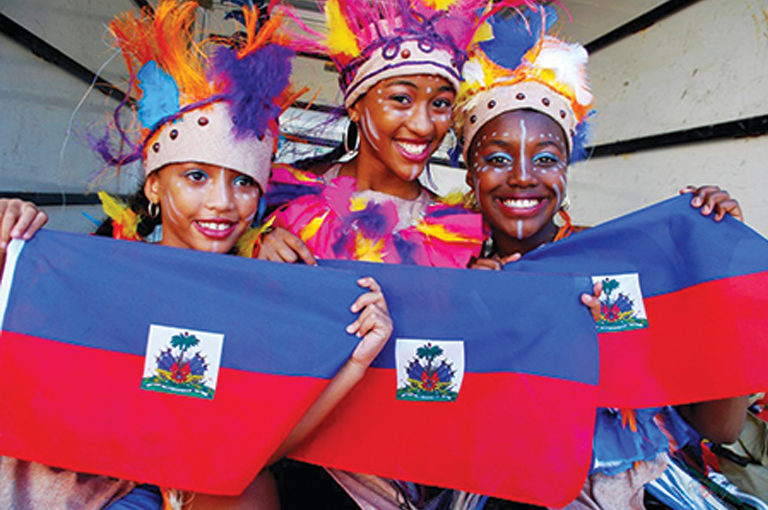
The national emblem of Haïti is a powerful symbol of the country’s identity, history, and values. It embodies the struggle for independence and the fundamental principles that unite Haitians. This article explores in depth the national emblem of Haiti, its elements, meaning, and importance to the Haitian nation.
The national emblem of Haïti consists of the country’s coat of arms, an important and distinctive symbol. This coat of arms was adopted in 1807 and is featured on the flag and official documents of the Republic of Haiti. The emblem is divided into several symbolic elements that reflect the country’s history, culture, and fundamental values.
The emblem of Haïti is rich in symbolism. At the center of the coat of arms is a palm tree (symbol of freedom), with cannons and flags representing the defense of the nation. A Haitian flag flies around the palm tree, evoking the struggle for independence.
Two crossed arrows, accompanied by laurel branches, symbolize the military victory and the honor of the Haitian people in their quest for freedom. On the bottom of the coat of arms, a banner bears the national motto: "L’Union fait la force", a principle that reaffirms the importance of national solidarity.
The blue and red colors that appear on the emblem symbolize unity and freedom. The blue represents the descendants of slaves who fought for independence, while the red represents the brotherhood between all Haitians.
The Meaning of the Coat of Arms
The coat of arms of Haïti has a deep and historical meaning. The palm tree, at the center of the emblem, symbolizes the freedom acquired after the Haitian revolution. It also represents the perseverance of the Haitian people in the face of adversity.
The cannons and flags on the sides are reminders of the heroic fight of the Haitians for their independence. These symbols embody the defense of the country and the spirit of resistance that allowed Haïti to become the first country to abolish slavery and found an independent black republic.
The laurel branches are a reference to military victory, but also to peace, honor and integrity. They are a sign of triumph and the dignity regained by the Haitian people after centuries of oppression.
The emblem of Haïti plays a central role in the construction of national identity. It is a constant reminder of the sacrifices and struggles that allowed Haïti to obtain its independence. Each element of the emblem is a symbol of Haitian pride and the sovereignty of the country.
Haitians both inside and outside the country view this emblem as a source of dignity and resilience. It is worn with pride during national celebrations and events where the unity and solidarity of the Haitian people are highlighted.
A Living Emblem of Haitian History
The national emblem of Haïti is much more than a simple design: it is a living testimony to the country’s history. It recalls not only the war of independence, but also the slave revolt and the victory over colonial oppression. As such, it represents the ideals of liberty, equality, and fraternity that have shaped Haiti.
Haitians continue to reclaim their emblem and bring it to life, whether it is seen flying in the streets during protests or finding it in art, music, and discussions about the nation. The emblem is a testament to the continuity of Haiti’s history and soul across generations.
Although specific to Haiti, the national emblem also has a universal dimension. It embodies the principles of the struggle for freedom, human dignity, and solidarity. These values resonate throughout the world, especially in Haitian communities in the diaspora, where the symbol continues to serve as a rallying point and collective pride.
The emblem of Haïti is therefore much more than a decorative element. It embodies the heritage, culture, and strength of the Haitian people, and it is a powerful vector of national identity, inspiring respect and solidarity on a global scale.
Share
About the Author
Appolon Guy Alain
Appolon Guy Alain
Full Stack Developer, Créatif, expérimenté, passionné des nouvelles technologies et de l’art.
First black nation to free itself from slavery and gain independence from France in 1804 and influenced other liberation movements around the world, inspiring struggles for freedom and equality.
Natural beauty
Haïti is blessed with spectacular natural landscapes, including white sand beaches, mountains and rich biodiversity.
Heritage
Haïti has a rich historical heritage, including sites like the Citadelle Laferrière and the Sans-Souci Palace, listed as UNESCO World Heritage Sites.
Culture
Haïti has a rich and diverse culture, influenced by African, European and indigenous elements. Haitian music, dance, art and cuisine are celebrated around the world.