contact@haitiwonderland.com+509 36184317

Discover

Shopping Cart

Diplomatic Fortnight: CEPOD’s plea for effective Haitian diplomacy
  • News
  • October 31, 2024

Diplomatic Fortnight: CEPOD’s plea for effective Haitian diplomacy

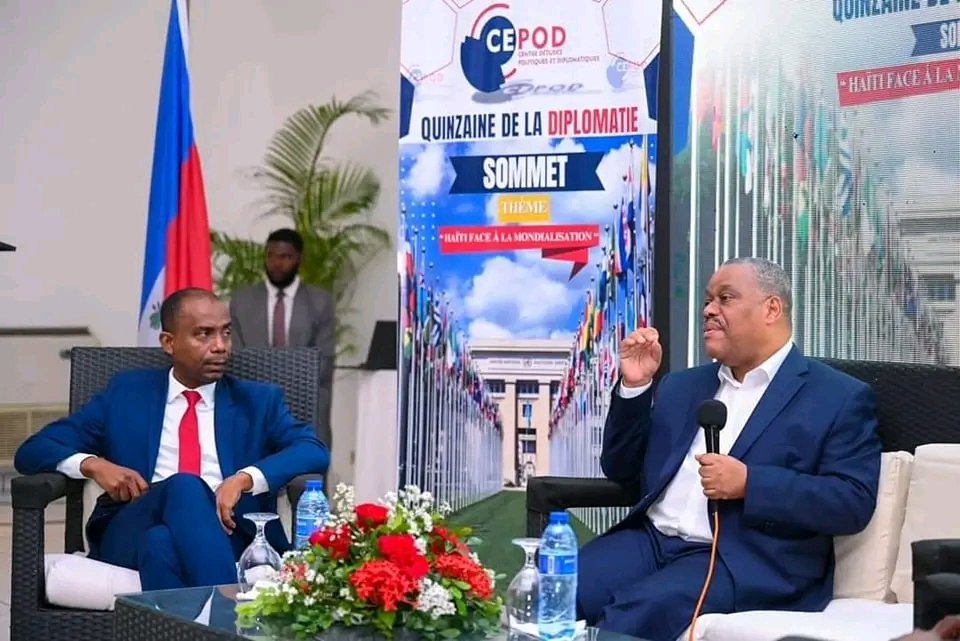
On Thursday, October 24, 2024, the Center for Political and Diplomatic Studies, CEPOD, launched its Diplomatic Fortnight via a summit that took place at the Montana Hotel in Pétionville. The event took place under the theme of Haiti’s place in globalization, and in the presence of an audience of distinguished guests. consisting of public authorities such as the current Haitian Prime Minister, Dr. Garry Conille (Honorary President of the summit); his Minister Delegate for Humanitarian Affairs, Mr. Herwil Gaspard; Foreign diplomats, among whom we can cite the Canadian Ambassador, Mr. André François Giroux (Guest of Honor of the summit); Dr. Christian Mouala, Country Director of UNAIDS Haiti, and a group of other public figures (such as sociologist Daniel Supplice), members of the press, such as senior journalist, Rotchild François Junior and students of all kinds.

Haïti
Haïti
Haïti

Interventions

The summit began with the intervention of the President of CEPOD, Mr. Jean Jul Desauguste, who had to mention the context surrounding the initiative, and took the opportunity to touch on the schedule of the fortnight, which according to him will be very busy in terms of diplomatic achievements. The members of CEPOD will even have to make trips abroad in favor of Haitian diplomacy during this intense diplomatic period, he had declared.

In addition, the interventions within the summit were subdivided into three main lines, each having a well-specified term that served as a framework for the interventions of each of the speakers.

Diplomacy and economic governance; Diplomacy and political education; Diplomacy, humanitarian and migratory crisis were addressed respectively by all the speakers.

Haitian Prime Minister Dr. Garry Conille, in his speech, insisted that the country should not stop living because of the security crisis affecting its capital and part of the Artibonite department. The fight against the sick parts of the country will also involve the development of areas of the country spared by the bad pathology, according to him. In this regard, he took the example of Jamaica in the 70s, whose capital found itself in a similar position to ours, and which had used a similar strategy that bore fruit. He declared that he had engaged his government in such an approach, in parallel with the fight for the recovery of the part of the country occupied by armed groups. In this sense, he is pleased with the resumption of cruise ship traffic in the north of the country. He also mentioned the need for a country like Haiti, largely exposed to climate change, to have a diplomacy with an enlightened, learned vision of what the country needs for its development, accompanied by a well-defined and ambitious program to present to its international partners. And also the need for Haïti to have alliances with countries that have similar difficulties to its own. He cited Rwanda under the leadership of Paul Kagame as an example, where he had to work for a while for the UN, in the early 2000s, and which less than 25 years later, had managed to transform itself into an emerging country and a key player in its region by using a similar approach. "The Haitian case is a case that must be opened to other partners who are looking for other areas to invest in," he concluded. It is in this sense that he registered his last trip to one of the countries of the Arabian Gulf. The Canadian ambassador, Mr. André François Giroux, for his part, was keen to emphasize the importance of Haiti, which is located close to the largest stock markets in the world, and whose revolution leading to its independence inspired the standards of universal freedom in force within the international community, in the eyes of his country. Furthermore, he recalled that Haïti is his country’s leading partner in terms of per capita investment. The annual support of one hundred million Canadian dollars to the Haitian police, the financing in large part of the security support mission led by Kenya, which is being deployed against armed groups in Haiti, of which his country is the leading financial contributor, Canada’s investment in the fight against corruption (the only reason, according to him, capable of explaining Haiti’s underdevelopment) characterized by the establishment of a sanction mechanism against a part of the Haitian elite, involved in proven corrupt practices, among other things constituted the bulk of the diplomat’s speech.

The former ambassador of Haïti to the Dominican Republic, historian and sociologist Daniel Supplice, focused his speech on the current migration situation that pits the Dominican authorities against Haitian migrants. He especially recalled that Haïti has not always been a country of immigration. He stressed that the current Haitian diplomatic authorities must use the diplomatic instruments at their disposal to demand respect for the fundamental rights of Haitian migrants in the Dominican Republic. He also mentioned the importance for the internal Haitian authorities to set up a system to identify people expelled by the Dominican Republic, who unfortunately are sometimes citizens of other nations, but sent to Haïti just because they have black skin. The bestial attitude of some Dominican immigration agents towards children must be rigorously denounced. He took the time to conclude his speech by emphasizing the need for the Haitian authorities, and Haitian society as a whole, to work to make the country more livable. Because if people leave, it is because they are fleeing a deep malaise.

See as well

The Summit’s Stakes

The summit took place at a crucial time for the country, a time when the very existence of the Haitian nation is under very strong threats in its deepest confines.

The threats are both internal and external. The internal ones are characterized by the permanent pressure exerted by armed groups on the Haitian people and its state institutions. And externally, the threats are symbolized firstly by the aggressive behavior (symbol of a continual hostility) of the Dominican Republic towards Haiti, which in recent times, is particularly materialized by the massive expulsion, sometimes illegal, but above all in a totally inhumane manner of tens of thousands of Haitian refugees (outside the basic standards of fundamental human rights) who are fleeing the violence of Haitian armed groups, all via a racist policy, targeting all people with black complexions.

External threats also characterized by the invisibility of the Haitian crisis on a global scale, due to a context of constant unrest, within the international community. The Haitian crisis, appearing in the eyes of some, to be of lesser importance, is shamefully neglected in the background despite its considerable number of victims, to the detriment of other crises described as more major, such as the semi-open conflict of influence, between the emerging powers united under the acronym of BRICS and Allies, with the great industrialized powers of the world. The Haitian crisis is also made invisible by the Israeli-Palestinian-Lebanese war, that in Sudan, that in the east of the Democratic Republic of Congo (DRC), the conflicts listed within the Sahelian states, and most certainly that which opposes Russia to the Ukrainian army.

The importance of diplomacy

In such a context, the Haitian diplomatic channel cannot be useful by remaining confined to fruitless silence. In these difficult times when the future of the land of Toussaint Louverture, Jean-Jacques Dessalines and his sons is compromised, Haitian diplomacy has a duty to move, rearm and get in tune with the aim of ensuring a real revitalization of its branches, in order to be able to constitute a strong, effective representation of the Haitian voice in the midst of this great alarming hubbub, which represents the undermined globalization of recent times. Haitian diplomacy must absolutely live up to its extremely important mission and the challenges of the hour

This element among others make up the stakes surrounding this summit. An event that has its place in the Haitian diplomatic landscape, particularly at a time when Haitian diplomacy has no right to sleep, and its place has clearly increased, to the point of becoming a major player in the survival of the Haitian people. This people has been constantly struggling since gaining its independence on January 1, 1804.

Conference / Festival Quatre Chemins / 21st edition

Conference / Festival Quatre Chemins / 21st edition

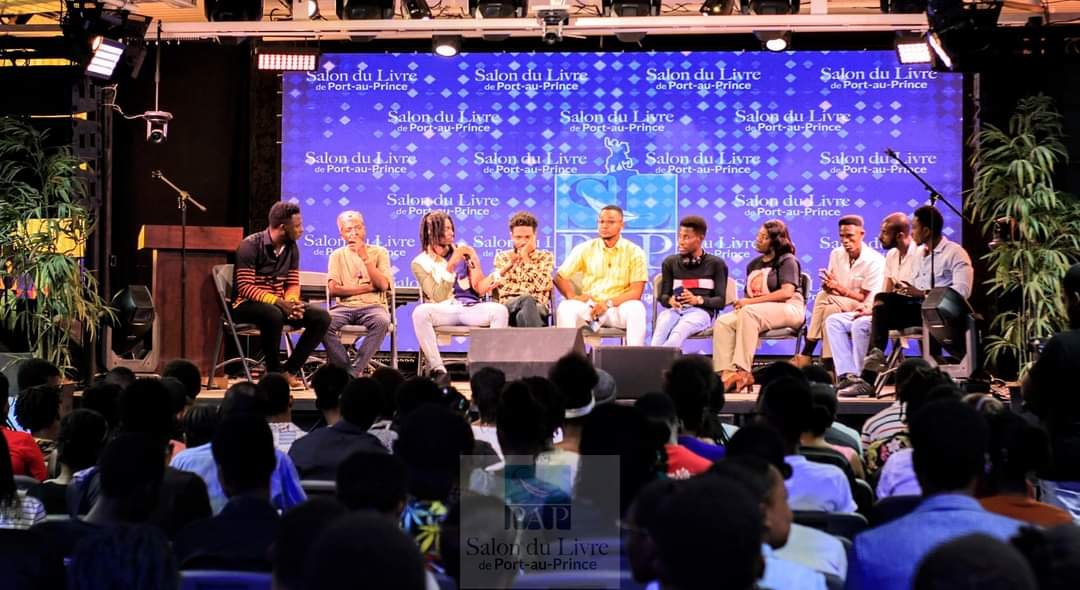
The impact of collective and individual trauma on the personal development of young people in Port-au-Prince While writers, actors, dancers, poets, among others, have gratified us with their performances, the master’s degree student in psychology at the Faculty of Human Sciences (FASCH), Lourdya Blaise, spoke with the audience about trauma. Structured around the theme "Youth and Trauma, analysis of the impact of collective and individual trauma on the personal development of young people living in Port-au-Prince between 2010-2024", this conference gave rise to enriching discussions. During this meeting, moderated by Michaël Formilus, Ms. Blaise showed how the events that have taken place in the country have caused cases of trauma among Haitians. According to the student, citing the American Psychological Association, we speak of trauma as a consequence of trauma. The latter is explained by the fact that we feel threatened, whether it is the person in question or their loved ones. However, she specifies that a collective trauma remains depending on the impact that the event has on the individual. To illustrate her remarks, she mentioned the earthquake of January 12, 2010, considered a collective trauma, insofar as it still occupies our minds. This tragedy reminds us of the disappearance of our loved ones and enormous losses. This is the case of a trauma that becomes a collective trauma. For the student, it should be emphasized that when an event occurs, some people are traumatized and others are not. According to him, the violence of armed gangs is not perceived in the same way, says Ms. Blaise. There are people who have fled their homes but are not traumatized. In fact, some people see traumatic situations as a passing event, she says. The speaker also spoke about collective trauma, which, according to him, preoccupies the mind, even if we no longer experience it. It manifests itself in several forms: lack of sleep, fear psychosis, intrusive thoughts, intense heartbeat, etc. Generally, symptoms related to trauma are hard to die. When it persists, it becomes acute stress. To deal with it, we must talk to other people. If the situation persists, acute stress turns into a phase of post-traumatic stress; in this case, we must confide in a trusted person or go see a mental health specialist, she advises. In her presentation, Lourdya Bazile also drew attention to the psychological state of children in these times. According to the presenter, children are also facing this crisis situation, even if they do not talk about it to their parents. As much as adults, children also plan their future. Faced with flouted school years, they become pensive and worried, she stressed. They withdraw. The child who used to be brilliant can become violent and perform less well at school. Parents are called upon to listen to them and understand them. A good moment of exchange, rich in practical advice. The audience participated fully. In turn, the presenter invites them to breathe better and meditate. "We live in a country where worries mix, we must take time for ourselves, do sports, eat well, make sure that the sleeping space is clean and take time for ourselves. There is more than one way to find calm," recalls the psychologist. Gertrude Jean-Louis

Share
About the Author
Moise Francois
Moise Francois
Moise Francois

Journalist editor, poet and apprentice lawyer.

See other articles from Moise Francois
Leave a comment

Recently Posted

Newsletter

Subscribe to our newsletter to stay informed of all our activities and news on Haiti.

Haïti / Fort Picolet: Historical Guardian of Liberty

Cap-Haïtien, Haiti’s historic jewel, is home to a fascinating architectural relic: Fort Picolet. Built at the end of the 18th century by the French, this imposing bastion majestically dominates the bay of Cap-Haïtien, bearing witness to the tumults of Haitian history and the fierce struggle for independence. The history of Fort Picolet is closely linked to that of Haiti, particularly at the time of the Haitian Revolution. During this tumultuous period, when slaves and freedmen rose up against colonial oppression, the fort was the scene of epic battles and fierce sieges. Sometimes used by French forces, sometimes by Haitian revolutionaries, Fort Picolet was a silent witness to the events that shaped the destiny of the nation. Designed with a strategic vision, the fort embodies the military architecture of its era. Its thick stone walls, strategically positioned cannons and viewpoints overlooking the bay make it an impregnable bastion. Its name, Fort Picolet, pays homage to General Louis Marie, Marquis de Picolet, French governor of Cap-Français at the end of the 18th century. Today, Fort Picolet remains much more than a simple historical monument. It is a living symbol of the resilience and determination of the Haitian people. Visitors who wander through its ruins can feel the imprint of history and contemplate the remains of a tumultuous past. From up there, a panoramic view of the bay of Cap-Haitien is available to them, offering a unique perspective on the strategic importance of this place in the maritime history of Haiti. As a pillar of Haitian tourism, Fort Picolet attracts visitors from around the world. Its historical aura, combined with the natural beauty of its environment, makes it a must-see destination for history and culture lovers. More than just a tourist attraction, Fort Picolet is a poignant testimony to the endless struggle for freedom and the cultural richness of Haiti. Throughout the centuries, Fort Picolet has survived the test of time, reminding everyone that freedom is an inalienable right, hard won and carefully preserved. By exploring its ramparts, contemplating its silent cannons, visitors find themselves immersed in the tormented history of Haiti, a story of courage, resistance and hope. Live an extraordinary experience by virtually visiting the ruins of Fort Picolet: https://haitiwonderland.com/haiti-virtual-reality-ht/monuments-histoire/haiti--fort-picolet--visite-virtuelle/14

Recently Posted

History

History

First black nation to free itself from slavery and gain independence from France in 1804 and influenced other liberation movements around the world, inspiring struggles for freedom and equality.

Natural beauty

Natural beauty

Haïti is blessed with spectacular natural landscapes, including white sand beaches, mountains and rich biodiversity.

Heritage

Heritage

Haïti has a rich historical heritage, including sites like the Citadelle Laferrière and the Sans-Souci Palace, listed as UNESCO World Heritage Sites.

Culture

Culture

Haïti has a rich and diverse culture, influenced by African, European and indigenous elements. Haitian music, dance, art and cuisine are celebrated around the world.

  • +
    • Post