contact@haitiwonderland.com+509 36184317

Discover

Shopping Cart

Frankétienne, the Nobel Prize Winner

Frankétienne, the Nobel Prize Winner

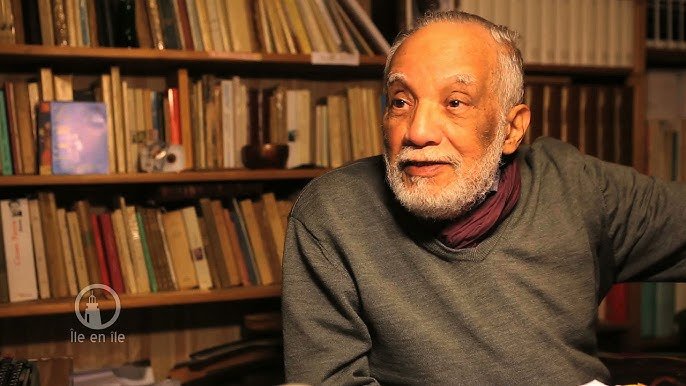
Frankétienne is the stage name of the man who officially bore the name Jean-Pierre Basilic Dantor. He was born in the Artibonite department of Haïti on April 12, 1936. His father, who did not recognize him at birth, was, according to his own account, an American industrialist who had come to do business in Haiti, and his mother was an Artibonite farmer. This makes Frank a similar case to the great Jamaican artist Bob Marley, who had a typical story, in addition to the fact that both men made their country known abroad and left their mark on their land from within through their art. Frank died on Thursday, February 20, 2025, in Delmas, his home town for decades. He was about to celebrate his 89th birthday.

Haïti
Haïti
Haïti

The Child King

Frankétienne spent very little time in Ravine Sèche (his hometown) after his birth. His mother fled Haitian provincial poverty to settle with the little boy in the famous Bel-Air neighborhood of Port-au-Prince, one of the most vibrant and vibrant of its time. This neighborhood would mark little Frank’s life, and he would be influenced by its creativity and dynamism to this day. Moreover, Frankétienne recounts growing up under the banners of freedom and in unparalleled joy in this neighborhood where Port-au-Prince was born. In Bel-Air, he tells himself, his mulatto skin made him a popular white boy in this very working-class neighborhood, densely populated by blacks.

See as well

Haïti
Haïti
Haïti

Sacred Monster

Frankétienne recounts entering literature through the front door of reading. And this great love of reading came to him in the monumental aftermath of a vast failure. Little Frank, having just arrived from Ravine Sèche, was asked his name by a Catholic nun, and he didn’t know what to answer. He stood in front of a room, taking refuge in a shameful silence to defend himself against this ignorance. This episode would push little Frank toward books, to the point of loving them to the end.
Today, Frankétienne is honored by UNESCO, which has just created a literary prize in his honor for his literary creativity. He is one of the most prolific authors of his time, with more than 30 written works, a considerably diverse body of work consisting of plays, poetry, novels, and essays. Among his most famous works, works that have left their mark on the Haitian imagination, we can cite Dézafi, Pèlentèt, Foukifoura, L’ultravocal, and Les affres d’un défi.

Haïti
Haïti
Haïti

A Creator of Universes

Frankétienne’s life was marked by his immense creative spirit. He was one of the greatest creators of worlds, an unparalleled inventor, pursuing the greatest in history in this field. He is one of the founders of a literary movement called Spiraliste, alongside Jean-Claude Charles and René Philoctète. But far beyond literature, for the man who was Minister of Culture under the presidency of Nesly François Manigat, creation and life are two inseparable sides of the same coin. This is why, alongside this richly literary life, in which he is simultaneously a poet, novelist, playwright, and essayist, he is also a painter, singer, and drummer. With so much, it seems impossible not to leave a mark on his country and his era.

Pity or the work of an old soul crushed under the weight of an absinthe-flavored existence

Pity or the work of an old soul crushed under the weight of an absinthe-flavored existence

The word crisis carries an infinite number of meanings. No intention of revealing them all this afternoon. However, a few clarifications are necessary. A kid whose parents do not have enough money at Christmas to buy her a Little Black Mermaid doll has a fit and locks herself in her room without touching her meals for the day. A boy whose dog was suddenly poisoned by a neighbor in revenge or shot after contracting rabies, losing a faithful friend overnight, enters into crisis. Finally, a society in the grip of all sorts of mutations and whose leaders are weak, perhaps prolonged in a deep crisis. In the first case, the young girl sulks to attract the attention of her parents in order to feel appreciated by children her age at school or in the neighborhood. Today, thirty minutes of negotiations can be enough to find a lasting solution. In my day, a few well-aimed belt blows would have overcome this whim. But, humanity evolves, they say. In the second case, this boy can find his smile again after a few weeks. He needs a little attention and, probably, another dog. As Stendhal would say, only passion triumphs over passion. In the last case, this society led by inepts is shaken to its deep foundations. Its institutions can disintegrate one by one. The vital forces dissolve in no time. This situation creates a societal tsunami that destroys all life within this community. It is indeed a crisis. The crisis from this point of view constitutes an alarming, desperate situation in the existence of a community where nothing is going well. Chaos reigns supreme. The very essence of life disappears. The individual can take precedence over the community. Everyone tries to solve their problems without worrying about others. The closest neighbor is relegated light years away from you. How can we turn to creation? How can we continue to conceive of otherness? How can the artist absorb this great collective disarray as a source of motivation? These are the questions I must answer. An artist sees and feels what ordinary mortals cannot even imagine in a thousand-year life. He creates to denounce, when his conscience as a human being is revolted. He exalts heroes or the homeland according to his feelings. He sings the beauty of an irresistible, captivating or ugly resplendent woman. He can also use the ambient desolation to give meaning to life. Creating in literature as in the arts in general does not depend on the situation. The act of creation depends on the creator’s disposition. Events paralyze some and galvanize others. Creating is enjoyable. Everyone therefore enjoys according to their own whim. Writing opens the way to change. The writer takes a different look at the world. By embedding himself in reality, he embellishes it, makes it better or hideous depending on the message he intends to share. All things considered, with him, life is never fixed. Writing is putting the world in a jar to travel the universe. The artist broods over his work in all weathers. Oswald Durand was delighted to see Choucoune’s beautiful body from his secret observatory. Musset, on the other hand, was in pain writing his October night. As for Dany Laferrière, in exile, he described the horrors of the Duvalier dictatorship and the carefree attitude of the young girls in his neighborhood in this violent and dangerous world. Ultimately, the writer lives in a society with values ​​that he shares or not. They condition his existence or have no hold on him. In many ways, the surrounding world serves as his laboratory. He carries out his experiments there. He casts a new, worn, disillusioned, melancholic, violent, bitter look at the world depending on his mood. Pitié is the work of an old soul crushed under the weight of an existence that tastes of absinthe. Young Mike Bernard Michel lives by expedients and lies. The hands of life fall on him with indescribable violence. Misfortune embraces him day and night. Should we give up? Musset liked to say: "Man is an apprentice, pain is his master. And no one knows himself until he has suffered." The artist must produce under all skies. Such is his vocation. Incompetents in power, legal or highway bandits, the high cost of living, unemployment, heartaches are all subjects of concern for him. If it is true that a hungry belly has no ears, the fact remains that it keeps the brain awake. What am I saying, it stimulates it to the point of creating timeless works. Mr. Pitié, you have a bright future ahead of you. Work of Jean Rony Charles, the book is available from Éditions Repérage.

Haïti
Haïti
Haïti

A Lover of Haiti

Frank remained a great defender of Haitian culture until the end of his life, elevated to the rank of permanent ambassador of this culture by the Haitian Ministry of Culture and Communication. But Frank wasn’t limited to culture. A graduate of the École Normale Supérieure of the State University of Haiti, he used this pretext to invest in education, notably by creating a school in his eternal neighborhood of Bel-Air. Frank demonstrated how much he loved his country with this feat. Because when you love your country, you don’t steal it, but rather you build schools within it for the education of its children. Moreover, those who love their country defend it and enhance its name. Frank had the courage to use his art to free his country from the ferocious and very costly dictatorship of the Duvalier regime. And the other great proof of his love for his country is the fact that he remained inhabited there until the end, even though he had more than enough means to continue his life in any major country in the world. A straightforward way of saying that when you love your country, you’re even willing to let yourself die in it. We can only salute this man’s courage. Port-au-Prince is the most dangerous city in 2024, according to some foreign experts; you flee a city like that if you have the means. Staying there to die, when you bear the name Frankétienne, is a proof of immeasurable love.
Haïti
Haïti
Haïti

Frank, the Thirsty for Greatness

Frankétienne aptly captures the marvelous side of the Haitian sun. He was a man who knew he was equal to the rest of the world and who set out to chase the stars. Frank said he was waiting for his Nobel Prize in Literature, because he rightly felt he was worthy of it, and waited patiently for this title from his residence in Delmas 31, telling himself he was a man who had built enough and left his mark on his time for that. If Bob Dylan, the wonderful American singer of his time, etc., received this Nobel Prize, why not Frank? For both were born men and very early on took possession of their right to become creators. Both took art seriously from the beginning of their youth. If Frank is the product of a small country, he told himself, at least his creation is the equal of that of any man. And nothing less.

This wonderful man strove, despite any false, demeaning tendency of his current country, to be a Man in the immediate lineage of his ancestors. To be a worthy successor in the great pride of Dessalin, Louvertur, and Christophe. And to extend into the great past figures like Louis-Joseph Janvier, Jean Price-Mars, Anténor Firmin, or Demesvar Delorme. Frank is a great symbol of rebellion against the baseness and mediocrity of our current Haiti, Frank has always been. A symbol of a wonderful scandal, stitched together from the wounds of this country brought low from the head. If only in this sense, this man, we must rely on the example of his life when we seek to honor him. His life and the great legacy he left behind should be held up as a model for all children around the world.

Share
About the Author
Moise Francois
Moise Francois
Moise Francois

Journalist editor, poet and apprentice lawyer.

See other articles from Moise Francois
Leave a comment

Recently Posted

Newsletter

Subscribe to our newsletter to stay informed of all our activities and news on Haiti.

Petit-Goave, Haiti: Decryption of the 3rd rara weekend!

It is more and more obvious that in Petit-Goave the media space is absorbed by the rivalry between Ratyèfè, triple champions and lambi gran lambi dlo, a former champion. The past weekend was once again irrefutable proof of the media tension over these two rival bands. With a carnival-like appearance, the fan club of the first dressed in a white shirt, short orange-yellow skirt, purple tie, black boot; the other dressed in a traditional hat, yellow jersey, red pants, red or yellow tennis shoes. This marriage of colors with the taste of carnival is the expression of cultural diversity as La Fontaine said in his book tales and short stories "diversity is my motto." This formula can adapt well to the rara. If it is true in Léogane this marriage of color has existed for ages. It is no less true that this was the case in Petit-Goave because we had to wait for the strong return of Ratyèfè in 2018 to see the rara fan clubs dress differently each new weekend. Last Saturday more than one expected a new face to face between Lambi gran dlo and Ratyèfè because the latter weighed anchor in the direction of the 2nd plain and the latter, in the direction of the city center. Less than in any other circumstance, this duel at the top was obvious. If for some comments it was a favorable opportunity for Lambi to take his revenge on his rival compared to the previous weekend because he had done the profile although he had the advantage because he was two against one. (Lambi,chenn tamarin vs Ratyèfè). This enormous advantage did not work in their favor because the hours that had passed worked against them, as proof they had gone to sleep while ratyèfè remained to play for at least 30 more rounds. Surprisingly but not surprisingly during the meeting long awaited by less than one, at the Acul not far from the Saint Jean-Baptiste church, lambi had decided not to play anymore. However, according to the customs and costumes of the rara when there are two bands, the one who stops playing first, shows weakness and surrender. Consequently, the other who is opposite out of decency and good morals has no other choice to do the same. It follows that for the umpteenth time the great power formation (lambi grand dlo) was unable to take revenge on its rival. For many cultural journalists who were present to witness this event did not have their tongue in their pocket to give their impression of Ratyèfè’s monster performance. This is the case for Brignol, a cultural commentary which wondered if Ratyèfè had the devil in his body so that the most incredulous were in their feeling of joy. On Sunday evening this monster of animation once again made its mark in the art of its know-how. This is what explains the almost unanimity among the cultural journalists of Petit-Goâve in granting first place to this band for its performance and its musical discipline. So, for this weekend according to the circle of cultural journalists of Petit-Goave and with the approval of many other cultural comments. We have the following classification: 1st Ratyèfè 2nd Grap Kenèp 3rd Orgueil de la jeunesse

Recently Posted

History

History

First black nation to free itself from slavery and gain independence from France in 1804 and influenced other liberation movements around the world, inspiring struggles for freedom and equality.

Natural beauty

Natural beauty

Haïti is blessed with spectacular natural landscapes, including white sand beaches, mountains and rich biodiversity.

Heritage

Heritage

Haïti has a rich historical heritage, including sites like the Citadelle Laferrière and the Sans-Souci Palace, listed as UNESCO World Heritage Sites.

Culture

Culture

Haïti has a rich and diverse culture, influenced by African, European and indigenous elements. Haitian music, dance, art and cuisine are celebrated around the world.

  • +
    • Post