contact@haitiwonderland.com+509 36184317

Discover

Shopping Cart

The compas direct: an important part of Haitian identity
  • Music
  • July 03, 2024
  •     2

The compas direct: an important part of Haitian identity

La musique joue un rôle crucial dans la formation de l’identité d’une nation, en haïti, elle occupe une place centrale dans la vie de presque tous les haïtiens. Elle est utilisée comme étant l’un des moyens les plus fiables dont se sert le peuple haïtien pour s’évader face aux nombreux événements qui constituent l’essentiel de son quotidien. Le genre musical qui prédomine en haïti est le compas direct. Créer par l’esprit créatif haïtien, le compas à évoluer au fil des années pour aboutir jusqu’à sa position actuelle.

Music plays a crucial role in shaping the identity of a nation; in Haiti, it occupies a central place in the lives of almost all Haitians. It is used as one of the most reliable means used by the Haitian people to escape from the many events that constitute the majority of their daily lives.

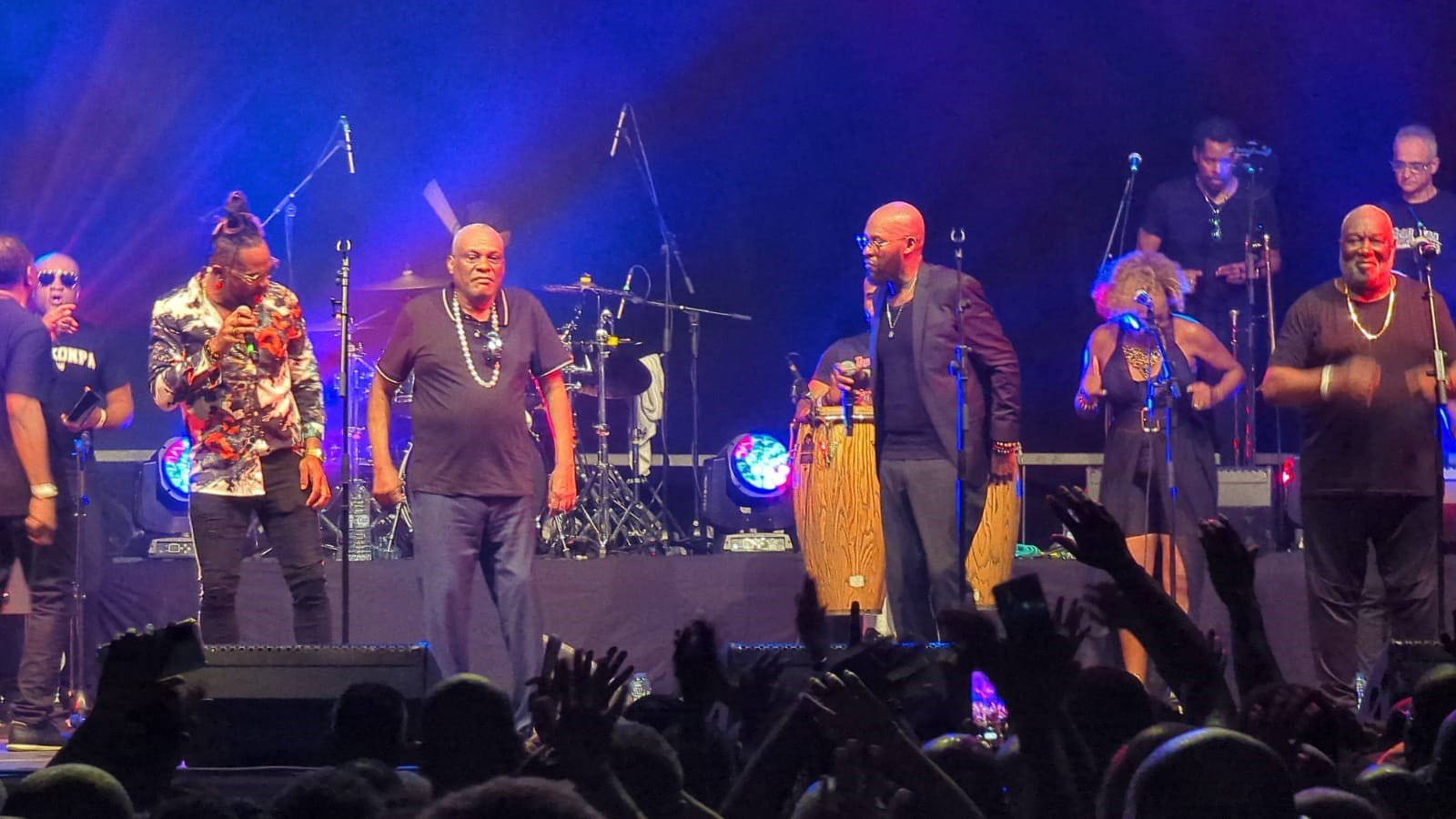
The musical genre that predominates in Haïti is direct compass. Created by the Haitian creative spirit, the compass evolved over the years to reach its current position. Today we can say with certainty that it is a musical genre that transcends generations and borders, becoming a symbol of pride and an inspiring sign for Haitians around the world.

Compas
Compas
Compas

The compass a real instrument of social cohesion

The privileged place occupied by the compass allows it to be an omnipresent musical genre in Haitian society. It is found both in the most exclusive salons and in the neighborhoods most exposed to poverty. It manifests itself strongly in all religious cults (Protestants; Catholics; Vodouists); popular festivities, including political movements. It is also a means of celebration, protest, and above all, preservation of Haitian cultural identity in the face of the challenges of acculturation due to the strong exposure of young Haitians to dominant external cultures.

Compas
Compas
Compas

The origin of the direct compass.

The direct compass was born in the middle of the 20th century and then was popularized by Nemours Jean-Baptiste, a famous Haitian musician, internationally recognized and considered the father of the direct compass, it was he who launched the genre in 1955 with his orchestra musical.

Technically the compass is a mixture of Afro-Caribbean rhythms, meringue and African-American jazz influences, characterized by driving rhythms and bass lines. This fusion gave birth to a distinctive sound that quickly captured the hearts of Haitians and West Indians in general.

Compas
Compas
Compas

The influence of the compass in life in Haïti and within the Haitian diaspora.

The compass is not just a musical genre; it is a way of life for many Haitians. For the Haitian diaspora, the compass is a means of attachment to the country. It is an effective tool for combating exile and feeling in the middle of your culture just by listening to a piece of music.

The lyrics of compas songs most often reflect the social and political realities of the country and those of Haitians in the diaspora. We can cite as examples the works of ti manno, with his group dipi-exprès those of skacha #1, a group of internationally recognized compass, whose sounds recount the daily adventures of Haitians, the beauty of Haitian women and the joys of Haitians despite their difficulties. We can take "koupé klouré" as an example to conclude, Gesner Henry, his real name, is the greatest phenomenon of the compass. Listening to him we feel very clearly the intimacy of Haitians which is revealed in broad daylight, thus becoming a mirror of Haitian society. Generally speaking, compass artists are emblematic figures who inspire and mobilize in society. Their voice matters a lot.

Compas
Compas
Compas

The evolution of the compass.

Since its creation, the compass has undergone numerous developments. In the 1970s and 1980s it went international with bands like Tabou Combo and Magnum Band who brought the genre to the world stage. In the 1990s and 2000s, Compass incorporated elements of electronic music, rap and reggae, while still retaining its roots. Today, the compass continues to reinvent itself, influencing and being influenced by other musical genres, while remaining true to its essence.
At first glance, the nemours compass is not that of zenglen, djakout, or even zafèm to cite the current group of superstars of the direct compass at the moment. It is a music reworked almost from top to bottom and whose most necessary tools and instruments have been reworked in order to be able to adapt to the demands of our time.

Compas
Compas
Compas

The compass at the origin of zouk

The impact of the direct compass on zouk and West Indian music in general is very considerable. And can only be measured on a multiple variation scale.
Departing from this significant impact, the Antilles remain favorable terrain for the development of the compass outside of Haiti. And it is practically from this influence that the greatest classics of West Indian music emerge.

In the 1980s, Guadeloupean and Martinican musicians, such as the founders of the group Kassav’, were inspired by the compass to create zouk. This new genre which had quickly gained popularity in the Caribbean, Africa and beyond, establishing a musical bridge between the West Indians and the rest of the world. Enriching the Caribbean musical heritage, by uniting all the West Indian peoples through a common musical history.
The compass can boast of being at the origin of West Indian zouk.

In other words, beyond the painful memories of slavery and the socio-economic challenges that characterize the West Indies, the direct compass from its great influence stands out as a unifying element which Haitians and West Indians use to create a common voice. It represents the resilience, creativity and joy of living of the Haitian people who refuse to stay on the ground.

In short, direct compass is much more than a musical genre; it is a reflection of the Haitian soul and a testimony to the cultural richness of the Antilles. It continues to evolve, and will continue to unite and inspire, affirming its central place in the identity of an entire region. And Haïti has the precious privilege of being at the origin of this highly impactful musical phenomenon. It is one of the elements which confirms the great cultural wealth of this beautiful little Caribbean country.

Share
About the Author
Moise Francois
Moise Francois
Moise Francois

Journalist editor, poet and apprentice lawyer.

See other articles from Moise Francois
François Dordy

Mwen ta renmen aprann plis sou kilti m avèk Wonderland.
Mèsi anpil pou gwo travay sa a.
Kenbe djanm.

November 01, 2024 - 06:40:10 AM
Allian Gentille

Felisitasyon!

May 18, 2026 - 07:57:17 AM
Leave a comment

Recently Posted

Launch of the Engagement Award: An Initiative to Honor and Encourage Young Leaders in Haiti

August 29, 2025, will mark two exceptional events: the eighth anniversary of Pierre Marc BAPTISTE’s commitment as a young leader and social and political activist, and the official launch of the Engagement Award. This unique initiative aims to honor and encourage young leaders, professionals, and academics for their dedication and active involvement in community life. The Engagement Award’s mission is to recognize youth leadership, promote civic engagement, and highlight inspiring role models capable of positively influencing an entire generation. Through this award, Pierre Marc BAPTISTE hopes to encourage young people to get involved in concrete actions aimed at solving community problems, reducing social inequalities, and strengthening civic participation. The first edition will be particularly symbolic. Eight young leaders from the Cité Soleil plain will be honored for the social and community impact of their initiatives. In a concrete gesture of solidarity and knowledge sharing, 200 books will also be donated to the Duvivier High School library in Cité Soleil, contributing to the education and training of future generations. With this award, Pierre Marc BAPTISTE reaffirms his belief that youth engagement is an essential lever for social and political change in Haiti. This is a unique opportunity to celebrate those who are taking action to transform their community, while inspiring other young people to follow the path of action and leadership. On August 29, 2025, Haitian youth will be honored, and a new tradition of recognition and inspiration will be established to promote civic engagement and responsibility throughout the country.

Haiti: The Center department, one of the departments most resistant to natural earthquakes

The Center department, commonly called Plateau Central, is one of the ten (10) departments of Haïti most robust in the face of certain natural phenomena. Before becoming one of the ten (10) departments of Haiti, the Center department was part of the Great North. It is renowned for its natural landscapes, its biosphere climate and its resistance to certain natural phenomena. In addition to its natural productions such as corn, millet and livestock, the Center department is also known for its high mountains which constitute a robust defense against certain natural phenomena such as earthquakes and floods. Composed mainly of high mountains, the department of Charlemagne Peralte and Benoît Batravil is the only one of the ten (10) not to have an outlet to the sea. However, its inhabitants take advantage of the vast rivers, rivers and lakes which cross it . With an area of ​​3,487 km², the population of the Center department is estimated at 678,626 according to a study carried out in 2009. On this same area, the department is divided into four (4) districts and twelve (12) communes. Bordered to the east by the Dominican Republic, the Center department connects other departments of the country such as Nord and Artibonite, and connects the two countries of the island through border areas like Balladère, Hinche and Cerca Carvajal. In the Center department, there are sites that could attract tourists for their natural beauty. In Saut d’Eau, there is the Saut d’Eau waterfall, in Hinche we find the Zim basin, the Péligre lake, the Péligre hydroelectric dam, the Artibonite river, and the Deux river (2 ) Rooms in Thomonde, more precisely in "El Manni", not far from the communal section of Caille-Epin. Thanks to its strong mountains and its natural climate, the Center department remains one of the most resistant departments in the event of an earthquake in Haiti.

Newsletter

Subscribe to our newsletter to stay informed of all our activities and news on Haiti.

Haitian traditions

Haiti, the pearl of the Antilles, is a country rich in history and traditions. Its vibrant and diverse culture is reflected through its national holidays, cultural festivities, traditional foods, religious beliefs, folk tales, and traditional games. Let’s immerse ourselves in the social fabric of Haïti to discover the beauty of its traditions. b~National Holidays:~b National holidays in Haïti are moments of pride and national unity as January 1, Independence Day, commemorates the victory of Haitian slaves over French colonial forces in 1804, making Haïti the first independent country in Haiti. Latin America and the Caribbean or the commemoration of the Battle of Vertières on November 18. The Battle of Vertières was one of the last great battles of the revolution. It took place in Vertières, near the town of Cap-Haitien. b~Cultural Festivities:~b Haïti is also famous for its cultural festivities, particularly Carnival, which is an explosion of color, dance, and music. Artistic and craft events, such as the Rara festival, are an opportunity for artists to showcase their talent. The Rara, a musical parade, combines folklore and spirituality, creating a unique experience. b~Traditional Foods:~b Haitian cuisine is a delight for the taste buds. Dishes like griot (fried pork), diri djon djon (rice with black mushrooms), and the legendary joumou (joumou soup) are an integral part of Haitian culinary tradition. Bold flavors, spices and cooking methods inherited from African and French tradition make Haitian cuisine unforgettable. b~Vodou:~b Vodou, often misunderstood, is a synchretic religion that incorporates elements of Catholicism, African animism, and indigenous beliefs. It plays a significant role in the daily lives of Haitians, influencing music, dance, and religious rites. Vodou is a profound expression of Haitian spirituality. The Tales (Krik Krak, Tim Tim, Bwa Sèch): Haitian folk tales, passed down from generation to generation, are rich in morality and wisdom. b~Konbit :~b The concept of Konbit represents community solidarity. Haitians come together to perform community tasks, whether in agricultural fields or for construction projects. It is a living example of the collective spirit that permeates Haitian society. The most recent major project to date concerns the construction of the canal from the Massacre River to Ouanaminthe, which took place between September and December 2023. Thousands of inhabitants of the north of the country mobilized all their forces to erect a canal allowing to collect water intended for irrigation of their plantations, with the aim of obtaining better harvests. Despite their modest means, they were motivated by the slogan "KPK" (Kanal la pap kanpe), a direct response to Dominican President Luis Abinader who warned them and did everything in his power to stop the construction of the canal. This channel represents the deep solidarity of Haitians and reaffirms national pride. Despite economic challenges, the people of northern Haïti have demonstrated exceptional determination to work together for a common goal. The slogan “Kanal la pap kanpe” embodies their resilience in the face of external pressures and demonstrates their unwavering will to continue the construction of the canal. b~Traditional Games:~b Traditional games are an essential part of daily life in Haiti. Games like lido, sote kòd, Yoyo, Ralba, Marèl, TiTaTo, Kay, lago kache, Monte kap, teke mab, woule sèk, twa fwa se manbo, and domino bring people together, promoting camaraderie and fun. Haitian traditions are a harmonious blend of spirituality, community, and cultural diversity. Every aspect, from national holidays to traditional games, helps weave the rich cultural tapestry that makes Haïti proud. These traditions are the beating heart of the nation, a precious heritage that continues to be passed down from generation to generation.

Recently Posted

History

History

First black nation to free itself from slavery and gain independence from France in 1804 and influenced other liberation movements around the world, inspiring struggles for freedom and equality.

Natural beauty

Natural beauty

Haïti is blessed with spectacular natural landscapes, including white sand beaches, mountains and rich biodiversity.

Heritage

Heritage

Haïti has a rich historical heritage, including sites like the Citadelle Laferrière and the Sans-Souci Palace, listed as UNESCO World Heritage Sites.

Culture

Culture

Haïti has a rich and diverse culture, influenced by African, European and indigenous elements. Haitian music, dance, art and cuisine are celebrated around the world.

  • +
    • Post