contact@haitiwonderland.com+509 36184317

Discover

Shopping Cart

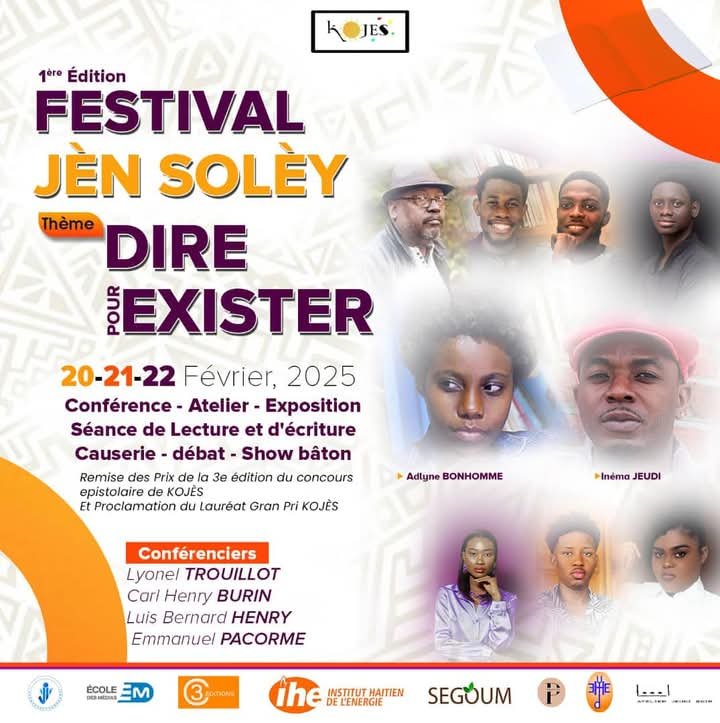
The KOJES Jèn Soley Festival: A Place for Cultural Exchange and Encounters

The KOJES Jèn Soley Festival: A Place for Cultural Exchange and Encounters

KOJES is a non-profit youth association founded in November 2020 in Cité Soleil, the largest slum in Haïti and the Caribbean. From its inception, KOJES has been committed to promoting education, culture, and training through various initiatives. One of its flagship projects is a space for social and cultural debate that has allowed many young people to meet and discuss social issues. Although the clashes that resumed in Cité Soleil in September 2022 temporarily halted this section, KOJES was able to recover by launching the KOJES letter-writing competition, aimed at reestablishing this precious connection between young people through literature. Today, the association is embarking on a new challenge with the Jèn Soley Festival, which will take place from September 20 to 22, 2025, under the evocative theme: "Saying to Exist." Among the guests participating in this festival are the renowned Lyonel Trouillot, the talented poet Carl Henry Burrin, the young slam poet Pacôme Emmanuel, the novelist Louis Bernard Henry, the poet Inima Jeudi, and the young poet Adlyne Bonhomme.

Haïti
Haïti
Haïti

Why another literary festival in the Haitian cultural landscape?

"In a constantly evolving cultural environment, there is always room for new initiatives," writer Litainé Laguerre, coordinator of the association, told us. He also affirmed that the KOJES 2025 Festival aims to create a space for encounters and sharing around literature, while emphasizing the importance of artistic expression in a society in crisis. "This festival is distinguished not only by its commitment to including writers from diverse regions, but also by the launch of the Gran Pri KOJES, an award designed to honor a writer for their complete work. This event will highlight the importance of Haitian literature in an increasingly difficult context, while providing a platform for young talent," he concluded.

See as well

Haïti
Haïti
Haïti

An investment in art despite the challenges

Organizing a large-scale event in a context as uncertain as Haiti’s is a major challenge. However, KOJES firmly believes that art and culture are essential to human life. Despite the successive crises affecting the country, the association wanted to provide a space where everyone can express themselves through dance, writing, reading, and drawing workshops, particularly for the children of Cité Soleil. The festival thus becomes an act of cultural resistance, a way of demonstrating that, even in adversity, culture can and must survive.

Call for Public Collaboration

KOJES invites the public to actively participate in the festival, not as mere spectators, but as collaborators. The goal is to create a collective dynamic where every voice counts. The public, essential to the success of the event, is invited to be at the heart of this gathering, to exchange, discuss, and get involved in the association’s cultural project.

Haïti
Haïti
Haïti

Festival Supporters

The first edition of the KOJES 2025 Festival benefits from the support of several institutions such as the Haitian Energy Institute, C3 Éditions, Atelier Jeudi Soir, Éditions de l’Université d’État d’Haïti, Segoum, Éditions Pwotra haitiwonderland, and the École des Médias. Despite the current economic and political difficulties, KOJES remains optimistic about the success of this event and hopes that more institutions will join the initiative in future editions.


In short, this Festival led by KOJES is not a gesture too many in a Port-au-Prince plagued by all sorts of ills. It aims to offer a measure of healing to the major wounds that plague the city. It is yet another demonstration of the true power of words in a hostile environment; it is also a testament to the resilience of young people determined to promote culture and their clear boldness in favor of literature as a factor in creating life. They clearly believe that art is a serious means with the power to offer everyone the opportunity to use words to affirm their existence.

Share
About the Author
Moise Francois
Moise Francois
Moise Francois

Journalist editor, poet and apprentice lawyer.

See other articles from Moise Francois
Leave a comment

Recently Posted

Vertières, Fort Mazi: Beyond historical truth;

If you look up the word vertière in a French dictionary, you will not find it for fear that the world does not know this place represents the Achilles heels of the most powerful European army. What’s more, this one had just successfully won the eastern campaign. French historians of the time erased this geographical location from the radar of history because they did not want to tell the story as it is in the sense of explaining the first great humiliation of the expeditionary army French by bands of slaves who were totally ignorant in the art of waging war, much less in the handling of weapons. However, these illiterate wars routed the Napoleonic army, the most powerful at that time, using the means at hand. This expeditionary army, after having brought Europe to its knees, would experience its first rout by slaves in this geographical location, located in the Northern department of Haiti. Funny story, this city is not on the list of French words even though given its historical importance, it should be at the heart of universal history, far from putting an end to the invincibility of the undefeated army army. So as not to offend the white masters, no political leader has ever asked why vertière does not appear in any French dictionary? However, they celebrate this battle with great fanfare every November 18. What historic hypocrisy among our leaders! After Vertière many other historical places are strangled by historians in order to hide the extremes of atrocities of the French colonists on the slaves. It is in this context of historical strangulation that “Fort Mazi” is not mentioned in school history textbooks. This is located in Petit-Goave, 2nd municipal section, Arnoux locality. We came across this mega fort, during a mobile clinic entirely financed by the Ernest Junior foundation, a charitable foundation which works in the social sector, particularly in the field of art and music. According to residents , the oldest in this locality, this fort was built on at least 20 squares of earth by the settlers. It was a huge military complex divided into compartments, outposts, turtle rooms, rooms for treating colonists, a large Catholic church, and a cemetery. However, we never talk about this fort so much so that it is ignored by history teachers in the town of Petit-Goave. Certainly, the desired disappearance of this fort under the radar of history buries the atrocities, the barbarities, the most inhumane punishments of the colonists on the slaves. Looking closely at reality, everything seems true that it is the largest fort ever built during the period of colonization. Moreover, it probably seems the most fortified in relation to its importance. Remember that Vertière only exists in Haitian school history textbooks while Fort Mazi does not appear, much less in French dictionaries or history books. This explains why this fort was a secret place in which the settlers practiced crimes and atrocities that went beyond human understanding. Is it not a clear desire of historians to hide what this immense fort built on at least 20 tiles of earth really was? Discover the history of Haiti: A fascinating story to explore! : https://haitiwonderland.com/haiti/histoire/decouvrez-l-histoire-d-haiti--un-recit-fascinant-a-explorer/81

Newsletter

Subscribe to our newsletter to stay informed of all our activities and news on Haiti.

Recently Posted

History

History

First black nation to free itself from slavery and gain independence from France in 1804 and influenced other liberation movements around the world, inspiring struggles for freedom and equality.

Natural beauty

Natural beauty

Haïti is blessed with spectacular natural landscapes, including white sand beaches, mountains and rich biodiversity.

Heritage

Heritage

Haïti has a rich historical heritage, including sites like the Citadelle Laferrière and the Sans-Souci Palace, listed as UNESCO World Heritage Sites.

Culture

Culture

Haïti has a rich and diverse culture, influenced by African, European and indigenous elements. Haitian music, dance, art and cuisine are celebrated around the world.

  • +
    • Post