Learning with AI, in Creole: The Skoleda Initiative
Discover how Skoleda is revolutionizing education in Haiti through an artificial intelligence system in Haitian Creole, designed to assist students and support teachers.
Globally, nearly nine out of ten students already use artificial intelligence for learning. In Haiti, one in seven children is no longer in school. With its learning assistant in Creole, Skoleda aims to ensure that the Haitian school system participates in this revolution rather than just watching it pass by.
Artificial intelligence is no longer a distant promise for educationit is already in students’ school bags. Pupils use it to grasp concepts, teachers use it to prepare lessons, and institutions are still figuring out how to regulate it.
The question is no longer whether AI will enter the classroom, but rather who will design it, in what language, and for which students. This is the space where Skoledaa school management platform developed by Cybalgoseeks to position itself: an educational AI conceived in Haiti, for Haitian schools.
AI in Schools: Widespread Adoption, Lagging Regulation
Data from 2025 and 2026 tell a consistent story across every continent: the adoption of technology has outpaced the development of guidelines.
Among learners, adoption is nearly universal. According to a 2026 survey by the Digital Education Council, 88% of students across 35 countries use AI for learning, while 77% of higher education instructors use it for teachingan increase of 16 percentage points compared to 2025. The phenomenon also extends to the Global South: according to the 2026 Stanford AI Index, 83% of students in Kenya and 79% in Brazil use AI.
For teachers, the benefit is measured in time saved. In the United States, those who use AI on a weekly basis report saving 5.9 hours per week, according to Gallup and the Walton Family Foundation.
However, institutional support is lagging. Only 29% of students believe their teachers are prepared to provide guidance on AI. UNESCO notes that since 2022, only seven countries have established a framework or training program on AI for teachers, and just 16% of countries have laws in place to guarantee data privacy in education.
Two key lessons emerge. First, AI is not exclusive to wealthy nations: students in Kenya and Brazil use it just as much asif not more thantheir American counterparts (67%). Second, the most tangible benefit to date is the time returned to teachers, provided that schools establish a clear framework.
The same surveys also suggest a need for caution. Two out of every three students worry that AI makes learning too superficial, and about one in five reports retaining less information or struggling to complete work without it. A sound educational tool should therefore facilitate understanding, rather than doing the student’s work for them.
Haiti: An Immense Need, A Risk of Disengagement
In Haiti, the challenge is not merely attending school, but actually learning while there. According to the World Bank’s 2020 Human Capital Index, a child who enters school at age four will spend an average of 11.4 years in the system by the time they turn 18yet their actual level of learning is equivalent to only 6.1 years of schooling. Consequently, nearly half of the time spent in the classroom does not translate into actual learning outcomes.
The security crisis exacerbates this lag. As of early 2025, UNICEF estimated that one in seven children was out of school, with nearly a million more at risk of dropping outa situation compounded by the destruction of 284 schools in 2024 and another 47 in January 2025 alone. When a school closes or a teacher is absent, students are left without anyone to re-explain the lesson.
This is where AI can make a difference, a fact that similar nations are beginning to recognize. In Nigeria, a randomized trial conducted by the World Bank showed that, over six weeks of AI-driven tutoring overseen by teachers, high school students improved by approximately 0.3 standard deviationsthe equivalent of 1.5 to 2 years of typical academic progress. In Ghana, a mathematics tutoring tool accessed via mobile phone yielded a gain of 0.36 standard deviations at a marginal cost of roughly $5 per student, according to an IZA synthesis from October 2026.
However, these results come with caveats. The same synthesis notes that no study has yet measured learning outcomes a year later; furthermore, power and internet outages have disrupted these programs. Moreover, the gains are contingent upon adult supervision and the use of tools that encourage students to think critically. In Haitiwhere, according to a 2020 UNICEF-ITU report, 79% of school-aged children lacked an internet connection at homethis necessitates the use of lightweight tools that can function both in school and on mobile phones.
Then there is the issue of language. Large AI models overrepresent dominant languages and knowledge that has already been digitizedrisking the further marginalization of local languages, as UNESCO warns in its 2026 report, *The Algorithm in the Room*. In Haiti, Creole has been recognized as a language of instruction since the 1979 reform; an educational AI that only functions effectively in French or English would run counter to this policy.
Skoleda: An Educational AI Designed for Haitian Schools
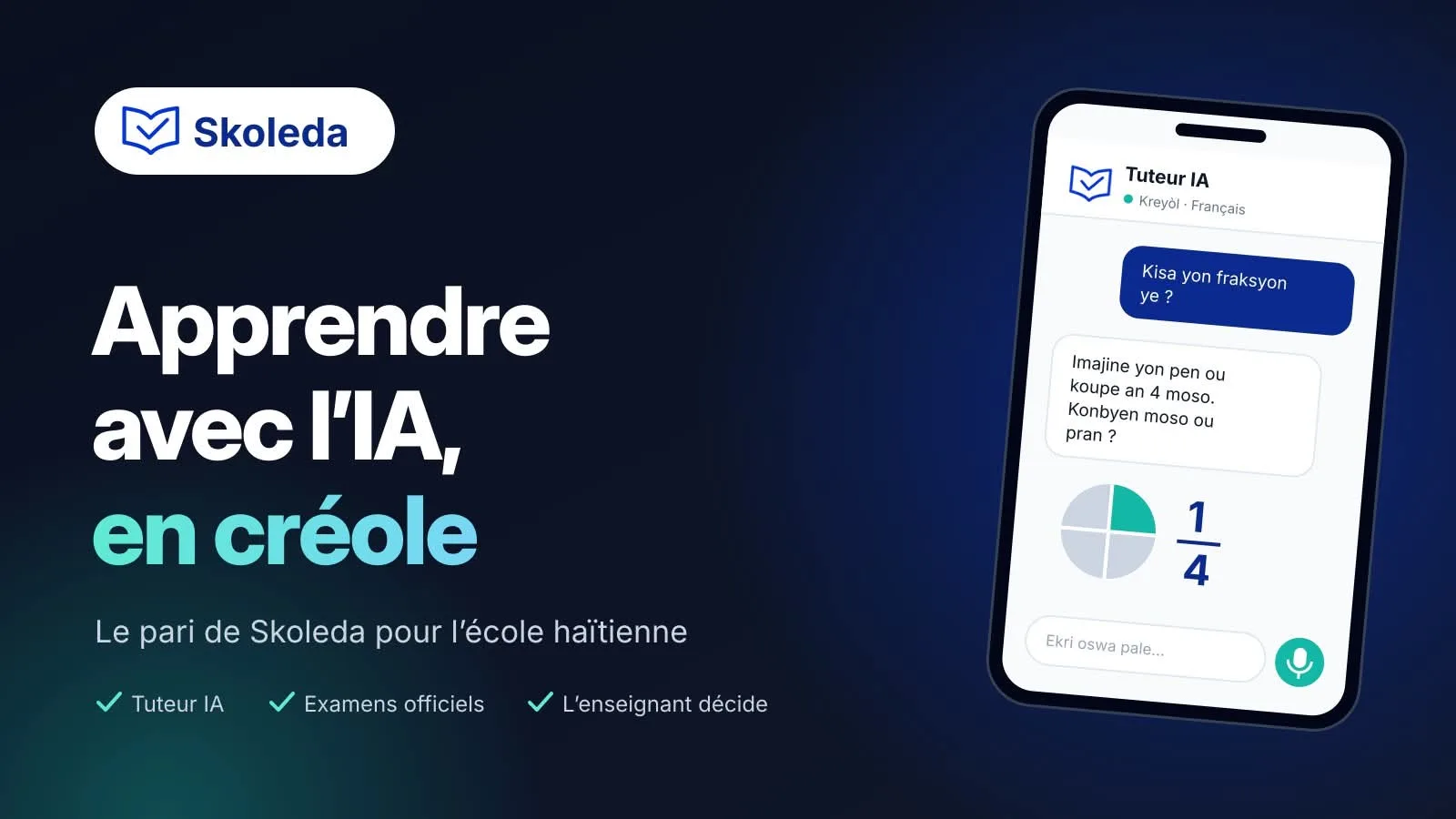
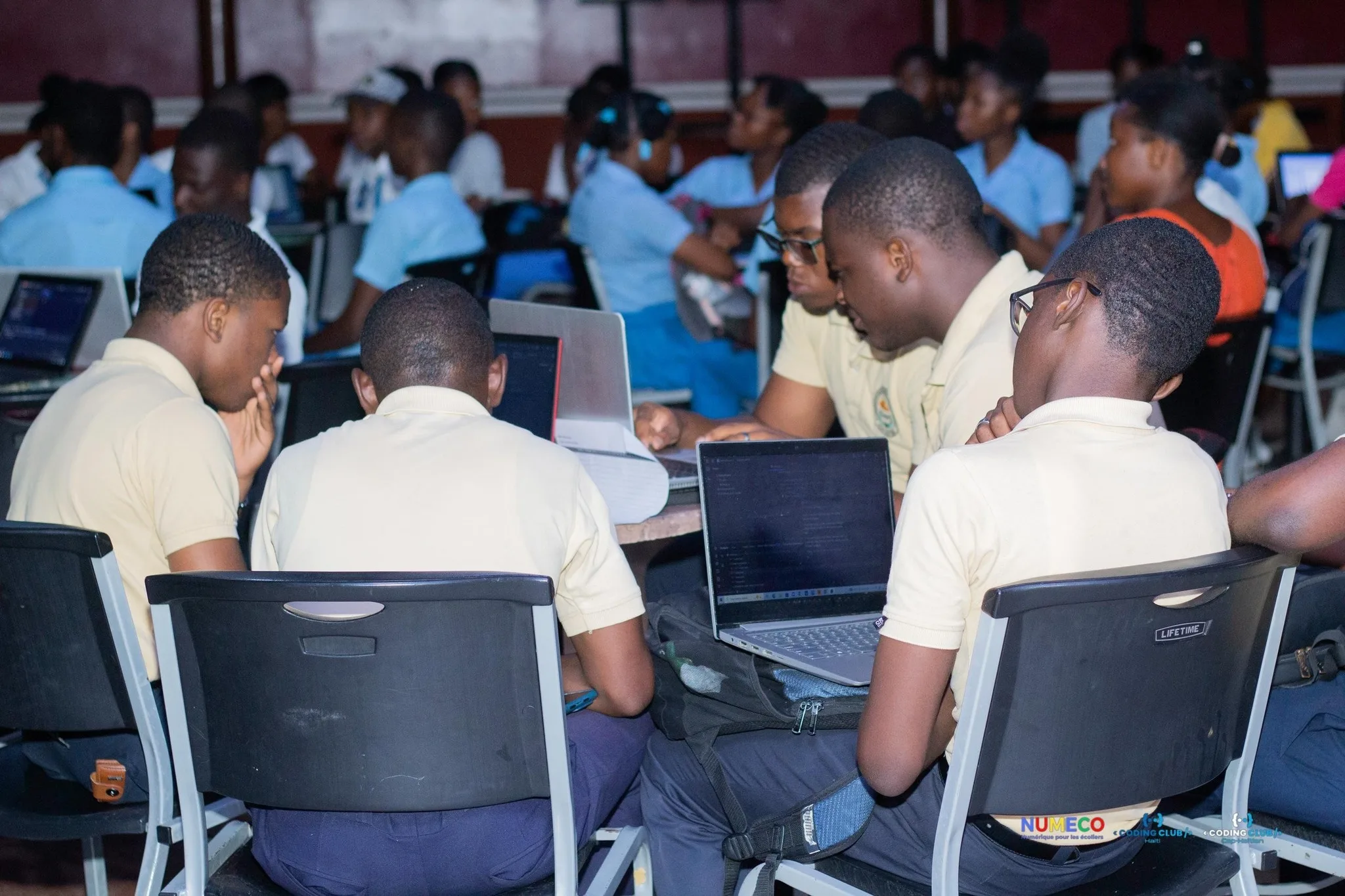
Skoleda does not simply add a generic chatbot to management software; instead, the AI is integrated into the life of the school, operating in the students’ own language and aligned with their curriculum. The platform is already in use in over a dozen Haitian schools, supporting more than 1,500 students, from preschool through higher education.
This approach is built upon four concrete applications:
- A tutor in Haitian Creole, available via text and voice. Accessible at any time, it can walk students through a concept step-by-step when the teacher is not present.
- Preparation for official examinations. A collection of past Haitian official exams allows students to practice using real test questions, complete with explanations.
- AI-assisted grading. The AI provides suggested corrections, while the teacher retains the final say. This process returns valuable time to teachersa benefit highlighted in international studies.
- "Le Média," a student blog. The AI evaluates each article (assessing writing quality, relevance, and originality) and flags suspicious content; the final decision to publish remains in human hands.
This AI is built upon a foundation that few mainstream tools possess: the structured data of the school itself. Grades, attendance, assignments, and report cards are already integrated into Skoleda, grounding AI within the school’s curriculum and daily operations, rather than providing responses detached from the specific educational context.
Access is designed to reflect the reality on the ground. A web browser is all that is neededwhether on a phone or a computerand families without an email address can access the system through a dedicated parent portal.
In this way, Skoleda joins a generation of Haitian initiativessuch as the HART’S Education & Innovation Network, featured in *Le Nouvelliste* in August 2026that aim to bring AI into the classroom. What sets Skoleda apart is its direct link to the day-to-day management of the school.
Responsible AI: The teacher decides; data remains at the school
Skoleda follows a simple principle: AI makes suggestions, but humans make the decisions. This aligns with the position held by UNESCO, which maintains that significant decisions regarding a student should not be entirely delegated to automated systems, and that the teacher must remain the architect of the learning process.
This principle is embedded in how the platform functions. Any grading suggested by the AI must be validated by the teacher, and no content is published on the platform without human approval.
Student data is protected by design. Each school’s data is siloed, access is determined by individual roles, and an audit log records sensitive operations. On the public-facing blog, students are identified by default only by their first name and the initial of their last name.
Furthermore, the inclusion of a tutor that operates in Creole, along with a repository of official Haitian exams, supports UNESCO’s call to value local languages and indigenous knowledge.
The implications extend well beyond Haiti. Very few countries have established legal frameworks for the protection of educational data, as highlighted in the UNESCO report, *AI and Education: Protecting the Rights of Learners*. In the absence of a binding legal framework, the protection of students depends primarily on the design choices made by developers.
Another safeguard is pedagogical: a good tutor encourages the student to seek out answers rather than simply providing them. In a trial conducted in Sierra Leone, approximately 76% of the tutor’s messages were questions, while only 2% were direct answers, according to a summary by the IZA. This is the model to follow to ensure that AI strengthens learning rather than fostering dependency.
Making AI an Opportunity for Every Haitian Student
Educational AI is currently under development; countries that do not participate will end up with tools designed elsewherein other languages and for different curricula. Haïti has the assets to take a different path: families who prioritize education above all else, a language shared across the entire country, and teams capable of building their own tools.
With Skoleda, Cybalgo offers a locally developed solution: an AI that speaks Creole, is familiar with official examinations, saves time for teachers, and ensures that schools retain control over their own data and decision-making.
To see these applications of AI in a real-world school setting, you can reach out to the Skoleda team at www.skoleda.com.
Sources
- Global survey of 45,000 finds universities losing the AI race with their own students, EdTech Innovation Hub, July 9, 2026 (Digital Education Council, AI in Higher Education Global Survey 2026: 45,398 respondents, 35 countries).
- Only 6% of teachers say their school’s AI policy is clear, The Next Web, September 14, 2026 (Education chapter of the Stanford AI Index).
- Three in 10 Teachers Use AI Weekly, Saving Six Weeks a Year, Gallup and Walton Family Foundation, June 2025.
- AI and education: Protecting the rights of learners, UNESCO, 2025.
- 8 Takeaways From UNESCO’s New White Paper: The Algorithm in the Room, Tech & Learning, 2026.
- Addressing the learning crisis with generative AI: lessons from Edo State in Nigeria, World Bank, June 25, 2025.
- Making AI Tutoring Work for Poorer Schools, Hai-Anh H. Dang and Minh N. N. Do, IZA Discussion Paper No. 19025, October 2026.
- Global Partnership for Education approves a grant for education reform in Haiti, World Bank, July 2021 (2020 Human Capital Index).
- Education under attack in Haiti, UNICEF Haiti, March 3, 2025.
- 79% of school children in Haïti do not have access to the Internet, HaïtiLibre, December 2, 2020 (UNICEF-ITU report).
- Lentz Wendy Civil Presents a Haitian Vision for Education in the AI Era, Le Nouvelliste, August 5, 2026.
- Information on Skoleda: Skoleda commercial dossier (Cybalgo, September 2026).