






Haïti Wonderland
Haïti Wonderland is a citizen-led and patriotic initiative aimed at radically transforming Haiti’s online image. Our country is full of spectacular landscapes, a rich history, an invaluable cultural heritage, and a resilient people. Yet, even a simple online search reveals a distorted, stigmatized, and unrealistic image.
Our goal
To create a positive, inspiring, and accurate image of Haïti on search engines through the massive production of web-optimized content (articles, photos, videos).
Our Initiative
Since December 2023, our team has launched a concrete project: the creation and dissemination of positive content about Haiti, carefully optimized for SEO, through our website: www.haitiwonderland.com
Restoring Haiti’s Well-Deserved Shine
We have set ourselves an ambitious mission:
- Create and widely distribute positive content (articles, videos, images) so that search engines finally reflect Haiti’s beauty and richness.
- Reach the top results on Google with images and stories that show Haïti in its best light.
- Inspire a new global perception of Haiti, highlighting its culture, beaches, mountains, and unique history.
How can this benefit Haiti?
Improved international image
Positioning positive and inspiring content at the top of search results helps counter negative stereotypes and showcase a country rich in culture, history, and natural beauty. A better global perception fosters renewed respect and interest in Haiti.
Attracting tourists and investors
When images and stories highlighting Haiti’s paradisiacal beaches, historical heritage, and vibrant festivals dominate searches, it attracts more tourists. Foreign visitors are more likely to explore a country whose image reflects safety, beauty, and hospitality. An increase in tourism generates significant revenue for the local economy and opens the door to investment opportunities.
National pride and Haitian mobilization
Seeing their country showcased on an international platform gives Haitians a sense of collective pride. This promotion strengthens national identity and motivates citizens to share their own positive experiences, thus amplifying the movement.
Other economic opportunities
Promotion of local products: By drawing attention to Haiti’s cultural and artisanal riches, this provides local producers with a showcase for exporting their products.
Job creation: Growth in tourism and increased interest in Haïti encourage the creation of new jobs in the travel, hospitality, restaurant, and retail sectors.
Terms and conditions
Welcome to our platform dedicated to the promotion of Haiti, the jewel of the Antilles. Our mission is to highlight the natural beauty, rich culture, fascinating history, delicious cuisine, heritage treasures, heavenly beaches and all the characteristics that make Haïti the pearl of the Antilles. We give you the opportunity to share your moments of happiness in Haïti by publishing images that pay tribute to this wonderful country.
Our Standards:
We only accept images related to Haiti, of good quality, not exceeding 3 MB, and which promote Haiti.
Image Sharing:
To share images from Haïti on our platform, you must create an account. Once registered, please only post images related to Haiti, highlighting its natural beauty, its rich culture, its fascinating history, its delicious cuisine, its heritage treasures, its heavenly beaches and all the characteristics that make it the pearl of Antilles.
We reserve the right to delete any image that does not honor Haïti on our platform at any time, or to block an account that does not meet our standards.
Sharing Businesses and Locations:
You also have the option to share images of your business, hotel, bar/restaurant, or other locations in our "Destination" section. This will make it easier for other people to find you on the Internet. When you share a location in our "Destination" section, we will analyze your post, then validate it if it meets our standards. Otherwise, your publication will be declined.
Responsibility for Images:
We are not responsible for any images shared by our users on our platform regarding image rights. Users are free to post whatever they want as long as it meets our standards.
Engage yourself :
Changing the perception of Haïti is a duty that falls to all of us. We invite you to get involved today. Create an account on our site, share beautiful images of Haïti so that the whole world can discover the beauty of this country. By joining forces, we can help transform Haïti into an essential destination, both online and in reality.
Join us on this exciting mission to celebrate Haïti in a new light. Together we can make a difference.
Privacy Policy
Welcome to our platform dedicated to the promotion of Haiti, a treasure of the Antilles. We are delighted that you want to share your love for this beautiful country by contributing to our community. In order to guarantee a respectful and secure environment for all our users, we have implemented a clear and transparent privacy policy. Please take the time to read the information below to understand how we manage your data and maintain our quality standards.
1. Types of Data Collected
We mainly collect images related to Haiti. To be accepted on our platform, these images must meet the following criteria:
- They must represent Haiti.
- They must be of good quality.
- They must not exceed a size of 3 MB.
- They must highlight Haiti, whether it is its natural beauty, its rich culture, its fascinating history, its delicious cuisine, its heritage treasures, its heavenly beaches, or all the characteristics that make it the pearl of the Antilles.
2. Account Creation and Image Sharing
To share images from Haïti on our platform, you must create an account. When you create your account, we collect information such as your name, email address, and phone number. This information is used only to communicate with you and will not be shared with any other parties. Only your name will be displayed on posts you share on our platform. We will not use your information for advertising purposes outside of our site.
3. Quality Standards and Right of Deletion
We reserve the right to remove any images that do not honor Haïti on our platform at any time. Additionally, we may block an account that does not meet our quality standards. We encourage our users to contribute positively to the promotion of Haiti.
4. Sharing Commercial Content
You also have the option to share images related to your business, hotel, bar/restaurant, or other establishments in our "Destination" section. We will review your post and validate it if it meets our standards. If your publication does not meet these criteria, it will be declined.
5. Responsibility for Image Rights
We are not responsible for any images shared by our users regarding copyright and intellectual property rights. Users are free to post whatever they want, as long as it meets our quality standards.
Changing the perception of Haïti is a duty that falls to all of us. We invite you to get involved today. Create an account on our site, share beautiful images of Haïti so that the whole world can discover the beauty of this country. By joining forces, we can help transform Haïti into an essential destination, both online and in reality.
Join us on this exciting mission to celebrate Haïti in a new light. Together we can make a difference.
History
First black nation to free itself from slavery and gain independence from France in 1804 and influenced other liberation movements around the world, inspiring struggles for freedom and equality.
Natural beauty
Haïti is blessed with spectacular natural landscapes, including white sand beaches, mountains and rich biodiversity.
Heritage
Haïti has a rich historical heritage, including sites like the Citadelle Laferrière and the Sans-Souci Palace, listed as UNESCO World Heritage Sites.
Culture
Haïti has a rich and diverse culture, influenced by African, European and indigenous elements. Haitian music, dance, art and cuisine are celebrated around the world.
Haitian cuisine
Haitian cuisine is appreciated for its unique flavors and traditional dishes such as griot, tassot, diri ak djon-djon, and vegetables in sauce.
Haiti: The Epic of Freedom and Independence
Haiti, the pearl of the Antilles, is a fascinating destination that combines spectacular natural beauty with a rich and complex history. Nestled in the Caribbean Sea, this island nation is a well-kept treasure, offering visitors a unique blend of magnificent landscapes, vibrant culture and historical heritage.
The Natural Beauty of Haiti
Haïti is a nature lover’s paradise, offering a variety of breathtaking landscapes. Among its natural treasures are white sand beaches lined with palm trees, majestic mountains, hidden jungle waterfalls, colorful coral reefs and lush forests. The beaches of Labadee, Jacmel and Île-à-Vache are particularly renowned for their beauty.
The mountains of Haïti are also a breathtaking sight. The Selle Massif, home to La Selle Peak, is the highest peak in the Caribbean, offering breathtaking panoramic views. The Massif de la Hotte mountain range is home to exceptional biodiversity, with many endemic species of plants and animals.
Haiti’s natural beauty also extends underwater. Dives around Turtle Island and Cow Island allow you to explore unspoilt coral reefs, home to colorful marine wildlife including tropical fish, sea turtles and manta rays.
History of Haiti: A Story of Independence and Resilience
Haiti’s history is deeply rooted in the struggle for independence and resilience of the Haitian people. Before becoming the world’s first independent black republic in 1804, Haïti was a prosperous French colony, dependent on slavery for its sugar and coffee production. This quest for freedom was led by emblematic figures like Toussaint Louverture and Jean-Jacques Dessalines.
However, this struggle for independence left deep scars, with lasting consequences for the country. Haïti had to pay an exorbitant debt to France in exchange for international recognition, leading to economic instability.
Haiti’s history is also marked by its rich cultural heritage. Vodou, an Afro-Haitian religion, is an integral part of Haitian culture, blending elements of ancient African beliefs with Catholicism. Haitian arts, dance, music and cuisine are also a reflection of this diverse and dynamic culture.
When you explore Haiti, you will be amazed by the diversity of its landscapes and inspired by the history and culture of the Haitian people. It is a country that deserves to be discovered, celebrated and preserved for future generations. Haïti is truly a jewel of the Caribbean, where natural beauty and history combine to create an unforgettable experience.
Account deletion
We understand that you have made the decision to delete your account and we are sorry to see you go. Before proceeding with permanent deletion, we would like to offer you the opportunity to resolve any issues or concerns you may have encountered with our platform.
Your satisfaction as a user is our top priority and we are ready to work with you to resolve any issues you may encounter. If you experience any technical difficulties, usability issues, or concerns of any kind, please contact us at the following email address: deleteaccount@haitiwonderland.com via the email you provided during creation of your account. Our team will be happy to help you and answer all your questions.
However, if you are confident in your decision to delete your account, please send us an email to the address above indicating the reason for your choice. We will then contact you to confirm your request and complete an authentication process to ensure that you are the account holder. Once this step is completed, all data associated with your account will be securely deleted and no information will be retained.
We would like to thank you for being part of our community and we hope to have the opportunity to serve you again in the future. If you have any additional questions or comments, please do not hesitate to contact us.
Sincerely.
Terms of Use and Image License
Welcome to our image bank dedicated to Haiti.
All images accessible via the following link: https://haitiwonderland.com/haiti-image-bank are made available free of charge for personal or professional use, subject to compliance with the conditions below.
License to Use
You are free to download, use, and share the images, provided you comply with the following rules:
Mandatory Credit
Any use, distribution, or publication of an image must include the photo credit.
Credit to be provided: Photographer’s Name / Haïti Wonderland
Permitted Uses
Images may be used for personal, educational, editorial, or commercial purposes without restriction.
Modifications permitted
You may modify or adapt the images as needed, provided you always include the photo credit.
Prohibitions
- It is prohibited to resell the images in their original form.
- It is prohibited to use the images in any illegal, offensive, or defamatory context.
How to include credit?
Here are some examples of best practices for including credit:
- On a website: below the image or at the bottom of the page
- On social media: in the description or comments
- In a printed document: in the caption or acknowledgments
Contact
For any questions regarding the use of images or for any specific requests, please contact us at the following address:
contact@haitiwonderland.com
Please respect these conditions to support the work of the authors and contribute to the promotion of Haitian culture throughout the world.
Haïti : Royal Decameron
The Royal Decameron Indigo Beach Resort & Spa is a hotel complex located in Haiti, on the north coast, in Montrouis. It is a popular destination for travelers looking for relaxation, sun and sandy beaches.
The Royal Decameron Indigo Beach Resort & Spa is an all-inclusive property that offers a wide range of services and activities for guests. Here you will find comfortable rooms, several restaurants serving a variety of cuisines, swimming pools, water sports facilities, evening entertainment and much more.
The resort’s coastal location allows visitors to enjoy the Caribbean Sea, whether swimming, snorkeling, or relaxing on the beach. Travelers can also explore the surrounding area, visit the town of Montrouis or go on an excursion to discover Haitian culture and its attractions.
Haïti : Kenscoff et Furcy
Kenscoff and Furcy are two communes located in Haiti, in the West department, on the outskirts of the capital Port-au-Prince. Here is some information about these two places:
1. Kenscoff:
- Kenscoff is a mountain commune located about 10 kilometers south of Port-au-Prince. It is known for its cool climate due to its altitude, making it a popular destination to escape the heat of the capital.
- The Kenscoff region is also renowned for its agricultural operations, particularly the cultivation of vegetables and flowers. The fertile soil and favorable climate make it an important place of agricultural production for the region.
- Kenscoff also offers beautiful panoramic views of the surrounding mountains and the Caribbean Sea.
2. Furcy:
- Furcy is a small town located near Kenscoff, in the mountains of western Haiti. It is a place even higher in altitude than Kenscoff, thus offering cooler temperatures.
- The Furcy region is also known for its natural beauty and mountainous landscapes. It is a favorite place for hiking and ecotourism, offering plenty of opportunities to explore the surrounding nature.
- Many visitors to Port-au-Prince travel to Furcy to escape the heat of the city and enjoy the fresh air and scenic views.
These two mountain communes are popular destinations for those looking to escape the heat and hustle and bustle of the Haitian capital, while enjoying the area’s natural beauty and learning about local agriculture.
Haïti : Parc National Macaya
Macaya National Park is a national park located in Haiti, on the Tiburon Peninsula, on the western tip of the island. It is one of the largest and most biodiverse national parks in the country. The park takes its name from Macaya Mountain, which is the highest mountain on the peninsula and rises to approximately 2,347 meters above sea level.
Macaya National Park is famous for its rich biological diversity, home to many plant and animal species endemic to Haiti. The park encompasses diverse ecosystems, including montane forests, cloud forests, rivers, waterfalls and karst formations. It is of great importance for the conservation of Haitian flora and fauna, some of these species being threatened with extinction.
Haïti : Les Cayemites
The Cayemites are a group of islands located in Haiti, in the Caribbean Sea. They are located west of the Tiburon Peninsula, near the southwest coast of Haiti. The Cayemites archipelago is made up of two main islands, Grande Cayemite Island (or Grande Cayemites) and Petite Cayemite Island (or Petite Cayemites), as well as a few smaller islets.
These islands are relatively small and sparsely populated, but they are known for their natural beauty, white sand beaches and crystal clear waters. The place is popular for diving, fishing and other sea-related activities.
Haïti : Cathédrale de Milot
Milot Cathedral, also known as Saint-Jacques Cathedral, is a historic church located in Milot, a small town in the Nord department, Haiti. This cathedral is a remarkable example of French colonial architecture and was built in the early 19th century, during the period of French colonization of the island of Santo Domingo, which is now Haiti.
Milot Cathedral is famous for its neo-Gothic architecture, with pointed arches, colorful stained glass windows and elaborate architectural features. The interior of the cathedral is equally impressive, with magnificent wooden carvings and an ornate altar.
Milot Cathedral is a popular tourist site in Haïti due to its historical and architectural significance. It is part of the site of the Palais Sans-Souci, another historic monument located nearby, and was declared a UNESCO World Heritage Site in 1982.
Haïti : Héros de Vertières
The Heroes of Vertières are emblematic figures in the history of Haïti because of their role in the fight for the country’s independence. Their most famous action was the Battle of Vertières, which took place on November 18, 1803. It was during this battle that Haitian forces, under the command of General Jean-Jacques Dessalines, managed to defeat French troops. , thus marking the end of the French colonial yoke and the proclamation of the independence of Haïti on January 1, 1804.
The Heroes of Vertières, of which Dessalines is one of the most important figures, are widely honored in Haïti for their role in the fight for independence and the creation of the first independent black republic in the world. Their status is celebrated every year on November 18 in Haïti during Vertières Heroes Day. This day commemorates the victory at Vertières and pays tribute to historical figures who played a crucial role in the liberation of Haiti.
Haïti : Gelée
Gelée Beach, located in the south of Haiti, in the town of Les Cayes, is a real treasure for lovers of seaside destinations. This place, beloved by locals and the Haitian diaspora, is a public place of exceptional interest. Every year, thousands of visitors flock to its shores to enjoy its natural beauty and the festive atmosphere that reigns there.
Gelée beach is much more than just a stretch of sand and water. It is a place to gather, relax and celebrate. Throughout the summer seasons, it transforms into a place of festivities where people come to have fun and recharge their batteries. Among the significant events that take place there, the Feast of Notre-Dame stands out for its scale, attracting tens of thousands of visitors each year.
What makes Jelly Beach so special is its unique combination of attractive features. Its picturesque landscape is a true gem, offering breathtaking views of the Caribbean Sea.
Additionally, Gelée Beach is home to a bustling commercial heart, where one can find a variety of local products, delicious foods, and Haitian crafts. It’s the perfect place to taste authentic local flavors and buy unique souvenirs.
Haïti : Île à Rat
Ile-à-Rat, a gem off the northern coast of Haiti, where adventure and tranquility meet in perfect balance. This small island offers an ideal getaway for lovers of scuba diving, with its turquoise waters hiding treasures from the past.
Maritime history enthusiasts will be delighted to discover the submerged remains of old cannons and cannonballs resting silently at the bottom of the sea. Each dive thus becomes a fascinating exploration through time, offering an insight into the mysteries and stories that have forged this region.
On the beach, the charm of the island does not stop. Local fishermen will welcome you with their warm hospitality, offering fresh grilled fish. Imagine tasting this local delicacy, tasty and fragrant, served on a leaf from the trees that shade the island. It is an authentic culinary experience, evoking the unique taste of the sea and the refined simplicity of island life.
Ile-à-Rat is much more than a destination for lovers of diving and local cuisine. It is a romantic refuge, a place where one can escape from the daily hustle and bustle and lose oneself in the natural beauty that surrounds it. Spectacular sunsets, calming sea breezes and lapping waves create the perfect backdrop for an unforgettable romantic getaway.
Whether you are drawn to underwater mysteries, authentic local cuisine or simply the serenity of nature, Ile-à-Rat offers a unique experience that captures the hearts of those lucky enough to discover it. It’s a place where time seems to slow down, allowing visitors to reconnect with the simple, timeless beauty of island life.
Haïti : Pointe Sable
Pointe Sable is a coastal region in Haïti that is characterized by beautiful sandy beaches and clear waters. It is a popular location for tourism due to its stunning natural scenery.
The southern coast of Haïti is renowned for its beaches, and Pointe Sable is one of the top destinations for those looking to enjoy the sea, sun and water activities. It is located near the town of Les Cayes, which is an important town in the region.
Haïti : MUPANAH
The MUPANAH, or Haitian National Pantheon Museum, is a museum located in Haiti, more precisely in Port-au-Prince. This museum is dedicated to the history and culture of Haiti, and it plays a vital role in preserving the country’s cultural heritage.
MUPANAH houses an extensive collection of objects, documents, and artifacts relating to Haiti’s history, including works of art, manuscripts, ancient weapons, Voodoo ceremonial objects, and much more. The museum aims to trace the country’s history since its struggle for independence, highlighting key personalities and events that shaped the Haitian nation.
This museum is an important venue for education and the preservation of Haiti’s cultural identity, and it attracts visitors from around the world interested in the history and culture of this Caribbean country. MUPANAH also plays a significant role in promoting national pride and unity in Haïti by celebrating the nation’s achievements and recalling the courage and determination of its people during the struggle for independence, which led to the birth of Haïti as the first independent state in Latin America.
Haïti : Fort Jacques
Fort Jacques, also known as Fort Jacques Dessalines, is an ancient fortification located in Haiti. It lies in the hills east of the capital, Port-au-Prince. The fort is important for its role in Haitian history, particularly during the Haitian Revolution and the struggle for independence from French colonial rule.
The fort is named for Jean-Jacques Dessalines, a key figure in the Haitian Revolution and the first leader of independent Haiti. It was at Fort Jacques that Dessalines, alongside other revolutionary leaders such as Alexandre Pétion and Henri Christophe, strategized and launched military operations against the French and their local allies.
Today, Fort Jacques is a historic site and a popular tourist destination. Visitors can explore the well-preserved fortifications, including stone walls, cannons and other remnants of the past. The site offers panoramic views of the surrounding countryside and the city below, making it a picturesque location for both history buffs and those interested in Haiti’s natural beauty. It is also a place to reflect on the importance of the Haitian Revolution and the country’s struggle for freedom and independence.
Haïti : Parc Historique de la Canne à Sucre
The Sugar Cane Historical Park (PHCS) is a tourist site located in Haiti. It is located in the town of Tabarre, near the capital Port-au-Prince. The park aims to preserve and highlight the history and culture of sugar cane in Haiti, as well as the importance of this crop for the country’s economy.
The site includes sugar plantations, historic sugar mills, museums and interactive exhibits.
In addition to its historical aspect, the Canne à Sucre Historical Park also offers cultural activities, craft demonstrations, traditional Haitian shows, and restaurants serving local dishes. It is a place that allows visitors to better understand the history of agriculture and the sugar industry in Haiti, as well as the importance of these traditions to Haitian culture.
Haïti : Jardin botanique des Cayes
The Jardin Botanique des Cayes, located in Haiti, is one of the country’s botanical gardens. It is located in the town of Les Cayes. This botanical garden is a place dedicated to the preservation and presentation of local flora, as well as raising public awareness of the importance of biodiversity conservation.
It also serves as research and education centers, as well as places for visitors to relax and walk, showcasing a variety of native and exotic plants and plays a key role in endangered species preservation and research. on botany.
Haïti : Grotte Marie-Jeanne
Grotte Marie-Jeanne is one of many caves located in Haiti. It is located in the Sud-Est department, near the town of Belle-Anse, on the southern peninsula of the island of Hispaniola, where Haïti is located. This cave is famous for its stalactite and stalagmite formations, as well as its natural beauty.
The Marie-Jeanne cave is also culturally and historically important. It played a significant role in the Haitian Revolution which resulted in Haiti’s independence in 1804. It is said that the cave served as a refuge for rebel slaves led by General Jean-Jacques Dessalines. This cave has become a symbol of the struggle for freedom and is often visited by tourists and Haitians to commemorate this history.
Haïti : Saut-Mathurine
Saut-Mathurine is a beautiful waterfall located in Haiti. It is located near the town of Les Cayes, in the Southern Peninsula. This waterfall is one of the most famous natural attractions in the country.
Saut-Mathurine is known for its spectacular waterfall which falls from a considerable height into a natural swimming pool surrounded by lush vegetation. The place is a popular relaxation spot for locals and visitors looking for some freshness and natural beauty. Visitors can swim in the pool, picnic nearby, or simply enjoy the view of the waterfall.
The waterfall is located in a mountainous region, providing a stark contrast to the sandy beaches that Haïti is also famous for. It is a fine example of the natural wonders that this Caribbean country has to offer nature lovers and adventurers.
Haïti : Île-à-Vache
Île-à-Vache is a small island located off the southwest coast of Haïti in the Caribbean Sea. It is part of the South Department of Haïti and is known for its picturesque landscapes, white sand beaches and relatively unspoilt natural beauty. The island has historically been a popular destination for tourists seeking an escape from the hustle and bustle of Haiti’s more populated and developed regions.
Île-à-Vache is characterized by its peaceful and unspoiled environment, making it a popular location for ecotourism and for those seeking a more peaceful vacation experience. The island is renowned for its pristine beaches, clear waters and vibrant coral reefs, making it an ideal place for snorkeling and scuba diving.
The island has undergone some development efforts to attract tourists, including the construction of small hotels and resorts, but it has retained much of its traditional, laid-back atmosphere.
Haïti : Bassin Bleu
Bassin Bleu is a popular tourist destination in Haiti, located in the Jacmel region, in the Sud-Est department. It is a set of three natural pools of blue water surrounded by lush vegetation and spectacular rock formations. These pools get their name from the deep blue color of the water.
Bassin Bleu’s three pools are fed by streams and waterfalls that create a refreshing and picturesque experience. Visitors can swim in natural pools, jump from rocks into the water, or simply enjoy the natural beauty of the place. Adventurous travelers can also hike to reach Bassin Bleu, which adds an extra dimension to the experience.
Haïti : Côte des Arcadins
The Côte des Arcadins is a tourist destination in Haiti, located on the west coast of the country, along the Gulf of Gonâve, about an hour’s drive from the capital, Port-au-Prince. This coastal region is known for its white sand beaches, turquoise waters, and tropical climate, making it a popular destination for visitors looking for sun, sea, and relaxation.
The Côte des Arcadins offers a variety of accommodation options, including resorts, private villas and hostels. Many establishments offer water activities, such as scuba diving, kayaking, sailing, and fishing. It is a popular location for weddings and special events because of its picturesque setting.
In addition to its seaside attractions, the Côte des Arcadins region allows visitors to discover Haitian culture through its cuisine, music and local festivals. It is recommended to try Haitian cuisine, which is influenced by African, Creole and French traditions. Music and dance are also central to Haitian culture, and you can enjoy performances of kompa music and other local styles.
Haïti : Labadee
Labadee is a private resort located on the northern coast of Haiti. It is a scenic destination owned by the cruise line Royal Caribbean International and is used exclusively by their cruise ships. Labadee offers visitors a beautiful tropical setting with stunning beaches, lush vegetation and a range of activities and amenities.
Here are some of the things you can enjoy in Labadee:
Beaches: Labadee offers several beautiful beaches where you can relax and soak up the sun. These beaches are famous for their clear waters and peaceful environment.
Water Sports: Visitors can indulge in various water activities such as snorkeling, jet skiing, and kayaking. The area’s warm waters make it an excellent place for aquatic adventures.
Zipline: One of the most popular attractions in Labadee is the Dragon’s Breath Zipline, one of the longest ziplines over water in the world. It offers breathtaking views of the surrounding landscape.
Water Park: There is a water park with floating water slides and play areas for children and adults. This is a fun option for families.
Cultural Experiences: Labadee offers opportunities to explore Haiti’s local culture and art, with artisans and merchants selling their handcrafted goods.
Private Cabanas: If you’re looking for a more exclusive and relaxing experience, Labadee offers private cabanas for rent. These cabanas offer various amenities, including a personal butler.
Lunch: Royal Caribbean offers a buffet-style lunch for visitors, which is included in the cruise package.
Haïti : Palais Sans Souci
The Sans Souci Palace is a former palace located in Haiti, near the town of Milot in the north of the country. It was built at the beginning of the 19th century during the reign of King Henry I (Henri Christophe).
The Sans Souci Palace was the royal palace of Henry I and was designed to rival European palaces of the time in terms of grandeur and architectural sophistication. It was surrounded by beautiful gardens and fountains, making it a luxurious place to reside. The name “Sans Souci” means “Without Worries” in French, which reflects the carefree and opulent ambiance of the place.
Unfortunately, the Sans Souci Palace was heavily damaged by an earthquake in 1842 and was never restored. Today, its ruins remain as a historical and tourist site. In 1982, the Sans Souci Palace was declared a UNESCO World Heritage Site, in recognition of its historical and architectural importance.
Visitors can explore the palace ruins and learn about the history of this period in Haiti’s history, as well as the life of King Henry I. The site also offers panoramic views of the surrounding countryside. The Palais Sans Souci is often visited in conjunction with the Citadelle Laferrière, an impressive fortress located nearby, which was also built by Henry I to defend the kingdom against foreign attacks.
Haïti : Citadelle la Ferrière
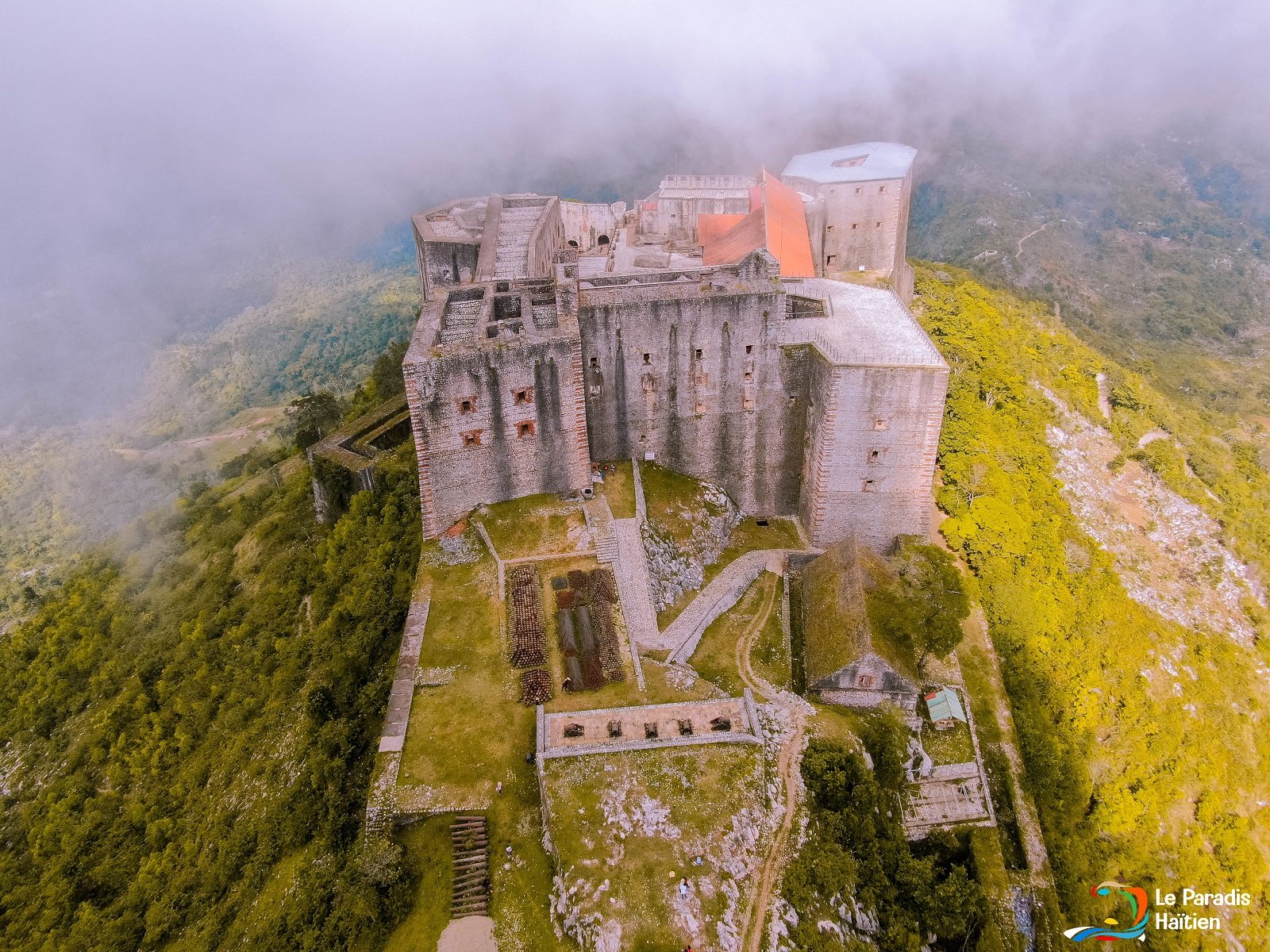
Citadelle La Ferrière, also known as Citadelle Henry, is one of Haiti’s most iconic structures. It is located in the mountains in the north of the country, near the town of Milot. The Citadel was built in the early 19th century during the reign of Henri Christophe, a former slave who became an important military and political leader after the Haitian Revolution, which resulted in Haiti’s independence in 1804.
The Citadelle La Ferrière was built to serve as a military fortification and refuge in the event of foreign invasion. It is a massive structure, with thick walls, cannons and watchtowers. The Citadel is perched on a mountain, making it a strategic location for defense.
The architecture of the Citadel is impressive, and it is a UNESCO World Heritage Site due to its historical importance and unique architecture. Visitors today can explore the Citadel and enjoy panoramic views of the surrounding countryside. It is one of the most popular tourist attractions in Haiti, offering visitors a glimpse into the nation’s fascinating history and cultural heritage.
Haïti
Haiti, the pearl of the Antilles, is a fascinating destination that combines spectacular natural beauty with a rich and complex history. Nestled in the Caribbean Sea, this island nation is a well-kept treasure, offering visitors a unique blend of magnificent landscapes, vibrant culture and historical heritage.
The Natural Beauty of Haiti
Haïti is a nature lover’s paradise, offering a variety of breathtaking landscapes. Among its natural treasures are white sand beaches lined with palm trees, majestic mountains, hidden jungle waterfalls, colorful coral reefs and lush forests. The beaches of Labadee, Jacmel and Île-à-Vache are particularly renowned for their beauty.
The mountains of Haïti are also a breathtaking sight. The Selle Massif, home to La Selle Peak, is the highest peak in the Caribbean, offering breathtaking panoramic views. The Massif de la Hotte mountain range is home to exceptional biodiversity, with many endemic species of plants and animals.
Haiti’s natural beauty also extends underwater. Dives around Turtle Island and Cow Island allow you to explore unspoilt coral reefs, home to colorful marine wildlife including tropical fish, sea turtles and manta rays.
History of Haiti: A Story of Independence and Resilience
Haiti’s history is deeply rooted in the struggle for independence and resilience of the Haitian people. Before becoming the world’s first independent black republic in 1804, Haïti was a prosperous French colony, dependent on slavery for its sugar and coffee production. This quest for freedom was led by emblematic figures like Toussaint Louverture and Jean-Jacques Dessalines.
However, this struggle for independence left deep scars, with lasting consequences for the country. Haïti had to pay an exorbitant debt to France in exchange for international recognition, leading to economic instability.
Haiti’s history is also marked by its rich cultural heritage. Vodou, an Afro-Haitian religion, is an integral part of Haitian culture, blending elements of ancient African beliefs with Catholicism. Haitian arts, dance, music and cuisine are also a reflection of this diverse and dynamic culture.
When you explore Haiti, you will be amazed by the diversity of its landscapes and inspired by the history and culture of the Haitian people. It is a country that deserves to be discovered, celebrated and preserved for future generations. Haïti is truly a jewel of the Caribbean, where natural beauty and history combine to create an unforgettable experience.
Haïti : Chic Chateau
Chic Chateau, located at 10 Rue Petavi, Cayes-de-Jacmel 9130, Haiti, is a retreat of private elegance with rustic charm, nestled in the heart of a breathtaking landscape with breathtaking sea views. is a little corner of paradise where you can relax and recharge your batteries in a sumptuous setting.
At Chic Chateau, the combination of elegance, comfort and nature promises you an exceptional stay. Whether you are looking for relaxation, adventure or cultural discovery, Chic Chateau offers a unique experience for all travelers seeking serenity and beauty by the sea.
Haïti : Manoir Adriana
Located in Jacmel, the Manoir Adriana Hotel is an exceptional address that offers its guests a memorable experience. the property welcomes you with a beautiful garden, free private parking for your convenience, a shared lounge for moments of relaxation, a charming terrace to enjoy the fresh Caribbean air, attentive room service, an open front desk 24 hours a day to meet all your needs, as well as free Wi-Fi throughout its premises.
The Manoir Adriana Hotel is much more than just a place to stay. It is a haven of tranquility where you can recharge your batteries and immerse yourself in Jacmel.
Haïti : Hotel Cyvadier
Located on the edge of the magnificent sea of Jacmel, the Hotel Restaurant Cyvadier Plage offers 3-star accommodation, promising its visitors a memorable getaway. Nestled in the middle of a tropical oasis, the property welcomes you with a refreshing outdoor swimming pool, a lush garden and a shared lounge for convivial relaxation. In addition, a large sunny terrace, a welcoming bar, and a heavenly private beach are at your disposal to make your stay unforgettable. There is also a restaurant offering delicious American cuisine, as well as free private parking for your convenience.
Haïti : Hotel Florita
Listed as a historic monument by UNESCO and the World Monument Foundation, Hôtel Florita is a treasure located in the heart of Jacmel, a pearl of Haiti, just one block from the magnificent seaside promenade. This iconic establishment charms its visitors with captivating architecture, a refreshing outdoor pool and a sunny terrace complete with a quaint bar.
The rooms at Hotel Florita are a true ode to Haitian history and culture, displaying elegant decoration inspired by the plantation theme. You’ll be greeted by exquisite wooden furniture, mosquito nets that add a touch of romance, and four-poster beds adorned with soft cotton sheets and plush feather pillows.
The Florita Hotel is much more than just a place to stay. It is an open door to the history, culture and beauty of Jacmel, Haiti.
Haïti : Rollanda Hotel
The “Rollanda Hotel” is the ideal place. This property offers an excellent space for relaxation and comfort, including an outdoor swimming pool, free Wi-Fi, a conference room and facilities for all your events. Whether you are traveling for business or looking for leisure, the hotel will meet all your needs to make your stay memorable.
Haïti : Cap Deli
Cap Deli is one of the best restaurants in the town of Cap Haïtien. If you are passing through the city, you will find a well-ventilated space, quality service provided by attentive staff, excellent cuisine and tasty cocktails. Additionally, the restaurant offers a free delivery service to central Cape Town. You can enjoy homemade hamburgers and gourmet salads in a recently decorated setting, and enjoy the most pleasant service.
Haïti : Cormier
Located just 3.8 km from the majestic Notre-Dame Cathedral of Cap Haïtien, one of the most famous monuments in the region, Cormier Plage is much more than just a beachside hotel-restaurant, it is a real tourist destination. Through Cormier, you can enjoy an unforgettable experience that combines culture, outdoor adventure and gastronomic delights.
Cormier Plage is much more than a beach hotel and restaurant, it is a complete destination for travelers looking for authenticity, adventure, relaxation and cultural discoveries. Join us for a unique experience in Cap-Haïtien.
Haïti : Campus Henry-Christophe de Limonade (CHCL)
The Campus Henry-Christophe de Limonade (CHCL), located in northern Haiti, is a higher education institution that honors Henri Christophe, a key figure in the country’s independence. It is closely linked to the Université Roi Henri Christophe (URHC), a renowned public university.
CHCL offers a wide range of academic programs covering various fields of study, including social sciences, natural sciences, health sciences, humanities, computer sciences, and many others. Like many other higher education establishments, its mission is to provide quality education to its students and to contribute to the development of Haitian society. CHCL is committed to training the next generation of professionals and leaders while fostering the growth and evolution of the nation.
The legacy of Henri Christophe, as a historical figure of capital importance in the history of Haiti, gives the Henry-Christophe de Limonade Campus a special meaning, recalling the importance of education and knowledge for the progress of the nation. CHCL remains a pillar of higher education in the region, providing essential learning and research opportunities for Haitian students.
Haïti : Moulin Sur Mer
Moulin Sur Mer, also known as Moulin sur Mer Beach Resort, is a popular tourist destination in Haiti. It is located on the Côte des Arcadins, a beautiful stretch of coastline along the Gulf of Gonâve. The complex is located approximately 45 kilometers north of the capital, Port-au-Prince.
Moulin Sur Mer is renowned for its picturesque setting, with palm-fringed beaches, turquoise waters and lush tropical vegetation. The resort occupies the grounds of a former sugar plantation and houses a historic colonial mansion, which adds a touch of charm to the property.
Visitors to Moulin Sur Mer can enjoy a range of activities including swimming, snorkelling, kayaking and beach volleyball. The resort also has a swimming pool for guests to relax in. Additionally, walking tours are available for those wishing to explore the historical aspects of the property.
The resort offers accommodation in the form of bungalows, hotel rooms and suites. It caters to both tourists and locals looking for a quiet seaside escape. The combination of natural beauty, historic ambiance and recreational activities makes Moulin Sur Mer a popular choice for those looking for a beachside retreat in Haiti.
Haïti : cascade Saut d’Eau
The Saut d’Eau waterfall is an important natural and cultural site located in Haiti. It is renowned for its picturesque beauty and is also a place of religious pilgrimage.
Natural Environment:
The waterfall itself is surrounded by lush vegetation, creating a spectacular natural setting. The area also offers opportunities for hiking and nature exploration.
Cultural Aspect:
The site is associated with Voodoo religious beliefs. Every year in July, thousands of pilgrims go to the waterfall to participate in ceremonies dedicated to the Virgin Mary, in particular to Our Lady of Mount Carmel. It is part of a tradition that combines elements of voodoo with Catholic rituals.
Annual Pilgrimage:
The pilgrimage to the Saut d’Eau waterfall reaches its peak on July 16. Participants believe in the purifying power of the waterfall water and perform bathing rituals to gain spiritual blessings and healings.
The Saut d’Eau waterfall thus represents a unique blend of natural beauty, cultural tradition and religious spirituality.
Haïti : Anse d’Azur
Anse d’Azur, formerly called Anse à Cochons, emerges like a tropical pearl along the Haitian coast, just a few kilometers from the charming town of Jérémie. This enchanting beach, lined with fine sand, is a hidden treasure that offers a heavenly escape to visitors eager for authentic discoveries.
This exceptional coastline takes its name from its bright blue waters, creating a stunning visual palette, reminiscent of the azure color of the cloudless sky. Nestled in a deep and wide cove, Anse d’Azur seduces nature lovers and relaxation enthusiasts with its preserved natural beauty. The crystal clear, transparent water invites travelers to dive into its refreshing depths, creating an unforgettable sensory experience.
L’Anse d’Azur is much more than just a beach; it is an ecosystem rich in biodiversity. Curious visitors will have the opportunity to discover a variety of colorful marine life and marvel at the diversity of species that inhabit the nearby coral reefs. Scuba diving enthusiasts will find here an aquatic paradise, where each dive reveals new underwater treasures.
The gentle sea breeze and the murmur of the waves complete this sensory experience, creating an atmosphere of total relaxation. L’Anse d’Azur is emerging as a destination where you can recharge your batteries in symbiosis with nature, far from the daily hustle and bustle.
Whether one is looking for moments of serenity, thrilling underwater adventures or simply an exotic getaway, Anse d’Azur provides the perfect backdrop for an unforgettable tourist experience. Come lose yourself in the natural beauty of this magical place, where every grain of sand and every wave tells you a captivating story of Anse d’Azur.
Haïti : Club Indigo
Located just an hour’s drive from Port-au-Prince International Airport, Club Indigo is much more than just a hotel complex. It is a haven of peace, nestled far from the hassles of the city, offering an idyllic getaway in the heart of unspoilt nature. Nestled on the most beautiful stretch of the Coast and on the edge of the Arcadins Nature Reserve, Club Indigo benefits from a privileged location, offering its visitors an enchanting setting.
About a thirty-minute walk away, you will find the center of Montrouis, allowing visitors to discover the local culture and authenticity of the region. Toussaint-Louverture International Airport is located at a distance of 75 km, ensuring easy accessibility for international travelers.
Club Indigo offers a complete residential experience, with 408 rooms offering stunning sea views. Each room has a private balcony and air conditioning, ensuring optimal comfort throughout the stay. The bathrooms are equipped with a separate toilet and a shower, offering a total relaxation experience.
Rated 4 stars, the Royal Decameron Indigo not only offers quality accommodation, but also offers exquisite cuisine. Breakfast is served at the restaurant each day, offering visitors a fine dining experience in an enchanting setting.
Whether you are looking for leisure, relaxation or business travel, Club Indigo meets all expectations. With its unique blend of comfort, nature and authenticity, it is the ideal place to escape everyday life and immerse yourself in an unforgettable experience.
Haïti : Kaliko Beach
Located in Arcahaie, is a popular tourist destination with three stars. Ideally located just 55 kilometers from Toussaint-Louverture international airport, this establishment offers a heavenly getaway, combining relaxation, leisure and discovery.
The hotel stands out for its quality facilities, including a refreshing swimming pool and a well-equipped gymnasium. Whether you are a traveler eager to relax or a fitness enthusiast, Kaliko Beach Club will meet your expectations.
The establishment’s proximity to the city center of Arcahaie, just a 5-minute walk away, allows visitors to easily discover local life, its colorful markets and its authentic atmosphere. Additionally, the Public Beach, one of Arcahaie’s tourist gems, is just 1 kilometer from the hotel, providing guests with easy access to stretches of golden sand and crystal clear waters.
The 55 rooms at Kaliko Beach Club All Inclusive Resort are designed to offer optimal comfort. Each room is equipped with a convenient dressing room, a flat-screen TV with satellite channels for entertainment and air conditioning to ensure a pleasant stay. The bathrooms are fitted with a walk-in shower, adding a modern and luxurious touch, and a separate toilet for added privacy.
Whether you want to relax by the pool, explore the natural treasures of Arcahaie or immerse yourself in the local culture, Kaliko Beach Club All Inclusive Resort offers a complete experience. Enjoy an unforgettable vacation where comfort, friendliness and discovery meet in an idyllic setting.
Haiti: Fortified Site of Ramiers
At the majestic summit of Morne Ramiers, in the commune of Dondon, emerges a historical jewel which completes the strategic role of the Citadel Henry in the postcolonial defensive system of Haiti. This site, known as the Fortified Site of Ramiers, offers visitors a captivating dive into the tumultuous history of this Caribbean nation.
Nestled in the southern extension of the Bonnet-à l’Evêque range, it offers a breathtaking view of the surrounding area. The strategic position of this site made it essential in the postcolonial defense system, contributing to the security of the region.
Made up of four redoubts with the distinctive shape of truncated pyramids, the site was initially accessible only by a drawbridge, which unfortunately has disappeared today. These redoubts served as advanced posts and represented a key element of the defensive system. The site also includes a residence in ruins which bears witness to the grandiose past of this fortress, as well as troop housing, also in a state of decay.
The Ramiers Fortified Site is an essential element of the Citadelle, Sans-Souci, Ramiers National Historical Park. This park was listed as a UNESCO World Heritage Site in 1982, in recognition of its cultural and historical importance. The inclusion of the Fortified Site of Ramiers highlights its crucial role in the preservation of Haitian history.
For history buffs and curious travelers, a visit to the Fortified Site of Ramiers offers a unique experience. Visitors can explore the ruins of the residence, imagine the lives of the troops who served here, and gaze at the panoramic views that stood silent witness to many historic events.
The Fortified Site of Ramiers evokes a glorious and tumultuous past of Haitian history. As a tourist destination, it offers visitors a unique opportunity to delve into the pages of this captivating tale. This historic monument, located in the heart of a World Heritage site, is an invitation to explore, learn and appreciate the cultural richness of Haiti.
Haiti: Discovering Fort Picolet
Haiti, with its rich historical heritage, is home to several gems that bear witness to the country’s fascinating past. Among these is Fort Picolet, a vital part of the French colonial defensive system, which stands majestically on the coast. This site, steeped in history, offers visitors a captivating dive into the island’s tumultuous past.
Fort Picolet was designed as a strategic fortress, composed of two superimposed batteries, a parapet walk and a wall that runs along the coast. Construction work began in 1736 under the direction of M. de Larnage and was completed in 1741 by the engineer M. du Coudreau. This imposing structure bears witness to the architectural know-how of the French colonial era.
The fort played a crucial role during the French expedition of February 1802, under the command of General Henry Christophe. Controlling the passage of large tonnage boats between Pointe Picolet and the Grand-Mouton reefs, Fort Picolet temporarily blocked access to the port of Cape Town for the squadron led by Captain General Leclerc. This historic episode marked the beginning of fierce resistance, with General Christophe proclaiming from the ramparts of the fort his famous words: "If you have the force with which you threaten me, I will lend you all the resistance that characterizes a general".
Unfortunately, part of the surrounding wall was destroyed during the explosion of the powder magazine. Despite this incident, Fort Picolet has survived over the centuries, testifying to the resilience of its architecture and its historical importance.
Today, Fort Picolet stands out as an essential tourist destination in Haiti. Visitors can stroll through its historic corridors, soak up its history-filled atmosphere and admire the panoramic views of the Caribbean Sea. Preservation efforts have been made to restore parts of the fort, providing visitors with an immersive experience into the nation’s past.
Haiti: Place d’Armes du Cap: A Tourist and Historical Treasure
Located in the heart of Cap-Haïtien, Place d’Armes, also known as Place Notre Dame, presents itself as an unmissable tourist and historical destination in Haiti. This iconic place, steeped in rich history, not only offers a unique cultural experience but also constitutes a living witness to the crucial events that shaped the Haitian nation.
Place d’Armes has been the scene of defining moments in Haitian history. In 1758, it was the site of the immolation of the maroon Makandal, an emblematic figure in the fight against slavery. In 1789, this square was the scene of the torture of the Lacombe freed revolutionaries, thus marking an important step towards the emancipation of slaves.
The major event took place in August 1793 when Commissioner Sonthonax proclaimed, on this very square, the general emancipation of slaves in the Northern province. This historic moment played a crucial role in the fight for Haiti’s independence and the end of the slave regime.
Over the centuries, Place d’Armes has undergone several architectural transformations. Originally decorated with a colonial fountain, it was demolished in 1944 to make way for a statue of Jean-Jacques Dessalines, one of the major figures of the Haitian revolution. This symbolic change reinforced the historical importance of the square by celebrating national heroes.
In 2002, Place Notre-Dame underwent a complete renovation, allowing visitors to discover its history while enjoying a modernized and welcoming setting. This renovation made it possible to preserve the historic character of the place while adapting it to contemporary needs.
Today, Cape Town’s Place d’Armes serves as a central venue for the celebration of cultural events, festivals and artistic demonstrations. Visitors can wander the square, steeped in the historic atmosphere that surrounds it, and discover the memorials that tell the tumultuous history of the region.
Haiti: Alliance Française Cap-Haïtien
Nestled on the corner of streets 15 B-D, the Alliance Française du Cap-Haïtien stands proudly, embodying a cultural gem at the heart of the city’s characteristic 19th century architecture. This two-level house with its wooden balcony offers much more than just infrastructure, it is a reflection of the commitment to promoting the French language and culture in the region.
The building which houses the Alliance Française in Cap-Haitien has a distinctive appearance, fitting perfectly into the Capois architectural style of the 19th century. The thoughtful details and traditional aesthetic of this split-level home are sure to catch visitors’ eyes, creating a warm and welcoming atmosphere.
The wooden balcony, a true signature of the period, adds a touch of elegance to the facade, recalling the French influences which have deeply marked the history of the region. This harmonious marriage between local architecture and characteristic elements of the 19th century makes the Alliance Française a true work of art anchored in the architectural heritage of Cap-Haïtien.
Beyond its architectural charm, the Alliance Française du Cap-Haïtien fulfills an essential cultural mission as a center for promoting French language and culture. Within its walls, the vibrant energy of the Francophonie comes alive through French courses, cultural events, artistic exhibitions and many other activities that promote intercultural exchange.
The role of the Alliance Française in the community goes beyond language teaching. It also works to strengthen ties between Haïti and France, facilitating intellectual and cultural exchanges between the two nations. This place thus becomes an essential meeting point for lovers of the French language and those passionate about the cultural wealth it conveys.
Haiti: A visit to a small town in the municipality of Cerca-la-Source
I am in the municipality of Cerca-la-Source in the central department of Haiti. I am happy to join you to sell our beloved country with a better image. Thank you Ing Appolon for the invitation.
In this small town, farmers plant a lot of cabbages, peppers, carrots and leeks which can supply 3 departments of the country. The blood of the people has not yet found the presence of the central state.
Haïti : Fort Gary
Fort Gary, located not far from the town of Petit-Goâve, more precisely in the 7th communal section named Fortress of Platon, this historical monument testifying to the grandeur of the architecture of the colonial era with its star shape.
Haiti: Fort-Jacques and Fort Alexandre
After decades of struggle against colonial rule, Haïti achieved independence in 1804, marking a major cultural moment for the Haitian people. This event was celebrated with enthusiasm and festivities, symbolizing the long-awaited liberation from French oppression. Just as independence from British rule was crucial for Americans, Haiti’s continues to resonate in the country’s history.
However, the joy of independence was tempered by the caution of General Alexandre Pétion, a visionary man in the Haitian army. Aware that former colonizers might attempt to regain control of the island, Pétion took proactive measures to protect the newly acquired freedom. This is how he supervised the construction of two strategic forts: Fort Alexandre and Fort Jacques.
Fort Alexandre, named after its commander Pétion, was an imposing fortress erected to counter any attempt at reconquest. Similarly, Fort Jacques was named in honor of Jean-Jacques Dessalines, the emperor of Haïti at the time. These two forts were built within a year, highlighting the urgency that Pétion felt to ensure the lasting protection of the Haitian nation.
Today, centuries after their construction, Fort Jacques remains a powerful testimony to Haiti’s heroic history. Perched on the mountains, the fort not only offers stunning views of the surrounding area, but it also houses some of the cannons used to defend Haiti’s independence. These cannons, once symbols of resistance, are now museum pieces, reminding visitors of the importance of the fight for freedom.
Fort Jacques has transformed into an iconic site, attracting both locals and tourists seeking to understand Haiti’s rich and complex heritage. The fortress has become a place of memory, where current generations can connect with the glorious past of their country.
By exploring these historic forts, we dive into the heart of Haiti’s history, where the determination and resilience of the people triumphed against all adversities. Forts Jacques and Alexandre are much more than stone structures, they are living monuments that continue to bear witness to the courage and determination that have marked Haiti’s history.
Haiti: the Island of Lovers
An enchanting place for memorable vacations, a romantic honeymoon, exhilarating adventures, sightseeing getaways, and much more. Nestled in the south of Haiti, near Île-à-Vache, this paradise island offers a picturesque setting that makes it an exceptional destination.
A stone’s throw from Île-à-Vache, a 128 km² pearl bathed by the crystal clear waters of the Caribbean Sea, Île des Amoureux is a true gem to discover in Haiti. Just 5.50 nautical miles from the coastal town of Les Cayes, this island is easily accessible. Travelers can reach Les Cayes by car or opt for charter flights to the regional airport. From the port of Les Cayes, a short 20-minute boat trip takes you to this enchanting destination.
The fascinating history of Île-à-Vache adds a touch of authenticity to your experience. Once a haunt of pirates and buccaneers, this island was nicknamed “Treasure Island”. Even today, it seduces visitors with its preserved atmosphere, its immaculate beaches and its translucent waters.
Whether you long for relaxation on the warm sand, underwater adventures, a romantic getaway, cultural discoveries or an exotic experience, Lovers’ Island meets all your expectations. Dive into the clear waters to explore shimmering coral reefs, hike through lush vegetation or soak up the bustling atmosphere of local markets. For lovers looking for romance, there’s nothing like a sunset stroll on the beach, followed by a candlelit dinner under the stars.
Lover’s Island transcends the simple status of a vacation destination to become a true haven of peace where adventure and relaxation combine harmoniously. Whether you are a fan of relaxation or an explorer at heart, this island will enchant you with its authenticity and its breathtaking panoramas. Embark on an unforgettable getaway and discover all that Haïti has to offer on this island paradise.
Plage Gressier
Youn nan pi bèl plaj gresye, ou konn la ?
🏖️🌊
Youn nan bel plaj, ki nan vil tigwav
Youn nan bel plaj ki nan ti gwav, bel lanme, bel soley
Haïti : Citadelle la Ferrière / virtual tour
Immerse yourself in a unique immersive experience by donning your virtual reality headset or simply using your phone to explore this world heritage gem.
The Citadelle La Ferrière, also known as the Citadelle Henry, sits among the most iconic structures in Haiti. Nestled in the mountains of the north of the country, near the town of Milot, this imposing fortress was built at the beginning of the 19th century during the reign of Henri Christophe. A former slave who became a renowned military and political leader following the Haitian Revolution, Henri Christophe played a major role in obtaining Haiti’s independence in 1804.
The virtual tour of the Citadelle La Ferrière offers a unique opportunity to explore the architectural details, fascinating history and spectacular panoramas of this site imbued with grandeur. Walk the imposing ramparts, gaze at breathtaking views of the surrounding mountains, and delve into the rich past of this powerful symbol of Haitian freedom.
Whether you are a history buff, a world heritage enthusiast or simply curious to discover the beauty of the Citadelle La Ferrière, this virtual tour transports you to the very heart of this historical treasure. Embark on an unforgettable visual adventure and marvel at the preserved grandeur of this iconic site.
https://haitiwonderland.com/virtual-tour/citadelle-la-ferriere/
Haiti: Palais Sans Souci / virtual tour
Immerse yourself in a unique immersive experience by donning your virtual reality headset or simply using your phone to explore this world heritage gem.
Sans Souci Palace, located near the town of Milot in northern Haiti, was erected in the early 19th century during the reign of King Henri I, also known as Henri Christophe. As the royal palace of Henry I, it was intended to rival the sumptuous European buildings of the time, both in terms of grandeur and architectural sophistication.
Surrounded by exquisite gardens and fountains, Palais Sans Souci was once a lavish residence, providing a luxurious setting for its royal occupant. The name "Sans Souci" translated into French as "Sans Soucis" perfectly reflects the carefree and opulent atmosphere that reigned in these places.
Prepare to be amazed by the architectural splendor and captivating history of Palais Sans Souci on this virtual tour. Whether you are equipped with a virtual reality headset or simply using your phone, this experience will transport you to the heart of this exceptional historic site, offering a privileged look at the past grandeur of this remarkable palace. Experience total immersion and discover the hidden treasures of this world heritage, inviting you on a journey through time and the cultural wealth of Haiti.
Haiti: Île-à-Rat / virtual tour
Immerse yourself in a unique immersive experience by putting on your virtual reality headset or simply using your phone to explore this gem.
Ile-à-Rat, a gem off the northern coast of Haiti, where adventure and tranquility meet in perfect balance. This small island offers an ideal getaway for lovers of scuba diving, with its turquoise waters hiding treasures from the past.
Haiti: Henry-Christophe de Limonade Campus (CHCL) / virtual tour
Immerse yourself in a unique immersive experience by putting on your virtual reality headset or simply using your phone to explore the Henry-Christophe de Limonade Campus.
Much more than just a place of learning; it is a bastion of knowledge, a hotbed of creativity and a melting pot of diverse talent. Nestled in the heart of Limonade, a commune in northern Haiti, this campus embodies the commitment to education, innovation and progress.
As soon as you set foot on its shaded paths, you immediately feel a vibrant atmosphere, charged with energy and intellectual enthusiasm. Modern buildings blend harmoniously with lush greenery, creating an environment conducive to thinking and learning. From classrooms equipped with the latest technologies to cutting-edge laboratories, CHCL offers an ideal setting for exploring and pushing the boundaries of knowledge.
This campus not only offers quality education, but also encourages personal growth and professional development. Diverse academic programs, ranging from science and technology to arts and humanities, allow students to explore their passions and cultivate their unique talents. Additionally, vibrant extracurricular activities, clubs and cultural events enrich the student experience, fostering the development of a vibrant and inclusive community.
Haiti: Cap Déli / Virtual tour
Discover the immersive experience of Cap Déli, one of the best restaurants in the city of Cap-Haitien, by putting on your virtual reality headset or simply using your phone. Join us to enjoy delicious meals and spend quality time.
Haiti: Boukanye / Virtual tour
Discover Boukanye without leaving your home thanks to our immersive virtual tour! Whether you use your smartphone or a virtual reality headset, immerse yourself in the captivating world of this Haitian pirate house.
Boukanye is much more than just a restaurant; it is an authentic experience that highlights Haitian craftsmanship. Its rustic atmosphere, imbued with the Haitian spirit, Boukanye takes you on an unforgettable culinary journey. Since its opening in July 2016, Boukanye has captivated the hearts of the inhabitants of Cap Haïtien and visitors from elsewhere.
Inspired by the richness of local cuisine, Boukanye offers a bold fusion of flavors, combining tradition and innovation. From breakfast to dinner, our varied menu will satisfy all your desires, with seasonal dishes and exquisite cocktails.
Join us for a unique gastronomic experience where history mixes with the delight of the taste buds. Explore every corner of Boukanye during our virtual tour and let yourself be carried away by the very essence of Haitian culture.
Haiti: Coin Capois / Virtual tour
Explore the sensory world of Coin Capois, one of the most famous restaurants in Cap Haitien, thanks to an immersive virtual tour. Put on your virtual reality headset or simply use your phone to discover this enchanting place, where exquisite gastronomy and conviviality meet to offer a memorable experience.
Haiti: Pot’iwa Pizza / Virtual tour
Discover the immersive experience of Pot’iwa Pizza in Cap-Haitien through your smartphone or virtual reality headset and explore their mouth-watering menu, including specialties such as smoked herring pizza, chicken pizza and mixed pizza . Their culinary creations are infused with a unique flavor that makes them a premier destination to enjoy delicious pizza and much more. Don’t miss the opportunity to live this captivating virtual experience and treat yourself to the delights of Pot’iwa Pizza, wherever you are.
Haiti: Gwòg / Virtual tour
Immerse yourself in the captivating experience of Gwòg, one of Cap-Haïtien’s culinary gems, whether you are equipped with your virtual reality headset or just your phone. Explore this renowned restaurant virtually and let yourself be transported by its gastronomic delights and welcoming atmosphere.
Haiti: Fort Saint-Joseph / Virtual tour
Fort Saint-Joseph, a crucial defensive work in the Bay of Cap-Français during the French colonial period, is today accessible via an immersive virtual tour. Built in two stages in 1748 and 1774, it was part of a network of forts intended to control maritime passages. Under the command of General Henry Christophe in 1802, it was rendered unusable for the French expeditionary army by the explosion of its powder magazine and its entrance gate. The scars left by this event bear witness to the conflicts between the French mainland forces and those of the colony. Classified as national heritage in 1995, the fort has recently benefited from restoration work, thanks to collaboration between the public sector and local private funding.
Haiti: Lakay Bar Restaurant / Virtual tour
Explore the immersive experience of Lakay, one of Cap-Haïtien’s most magnificent restaurants, by donning your virtual reality headset or simply using your phone. Join them to enjoy delicious meals and quality time as they host some of the biggest names in Haitian music.
Haiti: Déco Bar Restaurant / Virtual tour
Immerse yourself in the unique world of Déco Bar Restaurant, where history mixes with gastronomy for an unforgettable experience. Explore this iconic establishment by donning your virtual reality headset or simply using your phone. Discover the culinary delights while soaking up the history-rich atmosphere of this place where past and present meet harmoniously.
Haiti: Fort Picolet / Virtual tour
Live an extraordinary experience by virtually visiting the ruins of Fort Picolet, which played an important role in several significant events in Haiti’s history. During the Haitian Revolution, which led to the country’s independence from France in 1804, the fort served as a stronghold for French and Haitian forces at different times. It was the scene of battles and sieges as various factions fought for control of the strategic port city.
Complexe Versailles
In the heart of Cap-Haïtien, the Versailles Complex stands out as a true sanctuary dedicated to art, entertainment, and culture. Nicknamed the "Palace of Culture," this iconic venue is now considered the nerve center for the development and promotion of culture in the region.
La Reserve Hotel Bar Piscine
Discover La Réserve Hotel, Bar & Pool, a haven of comfort and relaxation offering a refreshing pool, a stylish lounge bar, a modern conference room, a well-equipped gym, free Wi-Fi, and lively evenings in a refined atmosphere. Ideal for a stay combining pleasure, work, and well-being.
Haïtian cuisine
Haïtian cuisine is rich in flavors and diversity, reflecting the history and culture of the country. Mealtimes are often an opportunity to bring family and friends together around delicious food and celebrate life.
A delicious fusion of African, French, Spanish and indigenous Taino flavors. It is often characterized by the generous use of spices, chili peppers and aromatic herbs. Here are some emblematic dishes and ingredients of Haïtian cuisine:
Rice and Peas (Riz et Pois Rouges): This is a dish of rice cooked with red peas, often accompanied by meat (usually pork or chicken), vegetables and spices.
Griot: These are pieces of pork marinated and fried until crispy. Griot is often served with rice and beans.
Diri ak Djon Djon: A black rice dish prepared with djon-djon mushrooms, which give the dish a distinctive color and unique flavor.
Pikliz: A spicy condiment made from cabbage, carrots, peppers and onions marinated in vinegar with chili peppers.
Lambi: Lambi is a preparation made from sea conch, often simmered in a spicy sauce.
Accra: Fried donuts made from cassava, flour and spices.
Soup Joumou: A soup traditionally served on January 1st to celebrate the independence of Haïti. It is prepared with pumpkin, meat (usually beef), vegetables and spices.
Bannann Peze: Slices of plantains crushed and fried, creating a sort of pancake that is crispy on the outside and tender on the inside.
Tassot: Pieces of meat, often beef or kid, marinated, fried and served with accompaniments such as rice and beans.
Bataille de Vertières
The Battle of Vertières was one of the last great battles of the revolution. It took place in Vertières, near the town of Cap-Haitien, which was then the main French colonial center in Santo Domingo. Haitian troops, under the command of General Jean-Jacques Dessalines, confronted French troops commanded by General Rochambeau.
The battle was fierce, but Haitian forces ultimately won a decisive victory on November 18, 1803. This victory led to the surrender of French troops and marked the end of French colonial rule in Saint-Domingue. On January 1, 1804, Jean-Jacques Dessalines proclaimed the independence of Haiti, making the country the first independent nation in Latin America and the second independent republic in the Western Hemisphere, after the United States.
The Battle of Vertières is therefore commemorated in Haïti each year on November 18 as Battle of Vertières Day, a national holiday celebrating the independence and victory of Haitians against colonial rule.
Diri ak Djon Djon
Among Haiti’s culinary treasures is an iconic dish, "Diri ak Djon Djon". This dish, made from rice and black mushrooms called "djon djon", alone embodies the richness of Haitian gastronomy.
Preparing Diri ak Djon Djon requires simple but carefully chosen ingredients to create a symphony of flavors. The basics include rice, peas (usually black peas), oil, onions, garlic, thyme, parsley, pepper, and of course, the famous djon djon mushrooms.
Djon djon mushrooms are black mushrooms endemic to Haiti. Their dark color gives the dish a characteristic hue, while their unique flavor adds unparalleled depth to the rice. These mushrooms are often dried before use, thus intensifying their aroma.
The magic of Diri ak Djon Djon lies in the meticulous preparation. The rice is first washed and soaked, then cooked with the peas and djon djon mushrooms. The whole thing is enhanced with aromatics such as garlic, onion, thyme and parsley. Slow cooking allows the rice to absorb all the flavors, creating a moist and fragrant texture.
Djon djon mushrooms, in addition to adding a distinctive color, release a woody, umami flavor that pairs perfectly with rice. It is this combination of simple but well-orchestrated ingredients that makes Diri ak Djon Djon so unique.
Diri ak Djon Djon is often associated with celebrations and joyful times in Haiti. It is frequently served at weddings, family celebrations and other festive events. The richness of flavors and the festive aspect of the dish make it a symbol of conviviality and sharing.
Much more than just a dish, Diri ak Djon Djon is a tribute to Haitian culture, reflecting the culinary heritage passed down from generation to generation.
Dany Laferrière
Dany Laferrière, writer, journalist and member of the French Academy, embodies the literary pride of Haïti. Born on April 13, 1953 in Port-au-Prince, Laferrière conquered the literary world with his exceptional talent and his commitment to the promotion of Haïtian culture. His fascinating journey and international success make him an emblematic figure who inspires and elevates the Haïtian nation.
Dany Laferrière grew up in the Bel Air district of Port-au-Prince, immersed in the richness of Haïtian culture. However, in 1976, faced with a difficult political climate in Haïti, he had to go into exile in Quebec, Canada. It was there that his literary career truly took off.
Her first novel, "How to Make Love to a Negro Without Getting Tired," published in 1985, sparked controversy but also attracted critical attention. Laferrière continued to write on themes such as identity, exile and diaspora, captivating a global audience. His works, translated into several languages, have contributed to changing the perception of Haïtian literature internationally.
Dany Laferrière is not only an accomplished writer, but also a passionate ambassador of Haïtian culture. His writings explore the deeper aspects of Haïti’s history and daily life, providing an authentic perspective on the richness of this Caribbean nation.
His presence at the French Academy since 2013 represents exceptional recognition of his work and a victory for Haïtian literature. By integrating this prestigious institution, Laferrière has paved the way for greater visibility and a deeper understanding of Haïtian culture on a global level.
Dany Laferrière’s success transcends literary borders and becomes a source of inspiration for young Haïtian writers. His perseverance in the face of personal and political challenges shows that talent and determination can triumph, even in the most difficult circumstances.
Soup Joumou
Soup Joumou, an iconic Haitian dish, is much more than just a soup. It is a symbol of resilience, freedom and celebration. Every year on January 1, Haitian families gather around this feast to commemorate Haiti’s independence and savor the rich and complex flavors of this delicious dish.
Soup Joumou has a history deeply rooted in the struggle for freedom. It dates back to the time of the Haitian Revolution, when slaves rebelled against their oppressors and finally gained independence on January 1, 1804. At the time, squash soup, or "joumou" in Haitian Creole, was a dish forbidden to slaves. However, once free, they adopted this soup as a symbol of their new freedom.
Soup Joumou is a complex concoction of flavors, requiring a variety of carefully selected ingredients. Key elements include joumou squash, beef or chicken, vegetables such as cabbage, carrot, turnip and leek, and spices such as thyme and chili pepper. This combination of ingredients creates a symphony of flavors that tempts the taste buds.
Preparing Soup Joumou is a ceremony in itself. The vegetables are carefully cut, the meat is marinated and the spices are mixed with love. The joumou squash is peeled, cut into pieces and cooked until a velvety consistency. Everything is then combined in a large pot, simmering slowly to allow the flavors to blend together harmoniously.
Soup Joumou is much more than just a dish; he embodies the strength and resilience of the Haitian people. Each spoonful of this delicious soup is a celebration of Haitian independence and a reminder of the courageous struggle that led to its achievement.
Haitian Compas
Kompa music is a Haitian musical genre that has evolved over time to become an integral part of Haiti’s musical culture. Kompa, also known as Compas Direct, is a style of dance music characterized by driving rhythms, electric guitars, brass instruments and often poetic lyrics. It is often played at parties, celebrations and festivals, and has also gained popularity internationally. Artists such as Tabou Combo helped spread Kompa to a global audience.
Haitian Carnival
Carnival in Haïti is one of the most vibrant and iconic cultural events. Celebrated before Lent, it is marked by colorful parades, extravagant costumes, exhilarating dances and musical performances. Haitian Carnival is a joyful fusion of African, European and indigenous traditions, with artistic manifestations that express the richness of Haitian cultural identity. Carnival festivities reflect the creative spirit, resilience and vitality of the Haitian people.
Haitian Voodoo
Voodoo is an essential component of Haitian culture. It is a synchretic religion that incorporates elements of African worship, indigenous beliefs and Catholic influences. Voodoo is a spiritual practice rich in rituals, dances, songs and ceremonies. It is considered a way to communicate with spirits and maintain a connection with ancestors. Voodoo has a significant influence on Haitian art, music and dance, and is often celebrated at festivals and cultural events.
“Ewo” Beer: Haitian Pride across the World
December 1 marked an exceptional moment for the Haitian community and beer lovers around the world, with the official launch of “Ewo” beer by Haitian entrepreneur Jhonson Napoléon.
After the success of “Kola Choucoune”, already present in several countries, including the United States and Canada, it is the turn of “Ewo” beer to take the American market by storm. Available in several cities in the United States, this beer embodies the perfect marriage between tradition and innovation, offering consumers a unique taste experience.
“Ewo” beer is much more than just an alcoholic beverage. It is a delight that skillfully blends the authentic flavors of Haitian culture with a touch of innovation. In a country where Prestige beer and Barbancourt rum have already conquered palates around the world, “Ewo” beer is proudly added to the list of Haitian taste treasures.
Jhonson Napoléon, the man behind this new creation, continues to fly the colors of Haïti across the globe. His commitment to promoting quality Haitian products continues to strengthen the reputation of his country of origin. “Ewo” beer is not just a drink, it is a symbol of Haitian creativity and perseverance that transcends borders.
This new step demonstrates the country’s ability to be part of the global trend for quality craft beers. “Ewo” beer is not only a leading local product, but it also stands out on the international scene as the representative of a rich and dynamic culture.
The pride that Haitians feel for the success of Jhonson Napoléon and the growing fame of “Ewo” beer is palpable. It is a success story that transcends geographic boundaries and embodies the strength of the Haitian entrepreneurial spirit.
Rue Isaac Pardo, Jacmel
Nestled on the southern coast of Haiti, the city of Jacmel stands as a cultural and natural gem, captivating visitors with its rich history, vibrant festivals and exceptional coastal beauty.
Jacmel is renowned for its festivals, the most famous of which is the Jacmel Carnival. This carnival, different from that of Port-au-Prince, is marked by artistic parades, elaborate masks and musical performances that reflect the boundless creativity of the inhabitants. The town is also a center for crafts, where local artists produce exceptional works, including wood carvings and vibrant paintings.
CP : Dave Photography
Haïti Cuisine: “JOUNEN RETWOUVAY AK MANJE AYISYEN” on the occasion of Andy Vibert’s Birthday
On October 19, 2023, the Haitian community came together to celebrate Andy Vibert’s birthday in an extraordinary way, by organizing a special event titled "JOUNEN RETWOUVAY AK MANJE AYISYEN." This exceptional day was an opportunity to highlight the richness of Haitian cuisine by offering a delicious variety of traditional dishes, such as joumou soup, chiktay, weighed bananas, tonmtonm, tchaka, lalo, white rice, pea and vegetable puree, bòy ak sòs pwa, and of course, the famous griots.
Beyond the simple celebration of an anniversary, this evening had a deeper objective, namely to encourage fellow Haitians to favor local consumption. Andy Vibert, by highlighting these traditional dishes, wanted to make guests aware of the importance of supporting national production.
Haïti Music: Haitian artist Rutshelle Guillaume crowned “Best Caribbean Artist” at the Trace Awards & Festival 2023
The international music scene buzzed with excitement on Saturday, October 20, 2023 when talented Haitian singer Rutshelle Guillaume was crowned “Best Caribbean Artist” at the prestigious Trace Awards & Festival 2023, held in Kigali, Rwanda. This award recognizes a remarkable career and a significant contribution to the evolution of Caribbean music.
Rutshelle Guillaume is an artist who has captured the hearts of music lovers thanks to her undeniable talent and her numerous quality productions.
The Trace Awards & Festival is an event renowned for its promotion of Afrocentric music and culture. It is a platform that celebrates the musical diversity of the Caribbean while highlighting the creativity of the region. Caribbean artists are honored for their exceptional contribution to the enrichment of world music.
Rutshelle Guillaume’s victory at this prestigious event is not only a tribute to her talent, but also a recognition of the richness of Caribbean music and its ability to transcend geographical boundaries. The Haitian singer knew how to embody this musical diversity and touched the hearts of many listeners around the world.
Her career, marked by memorable titles and collaborations with other talented artists, has made her an ambassador for Caribbean music on an international scale. His commitment to promoting Haitian and Caribbean culture has helped strengthen ties between artists in the region and the rest of the world.
Rutshelle Guillaume continues to inspire many emerging artists and show that passion, talent and dedication can lead to extraordinary achievements. His victory at the Trace Awards & Festival 2023 is a well-deserved tribute to his influence and undeniable contribution to Caribbean music.
Ultimately, Rutshelle Guillaume’s recognition as "Best Caribbean Artist" at the Trace Awards & Festival 2023 is a reminder of the power of music to unite cultures and celebrate artistic diversity. It is a historic moment for the Haitian artist and a source of pride for the Caribbean as a whole. Rutshelle Guillaume continues to be an inspiration to many artists and music lovers around the world, and her music will live on as a testament to her incredible talent and dedication to her art.
Explore Haiti’s tourist and historical treasures
Haiti, a country located in the Caribbean, is an exceptional destination offering rich history, vibrant culture and magnificent landscapes. Here is a list of historical monuments and beautiful places to visit in Haïti to immerse yourself in this land full of treasures.
Citadelle la Ferrière
Citadelle Laferrière, also known as Citadelle Henry, is an imposing fortress located in Haiti. It was built in the early 19th century, between 1805 and 1820, during the reign of King Henri Christophe, a former slave who became an important ruler of Haïti after the country’s independence in 1804. The Citadel was built to protect Haïti against a possible French invasion aimed at reestablishing slavery, as well as to serve as a symbol of the strength and independence of the Haitian nation.
Visit Citadelle la Ferrière virtually:
https://haitiwonderland.com/haiti-virtual-reality-ht/lieux-touristiques/haiti--citadelle-la-ferriere--visite-virtuelle/1
Palais Sans Souci
Palais Sans Souci is a historic site located in Haiti. It is a former royal palace built in the early 19th century. The palace was commissioned by King Henri I of Haiti, also known as Henri Christophe, who was a former freed slave and one of the leaders of the Haitian Revolution.
Virtually visit the Sans Souci Palace:
https://haitiwonderland.com/haiti-virtual-reality-ht/lieux-touristiques/haiti--palais-sans-souci--visite-virtuelle/3
Labadee
Labadee is a private and heavenly beach located on the northern coast of Haiti. It is surrounded by green hills and offers a variety of water activities, from snorkeling to relaxing on the white sand.
Côte des Arcadins
This western coast of Haïti is renowned for its beautiful beaches, resorts and picturesque coastal landscapes. It is an ideal place to relax, recharge and enjoy the sun.
Bassin Bleu
Located in the Jacmel region on the southern coast of Haiti, not far from the city of Jacmel, Bassin Bleu is a beautiful natural attraction located in Haiti. It is known for its magnificent turquoise pools and waterfalls, nestled in a lush rainforest. This serene oasis is a popular destination for both locals and tourists, providing a refreshing escape from the heat and an opportunity to enjoy Haiti’s natural beauty.
Île-à-Vache
This small island in the southwest of Haïti is a true tropical paradise. Its white sand beaches, crystal clear waters and welcoming locals make it an idyllic getaway.
Saut-Mathurine
Saut Mathurine is the highest waterfall in Haiti. This waterfall is an impressive natural landmark, surrounded by beautiful forest and picturesque landscapes.
The Saut Mathurine waterfall is fed by the Rivière de Cavaillon river, and it falls from a height of around 100 meters (around 330 feet) into a natural pool below. The falling water creates a magnificent spectacle, and the site is a favorite spot for lovers of nature and natural beauty.
Grotte Marie-Jeanne
This limestone cave is located in the South department of Haiti. It is known for its stalactite and stalagmite formations, as well as its natural beauty.
Jardin botanique
The Les Cayes Botanical Garden is a peaceful place to stroll and admire the flora of Haiti. It is home to a variety of tropical plants, rare trees and exotic flowers.
Parc Historique de la Canne à Sucre
Located in Port-au-Prince, this park traces the history of sugar cane cultivation in Haïti and its role in the country’s economy.
Fort Jacques
Located in the mountains near Port-au-Prince, Fort Jacques is a former military fortification that offers panoramic views of the Haitian capital.
Haitian National Pantheon Museum (MUPANAH)
This museum in Port-au-Prince exhibits Haitian history and culture through a rich collection of artifacts, paintings and sculptures.
Pointe Sable
This beautiful golden sand beach, lined with coconut trees, is a great place to relax, swim and enjoy Haiti’s coastal setting.
Île à Rat
A small island off the northern coast of Haiti, known for its clear waters, secluded beaches and snorkeling opportunities.
Virtually visit Île à Rat:
https://haitiwonderland.com/haiti-virtual-reality-ht/lieux-touristiques/haiti--ile-a-rat--visite-virtuelle/4
Gelee
A golden sand beach famous for its relaxed vibe, calm waters and fresh seafood restaurants.
Héros de Vertières
The site of the Battle of Vertières, where Haitian troops won a decisive victory over French forces, plays a key role in Haiti’s history.
Milot Cathedral
Milot Cathedral is nestled within the magnificent Sans Souci Palace, an architectural masterpiece built in the early 19th century by Henri Christophe, a former slave who became the king of Haïti as Henri I. Henri Christophe played a key role in Haiti’s struggle for independence, alongside iconic figures such as Toussaint Louverture and Jean-Jacques Dessalines.
Les Cayemites
A group of islands off the northern coast of Haiti, offering beaches and crystal clear waters, perfect for diving.
Parc National Macaya
This national park protects a large part of Haiti’s rainforest, home to diverse flora and fauna. It is a paradise for hiking enthusiasts.
Kenscoff and Furcy
Both of these mountain towns are surrounded by picturesque landscapes, terraced gardens, and hiking opportunities.
Haïti is full of natural and cultural beauty, offering travelers a unique experience. From heavenly beaches to cultural and natural treasures, including tasty cuisine, this country has everything to please those who wish to explore its riches.
Royal Decameron
The Royal Decameron Indigo Beach is a beautiful resort located on the sunny coast of the Republic of Haiti. Nestled along the shores of the Caribbean Sea, this property offers travelers an exquisite getaway in a tropical paradise setting.
Discover the history of Haiti: A fascinating story to explore! : https://haitiwonderland.com/haiti/histoire/decouvrez-l-histoire-d-haiti--un-recit-fascinant-a-explorer/81
Haïti : the pearl of the Antilles
Haiti, the pearl of the Antilles, is a fascinating destination that combines spectacular natural beauty with a rich and complex history. Nestled in the Caribbean Sea, this island nation is a well-kept treasure, offering visitors a unique blend of magnificent landscapes, vibrant culture and historical heritage.
The Natural Beauty of Haiti
Haïti is a nature lover’s paradise, offering a variety of breathtaking landscapes. Among its natural treasures are white sand beaches lined with palm trees, majestic mountains, hidden jungle waterfalls, colorful coral reefs and lush forests. The beaches of Labadee, Jacmel and Île-à-Vache are particularly renowned for their beauty.
The mountains of Haïti are also a breathtaking sight. The Selle Massif, home to La Selle Peak, is the highest peak in the Caribbean, offering breathtaking panoramic views. The Massif de la Hotte mountain range is home to exceptional biodiversity, with many endemic species of plants and animals.
Haiti’s natural beauty also extends underwater. Dives around Turtle Island and Cow Island allow you to explore unspoilt coral reefs, home to colorful marine wildlife including tropical fish, sea turtles and manta rays.
History of Haiti: A Story of Independence and Resilience
Haiti’s history is deeply rooted in the struggle for independence and resilience of the Haitian people. Before becoming the world’s first independent black republic in 1804, Haïti was a prosperous French colony, dependent on slavery for its sugar and coffee production. This quest for freedom was led by emblematic figures like Toussaint Louverture and Jean-Jacques Dessalines.
However, this struggle for independence left deep scars, with lasting consequences for the country. Haïti had to pay an exorbitant debt to France in exchange for international recognition, leading to economic instability.
Haiti’s history is also marked by its rich cultural heritage. Vodou, an Afro-Haitian religion, is an integral part of Haitian culture, blending elements of ancient African beliefs with Catholicism. Haitian arts, dance, music and cuisine are also a reflection of this diverse and dynamic culture.
When you explore Haiti, you will be amazed by the diversity of its landscapes and inspired by the history and culture of the Haitian people. It is a country that deserves to be discovered, celebrated and preserved for future generations. Haïti is truly a jewel of the Caribbean, where natural beauty and history combine to create an unforgettable experience.
10 reasons to discover Haiti
Haiti, the pearl of the Caribbean, blessed with spectacular natural beauty, rich world heritage, legendary history, exceptional biodiversity and diverse culture, is worth exploring for an enriching experience. Here are 10 reasons to discover all that Haïti has to offer.
1.Spectacular Natural Beauty:
Haïti’s landscapes are breathtaking, with majestic mountains, picturesque waterfalls and lush vegetation. From fine sandy beaches to green mountains, every corner of the island is an invitation to wonder.
2.World Heritage:
Haïti is home to the UNESCO World Heritage-listed Sans-Souci Palace, Citadelle La Ferrière and others. These historic sites bear witness to the country’s past greatness and offer an immersion in its rich heritage.
3.Rich and Legendary History:
First black nation to free itself from slavery and gain independence from France in 1804 and influenced other liberation movements around the world, inspiring struggles for freedom and equality. Exploring historic sites allows you to understand and appreciate the courage and resilience of the Haitian people.
4.Exceptional Biodiversity:
Haïti is home to astonishing biodiversity, with a variety of ecosystems ranging from rainforests to coral reefs. Nature lovers will find it a paradise for exploration.
5.Rich and Diverse Culture:
Haitian culture is vibrant, colorful and full of unique traditions. From vibrant festivals to folk dances, every aspect of daily life is a celebration of cultural identity.
6.Delicious Cuisine:
Haitian cuisine is a delight for the taste buds, blending African, European and indigenous flavors. Dishes such as griot, sticky rice and marinad can be enjoyed in bustling markets and local restaurants.
7.Unique Craftsmanship:
Haitian crafts are renowned for their creativity and originality. From wood carvings to vivid paintings, each piece tells a unique story and offers a glimpse into the artistic soul of the country.
8.Folklore and Spirituality:
Haitian folklore is rich in tales and traditions, often linked to Voodoo spirituality. Exploring these aspects of culture offers a deeper understanding of local beliefs and practices.
9.Sunny Coasts:
In addition to its mountainous interior, Haïti offers miles of sunny coastline. The peaceful beaches and crystal clear waters invite relaxation and contemplation, complementing the diverse experience that Haïti offers its visitors.
10.Warm Hospitality:
Haitians are known for their warm hospitality. Visitors are greeted with a friendly smile, creating a friendly and welcoming atmosphere that leaves lasting memories.
Exploring Haïti is much more than just a trip, it’s an immersive dive into a rich culture, fascinating history and breathtaking nature. Each corner of the island reveals a different facet of its beauty, making this destination a treasure to discover.
Discover the history of Haiti: A fascinating story to explore! : https://haitiwonderland.com/haiti/histoire/decouvrez-l-histoire-d-haiti--un-recit-fascinant-a-explorer/81
Haïti Wonderland: Technology at the Service of the Haïtian Narrative
On this 220th anniversary of the legendary independence of Haïti, a new initiative is born on the web: Haïti Wonderland. Launched on January 28, 2024, this innovative site’s mission is to revolutionize the way Haïti is perceived online, by highlighting its natural, cultural, historical and human assets.
An Ambitious Vision
Haïti Wonderland aspires to a significant change in the perception of Haïti on the Internet. The goal is clear: when you search for “Haïti” on search engines, you should be greeted by beautiful images and inspiring stories. The team behind Haïti Wonderland wants to transform the web to allow only the beauty and wealth of this country to emerge, thus reflecting Haïtian reality.
Authentic and Immersive Content
To achieve these goals, Haïti Wonderland regularly publishes news articles and special blogs highlighting Haïti’s beauty, historic destinations, exquisite cuisine and anything else that can spark Haïtian pride. The emphasis is on promoting a positive and authentic image of the country.
The experience offered to visitors to the site is also out of the ordinary. Thanks to virtual reality, you can explore the treasures of Haïti from anywhere in the world, providing total immersion in the splendor of this jewel of the Antilles.
Smart Support and Rewards
Haïti Wonderland goes beyond by integrating artificial intelligence on its site. This AI is there to provide visitors with all the information they need about Haïti, thus guiding their journey through the site in an interactive way.
And that’s not all ! Haïti Wonderland offers an incentive compensation program for contributors. You can earn money by publishing blog posts on the site, rewarded based on the number of views generated.
Commitment to Narrative Change
The founder of Haïti Wonderland, Appolon Guy Alain, sees his initiative as a way to actively participate in changing the Haïtian narrative on the Internet. It is open to any collaboration and support aimed at achieving this common objective of improving the image of Haïti online.
Through Haïti Wonderland, Appolon also wishes to raise awareness among online media to stop broadcasting demeaning images of Haïti that contribute to tarnishing its reputation. He calls for collective commitment to present the best version of Haïti.
To discover the beauty of Haïti from a new perspective, visit the website: https://haitiwonderland.com or download the application from Play Store: https://play.google.com/store/apps/details?id =com.appographic.haitiwonderland.
For all correspondence, contact them by email at contact@haitiwonderland.com.
Haïti Wonderland: Rediscover, Share, Marvel.
Haïti, a rich and impoverished country
Located in the western part of the island of Hispaniola, Haïti is a land imbued with natural, cultural and historical wealth. Unfortunately, behind the beauty of its landscapes, the richness of its culture and the delicacy of its cuisine lies a complex reality marked by the debt of its independence and the persistent interference of third countries, casting a shadow over its stability.
The Natural Beauty of Haïti
Haïti, nicknamed the "Pearl of the Antilles", dazzles with the diversity of its landscapes. From majestic mountains and lush valleys to meandering rivers and sandy beaches, the country offers natural beauty worth celebrating. The famous Citadelle Laferrière mountains and the refreshing waterfalls of Bassin-Bleu are just a few examples of the splendor that characterizes this nation.
A Rich and Diverse Culture
Haïti stands out for its vibrant and diverse culture. A heritage of African, French and indigenous influence, Haïtian music, dance and art reflect a unique fusion. Colorful festivals, like Carnival, are celebrations of this cultural richness, attracting visitors from all over the world.
Delicious Cuisine
Haïtian cuisine, tasty and spicy, is another aspect worth celebrating. Dishes like griot, sticky rice, and the legendary joumou soup, traditionally prepared to commemorate independence, are all culinary delights that demonstrate the country’s gastronomic ingenuity.
Heritage Treasures and Paradise Beaches
Haïti’s heritage treasures, such as the remains of the Sans-Souci Palace and the Citadelle Laferrière, listed as UNESCO World Heritage Sites, are testimonies to the architectural grandeur of Haïti’s past. At the same time, beaches like Labadee and Jacmel offer havens of peace with crystal clear waters, attracting travelers in search of a tropical paradise.
A Fascinating Story
The history of Haïti is both fascinating and tragic. It was the first country in the Americas to gain its independence, in 1804, after a courageous slave revolt. However, this independence came with a heavy financial price. France demanded exorbitant compensation, thus laying the foundations for Haïti’s foreign debt.
The Debt of Independence and Foreign Interference
Despite these treasures, Haïti struggles with the reality of its independence debt. After gaining its freedom, the country was forced to pay France a considerable sum in compensation for losses associated with the abolition of slavery. This debt has been a major economic burden for Haïti, hindering its development.
Additionally, foreign interference continues to create significant challenges. External political and economic interventions have often contributed to the country’s instability, hindering its ability to build a sustainable future for its citizens.
In conclusion
Haïti remains a country of multiple riches, but its challenges persist. Despite its natural beauty, rich culture and fascinating history, the nation needs enlightened international support and lasting solutions to overcome the obstacles that stand in its way. Haïti’s wealth lies not only in its enchanting landscapes, but also in the potential of its people to be resilient and prosper despite persistent challenges.
10 Things to do in Haiti
Haiti, a jewel of the Caribbean where history, culture and nature meet to create an unforgettable experience. Whether you are passionate about adventure, relaxation or cultural discovery, Haïti offers a variety of activities that will captivate your heart. Here are 10 essential things to do in this paradise country.
1. Explore Idyllic Beaches:
Haïti is blessed with breathtaking beaches and turquoise waters. Among the must-sees are Labadee in Cap-Haïtien, Pointe-Sable in Port-Salut. Relax under the warm sun, take a dip in the crystal clear waters and enjoy the incomparable natural beauty.
2. Visit the Citadelle Laferrière:
Listed as a UNESCO World Heritage Site, the Citadelle Laferrière is an imposing fortress located on the top of a mountain. Built in the early 19th century to protect Haïti from invasions, it offers spectacular panoramic views of the surrounding mountains and the Caribbean Sea.
3. Taste Creole cuisine:
Haitian gastronomy is a delicious fusion of African, French and Creole influences. Try traditional dishes such as griot (marinated pork), rice and peas, or joumou soup for an authentic dining experience.
4. Venturing into the Kenscoff Mountains:
Hiking enthusiasts will be delighted by the Kenscoff mountains. With its scenic trails, this area offers a refreshing escape from the hustle and bustle. Along the way, discover magnificent waterfalls and breathtaking views of the Haitian countryside.
5. Discover the cultural richness of Jacmel:
Jacmel, a city of art and culture, attracts visitors with its cobbled streets, colorful houses and art galleries. Don’t miss the Jacmel Carnival, one of Haïti’s largest artistic festivals, where the streets come alive with parades, dances and extravagant costumes.
6. Dive into marine life in Île-à-Vache:
This quiet island south of Haïti is a true paradise for divers. Coral reefs teem with colorful marine life, providing an unforgettable diving experience. Île-à-Vache is also the perfect place to relax on secluded beaches.
7. Explore "grotte Marie Jeanne"
Grotte Marie-Jeanne is one of many caves located in Haiti. It played a significant role in the Haitian Revolution which resulted in Haitian independence in 1804. It is said that the cave served as a refuge for rebel slaves led by General Jean-Jacques Dessalines. This cave has become a symbol of the struggle for freedom and is often visited by tourists and Haitians to commemorate this history.
8. Visit the Botanical Garden of Les Cayes
A place for visitors to relax and stroll, featuring a variety of native and exotic plants and plays a key role in the conservation of endangered species and research. on botany.
9. Attend a Voodoo Dance Show:
Voodoo, anchored in Haitian culture, is celebrated through captivating dances and mystical rituals. Attend a voodoo dance performance for an immersive cultural experience that will immerse you in Haitian spirituality.
10. Support local crafts:
Take home a meaningful souvenir by exploring local craft markets. Shop for vibrant paintings, wooden sculptures, and unique crafts to support local talent and bring a part of Haitian culture home with you.
Haiti, with its natural diversity, rich history and vibrant culture, offers travelers a unique experience. Whether you’re drawn to the heavenly beaches, majestic mountains, or bustling cultural scene, Haïti is sure to amaze you. Embark on an unforgettable adventure in this country that breathes life and passion.
Haïti: The Pearl of the Antilles
Located in the Caribbean Sea, Haïti is often nicknamed "The Pearl of the Antilles". This laudatory title not only reflects the beauty of its idyllic beaches, but also the history, culture and natural wealth of this island nation. Throughout the centuries, Haïti has acquired this prestigious reputation for various reasons, which go beyond its picturesque landscapes.
Natural Beauty:
Haïti is blessed with an abundance of natural beauty. Its sandy beaches, crystal clear waters, majestic mountains and lush valleys make it a dream destination for travelers from all over the world. Generous nature has endowed Haïti with impressive ecological diversity, which has helped shape its image as the pearl of the Antilles.
Cultural Wealth:
Beyond its landscapes, it is the richness of Haïtian culture which contributes to its reputation as a pearl. Haïti has a fascinating history, blending influences from indigenous Taino people, European settlers and African slaves. This cultural fusion gave rise to a unique artistic and musical tradition, embodied in expressions such as voodoo, naive painting and compass music.
Historical Heritage:
Haïti has played a central role in the history of the struggle for freedom and equality. In 1804, it became the first independent republic in Latin America and the Caribbean, after a revolution led by freed slaves. This courageous act of independence established Haïti as a symbol of resistance and determination, adding a historic dimension to its status as the pearl of the Antilles.
Natural Resources
Haïti is abundant in valuable natural resources, which has contributed to its nickname as the Pearl. Mineral-rich mountains, fertile soils and abundant water reserves have made Haïti a land of opportunity.
Haïti, the pearl of the Antilles, is much more than just a tourist destination. It is a country whose natural beauty, cultural richness, historical heritage and natural resources contribute to a unique identity. It remains a jewel in the crown of the Caribbean, reminding the world of the strength and resilience of the Haïtian people.
Haiti: The History of the World’s First Free Black Nation
Haiti, the pearl of the Antilles, is a Caribbean island with a rich and complex history. However, its special status as the world’s first free black nation gives it a unique place in the annals of history. This small island was the scene of an extraordinary revolution which resulted in independence, thus marking the beginning of a new era for the black community and the abolition of slavery. Let’s delve into the captivating story of the birth of the first black republic, Haiti.
The colonial era and slavery
Haiti’s history dates back to the arrival of Europeans in the 15th century, when Christopher Columbus discovered the island. European settlers, mainly Spanish and French, introduced slavery to exploit the island’s resources, including sugar, coffee and cotton. The indigenous Native American population was decimated, paving the way for the massive importation of African slaves.
The Haitian Revolution
On August 14, 1791, Haitian slaves rose up against their oppressors, sparking the Haitian Revolution. Under the leadership of iconic figures such as Toussaint Louverture, Jean-Jacques Dessalines and Henri Christophe, the insurgent slaves inflicted defeats on European armies, demonstrating fierce resistance and a desperate quest for freedom.
The Declaration of Independence and the creation of the Republic of Haiti
On January 1, 1804, Haïti proclaimed its independence, becoming the world’s first free black nation. This historic declaration symbolized the end of slavery and the triumph of the will of a people determined to live free. The Republic of Haïti was born in struggle and blood, asserting its autonomy in the face of the colonial powers.
Post-independence challenges
However, independence did not mean the end of challenges for Haiti. The country had to face external pressure, reparations imposed by France in exchange for recognition of its independence, as well as internal unrest. Despite these obstacles, Haïti strove to build a free and sovereign nation.
The story of Haïti is that of a nation that overcame countless challenges to emerge as a pioneer of freedom for the black population. The Haitian Revolution remains a unique example of resistance, courage and determination, and Haïti continues to carry the torch of independence in the contemporary world. The legacy of this small Caribbean island still resonates today, reminding the world that freedom is a universal right that can be won even in the most difficult circumstances.
Haiti: A Little-Known Pillar of World Independence
Haiti, the world’s first independent black republic, played an exceptional role in the quest for independence for other nations. Although often overshadowed by other historical events, Haiti’s contribution to the liberation of other countries was significant and deserves to be highlighted.
The Haitian Revolution
At the turn of the 19th century, Haïti threw off the chains of slavery and achieved the impossible by freeing itself from French colonial rule. In 1804, the country proclaimed its independence, ushering in a new era for oppressed peoples around the world.
Inspiration for Latin America
The Haitian Revolution was a major source of inspiration for independence movements in Latin America. Iconic figures such as Simón Bolívar and Francisco de Miranda recognized the courage and determination of Haitians as a driving force for their own struggles. By materially and ideologically supporting these movements, Haïti contributed to the emergence of several independent nations in South America.
Influence in Africa
Beyond the Americas, Haïti also played a crucial role in the quest for independence in Africa. African leaders have left a legacy that has inspired entire generations of freedom fighters on the African continent. The idea that oppressed people could rise up against their oppressors found a powerful echo in the struggles for independence in Africa.
Support for Liberation Movements
Throughout its history, Haïti has provided substantial support to liberation movements around the world. Whether through troop dispatches, financial resources or active diplomacy, the country has demonstrated its solidarity with those fighting for their autonomy. Haiti’s contributions have often been discreet but crucial.
Haiti, as a pioneer of independence and freedom, has left a lasting impact on the world stage. His legacy resonates across continents, reminding the world that the quest for freedom is universal. By recognizing and celebrating Haiti’s role in the independence of other nations, we not only honor its history, but we also commit to promoting a future where all people have the opportunity to shape their destiny.
A Call for Online Media Awareness to improve the image of Haïti on the internet
A simple Google search for "Haïti" will leave you with a bitter taste, as you will mostly discover degrading images that fail to pay homage to Haïti’s natural beauty, rich history, and vibrant culture. This reality stems from a multitude of online media outlets that, in their relentless quest for visibility and profit, disseminate images that do not reflect the true essence of Haïti.
It is time to challenge this trend and raise awareness among Haïtian online media of the profound impact of their editorial choices on the image of their own country.
The Consequences of the Dissemination of Degrading Images:
Sharing degrading images of Haïti contributes to perpetuating prejudices and reinforcing negative stereotypes associated with the country. This can have serious consequences for tourism, foreign investment, and even the national pride of Haïtians. Furthermore, it creates a distortion of reality, masking the many positive and inspiring aspects of Haïti.
A Call for Editorial Responsibility:
It is imperative that Haïtian online media take editorial responsibility in ensuring that the images and stories they broadcast reflect the diversity and richness of Haïti. Rather than focusing only on the negative aspects, they should highlight the successes, positive initiatives, and exceptional contributions of Haïtians to global society.
Promote a Balanced Image:
Haïti’s diversity, both culturally and socially, deserves to be celebrated. Haïtian online media have the opportunity to play a key role in promoting a more balanced image of the country by highlighting its successes, its innovations and its rich history. This will not only help educate the global public, but also inspire pride and confidence in Haïtians themselves.
It is time for Haïtian online media to realize their power as opinion shapers and actively contribute to transforming Haïti’s image. By choosing to share balanced and positive stories, they can play a vital role in building a more accurate and respectful perception of this remarkable country. It is a call for editorial responsibility, sensitivity and national pride, in order to restore Haïti to its rightful place on the world stage.
The Haïtian Compas: A Musical and Cultural Journey
Music has always been an essential part of Haïtian culture, and among the many genres that have emerged from this Caribbean island, Compas holds a special place. It is a musical style that carries with it the history, cultural diversity and vibrant energy of Haïti.
Origins and Evolution
The Compas Haïtien, also known as Kompa, has deep roots in Haïtian and African musical traditions. Its development was influenced by genres such as Dominican merengue, Cuban salsa, jazz and even rock. This fusion of styles has resulted in a distinctive sound that embodies the cultural richness and diversity of Haïti.
The Haïtian Compass has evolved over the decades, moving from a more traditional style to more modern and sophisticated forms. Iconic artists such as Nemours Jean-Baptiste and Tabou Combo helped shape the genre and propel it onto the international music scene.
The Characteristics of the Compass
Le Compas Haïtien is characterized by its intoxicating rhythm and complex arrangements. Traditional instruments such as guitar, saxophone, drums, and of course, bass, play a crucial role in creating this catchy music. The lyrics, often sung in Haïtian Creole, address varied themes, from love and joy to social and political issues.
Dance is an inseparable component of the Haïtian Compass. The irresistible rhythms encourage the dancers to sway to the music. Traditional dance moves, such as "Kompa Direk" and "Kompa Love," reflect the joyful expression and sensuality that characterize this musical genre.
Global Influence
Over the years, the Haïtian Compas has transcended the borders of Haïti to conquer the international stages. Haïtian artists helped popularize the genre around the world, bringing with them the warmth and vitality of Haïtian culture. Music festivals dedicated to Compas attract fans from around the world, providing an immersive experience of this catchy music.
The Haïtian Compass is much more than a musical genre; it is a standard bearer of Haïtian culture, a mirror reflecting the history, diversity and resilience of the Haïtian people. Discovering the Haïtian Compas means diving into a world of captivating rhythms, passionate dances and captivating stories, while celebrating Haïti’s unique musical heritage. Whether you are a world music lover or simply curious about new experiences, the Compas Haïtien is an invitation to an unforgettable sound journey.
Plan your trip to Haïti
Haïti, the pearl of the Caribbean nestled west of the island of Hispaniola, offers a captivating combination of natural beauty and rich history. For an unforgettable trip, follow these wise tips to plan your stay.
Prior Research
Before you begin your trip, immerse yourself in Haïti’s rich culture, fascinating history, delicious cuisine and top attractions. This prior immersion will allow you to make the most of your stay and connect more easily with locals.
Ideal time to travel
Haïti’s mild climate throughout the year makes it an attractive tourist destination at any time. Your choice of period will depend on your preferences.
If you’re passionate about cultural festivities, don’t miss the Haïtian Carnival in February, a vibrant celebration leading up to Lent.
For lovers of paradise beaches like Labadee, La Côte des Arcadins, and others, summer offers a perfect mix of sun and fun times in crystal clear waters.
If spirituality appeals to you, August 15 marks the Feast of the Assumption, a religious celebration marking the Virgin Mary’s ascension into heaven.
And also November 1st and 2nd are dedicated to the Day of the Dead. Families go to the cemetery to honor and decorate the graves of their deceased loved ones, creating an atmosphere steeped in memory and tradition.
History buffs may choose to visit on national holidays such as National Independence Day on January 1, Flag Day on May 18, and other significant events.
Choice of Accommodation
Haïti offers a range of accommodation options, from luxury hotels to family-friendly B&Bs. Adapt your choice according to your budget and preferences, favoring local accommodation for a more authentic experience.
Unmissable Tourist Sites
Among the gems to explore, discover the majestic Citadelle Laferrière, listed as a UNESCO world heritage site, the Sans Souci Palace, the La Visite National Park, the Milot Cathedral, Fort Jacques, the Heroes of Vertières, the Bassin Bleu , the Saut-Mathurine Waterfall, the Marie-Jeanne Cave, Kenscoff and Furcy, as well as the Saut d’Eau Waterfall. Also explore the artistic wealth of Haïti through its artisan markets.
Taste Local Cuisine
Haïtian cuisine is a symphony of exotic flavors. Be sure to sample local dishes such as griot and pea-sticky rice at local markets for an authentic culinary experience.
Local Culture
Haïtian culture, influenced by a rich history, is diverse and vibrant. Respect local customs, be open-minded and willing to learn. The warmth and hospitality of the Haïtians add a unique dimension to your experience.
Means of Transport
Opt for modern means of land transport such as Capital Coach Line, Transport Chic, Sans-Souci Tours, Le Transporteur, Grand Nord. For aerial explorers, easily book your flight with Sunrise Airways. Car rental is also an option for those looking for a more private experience.
Language and Communication
Although Haïtian Creole is the main language, French is also widely used. Learn a few basic phrases in Creole to facilitate exchanges and enrich your experience.
By meticulously planning your trip to Haïti, you open yourself up to discovering the natural beauty, cultural richness, and warm hospitality of this Caribbean gem. Get ready to experience a unique and memorable adventure in Haïti.
The Haitian Carnival: A Festival of Colors, Music and Traditions
The Haitian carnival, an emblematic and essential celebration of the country’s festive calendar, is much more than a simple party. It embodies the very essence of Haitian culture, joyfully blending ancestral traditions, intoxicating music and a deep sense of community. Each year, this vibrant celebration transforms the streets into a vibrant and colorful spectacle, attracting thousands of participants and spectators eager to take part in this one-of-a-kind celebration.
Haitian carnival has deep roots in the country’s history, dating back to colonial times. It has evolved over the centuries, incorporating elements of African, French and Creole culture to create a distinct and captivating celebration. The carnival period in Haïti traditionally begins in January and culminates with extravagant festivities that take place over several days.
One of the most striking features of the Haitian carnival is the profusion of colors. Traditional costumes, called "masks", are elaborate and beautifully designed. They feature vivid patterns and vibrant decorations, creating a vivid picture of Haitian cultural identity. Participants, dressed in these elaborate costumes, parade through the streets to the sound of lively music, creating an electric atmosphere.
Music is at the heart of the Haitian carnival. The captivating rhythms of compass, rasin, rara and other local musical genres resonate throughout the city, inviting people to dance to the rhythm of the party. Orchestras parade through the streets, accompanying the dancers and creating a unique symbiosis between the music and the graceful movements of the participants.
The Haitian carnival parade is not just about the music and costumes; it also celebrates the richness of street arts. Talented artists create giant sculptures, art installations and theatrical performances that tell deep stories of Haitian history and culture. These artistic expressions contribute to the transmission of values and stories that shape the identity of the Haitian people.
Haitian rhythms: Exploring musical and dance traditions
Haiti, a land rich in history and cultural diversity, offers a unique musical treasure through its captivating rhythms. Haitian music, deeply rooted in the fusion of different African, European and Caribbean influences, constitutes a vibrant expression of national identity.
One of the distinctive elements of Haitian music is its rhythmic diversity, reflecting the many facets of daily life, from religious celebrations to moments of joy and sorrow. Haitian rhythms, carrying contagious energy, are a reflection of the soul of the Haitian people.
One of Haiti’s most iconic musical genres is direct compas, which emerged in the 1950s. This catchy rhythm, coupled with captivating melodies, has captured hearts globally. The direct compass embodies the fusion of different musical styles, including jazz, merengue, and elements of traditional Haitian music.
Haitian musical traditions are not limited to contemporary sounds. Vodou, an ancestral spiritual practice, also has a major influence on Haitian music. Vodou rhythms, often associated with religious ceremonies, create a deep connection between spirituality and artistic expression.
Furthermore, dance is inseparable from Haitian music. The graceful and energetic movements of traditional dances like rasin, combined with captivating rhythms, transport dancers and spectators to a world where bodily expression becomes a living art form.
Exploring the musical and dance traditions of Haïti is like diving into a universe where history, culture and spirituality are harmoniously woven together. These rhythms, passed down from generation to generation, are much more than simple notes; they embody the soul of a people and the richness of its diversity. Celebrating these traditions pays homage to Haiti’s exceptional cultural heritage and its invaluable contribution to the global music scene.
Cultural exploration: Discovering the Haitian soul
Cultural exploration offers a fascinating window into the richness and diversity of world heritage. Among destinations that captivate with their history, art and unique identity, Haïti stands out as a cultural gem worth discovering.
Historical heritage:
The history of Haïti is marked by the resilience of the Haitian people in the face of slavery, colonization and political challenges. It is the first independent state in Latin America and the only one founded by a successful slave revolt. Haiti’s historical heritage is reflected in its art, music, dance and beliefs.
Art and Crafts:
Haitian artistic expression is vibrant and powerful. Naive painting, famous for its bright colors and narrative themes, has its roots in Vodou traditions and local folklore. Haitian artists have gained international fame by capturing the mystical spirit and daily life of the country.
Music, rhythm of the Haitian soul:
Music is the pulsating soul of Haiti. From direct compass to voodoo to jazz to rasin, each musical genre has a deeply rooted history in Haitian culture. The iconic band, Boukman Eksperyans, fuses traditional rhythms with modern influences, creating a unique sonic experience that transcends boundaries.
Dance and movements:
Dance in Haïti is a celebration of life and spirituality. Voodoo dances, such as Yanvalou and Banda, embody sacred rituals while preserving African heritage. The graceful movements and colorful costumes tell stories from Haitian history, creating a deep connection between past and present.
Spirituality and Voodoo:
Vodou, often misunderstood, is an essential component of Haitian culture. It is a syncretic religion that combines African, Native American and Catholic elements. Vodou ceremonies, with their intoxicating dances and mystical rituals, are powerful expressions of Haitian spirituality and are rooted in the quest for connection with ancestors and deities.
Exploring the Haitian soul means delving into a world where history, art, music and spirituality intertwine to form a unique cultural web. Haiti, with its diversity and resilience, offers an experience rich in emotions and discoveries. Whether through the bustling streets of Port-au-Prince, the vibrant art galleries or the captivating rhythms, every corner of this Caribbean country reveals a captivating facet of its deep and living soul.
Why Choose Haïti as a Tourist Destination?
Haiti, the pearl of the Antilles, is attracting more and more attention from travelers looking for unique and authentic experiences. This Caribbean jewel is full of cultural, historical and natural riches that make it an unmissable tourist destination. So why choose Haïti among so many other destinations?
The Fascinating History
Haïti has a rich history, marked by the Haitian Revolution of 1804, which led to the country’s independence and made Haïti the first independent black republic. Historical sites such as the Citadelle Laferrière, listed as a UNESCO world heritage site, bear witness to this glorious past. History lovers will be delighted by the colonial remains, museums and monuments that dot the country.
An Exuberant Nature
The natural landscapes of Haïti are breathtaking. From white sand beaches to lush mountains and picturesque waterfalls, the country offers a diversity of vistas to explore. La Visite National Park and the Bassin Bleu are must-sees for nature lovers and adventurers in search of discoveries.
Cultural Wealth
Haïti is the birthplace of Voodoo, an Afro-Caribbean religion that has deeply influenced Haitian culture. Visitors have the opportunity to experience voodoo ceremonies, traditional dances and captivating music. Colorful markets, lively festivals and local artisans offer total immersion into daily Haitian life.
A Living Art
The Haitian art scene is vibrant and unique. Painting, sculpture and traditional crafts reflect the boundless creativity of the Haitian people. Local art galleries and markets are full of colorful and expressive works, offering visitors the opportunity to acquire unique pieces as souvenirs of their trip.
Haitian Hospitality
Haitians are renowned for their warmth and exceptional hospitality. Visitors are greeted with a genuine smile and remarkable kindness. Hospitality traditions are deeply rooted in Haitian culture, creating a warm and friendly atmosphere that makes each stay memorable.
Haïti stands out for its captivating blend of culture, history, nature and hospitality. Choosing Haïti as a tourist destination means opting for an authentic adventure in the heart of the Caribbean, where each corner of the island reveals a new facet of its beauty and wealth. So, let yourself be seduced by the Haitian magic and set off to discover this unique Caribbean treasure.
10 Must-See Beaches to visit in Haiti
Haiti, pearl of the Caribbean, is full of natural and cultural treasures that deserve to be explored. Among these treasures, the breathtakingly beautiful beaches occupy pride of place. Here is our selection of the 10 must-see beaches to visit in Haiti, offering unique and memorable seaside experiences.
1. Labadee
Labadee, jewel of the north coast of Haiti, is a paradise beach with crystal clear waters edged with white sand. This destination is often associated with cruises, offering visitors an unforgettable escape between lush green mountains and sparkling seas.
2. Moulin sur Mer
Located on the Côte des Arcadins, Moulin sur Mer is a beach with a quiet and historic atmosphere. The site, formerly an 18th century sugar mill, today offers an elegant and peaceful seaside retreat, where history blends seamlessly with natural beauty.
3. Royal Decameron
The Royal Decameron Indigo Beach Resort & Spa is a hotel complex located in Haiti, on the north coast, in Montrouis. It is a popular destination for travelers looking for relaxation, sun and sandy beaches.
4. Pointe Sable
Nestled on the southern coast of Haiti, Pointe Sable offers a breathtaking seascape. This secluded beach is perfect for those seeking tranquility, surrounded by panoramic views and calm seas.
5. Cormier
Cormier Beach Resort, located in Cap-Haitien, offers an idyllic private beach with beachfront bungalows. Visitors can enjoy privacy and serenity while delighting in local cuisine.
6. Gelee
Gelee beach, located in Les Cayes, is famous for its long stretch of golden sand lined with coconut trees. It is an ideal place for water sports enthusiasts and nature enthusiasts.
7. Kalico Beach
Located on the Côte des Arcadins, Kaliko Beach Club is a 3-star hotel which offers an outdoor swimming pool. It is a popular destination for travelers looking for relaxation
8. Île-à-Vache
Île-à-Vache, a little corner of paradise off the southern coast of Haiti, seduces with its secluded beaches, crystal clear waters and calming atmosphere. It’s the perfect place for a tropical getaway from the hustle and bustle.
9. Anse d’Azur
Anse d’Azur, located a few kilometers from the town of Jérémie, enchants visitors with its unique sand and turquoise waters. It is a place of relaxation where you can appreciate the striking contrast between the beach, the sea and the lush vegetation.
10. Île à Rat
Ile-à-Rat, a gem off the northern coast of Haiti, where adventure and tranquility meet in perfect balance. This small island offers an ideal getaway for lovers of scuba diving, with its turquoise waters hiding treasures from the past.
Haiti’s beaches offer a diversity of coastal landscapes, from bustling beaches to secluded retreats. Each destination has its unique charm, and exploring these coastal gems promises unforgettable moments amid Haiti’s natural beauty.
Discover Haiti, Know Haiti, Promote Haïti with Le Paradis Haitien
Le Paradis Haitien, a passionate community operating in the fields of tourism, history and heritage, has given itself the noble mission of discovering, knowing and promoting Haiti. This initiative goes well beyond simple tourism, as it aims to strengthen the connection between Haitians, whether they reside in Haïti or abroad, and their country, by offering unique and meaningful experiences.
The Haitian Paradise Mission
The mission of Paradis Haitien is clear and inspiring. It’s about reconnecting and connecting every Haitian, wherever they are, with their country in a way that transcends the usual clichés. They aspire to create a sense of belonging by offering unparalleled experiences that showcase the cultural richness and diversity of Haiti. By building and strengthening the “Haitian Narrative,” Haitian Paradise seeks to ensure that each individual reappropriates, defends and acts responsibly for the well-being and development of the country.
Their Mission in Action
To achieve this mission, Paradis Haitien organizes tours across the country, from North to South. Whether it is the imposing visit to the Laferrière Citadel, the discovery of the Sans Soucis Palace, the exploration of Labadee or the adventure on Rat Island, each step is carefully planned to offer an authentic immersion in the cultural richness and history of Haiti.
Their commitment does not stop there. Hikes lasting several days, crossing entire departments over considerable distances, testify to their determination to explore every corner of the country. Walks, such as from Furcy (Kenscoff) to the picturesque town of Jacmel, highlight Haiti’s geographic and cultural diversity.
The Vision of Haitian Paradise
Le Paradis Haitien dreams of a Haïti where every citizen, whether living locally or abroad, can have a deep and authentic experience with its culture, its history and its multiple facets. They aspire to see every Haitian become a cultural ambassador for Haiti, thus helping to strengthen the country’s reputation.
Their bold vision also includes Haïti as the undisputed adventure capital and tourism destination of the Caribbean. An ambitious objective which is based on the conviction that each tourist, guided by Le Paradis Haitien, will contribute to positively shaping the story around Haiti.
Do not hesitate to visit their website: https://leparadishaitien.ht. There, you can keep up to date with their upcoming tourist tours, unique experiences that will allow you to discover Haïti in a new light.
Tourist places in Haiti
Haiti, a country located in the Caribbean, is an exceptional destination offering rich history, vibrant culture and magnificent landscapes. Here is a list of historical monuments and beautiful places to visit in Haïti to immerse yourself in this land full of treasures.
Citadelle la Ferrière
Citadelle Laferrière, also known as Citadelle Henry, is an imposing fortress located in Haiti. It was built in the early 19th century, between 1805 and 1820, during the reign of King Henri Christophe, a former slave who became an important ruler of Haïti after the country’s independence in 1804. The Citadel was built to protect Haïti against a possible French invasion aimed at reestablishing slavery, as well as to serve as a symbol of the strength and independence of the Haitian nation.
Visit Citadelle la Ferrière virtually:
https://haitiwonderland.com/haiti-virtual-reality-ht/lieux-touristiques/haiti--citadelle-la-ferriere--visite-virtuelle/1
Palais Sans Souci
Palais Sans Souci is a historic site located in Haiti. It is a former royal palace built in the early 19th century. The palace was commissioned by King Henri I of Haiti, also known as Henri Christophe, who was a former freed slave and one of the leaders of the Haitian Revolution.
Virtually visit the Sans Souci Palace:
https://haitiwonderland.com/haiti-virtual-reality-ht/lieux-touristiques/haiti--palais-sans-souci--visite-virtuelle/3
Labadee
Labadee is a private and heavenly beach located on the northern coast of Haiti. It is surrounded by green hills and offers a variety of water activities, from snorkeling to relaxing on the white sand.
Côte des Arcadins
This western coast of Haïti is renowned for its beautiful beaches, resorts and picturesque coastal landscapes. It is an ideal place to relax, recharge and enjoy the sun.
Bassin Bleu
Located in the Jacmel region on the southern coast of Haiti, not far from the city of Jacmel, Bassin Bleu is a beautiful natural attraction located in Haiti. It is known for its magnificent turquoise pools and waterfalls, nestled in a lush rainforest. This serene oasis is a popular destination for both locals and tourists, providing a refreshing escape from the heat and an opportunity to enjoy Haiti’s natural beauty.
Île-à-Vache
This small island in the southwest of Haïti is a true tropical paradise. Its white sand beaches, crystal clear waters and welcoming locals make it an idyllic getaway.
Saut-Mathurine
Saut Mathurine is the highest waterfall in Haiti. This waterfall is an impressive natural landmark, surrounded by beautiful forest and picturesque landscapes.
The Saut Mathurine waterfall is fed by the Rivière de Cavaillon river, and it falls from a height of around 100 meters (around 330 feet) into a natural pool below. The falling water creates a magnificent spectacle, and the site is a favorite spot for lovers of nature and natural beauty.
Grotte Marie-Jeanne
This limestone cave is located in the South department of Haiti. It is known for its stalactite and stalagmite formations, as well as its natural beauty.
Jardin botanique
The Les Cayes Botanical Garden is a peaceful place to stroll and admire the flora of Haiti. It is home to a variety of tropical plants, rare trees and exotic flowers.
Parc Historique de la Canne à Sucre
Located in Port-au-Prince, this park traces the history of sugar cane cultivation in Haïti and its role in the country’s economy.
Fort Jacques
Located in the mountains near Port-au-Prince, Fort Jacques is a former military fortification that offers panoramic views of the Haitian capital.
Haitian National Pantheon Museum (MUPANAH)
This museum in Port-au-Prince exhibits Haitian history and culture through a rich collection of artifacts, paintings and sculptures.
Pointe Sable
This beautiful golden sand beach, lined with coconut trees, is a great place to relax, swim and enjoy Haiti’s coastal setting.
Île à Rat
A small island off the northern coast of Haiti, known for its clear waters, secluded beaches and snorkeling opportunities.
Virtually visit Île à Rat:
https://haitiwonderland.com/haiti-virtual-reality-ht/lieux-touristiques/haiti--ile-a-rat--visite-virtuelle/4
Gelee
A golden sand beach famous for its relaxed vibe, calm waters and fresh seafood restaurants.
Héros de Vertières
The site of the Battle of Vertières, where Haitian troops won a decisive victory over French forces, plays a key role in Haiti’s history.
Milot Cathedral
Milot Cathedral is nestled within the magnificent Sans Souci Palace, an architectural masterpiece built in the early 19th century by Henri Christophe, a former slave who became the king of Haïti as Henri I. Henri Christophe played a key role in Haiti’s struggle for independence, alongside iconic figures such as Toussaint Louverture and Jean-Jacques Dessalines.
Les Cayemites
A group of islands off the northern coast of Haiti, offering beaches and crystal clear waters, perfect for diving.
Parc National Macaya
This national park protects a large part of Haiti’s rainforest, home to diverse flora and fauna. It is a paradise for hiking enthusiasts.
Kenscoff and Furcy
Both of these mountain towns are surrounded by picturesque landscapes, terraced gardens, and hiking opportunities.
Haïti is full of natural and cultural beauty, offering travelers a unique experience. From heavenly beaches to cultural and natural treasures, including tasty cuisine, this country has everything to please those who wish to explore its riches.
Royal Decameron
The Royal Decameron Indigo Beach is a beautiful resort located on the sunny coast of the Republic of Haiti. Nestled along the shores of the Caribbean Sea, this property offers travelers an exquisite getaway in a tropical paradise setting.
Discover the history of Haiti: A fascinating story to explore! : https://haitiwonderland.com/haiti/histoire/decouvrez-l-histoire-d-haiti--un-recit-fascinant-a-explorer/81
Tourist site in Haiti
Haiti, a country located in the Caribbean, is an exceptional destination offering rich history, vibrant culture and magnificent landscapes. Here is a list of historical monuments and beautiful places to visit in Haïti to immerse yourself in this land full of treasures.
Haïti summer: Travel Guide for an Unforgettable Adventure: https://haitiwonderland.com/haiti/tourisme/haiti-ete--guide-de-voyage-pour-une-aventure-inoubliable/93
Citadelle la Ferrière
Citadelle Laferrière, also known as Citadelle Henry, is an imposing fortress located in Haiti. It was built in the early 19th century, between 1805 and 1820, during the reign of King Henri Christophe, a former slave who became an important ruler of Haïti after the country’s independence in 1804. The Citadel was built to protect Haïti against a possible French invasion aimed at reestablishing slavery, as well as to serve as a symbol of the strength and independence of the Haitian nation.
Visit Citadelle la Ferrière virtually:
https://haitiwonderland.com/haiti-virtual-reality-ht/lieux-touristiques/haiti--citadelle-la-ferriere--visite-virtuelle/1
Palais Sans Souci
Palais Sans Souci is a historic site located in Haiti. It is a former royal palace built in the early 19th century. The palace was commissioned by King Henri I of Haiti, also known as Henri Christophe, who was a former freed slave and one of the leaders of the Haitian Revolution.
Virtually visit the Sans Souci Palace:
https://haitiwonderland.com/haiti-virtual-reality-ht/lieux-touristiques/haiti--palais-sans-souci--visite-virtuelle/3
Labadee
Labadee is a private and heavenly beach located on the northern coast of Haiti. It is surrounded by green hills and offers a variety of water activities, from snorkeling to relaxing on the white sand.
Côte des Arcadins
This western coast of Haïti is renowned for its beautiful beaches, resorts and picturesque coastal landscapes. It is an ideal place to relax, recharge and enjoy the sun.
Bassin Bleu
Located in the Jacmel region on the southern coast of Haiti, not far from the city of Jacmel, Bassin Bleu is a beautiful natural attraction located in Haiti. It is known for its magnificent turquoise pools and waterfalls, nestled in a lush rainforest. This serene oasis is a popular destination for both locals and tourists, providing a refreshing escape from the heat and an opportunity to enjoy Haiti’s natural beauty.
Île-à-Vache
This small island in the southwest of Haïti is a true tropical paradise. Its white sand beaches, crystal clear waters and welcoming locals make it an idyllic getaway.
Saut-Mathurine
Saut Mathurine is the highest waterfall in Haiti. This waterfall is an impressive natural landmark, surrounded by beautiful forest and picturesque landscapes.
The Saut Mathurine waterfall is fed by the Rivière de Cavaillon river, and it falls from a height of around 100 meters (around 330 feet) into a natural pool below. The falling water creates a magnificent spectacle, and the site is a favorite spot for lovers of nature and natural beauty.
Grotte Marie-Jeanne
This limestone cave is located in the South department of Haiti. It is known for its stalactite and stalagmite formations, as well as its natural beauty.
Jardin botanique
The Les Cayes Botanical Garden is a peaceful place to stroll and admire the flora of Haiti. It is home to a variety of tropical plants, rare trees and exotic flowers.
Parc Historique de la Canne à Sucre
Located in Port-au-Prince, this park traces the history of sugar cane cultivation in Haïti and its role in the country’s economy.
Fort Jacques
Located in the mountains near Port-au-Prince, Fort Jacques is a former military fortification that offers panoramic views of the Haitian capital.
Haitian National Pantheon Museum (MUPANAH)
This museum in Port-au-Prince exhibits Haitian history and culture through a rich collection of artifacts, paintings and sculptures.
Pointe Sable
This beautiful golden sand beach, lined with coconut trees, is a great place to relax, swim and enjoy Haiti’s coastal setting.
Île à Rat
A small island off the northern coast of Haiti, known for its clear waters, secluded beaches and snorkeling opportunities.
Virtually visit Île à Rat:
https://haitiwonderland.com/haiti-virtual-reality-ht/lieux-touristiques/haiti--ile-a-rat--visite-virtuelle/4
Gelee
A golden sand beach famous for its relaxed vibe, calm waters and fresh seafood restaurants.
Héros de Vertières
The site of the Battle of Vertières, where Haitian troops won a decisive victory over French forces, plays a key role in Haiti’s history.
Milot Cathedral
Milot Cathedral is nestled within the magnificent Sans Souci Palace, an architectural masterpiece built in the early 19th century by Henri Christophe, a former slave who became the king of Haïti as Henri I. Henri Christophe played a key role in Haiti’s struggle for independence, alongside iconic figures such as Toussaint Louverture and Jean-Jacques Dessalines.
Les Cayemites
A group of islands off the northern coast of Haiti, offering beaches and crystal clear waters, perfect for diving.
Parc National Macaya
This national park protects a large part of Haiti’s rainforest, home to diverse flora and fauna. It is a paradise for hiking enthusiasts.
Kenscoff and Furcy
Both of these mountain towns are surrounded by picturesque landscapes, terraced gardens, and hiking opportunities.
Haïti is full of natural and cultural beauty, offering travelers a unique experience. From heavenly beaches to cultural and natural treasures, including tasty cuisine, this country has everything to please those who wish to explore its riches.
Royal Decameron
The Royal Decameron Indigo Beach is a beautiful resort located on the sunny coast of the Republic of Haiti. Nestled along the shores of the Caribbean Sea, this property offers travelers an exquisite getaway in a tropical paradise setting.
Discover the history of Haiti: A fascinating story to explore! : https://haitiwonderland.com/haiti/histoire/decouvrez-l-histoire-d-haiti--un-recit-fascinant-a-explorer/81
12 Must-See Hotels in Haiti
Welcome to Haiti, a hidden gem of the Caribbean, where warm hospitality, pristine beaches and rich culture await you. If you are planning to visit this heavenly country, we have compiled a list of 12 most notable hotels to make your stay unforgettable.
1. Marriott - Port-au-Prince
Located in the heart of the capital, the Port-au-Prince Marriott offers a perfect blend of luxury and comfort. With elegantly appointed rooms, delicious cuisine and panoramic city views, this hotel is an ideal choice for discerning travelers.
2. Royal Decameron Indigo Beach Resort & Spa - Montrouis
Nestled on the coast of Montrouis, this all-inclusive resort offers a relaxing getaway with its white sand beaches, crystal clear waters and a variety of water activities. Perfect for families, couples or travelers looking for relaxation.
3. Hotel Montana - Pétion-Ville
Perched in the hills of Pétion-Ville, Hotel Montana offers breathtaking views of Port-au-Prince. With its peaceful ambiance, lush gardens and attentive service, this establishment is an oasis of tranquility.
4. Karibe Hotel - Pétion-Ville
The Karibe Hotel is renowned for its blend of elegance and modernity. Spacious rooms, world-class spa facilities, and gourmet restaurants make this hotel a top choice.
5. Kinam Hotel - Pétion-Ville
Kinam Hotel is a choice address for business and leisure travelers. With its contemporary design, refreshing swimming pool and fine dining options, it promises an unforgettable experience.
6. El Rancho Hotel - Pétion-Ville
The El Rancho Hotel, steeped in history and charm, offers well-appointed rooms, exotic gardens and recreational facilities. It’s a perfect getaway for those looking for an authentic atmosphere.
7. Hotel Cyvadier - Jacmel
Located in Jacmel, this hotel offers a unique experience with its colonial architecture, its rooms overlooking the Caribbean Sea and its artistic atmosphere. An ideal location for travelers looking to explore Haitian culture.
8. Manoir Adriana Hotel - Jacmel
The Manoir Adriana Hotel Jacmel, a three-star establishment, proudly stands just 5 minutes from Lakou New York. With its 30 rooms offering modern comfort, this hotel promises a pleasant and relaxing experience. Ideally located, it allows easy access to the lively heart of downtown Jacmel, about a 20-minute walk away. An oasis of tranquility close to the hustle and bustle of the city, Manoir Adriana offers the perfect balance between convenience and serenity for travelers looking for a memorable getaway in Jacmel.
9. Royal Oasis - Pétion-Ville
The Royal Oasis is synonymous with sophistication. Elegant rooms, fine restaurants and first-class amenities make this one of the most exclusive hotels in Haiti.
10. Hotel Villa Therese - Pétion-Ville
With its intimate atmosphere, Hotel Villa Therese offers a peaceful refuge. Tropical gardens, a refreshing swimming pool and exceptional hospitality make this an ideal retreat.
11. Le Plaza Hotel - Port-au-Prince
Located in the heart of the city, The Plaza Hotel is a blend of history and modernity. Elegant rooms, world-class meeting facilities and impeccable service make it an ideal choice for business travelers.
12. Wahoo Bay Beach Hotel - Montrouis
This seaside resort in Montrouis offers a heavenly experience with its white sand beaches, water sports facilities and ocean view rooms. An ideal place to relax and recharge your batteries.
In conclusion, whether you are looking for luxury, relaxation or cultural immersion, these hotels in Haïti offer a variety of options to suit all tastes. Prepare to be wowed by the natural beauty and warm hospitality of this enchanting Caribbean country.
The Delights of Haitian Cuisine: 20 Essential Dishes
Haitian cuisine is often considered one of the best in the world, thanks to its spicy flavors and tasty dishes. It reflects the rich history and culture of the country, mixing African, European and Caribbean influences. We invite you to explore 20 must-try Haitian delights, whether it’s breakfast, lunch or dinner.
1. Diri blan, sòs pwa, legim
“Mèt afè a”, it is often considered the dish most appreciated by Haitians.
This Haitian classic consists of white rice, pea puree, and stewed vegetables. Flavored with traditional spices, this dish is balanced, nutritious and delicious, often served on special occasions.
2. Pate kòde
Impossible to walk the Haitian streets without encountering a “Pate Kòde” seller. This traditional delicacy, found in alleyways as well as in upscale restaurants, is a tasty blend of dough, spices, and meat, often chicken. Whichever flavor you choose, each bite is an explosion of authentic tastes.
3. Soup joumou
“Soup Joumou” is emblematic in Haiti, celebrating the country’s independence on January 1st. Prepared with giraumon, it symbolizes the freedom acquired in 1804 and recalls the ban on this ingredient for slaves under the French colonial regime.
4. Diri Shela, Poul Fri
Haitian Diri Shella Rice is often accompanied by fried chicken sauce, creating a pure delicacy enjoyed during the festivities.
5. Diri a djondjon, sòs poul
“Diri ak Djondjon” is a popular dish with its black rice thanks to the “djondjon” mushroom. Paired with a flavorful chicken sauce, it’s a unique dining experience.
6. Tonmtonm Ak sòs Kalalou
A traditional dish from the town of Jérémie, “Tonmtonm Ak sòs Kalalou” combines breadfruit with a kalalou, beef, chicken or crab gumbo sauce.
7. Griyo
Haitian griot is a popular traditional dish, consisting of pieces of pork marinated, boiled and fried to a crispy texture on the outside and tender on the inside.
8. Mayi sòs pwa, sòs vyann ak Kalalou
A preparation made from corn, black beans and beef or chicken, accompanied by kalalou okra, offering a unique delicacy.
9. Ragou
A classic Haitian stew made with chunks of meat, vegetables and spices, creating a perfect symphony of flavors.
10. Bouyon Tèt Kabrit
This traditional goat’s head soup is simmered with herbs, root vegetables and plantains, providing a hearty dish for special occasions.
11. Bannann a pwason
A balanced and energetic dish based on banana and boiled fish sauce, accompanied by salad, constituting a pure delight.
12. Fritay
One of the most popular street foods, fritay, offers a variety of fried foods such as plantains, pate kòde, accra, pickle and others.
13. Lalo
Haitian lalo, made from lalo leaves, is accompanied by white rice, providing a delicious experience.
14. Poulet Aux Noix
This fusion of chicken in sauce and cashew nuts offers an extraordinary taste, particularly appreciated in the north of the country.
15. Tchaka
Originally from Haiti, tchaka is a stew of red beans, corn and pork, associated with a festive and family atmosphere.
16. Diri sòs pwa kongo ak sòs poul
A blend of white rice, beans and chicken sauce, offering a comforting treat, perfect in winter.
17. Pwason Boukannen
Haitian “pwason boukannen”, grilled fish, highlights the freshness of the fish with tasty seasonings.
18. Pen Patat
A classic dessert made with sweet potatoes, bananas, butter, eggs and coconut milk, offering unrivaled sweetness.
19. Boulèt lam
Warm, spicy golden breadfruit croquettes, often served at special events.
20. Salad
A creamy and flavorful beet and potato salad made with potatoes, beets, onions, salt, mayonnaise, spices and sometimes corn and other vegetables.
Explore these Haitian delights for a unique culinary experience, delving into the heart of the gastronomic richness of this magnificent Caribbean country.
Idea for your breakfast in Haiti
Haiti, a pearl of the Caribbean, not only boasts picturesque landscapes and rich history, but also offers a variety of culinary delights that tantalize the taste buds from the first meal of the day. Haitian breakfast, an exquisite blend of local flavors and culinary traditions, is an experience in its own right. Let’s discover together some ideas to start your day in the most delicious way possible.
1. Bannann a Ze: The Perfect Alliance of Egg and Plantain
In the Haitian countryside, breakfast often begins with the classic delights of well-spiced Haitian eggs and sweet plantains. It’s a simple but divine combination that awakens the senses and offers a dose of energy to face the day.
2. Pate Kòde: The Crispy Tradition of the Streets of Haiti
Impossible to walk the Haitian streets without encountering a “Pate Kòde” seller. This traditional delicacy, found in alleyways as well as in upscale restaurants, is a tasty blend of dough, spices, and meat, often chicken. Whichever flavor you choose, each bite is an explosion of authentic tastes.
3. Bannann a Pwason: A Healthy and Tasty Balance
This balanced and energetic Haitian dish combines bananas with boiled fish sauce, accompanied by a fresh salad. An ideal option for those looking for a nutritious breakfast without compromising on flavor.
4. Akasan: The Sweet Sweetness of Haitian Tradition
For lovers of sweets, Akasan is an essential choice. This popular and traditional Haitian drink, made from corn, can be enjoyed cold or warm. Its consistency is reminiscent of a smoothie, making it the ideal companion for a morning enjoyment, particularly with bread.
5. Chokola a Pen: Comforting Hot Chocolate and Gourmet Accompaniments
Start your day gently with a delicious Haitian hot chocolate, accompanied by bread and butter or mamba (peanut butter). A comforting option that warms the heart and stomach.
6. Pen a Ze: A Classic for an Energetic Start
There’s nothing like a classic breakfast of bread and omelet, topped with tomatoes, onions and other fresh vegetables. A real delight to start the day off right.
7. Lam Bouyi Sòs Pwason: The Culinary Art of Breadfruit
Lam (Bread Fruit) occupies a special place in Haitian cuisine. Boiled and accompanied by fish in sauce, it is an authentic taste experience. It is also found in popular juices such as Tonmtonm.
8. Mayi Moulen ak Fèy Zepina: Fusion of Corn and Spinach
Originally from Haiti, this preparation made from ground corn mixed with spinach leaves offers a healthy and delicious option for breakfast.
9. Haitian Spaghetti: A Variation Full of Flavors
Haitian spaghetti, or "espageti", is a delicious fusion of pasta, tomato sauce and sausage. This Haitian recipe, enriched with onions, green pepper, chili pepper, olive oil and fresh thyme, will awaken your taste buds in the morning.
10. Bannann in Fwa: A Balanced Feast
This typically Haitian dish combines bananas with a beef or goat liver sauce, called “sòs fwa di”. In the absence of these meats, one can opt for chicken or turkey livers and gizzards for an equally delicious experience.
11. Pen a Zaboka: The Perfect Accompaniment
Pen ak zaboka is a Haitian classic. This combination of bread and avocado is a morning staple, often accompanied by a cup of strong coffee.
12. Kasav a Manba: The Cassava Cake with All Flavors
This round cassava-based pancake is a versatile choice. Eaten for breakfast or as a snack, it can be accompanied by butter, mamba, jam, avocado, or even filled with coconut, offering an explosion of flavors in the morning.
In conclusion, Haitian breakfast is much more than just a meal. It is a culinary experience that captures the very essence of Haitian culture and tradition. Whether you opt for the rustic simplicity of a Bannann a Ze or the elegance of Pate Kòde on the busy streets, each bite transports you to the heart of Haiti’s vibrant culinary scene. So, let yourself be carried away by these exquisite flavors and make your breakfast an unforgettable taste adventure.
12 Must-See Restaurants to Visit in Haiti
Welcome to Haiti, the pearl of the Caribbean! This enchanting country offers much more than white sandy beaches and crystal clear waters. To complete your heavenly experience, here is a list of 12 restaurants to visit in Haïti where you can taste the best Haitian dishes.
1. Hotel Cyvadier Restaurant - Jacmel
Located in Jacmel, Hotel Cyvadier Restaurant offers stunning views of the Caribbean Sea. With its comfortable rooms and gourmet restaurant, this hotel combines charm and hospitality.
2. Boukanye - Cap-Haïtien
Ideal for breakfast, lunch or dinner facing the ocean, Boukanye is an unmissable place in Cap Haïtien where the atmosphere is in full swing on weekends. Many evenings and concerts are organized for a unique experience.
3. Lakay - Cap-Haïtien
With a friendly atmosphere, Lakay offers a restaurant and a dance bar. Evening events and concerts are regularly organized, and the cuisine offers a delicious fusion of traditional Creole and international dishes.
4. Hotel Karibe - Pétion-Ville
The Karibe Hotel is renowned for its blend of elegance and modernity. Spacious rooms, world-class spa facilities and gourmet restaurants make this hotel a top choice in Pétion-Ville.
5. Les Jardins du Mupanah - Port-au-Prince
A quiet and relaxing place after visiting the museum, Les Jardins du Mupanah offers a spacious, comfortable and clean space in the middle of the city center. Modern architecture adds a touch of elegance to these delicious gourmet restaurants.
6. Yanvalou - Port-au-Prince
A great place in the Pacot neighborhood of Port-au-Prince to dine on your favorite dishes six days a week, sip local coffee accompanied by homemade pastries during our special weekend breakfast. Weekly concerts with outdoor and indoor garden seating available.
7. GINGERBREAD RESTAURANT - Port-au-Prince
Located in Port-au-Prince, GINGERBREAD RESTAURANT is located in a gingerbread-style house, an emblematic architecture of Haiti. The intimate atmosphere and delicious food make it a place not to be missed.
8. Kokoye Bar & Grill - Port-au-Prince
The Kokoye Bar & Grill is a unanimously acclaimed restaurant serving Creole specialties and pizzas. You can also enjoy burgers, seafood and other delicacies in a warm atmosphere.
9. Magdoos - Pétion-Ville
Located in Pétion-Ville, Magdoos offers an oasis of tranquility. The well-tended gardens and spacious rooms create a relaxing atmosphere, perfect for escaping the hustle and bustle of everyday life.
10. Nh Haïti El Rancho - Pétion-Ville
Nh Haïti El Rancho, in Pétion-Ville, blends modern elegance with Haitian heritage. World-class facilities, a spectacular swimming pool and exceptional service make it a premier destination.
11. Cap Deli - Cap-Haïtien
Located in Cap-Haïtien, Cap Deli is a charming restaurant that offers a warm atmosphere. it is a captivating choice where you can taste special dishes that will make you drool.
12. Hotel Florita Bar and Restaurant - Jacmel
In Jacmel, the Hotel Florita Bar and Restaurant is a place full of charm and history. Housed in an old colonial house, offers a unique experience combining elegance and tradition.
As you explore these restaurants, you will discover the diversity and richness of Haitian hospitality. Whether you are looking for relaxation, adventure or culture, Haïti has everything you need to make your stay unforgettable. Take advantage of these hidden gems and let yourself be carried away by the magic of this heavenly country.
Holidays in Haiti
Haiti, the pearl of the Antilles, is a country rich in history and culture. Its public holidays are moments of celebration, commemoration and reflection on its glorious past. Each date has a special meaning, plunging Haitians into a festive and memorable atmosphere.
January 1: National Independence Day and New Year
January 1st is a doubly special day in Haiti. On the one hand, it is National Independence Day, commemorating the victory of Haitian slaves over French colonial forces in 1804. On the other hand, it is New Year’s Eve, marking the start of a new year full of promises and hopes.
January 2: Feast of the Forefathers
January 2 is dedicated to the memory of ancestors. It is an opportunity for Haitians to remember their roots, to celebrate the cultural heritage passed down from generation to generation.
February: Carnival, Shrove Monday, Fat Tuesday, Ash Wednesday
The month of February is marked by Carnival, one of the most colorful and dynamic festivities in Haiti. The streets fill with parades, lively music and wild dancing. Mardi Gras is the culmination of Carnival, followed by Ash Wednesday, marking the start of Lent.
April: Easter, Maundy Thursday, Good Friday
Easter celebrations in Haïti include the religious traditions of Maundy Thursday and Good Friday. It is a time of prayer and reflection for many Haitians.
May 1: Agriculture and Labor Day
May 1 is dedicated to celebrating the work and importance of agriculture in the life of the country. It is an opportunity to recognize the efforts of workers and to highlight the agricultural sector.
May 18: Flag Festival
Flag Day celebrates the Haitian flag, a symbol of independence and national pride. Haitians honor their colors and remember the courage of their ancestors in the fight for freedom.
May 23: National Sovereignty Day
This day commemorates the recognition of Haitian sovereignty by France in 1805. It is a moment of national pride and reaffirmation of independence.
May - August: Ascension
The Ascension is celebrated between May and August, a religious festival marking the ascension of Jesus Christ into heaven.
June: Fête-Dieu
Fête-Dieu, also known as the Feast of the Body and Blood of Christ, is an important religious celebration in June.
August 15: Assumption of Mary
The Assumption of Mary is a Christian holiday marking the ascension of the Virgin Mary into heaven. It is celebrated with fervor in Haiti.
September 20: Birth Anniversary of Jean-Jacques Dessalines
This date commemorates the birth of Jean-Jacques Dessalines, one of the founding fathers of Haïti and a key leader in the struggle for independence.
October 17: Death of Dessalines
October 17 is a day of commemoration of the death of Jean-Jacques Dessalines, recalling his impact on Haitian history.
November 1: All Saints’ Day
All Saints’ Day is a religious holiday honoring all saints, celebrated with prayers and visits to cemeteries.
November 2: Day of the Dead
All Souls’ Day is an opportunity to pay homage to the deceased by decorating graves and participating in religious ceremonies.
November 18: Commemoration of the Battle of Vertières
This day honors the decisive Haitian victory at the Battle of Vertières in 1803, marking the end of the French occupation.
December 5: Discovery Day
December 5 celebrates the discovery of the island by Christopher Columbus in 1492.
December 25: Christmas
Christmas celebrations in Haïti are marked by family reunions, festive meals and religious traditions.
Public holidays in Haïti are much more than breaks from everyday life; these are moments that embody the soul and resilience of a people. Each celebration provides an opportunity to come together, remember the past and look to the future with hope and determination.
Haitian traditions
Haiti, the pearl of the Antilles, is a country rich in history and traditions. Its vibrant and diverse culture is reflected through its national holidays, cultural festivities, traditional foods, religious beliefs, folk tales, and traditional games. Let’s immerse ourselves in the social fabric of Haïti to discover the beauty of its traditions.
National Holidays:
National holidays in Haïti are moments of pride and national unity as January 1, Independence Day, commemorates the victory of Haitian slaves over French colonial forces in 1804, making Haïti the first independent country in Haiti. Latin America and the Caribbean or the commemoration of the Battle of Vertières on November 18. The Battle of Vertières was one of the last great battles of the revolution. It took place in Vertières, near the town of Cap-Haitien.
Cultural Festivities:
Haïti is also famous for its cultural festivities, particularly Carnival, which is an explosion of color, dance, and music. Artistic and craft events, such as the Rara festival, are an opportunity for artists to showcase their talent. The Rara, a musical parade, combines folklore and spirituality, creating a unique experience.
Traditional Foods:
Haitian cuisine is a delight for the taste buds. Dishes like griot (fried pork), diri djon djon (rice with black mushrooms), and the legendary joumou (joumou soup) are an integral part of Haitian culinary tradition. Bold flavors, spices and cooking methods inherited from African and French tradition make Haitian cuisine unforgettable.
Vodou:
Vodou, often misunderstood, is a synchretic religion that incorporates elements of Catholicism, African animism, and indigenous beliefs. It plays a significant role in the daily lives of Haitians, influencing music, dance, and religious rites. Vodou is a profound expression of Haitian spirituality.
The Tales (Krik Krak, Tim Tim, Bwa Sèch):
Haitian folk tales, passed down from generation to generation, are rich in morality and wisdom.
Konbit :
The concept of Konbit represents community solidarity. Haitians come together to perform community tasks, whether in agricultural fields or for construction projects. It is a living example of the collective spirit that permeates Haitian society.
The most recent major project to date concerns the construction of the canal from the Massacre River to Ouanaminthe, which took place between September and December 2023. Thousands of inhabitants of the north of the country mobilized all their forces to erect a canal allowing to collect water intended for irrigation of their plantations, with the aim of obtaining better harvests. Despite their modest means, they were motivated by the slogan "KPK" (Kanal la pap kanpe), a direct response to Dominican President Luis Abinader who warned them and did everything in his power to stop the construction of the canal.
This channel represents the deep solidarity of Haitians and reaffirms national pride. Despite economic challenges, the people of northern Haïti have demonstrated exceptional determination to work together for a common goal. The slogan “Kanal la pap kanpe” embodies their resilience in the face of external pressures and demonstrates their unwavering will to continue the construction of the canal.
Traditional Games:
Traditional games are an essential part of daily life in Haiti. Games like lido, sote kòd, Yoyo, Ralba, Marèl, TiTaTo, Kay, lago kache, Monte kap, teke mab, woule sèk, twa fwa se manbo, and domino bring people together, promoting camaraderie and fun.
Haitian traditions are a harmonious blend of spirituality, community, and cultural diversity. Every aspect, from national holidays to traditional games, helps weave the rich cultural tapestry that makes Haïti proud. These traditions are the beating heart of the nation, a precious heritage that continues to be passed down from generation to generation.
Christmas in Haiti: Between Magic, Discoveries and Delicacies
The joyful ringing of bells echoes through the streets of Haïti as the holiday season approaches. Christmas is a magical time when the streets light up, families gather and a warm atmosphere invades the island. Between traditions, cultural discoveries and gourmet feasts, Christmas in Haïti promises a unique experience.
The Magic of Lights and Decorations
From the beginning of December, Haïti is adorned with sparkling lights and festive decorations. The markets come alive with shimmering garlands, twinkling stars and ornate fir trees. The streets of Port-au-Prince in Jacmel shine with a special magic, inviting locals and visitors to immerse themselves in the festive spirit.
Haitian Traditions at Christmas
Christmas in Haïti is celebrated with a unique combination of religious traditions and local customs. Midnight Mass is a deeply rooted tradition, drawing worshipers to churches to celebrate the birth of Jesus in a vibrant atmosphere of song and prayer.
A popular tradition is the "Dawn Mass" which takes place at dawn on December 25. The faithful gather to welcome Christmas Day with special fervor, testifying to the deep spirituality that permeates the festivities.
The festivities are not limited to churches. Street parades, folk dances and concerts are commonplace, creating a joyful atmosphere throughout the country. Traditional Haitian music, such as direct compass and voodoo, adds a special dimension to these celebrations.
Cultural Discoveries: Haitian Crafts
Christmas is also an ideal opportunity to discover unique Haitian crafts. Christmas markets offer a variety of handicrafts, such as wooden sculptures, vivid paintings, wrought iron items and traditional jewelry. These works of art reflect the artistic talent of the Haitian people and provide unique and meaningful gifts.
Local markets, such as the Ferrier market in Cap-Haitien and the Jacmel market, are essential places to discover the authenticity of Haitian crafts. These purchases also help support local artists and the community economy.
Gourmet Feasts: Christmas Cuisine
Christmas in Haïti is also a gastronomic celebration. Families gather around festive tables laden with traditional culinary delights. “Joumou soup”, a pumpkin soup, is an essential specialty of the holiday season. Pork, lamb and chicken dishes are also common, accompanied by rice and local vegetables.
Traditional desserts, such as “Pen patat” and “Tablèt Pistach,” add a sweet touch to the celebration. Tropical fruits, such as mangoes and bananas, are also often present on Christmas tables, recalling the richness of Haitian biodiversity.
Christmas in Haïti is a vibrant celebration that blends the magic of lights, religious traditions, local crafts and delicious cuisine. It is a time when joy and generosity are in the spotlight, and when Haitians open their hearts to share the magic of the season with the world.
Haiti: Best tourist destination to spend the summer
When it comes to choosing the perfect destination to spend the summer, Haïti emerges as a hidden gem in the Caribbean. With its favorable climate, sunny beaches and dazzling natural beauty, this island offers a unique and memorable tourist experience.
1. Enchanted Climate:
Haïti benefits from a tropical climate that appeals to travelers looking for warmth and sun. Pleasant temperatures, ranging between 25 and 32 degrees Celsius, create the perfect environment for sunny days and balmy evenings. Summer in Haïti means azure skies, gentle breezes and endless days, providing visitors with an ideal summer getaway.
2. Paradise Beaches:
Haitian beaches rival the most beautiful in the world. Stretches of pristine white sand line the crystal clear waters of the Caribbean Sea. Must-sees include Cormier, famous for its laid-back vibe and turquoise waters, and Labadee Beach, an unspoiled enclave surrounded by verdant mountains. These beaches offer an idyllic setting for relaxing, swimming and enjoying the bright sunshine.
3. Stunning Natural Beauty :
Haïti is blessed with extraordinary natural wealth. Majestic mountains, like the Selle chain, offer breathtaking panoramas. Waterfalls, such as the Saut-Mathurine waterfall, add a refreshing touch to the summer experience. Nature lovers can also explore La Visite National Park, which is home to diverse flora and fauna, making each hike a unique adventure.
4. Exquisite Gastronomy :
Haitian cuisine is a delectable fusion of African, French and Creole influences. Traditional dishes such as griot (marinated pork) and diri ak djon djon (rice with black mushrooms) offer a feast for the taste buds. Local markets are full of exotic flavors, providing visitors with an authentic and memorable culinary experience.
In short, Haïti is emerging as an essential tourist destination for the summer. Its favorable climate, its heavenly beaches and its breathtaking natural beauty make it a place where you can escape everyday life and immerse yourself in an enchanting atmosphere. Whether you are a beach lover, a nature enthusiast or simply looking for relaxation, Haïti offers an incomparable summer experience that will remain engraved in your memories. So why not consider Haïti as your next summer destination? One thing is certain, you will not be disappointed by this pearl of the Caribbean.
Official launch of “Ewo” Beer: Haitian Pride across the World
December 1 marked an exceptional moment for the Haitian community and beer lovers around the world, with the official launch of “Ewo” beer by Haitian entrepreneur Jhonson Napoléon.
After the success of “Kola Choucoune”, already present in several countries, including the United States and Canada, it is the turn of “Ewo” beer to take the American market by storm. Available in several cities in the United States, this beer embodies the perfect marriage between tradition and innovation, offering consumers a unique taste experience.
“Ewo” beer is much more than just an alcoholic beverage. It is a delight that skillfully blends the authentic flavors of Haitian culture with a touch of innovation. In a country where Prestige beer and Barbancourt rum have already conquered palates around the world, “Ewo” beer is proudly added to the list of Haitian taste treasures.
Jhonson Napoléon, the man behind this new creation, continues to fly the colors of Haïti across the globe. His commitment to promoting quality Haitian products continues to strengthen the reputation of his country of origin. “Ewo” beer is not just a drink, it is a symbol of Haitian creativity and perseverance that transcends borders.
This new step demonstrates the country’s ability to be part of the global trend for quality craft beers. “Ewo” beer is not only a leading local product, but it also stands out on the international scene as the representative of a rich and dynamic culture.
The pride that Haitians feel for the success of Jhonson Napoléon and the growing fame of “Ewo” beer is palpable. It is a success story that transcends geographic boundaries and embodies the strength of the Haitian entrepreneurial spirit.
Haiti: Exploration of Nautical Activities
Haiti, associated with its rich history and vibrant culture, also offers a little-known aquatic paradise. With its pristine beaches, crystal clear waters and spectacular marine diversity, this Caribbean country is an ideal destination for lovers of water activities. Discover a fascinating underwater world, experience thrilling adventures and enjoy the Haitian coastline.
Scuba Diving in Jacmel
Jacmel, located on the southeast coast of Haiti, is an essential scuba diving destination. Colorful coral reefs, mysterious underwater caves and abundant marine life attract divers from around the world. Local dive centers offer courses for beginners and excursions for experienced divers, providing an unforgettable experience for all levels.
Windsurfing in Labadee
The Labadie peninsula, in the north of the country, is a perfect place for windsurfing enthusiasts. With its constant winds and calm waters, Labadie offers ideal conditions for beginners and experienced enthusiasts. Local windsurfing schools offer lessons for those who want to learn, while the more adventurous can explore the picturesque coastline by windsurfing.
Kayaking in Decameron
The Royal Decameron Indigo Beach Resort & Spa is a hotel complex located in Haiti, on the north coast, in Montrouis. It offers a leisurely kayaking experience in an exceptional natural setting. Paddle through mangroves, explore hidden coves and discover the region’s biodiversity. Kayaking is a relaxing way to connect with nature while admiring unspoiled coastal landscapes.
Sport fishing off the Gonâve Islands
The waters surrounding the Gonâve islands offer exceptional sport fishing opportunities. Species such as marlin, tuna and barracuda attract fishing enthusiasts from all over the world. Guided fishing excursions allow visitors to participate in this exciting experience while enjoying the spectacular setting of the Gonâve Islands.
Explore Île à Rat
Ile-à-Rat, a gem off the northern coast of Haiti, where adventure and tranquility meet in perfect balance. This small island offers an ideal getaway for lovers of scuba diving, with its turquoise waters hiding treasures from the past.
Flyboarding in Haiti
The flyboard is an aquatic propulsion device that allows a person to rise above the water using pressurized water. The device is attached to the feet of the participant, who is then propelled into the air using a powerful jet of water generated by a hose connected to a jet ski or other water source. The person can thus perform acrobatic figures, dive into the water and experience the sensation of flying above the surface of the water.
Haïti offers a variety of activities to satisfy water sports enthusiasts. Whether you are a diver, a windsurfer, a kayaker, a fisherman or simply a lover of the sea, Haitian waters have unforgettable adventures in store for you. So, get ready to explore the hidden treasures of this Caribbean paradise and create marine memories that will last a lifetime.
Haiti: Haitian Fritay: An Explosion of Flavors in the Streets
Haiti’s bustling streets often echo with the tantalizing murmur of street vendors selling one of the country’s most prized culinary marvels: Fritay. This street feast, with its mouth-watering fried foods, is a true celebration of Haitian cuisine.
Variety and Tradition
The Haitian Fritay is a culinary experience that transcends the boundaries of a simple street meal. It is a true institution, a cultural heritage that brings together local residents and visitors around a common passion for unique flavors. Some of the most popular delicacies include fried plantains, pate kòde, accra, pickle and many more.
Fried Plantains: A Symphony of Crispy and Sweetness
Plantains, green bananas with firm flesh, are often the star of Haitian Fritay. These plantain slices are dipped in a special batter, then fried until they reach crispy perfection. The contrast between the golden, crisp exterior and the tender, sweet interior of the plantains creates a symphony of flavors that delights the taste buds.
The Haitian Griot
The Haitian griot, culinary jewel of Haitian culture, embodies the very essence of gastronomic creativity and cultural heritage. This dish, often prepared during celebrations and family gatherings, is much more than just a delicious delicacy; it carries within itself the rich and vibrant history of the Haitian people.
At the heart of the griot is pork marinated in a mixture of exotic spices, giving rise to an explosion of flavors on the palate. The careful preparation and patience required to marinate and cook griot reflect the dedication to quality that characterizes Haitian cuisine.
Pate Kòde
Impossible to walk the Haitian streets without encountering a “Pate Kòde” seller. This traditional delicacy, found in alleyways as well as in upscale restaurants, is a tasty blend of dough, spices, and meat, often chicken. Whichever flavor you choose, each bite is an explosion of authentic tastes.
Accra: An Explosion of Spicy Flavors
Accra, another star of Haitian Fritay, is a spicy creation made from Cassava. Seasoned with local spices, the accra is fried until it has a golden crust, offering an explosion of flavors in the mouth. It’s a must-try for those looking to spice up their Haitian dining experience.
Marinade: Fried and Marinated Pleasure
The marinade is a unique and flavorful blend of flour and spices, often enjoyed with pikliz or sauce. This combination of textures and flavors is a treat for Fritay lovers.
A Tradition That Travels
Although Haitian Fritay is rooted in local culture, it has also resonated beyond national borders. Haitian restaurants around the world often incorporate these iconic street foods into their menus, allowing food lovers to enjoy these delights without having to travel thousands of miles.
Haitian Fritay is much more than just a street food. It is a celebration of the richness of Haitian flavors, a culinary experience that captivates the senses and nourishes the soul. So, whether you’re a local or an intrigued traveler, immerse yourself in the deliciously fried world of Haitian Fritay and discover a symphony of flavors that will remain etched in your taste memory.
Virtual tour: Explore Haïti in virtual reality!
Haiti, a jewel of the Caribbean, is full of historical and tourist treasures that capture the imagination of travel enthusiasts. With its monuments steeped in history, its heavenly beaches and its vibrant culture, the country offers a unique experience. Today, thanks to virtual reality, an immersive visit to these emblematic places is within everyone’s reach. Discover with Haïti Wonderland, a virtual adventure that transports you through the country’s picturesque alleys and fascinating historical sites, wherever you are in the world.
If you would like to benefit from our virtual tour services, read this article: https://haitiwonderland.com/haiti/technologie/service-de-visite-virtuelle-pour-airbnb-hotels-et-restaurants-en-haiti/86
Explore Citadelle La Ferrière
One of the main attractions that you can discover during your virtual tour is the majestic Citadelle La Ferrière. Perched on a mountain, this imposing fortress not only offers breathtaking panoramic views, but also a dive into Haiti’s tumultuous history. Through your virtual reality headset, feel the emotion of this UNESCO World Heritage site.
https://haitiwonderland.com/haiti-virtual-reality-ht/lieux-touristiques/haiti--citadelle-la-ferriere--visite-virtuelle/1
The Sans Souci Palace: A Dive into Haiti’s Royal Past
Another must-see place available to you is the Sans Souci Palace, the historic residence of the Haitian kings. With Haïti Wonderland, explore the majestic halls and enchanting gardens that bear witness to the country’s rich royal past. Let yourself be transported to a bygone era while appreciating the architectural finesse and grandeur of this emblematic site.
https://haitiwonderland.com/haiti-virtual-reality-ht/lieux-touristiques/haiti--palais-sans-souci--visite-virtuelle/3
Île-à-Rat: An Oasis of Natural Beauty
No virtual tour of Haïti would be complete without a stopover on Île-à-Rat, a tropical paradise with pristine beaches and crystal clear waters. Haïti Wonderland allows you to virtually relax on these idyllic shores, transporting you to a true haven of peace in the heart of the Caribbean. Explore the colorful marine life and discover the rich biodiversity of the island.
https://haitiwonderland.com/haiti-virtual-reality-ht/lieux-touristiques/haiti--ile-a-rat--visite-virtuelle/4
Fort Saint-Joseph
Explore this historic defensive stronghold via an immersive virtual tour. Built in two stages between 1748 and 1774, it bears witness to the colonial conflicts between French and Haitian forces. Classified as national heritage, it was recently restored thanks to collaboration between the public sector and local private funding.
https://haitiwonderland.com/haiti-virtual-reality-ht/monuments-histoire/haiti--fort-saint-joseph--visite-virtuelle/11
Campus Henry-Christophe de Limonade (CHCL)
Immerse yourself in this dynamic campus, a place of learning, innovation and diversity. Nestled in the heart of Limonade, it offers an environment conducive to thinking and learning, as well as varied academic programs and dynamic extracurricular activities.
https://haitiwonderland.com/haiti-virtual-reality-ht/universite/haiti--campus-henry-christophe-de-limonade-chcl--visite-virtuelle/5
Lakay Bar Restaurant
Enjoy a unique dining experience in Cap-Haïtien at Lakay Bar Restaurant, where you can savor delicious meals and enjoy exceptional musical performances.
https://haitiwonderland.com/haiti-virtual-reality-ht/bar--restaurant/haiti--lakay-bar-restaurant--visite-virtuelle/12
Cap Déli
Discover the warm atmosphere of Cap Déli, one of the best restaurants in the city of Cap-Haitien, offering delicious cuisine in a welcoming setting.
https://haitiwonderland.com/haiti-virtual-reality-ht/bar--restaurant/haiti--cap-deli--visite-virtuelle/6
Boukanye
Immerse yourself in the enchanting world of Boukanye in Cap-Haitien, a restaurant that celebrates Haitian craftsmanship through innovative cuisine and exquisite cocktails.
https://haitiwonderland.com/haiti-virtual-reality-ht/bar--restaurant/haiti--boukanye--visite-virtuelle/7
Fort Picolet
Live a virtual experience of the ruins of Fort Picolet, witness to significant events in Haiti’s history during the Haitian Revolution.
https://haitiwonderland.com/haiti-virtual-reality-ht/monuments-histoire/haiti--fort-picolet--visite-virtuelle/14
Pot’iwa Pizza
Discover the culinary delights of Pot’iwa Pizza through an immersive experience where you can explore their mouth-watering menu, including unique specialties.
https://haitiwonderland.com/haiti-virtual-reality-ht/bar--restaurant/haiti--pot-iwa-pizza--visite-virtuelle/9
Gwòg
Explore the captivating flavors of Gwòg, one of Cap-Haïtien’s culinary gems, through an immersive virtual tour.
https://haitiwonderland.com/haiti-virtual-reality-ht/bar--restaurant/haiti--gwog--visite-virtuelle/10
Déco Bar Restaurant
Soak up history and gastronomy at Déco Bar Restaurant, where the past blends harmoniously with the present for an unforgettable experience.
https://haitiwonderland.com/haiti-virtual-reality-ht/bar--restaurant/haiti--deco-bar-restaurant--visite-virtuelle/13
Coin Capois
Explore the sensory universe of Coin Capois, one of the most famous restaurants in Cap Haitien, through an immersive virtual tour.
https://haitiwonderland.com/haiti-virtual-reality-ht/bar--restaurant/haiti--coin-capois--visite-virtuelle/8
Immerse yourself in the heart of Haiti’s cultural and historical wealth through these unique immersive experiences. From the remains of colonial forts to contemporary culinary gems, each virtual tour offers a captivating exploration of the history, cuisine and vibrant atmosphere of this Caribbean island. Whether you are passionate about history, gastronomy or simply looking for an enriching sensory experience, these virtual destinations promise you an unforgettable journey through the treasures of Haiti.
Discover the history of Haiti: A fascinating story to explore! : https://haitiwonderland.com/haiti/histoire/decouvrez-l-histoire-d-haiti--un-recit-fascinant-a-explorer/81
Haiti: Flora and Fauna
Haiti, located on the western part of the Caribbean island of Hispaniola, is often associated with its rich and complex history. However, beyond its cultural and historical aspects, Haïti is home to a remarkable diversity of fauna and flora that deserves to be explored and preserved. This article highlights the ecological wealth of Haiti, emphasizing its unique flora and fauna.
Fauna:
Haïti is home to a variety of animal species, some of which are endemic to the island. The country’s tropical rainforests are home to a great diversity of birds. The rugged mountains provide suitable habitat for rare species.
The waters surrounding Haïti are also rich in biodiversity. Colorful corals, tropical fish and sea turtles find refuge in the coral reefs along the coast. Conservation efforts are crucial to protect these fragile marine ecosystems and preserve marine life.
Flora:
Haiti’s landscapes are adorned with a wide variety of plants and flowers. The tropical rainforests are home to majestic trees, the Hispaniola pine and the gum tree. These forests play an essential role in climate regulation and the preservation of biodiversity.
The coastal plains are dotted with palm trees, including Haiti’s iconic royal palm. Botanical gardens, such as the Jardin Botanique des Cayes, are havens of greenery where you can admire a wide variety of tropical plants, some of which are endemic to the region.
Haiti, with its unique flora and fauna, is an ecological gem that deserves to be preserved for future generations. Awareness, conservation and sustainable development are key elements to ensure the survival of this natural wealth. By investing in the protection of its environment, Haïti can not only preserve its ecological heritage, but also promote sustainable tourism and strengthen the resilience of its ecosystems in the face of current global challenges.
Haiti: Music and dance
Haiti, pearl of the Antilles, is a multifaceted country where vibrant culture is manifested through its captivating music and dances. Let’s dive into the sound and choreographic world of Haiti, exploring the catchy rhythms, captivating melodies and graceful movements that captivate souls around the world.
Haitian musical diversity
Haitian music is a kaleidoscope of genres, reflecting the country’s African, European and indigenous heritage. Compass, rasin, twoubadou, vodou are all styles that create a unique symphony. Percussive rhythms, from Vodou traditions, merge with contemporary influences to create an unforgettable musical experience.
The Compas
The Compas, an emblematic genre, is an energetic dance accompanied by cheerful melodies. Orchestras such as Tabou Combo and T-Vice have propelled the compass onto the international stage, captivating listeners with their infectious energy.
Vodou: The spiritual dimension
Vodou, an essential component of Haitian culture, is also expressed through music. Vodou ceremonies are punctuated by drums, creating a mystical and powerful atmosphere. Artists like Boukman Eksperyans incorporate these elements into their music, sharing the richness of Haitian spirituality with the world.
Haitian dance: body language in movement
Haitian dances are just as captivating as the music. The movement of the body expresses the joy, resilience and deep spirituality of the Haitian people. Traditional dances, such as mayi, rara and yanvalou, transport dancers and spectators into a celebration of life.
Carnival: an explosion of colors, rhythms and dances
The Haitian Carnival is a spectacular celebration that attracts thousands of visitors each year. Musicians, dancers and costumed participants parade through the streets, creating an electric atmosphere. Carnival music, influenced by various genres, becomes the pulsating heart of this grandiose celebration.
World Scene
Haitian artists such as Emeline Michel, Wyclef Jean and Michael Brun continue to spread the fame of Haitian music on the world stage. Supporting these artists, discovering their work and sharing these cultural treasures helps to broaden the global musical horizon.
Haiti, with its rich musical palette and captivating dances, offers an incomparable cultural experience. By exploring the diversity of its music and dance, we can celebrate the resilience, spirituality and joy that characterize the Haitian people. May the captivating rhythms and graceful dance steps of Haïti continue to inspire and connect the world to this pearl of the Antilles.
Haiti: The Rara season in Petit-Goâve: A celebration of life, unity and resilience
As the new season of Rara looms on the horizon, certain groups such as Saint Jacques Majeur, Ratyèfè, Florida Band, Lambi Grand, and Grap Kenèp are already preparing to light up the streets of Petit-Goâve with their flamboyant costumes and their captivating melodies. For these groups, the future looks bright, promising a season full of passion and success. However, other rara bands are still hesitant about which direction to take. Despite these uncertainties, optimism reigns regarding the success of this new season for all rara groups in the commune of Petit-Goâve.
Rara, anchored in the Vodou tradition, is much more than a simple artistic manifestation. It embodies the very essence of Haitian culture, highlighting questions of memory, tradition and identity. This increasingly popular form of artistic expression attracts a large audience and arouses unprecedented enthusiasm. Groups like Ratyèfè, Grap Kenèp, Florida Band and Chenn Tamaren, recognized for their ability to delight their fans, play a crucial role in the continued growth of rara in the town.
The rara season traditionally begins on Dead Thursday and ends on the night of Easter Sunday or quasimodo Monday. To mark the beginning of this sacred period, groups organize opening ceremonies, honoring the spirits of the deceased in rituals steeped in spirituality. These ceremonies, often held in cemeteries or in the "Bitasyons" of groups, symbolize the deep link between the rara and Vodou traditions.
Haiti: the Island of Lovers
The ideal place for vacations, honeymoons, excursions, sightseeing tours and much more. This paradise island, located in the south of Haiti, near Île-à-Vache, offers a picturesque setting which makes it a destination of choice.
A stone’s throw from Île à Vache, a 128 km² island bathed by the crystal clear waters of the Caribbean Sea, Île des Amoureux is a true gem to explore in Haiti. Just 5.50 nautical miles from the coastal town of Les Cayes, this island is easily accessible. Travelers can reach the town of Les Cayes by car or opt for charter flights arriving at the regional airport. From the port of Les Cayes, a short 20-minute boat trip will take you to this enchanting destination.
The fascinating history of Île à Vache adds an extra dimension to your experience. Once a refuge for pirates and buccaneers, this island was nicknamed "Treasure Island". Today, it continues to charm visitors with its authentic ambiance, pristine beaches and crystal clear waters.
Whether you’re looking for beach relaxation, underwater adventures, a romantic getaway, an exotic adventure or cultural discoveries, Lovers’ Island has it all. Dive into the clear waters to explore colorful coral reefs, hike through lush vegetation, or soak up the bustling atmosphere of local markets. For couples looking for romance, there’s nothing like a sunset stroll on the beach, followed by a candlelit dinner under the stars.
Lovers’ Island is much more than just a vacation destination, it is a true haven of peace where adventure and relaxation meet. Whether you are a lover of relaxation or an adventurer at heart, this island will seduce you with its authentic charm and breathtaking landscapes. Embark on an unforgettable getaway and discover all that Haïti has to offer on this island paradise.
Haiti: Carnival and Rara: Crossed Perspectives on Culture and Haitian Identity
In our tradition, carnival represents an essential cultural activity. Indeed, for the holding of it this year, the State had drawn from the public treasury not only a huge sum but also a strong concentration of law enforcement to ensure the protection and security of carnival-goers in the area. metropolitan. Despite numerous criticisms and concerns expressed by certain media on the one hand, then on the other hand by the democratic opposition. While it is true that in Port au Prince these concerns had had a no less valuable consequence on the progress of this festivity. It is no less true that this was the case in other provincial towns, as proof in the southeast department the authorities did not record anything as an element of accident or incident during the progress of the carnival unlike Port au Prince.
Certainly, socio/economic problems are increasingly worrying, nevertheless what makes us what we are today, a free and independent people is none other than our exceptionality. This deeply expresses our intrinsic characteristic in relation to people. In fact, historically we are a people who laugh and cry, smile and irritate, dance and hit the system, sing and fight so well that "grenadya alaso sa ki mouri zafè ya yo" is the most emblematic song of the slaves for the conquest of our freedom. We do not intend to claim that those who expressed their disagreement with the carnival are showing a historical deficit. However, we leave in the shadows a fundamental question: why is carnival taken care of by the State while the rara is like an abandoned child?
The rara is not only a simple cultural tradition but, above all, it is the heritage of our valiant warriors who bravely fought the French expeditionary army, the most powerful of the time. While, this mass cultural, she is still marginalized by state authorities. It is emphasized that social cohesion is the dead point of carnival. On the other hand, this is the strong point of rara. As proof, the Thursday of the Dead in our Voudouesque tradition which represents the opening ceremony for the rara bands is the blatant testimony of this social cohesion.
And, in fact, there were circles of people who took divergent directions to attend the opening ceremony of their rara bands.
For this opening ceremony the atmosphere was a taste of carnival in terms of color. On the side of Croix Hilaire, for the title champion Ratyèfè full force band, the color of his club was very diverse, a long dress of apricot yellow, mauve white, then white scarf. In terms of performance, this band had completely proven its champion skills thanks to its arsenal of musicians who were not in their testing phase. To tell the truth, they performed their note with surgical precision as a doctor-surgeon in his surgical procedure. The synchronization between the musicians, the instruments and then the fans form a whole and harmonize perfectly well. This band not only has the magic of words and verbs, it seems that they also have the magic to thrill even the most reluctant fans. Moreover, his performance for this dead Thursday was a challenge for his rivals this weekend to the extent that their performances were less good.
On the symbol side of light, Grap Kenèp was the wonder of the Thursday evening of the dead. His club dressed in the appropriate color for this evening, purple scarf, purple jersey, then white “kolan”. In a symbolic way, this marriage of color represents Baron in Haitian Vodou. Without a doubt, it was the most beautiful symbolic representation of the evening. In terms of performance, returning from the cemetery we felt a very strong warmth of jubilation, elation, and playfulness for a completely balanced performance. As far as Chenn Tamarin is concerned, it was already 2 a.m. when our team met him, it was a less good performance than what we were accustomed to. On the symbolic side it leaves something to be desired. His news was that he had his own media.
Petit-Goave/Culture and Society
Haiti: Jacmel Vibrates to the Sound of Jazz: A Memorable Performance of the Acoustic Revival at the Alliance Française
The night of February 17, 2024 will remain engraved in the memories of music lovers in Jacmel, Haiti, thanks to a breathtaking show which took place at the Alliance Française. This remarkable event, part of the prestigious Jacmel Jazz Festival calendar, offered spectators an exceptional musical experience with its Acoustic Revival program.
Haiti: A look back at the First Rara Weekend in Petit-Goave
Haitian culture is a true treasure, woven from the creativity of its artists, its rich heritage and the diversity of its cultural expressions. Among these cultural gems, the rara stands as a true national emblem, uniting Haitians through its captivating rhythms and centuries-old traditions.
During the first Rara weekend, this very essence of Haitian culture shone brightly, revealing palpable social cohesion. Despite the absence of law enforcement, tranquility reigned in Petit-Goâve, testifying to the ability of citizens to come together in peace and conviviality.
However, media attention was mainly focused on the first plain, leaving a certain imbalance in the coverage of the festivities. Ratyèfè, three-time reigning champion, once again captivated minds with his talent and artistic mastery, offering an unparalleled spectacle. But his rival, Lambi gran dlo, was not to be outdone, displaying a determination to compete for first place.
The event was also marked by unfortunate incidents, reminding us that despite the beauty of tradition, tensions can arise. Clashes between fans of different groups tarnished the festive atmosphere, highlighting the need for careful management of celebrations to avoid such excesses.
At the heart of this musical competition, where each group aspires to recognition and victory, a complex picture of rivalries and alliances emerges. Chenn tamarin, although appearing asleep in the first moments, shows signs of waking up, ready to shake up the established order.
On Sunday evening, Lambi gran dlo honored the memory of one of its loyal supporters, while Grap Kenèp was the scene of violence between fans, recalling the fragility of social cohesion when passion runs wild.
In this whirlwind of emotion and competition, it is crucial to keep in mind that it is the journalist who must look to the events, and not the other way around. This is how we draw up the first ranking for this first weekend:
1. Ratyèfè
2. Lambi grand dlo
3. Chenn tamarind
Beyond the results, it is the preservation of unity and mutual respect that must remain at the heart of these celebrations, making the rara not only a musical festival, but above all a symbol of the wealth and resilience of the people Haitian.
Haïti Crafts: A World of Creativity
Haiti, a Caribbean island rich in culture and tradition, is renowned for its unique craftsmanship and unparalleled creativity. From wrought iron work to wood carvings to vivid paintings and colorful textile creations, Haitian craftsmanship embodies the very essence of the art and soul of the Haitian people.
A Legacy Story
Crafts in Haïti date back centuries, steeped in the island’s complex history, African, European and indigenous heritage. Artisanal techniques have been passed down from generation to generation, preserving unique know-how and local traditions.
Diversity and Creativity
Haitian craftsmanship is distinguished by its diversity and creativity. Each region of the island has its own specialties, ranging from the ceremonial voodoo masks of Jacmel to the sculptures in Jérémie. Haitian artisans draw inspiration from the lush nature that surrounds them, as well as their rich cultural heritage, to create pieces that tell unique and captivating stories.
An Economic and Social Impact
Crafts play a crucial role in the Haitian economy, providing employment opportunities for local artisans and contributing to the preservation of culture and traditions. Many cooperatives and organizations support artisans by providing them with resources, training and outlets to market their creations in local and international markets.
Haitian craftsmanship is much more than just an artistic expression; it is a living testimony to the history, creativity and resilience of the Haitian people.
Haiti: Discover the Magic of the Pichon Waterfall in Belle-Anse: A Natural Treasure to Explore
Located in the heart of southeastern Haiti, the Pichon Waterfall emerges as a natural gem, providing a breathtaking experience for visitors seeking adventure and natural beauty. Nestled in the lush greenery of the Belle-Anse region, this majestic waterfall amazes with its imposing height and its crystal clear waters which cascade down the rocks with grace.
The Pichon waterfall is much more than just a natural wonder; it is a place steeped in history and legends, captivating visitors with its mystical ambiance. According to local tradition, it would have been a gathering place for indigenous communities, testifying to the cultural richness of the region.
For outdoor enthusiasts and adventure-seeking travelers, Pichon Waterfall offers a myriad of exciting activities. Scenic hikes through the surrounding jungle lead to spectacular viewpoints of the waterfall, offering unforgettable opportunities to take stunning photos.
Additionally, travelers can refresh themselves in the crystal clear waters of the waterfall, letting themselves be enveloped by the revitalizing freshness of nature. The more adventurous can even venture to swim in the natural pools formed by the waterfall, creating lasting memories of their visit to Belle-Anse.
As an emerging tourist destination, Pichon Waterfall also offers a unique opportunity to experience local culture and support surrounding communities. Visitors can explore the nearby picturesque villages, discover local crafts and taste delicious traditional Haitian cuisine.
Whether you are a nature enthusiast, an adventure lover or simply in search of tranquility and beauty, the Pichon waterfall in Belle-Anse invites you to immerse yourself in a world of natural wonders and unforgettable discoveries. Come discover this hidden treasure and let yourself be seduced by the magic of the Pichon waterfall, an unforgettable experience in the heart of Haiti.
Haïti et son Rôle Pionnier dans l’Abolition de l’Esclavage Mondial
For centuries, the institution of slavery has darkened human history, leaving behind a legacy of pain, oppression and the struggle for freedom. However, in this dark tale, one nation stands out for its courage and determination to break the chains of oppression: Haiti. Located in the Caribbean, Haïti played a pioneering role in the abolition of slavery, laying the foundation for the fight for freedom and equality around the world.
The history of slavery in Haïti dates back to the arrival of Europeans on the island, which was then called Santo Domingo, in the 15th century. French colonists quickly established an economy based on sugar and coffee production, cruelly exploiting millions of African slaves deported to work on plantations. However, this brutal system engendered fierce resistance from slaves, whose fight for freedom ultimately led to one of the most significant revolutions in history.
In 1791, under the leadership of iconic figures such as Toussaint Louverture, Jean-Jacques Dessalines and Henri Christophe, Haitian slaves rose up against their oppressors in an unprecedented rebellion. This revolt resulted in a war of independence that lasted more than a decade, but ultimately resulted in the proclamation of Haiti’s independence in 1804, making that country the first post-colonial nation ruled by people from slavery.
The impact of the Haitian Revolution on the abolition of slavery worldwide cannot be overstated. By breaking the chains of oppression and proclaiming their independence, Haitians have sent a powerful message to all oppressed peoples around the world: freedom is possible, and it is worth the struggle. The example of Haïti inspired other movements for the abolition of slavery in the Americas and beyond, thus helping to shake the very foundations of the institution of slavery.
Haiti’s participation in the fight against slavery was not limited to its territory; it also extended to external actions where Haitian men were sent or actively participated in movements for the abolition of slavery in other regions of the world.
For example, Haitian President Alexandre Pétion supported Simón Bolívar, the leader of the South American revolution, by providing him with weapons, money and even men, which contributed to the liberation of several countries in America Latin of colonial domination.
Haïti also provided support for independence movements in Central America. Haitian fighters, led by General Jean-Pierre Boyer, helped Venezuelan patriots fight against Spanish rule, contributing to the liberation of that region.
The Haitian government financially and diplomatically supported movements for the abolition of slavery in countries such as Venezuela, Colombia and Mexico, contributing to the gradual eradication of this institution throughout the region.
Although Haïti did not directly participate in the American Civil War, many Haitians and descendants of Haitians played crucial roles in the abolitionist movement in the United States. Figures who were of Haitian origin or of Haitian ancestry, were important voices in the fight against slavery and for equal rights in the United States.
The legacy of the Haitian Revolution remains a symbol of resistance and courage for future generations. Today, as the world continues to struggle against injustice and oppression in various forms, Haiti’s history reminds us that the fight for freedom is a universal fight, one that transcends borders and times.
Haiti’s participation in the abolition of slavery throughout the world remains a crucial chapter in the history of humanity. Through their courage and determination, Haitians have paved the way for a future where freedom and equality are inalienable rights for all.
Haiti: Ministry of Tourism
In its quest to revitalize its tourism industry and highlight its natural and cultural riches, Haïti relies on a key player: the Ministry of Tourism. As a government entity dedicated to the promotion and development of tourism, this ministry plays a crucial role in transforming Haïti into a leading tourist destination.
One of the main objectives of the Ministry of Tourism is to strengthen the attractiveness of Haïti to international travelers. To do this, it develops innovative marketing campaigns, highlighting the country’s pristine beaches, fascinating historical sites, rich culture and exquisite cuisine. These efforts aim to change the perception of Haïti and generate interest among potential tourists around the world.
In collaboration with private sector players, the ministry is committed to supporting and promoting local tourism businesses. By encouraging entrepreneurship and innovation in the tourism sector, the ministry helps create jobs and stimulate the local economy.
The Ministry of Tourism also attaches great importance to the preservation of the environment and cultural heritage of Haiti. It implements policies and initiatives aimed at protecting the country’s natural sites, national parks and historic monuments. By encouraging sustainable and responsible tourism, the ministry ensures that future generations will also be able to enjoy the beauty and cultural richness of Haiti.
Finally, the Ministry of Tourism works closely with other national and international organizations to promote Haiti’s tourism development. Through strategic partnerships and exchanges of best practices, Haïti benefits from the expertise and support necessary to strengthen its tourism sector and increase its competitiveness in the global market.
Haiti’s Ministry of Tourism is a key player in transforming the country into an attractive and sustainable tourist destination. Through its continued efforts to promote tourism, support local businesses, and preserve Haiti’s natural and cultural heritage, the ministry is paving the way for a bright future for the country’s tourism industry.
Haïti Tourism: Dive into the Bewitching Beauty of Haiti!
Situated in the turquoise waters of the Caribbean, Haïti is a destination that never ceases to fascinate and inspire. Often overlooked and underrated as a tourist destination, this island is full of natural treasures, cultural richness and captivating history that are worth exploring.
A Dazzling Natural Heritage
Haïti amazes with its natural diversity. From white sand beaches lined with palm trees to lush green mountains that stretch as far as the eye can see, the scenery is breathtaking. Nature lovers will find what they’re looking for by exploring national parks such as Parc National La Visite, offering picturesque hiking trails and exotic flora and fauna. Scuba diving enthusiasts will also be delighted by the spectacular coral reefs that abound along the coasts.
A Living Cultural Wealth
The vibrant soul of Haïti lies in its rich and diverse culture, a captivating blend of African, European and Caribbean influences. From the haunting music of the Haitian compass to Voodoo, a religion and spiritual practice integrated into daily life, every aspect of Haitian culture is imbued with passion and creativity. Visitors will be able to explore the lively markets where local crafts, naive paintings and traditional gastronomy awaken the senses and bear witness to the authenticity of the Haitian people.
A Journey Through History
Haïti bears the scars and triumphs of a turbulent history. It was the first country in the Americas to gain independence from colonial hands, a revolutionary event that marked the course of world history. Curious travelers can delve into the country’s fascinating past by visiting historical sites such as the Citadelle Laferrière, an imposing fortress perched on a mountain, or the Palais Sans-Souci, former residence of King Henri Christophe. Each stone of these monuments tells a story, offering a fascinating insight into the heritage and resilience of the Haitian people.
Haiti, with its raw beauty and deep heritage, is much more than just a tourist destination. It is an invitation to an authentic and enriching adventure, where each street corner reveals a new facet of its magic. Whether you are looking for adventure, culture or simply moments of tranquility on heavenly beaches, Haïti awaits you, ready to welcome you with open arms and captivate you with its splendor.
Haiti: seaside resorts
Haiti, often recognized for its rich history, vibrant culture and mountainous landscape, is also blessed with a stunning coastline lined with picturesque beaches. Haitian beach resorts offer a unique experience where white sand meets the crystal clear waters of the Caribbean Sea. These beach destinations are emerging as hidden gems, ready to be discovered by travelers hungry for sun and adventure.
A Rich and Cultural History
Haiti’s resorts don’t just offer breathtaking scenery; they are also steeped in rich history and culture. Visitors can explore historic sites such as the Citadelle Laferrière, a majestic fortress built in the early 19th century, or the Palais Sans-Souci, a former royal residence dating back to the colonial era. Additionally, Haitian music, dance and cuisine bring a lively and colorful touch to the seaside experience, giving visitors an authentic insight into local culture.
Heavenly Beaches
Haiti’s beaches are some of the most beautiful in the Caribbean, offering miles of pristine white sand bordered by sparkling turquoise waters. Destinations such as Jacmel, Labadee and Île-à-Vache offer tranquil retreats where visitors can relax in the tropical sun or indulge in a host of water activities, such as snorkeling, sailing and boating. kayak. Whether you’re looking for excitement or tranquility, Haiti’s beaches offer something for everyone.
An Emerging Ecotourism
Haïti is also becoming a popular destination for ecotourism enthusiasts. With its unique biodiversity and unspoilt landscapes, the country offers unique opportunities for bird watching, jungle hiking and discovering spectacular natural sites such as the Saut-d’Eau waterfalls and caves. Environmentally conscious travelers will find in Haïti a perfect balance between adventure and nature conservation.
Haiti’s resorts offer much more than spectacular beaches. They offer immersion in a vibrant culture, fascinating history and preserved nature. By choosing to visit Haiti, travelers have the opportunity to discover a jewel of the Caribbean, while contributing to the economic development and well-being of this extraordinary country.
Haiti: In the Kingdom of Legends: Le Colombier, Keeper of the Secrets of Belle-Anse
In the heart of the azure waters of the Caribbean Sea, stands majestically the Colombier, an imposing rock mass that defies time and the elements. Located off the picturesque coast of Belle-Anse in southeastern Haiti, the Colombier is more than just a geological formation; it is a symbol of the natural beauty and cultural heritage of the region.
Dominating the marine horizon with its imposing silhouette, the Colombier is shrouded in mystery and legends passed down from generation to generation. According to local stories, this rock was formed by the sea gods themselves, testifying to their passage through these crystal clear waters. A legend which adds an aura of fascination to this already enchanting place.
But beyond its mythical appearance, the Colombier also offers a breathtaking visual experience. Visitors who venture to this natural wonder are rewarded with breathtaking panoramas: steep cliffs plunging into turquoise waters, isolated coves hemmed with golden sand, and abundant marine flora that enlivens the seabed.
Le Colombier is also a refuge for remarkable biodiversity. Its waters are home to a multitude of marine species, from colorful fish to spectacular corals and majestic sea turtles. Scuba diving and snorkeling enthusiasts will find a preserved paradise there, where nature reigns supreme and each immersion is a fascinating exploration.
As a tourist spot, Le Colombier offers an unforgettable getaway for travelers looking for adventure and authentic discoveries. Boat excursions from Belle-Anse allow visitors to get up close and personal with this natural wonder, contemplate its spectacular shapes and let themselves be captivated by its captivating beauty.
In short, the Colombier embodies the quintessence of Haiti’s natural beauty, a hidden treasure in the heart of the Caribbean Sea. Between its breathtaking landscapes, its cultural heritage rich in legends and its exceptional biodiversity, this maritime jewel fully deserves its reputation as an essential tourist destination. Come discover the Colombier and let yourself be carried away by the magic of this exceptional place.
Bassin Bleu in Jacmel: The Ultimate Natural Retreat in Southeast Haiti
Nestled in the picturesque coastal town of Jacmel, in southeastern Haiti, Bassin Bleu is a true haven of tranquility in the heart of nature. Its crystal-clear blue waters and imposing rock formations make it a breathtakingly beautiful site, attracting travelers from around the world in search of escape and discovery.
The sparkling turquoise waters of Bassin Bleu offer a feast for the eyes, inviting visitors to relax and rejuvenate in this idyllic setting. Whether swimming in its refreshing waters or lounging on its lush green banks, this natural oasis provides a welcome escape from the hustle and bustle of daily life.
Surrounded by lush tropical vegetation, Bassin Bleu is home to exceptional biodiversity, with a multitude of unique plants and animals to discover. Hiking enthusiasts can venture along winding trails that meander through the surrounding forest, offering spectacular views of this pristine landscape.
As a tourist destination, Bassin Bleu also offers economic development opportunities for local communities. By promoting sustainable tourism, it contributes to job creation, infrastructure development, and the promotion of local culture. Moreover, by raising awareness among visitors about the importance of preserving this fragile natural environment, tourism plays an essential role in its long-term conservation.
Bassin Bleu in Jacmel is much more than just a tourist attraction: it is a true natural treasure to be preserved and appreciated. With its stunning natural beauty, remarkable biodiversity, and sustainable development opportunities, this magical place offers an authentic experience for travelers seeking moments of tranquility in the heart of nature.
Haïti Kompa: Ayo girl, Jason Derulo ft Robinson ft Mikaben
The fusion of cultures and musical genres is at the heart of Jason Derulo’s latest single, "Ayo Girl", in collaboration with Belgian artist Robinson and Afro-rave prodigy Rema. This avant-garde piece, from the album “Nu King”, has already aroused the enthusiasm of Haitian fans, in particular because of the presence of Mikaben, who brings an authentic touch to the piece.
What makes this single even more special is the remix of the song by Jason Derulo himself, introducing a compass beat, a vibrant tribute to Haitian music legend, Michael Benjamin. This initiative was welcomed by Benjamin’s family, recognizing Derulo’s respect and preservation of the musical heritage of the Haitian artist.
The Compas Haïtien, pillar of Haitian music, was also honored through this piece, demonstrating once again the ability of music to transcend cultural boundaries and unite people across the world.
With “Ayo Girl,” Jason Derulo and his collaborators not only deliver a captivating track that resonates with diverse musical influences, but also a heartfelt tribute to the richness and diversity of Haitian music.
Haïti Satama Hotel: An Oasis of Luxury and Relaxation in Cap-Haitien
In Cap-Haïtien, a Caribbean pearl where history meets natural beauty, the Satama Hotel stands majestically, providing an unforgettable stay experience for discerning travelers. With its ideal location less than 5 kilometers from Labadie, this jewel of four-star hospitality is a haven of peace and comfort for visitors wishing to discover the cultural and natural wealth of the region.
Nestled near the magnificent Notre-Dame-de-l’Assomption Cathedral in Cap-Haïtien, the Satama Hotel offers its guests 54 elegantly appointed rooms, offering breathtaking views of the Caribbean Sea. Whether for a business or leisure stay, each room is an enclave of comfort and sophistication, equipped with a flat-screen TV with satellite channels, a private safe and smoke detectors for complete peace of mind.
Haiti: Official launch of the Coding Club Cap-Haïtien!
In a world where the digital revolution is in full swing, mastery of technological tools has become crucial. The Coding Club Haïti positions itself as an essential actor in the dissemination of knowledge related to this field to young Haitians. With this in mind, Coding Club Haïti officially launched Coding Club Cap-Haitien on Friday, March 1, 2024, a welcome expansion of the successful initiative at Carrefour. By providing an environment conducive to learning and creativity, the club opens new pathways to a future where innovation is accessible to all.
The Henry Christophe Campus of Limonade CHCL was the vibrant scene of this inaugural event, bringing together more than sixty curious minds eager to master the art of computer programming. Under the direction of Appolon Guy Alain, the passionate initiator of Coding Club Haiti, Mauricette John Stevens, coordinator of Coding Club Cap-Haitien, and Philistin Rochernie, membership manager, this new branch of the club is committed to offering its expertise in Capois and Capoises who are passionate about computer programming.
Haiti: “Kanbiz Toupatou”, the new game from Katkat Games is coming soon!
For some time now, engineer Certil Rémy has enthusiastically announced the imminent release of his new game, now officially named "Kanbiz Toupatou". Details about this exciting game are now available on the official Katkat Games website: https://www.katkatgame.com/ .
By diving into this game, you will embark on a cultural and gastronomic journey through the treasures of the Caribbean, in particular those of Haiti. Explore the rich culture, immerse yourself in a world of authentic gastronomic delights and discover the traditional and delicious dishes of each region. This adventure promises to be extraordinary, offering an unparalleled immersion in the treasures of Haiti.
From Les Anglais to La Tortue, each town crossed will offer its own culinary challenges, as well as the possibility of unlocking unique souvenirs. Collect them all to unlock new destinations and continue this captivating adventure.
In "Kanbiz Toupatou", you will also have the opportunity to live a unique tourist experience by collecting souvenir cards representing the ancestors and famous sites of Haiti. Each map will bring you closer to culinary mastery and allow you to unlock exquisite new communes.
Likino and Amarah will be the two main characters of the game, and you will have to choose one of them as a guide for this culinary adventure through the different stages of Haitian cuisine.
With over 167 exciting levels to unlock, this game offers a great challenge to becoming a master of Haitian culture. Collect souvenirs, perfect your culinary skills and share your creations with the world!
You can also invite your friends to join you on this culinary adventure, exchange memories and share tips. Prepare for an exceptional experience through the bustling streets and vibrant culture of Haiti.
Although the game has not yet been launched, you can already reserve your place by adding your email address on the official Katkat Games website. You will be among the first to be informed when it is available for download.
Don’t miss this opportunity to discover Haïti through "Kanbiz Toupatou", the exciting new game from Certil Rémy and the Katkat Games team. With its historic sites, tourist attractions, delicious cuisine, heavenly beaches and vibrant culture, Haïti awaits you for an unforgettable adventure in this jewel of the Antilles.
Haiti: Haitian Cuisine, Among the Best in the World!
Haitian cuisine is a true culinary treasure that charms taste buds around the world. With its African, French, Creole and Native American influences, it offers a unique and memorable taste experience. From street food to festive dishes, Haitian cuisine celebrates the diversity of local ingredients and the ingenuity of chefs who transform them into culinary delights.
Haiti: Appolon Guy Alain, among the best Haitian developers
In the vast world of IT development in Haiti, there are figures who stand out for their talent, dedication and vision. Among them, Appolon Guy Alain emerges as one of the best developers in the country, recognized for his ingenuity and creativity.
With a strong background in the field of software development, Apolon has managed to rise to the top of its field. Its reputation extends well beyond Haitian borders, attracting the attention and respect of many companies abroad. It is not only his technical expertise that sets him apart, but also his ability to combine art and technology in a unique way.
Discover some of Guy Alain Appolon’s achievements by clicking on the following link: https://haitiwonderland.com/haiti/personnalite/le-webmaster-haitien--guy-alain-appolon-une-reference-incontestee/79
What makes Apolon unique is its versatility. As a full-stack developer, he excels in all phases of a project, from design to implementation to user interface development. His ability to merge his talents as a painter, professional musician and computer graphic designer allows him to create attractive interfaces that captivate users at first glance. The Haïti Wonderland website (www.haitiwonderland.com) is a shining example, captivating visitors with its attractive and intuitive design.
Read also: https://haitiwonderland.com/haiti/personnalite/expert-en-seo-et-uiux-design--decouvrez-le-developpeur-haitien-appolon-guy-alain/65
Discover the Hidden Gem of Caracol: A Peaceful Haven in Haiti
Nestled in the enchanting embrace of Haiti’s North East department lies a true marvel Caracol. This picturesque area is more than just a destination; it’s a sanctuary where tranquility dances in harmony with the gentle whispers of nature. From the chirping of content birds to the warm smiles of its inhabitants, Caracol is a true wonderland waiting to be explored.
One of the most captivating aspects of Caracol is its serene ambiance. Here, peace isn’t just a concept; it’s a way of life. Even the birds seem to sing with an extra ounce of joy, as if they’ve found their own slice of paradise amidst the lush greenery. Stepping into Caracol feels like entering a world where time slows down, allowing you to embrace the simple pleasures of life.
But what truly sets Caracol apart is its people kind-hearted souls who find solace in the simplicity of their daily lives. Engaged in activities like fishing and gardening, they embody a deep connection to the land that sustains them. And amidst it all, the industrious spirit of Caracol shines through, with the industrial parc serving as a beacon of progress and opportunity for the community.
Yet, amidst the tranquil rhythm of everyday life, Caracol pulsates with the vibrant energy of Haitian culture. Voodoo, an integral part of local life, weaves its mystical threads into the fabric of daily rituals and traditions. And come July, the entire community comes alive with patronal celebrations that draw Haitian diaspora from every corner of the globe. It’s a time of joyous reunions, where cultural immersion meets spirited competitions, from exhilarating running races to thrilling boat races on the sparkling waters.
As the sun sets on another day in Caracol, the excitement doesn’t end it transforms. Carnival season, known as "mardi gras," casts its spell over the land, igniting the imaginations of children who eagerly don disguises and wield whips to make merry mischief. Laughter fills the air as they chase each other, their gleeful shrieks echoing through the streets, creating memories that will last a lifetime.
In Caracol, every moment is a celebration, every day a testament to the resilience and warmth of its people. So, whether you’re seeking a tranquil retreat or a cultural adventure, Caracol invites you to discover its hidden wonders and experience the magic for yourself. After all, in this captivating corner of Haiti, every day is a journey into the heart of paradise.
Haïti is not just about gangs
Haiti, often reduced to alarming headlines about gang activity, is much more than that. It is a country whose history, natural riches and culture are deeply woven into the fabric of humanity. Although it faces challenges, there is so much to admire and celebrate in this Caribbean nation.
A legendary story
In 1791, a revolutionary movement of unprecedented scale broke out on the island. Under the leadership of iconic figures such as Toussaint Louverture, Jean-Jacques Dessalines and Henri Christophe, slaves rose up against their oppressors, leading to a war of independence that culminated with the proclamation of Haitian independence in 1804 It was a defining moment, making Haïti the first independent black republic in the world and demonstrating the capacity of all people to free themselves from oppression.
Pioneer in the Abolition of Global Slavery
The impact of the Haitian Revolution on the abolition of slavery on a global scale is immeasurable. By breaking the chains of oppression and proclaiming their independence, Haitians have sent a powerful message to all oppressed people: freedom is achievable and worth the fight. Haiti’s example spurred other movements for the abolition of slavery in America and beyond, undermining the very foundations of that institution.
Haiti’s contribution to the fight against slavery was not confined to its own territory; it was also manifested through external actions where Haitians were sent or actively participated in movements for the abolition of slavery in other regions of the globe.
For example, Haitian President Alexandre Pétion supported Simón Bolívar, leader of the South American revolution, by providing him with weapons, funds and even men, thereby helping to liberate several Latin American nations from colonial rule.
Haïti also supported independence movements in Central America. Under the leadership of General Jean-Pierre Boyer, Haitian fighters aided Venezuelan patriots in their fight against Spanish domination, contributing to the liberation of that region.
The Haitian government offered financial and diplomatic support to movements for the abolition of slavery in countries such as Venezuela, Colombia and Mexico, facilitating the gradual eradication of this institution throughout the region.
Pleasant climate
Haïti is a gem in terms of climate. Indeed, the country benefits from a perfect balance of climate which appeals to travelers. Throughout the year, Haïti enjoys pleasant temperatures, a tropical climate that is neither too hot nor too cold, creating the perfect environment for sunny days and balmy evenings. What many other countries in the world are looking for in search of well-being, Haïti benefits from all the necessary resources for people to live well there. Summer in Haïti means azure skies, gentle breezes and endless days, providing visitors with an ideal summer getaway. Haïti is often less affected by hurricanes and strong winds despite the devastation they cause as they pass through the Caribbean, thanks to its protective mountains. Without the political unrest, Haïti would be a paradise on earth.
Natural resources
Haïti has deposits of mineral resources such as gold, gypsum, limestone, marble, nickel, bauxite, as well as other important resources such as oil, natural gas, mercury, magnesium calcium and iridium, still underexploited.
Renewable energy
Thanks to its climate, Haïti has significant potential for renewable energy, including hydroelectricity, solar and wind power. The country has no shortage of year-round sunshine and other renewable energy resources, making Haïti a gem in the entire Caribbean.
Agriculture
Haïti has fertile land that supports a variety of agricultural crops, including coffee, cocoa, mangoes, bananas, rice and others. Thanks to these fertile lands, Haïti produces better agricultural products than many other countries, without the need for fertilizers.
World Heritage
Historical sites such as the Citadelle Laferrière and the Sans-Souci Palace, listed as UNESCO world heritage sites, bear witness to this glorious past. History lovers will be delighted by the colonial remains, museums and monuments that dot the country. These sites greatly influenced the destiny of black people by giving them hope and participating in the fight for the abolition of slavery.
Stunning Natural Beauty
Haïti is blessed with extraordinary natural wealth. Majestic mountains, like the Selle chain, offer breathtaking panoramas. Waterfalls, such as the Saut-Mathurine waterfall, add a refreshing touch to the summer experience. Nature lovers can also explore La Visite National Park, which is home to diverse flora and fauna, making each hike a unique adventure.
Cuisine appreciated around the world
Haitian cuisine is a delectable fusion of African, French and Creole influences. Traditional dishes such as griot, diri ak djon djon (rice with black mushrooms), joumou soup and others offer a feast for the taste buds. Local markets are full of exotic flavors, providing visitors with an authentic and memorable culinary experience.
If you want to discover some Haitian delicacies, click on: https://haitiwonderland.com/haiti/cuisine/les-delices-de-la-cuisine-haitienne--20-plats-incontournables/24
Heavenly beaches
Haitian beaches rival the most beautiful in the world. Stretches of pristine white sand line the crystal clear waters of the Caribbean Sea. Must-sees include Cormier, famous for its laid-back vibe and turquoise waters, and Labadee Beach, an unspoiled enclave surrounded by verdant mountains. These beaches offer an idyllic setting for relaxing, swimming and enjoying the bright sunshine.
A Rich and Diverse Culture
Haïti stands out for its vibrant and diverse culture. A heritage of African, French and indigenous influence, Haitian music, dance and art reflect a unique fusion. Colorful festivals, like Carnival, are celebrations of this cultural richness, attracting visitors from all over the world.
Recent initiatives
Recent initiatives such as the Coding Club Haiti, which is a community of Haitian developers for the advancement of technology in Haiti, Leaders of Tomorrow where young leaders work every day to contribute to the social development of the country through their actions, Gwoup Konbit , as well as other activities like literary clubs, scientific clubs, technological advancements, industrial advancements, etc., make Haïti a country with a lot of hope.
The Debt of Independence and Foreign Interference
Despite these treasures, Haïti struggles with the reality of its independence debt. After gaining its freedom, the country was forced to pay France a considerable sum in compensation for losses related to the abolition of slavery. This debt has been a major economic burden for Haiti, hindering its development.
Additionally, foreign interference continues to create significant challenges. External political and economic interventions have often contributed to the country’s instability, hindering its ability to build a sustainable future for its citizens.
In summary, Haïti is not just about gangs, but a great nation that contributed to the emancipation of black people by showing them the path to freedom by defeating the largest army of the time. Despite the political turmoil, this nation deserves to be respected for what it represents throughout the world, and that is why other nations do not want it to develop and always interfere in the internal politics of the country, thus creating a climate of unrest. However, Haitians fight every day for the return of the jewel of the Caribbean.
Appolon Guy Alain: Reference Web Designer in Haiti
In the ever-changing world of web development, some names stand out for their expertise, creativity and commitment to knowledge sharing. Among them, Appolon Guy Alain shines like a beacon in the web design industry in Haiti. With more than 70 websites to his credit, intranet systems and many other projects, he is recognized as an indisputable reference in his field.
What sets Apolon’s work apart are the attractive interfaces it creates. Sites such as https://haitiwonderland.com/, https://leadersdedemain.org/, https://shippex.net/, https://telehaiti.ht/, https://www.kelphotographystudio.com/, https ://leparadishaitien.ht/, https://beltike.com/ and many others, demonstrate his exceptional talent for combining aesthetics and functionality in a harmonious way.
The key to Apolon’s success lies in its ability to merge art and technology. Before becoming an accomplished computer scientist, he was already a painter, a professional musician and a computer graphic designer. This diversity of talents gives him extraordinary creativity, allowing him to imagine unique and memorable interfaces.
But Apolon not only creates remarkable websites, he also generously shares his knowledge and experience. In December 2022, he launched Coding Club Haiti, an initiative aimed at providing younger generations with the opportunities offered by the digital world. This initiative has gone beyond the borders of Haïti thanks to a collaboration with the Scientific Club of Students of the Virtual University of Burkina Faso, thus allowing Appolon to share its knowledge with young people from Burkina Faso, and soon, other countries from Africa.
Read also: https://haitiwonderland.com/haiti/personnalite/expert-en-seo-et-uiux-design--decouvrez-le-developpeur-haitien-appolon-guy-alain/65
For Appolon, digital represents an essential pillar for the economic development of his country, Appolon is fully committed to this change.
However, Apollo does not rest on his laurels. Always eager to learn, he is currently venturing into fields such as robotics and artificial intelligence, looking forward to the challenges the future holds.
If you are looking for someone to create your website, Apolon is undoubtedly the best choice. Do not hesitate to contact him on his Facebook or Instagram page, or visit his personal website at https://www.appographic.com. With Appolon Guy Alain, your web project is in expert and creative hands, ready to bring your most daring ideas to life.
Follow Appolon on
Facebook : https://www.facebook.com/appolon.guyalain
Linkedin : https://www.linkedin.com/in/appolon-guy-alain-298424113
Instagram : https://www.instagram.com/appolonguyalain65
Twitter : https://twitter.com/GuyAppolon
Github : https://github.com/Appogithub
Haiti: The Center department, one of the departments most resistant to natural earthquakes
The Center department, commonly called Plateau Central, is one of the ten (10) departments of Haïti most robust in the face of certain natural phenomena.
Before becoming one of the ten (10) departments of Haiti, the Center department was part of the Great North. It is renowned for its natural landscapes, its biosphere climate and its resistance to certain natural phenomena.
In addition to its natural productions such as corn, millet and livestock, the Center department is also known for its high mountains which constitute a robust defense against certain natural phenomena such as earthquakes and floods.
Composed mainly of high mountains, the department of Charlemagne Peralte and Benoît Batravil is the only one of the ten (10) not to have an outlet to the sea. However, its inhabitants take advantage of the vast rivers, rivers and lakes which cross it .
With an area of 3,487 km², the population of the Center department is estimated at 678,626 according to a study carried out in 2009. On this same area, the department is divided into four (4) districts and twelve (12) communes.
Bordered to the east by the Dominican Republic, the Center department connects other departments of the country such as Nord and Artibonite, and connects the two countries of the island through border areas like Balladère, Hinche and Cerca Carvajal.
In the Center department, there are sites that could attract tourists for their natural beauty. In Saut d’Eau, there is the Saut d’Eau waterfall, in Hinche we find the Zim basin, the Péligre lake, the Péligre hydroelectric dam, the Artibonite river, and the Deux river (2 ) Rooms in Thomonde, more precisely in "El Manni", not far from the communal section of Caille-Epin.
Thanks to its strong mountains and its natural climate, the Center department remains one of the most resistant departments in the event of an earthquake in Haiti.
Haiti: Fort Liberté, a Historical and Cultural Jewel
Nestled on the northeast coast of Haiti, between the green mountains and the azure waters of the Atlantic Ocean, lies a small town with undeniable charm: Fort Liberté. This historical and cultural gem is full of fascinating stories, picturesque landscapes and cultural richness that captivate visitors from around the world.
A Historical Heritage
Fort Liberté owes its name to the old fortress which overlooks the city, a vestige of the French colonial era. Built in the 18th century to protect the region from foreign invasions, this fort offers stunning panoramic views of the surrounding area, testifying to its strategic importance at the time. Today, it serves as a major tourist attraction, offering visitors a captivating insight into Haiti’s turbulent history.
Culture and Traditions
The cultural richness of Fort Liberté is reflected in its vibrant traditions, captivating music and local crafts. The city’s residents are renowned for their warm hospitality and pride in their heritage. Visitors can immerse themselves in the local culture by experiencing authentic Creole cuisine, watching traditional dance performances, or exploring bustling markets where a variety of handmade crafts can be found, such as wood carvings and vivid paintings.
Natural beauty
The surroundings of Fort Liberté are full of breathtaking natural treasures. The white sand beaches lined with palm trees offer an idyllic setting to relax and soak up the tropical sun. Outdoor enthusiasts will also find what they are looking for in the surrounding mountains, where they can hike through lush nature and discover hidden waterfalls and breathtaking panoramas.
Fort Liberté, with its captivating blend of history, culture and nature, is a must-visit destination for those wishing to experience the true essence of Haiti. Whether you explore the historical remains, immerse yourself in the daily lives of the locals or marvel at the natural beauty of the surrounding area, this small town offers an enriching and memorable experience for all those who have the chance to visit it.
Haiti: Discovering Lake Péligre
At the heart of the majestic Haitian topography, lies a natural gem of breathtaking beauty: Lake Péligre. Nestled in the mountains of Haiti’s central region, this artificial lake is a wonder for local residents and amazed visitors alike. From its historical creation to its contemporary ecological importance, let’s explore together the riches of Lake Péligre.
Origin and History:
Lac de Péligre is the result of an ambitious engineering project undertaken in the 1950s. At that time, the Haitian government, in collaboration with international partners, undertook the construction of the Péligre Dam on the Artibonite River. The main goal was to provide large-scale electricity to Haïti while regulating river flooding to protect agricultural land downstream.
Ecology and Biodiversity:
Beyond its usefulness as a source of hydraulic energy, Lake Péligre is home to rich ecological diversity. The calm waters of the lake provide vital habitat for a variety of native fish species, supporting local fishing communities. In addition, the surrounding forests and hills that border the lake are home to diverse flora and fauna, contributing to the preservation of the regional ecosystem.
Tourism and Leisure:
For outdoor enthusiasts and nature enthusiasts, Lake Péligre offers a multitude of leisure opportunities. Visitors can enjoy peaceful boat rides on the tranquil waters of the lake, offering panoramic views of the surrounding mountains. Additionally, hiking trails winding through lush forests allow hikers to explore the area’s natural beauty.
Lake Péligre represents much more than a simple artificial body of water. It is a living testament to human ingenuity and the natural beauty of Haiti. As an emerging tourism destination, it offers visitors an immersive experience in nature, while highlighting the crucial importance of environmental conservation. By preserving this natural treasure, we also preserve the sustainable future of our planet.
Haiti: Savor the Endurance of the Island with the Lambi Kòk
Welcome to Haiti, land of contrasts and captivating flavors. Among the culinary treasures to discover during your trip is lambi kòk, a delicious and nourishing dish that also offers benefits for your endurance. In this article, immerse yourself in the world of lambi kòk and let yourself be seduced by its exquisite flavors and invigorating properties.
The queen conch, also known as the "queen conch", is an emblematic marine mollusk of Haiti. Its tender and tasty flesh makes it a true culinary delight. Imagine enjoying grilled conch, drizzled with fresh lemon juice, on a sunny Haitian beach, an experience that awakens all your senses and transports you to a world of gastronomic pleasures.
Where to taste lambi kòk in Haiti:
- Port-au-Prince: Explore local markets to discover stalls offering traditional conch dishes, such as grilled conch served with rice and fresh vegetables.
- Jacmel: In this picturesque town, go to the coastal restaurants to enjoy conch prepared according to ancestral Creole recipes.
- Les Cayes: Enjoy ocean views while tucking into fried conch at the friendly beach establishments of Les Cayes.
Lambi kòk in Haïti is much more than a tasty dish, it is a culinary and energizing experience that connects you to the natural and cultural richness of this magnificent country. Discover its flavors, feel its invigorating effect and let yourself be carried away by the magic of lambi kòk during your trip to Haiti.
Haiti: The First Free Black Republic in the World
Haiti, a Caribbean island of great historical significance, is known for being the world’s first free black republic. His tumultuous journey, punctuated by revolts, struggles for freedom and independence, left an indelible mark in the annals of world history.
Birth of the Haitian Revolution
During the 18th century, Haiti, then known as Santo Domingo, was the pearl of the Antilles. Its vast sugar plantations and rich exports of coffee and cotton were fueled by an economic system based on slavery. The slaves, torn from their lands of origin and transported by force, suffered inhumane conditions under the yoke of European colonists.
However, this oppression did not stifle Haitians’ desire for freedom. Inspired by the ideals of the French Revolution and galvanized by their own aspirations for independence, Haitian slaves rose up. The Haitian Revolution, led by iconic figures such as Toussaint Louverture, Jean-Jacques Dessalines and Henri Christophe, broke out in 1791 and ultimately resulted in the abolition of slavery in 1804.
Independence and the Creation of the First Black Republic
On January 1, 1804, Haïti proclaimed its independence, becoming the first nation to be founded by former slaves. This declaration of independence sent shockwaves across the world, challenging the established colonial order and inspiring other liberation movements in the Americas and beyond.
The creation of the first black republic was much more than a simple military victory. It was a powerful symbol of resistance and human dignity, affirming that all people, regardless of their past, had the right to freedom and self-determination.
Obstacles and Heritage
However, the path to stability and prosperity for Haïti has not been without obstacles. External pressures and foreign interference hampered the development of the newly independent nation. Furthermore, the burden of decades of colonial exploitation and the compensation owed to France, now worth more than $28 billion, have left deep economic and social scars that continue to be felt today. .
Despite these challenges, the legacy of the Haitian Revolution remains a beacon of hope and resilience. Haïti paved the way for other liberation movements around the world, inspiring generations of oppressed people to fight for their rights and dignity. His story reminds us that even in the face of the greatest adversity, human will can triumph and that freedom is an inalienable right.
Haïti remains a living symbol of courage, struggle and freedom. As the world’s first free black republic, its history continues to inspire and remind the world of the power of human resistance and the quest for justice.
CAONABO, the first to defend Haiti
We are all familiar with the words of this song: "Caonabo fut mis en prison à Isabella et quelques mois plus tard embarqué pour l’Espagne, il disparut en mer avec le bateau qui le portait...". But do you know the story of CAONABO, the first to defend the island?
Expert in SEO and UI/UX Design: Discover the Haitian developer, Appolon Guy Alain
In the vast universe of software development in Haiti, one figure emerges as an undisputed reference: Appolon Guy Alain. Originally from Carrefour, passionate about new technologies, Appolon has carved out a place of choice in the sector thanks to its versatile expertise.
A reference in the software development sector in Haiti.
With more than 70 websites created for various clients until the year 2024, intranet systems for schools, stores and other companies, as well as mobile applications, Apolon is recognized as one of the pillars Of the industry. What sets Apolon apart is its ability to marry art and technology. Thanks to his talents as a painter, musician and computer graphic designer, he designs excellent websites with attractive interfaces, as evidenced by the site "Haïti Wonderland" (https://haitiwonderland.com). His experience allows him to judiciously place buttons to ensure an optimal user experience.
Discover some of Guy Alain Appolon’s achievements by clicking on the following link: https://haitiwonderland.com/haiti/personnalite/le-webmaster-haitien--guy-alain-appolon-une-reference-incontestee/79
Sharing knowledge and experiences
But Apolon does not just carry out contracts. He generously shares his knowledge and experience through Coding Club Haiti, which he founded on December 10, 2022. This club provides a conducive environment for computer programming enthusiasts in Haïti and even Africa. Convinced that technology can contribute to the economic advancement of Haiti, Appolon firmly believes in the importance of sharing knowledge for future generations.
Read also: https://haitiwonderland.com/haiti/personnalite/appolon-guy-alain--web-designer-de-reference-en-haiti/58
Passionate about new technologies
Passionate about new technologies, Appolon founded "Haïti Wonderland", where users can virtually explore tourist places such as the Citadelle La Ferrière, the Palais Sans Souci, Île à Rat or the Henry-Christophe de Limonade Campus, at using a virtual reality headset or smartphone. Click https://haitiwonderland.com/haiti-virtual-reality to take a tour. Currently, he is working on new projects based on artificial intelligence, demonstrating his constant technological monitoring and his enthusiasm for innovation. He is often nicknamed "Nèg PHP a", in reference to his skills in PHP.
An entrepreneur at heart
But Apolon is much more than just a developer. Entrepreneurship has flowed through his veins since childhood. He launched several innovative and useful initiatives, such as "StartGraph" in 2012, specializing in t-shirt design, "AppoGraphic" in 2017, specializing in website design and all types of graphic design, as well as " Makèt pam" (https://maketpamht.com) in 2019, an online sales and services platform. In 2020, he founded "Funtchat" (https://funtchat.com), a fun dating platform, and in 2021, with Guercy Richard, he launched Bèltikè (https://www.beltike.com/) a online bus and plane ticket sales platform.
Recognized as one of the most in-demand developers in the country (https://haitiwonderland.com/haiti/personnalite/haiti--appolon-guy-alain-parmi-les-meilleurs-developpeurs-haitiens/55), Appolon works for many large companies in Haïti and abroad. He continues to develop his knowledge and share his experiences, thus contributing to the constant evolution of the software development sector in Haiti. His journey perfectly illustrates how passion, expertise and commitment can combine to create significant impact in the ever-changing digital world.
Follow Appolon on
Facebook : https://www.facebook.com/appolon.guyalain
Linkedin : https://www.linkedin.com/in/appolon-guy-alain-298424113
Instagram : https://www.instagram.com/appolonguyalain65
Twitter : https://twitter.com/GuyAppolon
Github : https://github.com/Appogithub
La cuisine haïtienne (Diri kole ak sòspwa, legim)
La cuisine haïtienne, riche et colorée, offre des plats savoureux comme le "Diri kole ak sòspwa" et le "Legim". Le Diri kole ak sòspwa, un mélange réconfortant de riz et de haricots rouges, est un pilier de l’alimentation haïtienne, souvent accompagné de viande ou de poisson. Le Legim, quant à lui, est un ragoût végétarien épicé fait de chou, de carottes, et d’épinards, épaissi avec de la purée d’aubergine et enrichi d’épices. Ces plats, profondément ancrés dans la tradition, symbolisent la fusion unique des influences africaines, françaises et taïno qui caractérise la cuisine haïtienne.
Haiti: Camp Louise: A Hidden Treasure in the Heart of Acul du Nord Bay
At the entrance to Haiti’s beautiful Baie de l’Acul du Nord lies an oasis of tranquility and natural beauty: Camp Louise, more affectionately known as Saint Michel Beach. With its black sand and rushing swells, this beach offers a spellbinding experience that captures the wild spirit of nature.
As soon as you set foot on this enchanting shore, you are enveloped by an atmosphere of mystery and serenity. The "ajoupas" dotted along the beach are home to modest restaurants serving local delicacies, from fresh grilled fish to succulent conch. With every bite, you taste the exquisite fusion of authentic flavors that celebrate Haiti’s culinary richness.
On your right, majestically sits the "M&M" restaurant, ready to delight your taste buds with its irresistible specialties, available to serve you at the end of the week, to crown your beach days with an exquisite gastronomic note.
Despite its proximity to the bustling town of Cap-Haïtien, located just 26 kilometers away, Camp Louise seems like a world apart. Accessible both by road and by sea, by jet ski from the neighboring beaches of Gaderas and Labadie, this beach offers a welcome escape from the hustle and bustle of everyday life.
Whether you are looking for adventure, relaxation or simply connection with nature, Camp Louise will meet all your desires. Its turquoise waters invite you to swim, its sandy beaches invite you to relax, and its warm atmosphere inspires wonder.
For travelers seeking authentic experiences and breathtaking scenery, Camp Louise proves to be a hidden treasure worth discovering and celebrating. So, let yourself be carried away by the captivating magic of this rare pearl in the heart of the Bay of Acul du Nord, and let your worries float away with the waves that gently caress its shores.
Plume en Quest: Celebration of Haitian Women at the Alliance Française of Jacmel.
On March 23, 2024, in an atmosphere full of emotion and reflection, the Alliance française de Jacmel witnessed a unique cultural event of its kind. In collaboration with the Jacmel Jazz Festival, Plume en Quête presented a captivating show entitled “The Haitian woman is an asset”.
Under the artistic direction of Jean Kenia, this captivating show drew on the provocative writings of the famous philosopher Simone de Beauvoir. Through striking artistic performances, the audience was transported on an introspective journey about the central role of women in Haitian society. The spectators, who came in large numbers to witness this event, were deeply touched by the evocative power of the show. “It was an incredible experience,” said one spectator. “This show captured the strength and resilience of Haitian women in a striking way.”
Beyond its artistic aspect, this show also raised important questions about gender equality and women’s empowerment. By highlighting the essential contribution of Haitian women to society, he called for collective reflection on the need to promote social justice and gender equality.
In short, this evening at the Alliance Française was much more than just entertainment: it was a vibrant testimony to the strength, resilience and beauty of Haitian women, as well as a call to action in favor of a fairer and more equitable future for all.
Caractéristique d’un lapin
Les lapins sont des mammifères appartenant à la famille des Leporidae. Voici quelques-unes de leurs caractéristiques principales :
1. **Physique** : Les lapins ont un corps couvert de fourrure douce, des oreilles longues et droites, de grands yeux sur les côtés de leur tête, et une queue courte et duveteuse. Ils possèdent de puissantes pattes arrière adaptées au saut.
2. **Taille et poids** : La taille et le poids peuvent varier considérablement selon la race, allant d’environ 500 grammes pour les plus petits à plus de 5 kilogrammes pour les plus grands.
3. **Comportement** : Les lapins sont connus pour être sociaux et peuvent vivre en groupes dans la nature. Ils communiquent entre eux par différents moyens, y compris par des sons et des mouvements corporels. Les lapins creusent des terriers pour y vivre et se protéger des prédateurs.
4. **Alimentation** : Ils sont herbivores, se nourrissant principalement de foin, d’herbes, de feuilles, de fleurs, et de certains légumes. Leur système digestif est adapté pour traiter une grande quantité de fibres.
5. **Reproduction** : Les lapins sont réputés pour leur capacité à se reproduire rapidement, avec des gestations courtes d’environ 28 à 31 jours. Une portée peut compter de un à douze lapereaux, selon la race.
6. **Sens** : Ils ont une excellente vision périphérique pour détecter les mouvements tout autour d’eux, mais ont une zone aveugle juste devant leur nez. Leur ouïe est également très développée, leur permettant de capter des sons à de grandes distances.
7. **Espérance de vie** : En captivité, les lapins peuvent vivre de 7 à 10 ans, selon la race et les soins prodigués, tandis que dans la nature, leur espérance de vie est généralement plus courte en raison des prédateurs et des maladies.
Ces animaux nécessitent des soins appropriés, notamment un régime alimentaire équilibré, de l’exercice, et une attention particulière à leur bien-être émotionnel et physique pour vivre une vie saine et heureuse en captivité.
Exploring Cayes-Jacmel, Haiti: Discovering a tourist and cultural treasure.
Nestled in the splendid mountains of the southeastern region of Haiti, the picturesque commune of Cayes-Jacmel emerges as a rare pearl, offering an incomparable tourist and cultural experience. With its lush green landscapes, rich cultural heritage and exciting activities, this destination promises an unforgettable journey for travelers seeking authenticity and natural beauty.
As soon as you arrive in Cayes-Jacmel, you will be captivated by the splendor of its landscapes. The plains and hills that dominate the terrain offer a breathtaking spectacle, ideal for picturesque hikes and leisurely walks. The town is also full of crystal clear waterways, perfect for a refreshing break or a relaxing fishing session. Explore the hidden trails and let yourself be enchanted by the thriving biodiversity of the region, where nature reigns supreme. Without forgetting the magnificent beaches of Kabic like "Ti Mouillage", where the fine sand and turquoise waters invite relaxation and water sports.
Cayes-Jacmel is steeped in rich history and vibrant culture, reflected in its majestic temples and churches. With more than thirty-two temples of all faiths, including Baptist churches, Churches of God and Catholic churches, the town is a symbol of religious diversity and tolerance. Immerse yourself in the region’s fascinating past by visiting the magistrate’s court and police station, witnesses to its political and legal legacy.
Experience the excitement of local life by participating in the lively festivals and cultural events of Cayes-Jacmel. Immerse yourself in the haunting rhythms of Haitian music during community celebrations, and discover traditional crafts at local markets. Don’t miss the town’s annual festival, where dance, gastronomy and the arts combine to create a festive and warm atmosphere.
Whether you’re a sports lover, adventure enthusiast, or simply looking for relaxation, Cayes-Jacmel has something to offer every traveler. Play football or basketball on the local pitches, or dance the night away at one of the town’s lively nightclubs. For an authentic experience, join a fishing excursion with the locals, or explore the region’s hidden gems on an exciting jeep tour.
With its breathtaking natural beauty, rich cultural heritage and captivating activities, Cayes-Jacmel emerges as an incomparable tourist and cultural destination in Haiti. Whether you are looking for adventure, relaxation or cultural discoveries, this picturesque town promises you an unforgettable experience, imbued with the very essence of Haitian life. Embark on a journey to the heart of the magic of Cayes-Jacmel and let yourself be enchanted by its charm.
Haïti / Fort Saint-Joseph: Historical Vestige of the Resistance
Located in the Bay of Cap-Haitien, Fort Saint-Joseph stands like a silent guardian of Haiti’s tumultuous history. Built in two stages, in 1748 and 1774, this defensive work was once a crucial element of the city’s protection system against French colonial assaults. Alongside other forts such as Picolet and Magny, its mission was to control maritime passages and defend Haitian sovereignty.
However, its history is not limited to its defensive function. In 1802, then under the control of General Henry Christophe, the fort became the scene of a heroic act of resistance. Faced with the French expeditionary army, Christophe ordered the destruction of the powder magazine and the entrance gate to the fort, thus rendering it temporarily unusable. This courageous gesture, although tactical, left indelible scars on the very structure of the fort, testifying to the fierce clashes between French colonial forces and Haitian resistance fighters.
These historic marks, still visible today, offer a window into the country’s tumultuous past. They allow visitors and historians to interpret the fierce struggles that forged Haitian identity. Fort Saint-Joseph, as a witness to the resistance and the struggle for freedom, embodies the indomitable spirit of the Haitian people.
Recognizing its historical significance, the Haitian government officially classified Fort Saint-Joseph as national heritage in 1995. This recognition paved the way for restoration efforts aimed at preserving this precious vestige of Haitian military heritage. Thanks to collaboration between the public sector and local private funding, the fort has recently been restored and enhanced.
Thus, Fort Saint-Joseph remains much more than a simple stone structure. It is a living symbol of the resilience and determination of the Haitian people, reminding all visitors that Haiti’s history is deeply rooted in the struggle for freedom and human dignity.
To virtually discover this jewel of Haitian history, you can visit the following link: https://haitiwonderland.com/haiti-virtual-reality-ht/monuments-histoire/haiti--fort-saint-joseph--visite- virtual/11
Haïti : Boukanye
In the picturesque landscape of Cap Haïtien, stands a place that embodies the very essence of Haitian art and cuisine: Boukanye. This pirate house, founded in July 2016, has quickly become a must-see gem among area restaurants, attracting visitors from around the world for its rustic atmosphere and innovative menu.
Located on the boulevard, Boukanye is much more than just a restaurant; it’s an experience in its own right. As soon as you walk through its doors, you are greeted by decor that celebrates local craftsmanship and the history of the pirates who once sailed these waters. Walls adorned with vibrant paintings and sculptures demonstrate the venue’s commitment to Haitian art, creating a warm and authentic ambiance.
But Boukanye is not content to seduce with its aesthetic; its cuisine is just as captivating. Inspired by local flavors, the restaurant offers an inventive fusion of traditional Haitian dishes and contemporary culinary techniques. Whether for breakfast, lunch or dinner, Boukanye’s menu offers a tantalizing variety of seasonal dishes, accompanied by exquisite cocktails that celebrate local ingredients.
What also sets Boukanye apart is his commitment to innovation. By launching a virtual tour accessible via smartphone or virtual reality headset, the restaurant has pushed the boundaries of the culinary experience. Thanks to this immersive technology, visitors from around the world can now explore the charms of Boukanye from home, immersing themselves in its captivating atmosphere and discovering its unique culinary delights. https://haitiwonderland.com/haiti-virtual-reality-ht/bar--restaurant/haiti--boukanye--visite-virtuelle/7
Whether you are a resident of Cap Haïtien or a traveler eager for authentic experiences, Boukanye offers an unforgettable getaway into the very heart of Haitian culture. By combining art, cuisine and innovation, this restaurant perfectly embodies the vibrant and dynamic spirit of Haiti, inviting everyone to embark on an unparalleled sensory journey.
Haïti / Pot’iwa Pizza: A Culinary Odyssey
Since 2015, Pot’iwa Pizza has conquered the hearts and taste buds of the inhabitants of Port-au-Prince, the capital of Haiti. Founded by visionaries Jude Vaillant and Rock André, Pot’iwa Pizza has become a true gastronomic icon by offering a unique specialty: smoked herring pizza. This culinary creation has revived childhood nostalgia among many Haitians, marking the beginning of an exceptional culinary adventure.
The very name of the company, "Pot’iwa", is a tribute to the Haitian regions where its founders were born. Jude Vaillant, originally from the "Iwa" region, and his accomplice Rock André, native of "Potino", have united their origins to create a company that harmoniously fuses tradition and innovation.
Despite the socio-economic challenges that punctuate Haitian daily life, Pot’iwa Pizza is committed to constantly improving its services. This unwavering determination led to the opening of a second branch of the company, this time in the city of Cap-Haïtien, in the north of the country. The inhabitants of this region now have the privilege of tasting the famous herring pizza, previously reserved for the inhabitants of Port-au-Prince.
Aware of the importance of protecting its culinary heritage, the company made a strategic decision by filing a patent in the United States to protect its specialty: herring pizza.
Jude Vaillant, CEO of the company, shares his vision behind the choice of herring: "In Haiti, our childhood was rocked by a particular flavor, present in many traditional dishes. We decided to bring this flavor to an emblematic dish like pizza, to create a unique culinary experience."
Pot’iwa Pizza embodies the passion, nostalgia and perseverance of Haitians for their traditional cuisine. It is a story of flavors and success that continues to seduce palates around the world.
For those who want to taste this delicious herring pizza, go to Pot’iwa Pizza, located at 26 boulevard Cap-Haïtien, or contact them at +509-47-30-9090. And for fans residing in Miami, USA, Pot’iwa Pizza is also available at 12485 NE 6th CT, North Miami, FL 33161. To order, call 305-456-5152.
Also explore the immersive experience of Pot’iwa Pizza through your smartphone or virtual reality headset, and dive into their mouth-watering menu by visiting the following link: https://haitiwonderland.com/haiti-virtual-reality-ht/ bar--restaurant/haiti--pot-iwa-pizza--virtual-tour/9.
Haïti / Fort Picolet: Historical Guardian of Liberty
Cap-Haïtien, Haiti’s historic jewel, is home to a fascinating architectural relic: Fort Picolet. Built at the end of the 18th century by the French, this imposing bastion majestically dominates the bay of Cap-Haïtien, bearing witness to the tumults of Haitian history and the fierce struggle for independence.
The history of Fort Picolet is closely linked to that of Haiti, particularly at the time of the Haitian Revolution. During this tumultuous period, when slaves and freedmen rose up against colonial oppression, the fort was the scene of epic battles and fierce sieges. Sometimes used by French forces, sometimes by Haitian revolutionaries, Fort Picolet was a silent witness to the events that shaped the destiny of the nation.
Designed with a strategic vision, the fort embodies the military architecture of its era. Its thick stone walls, strategically positioned cannons and viewpoints overlooking the bay make it an impregnable bastion. Its name, Fort Picolet, pays homage to General Louis Marie, Marquis de Picolet, French governor of Cap-Français at the end of the 18th century.
Today, Fort Picolet remains much more than a simple historical monument. It is a living symbol of the resilience and determination of the Haitian people. Visitors who wander through its ruins can feel the imprint of history and contemplate the remains of a tumultuous past. From up there, a panoramic view of the bay of Cap-Haitien is available to them, offering a unique perspective on the strategic importance of this place in the maritime history of Haiti.
As a pillar of Haitian tourism, Fort Picolet attracts visitors from around the world. Its historical aura, combined with the natural beauty of its environment, makes it a must-see destination for history and culture lovers. More than just a tourist attraction, Fort Picolet is a poignant testimony to the endless struggle for freedom and the cultural richness of Haiti.
Throughout the centuries, Fort Picolet has survived the test of time, reminding everyone that freedom is an inalienable right, hard won and carefully preserved. By exploring its ramparts, contemplating its silent cannons, visitors find themselves immersed in the tormented history of Haiti, a story of courage, resistance and hope.
Live an extraordinary experience by virtually visiting the ruins of Fort Picolet: https://haitiwonderland.com/haiti-virtual-reality-ht/monuments-histoire/haiti--fort-picolet--visite-virtuelle/14
Jean-Jacques Dessalines, leader of the Haitian Revolution
In the annals of the history of Haiti, an island located in the Caribbean at the entrance to the Gulf of Mexico and shared with the Dominican Republic, Jean-Jacques Dessalines emerges like a phoenix from the ashes of oppression. Born a slave on September 20, 1758 in the home of Henri Duclos, in Cormier (Grande-Rivière-du-Nord), in the French colony of Saint-Domingue, Dessalines was a Creole of African (Afro-Caribbean) origin. Freed during the 1794 abolition achieved through slave revolts, actually served as an officer in the French army during the French Revolution. At that time, the ideas of freedom and equality were at the heart of the concerns of the inhabitants of the colonies. Dessalines actively participated in the fighting against the Spanish and British forces, alongside the French, in Santo Domingo.
Having risen to the rank of Lieutenant General, Jean-Jacques Dessalines turned against the French during the Leclerc expedition, sent to Saint-Domingue by Bonaparte to reestablish colonial authority and slavery during the Haitian Revolution. After the capture and deportation of Toussaint Louverture to France on June 7, 1802, Dessalines assumed a leading role in continuing the struggle for independence. He led numerous battles, including the battle of Crête-à-Pierrot in March 1802, where he galvanized his soldiers with his famous declaration: “Let those who want to remain slaves of the French leave the fort, let those, on the contrary, who want to die as free men, line up around me.”
On January 1, 1804, Jean-Jacques Dessalines achieved the long-awaited goal of independence by proclaiming Haïti as a sovereign nation, becoming the second country in the Americas to gain independence from a colonial power. He became the first leader of the newly formed nation and was named Emperor under the name James I. However, his imperial reign was marked by authoritarian and brutal policies, including the massacre of many white settlers and the redistribution of land to peasants that was in the hands of the generals of the independence army. In addition, he organized the hunt for delinquents in the city while implementing rigorous agrarian policies, considering that they represented a threat to the stability of the nation, these controversial actions caused divisions within Haitian society.
Dessalines was assassinated on October 17, 1806 following a plot organized by some of his generals in the Haitian army. His death marked the end of his brief but influential period in power. Despite the controversies surrounding his methods, he is recognized as the main architect of Haiti’s independence and his name was honored in 1903 by being attributed to the Haitian national anthem, La Dessalinienne, composed by Justin Lhérisson.Finally, the great visionary man Jean Jacques Dessalines remains an emblematic figure in the history of Haiti, recognized for his role in the fight for independence and the end of slavery in the region.
Haiti: Immerse yourself in the Serenity of Étang Bossier in Cayes-Jacmel
Located about an hour’s drive northeast of the bustling town of Jacmel, Étang Bossier emerges like a verdant gem from the heart of the hills, captivating the senses and offering an idyllic getaway for nature and adventure lovers. This natural sanctuary, anchored in the picturesque community of Bossier, is a premier destination for travelers seeking authentic discoveries and enchanting landscapes.
With a generous surface area extending over 4 to 5 hectares, Étang Bossier stands majestically at an altitude of 600 meters in the 2nd section of the commune of Cayes-Jacmel, in Gaillard, surrounded by the magnificent sections of Ravine Normande , Cap Rouge and Michinot. This geographical diversity gives the place an incomparable ecological and landscape richness, inviting visitors to immerse themselves in the heart of lush nature.
Beyond its natural charm, Étang Bossier is the cradle of community life rich in agricultural and pastoral traditions. The green fields resonate with local agricultural activities, with varied crops such as pistachio, congo pea, millet, and corn which bear witness to the ancestral know-how of the region’s inhabitants. Every Thursday, the local market comes alive with colors and flavors, offering a tempting range of fresh produce, robust livestock and of course, “pèpè” fish, a delight for fishing enthusiasts.
However, behind this bucolic facade there are also challenges and needs. Despite the abundance of natural resources, many residents live in precarious conditions, highlighting the importance of sustainable support and development for the Bossier community and surrounding areas.
For travelers looking for authentic and enriching experiences, Étang Bossier is an invitation to escape. By exploring its winding paths, being lulled by the song of birds and discovering the daily life of its welcoming inhabitants, visitors will have the unique opportunity to delve into the heart of Haitian culture and create unforgettable memories.
During your next getaway to Cayes-Jacmel, let yourself be seduced by the magic of Étang Bossier. Whether for a day of adventure, a cultural immersion or simply a moment of relaxation in the middle of unspoiled nature, this hidden oasis promises you an extraordinary experience, imbued with authenticity and natural beauty. Come explore Étang Bossier and let yourself be enchanted by the simplicity and splendor of Haitian rural life.
The beaches of Petit-goave: Coastal escapes in Haiti.
The beaches of Petit-Goâve are true coastal escapes in Haiti. Nestled along the southwest coast of the island, in the West department of the Republic of Haiti, the town of Petit-Goâve is home to natural treasures that are often overlooked: its magnificent beaches. These coastal gems offer locals and visitors spaces for relaxation and leisure where fine sand meets the crystal clear waters of the sea.
JACMEL 3hr20 min from the Capital of Haïti is the Best Summer Destination
Summer is just around the corner, and if you’re looking for a sunny, cultural and flavorful destination, Jacmel and its surrounding areas in Haïti are the perfect place to discover. Nestled between sea and mountains, this region offers a unique experience combining relaxation, cultural exploration and culinary delights.
Charming Accommodation
Hotel Florita :
Located in the heart of Jacmel, this historic hotel immerses you in a colonial atmosphere with its charming architecture and comfortable rooms. Ideal for recharging your batteries after a busy day.
Hotel Cyvadier Plage :
Nestled along the coast, this hotel offers stunning ocean views and direct access to a private beach, perfect for relaxing days in the sun.
Collin’s Hotel :
Overlooking Lakou New York Beach, this hotel offers an idyllic setting for enjoying warm sand and turquoise water, with rooms offering magnificent ocean views.
Exquisite Haitian Gastronomy
La Jacmélienne (Jacmel) :
This restaurant invites you to savor the delights of Haitian Creole cuisine. Don’t miss the crispy griot accompanied by plantains and spicy pikliz.
Jacmel Pizzeria :
Renowned for its authentic wood-fired pizzas, this pizzeria offers a variety of fresh and tasty toppings to satisfy every craving.
Le Bon Coin (Marigot) :
Known for its traditional dishes, this address offers tender lambi kòk simmered in a fragrant Creole sauce, accompanied by djon djon rice.
Restaurant L’Union (Cayes-Jacmel) :
Discover the fusion of local flavors with dishes like fresh grilled fish, seasoned with local spices and served with market vegetable bulgur.
Kay Vyousie :
Head to Kay Vyousie to taste the famous chaka dish, prepared with care and served on traditional plates, offering an authentic culinary experience.
Surf Haïti :
For a unique zin atmosphere, head to Surf Haïti where you can relax by the pool while admiring the view of the river. Don’t miss their delicious freshly prepared lobster dishes, a true taste experience not to be missed during your stay in Jacmel.
Cultural Discovery
In addition to its gastronomic pleasures, Jacmel offers a cultural wealth to explore. Stroll the colorful streets of the city, visit the art galleries showcasing local crafts, and don’t miss the famous Jacmel Carnival, an explosion of color, music and traditional dances.
Seaside Pleasures
Don’t forget to visit the beautiful Raymond Les Bains Beach, where you can taste freshly caught fish and quench your thirst with delicious coconut waters, for an authentic and refreshing seaside experience.
Whether you’re looking for beach relaxation, cultural adventures or culinary delights, Jacmel and its surroundings promise an unforgettable summer experience, blending Haitian traditions and Caribbean charm.
The Haitian Webmaster: Guy Alain Appolon, an undisputed reference
In the digital panorama of Haiti, Guy Alain Appolon stands out as an essential figure, particularly in the field of web development. Its name resonates as a reference for quality and innovation. What sets Appolon apart is his ability to merge art and code, an ability forged by his multiple talents, notably as a painter, computer graphic designer and musician, giving him extraordinary creativity.
A start strewn with pitfalls
Guy Alain Appolon’s beginnings were not easy. After completing his classical studies in 2012, his childhood dream of being a civil engineer was interrupted by his mother’s illness, forcing him to temporarily abandon his university studies. But the passion for digital already present in him, in 2014, he decided to continue his path in the IT field, attracted by the infinite possibilities it offers.
A passion that transcends obstacles
Despite the financial and material challenges, Apolon remains motivated by his love for the profession. Without access to a computer, he began coding on his phone, leveraging apps to write code wherever he went. Even when his phones are stolen repeatedly, he is not discouraged. His determination and talent ultimately propel him to success.
An entrepreneurial journey
After his studies in 2017, Appolon founded his own company, Appo-Graphic, specializing in web development. Its objective is clear: to use technology to meet local needs and contribute to the progress of Haitian society. His first major achievement, Makèt pam https://www.maketpamht.com, an online sales platform, launched in 2019, places him among the best in the sector. Despite the country’s economic challenges, the platform still has thousands of users.
But Appolon does not stop there, it successively launches Funtchat https://funtchat.com in 2020, an online dating platform, and Beltikè https://beltike.com in 2021 with Guercy Richard, a reservation service for online transport tickets. His portfolio of businesses continues to grow, with initiatives such as Stargraph contributing to his reputation as a dynamic and visionary entrepreneur.
An accomplished professional
Over the years, Apolon has created more than 70 websites, mobile applications and intranet systems. His impressive achievements include projects for local and international companies, demonstrating his expertise and commitment to client satisfaction. Among these achievements, we can cite https://shippex.net, https://telehaiti.ht, https://hainet.ht, https://haitiwonderland.com/, https://jfelitetransportation.com/, www .mesdhasa.com, https://www.kelphotographystudio.com, www.alinstan.com, www.konbitsanpousan.org, www.cedelhaiti.org, www.leadersdedemain.org, www.beltike.com, www.kafounews.com , www.annkreye.com, www.koleg.net, www.integrationsn.org, www.ancrehaiti.org, www.codingclubhaiti.com, www.impact-e.org, www.sinyaleyo.com, www.hacsep.org , www.actif-ht.org, www.adrahaiti.org, www.appographic.com/demo/rokatel, www.leparadishaitien.com, www.fondationmariobregart.org, www.cetinfohaiti.com, www.appographic.com, www .jeanjeanpierre.com, www.hebdo24.com, www.centreinfos.com, www.exodenews.com, www.haitiinfoentrepreneurs.com, www.haitianticket.com, www.funtchat.com, www.maketpamht.com, www.dynastyhub .net, www.bondealpam.com, www.kozeteknoloji.com, www.citrouilleht.com, www.fanewo.com, www.kafoujazzfest.org, http://ekri.org.
What sets Appolon apart is its passion for art, which is reflected in its exceptional interfaces. His attention to detail and management acumen make him a valuable partner for any business looking to stand out in the digital world.
Read also: https://haitiwonderland.com/haiti/personnalite/expert-en-seo-et-uiux-design--decouvrez-le-developpeur-haitien-appolon-guy-alain/65
Social engagement and global influence
For Apolon, success is not only measured in financial terms. He is deeply involved in social initiatives aimed at democratizing access to education and technology in Haiti. Its Coding Club, launched in 2022, aims to strengthen the digital skills of young people and promote innovation. Its commitment goes beyond borders, with international collaborations such as that with the Scientific Student Club of the Virtual University of Burkina Faso.
Guy Alain Appolon embodies the dynamism and determination of Haitian entrepreneurs who work for a better future through technology. His inspiring journey testifies to Haiti’s immense potential in the field of digital development. As a visionary leader and accomplished developer, he continues to inspire future generations and shape the digital landscape of his country and beyond.
Follow Appolon on
Facebook : https://www.facebook.com/appolon.guyalain
Linkedin : https://www.linkedin.com/in/appolon-guy-alain-298424113
Instagram : https://www.instagram.com/appolonguyalain65
Twitter : https://twitter.com/GuyAppolon
Github : https://github.com/Appogithub
Infinity Pixel: Haitian entrepreneurs at the heart of Canadian digital innovation
In the dynamic landscape of Canadian digital innovation, one company stands out for its unique fusion of talent, creativity and dedication. Founded by a team of Haitian and Canadian talents, Infinity Pixel has quickly established itself as a leader in high-quality digital services.
A range of innovative services
Infinity Pixel offers a diverse range of services that meet the digital needs of modern businesses. Among its flagship offers:
Graphic design
Visuals are the language of the digital age, and Infinity Pixel excels in the art of visual storytelling. Their team of talented designers creates captivating and memorable visuals that embody the very essence of your brand.
Web Design
In a world where online presence is crucial, Infinity Pixel stands out by offering tailor-made website design solutions. Their approach combines digital innovation and artistic expertise to create web platforms that captivate and convert visitors.
Social media management
Social media has become the essential meeting point between brands and their audiences. Infinity Pixel offers professional and strategic social media management, developing tailored strategies to amplify business visibility and engagement.
Digital Marketing
The marketing landscape is rapidly evolving, and Infinity Pixel remains at the forefront with its targeted and effective digital strategies. Their expert team combines in-depth analysis and creativity to maximize online business visibility and engagement.
Virtual assistance
For small businesses, managing human resources can be a challenge. Infinity Pixel offers comprehensive virtual support, relieving entrepreneurs of administrative tasks so they can focus on growing.
Commitment to excellence and customer satisfaction
For Ketia Moise, one of the co-founders and leaders of Infinity Pixel, customer satisfaction is a top priority. Every day, the team works diligently to improve its services and deliver exceptional digital experiences that strengthen its clients’ brands.
If you’re looking to bring your brand to life on the web, amplify your social media presence, or take your business to new digital heights, Infinity Pixel is the perfect partner. Contact them today to find out how they can turn your vision into digital reality. Visit their website https://infinitypixel.ca for all your needs.
Discover the history of Haiti: A fascinating story to explore!
Once nicknamed "the pearl of the Antilles", Haïti is an island of remarkable fertility, a fascinating destination that combines spectacular natural beauty with a rich and complex history. It is part of the Greater Antilles alongside Cuba, Puerto Rico and Jamaica. Nestled between the two Americas, on the Panama Canal route, this island nation is a well-kept treasure, offering visitors a unique blend of magnificent landscapes, vibrant culture and historical heritage.
2. TOPONYMY OF HAITI
Haiti’s toponymy reflects a fascinating mix of historical and cultural influences, reflecting the movements and moments that have shaped the island over the centuries.
The story dates back to the French buccaneers who originally left their mark on Turtle Island to the north. Their expansion towards the western part of the island of Hispaniola led them to Frenchify the name of Santo Domingo, the Spanish capital located in the southeast.
Between 1630 and 1664, this name remained informal until Colbert integrated the region into the "colony of Saint-Domingue" under the aegis of the French West India Company. Confirmed by the treaties of Ryswick (1697) and Basel (1795), the name of Saint-Domingue became emblematic of the western part of the island, also nicknamed the "pearl of the Antilles" during the French colonial era.
The decisive turning point came on January 1, 1804, when Dessalines proclaimed the independence of Haiti. In a gesture of reaffirmation of identity and recognition towards the Native American people, he gave them back their original name, “Haiti”, borrowed from the Taino language.
Thus, the toponymy of Haïti resonates with a rich history of struggles, independence and cultural reappropriation, inscribing in its names the various layers of its tumultuous and vibrant past.
3. HISTORY OF HAITI
Haiti’s history is deeply rich and complex, marked by moments of resistance, revolution and struggle for independence that have profoundly shaped not only the identity of this Caribbean country, but also world history.
- THE FIRST INHABITANTS
The first inhabitants of the island were the Taino Indians, of the Arawak group, peaceful and living in harmony. Their existence was intertwined with the generosity of the forests, rich in fruit trees, which freed them from arduous agricultural work. Fishing and hunting were their main means of subsistence, supplemented by the cultivation of potatoes, corn and cassava. Unlike some neighbors in the Lesser Antilles, they did not practice cannibalism.
Nature was their home, and they revered it through their customs and daily lives. The black, straight hair fell in cascades over their shoulders, witness to their great natural beauty. Until the age of 18, they walked naked, tattooing their bodies with achiote, a rite of passage in their society. Women wore loincloths or tanga, a simple outfit that reflected their connection to the land.
Dance was their most vibrant form of expression, a way to celebrate life and communicate with the spirits in their environment. The island had different names for them: Boyo, Quisqueya, Haiti, so many names that resonated with the very essence of their existence.
Their craft skills were rudimentary but functional. They used gourds to store water and food, weaved cotton to create hammocks and loincloths, and they left traces of their know-how through pottery remains.
In the field of defense, they were ingenious. Their weapons included arrows and zagaies, strong sticks called buttons, daggers fashioned from fish bones, and very hard wooden clubs called macanas.
Their languages were varied, derived from a mother tongue, but without writing to preserve them, they eventually faded over time. Despite this, words of Indian origin such as coui, hamac, guanes, matoutou, matoutou, macana, rapadou and others continue to resonate in everyday language, recalling the lasting imprint left by these first inhabitants on the island.
- THE CACICATS
The island was divided into five kingdoms or cacicats:
a) The Marien, to the north, was led by Guacanagaric and extended from the bay of Môle St. Nicolas to the region of Monte Cristi.
b) La Magua, to the northeast, was governed by Guarionex and included the vast Vega Real plain, as well as Monte Christi and Samana.
c) Xaragua, to the west and south, led by Bohékio, occupied the entire southern peninsula, the plains of Léogâne and Cul de Sac, extending as far as the Artibonite.
d) La Maguana, in the center, was led by Caonabo and included the territory of Cibao, La Source, and part of Artibonite.
e) The Hyguey, to the east, governed by Cotubanama, extended from the banks of the Ozama to Cape Engano.
- THE CACIQUES
Ruled by powerful chiefs known as caciques. Each cacicat was led by a supreme chief, both guardian of traditions and spiritual guide of his people. Among these notable figures were names such as Caonabo, intrepid defender of the lands of Quisqueya, Guacanagaric, whose friendship towards foreigners was notorious, and the beautiful Anacaona, whose grace and talent in dancing intoxicated her subjects.
For the inhabitants of this island, divinity permeated every element of their existence: the majestic trees, the animals that inhabited the forests, the springs of living water, and the infinite expanse of the sea. Their beliefs were embodied in the Zemes, deities venerated during sacred rituals led by priests, the Butios. Each year, these colorful and lively ceremonies, mixing songs and dances, honored the mystical powers who governed their world. The first inhabitants, nourished by legends and hopes, dreamed of an earthly paradise where the delights of apricots would be eternal.
During large gatherings, the population went to the sacred caves, carried by the intoxicating music of the drums and the voices of their leaders. In this stone sanctuary, the sovereign took the lead in singing, raising his voice to commune with the Zémes. A solemn silence then enveloped the assembly, while the priests, through mystical rites, sought to unravel the secrets of the future. Once the oracle was revealed, eyes shone with hope or dulled with fear, depending on whether the signs announced were auspicious or disastrous. And when the deities smiled upon them, joy burst forth, setting hearts ablaze with faith and gratitude to the powers watching over them.
- ARRIVAL OF THE SPANISH
After years of approaches to various European courts, CHRISTOPHER COLUMBUS finally succeeded in capturing the interest of the Queen of Castile, Isabella the Catholic, with her ambitious project of discovering new horizons and thus extending the borders of the kingdom. Attracted by the promise of glory and riches that such an enterprise could offer, the queen agreed to provide Columbus with modest financing as well as two modest ships at her expense. Columbus had a third ship armed on his own initiative. Thus equipped, on August 3, 1492, La Santa Maria, La Pinta and La Niña, with a crew of 120 men, cast off from the port of Palos, in Andalusia.
It was the beginning of a daring and uncertain journey across the vast expanses of the ocean. The sailors faced raging storms, contrary winds and endless days with no land on the horizon. But their determination does not weaken. On October 12 of that same year, after weeks of navigation, their efforts were rewarded by the discovery of an island in the Bahamas, which they named Guanahani and which Columbus renamed San Salvador.
This historic moment marked the first step of Europeans on American soil, thus paving the way for centuries of exploration, conquest and irreversible upheaval for the indigenous peoples of the Americas.
- DÉCOUVERTE D’HAÏTI PAR CHRISTOPHE COLOMB
Continuing his exploratory journey with determination, Christophe Colomb discovered the coasts of Haiti, where he set foot on December 5, 1492. Landing on the northwest coast of the island, he entered a majestic bay which would become famous under the name from Môle Saint-Nicolas. It was there that he planted the standard of Spain and erected a cross, thus solemnly claiming this land in the name of his sovereigns.
Convinced that he had reached the Indies by sailing west, and aware of the roundness of the Earth, Christophe Colomb named the natives he encountered "Indians", believing he had reached the West Indies. During his brief stay, he collected numerous samples which testified to the prodigious wealth of the island. Struck by the similarities with his distant homeland, he decided to rename it Hispaniola, in homage to Spain, and Spain to Hispaniola.
- THE HOSPITALITY OF THE TAINOS
The Tainos, benevolent inhabitants of the island, welcomed the Spaniards with warm hospitality and respect. Among them, a young indigenous woman, introduced to Christopher Columbus, was treated with attention and generosity, adorned with clothes and gifts before returning to her community.
It was with the chief of Marien, Guacanagaric, that Columbus had his first exchanges. Informed of the shipwreck of La Santa Maria on December 24, 1492 at the entrance to Caracol Bay, Columbus found in Guacanagaric an ally and a friend. Touched by the compassion of the Taino chief, Columbus accepted his invitation to stay among them. A relationship of trust and friendship was then forged between the two men, so much so that Guacanagaric granted Columbus a plot of land on his own territory.
- BETRAYAL OF THE SPANISH - THE NATIVITY
After the shipwreck of La Santa Maria, Columbus decided to build the Fort of the Nativity from the wreckage of the stranded ship. He assigned a garrison of 39 men there, under the orders of Diego de Arena, Pedro Gutierrez and Rodrigue Escoredo, with clear instructions: respect the natives and not strip them of their wealth. In addition, he enjoins them to stay in the Marien region.
Having established this strategic post, Columbus returned to Spain, leaving The Nativity on January 4, 1493 to arrive the following March 3. Greeted by an impressed crowd, he revealed treasures of newly discovered America: sparkling gold, exotic plants and birds with shimmering plumage. Before Their Majesties Ferdinand and Isabella, he recounted the epic tale of his extraordinary discovery. In recognition of his exploits, on May 28, 1493, Christopher Columbus received from royal hands the prestigious titles of Admiral of the Ocean, Viceroy and Governor of all lands already discovered and yet to be discovered.
However, despite Columbus’ strict instructions, the Spanish stationed at The Nativity succumbed to the temptation of gold and brutality. Ignoring the dictates of their commander, they began to mistreat Guacanagaric’s peaceful subjects and pillage their treasures. Worse still, expeditions were launched into the Maguana region, where gold was abundant, exacerbating tensions and discontent among the natives. Thus, the betrayal of the Spanish sowed the seeds of discord and revolt in this fragile new world.
- CAONABO’S VENGEANCE
Furious at the abject actions of the foreigners, CAONABO, a resolute leader, swore to inflict implacable vengeance on them. He sealed an alliance with Guarionex, gathering a formidable army with the intention of punishing the invaders. One dark evening, like a vengeful shadow, they appeared on The Nativity. The garrison, taken by surprise, suffered a merciless assault, while the fortress was reduced to ashes under the fury of their attack.
Despite the torments inflicted by the Spaniards on his subjects, Guacanagaric came to the aid of the besieged. But Caonabo’s power was merciless: he quickly crushed Guacanagaric, seriously injuring him in the head, before ravaging his village in a devastating blaze. Thus, Caonabo’s vengeance fell like a scourge, sowing terror and desolation in the ranks of the invaders and their native allies.
1. HAÏTI
Located in the western part of the island of Hispaniola, Haïti is a country rich in history and culture. With an estimated population of 11.58 million in 2022, its official languages are French and Creole. Port-au-Prince, its bustling capital, is by far the most important city, a central point in the economic and social life of the country.
Haïti is divided into ten departments (Artibonite, Center, Grand’Anse, Nippes, Nord, Nord-Est, Nord-Ouest, Ouest, Sud, Sud-Est), each headed by a delegate appointed by the government. These departments offer geographical and cultural diversity, ranging from the fertile plains of Artibonite to the majestic mountains of the North.
The country, bordered by the Atlantic and the Caribbean Sea, also offers a picturesque coastline, punctuated by small coastal towns like Cap-Haitien to the north and Les Cayes to the south. Offshore, islands such as Île de la Tortue and Île à Vache add to the natural beauty of the area.
Haïti remains a place of great historical and cultural importance. Its heritage, shaped by centuries of African, European and indigenous influences, is reflected in its culture, cuisine and art, making this country a fascinating destination to discover.
Discover 10 reasons to visit Haiti: https://haitiwonderland.com/haiti/tourisme/10-raisons-pour-decouvert-haiti/5
- THE RETURN OF COLOMB
When Columbus set foot on the shores of the island on the morning of November 28, he was greeted by ruins at the Nativity Square, and Guacanagaric, the native chief, lay wounded in the head. On December 7, eager to find a suitable place to build a city intended to shelter the many adventurers who had followed him, Columbus set out in search of a suitable site. This is how he founded the city of Isabelle, the first in the New World, in the north of the island, in 1494.
Determined to provide a complete report on Hispaniola, Columbus set out to explore the Cibao. He entrusted this crucial task to Alfonso Ojeda, accompanied by some young hidalgos. Despite the obstacles, Ojeda managed to reach Cibao and confirm the presence of gold mines. Columbus was satisfied with the results of this expedition. On February 2, 1494, he sent out the fleet under the command of Antoine de Torres, responsible for transporting gold, cotton and other products to the sovereigns of Spain.
Columbus left Isabella with a troop of 400 men, miners and workers, leaving command of the colony to his brother Diego. On his way he discovered many gold mines. He first erected a fortress which he named Saint-Thomas, where he left 90 men under the direction of Pedro Margarite, then a second, the Magdalena, in the plain of Vega Real.
To ensure his domination, Columbus imposed a tribute in kind on the Indians, including food, cotton and gold dust. Faced with this oppression, Caonabo managed to unite several leaders against the Spaniards and prepared an offensive to eliminate them. He besieged Fort St. Thomas, holding it under his control for thirty days. The Magdalena was also attacked, but the attackers were repulsed, inflicting heavy losses.
- RULES OF THE SPANISH TO CAPTURE CAONABO
Colomb and his men hatched a cunning plan to capture Caonabo, the powerful cacique. They used a ruse to deceive the cacique of Maguana, who easily fell into the trap set by the Spaniards. Columbus requested an audience with Caonabo himself, who, without suspicion, agreed to meet him. Taking advantage of this opportunity, Ojeda, with skill, kidnapped Caonabo from the midst of his subjects and led him to Isabella. In March 1494, the prisoner was shipped to Spain, but fate decided otherwise, as he perished in a shipwreck at sea.
Although the capture of Caonabo weakened Indian resistance, some still attempted to fight. His brother, Manicatex, launched an attack on St. Thomas. However, the Spaniards, equipped with arquebuses and supported by mastiffs, inflicted massive losses on the Indians in numerous clashes, notably during a bloody battle in 1495 on the Vega Real plain.
https://haitiwonderland.com/haiti/histoire/caonabo-le-premier-a-avoir-defendu-haiti/64
- THE ORIGIN OF SLAVERY IN HISPANIOLA - THE REPARTIMIENTOS
After the disappearance of Caonabo and the horrors of the massacres perpetrated by the Spanish, Columbus’s adversaries seized the opportunity to plot his downfall. They denounced him to Queen Isabella, holding him directly responsible for the heinous crimes committed in Hispaniola. Columbus was forced to go to Spain, where he had little difficulty in discrediting his accusers.
During his absence, a man named Roldan, then a judge in Hispaniola, took advantage of the situation to rebel. Upon his return, Columbus found himself forced to compromise, yielding to the peace terms dictated by Roldan. These terms included the granting of land to the rebel leader and his followers, accompanied by a number of Indians assigned to cultivate the land. This is how the origin of slavery in Hispaniola was born, under the name of “repartimientos”.
These repartimientos marked the beginning of a devastating practice, where Indians were forced to work on the lands of Spanish settlers in often brutal and inhumane conditions. This dark period in Haiti’s history was the result of political intrigue and individual ambition, leaving an indelible mark on the island and its indigenous inhabitants.
- BOBADILLA AND THE DEATH OF COLOMB
The concessions granted by Colomb to Roldan caused further turmoil for the admiral. His opponents successfully maneuvered to bring Commissioner Bobadilla to the island, charged with investigating his conduct. Accusations rained down on Columbus, pushing him towards an unexpected outcome: Bobadilla arrested him and his brothers and sent them in chains to Spain.
Bobadilla took the reins of Hispaniola for two tumultuous years (1500-1502). Under his reign, many natives succumbed in the grim depths of the mines, victims of merciless working conditions.
Even if Isabella eventually disavowed the cruel actions of the royal commissioner, this in no way alleviated Columbus’s pain. Overwhelmed with disgust and sadness, he breathed his last in 1506 in Valladolid, in poignant solitude and deep misery. In accordance with his final wishes, his remains were repatriated to Hispaniola in 1526 and now rest in the majestic Santo Domingo Cathedral, a melancholy conclusion to a life marked by adventure, discovery and the torments of history.
- ESTABLISHMENT OF THE BLACK TRADE
Colomb’ reign ended with the arrival of Nicolas Ovando, who initially showed a certain humanity towards the Indians. However, this attitude soon gave way to a regime of implacable terror.
By 1501, Hispaniola was so depopulated that the importation of African slaves became inevitable. Every year, thousands of slaves, from various peoples such as the Bossales or Danda, the Congos, the Aradas, the Nagos, the Ibos, etc., landed on the island. They were sold like cattle in public markets, with Croix des Bossales as one of the main sales sites.
One of the most significant crops introduced to the island at this time was sugar cane. This plant would become the pillar of the island’s economy and society, but at the cost of brutal exploitation of African slaves, condemned to a life of forced labor in the sugar cane fields. Thus, with the establishment of the slave trade, a dark era in the history of Haïti began, leaving an indelible mark on its destiny and that of its inhabitants.
- SPANISH DECADENCE
During this tumultuous time, a young man named Henry, descended from a royal line that had once ruled Xaragua, found himself thrust into slavery. Although of royal blood, he was not spared the chains of servitude. In his youth, he was entrusted to the Dominican fathers of Santo Domingo, who taught him the basics of reading and writing. However, his fate changed when he came under the tutelage of Valenzuela, a master with particularly harsh treatment. Despite his complaints to the Spanish authorities, his suffering went unpunished. Eventually, tired of the mistreatment, he rebelled and fled to camp in the rugged highlands of Bahoruco, an isolated mountain in the southeast of the Republic of Haiti.
For fourteen long years the Spaniards attempted to dislodge the rebels from Bahoruco, but their efforts were in vain, only strengthening the resolve of the courageous defenders of the Indian race. Seeing the impasse, Emperor Charles V sent Baruo-Nuevo to Hispaniola to find a solution. The latter opted for the path of negotiation, concluding a treaty with the cacique Henri. Under this treaty, Henry obtained the small village of Boya as independent territory.
The concessions granted to the cacique Henry ended the conflict, but Hispaniola was desolate, its indigenous population decimated by the years of war. Spain, now more interested in the riches of the American continent, gradually abandoned its colony. This neglect encouraged the emigration of Spanish settlers and opened the way for English and French pirates, who began to roam the West Indies, thus marking the beginning of Spanish decadence in the region.
- THE ARRIVAL OF THE FRENCH
The decline of Spanish interest in Hispaniola opened the way for the buccaneers, the ruthless privateers who had made the West Indian Sea their domain. They first took possession of Turtle Island, a stronghold of piracy, before establishing bases along the northern coasts of the mainland around 1626. Soon, they settled there permanently, thus marking the beginning of French influence on the island in 1629.
Meanwhile, buccaneers, tired of the risks of piracy at sea, turned to a lucrative new venture: hunting the wild cattle and brown pigs abundant in the region. Their expertise in meat preparation (boucanage) earned them their name, but it was their role in the colony’s emerging economy that set them apart.
Little by little, the buccaneers and buccaneers abandoned their nomadic lifestyle to establish themselves as settlers or permanent inhabitants, thus inaugurating the first plantations of the new colony. With the arrival of the French and the gradual transformation of these sea adventurers into farmers and planters, Haïti entered a new era in its history, marked by cultural diversity and power conflicts between European empires seeking domination in the Caribbean.
- BEGINNING OF THE ORGANIZATION OF SANTO DOMINGO (HAITI)
For a certain time, the colony of Saint-Domingue (HAITI) was governed by leaders chosen from among the adventurers who had taken up residence there. However, the arrival of Bertrand d’Ogeron marked the beginning of a period of more formal organization under the yoke of France. D’Ogeron, the first governor officially appointed by France (1666-1675), was a key figure in the history of the colony.
Upon his arrival in Haiti, d’Ogeron was confronted with a population of only 400 people. Aware of the need to increase this number to ensure the prosperity of the colony, he took bold measures, notably by encouraging the immigration of French women to encourage colonists to found families. Under his administration, the first cocoa plantations were introduced to Haiti, laying the foundations for an economy that would prosper in the decades to come. In addition, he had the honor of founding the city of Cape Town in 1670, a city destined to become the beating heart of Santo Domingo, often compared to Paris.
Despite his achievements, d’Ogeron did not see the full extent of his legacy realized, as he died in Paris in 1675. His successor, M. de Pouancey, had to deal with a slave revolt at Port-de-Paix in 1678, led by a slave named Padrejan, who aspired to overthrow the colonists and take control of the colony. The colonial forces succeeded in suppressing the rebellion, and Padrejan died during the clash. Mr. de Pouancey himself died in 1682, leaving behind a complex legacy and an uncertain future for Saint-Domingue.
- THE BLACK CODE
For many years, the administration of justice in Santo Domingo suffered from a lack of serious organization. Criminal and misdemeanor cases were usually tried by a military tribunal presided over by the acting governor. However, under the governorship of M. de Cussy (1683-1690), significant efforts were undertaken to establish a more structured judicial organization.
Mr. de Cussy, successor to Mr. de Pouancey, was the first to seriously consider the establishment of regular courts, known as Sénéhaussees. Four of these courts were established, with a Supreme Court headquartered in Léogâne. This judicial organization marked notable progress in the governance of the colony, bringing a semblance of stability and order to the legal system of Saint-Domingue.
However, the most significant development came with the promulgation of the Edict of 1683, also known as the Code Noir. This code, a crucial regulation for colonial society, established strict rules governing the regime of slavery in Saint-Domingue as well as in the other French colonies. The Black Code imposed severe restrictions on slaves, limiting their rights and reinforcing masters’ control over their lives and destinies.
Thus, the introduction of the Code Noir marked a turning point in the history of Santo Domingo, profoundly shaping the social and economic relations of the colony and laying the foundations for a system of racial exploitation that would persist for decades.
- AMERICAN WAR OF INDEPENDENCE
In 1776, while the French metropolis was at war with England, a wind of revolt was blowing across the Atlantic in the English provinces of America. Taking advantage of this opportunity, France signed a treaty with the American insurgents, offering support to their cause.
In 1779, Count d’Estaing, a French representative, began recruiting men in Santo Domingo to reinforce the American troops led by Washington. Among these reinforcements were eight hundred blacks and mulattoes, ready to fight for freedom. These courageous men, including names such as Rigaud, Beauvais, Chavannes, Lambert, Christophe, Ferou, Cange, Martial Besse, Villate, Toureaux, Jourdain, Morne, and others, participated in the expedition with bravery and determination.
Their contribution was particularly noted during the famous siege of Savannah, where their valor and courage covered them with glory. Their engagement in the War for American Independence marked an important chapter in the history of Santo Domingo and demonstrated the solidarity between liberation movements in the Americas.
- MACKANDAL
In the tumultuous history of the slaves’ struggle for freedom in Santo Domingo, Haiti, no name inspires as much fear and respect as that of Mackandal. Despite his infirmity, this brown one-armed man emerged as the most formidable enemy of the French colonists.
Determined to avenge the suffering of his people, Mackandal took refuge in the mountains, becoming a maroon, a fugitive from the laws of the colony. There, he perfected his art of revenge by concocting deadly poisons from leaves and plants whose properties only he knew. These poisons were used to destabilize plantations and sow terror among settlers.
However, trickery is not enough for Mackandal to escape his tragic fate. Captured in a trap set by his enemies, he was quickly tried and sentenced to be burned alive on the Place d’Armes in Cape Town. Mackandal’s execution on January 20, 1758, was a dark and poignant moment in the history of Santo Domingo, Haiti, but his legacy of resistance and determination inspired and continued to inspire those who fought for freedom and freedom. justice.
- COLONIAL POPULATION
The colonial population of Santo Domingo (Haiti) was large and diverse, numbering approximately 606,000 individuals in total. Among them, whites were the largest group, numbering approximately 420,000. These whites were primarily French settlers and members of the colonial elite, who often enjoyed considerable privilege and power in slave society.
In addition to whites, there were approximately 25,000 freedmen, people of African or mixed race who had gained their freedom, often after being enslaved. Although free, freedmen were often subject to significant social and economic restrictions, but some managed to prosper despite the obstacles.
Finally, the vast majority of the colonial population consisted of slaves, who numbered approximately 533,000 individuals. These African men, women and children were held in forced servitude, working on the sugar, coffee and indigo plantations that were the mainstay of the colonial economy. Their hard work and suffering were the foundations on which the wealth and prosperity of Santo Domingo (Haiti) rested, but their story is also one of resistance and the struggle for freedom.
- PORT-AU-PRINCE FOUNDATION
The founding of Port-au-Prince dates back to the arrival of the ship Le Prince in the port formerly known as Port de l’Hôpital. From then on, this port took the name of Port-au-Prince, thus becoming the cradle of a city destined to become the capital of the future Republic of Haiti. The year of this foundation was 1750, when the town was built on the Randaut habitation.
Port-au-Prince was not alone in its rapid development. Other towns emerged and also prospered, such as Port-de-Paix, Môle St. Nicolas, St. Marc, les Cayes, and others. This urban expansion marked a new era in the history of the colony, testifying to the economic and demographic growth of the region.
To better administer this growth, the colony was divided into three distinct provinces: the Western province, with Port-au-Prince as capital, the Northern province, with Cap-Français as capital, and the southern province, having Les Cayes as its capital. Each of these provinces was then subdivided into parishes, with each group of parishes forming a district, thus creating an administrative structure that facilitated the management and organization of the colony.
- PROSPERITY OF SAINT-DOMINGUE (Haïti)
The economic reforms put in place, combined with the privileges granted to companies for the black trade, generated spectacular results for Santo Domingo. The colony experienced unprecedented prosperity, earning it the envied nickname of Pearl of the Antilles. Its capital, Cape Town, was honored with the title of Paris of Santo Domingo, testifying to its splendor and economic importance.
The commercial dynamism of Santo Domingo was reflected in impressive figures, with an annual business movement reaching the considerable sum of 350,000,000 francs, equivalent to approximately 70 million dollars. Among the colonial products which contributed the most to this wealth, coffee stood at the head. This lucrative crop was introduced to the island in 1729 and quickly became one of the pillars of its thriving economy.
In addition to coffee, Santo Domingo profited from the cultivation of various other commodities. Indigo, cotton, sugar cane and logwood were also successfully cultivated, contributing to the diversification and wealth of the colonial economy. This period of prosperity and abundance testified to the vigor and potential of Santo Domingo as a regional economic power, attracting the desires and investments of the Metropolis and other European nations.
- BEFORE THE SLAVE REVOLT
The beginnings of the slave revolt in Saint-Domingue (Haiti) were fueled by a series of significant events, both inside and outside the colony. These included iconic moments of the French Revolution, such as the storming of the Bastille and the Declaration of the Rights of Man on July 14, 1789. The ideals of liberty and equality proclaimed in this declaration quickly spread throughout the colony, exacerbating tensions between the different social classes present on the island at the time.
This tumultuous period saw three main groups clash: the great whites, defending their privileges, the little whites demanding equal rights, and the freedmen, aspiring to the full exercise of their political and social rights. Finally, the slaves, deprived of their freedom, demanded their emancipation.
The freedmen’s revolt broke out in 1790, led by figures such as Ogé, Chavannes and later Bauvais. The latter joined forces with Lambert and 300 slaves or Swiss, thus marking the start of a violent struggle against the colonial authorities.
After defeating the Whites, Bauvais continued his quest towards the habitation of Peinier, where he confronted Praloto’s army. During the fight which ensued on September 2, 1791, the French troops suffered a rout.
The 300 captured slaves or Swiss were handed over to the authorities, then loaded onto the boat "Emmanuel", bound for Florida. Unfortunately, their return to the harbor of Môle St Nicolas in 1792 ended in a bloodbath, when these unfortunate people were massacred by whites from the Artibonite, called the Saliniers. This terrible episode bears witness to the sacrifices made by those who fought for rights and freedom, a poignant reminder of the struggles and suffering that marked the path to emancipation in Santo Domingo (Haiti).
- THE SLAVE REVOLT
The night of August 14, 1791 marked a decisive turning point in the history of Saint-Domingue, as slaves, until then considered submissive, revolted in the West and North of the island. At Morne Rouge, on the Mezi habitation, around two hundred slaves gathered to witness the reading of a false decree. This fictitious document, allegedly from the National Assembly, proclaimed the abolition of the punishment of whipping and granted three days of freedom per week to slaves. This false decree served as a catalyst, triggering the general slave revolt.
- THE CAIMAN WOOD CEREMONY
On August 22, 1791, the slaves gathered around Boukman, who became their leader, supported by Jean-François, Biassou and Jeannot as lieutenants. Before launching their revolt, Boukman led the conspirators to the heart of the Bois Caïman forest, where a mystical ceremony took place. During this ceremony, a pig was sacrificed and its blood shared, symbolizing the participants’ solemn oath to follow their leaders and carry out their orders.
Shortly after 10 p.m., the surroundings of Cape Town echoed with the sinister sound of the queen conch. Groups of armed slaves, coming from various plantation workshops such as Clément, Turpin, Flavie, Noé, spread across the rich Cape plain. They engaged in acts of violence, slaughtering all the whites in their path, burning mills and plantations. Then, they headed towards the city of Cape Town, but were finally pushed back by the troops of the mother country.
Unfortunately for Boukman, his revolt ended when he was captured and executed by beheading. However, the Bois Caïman ceremony and the resulting revolt marked the beginning of a tumultuous and revolutionary period in the history of Santo Domingo, heralding the dawn of a fierce struggle for freedom and the emancipation of slaves.
- PROCLAMATION OF GENERAL FREEDOM OF SLAVES IN THE NORTH, WEST AND SOUTH
Growing tensions between the different factions of the colony plunge Saint-Domingue (Haiti) into unprecedented turmoil. Despite the efforts made by several commissions sent from France to restore order and peace, the situation remains unstable and volatile. The years of incessant conflicts, exacerbated by English threats and the rise in power of Jean François, leader of the rebellious slaves, pushed Sonthonax to make a radical decision: to proclaim the general freedom of slaves in the Northern province.
Thus, on the morning of August 29, 1793, on the Cape Town parade ground, in the presence of all components of society, Sonthonax announced in a firm and solemn voice:
All Negroes and half-breeds currently in slavery are now declared free and enjoy the rights attached to the status of French citizens.
This resounding proclamation of general freedom was quickly broadcast throughout the Northern Province. Shortly after, Commissioner Polvérel, in charge of the administration of the Western and Southern provinces, took a similar measure in these regions as well.
- TOUSSAINT LOUVERTURE
Among the insurgents was a remarkable man named Toussaint, born at the Bréda habitation near Cape Town on May 20, 1746, a descendant of Gaou-Guinou of the African tribe of the Aradas. Despite his status as a slave, Toussaint acquired an education thanks to Pierre Baptiste, who taught him to read and write. Having become a coachman for Mr. de Bâillon de Libertat, he gained the trust of his master. Endowed with extraordinary intelligence, he exerts a great influence on his peers.
His knowledge of medicinal plants propelled him to the rank of army doctor, then he quickly rose through the military ranks. He distinguished himself in the battles against the Spanish and the English, contributing to the successes of France. Appointed brigadier general, then lieutenant governor of Saint-Domingue (Haiti) in 1795, he is praised for his courage and his sense of administration. After triumphing over the English in 1796, he became the main leader of the colony.
France, worried about its growing power, sent General Hédouville to counter it, but in vain. Attempts to divide Toussaint and Rigaud failed, leading to war between them. Despite Rigaud’s peace efforts, he was forced into exile in France with his supporters in 1800.
Toussaint then pursued his ambition, extending his control over the island and abolishing slavery in the east. Proclaiming himself governor for life with a local constitution in 1801, he strengthened the administration, promoted education and ensured economic stability. But his act of independence defied France, triggering a reaction that would mark the history of Santo Domingo (Haiti).
- THE EXPEDITION OF 1802
The 1802 expedition against Santo Domingo (Haiti) was motivated by various factors, including the complaints of the colonists expelled by Toussaint, their poverty in France, the local Constitution of 1801 and the takeover of the Spanish side, as well as the arrest of Roume.
To break Toussaint’s power, Bonaparte organized an imposing expedition of 22,000 soldiers and 76 ships, coming from various French ports. Leclerc, Bonaparte’s brother-in-law, is secretly responsible for reestablishing slavery and deporting the rebel generals. With the title of Captain General and Governor of Santo Domingo (Haiti), Leclerc arrived in the colony accompanied by Rigaud and his supporters. Its objective is to occupy the main cities simultaneously.
On February 1, 1802, the fleet anchored in the harbor of Cap, where Leclerc summoned Christophe to deliver the city to him. The latter firmly refuses, proclaiming that he will only give it up until reduced to ashes. On February 4, hostilities broke out. Christophe burns the city of Cape Town, and despite fierce resistance from the Haitians, several towns fall under the control of French forces.
General Rochambeau massacred the garrison of Fort-Liberté, while Admiral Latouche Tréville took Port-au-Prince. Despite Dessalines’ determination, Saint-Marc was set on fire. This expedition marks a turning point in the fight for Haitian independence, marked by the fierce resistance of Haitians to attempts at French reconquest.
- CRÊTE-À-PIERROT HEADQUARTERS
The siege of Crête-à-Pierrot, near the town of Petite-Rivière, was a crucial battle during the struggles for Haiti’s independence. This strategic fort, armed with 12 cannons and housing 1,200 men under the command of Dessalines, was vital for the defense of the Cahos hills where Toussaint’s arsenal and treasure were believed to be.
On March 4, the French attempted a first assault led by Generals Debelle and Devaut, but failed. A week later, on March 11, a general attack led by General Boudet turned into a disaster for the French, with three generals wounded and more than 900 dead.
Faced with this failure, Leclerc decided to tighten the noose around the fort, launching an intense cannonade. However, the besieged, lacking water, food and ammunition, opted for evacuation. On the evening of March 24, 1802, they left the fort in an organized manner, opening a bloody passage through the French lines to join Dessalines at Morne du Calvaire.
This retreat, led admirably by Magny and Lamartinière in the lead, is considered one of the most remarkable exploits in the history of Haiti. Although Crête-à-Pierrot was evacuated, Toussaint continued the fight for some time. However, the successive submission of several Haitian leaders, including Charles Belair, Vernet, Christophe and Dessalines, ended up destroying any hope of success for Toussaint.
- DEATH OF TOUSSAINT LOUVERTURE
TOUSSAINT Louverture, after negotiations with Leclerc, is arrested during a conference on administrative questions. Taken first to Gonaïves, then to Cape Town, he was embarked for France aboard the ship “Le Héros”. At this crucial moment, he uttered prophetic words:
By overthrowing me, they only felled the trunk of the tree of Black Liberty in Santo Domingo. It will grow back through the roots, because they are deep and perennial .
Once in France, he was held in a damp dungeon at Fort Joux, deprived of all contact with his family and his faithful servant. Exposed to the cold and isolation, Toussaint, a major figure in the history of Haiti, died on April 7, 1803 at the age of 60.
After the elimination of Toussaint, Leclerc establishes terror in Santo Domingo. Any suspicion leads to shootings, hangings or drownings, establishing a climate of terror in the colony.
- JEAN-JACQUES DESSALINES
Jean-Jacques Dessalines, born in 1758 on the Cormiers habitation, nestled in the folds of the Grande-Rivière du Nord, embodied the quintessence of resilience. Despite his modest stature, his robust constitution and fierce spirit made him a man apart. The scars of slavery marked his soul, nourishing in him a deep aversion towards the French, a hatred that knew no respite.
Endowed with undeniable tactical genius, he was distinguished by his intrepid courage. Illiteracy had not hindered his rise, and it was only late that he learned the simple gesture of signing, thus testifying to his determination to overcome the obstacles that stood in his way.
- AGREEMENT BETWEEN DESSALINES AND PETION
At the heart of 1802, oppression weighed heavily on the blacks of Saint-Domingue. As Leclerc’s cruelties multiplied and the shadow of the reestablishment of slavery loomed, the horizon darkened. In this climate of terror, farmers and soldiers, fleeing the atrocities, joined the ranks of the insurgents, swelling the rebel bands.
Faced with this atmosphere of violence and despair, Leclerc attempted to exploit racial divisions to maintain his hold. He summoned Dessalines to Cape Town, daring to submit to him the audacious proposal to exterminate the men of color. It was after this famous conference, in the first days of October 1802, that Dessalines, returning to Artibonite, had a crucial meeting with Adjutant General Pétion, quartered at Haut du Cap, at Petite Anse.
From that moment on, a tacit agreement sealed the fate of the two main players in the future war for independence. On the night of October 13 to 14, Pétion and Clerveaux deserted the ranks of the French army, withdrawing their loyalty to Morne Rouge. From there, two days later, they launched the assault on the Cape. On the 18th, at dawn, Christophe and Toussaint Brave joined their struggle, thus marking the beginning of a determined resistance against colonial oppression.
- DESSALINES GENERAL IN CHIEF OF THE NATIVE ARMY
Faced with increasing difficulties in organizing the war, Pétion made a bold decision at the end of November 1802: to leave the North to go to Petite Rivière, where Dessalines commanded. Welcomed with enthusiasm, he was named brigadier general by Dessalines himself. This union, symbolized by Pétion recognizing the supreme authority of Dessalines, had a positive effect on the state of mind of the former Rigaudin officers.
Alongside Dessalines, figures such as Christophe, Vernet, Capois, Gabard, Cangé, Pérou, Moreau, Gérin, Daut, and others, contributed to the cause. The need for a unified leadership becoming more and more pressing, the officers met at Arcahaie from May 15 to 18, 1803 for a historic Congress. There, they solemnly conferred on Dessalines the title of General in Chief of the indigenous army, thus recognizing his undisputed leadership in the struggle for independence.
- CREATION OF THE NATIONAL FLAG (May 18, 1803)
During the historic congress held in May 1803, Dessalines made a capital decision: that of transforming the French tricolor flag. He opted for strong symbolism by removing the white and bringing the blue closer to the red. For him, this gesture embodied not only the radical break with the colonial past, but also the vibrant symbol of the union between blacks and mulattoes, thus uniting the sons and daughters of Santo Domingo in a common quest for freedom and independence.
The first martyrs of this new banner were Laporte and his companions. While they were traveling by barge to Léogâne after the Arcahaie Congress, they were chased by a French patrol. In a final act of defiance, Laporte proudly brandished the new flag, refusing to submit to oppression. With cries of
Long live freedom, Long live independence
, Laporte and his companions were swallowed up by the waves, taking with them the symbol of their indomitable struggle for the dignity and sovereignty of their people.
- YELLOW FEVER / DEATH OF LECLERC
During the month of May 1802, an invisible enemy fell on the colony of Saint-Domingue: yellow fever. Its ravages were devastating within the expeditionary army, decimating in four months no less than 45,000 men, including 26 generals. Even the Captain General himself, Leclerc, could not escape the clutches of this relentless disease. After a brief fight against illness, he succumbed on November 2, 1802. His remains, accompanied by his wife Pauline Bonaparte and a few officers, were repatriated to France and placed in the Pantheon.
Before taking his last breath, Leclerc designated his successor: General Rochambeau. Renowned for his indomitable courage but also for his limitless ferocity, Rochambeau distinguished himself by acts of barbarism which provoked a merciless response from Dessalines, plunging the colony into a cycle of reprisals and unprecedented violence.
Towards the end of June 1803, Dessalines undertook a crucial trip to Camp-Gérard, in the South, with the aim of uniting all the forces of the colony. There, he urged the natives to unity, appealing to turn the page of the past and stand up for freedom. He then named Geffrard division general, responsible for command of the Southern province. It was also at Camp-Gérard that the first meeting between Dessalines and Boisrond-Tonnerre took place, which would play a crucial role in the drafting of the Act of Independence, thus announcing a new era in the tormented history of Santo Domingo.
- CAPITULATION OF PORT-AU-PRINCE
Under the enlightened leadership of Dessalines, the war in the South was fought with unyielding determination, epitomized by figures such as Laurent Peru and Nicolas Geffrard. At Karatas, near the Coteaux, the independence forces of the South inflicted a crushing defeat on the French troops led against them by Rochambeau.
Under the implacable pressure of the native army, the garrisons of Jérémie, Les Cayes and Saint-Marc surrendered one after the other. With a force of 10,000 men, Dessalines, supported by Gabart, Cangé and Pétion, laid siege to Port-au-Prince at the end of September 1803. Faced with a shortage of food and water, the city found himself forced to capitulate.
On October 10, at 7 a.m., the general-in-chief entered the city, flanked by Pétion on his right and Gabart on his left. It was a historic moment, marking a decisive step in the fight for independence of Santo Domingo.
- BATTLE OF VERTIERES
At the end of November 1803, the majority of the native troops, bringing together a total of twenty-seven thousand men, deployed in front of the Cape, the last bastion where the remaining forces of the French army were regrouping. To weaken the city’s resistance, the besieging army had to first conquer a few fortified positions, notably those located in Haut-du-Cap. Among these, Vertières stood out for its strategic position that was difficult to take. This is where General Rochambeau took refuge with his guard of honor.
Dessalines ordered General Capois to seize the mound of the Charrier habitation, overlooking Vertières. Despite several repulsed assaults, Capois, braving death on the front line, tirelessly returned to the charge, galvanizing his men.
At the height of the fight, a ball knocked down Capois’ horse. Having fallen to the ground, he got up immediately, shouting that
En avant, En avant, Boulèt se pousyè
. A murmur of admiration ran through Rochambeau’s guard of honor. The drums of this guard beat, the fire stopped, and suddenly, a French horseman appeared at the natives’ camp, declaring enthusiastically:
Captain-General Rochambeau sends his admiration to the general officer who has just covered himself with so much of glory.
The hussar disappeared and the fire resumed. The fight, which began in the morning, did not stop until the evening. In the dark, under the pouring rain, the French had no choice but to capitulate. Aware that he faced enemies determined to win or die, Rochambeau decided not to unnecessarily prolong the hostilities. He retreated to the Cape and signed the capitulation on November 28, 1803.
During the negotiations for the capitulation of the Cape, Rochambeau sent a magnificent horse to Capois as a sign of admiration for the hero of Vertières, thus showing respect between worthy enemies.
- VICTORY OF THE NATIVE ARMY
At Môle Saint-Nicolas, under the residual command of General Noailles, some vestiges of the expeditionary army persisted. After the fall of Cape Town, Dessalines demanded that the head of the garrison there surrender his arms. At first, he stubbornly refused. However, learning of the Cape’s surrender, he in turn gave in. From then on, the flag of Haïti flew triumphantly in all the squares of the land of Santo Domingo, the Haitians remaining the sole masters of their destiny.
Dessalines sent the native troops back to their quarters after generously rewarding them for their courage and dedication. Determined to officially proclaim Independence on January 1, 1804, he summoned the generals of the South, West and North regions to Gonaïves at the end of December 1803, the location chosen for this historic celebration. His secretaries, Charéron, Chanlatte, Mentor and Boisrond-Tonnerre, were responsible for drafting the Act of Independence. It was Boisrond-Tonnerre who, with his just and powerful words, expressed the essence of this fundamental proclamation.
- PROCLAMATION OF INDEPENDENCE
On January 1, 1804, on the Place d’Armes in Gonaïves, a moment of capital importance took place in the history of Haiti. It was there that, in a solemn manner, Dessalines proclaimed the Independence of Haiti, thus reaffirming the sovereignty of the nation and giving it back its original name.
Under a sky full of promises, all the officers present at this ceremony solemnly swore to renounce France forever, ready to sacrifice their lives rather than live again under its oppressive yoke. It was a resolute oath, forged in the heat of the struggle for freedom and self-determination. On that memorable day, Dessalines’ voice resonated like a hymn to newfound dignity and freedom, marking the beginning of a new era for the Haitian people.
- DESSALINES FIRST HEAD OF HAITIAN STATE
In recognition of the eminent services rendered by Dessalines to the nation, the assembly of generals, by unanimous consent, proclaimed him Governor for life of the Haitian State. In a gesture of trust and respect, he established the seat of his government in Marchand, determined to guide the nation towards a future of prosperity and stability.
To ensure effective management of each province, Dessalines appointed some of his most loyal lieutenants to lead them: Geffrard in the South, Pétion in the West, Christophe in the North and Gabart in Artibonite. This decision, taken in the best interest of the nation, demonstrated Dessalines’ desire to establish a strong and balanced government, ready to meet the challenges that arise on the path to the reconstruction and development of Haiti.
- CONSTRUCTION OF FORTIFICATIONS
In a strategy aimed at preventing any attempt at French reconquest, Dessalines ordered his generals Christophe, Clerveaux, Gabart, Pétion, and Geffrard to build strategic fortifications in their respective departments, perched on top of the mountains.
Soon, these efforts resulted in the erection of defensive forts essential to the security of Haiti: Fort des Trois-Pavillons in Port-de-Paix, Fort Jacques à la Coupe, Fort Campan in Léogâne, and Fort Plato in Les Cayes. In addition, Christophe undertook the imposing work of the Citadelle La Perrière, a grandiose fortress intended to protect the country against any external threat.
These monumental works testified to Dessalines’ determination to guarantee the security and sovereignty of Haiti, and they became symbols of the resistance and strength of the Haitian people in the face of any attempt at foreign interference.
- MASSACRE OF THE FRENCH
One of the darkest and most significant events at the start of Dessalines’ government was the merciless order he gave to his lieutenants: to massacre, with the exception of priests, doctors, pharmacists and craftsmen, all the French people they would encounter in their command. This cruel directive plunged many innocent people into the horror of violence and death.
Many of these unfortunates were mercilessly immolated, their lives sacrificed on the altar of vengeance and anger. However, thanks to the protection of Dessalines and the compassion of certain provincial commanders, many were able to escape this disastrous fate. This massacre, testimony to the cruelty of troubled times, leaves an indelible stain in the history of Haiti, recalling the tragic consequences of blind hatred and revenge.
- DESSALINES EMPEREUR (September 2, 1804)
Eight months after being appointed governor, Dessalines took a new step in his political rise. On September 2, 1804, he rose to the summit of power by taking the title of Emperor. This bold decision marked a major turning point in Haiti’s history, asserting Dessalines’ sovereignty and authority over the newly independent nation.
A few days later, on October 8, in a solemn ceremony in Cap-Haïtien, he was crowned Emperor by the Curé Corneille Brelle. Under the name of James I, he reigned with authority and determination, thus consolidating his power over Haitian territory.
By taking the title of Emperor, Dessalines also had the privilege of choosing his successor, thus strengthening his dynasty and laying the foundations of a new era for Haiti. This historic moment symbolized the desire of the Haitian people to govern themselves and fiercely defend their freedom and independence.
- ADMINISTRATION OF DESSALINES
If Dessalines distinguished himself by his unrivaled skills as a warrior, his ability to govern was far removed from that of Toussaint Louverture. His administration was based entirely on military rule, reflecting his preference for command and discipline.
Financial management as well as several key ministries such as External Relations, Justice, Agriculture, Public Education and Public Works were entrusted to General Vernet. General Gérin took charge of the Ministry of War. The Emperor surrounded himself with a Council of State made up of brigadier and division generals, as well as his private secretariat made up of Boisrond-Tonnerre, Juste Chanlatte and Charéron Mentor.
Justice itself was administered by military officers, while the property of the former settlers was distributed, in the form of concessions, to the higher ranks of the army. The troops, in general, lacked uniforms and pay. Foodstuffs were mainly sold to the English, and trade was regulated solely by the whim of the monarch. Considerable disorder reigned in the administration, as the great leaders, including the emperor himself, quickly considered the public treasury as their personal property. This discretionary management of public resources contributed to the instability and inefficiency of the Haitian state under the reign of Dessalines.
- VERIFICATION OF PROPERTY TITLES
In the South, in particular, many citizens had taken possession of vast plantations without having legitimate property titles, formerly held by the settlers. Wishing to establish a more equitable distribution of these lands, Dessalines ordered a careful verification of the property titles in question. Titles deemed suspect were invalidated and destroyed.
This measure of justice, although intended to restore order and equity in land ownership, aroused the indignation of those who thus found themselves dispossessed of their land. However, it reflected Dessalines’ desire to put an end to the injustices inherited from the colonial era and to reform the land system for the well-being of the Haitian population.
- CONSTITUTION OF 1805
Two of the Emperor’s principal secretaries, Boisrond-Tonnerre and Juste Chanlatte, were the architects of the Imperial Constitution of 1805. However, Dessalines made the mistake of not first consulting the generals on this crucial subject, thus sparking new discontent. from his view.
The most striking feature of this constitution was the refusal to recognize the right of property to foreigners. His last article resonated like a rallying cry imbued with grandiose energy:
At the first sound of the alarm cannon, the cities disappear and the nation rises.
This Constitution, although carrying strong principles of defense of national sovereignty, unfortunately contributed to widening the gap between Dessalines and part of his entourage, thus accentuating the political tensions already present in the Haitian empire.
- REVOLT AGAINST DESSALINES
The revolt rumbled dully, like an ember smoldering for too long under the ashes of history. We quickly forgot the exploits and sacrifices of the man who had drawn the first lines of Independence, only to see the shadows of his questionable acts, the dark corners of his reign. The malcontents, lurking in the shadows, murmured names: Christophe, Gérin, Pétion, Geffrard, men of intrigue, souls in search of power.
The Emperor, without artifice or veil over his emotions, let escape the bitterness that was brewing within him. He took out his frustrations on his lieutenants, threatening in a fit of anger. But before their plans took shape, destiny cut the thread of the plot. Geffrard, one of the conspirators, was carried away by the unexpected breath of death, and with him evaporated the first breaths of a rebellion.
Yet destiny is a relentless intrigue weaver. At the beginning of October, in the troubled South, the spark finally broke out in Port-Salut. Dessalines, the furious sovereign, rushed towards the center of the rebellion, carrying on his shoulders the weight of his wavering authority. But destiny, a merciless executioner, had a disastrous encounter in store for him.
At the gates of Port-au-Prince, where Pétion held the reins of power, the Emperor was trapped, swallowed up by the shadow of a treacherous ambush. Thus ended the tumultuous reign of one who was both the founder and the victim of his own empire, carried away by the tumultuous waves of the revolt that he himself had helped to nourish.
- DEATH OF DESSALINES
On the night of October 17, 1806, fate played out cruelly for Emperor Dessalines. Launching towards Port-au-Prince with a modest escort, he was unaware of the dark designs that were being hatched against him. The darkness of the night enveloped his walk, and the silence of the Cul-de-Sac plain left nothing to foreshadow the betrayal that awaited him.
At the bend in the path, near the Pont-Rouge, a macabre scene appeared before him. Troops, which he believed to be his own, stood in menacing rows. Blinded by confidence and hope, he continued on his way, unaware of the trap that was closing in on him. But soon, the tone of orders and hostile shouts revealed the truth: he was surrounded by his enemies.
In a final act of bravery, the emperor attempted to fight his way through enemy lines, defying the death that awaited him. His voice rang out, calling for the loyalty of his soldiers, but the betrayal was already complete. The bullets whistled, taking with them the lives of the emperor and his faithful officer, Charlotin Marcadieu, who had stood at his side.
Dessalines’ mutilated body bore witness to the violence of the attack, while those who had orchestrated his fall sought to erase all traces of their crime. In the darkness of night, a lost soul, Parade, gathered the scattered remains of the LIBERATOR, leading them reverently to their final resting place.
But the tragedy did not end there. The conspirators, seeking to erase all traces of their guilt, attacked those close to the emperor. Mentor and Boisrond Tonnerre, his secretaries, were assassinated, while Juste Chanlatte found refuge in the North, near Christophe, thus escaping their disastrous fate.
Thus ended the tumultuous life of Dessalines, taking with him the hopes and dreams of a people in search of freedom. But his legacy, forged in the fire of struggle and resistance, would live on forever in the history of Haiti.
- AFTER THE DEATH OF DESSALINES
After the disastrous episode of the Pont Rouge, where the life of Emperor Dessalines was extinguished in a whirlwind of betrayal, a new horizon opened up for Haiti. The empire faltered and collapsed, giving way to the emergence of a new political era.
Representatives of the people, elected for this crucial task, gathered in Port-au-Prince to form a Constituent Assembly. On December 27, 1806, they gave birth to a Constitution which established the Republic as the new political regime of Haiti. In this new order, a Senate of 24 members was established, invested with extensive powers: to legislate, impose taxes, manage public finances, and appoint to civil and military positions.
At the heart of this transition, two men emerged as contenders for the presidency: Pétion, commander of the second Western division, and Christophe, general in chief of the army. The rivalry between them was palpable, with Pétion skillfully maneuvering to hinder his opponent’s chances. Using his influence and political shenanigans, he attempted to limit presidential power for his own purposes.
On December 28, 1806, despite Pétion’s maneuvers, Christophe was elected president. Informed of the plots hatched in Port-au-Prince by the deputies of the North, he set out with his army, already alerted by the winds of moving politics.
- BATTLE OF SIBERT
The crash of drums heralded the impending storm, as the two factions drew inexorably closer on the battlefield of Sibert. The Senate, lucid about Christophe’s shenanigans, clearly discerned his warlike intentions. With the announcement of its advance towards Arcahaie, the assembly entrusted Pétion with the mission of confronting it.
On January 1, 1837, under the early veil of dawn, the two armies found themselves on the grounds of the Sibert habitation, only three leagues from Port-au-Prince. There, Haiti’s destiny was sealed in the clash of arms and the tumult of war. A fierce battle broke out, where each cannon shot, each cavalry charge, made the earth tremble under their feet.
The Western troops, although engaged valiantly, were confronted with an implacable force, and soon, rout took hold of them. In the thick of the fight, bravery and determination clashed with the cold tactical efficiency of the enemy. Amidst the chaos and confusion, the outcome of the battle seemed already written.
- PETION PRESIDENT
After the resounding victory at Sibert, Christophe, like a wounded beast, rushed towards Port-au-Prince to do battle. But faced with the indomitable resilience of the inhabitants and the firmness of their defense, he finally had to lift the siege, forced to return to the North, where he established his own independent government, proclaiming himself the undisputed leader within it.
Meanwhile, the Senate, determined to put an end to the reign of terror, pronounced Christophe’s dismissal and declared him an outlaw. In the charged atmosphere of this tormented era, on March 9, 1807, eyes were turned towards a 37-year-old man, then almost at the dawn of his political life: Pétion. With confidence and hope, the Senate conferred on him the highest office in the state, thus placing him in command of a Haïti in search of stability and peace.
The Jacmel Jazz Festival 2024, An Eclectic Celebration of Haitian Music and Culture
The Jacmel Jazz Festival, one of the most anticipated cultural events of the year in Haiti, returns in force with its 8th edition. Organized by the cultural association of the same name, under the direction of Richecard Cine, founding president, the festival will take place on April 30, 2024 in the picturesque town of Jacmel, known for its rich artistic and cultural heritage.
5 cities in Haïti to explore
Haiti, a Caribbean republic with a rich historical past, is divided into ten departments comprising 140 communes. Its history dates back to pre-Columbian times with the Tainos, followed by European colonization and a historic rebellion against slavery and colonial rule, culminating in its independence in 1804. Despite its current challenges, Haïti offers remarkable natural beauty with its beaches, its mountains and its cultural diversity. Among its municipalities, some stand out for their charm and history. Here is a selection of five of the most remarkable communes in Haiti, inviting you to discover its hidden treasures.
1) Cayes
The town of Les Cayes was founded in 1726 according to a plan drawn up by Mr. de la Lance on the site of Salvatierra de la Zabana (Land saved from the waters), a Spanish town created during the government of Nicolás de Ovando in 1503. Now is the third city of Haiti, capital of the Sud department. It is a diverse destination that will delight travelers in search of nature, history and authentic discoveries. In addition to the famous Grotte Marie-Jeanne and the Bergeau botanical garden , visitors can enjoy the magnificent beaches of Gelée and Île à Vache for water activities and moments of relaxation. This city steeped in history, recalls the struggles for Haiti’s independence. The bustling Les Cayes market offers local produce and crafts, while colonial architecture and Haitian cuisine enrich the cultural experience. In summary, the city of Les Cayes is a diverse destination which will delight travelers in search of nature, history and authentic discoveries.
2) Les irois
Les Irois is a commune in Haiti, located in the department of Grand’Anse, district of Anse-d’Ainault. Founded in 1625 by two Irishmen, it was elevated to the rank of municipality in 1952. The municipality is bordered by the Caribbean Sea. Its relief is mainly composed of plains, and its climate is hot until November, becoming a little cooler from November to February.
Les Irois benefits from a magnificent coastal location, with Tikwann beach and the surrounding mountains. It thus offers a natural balance between maritime beauty and mountainous landscapes, inviting the discovery and exploration of its geographical and historical riches. .
3) Lascahobas
Lascahobas is a commune and the capital of the district of the same name, located in the Center department, 51 km northwest of Port-au-Prince. Formerly known as Acajoux, Lascahobas was founded in 1760 and elevated to the rank of commune in 1814. From a tourist point of view, it offers a particular attraction thanks to its caves, notably the Nan Remi, Nan Frechè, Nan Kafe and La Peigne, which are just five minutes from the city center. These natural formations add to the beauty of Lascahobas, making it a charming destination to discover in Haiti.
4) L’Estère
The town of l’Estère, located in the Gonaïves district of the Artibonite department, was established in 1908 and was formerly known as Chicotte. Its landscape mainly consists of a valley in the urban part and mountains (bleak) in other parts of the municipality. Due to its inland location, Estère benefits from a warm climate. It is renowned for its important historical site: La Ravine à Couleuvre de La Croix Périsse. Additionally, the city has natural resources such as the Estère River, lakes, salt marshes and marble quarries, making it a commercial center of national importance. These natural resources contribute greatly to the economic prosperity of Estère and reinforce its importance in the Artibonite region of Haiti.
5) Mole Saint-Nicolas
Môle-Saint-Nicolas, a commune in the North-West department of Haiti, marks the place where Christophe Colomb landed for the first time on December 6, 1492, naming the island "Hispaniola". This bay was considered a "Gibraltar of the Caribbean" after the Seven Years’ War, which led to the founding of the town of Môle-Saint-Nicolas in 1764. On August 31, 1798, the English general Thomas Maitland handed over the keys to the city to Toussaint Louverture, after his victory at Port-au-Prince with an army of ex-slaves.
In terms of tourism, the town of Môle St Nicolas is renowned for its economic potential and the preservation of its heritage. It offers historical sites such as the Poudrière, the Vieux Quartier, Fort Georges, the Vallière battery, and Fort St Charles, representing the French fortifications towards the sea. In addition, vestiges of the English occupation (Fort de Ralliement) and mountainous fortifications from the Haitian period (fort in Cabrit) are also present. The colonial cemetery and the French and English colonial architecture contribute to the historical appeal of the town of Môle.
The selected municipalities illustrate the diversity and splendor of this Caribbean country. From pristine beaches to mysterious caves, historic remains and mountainous landscapes, each destination reveals a unique aspect of Haiti’s cultural and natural wealth. Whether for adventure, relaxation or historical discovery, this country offers authentic experiences that captivate and amaze visitors. Explore these hidden gems and let yourself be seduced by the magic of Haiti.
Haiti, dream space.
Between dream and Haitian reality: A call for unity and action
Many men have dreamed big for Haiti. Toussaint Louverture and Jean Jacques Dessalines are examples. Although torn apart by invisible hands, the social fabric of the country had always been considered the greatest project to be set in motion by men of letters. Until then, the history of Haïti remains and remains for Haitians the most appropriate space to dream and propose full and complete freedom.
Indeed, Toussaint Louverture had the dream of improving the lot of slaves. Dessalines, for his part, sacrificed himself for the independence of our island (Haiti-Saint-Domingue). After our liberation from the French, men of letters had to take other paths to safeguard the dignity of the country. This situation showed another form of revolution like poets of the patriotism school with supporters such as: Louis Joseph Janvier, Anténor Firmin, Demesvar Délorme and the Generation of the Round with Fernand Hibbert, Georges Sylvain also the indigenous school with Jean Price Mars, Jacques Stephen Alexis, Roussan Camille etc... who express their discontent by pouring ink.
By describing or painting the situation of the country. Several years which were first conceived and then born the idea of giving the country its sovereignty, its own bicolor, its army, etc. it was not easy and did not continue like this.
Haïti needs for the moment men of dreams, men who love their countries, but not the wealth of this country, men who love the happiness of their country, but not its misfortunes, men who have viable projects , but are not specialists in carnage who are only interested in their pockets, rather for the happiness of our two-tone, men who must fight against corruption, against waste, against the invisible hands of foreigners, against this form of public administration which targets only a small group of people in the country to the detriment of the population, this form of insecurity planned by the state, the so-called bourgeoisies, economic powers from abroad such as: France, USA, Canada, Brazil.
Haïti in 1979 with full power. Maître Fevry is said to have declared: The dream of Haïti cannot support, nor accept improvised solutions
.
The Haitian’s dream must always be a team effort. A team of men of skill, vision, good will, reflection and meditation.
Men who can place their personal and private interests over public interests. Men who want to make a new start to achieve the dream of Jean Jacques Dessalines and that of Henri Christophe who aimed that Haitians will not envy any other country in the world so that all Haitians can be happy in their own country, chanted Professor Lesly Saint Roc Manigat.
Our dear Haiti, which was once the pearl of the Antilles, is no longer present today. For this we ask all Haitians: children, young people, adults and old people, let us unite our arms, our strength, our voices and all that we could do to liberate our dear homeland Haïti Chérie. Let’s change our reality together! Long live Haiti, long live freedom for the whole world.
Haïti SEO Agency: Experts in SEO (Natural SEO)
In today’s world, where online presence is crucial for business success, being visible on search engines is essential. Imagine this: a potential client is looking for services like yours in Haiti. He opens Google and types something like "Haïti web agency" or "Haitian developer". The question is: where does your business rank in these search results? In our case, Appo-graphic is present in the first three results for the search "Haïti web agency" and Appolon Guy Alain occupies the first place for the search on "developer Haitian", thanks to two of our well-optimized articles. This surely guarantees them more contracts, just as it guarantees us more contracts, because you found us among the first results when carrying out searches on natural referencing in Haïti and SEO.
At Haïti Wonderland, we understand the importance of this visibility. That’s why we work to ensure your business is among the top three search results for relevant keywords in your industry, as we know the majority of customers only click on those top three results.
Our services currently focus on writing highly optimized advertising articles, designed to propel you to the top of search results. We write about you and your industry, ensuring that each article is carefully targeted to attract the attention of search engines and potential customers. In just a few weeks, these articles can start ranking in the top positions of search results, providing increased visibility and driving traffic to your website or social media pages.
Why favor advertising articles rather than working directly on your website?
The answer lies in efficiency and speed. While optimizing your website can take months and require complex changes, our articles can start generating results in just a few weeks. Additionally, the associated costs are often much lower than a complete overhaul of your site and the optimization work that follows.
At Haïti Wonderland, we are passionate about the art of natural referencing. We understand the nuances of this ever-changing field and are ready to put our expertise to work to help you reach the top of search results. Don’t let your business get lost in the digital ocean. Contact us today to find out how we can help you climb the SEO ladder and propel your business to online success.
Read also: https://haitiwonderland.com/haiti/personnalite/expert-en-seo-et-uiux-design--decouvrez-le-developpeur-haitien-appolon-guy-alain/65
Virtual Tour Service for Airbnb, Hotels and Restaurants in Haiti
In the competitive world of the travel and hospitality industry, standing out is essential to attract customers and convince them to choose your property among a multitude of options. That’s where virtual tour services come in, providing an immersive experience that gives potential clients a realistic taste of what you have to offer. At the heart of this booming trend is Wonderland 360°, a division of Haïti Wonderland, specializing in creating high-end virtual tours for Airbnb, hotels, restaurants and other real estate businesses in Haiti.
Total Immersion: Redefining the Visual Experience
A virtual tour is not just a series of photos or videos. It’s an immersive dive into your property, designed to give the viewer the feeling of being physically present, no matter where they are. Using cutting-edge technologies and quality 360-degree images, Wonderland 360° creates an unparalleled user experience. Whether exploring an Airbnb or discovering the charms of a seaside hotel along the coast, our virtual tours capture the imagination and inspire action.
Transform Visitors into Customers
The ultimate goal of a virtual tour is to turn casual visitors into engaged customers. By allowing potential guests to visualize their stay or meal before even booking, you reduce uncertainty and hesitation. A well-designed virtual tour can even spark emotion and create a personal connection with your establishment, which can make all the difference when it comes to choosing where to stay or eat.
Create Unforgettable Experiences
At Wonderland 360°, we are committed to providing the highest quality services. Our highly trained technical team travels onsite to capture every detail precisely, ensuring a true representation of your property. Additionally, we use innovative marketing strategies to maximize the visibility of your virtual tour and reach a wide audience of potential travelers.
Effortless Integration Across All Your Platforms
As a host, we facilitate the integration of the virtual tour on all your booking and promotion platforms. Whether on your Airbnb page, your hotel website or your social networks, the virtual tour will be just a click away for all your potential customers.
Contact Us Today to Revolutionize Your Online Presence
If you’re ready to give your potential customers an unforgettable viewing experience and stand out from the competition, look no further than Wonderland 360°. Contact us today to discuss your virtual tour needs and find out how we can transform your property into a premier destination for travelers to Haiti.
Read also: https://haitiwonderland.com/haiti/entreprise/agence-seo-haiti--experts-en-seo-referencement-naturel/85
Vertières, Fort Mazi: Beyond historical truth;
If you look up the word vertière in a French dictionary, you will not find it for fear that the world does not know this place represents the Achilles heels of the most powerful European army. What’s more, this one had just successfully won the eastern campaign. French historians of the time erased this geographical location from the radar of history because they did not want to tell the story as it is in the sense of explaining the first great humiliation of the expeditionary army French by bands of slaves who were totally ignorant in the art of waging war, much less in the handling of weapons. However, these illiterate wars routed the Napoleonic army, the most powerful at that time, using the means at hand.
This expeditionary army, after having brought Europe to its knees, would experience its first rout by slaves in this geographical location, located in the Northern department of Haiti. Funny story, this city is not on the list of French words even though given its historical importance, it should be at the heart of universal history, far from putting an end to the invincibility of the undefeated army army. So as not to offend the white masters, no political leader has ever asked why vertière does not appear in any French dictionary? However, they celebrate this battle with great fanfare every November 18. What historic hypocrisy among our leaders!
After Vertière many other historical places are strangled by historians in order to hide the extremes of atrocities of the French colonists on the slaves. It is in this context of historical strangulation that “Fort Mazi” is not mentioned in school history textbooks. This is located in Petit-Goave, 2nd municipal section, Arnoux locality. We came across this mega fort, during a mobile clinic entirely financed by the Ernest Junior foundation, a charitable foundation which works in the social sector, particularly in the field of art and music. According to residents , the oldest in this locality, this fort was built on at least 20 squares of earth by the settlers. It was a huge military complex divided into compartments, outposts, turtle rooms, rooms for treating colonists, a large Catholic church, and a cemetery. However, we never talk about this fort so much so that it is ignored by history teachers in the town of Petit-Goave. Certainly, the desired disappearance of this fort under the radar of history buries the atrocities, the barbarities, the most inhumane punishments of the colonists on the slaves. Looking closely at reality, everything seems true that it is the largest fort ever built during the period of colonization. Moreover, it probably seems the most fortified in relation to its importance.
Remember that Vertière only exists in Haitian school history textbooks while Fort Mazi does not appear, much less in French dictionaries or history books. This explains why this fort was a secret place in which the settlers practiced crimes and atrocities that went beyond human understanding.
Is it not a clear desire of historians to hide what this immense fort built on at least 20 tiles of earth really was?
Discover the history of Haiti: A fascinating story to explore! : https://haitiwonderland.com/haiti/histoire/decouvrez-l-histoire-d-haiti--un-recit-fascinant-a-explorer/81
Petit-Goave, Haiti: Decryption of the 3rd rara weekend!
It is more and more obvious that in Petit-Goave the media space is absorbed by the rivalry between Ratyèfè, triple champions and lambi gran lambi dlo, a former champion. The past weekend was once again irrefutable proof of the media tension over these two rival bands. With a carnival-like appearance, the fan club of the first dressed in a white shirt, short orange-yellow skirt, purple tie, black boot; the other dressed in a traditional hat, yellow jersey, red pants, red or yellow tennis shoes. This marriage of colors with the taste of carnival is the expression of cultural diversity as La Fontaine said in his book tales and short stories "diversity is my motto." This formula can adapt well to the rara. If it is true in Léogane this marriage of color has existed for ages. It is no less true that this was the case in Petit-Goave because we had to wait for the strong return of Ratyèfè in 2018 to see the rara fan clubs dress differently each new weekend.
Last Saturday more than one expected a new face to face between Lambi gran dlo and Ratyèfè because the latter weighed anchor in the direction of the 2nd plain and the latter, in the direction of the city center. Less than in any other circumstance, this duel at the top was obvious. If for some comments it was a favorable opportunity for Lambi to take his revenge on his rival compared to the previous weekend because he had done the profile although he had the advantage because he was two against one. (Lambi,chenn tamarin vs Ratyèfè). This enormous advantage did not work in their favor because the hours that had passed worked against them, as proof they had gone to sleep while ratyèfè remained to play for at least 30 more rounds.
Surprisingly but not surprisingly during the meeting long awaited by less than one, at the Acul not far from the Saint Jean-Baptiste church, lambi had decided not to play anymore. However, according to the customs and costumes of the rara when there are two bands, the one who stops playing first, shows weakness and surrender. Consequently, the other who is opposite out of decency and good morals has no other choice to do the same. It follows that for the umpteenth time the great power formation (lambi grand dlo) was unable to take revenge on its rival. For many cultural journalists who were present to witness this event did not have their tongue in their pocket to give their impression of Ratyèfè’s monster performance. This is the case for Brignol, a cultural commentary which wondered if Ratyèfè had the devil in his body so that the most incredulous were in their feeling of joy. On Sunday evening this monster of animation once again made its mark in the art of its know-how. This is what explains the almost unanimity among the cultural journalists of Petit-Goâve in granting first place to this band for its performance and its musical discipline.
So, for this weekend according to the circle of cultural journalists of Petit-Goave and with the approval of many other cultural comments. We have the following classification:
1st Ratyèfè
2nd Grap Kenèp
3rd Orgueil de la jeunesse
Rich History, Vibrant Culture, Natural Beauty, Welcome to Haiti
Welcome to Haiti, the pearl of the Antilles, where rich history and vibrant culture blend with breathtaking natural beauty. Nestled in the Caribbean, this land is full of treasures to discover, offering an authentic experience for travelers eager for new sensations.
History and Geography
Haiti, the world’s first black republic, proudly bears the scars and triumphs of its tumultuous past. Its eventful history, marked by the struggle for independence and the abolition of slavery, resonates through its towns and countryside. From the remains of ancient plantations to colonial fortresses, every corner of Haïti tells a captivating story.
Geographically diverse, the island offers a stunning range of landscapes. From the forested peaks of the Massif du Nord mountains to the lush valleys of the south, refreshing waterfalls and mysterious caves, Haïti is a true nature lover’s paradise.
Discover the history of Haiti: A fascinating story to explore! : https://haitiwonderland.com/haiti/histoire/decouvrez-l-histoire-d-haiti--un-recit-fascinant-a-explorer/81
Tourist and Historical Places
Among the treasures to discover, the Laferrière Citadel, listed as a UNESCO world heritage site, stands as a symbol of resistance and freedom. The ruins of the Sans-Souci Palace, once the residence of King Henri Christophe, invite you on a journey back in time. The capital, Port-au-Prince, with its lively markets and vibrant atmosphere, offers a dive into the heart of Haitian culture.
Explore the Citadelle Laferrière in virtual reality! : https://haitiwonderland.com/haiti-virtual-reality-ht/monuments-histoire/haiti--citadelle-la-ferriere--visite-virtuelle/1
Haitian Cuisine
Haitian cuisine, a tasty blend of African, French and Creole influences, is a true explosion of flavors. From traditional rice and beans to griots (fried pork) and pikliz (spicy condiment), each dish is an invitation to a feast for the senses.
Discover some delights of Haitian cuisine: https://haitiwonderland.com/haiti/cuisine/les-delices-de-la-cuisine-haitienne--20-plats-incontournables/24
Vibrant Culture
Haitian culture, steeped in spirituality, music and dance, is a celebration of life. From haunting voodoo music to lively compass rhythms to colorful carnivals and arts festivals, every moment in Haïti is filled with joy and vivacity.
Cultural exploration: Discovering the Haitian soul: https://haitiwonderland.com/haiti/culture/exploration-culturelle--a-la-decouverte-de-l-ame-haitienne/17
Beaches of Haiti
Haiti’s beaches, among the most unspoiled and least crowded in the Caribbean, offer a refuge for travelers seeking tranquility. From the crystal clear waters of Jacmel to the golden sands of Labadee, each beach offers a haven of peace and natural beauty.
10 Essential Beaches to Visit in Haiti: https://haitiwonderland.com/haiti/plage/10-plages-incontournables-a-visiter-en-haiti/19
Haïti is much more than a tourist destination; it is an immersive experience in vibrant culture and lush nature. Whether you are passionate about history, a lover of gastronomy or simply looking for relaxation by the sea, Haïti will seduce and enchant you with its beauty and authenticity.
Haïti web agency: Appo-Graphic N°1 in website and mobile site creation
Since its launch in 2018, Appo-Graphic has established itself as the indisputable leader in the field of creating websites and mobile applications in Haiti. Specializing in a wide range of services, the agency stands out for its unrivaled expertise and commitment to providing tailor-made solutions for its clients.
Whether you are a company looking to develop an e-commerce site, a government institution wishing to modernize its intranet system, or even an individual wishing to create a personal blog, Appo-Graphic is here to make your vision a reality. With extensive experience and in-depth mastery of cutting-edge technologies, the Appo-Graphic team guides its clients through every step of the process, from initial design to final implementation.
What sets Appo-Graphic apart from its competitors is its commitment to user experience. The agency’s developers are experts in UI/UX design, creating sites and apps that captivate visitors and inspire them to take action. With over a hundred successful projects under their belt, including intranet sites for hotels, schools and restaurants, the Appo-Graphic team has valuable experience to meet the most demanding needs of its diverse clientele. .
In addition to its design expertise, Appo-Graphic also excels in the field of natural referencing (SEO). Using advanced SEO techniques, the agency ensures that its clients receive maximum visibility on search engines, helping to generate traffic and boost sales.
But Appo-Graphic’s commitment does not stop there. As a full-fledged communications agency, it also offers brand identity creation, social media management and digital strategy development services. Whether you need an impactful new logo or a complete digital marketing campaign, the Appo-Graphic team is ready to turn your ideas into tangible results.
If you are looking to bring your web project to life, do not hesitate to contact Appo-Graphic today. With their personalized approach and commitment to excellence, they are ready to make your vision a reality. Call now on 36184317 to discuss your needs and get a free quote. And don’t forget to visit their website www.appographic.com to check out some of their impressive work.
Need to be positioned first in search results for your field of activity? Read this article: https://haitiwonderland.com/haiti/entreprise/agence-seo-haiti--experts-en-seo-referencement-naturel/85
Labor Day in Haiti: Agriculture as an Economic Lever
Each year, May 1 is celebrated around the world as Labor Day, a day dedicated to honoring the contributions of workers and reflecting on work-related issues. In Haiti, this day takes on special significance, where agriculture is emerging as a crucial economic pillar. With its fertile lands and nature conducive to cultivation, Haïti has enormous agricultural potential that could transform its economy and improve the lives of its inhabitants.
Fertile Lands of Haiti
One of Haiti’s most valuable assets is its fertile soil. The country has a great diversity of agricultural land, ranging from fertile valleys to mountainous plateaus. Regions like Artibonite and the Northern Plains provide ideal conditions for growing a variety of agricultural products, from rice to coffee to cocoa. These fertile lands are a valuable natural resource which, if properly exploited, can provide a solid foundation for Haiti’s economic development.
Auspicious Nature of Haiti
In addition to its fertile lands, Haïti benefits from a tropical climate favorable to agriculture. With moderate temperatures and adequate rainfall, the country provides a conducive environment for crop growth throughout the year. Additionally, the variety of altitudes creates microclimates suitable for different types of crops. This climatic diversity allows Haïti to produce a wide range of agricultural products, which constitutes a competitive advantage on the international market.
Agriculture as an Economic Pillar
In a country where more than half of the population depends on agriculture for their livelihood, the agricultural sector plays a vital role in the Haitian economy. Not only does it provide employment to millions of people, but it also contributes significantly to the country’s GDP.
Future prospects
There is immense potential to develop agriculture in Haïti and make it an engine of sustainable economic growth. By investing in modern agricultural practices, robust agricultural infrastructure, technical training and agronomic research, the country can increase its agricultural productivity, improve food security and create jobs in rural areas. Additionally, by adopting sustainable agricultural practices and preserving its natural resources, Haïti can help mitigate the effects of climate change and promote the resilience of agricultural communities.
This Labor Day, it is essential to recognize the crucial role that agricultural workers play in Haiti’s development and to renew our commitment to supporting and promoting the agricultural sector. By investing in agriculture, we are investing in Haiti’s future, creating economic opportunities, reducing poverty and ensuring food security for all.
Beyond the clichés: Discover the real Haiti
Haiti, pearl of the Caribbean, often overshadowed by stereotypes and negative images. But beyond these clichés lies a nation of stunning natural beauty, rich in natural resources, steeped in vibrant culture and blessed with a fascinating historical heritage. From its idyllic beaches and majestic mountains to its bustling cities and friendly people, Haïti offers a unique and unforgettable experience to those who take the time to discover it.
The natural beauty of Haiti
Located in the Caribbean, Haïti dazzles with its natural beauty. Its white sand beaches, lined with swaying palm trees, offer a tropical paradise worthy of postcards. Gems like Labadee and Rat Island attract travelers from around the world with their turquoise waters and unspoiled coral reefs, perfect for scuba diving and relaxing in the sun.
Aside from the coasts, Haiti’s mountainous interior reveals spectacular landscapes. The mountains of the Massif de la Hotte range are home to remarkable biodiversity, with fascinating endemic species to discover on hikes through lush forests and green valleys. La Visite National Park also offers scenic hiking trails through breathtaking mountain landscapes.
Natural resources and tourist places
In addition to its natural beauty, Haïti is full of valuable natural resources. From impressive waterfalls and soothing thermal springs to winding rivers and fertile lands suitable for agriculture, the country offers an abundance of riches to explore.
Visitors should not miss Haiti’s historical treasures. The Citadelle Laferrière, perched on a mountain near Cap-Haitien, is a marvel of military engineering and a UNESCO World Heritage Site. Likewise, the Sans-Souci Palace, a former royal residence, offers a fascinating insight into the country’s tumultuous history.
Vibrant culture and tropical climate
Haitian culture is a heady blend of African, European and Caribbean influences, reflecting the diversity and resilience of the Haitian people. From the upbeat music of the Haitian compass to colorful festivals celebrating the voodoo tradition, every aspect of Haitian culture is infused with vibrant energy and an infectious joie de vivre.
Haiti’s tropical climate offers warm temperatures year-round, making it an ideal destination for those seeking sun and warmth. Whether you prefer to relax on a secluded beach, explore fascinating historical sites, or immerse yourself in the vibrant nightlife of Haitian cities, you will always find something to discover in this Caribbean gem.
Haïti is much more than the stereotypes that surround it. It is a country of stunning beauty, cultural richness and fascinating history that deserves to be explored and appreciated. By daring to look beyond the clichés, travelers will discover the true essence of Haïti and fall in love with it.
Haïti Summer: Travel Guide for an Unforgettable Adventure
Summer in Haïti is a magical season where the sun shines brightly, sparkling beaches invite you to relax, and iconic destinations reveal their cultural wealth. This Caribbean island, often little-known in the world of tourism, is full of treasures to discover. Whether you are a lover of relaxing on the fine sand, a history and culture enthusiast, or an adventurer eager for new experiences, Haïti offers a variety of activities that will satisfy all your summer desires.
Pleasant climate
Thanks to its tropical climate, summer in Haïti is synonymous with pleasant temperatures. It’s the perfect time to relax on the sandy beaches and let yourself be lulled by the sea breeze. Sunny days provide optimal conditions for swimming, sunbathing and water activities, while balmy evenings invite romantic walks by the water, under starry skies.
Dive into the crystal clear waters
Among the treasures of Haiti, the breathtakingly beautiful beaches occupy pride of place. Here is a selection of must-see beaches to visit in Haiti, offering unique and memorable seaside experiences:
Labadee
Nestled on the northern coast of Haiti, Labadee shines like a jewel with its crystal clear waters and pristine white sand. An unforgettable getaway between green mountains and sparkling sea.
Moulin sur Mer
Located on the Côte des Arcadins, Moulin sur Mer offers a tranquil and historic atmosphere, it is an elegant seaside retreat where history blends with natural beauty.
Royal Decameron
The Royal Decameron Indigo Beach Resort & Spa, located in Montrouis, is a popular destination for relaxation, sun and sandy beaches.
Île à Rat
Off the north coast, Île-à-rat is a gem where adventure and tranquility meet, providing an ideal getaway for recreational divers with its turquoise waters and hidden treasures.
Explore Rat Island in virtual reality! : https://haitiwonderland.com/haiti-virtual-reality-ht/lieux-touristiques/haiti--ile-a-rat--visite-virtuelle/4
Pointe Sable
On the south coast, Pointe Sable offers a breathtaking seascape, perfect for those seeking tranquility and panoramic views.
Cormier
Cormier Beach Resort, in Cap-Haitien, offers an idyllic private beach and oceanfront bungalows, offering privacy and serenity, accompanied by local culinary delights.
Bassin Bleu
Bassin Bleu is a popular tourist destination in Haiti, located in the Jacmel region, in the Sud-Est department. It is a set of three natural pools of blue water surrounded by lush vegetation and spectacular rock formations. These pools take their name from the deep blue color of the water.
Saut-Mathurine
Saut-Mathurine is a beautiful waterfall located in Haiti. It is located near the town of Les Cayes, in the Southern Peninsula. This waterfall is one of the most famous natural attractions in the country.
Kalico Beach
Kaliko Beach Club, on the Côte des Arcadins, is a 3-star hotel popular with travelers looking for relaxation, offering an outdoor swimming pool.
Gelee
Renowned for its golden sand fringed with coconut trees, Gelee Beach in Les Cayes is a paradise for water sports enthusiasts and nature lovers.
Île des Amoureux
An enchanting place for memorable vacations, romantic honeymoons, exhilarating adventures, sightseeing getaways, and much more. Nestled in the south of Haiti, near Île-à-Vache, this paradise island offers a picturesque setting that makes it an exceptional destination.
Cascade Saut d’Eau
The Saut d’Eau waterfall is an important natural and cultural site located in Haiti. It is renowned for its picturesque beauty and is also a place of religious pilgrimage
Île-à-Vache
Off the south coast, Île-à-Vache seduces with its secluded beaches, crystal clear waters and calming atmosphere, ideal for a tropical getaway far from the hustle and bustle.
Anse d’Azur
A few kilometers from Jérémie, Anse d’Azur enchants with its unique sand and turquoise waters, offering a striking contrast between beach, sea and lush vegetation.
The beaches of Petit-goave
The beaches of Petit-Goâve, Haïti offer tranquil destinations to relax and enjoy the sand and sea. The beach of "Ti sab blanch" is perfect for swimming and family picnics, while Balanier and Cocoyer Beach offer preserved and less crowded landscapes. These beaches are true hidden treasures to discover along the southwest coast of Haiti, inviting visitors to preserve these natural environments during their visit.
Each coastal destination in Haïti has its unique charm, promising unforgettable moments amid the island’s natural beauty.
Immerse yourself in Haiti’s history
Take advantage of your trip to Haïti this summer to explore the vestiges of the history of a people who changed the world by becoming the first black people to free themselves. Haïti is full of historical sites that bear witness to this rich and tumultuous past. The Citadelle Laferrière, listed as a UNESCO world heritage site, is a must-see. Perched on a mountain, this imposing fortress offers a breathtaking panoramic view and tells the turbulent history of the Haitian nation. Other monuments such as the Sans-Souci Palace in Milot, Fort Saint Joseph, Vertières and others also testify to the greatness of this nation. In Port-au-Prince, the Museum of the Haitian National Pantheon (MUPANAH) retraces the heroic epic of the Haitian revolution and highlights the great figures of the country’s history.
Explore the Citadelle Laferrière in virtual reality! : https://haitiwonderland.com/haiti-virtual-reality-ht/monuments-histoire/haiti--citadelle-la-ferriere--visite-virtuelle/1
Savor Haitian cuisine
A trip to Haïti would not be complete without discovering its rich and tasty cuisine. Traditional dishes like griot (marinated and fried pork) and rice stuck with beans will introduce you to the delights of Haitian gastronomy. Don’t miss out on tasting the local rum, renowned for its quality and unique flavor. Here are some of the restaurants where you can enjoy the local cuisine:
Hotel Karibe - Pétion-Ville
Renowned for its blend of elegance and modernity, the Karibe Hotel offers Pétion-Ville spacious rooms, world-class spa facilities and top-notch gourmet restaurants.
Boukanye - Cap-Haïtien
Boukanye is an unmissable place in Cap Haïtien, ideal for breakfast, lunch or dinner facing the ocean. The atmosphere is particularly lively on weekends, with many evenings and concerts for a unique experience.
Hotel Florita Bar and Restaurant - Jacmel
In Jacmel, the Hotel Florita Bar and Restaurant is a place full of charm and history. Housed in an old colonial house, it offers a unique experience combining elegance and tradition.
Lakay - Cap-Haïtien
With a friendly atmosphere, Lakay offers a restaurant and a dance bar in Cap-Haitien. Evening events and regular concerts complement a cuisine that skillfully fuses traditional Creole and international dishes.
Haïti El Rancho - Pétion-Ville
Blending modern elegance with Haitian heritage, NH Haïti El Rancho in Pétion-Ville offers world-class amenities, a spectacular pool and exceptional service.
Cap Deli - Cap-Haïtien
In Cap-Haïtien, Cap Deli is a charming restaurant offering a warm atmosphere and a selection of special dishes that will make you salivate.
Hotel Cyvadier Restaurant - Jacmel
Located in Jacmel, Hotel Cyvadier Restaurant offers breathtaking views of the Caribbean Sea. Its comfortable rooms and gourmet restaurant make this establishment a place combining charm and hospitality.
Les Jardins du Mupanah - Port-au-Prince
After visiting the museum, Les Jardins du Mupanah offers Port-au-Prince a calm and relaxed place in the heart of the city center. Modern architecture adds a touch of elegance to these quality gourmet restaurants.
Yanvalou - Port-au-Prince
In the Pacot district of Port-au-Prince, Yanvalou is the ideal place to enjoy your favorite dishes six days a week. Weekly concerts accompany a varied offering, with indoor and outdoor seating available.
GINGERBREAD RESTAURANT - Port-au-Prince
Housed in an iconic gingerbread style house in Haiti, the GINGERBREAD RESTAURANT offers Port-au-Prince an intimate atmosphere and delicious cuisine not to be missed.
Kokoye Bar & Grill - Port-au-Prince
Kokoye Bar & Grill, in Port-au-Prince, is unanimously appreciated for its Creole specialties, pizzas, burgers and seafood, all in a warm atmosphere.
Pot’iwa Pizza - Cap-Haïtien
If you want to taste a Haitian specialty, Pot’iwa Pizza is undoubtedly the best destination with its unique specialty: smoked herring pizza. This culinary creation has revived childhood nostalgia among many Haitians, marking the beginning of an exceptional culinary adventure. Since 2015, Pot’iwa Pizza has conquered the hearts and taste buds of the inhabitants of Port-au-Prince, the capital of Haiti.
Discover some delights of Haitian cuisine: https://haitiwonderland.com/haiti/cuisine/les-delices-de-la-cuisine-haitienne--20-plats-incontournables/24
Explore nature
For nature lovers, Haiti’s verdant mountains and national parks offer a wealth of adventure opportunities. La Visite National Park, located in the mountains near Port-au-Prince, is a true haven of peace where you can hike through breathtaking landscapes and discover unique flora and fauna. Macaya National Park, for its part, is home to one of the last pine forests in the Caribbean and is a refuge for many endemic animal and plant species.
Charming hotels
For your stay in Haiti, enjoy charming hotels where warm hospitality, pristine beaches and a rich culture await you. We have put together a list of remarkable hotels to make your stay unforgettable:
Marriott - Port-au-Prince
Marriott, located in the heart of the capital, offers a perfect blend of luxury and comfort. With elegantly appointed rooms, delicious cuisine and panoramic city views, this property is a top choice for discerning travelers.
Royal Decameron Indigo Beach Resort & Spa - Montrouis
Royal Decameron Indigo Beach Resort & Spa in Montrouis, nestled on the coast, offers a relaxing getaway with its white sand beaches, crystal clear waters and a variety of water activities. Suitable for families, couples and travelers looking for relaxation, it promises an unforgettable experience.
Hotel Montana - Pétion-Ville
Perched in the hills of Pétion-Ville, Hotel Montana offers breathtaking views of Port-au-Prince. With its peaceful ambiance, lush gardens and attentive service, this establishment is an oasis of tranquility.
Karibe Hotel - Pétion-Ville
Karibe Hotel, also in Pétion-Ville, is renowned for its blend of elegance and modernity. Spacious rooms, world-class spa facilities and gourmet restaurants make it a top choice.
Kinam Hotel - Pétion-Ville
Kinam Hotel, also in Pétion-Ville, is an address of choice for business and leisure travelers. With its contemporary design, refreshing swimming pool and fine dining options, it promises an unforgettable experience.
El Rancho Hotel - Pétion-Ville
El Rancho Hotel, also in Pétion-Ville, steeped in history and charm, offers well-appointed rooms, exotic gardens and leisure facilities. It’s a perfect getaway for those looking for an authentic atmosphere.
Hotel Cyvadier - Jacmel
Located in Jacmel, Hotel Cyvadier offers a unique experience with its colonial architecture, rooms overlooking the Caribbean Sea and artistic atmosphere, making it an ideal location for travelers looking to explore Haitian culture.
Manoir Adriana Hotel - Jacmel
Manoir Adriana Hotel, located just 5 minutes from Lakou New York, offers 30 rooms offering modern comfort. Ideally located, it allows easy access to the bustling heart of downtown Jacmel, offering the perfect balance between convenience and serenity for travelers looking for a memorable getaway.
Royal Oasis - Pétion-Ville
Royal Oasis de Pétion-Ville is synonymous with sophistication with its elegant rooms, refined restaurants and first-class amenities, making it one of the most exclusive hotels in Haiti.
Hotel Villa Therese - Pétion-Ville
With its intimate atmosphere, Hotel Villa Therese in Pétion-Ville offers a peaceful refuge with its tropical gardens, refreshing swimming pool and exceptional hospitality.
Le Plaza Hotel - Port-au-Prince
Located in the heart of the city, Le Plaza Hotel is a blend of history and modernity. Elegant rooms, world-class meeting facilities and impeccable service make it an ideal choice for business travelers.
Wahoo Bay Beach Hotel - Montrouis
Wahoo Bay Beach Hotel nan Montrouis ofri yon eksperyans nan syèl la ak plaj sab blan li yo, enstalasyon espò nan dlo ak chanm gade oseyan, kòm yon kote ideyal yo detann ak revitalize.
Means of transport
Choose from a range of ground transportation options, such as Capital Coach Line, Transport Chic, Sans-Souci Tours, Le Transporteur and Grand Nord. If you prefer the skies, book your flight hassle-free with Sunrise Airways. And if you prefer a more private experience, car rental is also available.
Whether you’re looking for beach relaxation, cultural exploration, or outdoor adventure, summer in Haïti promises an unforgettable experience. With its varied landscapes, its fascinating history, its delicious cuisine and the warm welcome of its inhabitants, this destination is well worth discovering. So, this summer, let yourself be seduced by the hidden treasures of this sunny Caribbean island.
Explore the Festivals, Gastronomy and Art of Haiti: An Immersive Dive
Haiti, the pearl of the Caribbean, is much more than its white sand beaches and turquoise waters. It is a country rich in culture, traditions and history. Among the many facets of Haitian culture, its festivals, its gastronomy and its art stand out for their diversity and authenticity.
Festivals: Celebrations of Life and Culture
Haitian festivals are vibrant celebrations of life, music, dance and spirituality. One of the most iconic festivals is Carnival, which takes place every year in February. This colorful and exuberant festival is a celebration of Haitian culture, with float parades, folk dances, haunting music and extravagant costumes. The Haitian carnival is an explosion of joy and creativity that attracts visitors from all over the world.
Besides Carnival, Haïti is home to a multitude of other festivals throughout the year. Each festival offers visitors a unique opportunity to immerse themselves in Haitian culture and enjoy unforgettable experiences.
Gastronomy: A Feast for the Senses
Haitian gastronomy is a delicious blend of African, French, Creole and indigenous flavors. Haitian dishes are often prepared with local ingredients such as rice, beans, plantains, cassava and chili peppers. An iconic dish is "diri djon djon", a fragrant rice cooked with local black mushrooms, which gives the dish a distinctive color and unique taste.
Meat dishes, such as griot (marinated and fried pork) and chicken boucané (grilled chicken), are also very popular. Fresh seafood abounds on Haiti’s shores, offering a variety of culinary delights such as grilled fish and spicy shrimp.
To accompany meals, Haitians often enjoy fresh "sugar cane juice" or "rum", an alcoholic beverage infused with local fruits and spices. Haitian gastronomy is a celebration of bold flavors and culinary traditions passed down from generation to generation.
Art: Expression of the Haitian Soul
Haitian art is a form of expression deeply rooted in the history and culture of the country. From painting to sculpture to crafts, Haitian art is diverse and vibrant. Haitian paintings, in particular, are famous for their bright colors, naïve motifs, and depictions of daily life, religion, and mythology.
Haitian sculptures, often made from recycled wood or metal, also reflect the creative spirit and ingenuity of the Haitian people. Traditional crafts, such as basketry and pottery, are another popular art form in Haiti, continuing craft techniques passed down from generation to generation.
Art galleries and craft markets across the country offer visitors the opportunity to discover and acquire unique works created by talented Haitian artists. Haitian art is much more than just decoration; it is a window into the soul and creative spirit of a people.
Haïti is a country rich in festivals, gastronomy and art. These elements constitute the fabric of Haitian culture, offering visitors an authentic immersion in the life and traditions of the country. Whether dancing to the rhythm of the carnival, tasting the local culinary delights or admiring the unique works of art, a visit to Haïti promises an unforgettable and enriching experience.
Citadelle Laferrière: The Largest Historical Monument in Haiti
Perched majestically on the verdant mountain peaks of northern Haiti, Citadelle Laferrière stands as an enduring symbol of the resilience and greatness of the Haitian nation. This impressive historical monument is much more than just a stone structure; he embodies the spirit of freedom and pride that animates the Haitian people.
An Architectural Masterpiece
Built in the early 19th century during the reign of King Henri Christophe, Citadelle Laferrière is an imposing fortress that was erected to protect the young Haitian state against potential attacks and to symbolize resistance against colonial oppression. Its colossal architecture, with its massive walls and imposing bastions, bears witness to the military genius of the time.
Discover the history of Haiti: A fascinating story to explore! : https://haitiwonderland.com/haiti/histoire/decouvrez-l-histoire-d-haiti--un-recit-fascinant-a-explorer/81
A Historical Heritage
The Laferrière Citadel takes its name from its designer, King Henri Christophe, who named it in honor of his predecessor, Baron de Laferrière. This grandiose building, listed as a UNESCO World Heritage Site, is a living testimony to the tormented history of Haiti, from its revolutionary independence in 1804 to the present day.
A Symbol of Resilience
Over the centuries, the Laferrière Citadel has survived political, social and natural challenges. Witness to the struggles and triumphs of the Haitian people, it remains a place of memory and reverence, where visitors can connect with the vibrant history of this Caribbean nation.
An Unmissable Tourist Site
Today, the Citadelle Laferrière is one of Haiti’s most popular tourist attractions, attracting visitors from around the world who come to admire its grandeur and fascinating history. Intrepid hikers can climb the steep trails to the top of the mountain to be rewarded with spectacular views of the surrounding countryside and the Caribbean Sea.
Explore the Citadelle Laferrière in virtual reality! : https://haitiwonderland.com/haiti-virtual-reality-ht/monuments-histoire/haiti--citadelle-la-ferriere--visite-virtuelle/1
The Laferrière Citadel remains not only Haiti’s largest historical monument, but also a symbol of Haitian resilience, pride and national identity. As the country moves into the future, it is essential to preserve this jewel of history for generations to come, so that it continues to inspire and captivate the world.
Labadee: One of the Most Beautiful Beaches in Haiti
Haiti, this Caribbean island with a rich historical past and generous nature, reveals one of its most precious treasures: Labadee. Nestled less than 10 km northwest of Cap-Haitien, Labadee stands like a seaside pearl, offering its visitors an exquisite experience combining relaxation, adventure and cultural discovery.
An Accessible Caribbean Eden
Labadee, also known as Labadie, extends like an oasis of serenity on the northern coast of Haiti. Owned by the Royal Caribbean International cruise line, this private enclave is a must-see stopover for travelers plying the turquoise waters of the Caribbean aboard the company’s cruise ships.
A Limitless Adventure
For thrill-seekers, Labadee has no shortage of breathtaking activities. From the dizzying heights to the crystal clear waters, every corner of the island has its share of excitement. Whether you want to glide over the ocean, jump on floating trampolines, or explore the crystal clear waters by speedboat, Labadee has something for you.
Here are some of the must-do activities in Labadee:
Beach Cabana Rentals: Enjoy a luxurious experience by renting a private beachside cabana, equipped with chairs and a comfortable bed.
Dragon’s Breath Zipline: Soar above the coast on this spectacular zipline offering breathtaking views of the coastline.
Excursion to Columbus Cove: Relax on this secluded beach, accessible by ferry, away from the crowds, for a peaceful seaside experience.
Dragon Splash Water Park: Have fun in this water park offering huge slides with views of the Caribbean Sea, as well as the Dragon roller coaster.
Speed Boat Tour: Explore the surrounding traditional villages at high speed on a speedboat tour.
Labadee Artisan Market: Soak up the local culture by strolling through this market, where you can find unique and authentic souvenirs.
A Sanctuary of Relaxation
Labadee isn’t just a playground for intrepid adventurers. Travelers looking for relaxation will find what they’re looking for in the crystal clear waters of Columbus Cove, a secluded beach offering tranquility and serenity. Renting a private beach cabana is also an option for those who prefer to relax in the shade while savoring the treats of this tropical paradise.
Discover 10 Essential Beaches to Visit in Haiti: https://haitiwonderland.com/haiti/plage/10-plages-incontournables-a-visiter-en-haiti/19
A Dive into Haitian Culture
Beyond its breathtaking landscapes, Labadee also offers visitors the opportunity to delve into the cultural richness of Haiti. Explore the local artisan market, where traditional Haitian crafts invite you on a sensory journey through the island’s art and culture. Unique and authentic objects, full of history and local know-how, are to be discovered and brought back as souvenirs of your getaway to Labadee.
Sail to Labadee with Royal Caribbean International
To reach the unspoilt paradise of Labadee, your gateway is aboard Royal Caribbean International’s luxurious ships. Embark on an enchanting cruise to this tropical gem and be captivated by its breathtaking natural beauty.
Labadee, a preserved corner of paradise, awaits you for an incomparable getaway. Immerse yourself in its crystal clear waters, stroll on its fine sandy beaches and let yourself be lulled by the gentle rhythm of island life.
By choosing a cruise with Royal Caribbean International, you are opting for an exceptional travel experience. From relaxing moments on deck admiring the scenery to thrilling adventures ashore, every moment will be memorable.
To book your trip to Labadee and learn more about the itineraries and activities offered, visit the official Royal Caribbean International website now: https://www.royalcaribbean.com/eng/en. There, you’ll discover everything you need to plan your getaway to this Caribbean treasure.
Labadee, with its unspoiled natural beauty and diverse activities, perfectly embodies the captivating spirit of the Caribbean. Whether you are looking for adventure, relaxation or cultural discovery, this heavenly enclave offers an unforgettable experience to all those who dare to venture there. Embark on a cruise with Royal Caribbean International and let yourself be enchanted by the captivating charms of Labadee, one of the most beautiful beaches in Haiti.
Discover the Mupanah: A Historical and Cultural Treasure of Haiti
The Mupanah Museum, a true jewel of Haitian culture and architecture, is an essential stop for anyone wishing to explore the rich history of this country. Through its magnificent exhibitions, the Mupanah offers a journey through the centuries, from the times of the indigenous Tainos to the present day, passing through the era of slavery, independence and the different governmental periods of the Republic from Haiti.
A Dive into Haitian History
Upon entering the Museum, visitors are immediately immersed in the captivating history of Haiti. The exhibitions vividly retrace key moments in the country’s history. Fascinating artifacts and works of art bear witness to the courage and resilience of the Haitian people throughout the ages.
A Stunning Collection of Haitian Art
One of the main attractions of Mupanah is its remarkable collection of paintings by Haitian artists from different eras. These works offer a unique insight into the evolution of art in Haïti and its role in society. Colorful and expressive masterpieces captivate visitors, transporting them into the vibrant world of Haitian culture.
An Oasis of Beauty : The Mupanah Gardens
Apart from its interior treasures, Mupanah also offers a unique visual and sensory experience through its beautifully landscaped gardens. These inviting green spaces offer visitors a moment of relaxation and contemplation, where they can recharge their batteries while admiring the natural beauty that surrounds the museum.
A must-see for Travelers and the Curious
Mupanah is much more than just a museum; it is a living testimony to the history, culture and art of Haiti. Whether you are a history buff, an art lover or simply a traveler in search of discovery, the Mupanah will amaze and inspire you. Don’t miss the opportunity to discover this historical and cultural treasure during your next visit to Haiti.
Discover the history of Haiti: A fascinating story to explore! : https://haitiwonderland.com/haiti/histoire/decouvrez-l-histoire-d-haiti--un-recit-fascinant-a-explorer/81
20 Best Places to Visit in Haiti: Tourist attractions, Beaches and More.
Haiti, a Caribbean island, is full of natural and cultural treasures just waiting to be discovered. From majestic mountains to white-sand beaches to fascinating historical remains, Haïti offers a variety of attractions that captivate travelers from around the world. Here is an overview of the main attractions not to be missed during your stay in Haiti:
Citadelle la Ferrière - Cap-Haitien
Perched on a mountain ridge, the Citadelle la Ferrière is an impressive and emblematic fortress in the history of Haiti. Built at the beginning of the 19th century to defend against foreign invasions, this citadel offers a breathtaking panoramic view of the surrounding area.
The architecture of the Citadel is impressive, and it is a UNESCO World Heritage Site due to its historical importance and unique architecture. Visitors today can explore the Citadel and enjoy panoramic views of the surrounding countryside. It is one of the most popular tourist attractions in Haiti, offering visitors a glimpse into the nation’s fascinating history and cultural heritage.
Explore the Citadelle Laferrière in virtual reality! : https://haitiwonderland.com/haiti-virtual-reality-ht/monuments-histoire/haiti--citadelle-la-ferriere--visite-virtuelle/1
Labadee - Cap-Haitien
Labadee, a peninsula in the north of Haiti, a dream destination for beach lovers. With its crystal clear waters and white sand beaches lined with palm trees, Labadee is the perfect place to relax and soak up the Caribbean sun. Owned by the Royal Caribbean International cruise line, this private enclave is a must-see stopover for travelers plying the turquoise waters of the Caribbean aboard the company’s cruise ships.
Cayes Botanical Garden - Cayes
Nestled in the heart of the town of Les Cayes, this botanical garden offers an oasis of greenery and tranquility. Visitors can admire a wide variety of tropical plants, as well as peaceful ponds and winding paths. This botanical garden is a place dedicated to the preservation and presentation of local flora, as well as raising public awareness of the importance of biodiversity conservation.
Bassin Bleu - Jacmel
For an adventure in the great outdoors, head to Bassin Bleu in Jacmel. This picturesque site is made up of three waterfalls surrounded by lush vegetation. Visitors can swim in natural pools of turquoise water and even zipline over the falls.
Palais Sans Souci - Cap-Haïtien
Former residence of King Henry I of Haiti, Palais Sans Souci is an architectural masterpiece nestled in the mountains near Cap-Haïtien. Visitors can explore the ruins of this majestic palace and imagine the island’s past grandeur. In 1982, the Sans Souci Palace was listed as a UNESCO World Heritage Site, in recognition of its historical and architectural importance.
Explore the Sans Souci Palace in virtual reality! : https://haitiwonderland.com/haiti-virtual-reality-ht/monuments-histoire/haiti--palais-sans-souci--visite-virtuelle/3
Royal Decameron Indigo - Montouis
Located on the northern coast of Haiti, this all-inclusive resort offers the perfect blend of relaxation and adventure. With its private beaches, world-class restaurants and water activities, the Royal Decameron Indigo is a haven for travelers seeking comfort.
Grotte Marie-Jeanne - Cayes
This spectacular cave near the town of Les Cayes is a true paradise for caving enthusiasts. Visitors can explore its underground galleries, admire its stalactites and stalagmites. It played a significant role in the Haitian Revolution which resulted in Haitian independence in 1804. It is said that the cave served as a refuge for rebel slaves led by General Jean-Jacques Dessalines. This cave has become a symbol of the struggle for freedom and is often visited by tourists and Haitians to commemorate this history.
Île à Rat - Cap-Haïtien
Accessible by boat from Cap-Haitien, Île à Rat is a small, unspoilt tropical paradise. Visitors can snorkel among the colorful coral reefs, relax on its white sand beaches, or simply enjoy the tranquility of the island.
MUPANAH - Port-au-Prince
The Musée du Panthéon National Haïtien in Port-au-Prince houses an impressive collection of artifacts and works of art that trace the turbulent history of Haiti, from pre-Columbian times to the present day. Visitors can discover historical artifacts, famous paintings and interactive exhibits.
Saut-Mathurine - Cayes
Located near the town of Les Cayes, this picturesque waterfall is one of the highest in Haiti. Visitors can swim in its refreshing waters, have picnics by the river, or simply admire its natural beauty.
Kenscoff and Furcy - Kenscoff
Nestled in the mountains near Port-au-Prince, the villages of Kenscoff and Furcy offer a peaceful refuge from the hustle and bustle of the city. Visitors can go on scenic hikes, learn about the local culture, and enjoy traditional Haitian dishes.
Moulin Sur Mer - Montouis
This former sugar plantation transformed into a hotel complex is a hidden gem on the northern coast of Haiti. Visitors can stay in quaint cottages, explore the ruins of the old sugar mill, and relax on its private beaches.
Parc Historique de la Canne à Sucre - Tabarre
This historic park near Port-au-Prince traces the history of sugar cane in Haiti, from cultivation to processing. Visitors can discover sugar cane plantations, restored mills, and even take part in local rum tastings.
Saut d’Eau Waterfall - Center Department
This sacred waterfall is an important place of pilgrimage for many Haitians. Every year, thousands of faithful come to bathe in its waters and pay homage to the Virgin Mary during the Saut d’Eau festival.
Heroes of Vertières - Cap-Haitien
This monument commemorates the decisive victory of Haitian troops over French forces at the Battle of Vertières in 1803, which led to Haiti’s independence. Visitors can discover monumental sculptures and learn more about the history of the Haitian revolution.
Cormier Beach - Cap-Haïtien
This quiet beach near Cap-Haitien is a true haven of peace for travelers looking for relaxation
Haiti, with its unique natural and cultural treasures, offers an unforgettable travel experience for those who dare to explore its hidden wonders. From historical remains to idyllic beaches to vibrant cities, every corner of this Caribbean gem is infused with the richness and diversity of Haitian culture. Whether you are a history buff, nature enthusiast, or intrepid adventurer, Haïti has something to offer every visitor.
Côte des Arcadins - Montouis
Côte des Arcadins is a coastal region located on the west coast of Haiti, north of the capital Port-au-Prince. It is famous for its magnificent white sand beaches, crystal clear waters and tropical atmosphere. The area is home to several resorts, resorts and restaurants offering visitors a range of activities, from relaxing on the beach to water sports like scuba diving and sailing. The Côte des Arcadins is also known for its lively nightlife, with bars, clubs and open-air concerts. It is a popular destination for tourists looking for sun, sea and relaxation in an exotic setting.
Fort-Jacques & Alexandre - Port-au-Prince
Fort-Jacques and Fort Alexandre are two historic sites located in Haiti, near the capital Port-au-Prince.
Fort-Jacques: This fort, built at the end of the 18th century, overlooks the town of Pétion-Ville. It was erected during the French colonial period to defend the region against possible attacks. Today, it is a popular tourist site offering panoramic views of the surrounding region and serving as a reminder of Haiti’s turbulent history.
Fort Alexandre: Also known as Fort Alexandre Pétion, it is also located in Pétion-Ville, near Fort-Jacques. Built under the presidency of Alexandre Pétion, one of the first Haitian leaders after the country’s independence, this fort played an important role in the defense of the region. It also offers a panoramic view and constitutes a testimony to the military history of Haiti.
These two forts are fascinating historical sites, offering visitors insight into Haiti’s history and military architecture, as well as spectacular views of the surrounding region.
Fort Picolet - Cap-Haïtien
Fort Picolet is an ancient fortification located in the town of Cap-Haitien, in northern Haiti. Built in the 17th century, this fort was part of the French colonial defense system established to protect the region against enemy attacks, including those from pirates and enemy fleets.
Fort Picolet is notable for its strategic location, perched on a hill overlooking the bay of Cap-Haitien. From here it provided a commanding view of the sea and surrounding areas, allowing defenders to monitor and repel potential attacks.
Today, Fort Picolet is one of the most important historical sites in Cap-Haïtien. Although partially in ruins, it remains a major tourist attraction, offering visitors a unique opportunity to learn about Haiti’s colonial history and admire the impressive remains of this ancient fortification.
Explore the ruins of Fort Picolet in virtual reality! : https://haitiwonderland.com/haiti-virtual-reality-ht/monuments-histoire/haiti--fort-picolet--visite-virtuelle/14
Parc national La Visite
La Visite National Park is one of the most important national parks in Haiti. Located in the mountains of the Massif de la Selle chain, it offers remarkable biodiversity as well as spectacular natural landscapes.
The park is a privileged place for lovers of hiking and ecotourism. It has marked trails that allow visitors to explore the natural beauty of the area while enjoying stunning views of the surrounding mountains. Local guides are often available to accompany visitors and provide information on the flora, fauna and history of the area.
Discover Cap-Haitien: The 2nd city of Haiti
Cap-Haïtien, is a coastal city in the northern department of Haiti, formerly known under the names of Cap-Français or Cap-Henri. Dominated by the Morne Jean mountain, this destination offers an immersion in the French colonial past and the Haitian revolution. Nestled by picturesque bays and bordered by the Haut-du-Cap river, Cap-Haitien appeals to travelers looking for authenticity and seaside adventure. The city, rich in history and culture, has seen the birth of renowned artists like Philomé Obin and hosts a vibrant music scene with the groups Septentrional and Tropicana from Haiti. Its hidden treasures, including the Citadelle La Ferrière and the historic site of Vertières, as well as its magnificent natural landscapes, make Cap-Haitien an unmissable destination in the Caribbean. Paradise beaches in Labadie and cobbled streets evoking a rich past invite visitors to fully immerse themselves in Haitian history and culture.
Cap-Haïtien, formerly Cap-Français or Cap-Henri, is the second city of Haiti, capital of the Nord department and the district of Cap-Haïtien. Located on the northern coast of the Republic of Haïti , was considered in the 19th century as the safest port. Dominated by the Morne Jean mountain, culminating at 718 meters above sea level, the town is located at the mouth of the Haut-du-Cap river, on the west coast. of the bay of Cap-Haïtien. To the west of the town lies the Acul Bay.
A Journey Through Time
To the east of Cap-Haïtien, formerly named Guarico by the Amerindians, Christopher Columbus had a fort named La Navidad built in 1492 from the debris of the Santa María which had been shipwrecked. He left 39 men there who were all killed by the natives before his return, tired of the abuses committed by the settlers.
In 1695, the city was attacked and pillaged by the English in retaliation for an expedition to Jamaica led by Jean-Baptiste du Casse. Thus, during the French colonial period, Cap-Français became the capital of Saint-Domingue, the richest French colonies, until the Haitian Revolution. During the period of the Haitian Revolution from 1791 to 1804, Cap-Haïtien was the scene of violent clashes. In 1793, the city was burned during a conflict between revolutionaries and counter-revolutionaries. Later, in 1802, during the Saint-Domingue expedition, General Henri Christophe, faced with French military superiority, started a fire which ravaged the city entirely. After the Battle of Sibert where the country was divided into two states , it was the capital of the State of Hayti led by King Henri 1st. In the decades later this city was designated, by President Louis Pierrot, capital of the country on November 1, 1845, losing its place a few years later in profit from Port-au-Prince.
The Cultural Renaissance
Cap-Haïtien is a culturally renowned city, having seen the birth of illustrious writers and painters such as Philomé Obin, one of the most important artists in the history of Haiti. It has a musical scene which is animated by the rivalry between two Jazz groups namely from Septentrional and Tropicana from Haiti, each with tens of thousands of fans nicknamed Djokannèl. Although cinema is not predominant in Cap-Haitien, the city has produced high-quality and remarkable works such as "Le Cap à la Une", "Journée de couleur" and "10 reasons to cheat on your husband". Despite economic challenges, the local arts scene is vibrant, with contemporary works and traditional music festivals often held during country festivals. For decades, young members of different cultural associations have emerged with enthusiasm to promote culture, education and theater, thus contributing to the cultural and artistic excitement that defines Cap-Haitien. These associations support through the Capoise community, proud of its heritage and actively engaged in preserving their tradition and craftsmanship.
Hidden Treasures
The natural landscapes of Cap-Haitien, with their picturesque bays and pristine beaches, make it a major tourist destination, attracting both affluent Haitian vacationers and international visitors seeking authenticity and seaside adventure. Additionally, the city’s relative political stability makes it an attractive refuge for those fleeing the unrest in the south of the island. At the heart of this city is an impressive testimony to the French colonial era with its well-preserved architecture. The cobbled streets and buildings with colorful facades evoke a rich and complex past, offering visitors a total immersion in Haiti’s history.
A few kilometers from the city is Labadie, a seaside resort where visitors can relax on heavenly beaches and discover the local craft market. Not far from there, the Palais Sans Soucis, Ramiers and the Citadelle La Ferrière, listed as a UNESCO world heritage site since 1982. The historic site of Vertières, near Cap-Haïtien, recalls the courage and determination of the Haitian people during the decisive battle that led to the country’s independence in 1803. With its unique blend of natural beauty, remarkable architecture and fascinating history, Cap-Haïtien continues to amaze and captivate world travelers entire, offering an incomparable cultural and tourist experience.
Haïti summer : Discover the unmissable beaches
Ah, summer in Haiti! A season where the sun shines high in the azure sky and the crystal clear waters of the Caribbean Sea invite relaxation and adventure. When you think of Haiti, its heavenly beaches may not be the first thing that comes to mind, but this Caribbean gem is actually full of breathtaking coastal treasures. From the north coast to the south coast, each beach offers a unique experience, blending history, culture and nature with stunning natural beauty. Here is a selection of the essential beaches to visit during your summer getaway to Haiti:
1. Labadee - Cap-Haitien
Located on the northern coast of Haiti, Labadee is a picturesque enclave lined with white sand beaches fringed with palm trees gently swaying in the tropical breeze. This corner of paradise is often visited by cruise lines, but it also offers independent travelers the opportunity to relax on deckchairs enjoying exotic cocktails or indulge in a multitude of water activities, such as kayaking, snorkeling and even jet skiing.
2. Moulin sur Mer - Montouis
Nestled on the north coast of the country, Moulin sur Mer is a destination of choice for travelers looking for calm and serenity. This former sugar cane plantation has been transformed into a charming seaside hotel, offering direct access to a private white sand beach lined with palm trees.
3. Pointe Sable - Port Salut
Port Salut is home to the picturesque Pointe Sable Beach, known for its calm, shallow waters, perfect for family swimming. Travelers can also take advantage of local seafood restaurants to enjoy fresh and tasty culinary specialties.
4. Royal Decameron - Montouis
The Royal Decameron Hotel, located in Montouis, is a popular destination for beach lovers. With exclusive access to a magnificent stretch of golden sand and turquoise waters, this property offers the ideal setting for a memorable tropical vacation.
5. Île à Rat - Cap-Haïtien
Located off the coast of Cap-Haitien, Île à Rat is a small uninhabited island renowned for its crystal clear waters and seabed rich in marine life. It is a great place for snorkeling and relaxation away from the hustle and bustle of everyday life.
6. Bassin Bleu - Jacmel
Although it is not a traditional beach, Bassin Bleu in Jacmel is a natural destination not to be missed. This series of three natural pools fed by waterfalls provides a picturesque setting for swimming and hiking in the surrounding jungle.
7. Saut-Mathurine - Cayes
Nestled in the mountains near the town of Cayes, Saut-Mathurine is a spectacular waterfall surrounded by lush vegetation. Visitors can enjoy the freshness of its crystal clear waters and admire the surrounding natural beauty.
8. Cormier Beach - Cap-Haïtien
Just minutes from Cap-Haïtien, Cormier Beach is a peaceful getaway offering clear, uncrowded waters. This quiet beach is perfect for a relaxing day in the shade of coconut trees.
9. Kalico Beach - Montouis
Kalico Beach, located in Montouis, is another popular destination for vacationers looking for sun and sea. This beach offers an idyllic setting in which to relax and enjoy the pleasures of seaside life.
10. Saut d’Eau Waterfall - Center Department
Saut d’Eau is an iconic waterfall located in the Center department, renowned for its sacred waters and annual spiritual celebrations. Visitors can bathe in the natural pools while soaking up the unique spiritual atmosphere of this place.
11. Gelee Beach - Cayes
Located in Les Cayes, Gelee Beach is one of the most popular beaches in Haiti. With its miles of fine sand and lively vibe, this beach attracts locals and visitors looking for fun and good local cuisine.
12. Île-à-Vache
For a more secluded getaway, the paradise island of Île-à-Vache is a true hidden gem. Accessible by boat from the southern coast of Haiti, this unspoiled island offers pristine beaches and incomparable tranquility.
Whether you’re looking for water adventures, relaxation on the warm sand, or cultural exploration, Haiti’s beaches offer an unforgettable experience for every traveler. So, this summer, let yourself be captivated by the captivating beauty of the Haitian coast and discover the hidden treasures of this Caribbean jewel.
Haïti Surf in Jacmel, the only place to surf in a zen oasis in Haiti
Haïti Surf, a hidden space on the coast of Jacmel which offers an unforgettable surfing experience in a breathtaking tropical setting. Situated among the crystal clear waves of the Caribbean Sea, Haïti Surf is a paradise for water sports enthusiasts and adventure-seeking travelers.
The Magic of Surfing in Jacmel
Jacmel, known for its pristine beaches and spectacular scenery, is the ideal setting for surfing enthusiasts. With waves perfect for all levels, from beginners to experienced surfers, Jacmel offers a variety of surf spots to suit every style and preference.
Haïti Surf: Your Relaxation Destination
Looking for a peaceful place to recharge your batteries? Welcome to the Haïti Surf space! Nestled close to the waves, this space offers a tranquil refuge to relax by the pool and enjoy delicious meals while enjoying Haiti’s heavenly landscape.
An Ambiance of Serenity to Respect
In this space dedicated to tranquility, an atmosphere of serenity and calm is valued. The Haïti Surf team wants to maintain this peaceful atmosphere and invites visitors to contribute by respecting the regulations, thus guaranteeing our guests a relaxing and harmonious experience.
Gîtes, Bungalows and Rooms by the River and near the Swimming Pool
Imagine yourself staying in Haïti Surf’s quaint lodges and comfortable bungalows, all located on the banks of the river that flows through this space, and close to the refreshing swimming pool. Let yourself be lulled by the gentle murmur of the water while being surrounded by lush nature and absolute tranquility.
Plan Your Adventure
Whether you are an experienced surfer or simply dream of discovering the joys of surfing, Haïti Surf in Jacmel promises you an authentic and memorable experience. Get ready to experience magical moments on the waves and create lasting memories in this corner of paradise in Haiti.
Haïti Wonderland: How to Rewrite the Narrative of Haïti on the Web?
For the last three decades the internet has transformed the way people live, access information and promote worthy causes. Institutions that embrace this technology lead the way in their respective industries and last, while countries that embrace this technology and wisely implement it enable themselves to thrive and build sustainable economies. After decades of existence, the internet has been shared with mainly two groups of people; those who use it as a tool to build, and those who use it as a tool of destruction. Those who see the internet as a bridge to make a positive impact in the world and those who see it as the comfy bed to never leave, hence, the difference between the consumer and producer. Unfortunately our beloved home, Haiti, has been of the former mindset.
Is it a lack of vision, lack of skills and competences or is it lack of hard working individuals?
Regardless what it is or had been for decades, now is the time to change the paradigm on all fronts necessary and reshape the future. If the past decades have been ruled by non-production and negative press, now is the time to change the paradigm by producing and using the limitless of the web to sell the beauty, the culture and the greatness of Haïti to the rest of the world. If the past has been ruled with a selective truth and an effort to showcase the worst and by extension create the worst narrative, now, my fellow Haitian, regardless of where you are on this planet, is the time for us to undertake this mission, to take responsibility and recreate the narrative of our mother land. A narrative based on truth and transparency, a narrative that tells the story of who we are and certainly who we are not, a narrative to invite the world to explore and see for themselves. It is our duty. If not now, when? If not you and I, then, who?
Our main mission at Haïti Wonderland is to rewrite the narrative of Haïti on the web. Then use the internet to bring Haïti back to the top of the touristic destination map once again. Those are what motivate us, the oxygen that we breath, they are the reason we wake up in the morning and fight.
We didn’t choose this path because we know it will be easy but we choose it because:
1. It is a noble cause
2. It is necessary and
3. It must be done.
But must importantly we take this path because we know you and every Haitian in this world, who knows the truth about Haïti are tired with what you see when typing Haïti on the web, and at the same time understand that something must change, and it must be done as soon as possible. We know you are ready for this, and together we will change the narrative of Haïti on the web and we will bring Haïti back to the top of the touristic destination map.
This is a call of duty to you, regardless of your field of endeavor or where you’re located in this world. This is a call to join (http://haitiwonderland.com) to first see for yourself the movement you’re joining, then create your own account and start creating and sharing.
Together we will rewrite the narrative of Haïti on the web.
Thank you for joining this worthy cause. Let’s invite the world to discover the true face of Haiti.
May 18 in Haiti: Celebration of the Flag and University Day
May 18 is an emblematic date in Haiti, marked by the celebration of the Flag and University Days. This day commemorates the creation of the Haitian flag and highlights the importance of education and universities in the country. The history and meaning of this day are deeply rooted in Haitian national identity.
Origins and Historical Significance
On May 18, 1803, during the Arcahaie Congress, the leaders of the Haitian revolution, under the leadership of Jean-Jacques Dessalines, decided to create a distinct flag to symbolize their fight against French colonization. According to tradition, Dessalines tore up the French tricolor, keeping only the blue and red stripes, which he sewed together horizontally to form the first Haitian flag. This action symbolized the break with France and the unity of the revolutionary forces.
Flag Day is therefore a tribute to the efforts and sacrifices of Haitian ancestors for independence, officially obtained on January 1, 1804. The flag, as an emblem of the nation, is a constant reminder of the freedom won and the ideals of justice and equality that guided the revolutionaries.
Discover the history of Haiti: A fascinating story to explore! : https://haitiwonderland.com/haiti/histoire/decouvrez-l-histoire-d-haiti--un-recit-fascinant-a-explorer/81
University Festival
May 18 is also dedicated to the University in Haiti. This association was born from the recognition of the crucial role that education plays in the development and emancipation of Haitian society. Higher education institutions, students and teachers are celebrated for their contributions to the knowledge, culture and socio-economic growth of the country.
University Day highlights the importance of education as a pillar of progress and social change. It encourages young people to continue their studies and actively contribute to the future of the nation.
Celebrations and Events
Every year, May 18 is marked by various celebrations across the country. Parades, speeches, official ceremonies and cultural activities are held to honor the flag and the university. Schools, government institutions and local communities actively participate in these festivities.
Ceremonies often take place in symbolic places like Arcahaie, where the flag was created, as well as in other historic cities like Cap-Haitien. Haitians, whether on national territory or in the diaspora, proudly display their flag, celebrating their heritage and identity.
Importance for Youth and the Diaspora
For Haitian youth, May 18 is a source of inspiration and a reminder of their potential and their role in society. It is a day to reflect on the values of patriotism, courage and determination. It also reinforces the importance of education and encourages young people to aspire to high ideals.
For the Haitian diaspora, the Flag and University Festival is an opportunity to reconnect with their roots and celebrate their culture, despite the distance. Haitian communities around the world hold events to commemorate the day, strengthening ties with their home country and passing on the heritage to subsequent generations.
May 18 is more than just a date on the Haitian calendar; it is a celebration of the history, culture and spirit of resilience of the Haitian people. The Flag and University Day embodies the struggle for freedom and the importance of education as a transformative force. On this day, Haitians come together to honor their past, celebrate their present and inspire their future.
Flag Day: Celebration of Freedom and National Identity in Haiti
On May 18, Haïti celebrates "Flag Day", a public holiday marking the creation of the Haitian flag in 1803. Displayed for the first time in Arcahaie by Jean-Jacques Dessalines, this national symbol results from the fight for independence against slavery and French domination. Established in 1926 by Timothée Paret, then Minister of Justice under the presidency of Louis Borno, this celebration took on a particular dimension in the midst of American occupation and remains as a tradition. Haitians honor this day with school parades, musical groups in the streets and patriotic songs, recalling the union and solidarity of ancestors. The “Flag Festival” is an opportunity to reflect on the values of freedom and determination which continue to forge the Haitian national identity.
Origin and creation of the Haitian flag
The design of the Haitian flag is attributed to Jean-Jacques Dessalines, one of the leaders of the Haitian revolution. According to historians, Dessalines tore up the French tricolor flag, removing the white band symbolizing loyalty for the French, the white for the Saint-Domingues and reuniting the remaining blue and red bands. This bold gesture gave birth to the two-tone flag, representing the union of blacks and mulattoes in the fight for independence.
Evolution of the Haitian flag
The blue and red of the Haitian flag carry great meaning. Blue represents Haiti’s black population, while red symbolizes Mulattoes. Together, they illustrate the unity and solidarity of the country’s different ethnic groups in the quest for freedom.
The flag has undergone several modifications over the years. Around the 1790s The French flag flew over Saint-Domingue until February 1803, when Jean-Jacques Dessalines and Alexandre Pétion, leaders of the black and mulatto insurgents, decided to break with France. In May 1803, Dessalines created the first Haitian flag by removing the white stripe from the French flag to symbolize the union of blacks and mulattoes in the fight for freedom. After the victory over the French in November 1803, Haïti declared its independence on January 1, 1804 and adopted a horizontal two-color flag, confirmed by the Constitution of 1843 later in article 192. Dessalines proclaimed himself emperor in October 1804 and established a flag black and red in 1805. After his assassination in 1806, Alexandre Pétion redesigned the flag in blue and red with the arms of the Republic. Henri Christophe, who became king in 1811, modified the flag for his kingdom. In 1822, Jean-Pierre Boyer annexed the Spanish part of the island, known today as the Dominican Republic, which, a few months earlier, on November 30, 1821, proclaimed its independence from Spain under the name "Republica del Haïti espanol" "Republic of Spanish Haiti" and at the same time, its union with Gran Colombia. The flag of the Spanish Republic of Haïti was raised in the first weeks of 1822 but it was the flag of Gran Colombia at the time. In 1847, Faustin Soulouque was elected president and in 1849, proclaimed himself emperor under the name of Faustin I (1849-1859). In his Constitution of 1849, he adopted the blue and red flag but replaced the coat of arms with a crest. The Empire of Faustin I ended on January 15, 1859 and the arms of the Republic returned to their initial place, in the center of the flag. In 1964, François Duvalier established a black and red flag, but after his departure in 1986, Haïti readopted the blue and red flag which was ratified a year later, on March 29, 1987, during the plebiscite on the 1987 Constitution.
May 18: celebration of freedom and identity of Haitians
Today, in Haiti, May 18 is celebrated as “Flag Day,” a public holiday that embodies national pride and recognition of the heritage left by ancestors. Established in 1926 by Timothée Paret, then Minister of Justice under the presidency of Louis Borno, this celebration is of particular importance. It was established in full occupation of the country by the American army, thus marking a powerful symbolic act of resistance and patriotism.
The “Flag Festival” commemorates the creation of the Haitian bicolor on May 18, 1803, during the Congress of Arcahaie. On this occasion, Jean-Jacques Dessalines, one of the leaders of the struggle for independence, made the historic decision to remove the white stripe from the French flag, a gesture symbolizing the union of blacks and mulattoes in their fight for freedom. Afterwards, he ordered Catherine Flon to sew the two remaining strips, blue and red, to form the new Haitian flag, carrying the motto “Liberty or Death”.
Every year, on this date, Haitians gather to honor this symbol of their independence and their struggle for freedom. Parades of schools and various musical groups fill the streets, singing anthems such as the Hymn to Youth and other songs that reflect Haitian pride and nationalist spirit. Parades, speeches and ceremonies are organized across the country to recall the importance of national unity and the sacrifices made by ancestors to achieve independence. Public and private institutions as well as local, national and even Haitian communities abroad actively participate in these celebrations, demonstrating their attachment to this symbol.
Discover the history of Haiti: A fascinating story to explore! : https://haitiwonderland.com/haiti/histoire/decouvrez-l-histoire-d-haiti--un-recit-fascinant-a-explorer/81
This day is much more than just a historical commemoration. It represents a moment of reflection on the values of freedom, solidarity and determination which have forged the Haitian nation. It is also an opportunity for each Haitian to renew their commitment to their country and to show their gratitude for this heritage transmitted by the ancestors. By celebrating May 18, Haitians honor their past while affirming their hope and determination for a better future.
Saut Mathurine : A Hidden Gem in the South of Haiti
Located in the southern metropolis of Haiti, within the commune of Camp Perrin, near the city of Les Cayes, Saut Mathurine is one of the largest and impressive waterfalls in Haiti. this natural site is a true treasure for nature lovers, adventurers and tourists in search of authentic beauty.
If the southern region of Haïti is known for its many lush beaches under the weight of the Antilles sun, its numerous caves, forts of all kinds and other important historical sites.
Among all this great natural wealth, there are cities which stand out for their exceptional side. And which does not leave those who are willing to visit them indifferent. The Mathurine jump is precisely one of them.
The Saut Mathurine stands out for its impressive height and powerful flow, creating a breathtaking natural spectacle. The waterfall, which flows forcefully into a pool, is made up of clear, turquoise waters, while providing an idyllic and peaceful setting for those who bathe there. In other words, visitors can take advantage of this enchanting setting to relax, picnic or swim in the fresh and invigorating waters of Mathurine Falls.
Global warming is a proven danger for the site.
The impact of global warming is being seen more and more everywhere on earth and affects almost all areas of life. If the unique and spectacular side of the Mathurine jump no longer needs to be demonstrated. Like the rest of the planet, it is affected by the negative developments of climate change. Due to climatic phenomena, water is becoming increasingly rare in the springs that feed the jump. Not to mention the excessive cutting of wood by the inhabitants who make charcoal for trade and cooking food.
All of these unfortunate initiatives seem to affect the spectacle of the site at a certain level.
However, even with so much difficulty in keeping its basic natural structure, the Mathurine jump remains an exceptional site capable of awakening intensely pleasant sensations in its visitors, capable of affecting all of the human senses.
And inspire people to get involved in the fight for the preservation of nature.
Among others, Saut Mathurine at Camp Perrin is undoubtedly one of the natural wonders of Haiti. Offering a perfect blend of natural beauty, adventure and cultural richness, this site is a must-visit destination for anyone wanting to discover Haiti’s hidden treasures. Whether you are a nature lover, a history buff or an adventurer looking for new challenges, Saut Mathurine promises an unforgettable experience.
Redefining the image of Haïti on the internet: Yes, we can do it!
Haïti is often viewed online through the prism of poverty, political instability and natural disasters. Although these aspects are part of the Haitian reality, they do not entirely define it. Cultural richness, a glorious past, abundant natural resources, exquisite gastronomy and other attractions are equally important, but unfortunately less publicized, facets.
The current perception of Haïti online
A quick Google search for “Haiti” will leave you with a negative impression, as you will find mostly demeaning images that do not reflect Haiti’s natural beauty, rich historical past, and vibrant culture. This situation results from the dissemination by many online media and international organizations, as well as Haitian media, of content highlighting only negative aspects of the country. Compared to other countries, Haïti is often presented in a particularly negative way, thus fueling stereotypes and prejudices. This perception has serious repercussions on tourism, foreign investment and even the national pride of Haitians. Additionally, it creates a distorted picture of reality, obscuring the many positive and inspiring aspects of Haiti.
Can we redefine the image of Haïti on the internet?
Redefining the image of Haïti on the internet is the mission that Haïti Wonderland has given itself. Officially launched on January 28, 2024, Haïti Wonderland is a tourism platform dedicated to redefining the image of Haïti on the internet by highlighting its natural, tourist and cultural treasures, as well as its glorious past. Thanks to content perfectly optimized for search engines like Google, Bing and others, we hope that searches for "Haiti" reveal images that honor the country, unlike those currently present online.
Promising results in just 4 months
Four months after its launch, images that honor Haïti are beginning to rank among the first search results for relevant keywords.
Screenshot on May 2, 2024:
While browsing the Internet, we wanted to find images of beaches in Haïti to feed one of our articles about summer in Haiti. To our great astonishment, for the term "Haïti summer", we found mainly degrading images. The only image that really did the country justice came from our site, Haïti Wonderland. What the hell are these images doing for the “Haïti summer” search? We saw fit to work on this keyword.
Screenshot on May 17, 2024:
Fifteen days later, we checked the same keyword and saw a complete change in results. Indeed, eight of the nine immediate images honored Haïti by highlighting different attractions such as beaches and natural resources. However, the work is far from finished, because going further down in the results, we still find degrading images.
This example shows that although we have already made significant progress, there is still much to do. The good news is that we can do it.
This is just an example. After only 4 months, Haïti Wonderland ranks first on several relevant keywords regarding Haiti. We already receive over 100 clicks per day on search engines, and this number is only increasing every day. Many people use our platform to talk about Haiti.
We look forward to presenting the results to you in 8 months, 12 months after our launch.
How to redefine the image of Haïti on the internet?
The results displayed by search engines come from content found online on the keywords in question. We can therefore redefine the image of Haïti by ensuring we produce as much content as possible every day. Haitian online media must get involved in ensuring that the images and stories they broadcast reflect the diversity and richness of Haiti. Rather than focusing only on the negative aspects, they should highlight the successes, positive initiatives, and exceptional contributions of Haitians to global society.
Investing in the online tourism sector in Haiti
If we cannot rely on Haitian media, the best option is to invest in tourist sites dedicated to promoting Haïti like Haïti Wonderland. While we can’t erase bad images of Haïti from the internet, we can make sure we put the best images first, thereby relegating other images to subsequent pages of search results. Studies indicate that less than 10% of users view the second page of search results, and this figure drops even further for subsequent pages. By investing in sites dedicated to promoting Haiti, we can occupy the first pages of search engines for searches about Haiti, although this is a challenge due to the high competition for the keyword "Haiti".
Call on SEO specialists
A good SEO strategy remains our best asset to change the image of Haïti on the internet. The majority of images that appear when searching for "Haiti" come from international online media and well-known organizations that invest in SEO every day to maintain their online positions. We also need to invest heavily in SEO to surpass them. The advantage we have over them is that we can create niche sites, dedicated specifically to very specific terms about Haiti, like Haïti Wonderland does.
What is SEO?
SEO, or Search Engine Optimization, is the set of techniques aimed at optimizing the positioning and visibility of a website in the results of search engines such as Google, Bing, Yahoo, etc. The main goal of SEO is to increase a website’s organic traffic by improving its ranking in search results for relevant keywords.
SEO practices can include optimizing content, HTML tags, site structure, inbound and outbound links, and other technical and off-page factors. In general, SEO aims to make a website more accessible, understandable and relevant to search engines and users, which can lead to increased traffic.
How to properly optimize my site for natural referencing?
If you wish to embark on this fight to redefine the image of Haïti on the internet, we offer you this free consultation. Optimizing a website for SEO involves several technical, content and usability aspects. Here are some tips for optimizing your site:
1. Technical optimization:
- Make sure your site is search engine friendly by using a logical site structure with understandable URLs, for example: https://haitiwonderland.com/haiti/tourisme/site-touristique-en-haiti/22 .
- Optimize your site loading speed by compressing images, minifying scripts and using browser caching.
- Make sure your site is compatible with mobile devices (responsive design) to provide an optimal user experience on all devices.
2. Quality content: Create high-quality, original and relevant content about Haiti. Use your keywords naturally in your titles, title tags (H1, H2, H3), descriptions and content.
3. HTML tags: Use HTML tags appropriately, including title tags (H1, H2, H3), description tags (meta description), image tags (alt text) to help search engines to understand the content of your site.
4. Quality Backlinks: Get quality backlinks from relevant and trusted websites. This can be achieved through partnerships, guest content, social media mentions, and others. To this day, backlinks remain an essential element in natural referencing. This is the part that you will have to invest in if you want to compete with other sites that do SEO.
5. Analytics and Tracking: Use analytics tools like Google Analytics and Google Search Console to track your site’s performance, identify search trends, and adjust your SEO strategy accordingly. This will sometimes require you to rewrite the content of your articles (titles or descriptions).
Other strategies to redefine the image of Haiti
Social media: Use social media campaigns to share positive stories, festivals, artwork and music creations.
Travel sites: Update information on travel sites to include recommendations for sustainable and eco-friendly tourism destinations in Haiti.
Sharing experiences: Encourage travel bloggers and influencers to visit Haïti and share their positive experiences.
Collaboration with international media: Work in partnership with international media to diversify the stories about Haiti.
Success stories: Publish and promote the success stories of Haitian entrepreneurs, artists and innovators.
In conclusion
Redefining the image of Haïti on the internet is a challenge but also an immense opportunity. By highlighting the cultural richness, local successes, and positive aspects of Haitian society, we can change the overall perception of this country. Yes, we can do it, and each initiative, each positive story shared, will contribute to building a more balanced and authentic image of Haïti on the world stage.
Haïti Wonderland does a great job, but it’s not enough. We need dozens of similar platforms to occupy the top positions in search results and thus change perception. It’s a collective fight, we must all commit in one way or another to present to the world a more respectable image of Haiti, this jewel of the Caribbean.
Here are five compelling reasons why you should definitely visit Haiti’s beaches
1- Abaka Bay (Île-à-Vache): Start your Haitian adventure with the magnificent Abaka Bay, recently named one of the most beautiful beaches in the world by CNN. Located on the enchanting island of Île à Vache, this bay offers a pristine white sand beach and calm Caribbean waters, framed by lush green hills. Abaka Bay Resort offers a truly exclusive and secluded experience, with bungalows located directly on the beach, offering panoramic views and direct access to the fine sand and crystal clear sea. The dining options are equally impressive, with one restaurant offering breathtaking ocean views and epic sunsets. To get to Île à Vache, simply take a 15-20 minute boat ride from Les Cayes, located off the southern coast of Haiti.
2- Île à Rat (Amiga Island): As soon as you set foot on Île à Rat (also known as Amiga Island), this little slice of paradise will steal your heart. Its smooth white sand beach immediately catches the eye, while gentle waves create a dreamy oasis against the pearly shore. Located in the turquoise waters off the coast of Plaine du Nord in northern Haiti, Île à Rat is a 1.8 hectare piece of white coral covered in a small wild forest. The island is a peaceful retreat, especially for couples looking for a serene getaway. To get to Île à Rat, you can take one of the many water taxis waiting in Labadee, a 30-minute drive from Cap-Haïtien. Keep in mind that the island is uninhabited, so it is important to bring everything you need for a comfortable stay, including drinking water.
3- Côtes des Arcadins: Nestled north of the bay of Port-au-Prince, Côtes des Arcadins stretches over 19 kilometers of white sand beaches lined with palm trees, making it one of the most popular seaside destinations from Haiti. The combination of the deep blue sea, mountains, mangrove forests and the coral reef formed by the Arcadins islets creates a breathtaking spectacle. It is also a great place for divers. To get there, follow the road north of the bay of Port-au-Prince. You will be amazed by the natural beauty of this region.
4- Plage de Gelée: This beach is one of the most popular thanks to its crystal clear waters and soft sand, all with a pastoral landscape in the background. If you are looking for a place to relax and soak up the sun, Gelée Beach is a great choice.
5- Jacmel Beach: Although swimming is not recommended here, Jacmel Beach is famous for its picturesque charm and artistic atmosphere. It is located in the historic town of Jacmel, known for its lively carnival and colorful houses. Explore the beach, admire the architecture and soak up Haitian culture.
Don’t forget your swimsuit and sunscreen, and enjoy these hidden treasures of Haiti! 🏖️☀️
15 Big Cities in Haïti to Explore
Haiti, often called "the Pearl of the Antilles" and formerly known as "Hispaniola", is a Caribbean country rich in history and culture. It is home to several major cities that play crucial roles in its economic, political and cultural development. Each of these cities has its own character and particularities. Here is an exploration of the 15 major cities of Haiti:
1. Port-au-Prince
Port-au-Prince, the capital and largest city of Haiti, is the economic and political heart of the country. Located on the bay of the same name, this dynamic city is the seat of the Haitian government and many international institutions. Port-au-Prince is known for its colonial architecture, bustling markets, and cultural institutions such as the Haitian National Pantheon Museum.
2. Cap-Haïtien
Cap-Haïtien, often nicknamed "The Capital of the North", is the second largest city in Haiti. Located on the north coast, this city is renowned for its rich historical and cultural heritage. Cap-Haïtien is home to the Citadelle Laferrière, a fortress listed as a UNESCO World Heritage Site, and the Palais Sans-Souci, symbols of Haitian resistance against colonization. The city is also an important economic center, with its port facilitating international trade.
Explore the Citadelle Laferrière in virtual reality! : https://haitiwonderland.com/haiti-virtual-reality-ht/monuments-histoire/haiti--citadelle-la-ferriere--visite-virtuelle/1
3. Les Cayes
Les Cayes, located in southern Haiti, is a key port city for commerce and agriculture. Les Cayes is a gateway to some of Haiti’s most beautiful beaches, such as Gelée and Port-Salut. The town is also close to Île-à-Vache, an idyllic island renowned for its pristine beaches and crystal clear waters. Les Cayes is also a center for the production of commodities such as coffee, sugar and cotton.
4. Jacmel
Jacmel is famous for its bohemian atmosphere and its artistic heritage. Located on the south coast, this city is a cultural and tourism hub, known for its well-preserved colonial architecture, vibrant carnival festivals and talented local artists. Jacmel is also known for its heavenly beaches and lush landscapes like Raymond-les-Bains or Bassin Bleu, attracting many national and international visitors.
5. Gonaïves
Gonaïves, located in Artibonite, is often called "The City of Independence" because it was here that Haiti’s act of independence was signed in 1804. The city plays a major historical role and is also an important agricultural center. Gonaïves is surrounded by vast agricultural plains, mainly producing rice and other cereals, making it a key player in the country’s food security.
6. Saint-Marc
Saint-Marc, located on the west coast, is another important port city in Haiti. It is known for its industrial development and its active port which facilitates the export of agricultural products. Saint-Marc also has a rich history and offers many cultural and natural attractions, such as Grosse Roche beach and the ruins of Fort Drouet.
7. Jérémie
Jérémie, often nicknamed "The City of Poets", is located in the Grand’Anse department. The city is renowned for its contribution to Haitian literature and culture, having been the birthplace of many famous writers and poets. Jérémie is also known for its stunning natural landscapes, with beaches, mountains and waterfalls, making it a popular tourist destination.
8. Ouanaminthe
Ouanaminthe, located on the border with the Dominican Republic, is a thriving trading town. It is one of the main crossing points between the two countries, facilitating commercial and cultural exchanges. The Ouanaminthe cross-border market is one of the most active in the region, attracting merchants and buyers from both sides of the border. The city is also an important agricultural center, producing rice, corn and beans.
9. Hinche
Hinche, located in the Center department, is an important historical and administrative town. It is known for its historical sites, notably the ruins of the colonial town of Fort-Liberté. Hinche is also a major agricultural center, producing products such as corn, beans and vegetables. The city is a convergence point for trade routes connecting different regions of the country.
10. Mirebalais
Mirebalais is a growing town located in the Center department. It became famous for its university hospital, Hôpital Universitaire de Mirebalais, built in partnership with Partners In Health after the 2010 earthquake. This modern facility is a leading medical care and training center in Haiti. Mirebalais is also an important agricultural center, with notable production of bananas and vegetables.
11. Léogâne
Léogâne, located west of Port-au-Prince, is a historic city, considered the cradle of Haitian culture. It is particularly known for being an important center of the slave revolt that led to Haiti’s independence. Léogâne is also a key agricultural center, producing sugar cane, mangoes and citrus fruits.
12. Petit-Goâve
Petit-Goâve, located in the West department, is an important historic and port city. Founded in the 17th century, it is one of the oldest cities in the country. Petit-Goâve is known for its beautiful beaches and its colonial architectural heritage. The city is also an agricultural center, producing fruits, vegetables and coffee. Its active port plays a crucial role in regional trade.
13. Fort-Liberté
Fort-Liberté, located in the Nord-Est department, is one of the oldest cities in Haiti, founded in 1578. The city is known for its magnificent bay and for Fort Dauphin, a historic fortress with stunning views on the Atlantic Ocean. Fort-Liberté is a commercial and agricultural center, with coffee, cocoa and banana production. Its strategic position also makes it an important port for regional trade.
14. Pétion-Ville
Pétion-Ville is one of the most dynamic and prosperous cities in Haiti, located in the hills east of Port-au-Prince. Known for its rapid development, its luxury residential neighborhoods, and its central role in the Haitian economy, Pétion-Ville is a city that mixes modernity and tradition.
Founded in 1831 and named in honor of Alexandre Pétion, one of the founding fathers of Haiti, Pétion-Ville has evolved from a small residential town into a major urban center. Its development was marked by rapid growth after the 1980s, particularly after the 2010 earthquake, when many international companies and organizations moved their offices to this more stable region.
The economy of Pétion-Ville is one of the most robust in Haiti. The city is a business hub, with many corporate offices, banks, luxury hotels, restaurants and shopping centers. The finance, real estate and retail sectors are particularly flourishing there. Pétion-Ville is also home to many embassies and international organizations, making it an important diplomatic center.
15. Carrefour
Carrefour is one of the major cities located near Port-au-Prince, the capital of Haiti. Its strategic position makes it an essential crossing point for those traveling to the south and west of the country. Route Nationale No. 2, which runs through Carrefour, is a vital artery connecting Port-au-Prince to other important regions such as Les Cayes and Jérémie. Carrefour has a rich history, dating back to French colonial times. Originally, it served as a passage for agricultural products and goods destined for Port-au-Prince. Over time, it developed into an important residential and commercial city.
Haiti’s major cities are vital centers for the country, each contributing uniquely to the culture, economy and national history. Despite the challenges, these cities continue to grow and develop, offering a rich blend of historic traditions and modern opportunities. Their diversity and resilience testify to the vitality and richness of Haitian society.
Jean-Jacques Dessalines: The man who challenged slavery in its entirety.
Jean-Jacques Dessalines is an emblematic figure in modern world history for his fruitful involvement in the fight against the slave system. Through his dedication and courage, he embodied the indomitable spirit of an entire black people forcibly deported from the African continent, implanted by this same violent mechanism, in America to suffer, but determined to free themselves from oppression by forging their own destiny despite all the risks and difficulties. Dessalines’ entire life, his entire journey bears the mark of a life inscribed in the fight to free his loved ones. His unfailing determination and passion for freedom made him a living symbol of resistance for all the oppressed nations of the earth, more than two centuries after his death.
We wrongly associate the image of Jean-Jacques Dessalines with chaos. The sole aim is to discredit his immense legacy before the eyes of history. “Koupe tèt, boule Kay” is the preferred expression to use for such purposes against his character, along the way, expressly forgetting the historical context hidden in the back of the “koupe tèt boule Kay” in question, also refusing to register this approach historical in the logic of a just and courageous stand, in the face of a barbaric, slavery system, devoid of morality and humanity.
Dessalines the rebellious child
History records that Dessalines was born around 1758 in Grande-Rivière-du-Nord, in the north of the French colony of Saint-Domingue. Like all black people of his time, a life installed in the midst of systemic violence built against his body and characterized by the most extreme brutality on his body was handed to him at birth. It was born in a context unfavorable to the development of all human life.
From an early age, Dessalines already demonstrated a rebellious spirit and a deep aversion to the injustice of slavery. It is said that his master whipped him much more than the other young slaves. His rebellion regularly manifests itself through acts of defiance towards this so-called master, but also through the incarnation of an intense thirst for freedom for him and his loved ones through his actions.
From this period of his life, Dessalines quickly learned about the harsh reality of slavery, and this knowledge was the foundation of his commitment to the liberation of the Haitian people.
Dessalines the exemplary soldier
The Haitian Revolution, which began in 1791, offered Dessalines the opportunity to transform his hatred of oppression into concrete action. Without hesitation, he joined the ranks of freedom fighters and quickly distinguished himself by his courage and bravery in the military hierarchy alongside Toussaint Louverture. Very quickly, he was able to climb the ranks and become one of the latter’s main lieutenants, until he put himself in the position of the one capable of succeeding him after his arrest to continue the struggle which would lead to the final victory of the slaves. of Saint-Domingue against the Napoleonic army.
Less strategist than his predecessor at the head of the indigenous army, certainly, but his radicalism and his determination beyond measure on the battlefields were able to inspire his comrades-in-arms in a very short time, leading to January 1, 1804, the day of the independence of Haiti.
Dessalines, father of the Haitian nation
After the arrest and deportation of Toussaint Louverture by the French in 1802, Dessalines succeeded the latter at the head of the native army in a natural way. His keen sense of leadership allowed him to achieve the union of blacks and mulattoes against the white slaveholders of Saint-Domingue, thereby strengthening his army, with the expertise of the mulattoes (who for the most part were trained in France ), alongside the brute force represented by the mass of slaves who made up the bulk of his army. This approach, fortunately, will be rewarded by an unprecedented victory, that of an army made up of slaves who became victors, facing the slave power that was France at the time.
As the first head of state of Haïti (the first independent black nation in the modern world and the first country in the Americas to abolish slavery), Dessalines adopted the title of emperor under the name of Jacques I very soon after his taking office as head of state. Firstly out of pure symbolism, and then with the aim of recognizing herself as the equal of the Emperor of France.
At the head of the young Haitian nation, he strove to rebuild the country ravaged by years of war for independence and to lay the foundations of a free and egalitarian society. In 1805 he established a constitution based on bravery, human dignity and justice. He also established public policies aimed at redistributing land to protect the right of former slaves to access better living conditions. The whole, by registering Haïti as a land of safety against all forms of slavery, and a land of welcome for the oppressed from around the world.
Among other things, Like any good father, Dessalines was committed to the defense of his subjects. The fortification of the national territory to prevent potential aggression from former settlers remains one of the flagship projects which demonstrate to what extent he was a visionary leader.
Dessalines the martyr
Despite his successes, Dessalines’ reign was marked by its short duration, internal tensions and power conflicts. His authoritarian style of governance and his efforts to centralize power had earned him many enemies among Haitian elites, including within the indigenous army. On October 17, 1806, Dessalines was assassinated by conspirators, betrayed by some of his closest allies.
His premature death transformed him into a martyr for the cause of Haiti’s freedom and independence. Dessalines’ vision of a free and egalitarian Haïti with the aim of inspiring nations around the world did not die with his death, because in leaving, Dessalines left the example of his life as an inspiring tool for his descendants. In addition, he deserves to be honored for his very decisive role in the fight against the system of absolute shame, that of slavery, and for his essential contribution in the creation of the first black republic in the world. .
If only for these two major achievements, his legacy must be known and endure not only in Haiti, but in any place that claims to be on the side of human rights, throughout the world. His exploits must resonate as a testimony to the power of the human spirit in the face of oppression.
Dessalines, the man who challenged slavery in its entirety, will forever be engraved in history as a champion of human dignity and freedom. Humanity will always owe him a debt of gratitude.
La Dessalinienne: National Anthem of Haiti
Since its tumultuous birth as the first independent Black republic in 1804, Haïti has been a beacon of resistance, independence, and pride for people around the world. At the heart of its national identity is an anthem of profound power and meaning: La Dessalinienne.
The Story Behind the Anthem
La Dessalinienne takes its name from Jean-Jacques Dessalines, the Haitian revolutionary leader who successfully led the fight against French colonial oppression and proclaimed Haïti as the world’s first independent black republic on January 1, 1804. Written by Justin Lhérisson and composed by Nicolas Geffrard, this anthem is a vibrant tribute to the legacy of Dessalines and the indomitable spirit of the Haitian people.
Discover the history of Haiti: A fascinating story to explore! : https://haitiwonderland.com/haiti/histoire/decouvrez-l-histoire-d-haiti--un-recit-fascinant-a-explorer/81
A Symbol of Resilience and Freedom
La Dessalinienne is not simply a patriotic song, but a rallying cry for freedom and justice. His poignant words evoke the constant struggle of the Haitian people to overcome challenges, resist oppression and defend their dignity. Every note resonates with the force of the revolutionary spirit that shook the foundations of injustice and slavery.
The Immortal Words
I
For the Country, for the Ancestors Let’s march united, let’s march united
In our ranks there are no traitors. Let us be the sole masters of the soil
Let’s walk united, let’s walk united For the Country, for the Ancestors
Let’s march, let’s march, let’s march united For the Country, for the
Ancestors
II
For the Forefathers, for the Homeland Happy bechons, happy bechons
When the field bears fruit The soul is strengthened Joyful bechons,
happy bechons For the Forefathers, for the Fatherland Bechons, bechons,
happy bechons For the Forefathers, for the Homeland
III
For the Country and for our Fathers Let us form Sons, let us form Sons
Free, strong and prosperous We will always be brothers Let us form
Sons, let us form Sons For the Country and for our Fathers
Let’s train, let’s train, let’s train Sons For the Country and for our
Fathers
IV
For the Forefathers, for the Fatherland O God of the Brave, O God of the Brave
Under your infinite care Take our rights, our life O God of
Preux, O God of the Precious For the Forefathers, for the Fatherland O God, O
God, O God of the Brave, For the Forefathers, for the Fatherland
V
For the Flag, for the Fatherland Dying is beautiful, dying is beautiful
Our past cries out to us: Have a seasoned soul Dying is beautiful,
dying is beautiful For the Flag, for the Fatherland To die, to die,
dying is beautiful For the Flag, for the Fatherland
These words resonate with timeless force, reminding Haitians of their responsibility to defend their homeland and preserve the heritage of their ancestors. They urge unity and solidarity, emphasizing that only by remaining united, the Haitian people can face the challenges that stand in their way.
Across borders
Although La Dessalinienne is the national anthem of Haiti, its message transcends geographic boundaries. It resonates with all those who fight for their freedom and dignity, inspiring liberation movements across the world. Its influence extends far beyond the shores of Haiti, becoming a universal symbol of courage and determination in the face of adversity.
La Dessalinienne remains a pillar of Haitian national identity, a constant reminder of the resilience and determination of the Haitian people to defend their freedom and dignity. As future generations rise to face new challenges, this anthem will continue to resonate as a call for unity, solidarity and justice for all.
Pot’iwa Pizza opens its doors in Brooklyn (New York)
Pot’iwa Pizza, a Haitian company renowned for its pizzas with authentic Haitian flavors, continues to expand its international footprint with the imminent opening of its fifth restaurant, located in Brooklyn, New York. This new opening marks an important step in the growth of Pot’iwa Pizza and demonstrates its undeniable success since its creation.
A 100% Haitian company
Founded in January 2015 in Pétion-Ville, Pot’iwa Pizza has seduced pizza lovers with its unique specialties such as aransò pizza, topped with herring, and griyo pizza, inspired by the traditional Haitian fried pork dish. In addition to these classics, Pot’iwa offers around twenty other varieties of pizzas with flavors as diverse as they are original, delighting the most curious gourmets.
On January 13, 2023, Pot’iwa Pizza made history by becoming the first Haitian restaurant company to open a franchise in the United States. This first foray onto American soil took place in North Miami, Florida, where the Haitian community and lovers of exotic cuisine welcomed the brand with enthusiasm.
With the opening of the Brooklyn restaurant, scheduled for Saturday June 1, 2024 at 5 p.m., Pot’iwa Pizza is strengthening its presence in the American market. This new restaurant joins the four existing establishments: in Pétion-Ville, in Les Irois, in Cap-Haïtien, and in North Miami. This rapid and strategic expansion demonstrates the growing popularity of the brand and the quality of its products.
The Pot’iwa Pizza team is extremely excited to share the delights of Haitian cuisine with residents of Brooklyn, as well as those in neighboring states like New Jersey, Connecticut and Pennsylvania. By bringing a touch of Caribbean flavor to the New York culinary scene, Pot’iwa Pizza hopes to not only delight the taste buds, but also promote the cultural and gastronomic richness of Haiti.
The grand opening in Brooklyn promises to be a memorable event, celebrating not only the opening of a new restaurant, but also the extraordinary journey of a small Haitian business becoming an international culinary ambassador. Pizza lovers and the curious are invited to join the party and discover the best that Pot’iwa Pizza has to offer.
A symbol of Haitian pride
For Jude Vaillant, CEO of Pot’iwa Pizza, this new opening is much more than just an addition to the restaurant chain.
The design of the restaurant, the standard, the quality of the pizzas that will be served, the music that will be played... everything has been designed with the aim of making Haitians proud, commensurate with the glorious past of the first republic black people in the world
, declared Jude Vaillant.
The choice of New York also has personal significance for Vaillant. In 2014, he left New York to return to Haiti, where he founded Pot’iwa Pizza with his associate and partner Rock André. Ten years later, the opening of this restaurant in Brooklyn represents a true "comeback" for him, symbolizing his dream come true to bring back to New York something precious, designed and born in Haiti.
Find a Pot’iwa Pizza restaurant
1. Port-au-Prince: 114, Rue Panamericane, Pétion-Ville
2. Cap-Haitien: 57, Rue 26, Boulevard Carrénage, Cap-Haitien
3. Les Irois: Downtown Les Irois
4. North Miami: 12485 NE, 6th CT, North Miami, FL 33161
5. Brooklyn: 1456 Flatbush Ave, Brooklyn, NY 11210
Explore the immersive experience of Pot’iwa Pizza in Cap-Haïtien through your smartphone or virtual reality headset by visiting the following link: https://haitiwonderland.com/haiti-virtual-reality-ht/bar--restaurant /haiti--pot-iwa-pizza--virtual-visit/9 .
The story of Pot’iwa Pizza, born from the combination of the birthplaces of founders Rock André (Potino) and Jude Vaillant (Irois), is a true source of inspiration and pride for the Haitian community. The opening of the Brooklyn restaurant marks a new stage in this wonderful culinary and cultural adventure.
Why do some people ignore the Guede party?
The Guédés Festival is a significant event in the Haitian Vodou religion. It takes place every November 1st and 2nd in Haiti, and it is dedicated to paying homage to the dead. Here are some elements to better understand this celebration:
Meaning of Guedes:
Guédés are spirits of death in the voodoo pantheon. They symbolize the transition between life and the afterlife.
Different names are attributed to these spirits: Papa Guédé, Guédé Nibo, Guédé Masaka, Guédé fouillé, Guédé plumage.
In the Voodoo concept, the Guédés maintain a harmonious relationship with the dead.
Ritual of the Feast of the Gedes:
Vodouists clean the graves and bring flowers to honor the memory of the deceased.
They dance and sing to the rhythm of vodou and rara music.
Vèvè (sacred symbols) are drawn to invoke the spirits.
The color black, symbol of mourning, marks the beginning of life in the voodoo world. Purple mauve evokes transformation, and white symbolizes purity.
Relationship with Protestants and Christians:
Some Protestants reject the Feast of Geeds and organize days of prayer to chase away “evil spirits”.
Christians do not pray for their dead, because their faith teaches them that the deceased are welcomed by the Lord.
In short, the Guédés festival is a crucial moment for Vodouists, marking the temporary return of spirits to the world of Vodou. It shows respect for the dead and is an integral part of Haitian culture.
Top 10 Tourist Sites to Visit in Haiti
Haiti, with its rich culture and diverse landscapes, is a fascinating tourist destination. Here is a selection of the ten best tourist sites not to be missed during your visit to Haiti.
1. Citadelle Laferrière
Located in northern Haiti, it is one of the most important symbols of Haitian freedom and resilience and is a UNESCO World Heritage Site.
Built between 1805 and 1820 under the leadership of Henri Christophe, a key leader of the Haitian Revolution who later became King Henry I of Haiti, the fortress was designed to serve as a defense against possible invasions, particularly from the France, which Haïti feared would attempt to regain control after the declaration of independence in 1804.
Perched atop Bonnet à l’Évêque Mountain, the Citadel is located approximately 900 meters (3,000 feet) above sea level, providing a clear vantage point for surveillance and defense. It covers approximately 10,000 square meters (108,000 square feet), making it one of the largest fortresses in the Americas. The fortress has massive stone walls, some up to 4 meters (13 feet) thick, and incorporates a combination of military architectural styles. It houses an impressive collection of cannons and other artillery, many of which are still in place today.
The Citadel is a powerful symbol of Haitian independence and the fight against colonialism and slavery. Recognized for its historical and cultural significance, the Citadel, along with the nearby Palais Sans-Souci, was listed as a UNESCO World Heritage Site in 1982. The Citadel is accessible from the town of Milot, located at the foot of the mountain . Visitors can reach the fortress by hiking or on the back of a horse or mule, often available for rental in Milot. As one of Haiti’s most important tourist attractions, the Citadel attracts visitors from around the world who come to explore its impressive structure and learn about Haiti’s revolutionary history.
The Citadelle Laferrière is not only an architectural marvel, but also a testament to the resilience and ingenuity of the Haitian people. Its history and grandeur make it a must-see site for those interested in Caribbean history and the legacy of the Haitian Revolution.
Explore the Citadelle Laferrière in virtual reality! : https://haitiwonderland.com/haiti-virtual-reality-ht/monuments-histoire/haiti--citadelle-la-ferriere--visite-virtuelle/1
2. Palais Sans-Souci
Located in northern Haiti, near the town of Milot. Built in the early 19th century, this palace is one of the most important symbols of Haitian history and cultural heritage.
The Sans-Souci Palace was built between 1810 and 1813 under the direction of King Henri Christophe, a former slave who became one of the leaders of the Haitian Revolution. Christophe proclaimed Haitian independence in 1804 and crowned himself king in 1811. The palace served as the royal residence and seat of government for his kingdom in northern Haiti. It is considered one of the finest examples of neoclassical architecture in the Caribbean.
The palace was known for its grandeur and luxury. It featured vast reception rooms, lavish gardens and elaborate fountains. Today, the ruins of the Sans-Souci Palace bear witness to the wealth and splendor of Henri Christophe’s kingdom as well as Haiti’s tumultuous history.
The Palais Sans-Souci, along with the nearby Citadelle Laferrière, was listed as a UNESCO World Heritage Site in 1982 due to its historical and cultural importance. Both sites are considered symbols of the Haitian struggle for independence and freedom. These monuments attract tourists from all over the world, who come to explore their fascinating history and impressive architecture.
A visit to the Sans-Souci Palace allows you to better understand the history of Haïti and the legacy of the Haitian Revolution. Preservation and restoration efforts continue to be made to protect this important site so that it can be enjoyed by future generations. The Sans-Souci Palace is not only a testament to the ingenuity and determination of the Haitian people, but also a must-visit destination for those interested in Caribbean history and culture.
Explore the Sans-Souci Palace in virtual reality! : https://haitiwonderland.com/haiti-virtual-reality-ht/monuments-histoire/haiti--palais-sans-souci--visite-virtuelle/3
3. Bassin Bleu
Located near the town of Jacmel in southeastern Haiti, it is made up of three natural basins fed by a series of waterfalls, Bassin Bleu is a popular destination for nature lovers, hikers and tourists to looking for a unique and serene experience in Haitian nature.
Bassin Bleu is famous for its crystal clear waters and lush surrounding landscapes. The three main basins are named Bassin Clair, Bassin Bleu and Bassin Palmiste. Each of these basins has unique characteristics:
- Clear Basin: Known for its clear and shallow waters, it is the first basin that visitors encounter when arriving at the site.
- Blue Basin: The most famous and largest of the three, this basin owes its name to the deep blue hue of its waters. It is fed by a waterfall several meters high, offering spectacular views and a perfect place for swimming.
- Palmiste Basin: Located a little further away, this basin is surrounded by palm trees and dense vegetation, offering a peaceful and secluded atmosphere.
With its impressive waterfalls and vibrantly colored waters, Bassin Bleu is a paradise for amateur and professional photographers.
Bassin Bleu is a must-see destination in Haiti, offering a unique combination of natural beauty, adventure and tranquility. Whether you are an outdoor enthusiast, photography enthusiast, or simply looking for a place to relax, Bassin Bleu offers a memorable experience in the heart of Haitian nature.
4. Grotte Marie-Jeanne
The Grotte Marie-Jeanne is a natural wonder located in the South department of Haiti, near the town of Port-à-Piment. This spectacular cave is one of the largest and most impressive in the country, offering a unique experience to visitors who explore its depths.
It stretches for several kilometers, with underground passages, spacious rooms and impressive rock formations. The cave walls are decorated with stalactites and stalagmites, forming fascinating structures that bear witness to millions of years of geological processes.
For experienced caving enthusiasts, Grotte Marie-Jeanne offers advanced exploration opportunities, allowing you to discover less accessible areas and further immerse yourself in the underground environment.
The Grotte Marie-Jeanne is a natural treasure of great beauty and historical importance in Haiti. With its impressive rock formations, underground lakes and mysterious ambiance, it offers an unforgettable experience to visitors who venture into its depths. Whether for exploration, discovering local legends or simply admiring its natural splendor, Grotte Marie-Jeanne is a place not to be missed for those visiting Haiti.
5. Jardin Botanique des Cayes
The Botanical Garden of Les Cayes is a magnificent natural space located near the town of Les Cayes, in the South department of Haiti. Created to promote biodiversity conservation, environmental education and scientific research, this garden is one of the country’s main ecotourism sites.
The garden has an extensive collection of native and exotic plants, including trees, shrubs, flowers, medicinal plants, and aquatic plants. Species are carefully labeled and arranged according to specific themes or ecosystems.
The garden has well-maintained walking trails that allow visitors to stroll and appreciate the natural beauty of the site. Picnic areas are also available for those who want to spend some relaxing time outdoors.
The Botanical Garden of Les Cayes is a must-see destination for nature lovers, researchers and tourists in search of natural beauty and tranquility. In addition to its conservation and educational role, the garden provides an enriching and inspiring experience, allowing visitors to discover Haiti’s plant diversity and better understand the importance of preserving our environment.
6. Musée du Panthéon National Haïtien (MUPANAH)
The Musée du Panthéon National Haïtien (MUPANAH) is a historical and cultural museum located in Port-au-Prince, the capital of Haiti. Inaugurated on April 7, 1983, it is dedicated to the preservation and presentation of Haitian national history, in particular that of the struggle for independence and the heroes who marked the history of the country.
One of the museum’s main attractions is the Haitian Revolution exhibit, which details the heroic fight of slaves for independence, culminating with the proclamation of independence in 1804. This section features artifacts, historical documents, and reproductions of weapons used during the war.
The MUPANAH honors national heroes such as Toussaint Louverture, Jean-Jacques Dessalines, Henri Christophe, and Alexandre Pétion. The museum displays personal items, portraits, and statues in their memory. Exhibitions also address various aspects of Haitian culture, including art, music, literature, and religious traditions. Works by renowned Haitian artists are regularly exhibited there.
The Haitian National Pantheon Museum is a must-see for anyone interested in the history, culture and heritage of Haiti. Its rich and varied exhibitions, its educational role and its cultural activities make it an important pillar in the conservation of Haitian national heritage. A visit to MUPANAH offers a deep immersion into Haiti’s history and a celebration of the heroes who shaped the nation.
7. Labadee
Labadee is a private beach destination located on the northern coast of Haiti, near the town of Cap-Haïtien. Operated by the cruise line Royal Caribbean International, this tourist enclave offers a unique and exclusive experience to cruise passengers, combining the natural beauty of Haïti with modern facilities and diverse activities.
Labadee offers a wide range of activities and attractions for all ages and tastes: Beaches, Sea Excursions, Water Park and others.
Labadee is an exceptional cruise destination that combines the natural beauty of Haïti with a full range of leisure activities and modern amenities. It remains a popular place for visitors looking for relaxation, adventure and discovery of the cultural and natural wealth of Haiti.
8. Parc Historique de la Canne à Sucre
The Canne à Sucre Historical Park is a cultural and historical site located in Tabarre, near Port-au-Prince, Haiti. Inaugurated in 1983, this park is dedicated to the preservation and interpretation of the history of the sugar cane industry in Haiti, as well as the presentation of Haitian culture and its traditions.
The Sugar Cane Historical Park was created to commemorate the importance of sugar cane in the economic and social history of Haiti. It offers visitors an insight into daily life on sugarcane plantations and the impact of this industry on the country’s development.
The Canne à Sucre Historical Park is a must-see destination for those wishing to explore the economic, social and cultural history of Haiti. With its informative exhibits, engaging activities and cultural events, the park provides an enriching and educational experience for all visitors. A visit to this park allows you to better understand the profound impact of sugar cane on the history of Haïti and to appreciate the richness of its cultural heritage.
9. Fort-Jacques & Alexandre
Forts Jacques and Alexandre are two historic fortifications located in the Kenscoff Mountains, Haiti. Built at the beginning of the 19th century, these forts are important monuments of Haitian military heritage and bear witness to the struggle for independence and the defense of the country against external threats.
Forts Jacques and Alexandre were built under the direction of Emperor Jean-Jacques Dessalines after Haiti’s independence was declared in 1804. Their construction was part of a larger effort to fortify the country and prepare for a possible invasion by French forces, who sought to reconquer Haïti after Napoleon’s defeat in Europe.
Forts Jacques and Alexandre are powerful symbols of Haiti’s history and resilience. Their construction at a crucial moment in Haitian history and their role in the defense of the country make them precious monuments of national heritage. Visiting these forts not only offers a dive into Haiti’s military past, but also an opportunity to contemplate the natural beauty of the region and reflect on the richness of Haitian history.
10. Île à rat
L’Île à Rat, also known as "Rat Island", is a small island located off the northern coast of Haiti, near the town of Cap-Haïtien. This island paradise is renowned for its pristine beaches, crystal clear waters and peaceful atmosphere, making it a popular destination for tourists and locals seeking relaxation and natural beauty.
Rat Island is a true natural gem off the coast of Haiti. With its white sand beaches, clear waters and rich coral reefs, it offers a perfect getaway for those looking to relax and reconnect with nature. Whether for a day or an extended stay, a visit to Rat Island promises a memorable and rejuvenating experience, highlighting the beauty and natural diversity of Haiti.
Explore Rat Island in virtual reality! : https://haitiwonderland.com/haiti-virtual-reality-ht/plage/haiti--ile-a-rat--visite-virtuelle/4
Haïti is a country full of natural and cultural treasures. These ten tourist sites illustrate the diversity and richness of this unique country, promising memorable experiences for all who visit.
Discover the cultural richness of Haiti
Haiti, often nicknamed "the Pearl of the Antilles", is a Caribbean island nation that shines with its cultural wealth. This richness is the result of a unique blend of African, French, Spanish and indigenous influences, shaped by a tumultuous history and remarkable resilience. Let’s explore together the varied facets of this vibrant and profound culture.
History and Influences
Haïti is the first independent black nation, having gained independence from France in 1804 after a revolution led by slaves. This historic victory not only marked a turning point for the nation, but also imbued its culture with a deep sense of pride and resistance.
African influence is predominant in Haiti, visible in music, dance, religion and cuisine. The traditions of the Yoruba, Congo and Dahomey peoples crossed the Atlantic and mixed with European influences to create a unique culture.
Language and Literature
Haitian Creole, a language resulting from contact between French colonists and African slaves, is spoken by almost the entire population. This language is a symbol of Haitian identity and its cultural resilience. French, the official language, also plays an important role, particularly in education and literature.
Haïti is the birthplace of many renowned writers such as Jacques Roumain, René Depestre and Dany Laferrière. Their works explore themes of struggle, identity and beauty, reflecting the complex realities of Haitian society.
Music and dance
Haitian music is a vibrant mix of African rhythms and European melodies. The compass, a musical genre invented by Nemours Jean-Baptiste in the 1950s, is extremely popular. Roots music, a genre that draws from Vodou and African traditions, is also very influential.
Dance plays a central role in Haitian culture. Merengue, Haitian meringue and traditional dances such as yanvalou and ibo are performed during religious festivals and ceremonies, illustrating the joie de vivre and spirituality of Haitians.
Religion and Spirituality
Religion in Haïti is a complex mix of Catholicism and Vodou. Vodou, often misunderstood and stigmatized, is a religion deeply rooted in Haitian culture. It is based on respect for spirits and ancestors, and its practices include ceremonies with dancing, singing and drumming.
Catholicism, introduced by French settlers, is the majority religion, but often the religious practices of Haitians integrate elements of both traditions, creating a unique spirituality.
Craftsmanship
Haitian art is famous for its liveliness and expressiveness. Haitian paintings are often colorful, depicting scenes of daily life, lush landscapes and spiritual figures. Artists like Hector Hyppolite and Préfète Duffaut are known for their iconic works.
Crafts are also a key element of Haitian culture. The wrought iron work, particularly the sculptures made from recycled metal cans, is particularly remarkable. Haitian artisans also create wooden objects, jewelry, textiles and pottery, often decorated with traditional motifs.
Gastronomy
Haitian cuisine is a delight for the senses, blending African, French, Spanish and indigenous flavors. Dishes like griot, acra and diri ak djon djon (rice with black mushrooms) illustrate the diversity and richness of local flavors. Spices play a crucial role, bringing unique warmth and depth to each dish.
Haiti’s cultural richness is a testament to its history, resilience and creative spirit. Every aspect of this culture, whether it is language, music, dance, religion, art or cuisine, tells a story of fusion and transformation. By celebrating this wealth, we pay homage to the strength and beauty of the Haitian people.
Discover Festivals in Haiti
Haiti, a multifaceted island, is renowned for its picturesque landscapes, rich culture and vibrant festivals. Haitian festivals are much more than just celebrations; they represent the very soul of the nation, embodying its history, its traditions and its community spirit. Let’s dive into this journey, through some of Haiti’s most iconic festivals.
- The Haitian Carnival
The Haitian Carnival is one of the most anticipated and spectacular cultural events in the country. Taking place primarily in major cities like Port-au-Prince, Jacmel and Cap-Haitien, Carnival is an explosion of color, music, dance and traditions that attracts thousands of local participants and tourists each year. Celebrated just before Lent, Carnival is not only a celebration, but also a profound expression of Haitian identity and history.
Haitian Carnival has its roots in African, European and indigenous traditions, fused over the centuries to create a unique celebration. Introduced by French colonists in the 18th century, carnival evolved to incorporate elements of African culture brought by slaves, as well as indigenous rituals. Today, Carnival is a symbol of the resilience and creativity of the Haitian people, a manifestation of joy and freedom.
The heart of the Haitian Carnival is its spectacular parades. The streets are filled with beautifully decorated floats, groups of dancers in elaborate costumes and musicians playing wild rhythms. Each city and each carnival group, or “band,” brings its own style and theme, making each parade unique.
The costumes are often carefully made, using local and recycled materials, and are decorated with beads, feathers and sequins. Masks, often inspired by local mythology and historical figures, are an essential part of disguises. These costumes tell stories, transmit political and social messages, and celebrate the cultural diversity of Haiti.
- Rara Festival
The Rara Festival is one of the most authentic and vibrant cultural events in Haiti. Anchored in the history and spirituality of the country, Rara is a tradition that mixes music, dance, religion and social protest. Taking place mainly during Lent, between Ash Wednesday and Easter Sunday, the Rara is a festival which invades the streets of villages and towns with its colorful processions and captivating rhythms.
Rara draws its origins from African traditions brought by slaves to Haïti and fused with indigenous and European influences. This celebration is closely linked to Voodoo, a religion practiced by a large part of the Haitian population. Rara processions are often led by voodoo priests, and the songs and dances are filled with religious and spiritual symbolism.
Rara is also a form of resistance and protest. Historically, slaves used these festivities to communicate and organize revolts against the colonists. Today, the Rara continues to be a means for the Haitian people to express their social and political demands.
The Rara is deeply spiritual, with voodoo rituals integrated into the celebrations. Before beginning a procession, Rara groups may perform ceremonies to invoke the spirits and ask for their protection. Participants believe that these spirits accompany them throughout the party, guiding and protecting the group.
In addition to its spiritual dimension, the Rara plays a crucial role in social cohesion and political resistance. It is a space where communities can come together, express solidarity and affirm their cultural identity. The messages conveyed through songs and dances can denounce injustices, celebrate victories and recall past struggles.
- Port-au-Prince International Jazz Festival (PapJazz)
The Port-au-Prince International Jazz Festival, commonly known as PapJazz, is a flagship event on the Haitian cultural calendar. Since its inception in 2007, this annual festival has attracted world-renowned jazz artists as well as local talent, transforming the Haitian capital into a vibrant hub of music, culture and creativity.
PapJazz stands out for its ability to bring together musicians from diverse backgrounds, thus providing a unique platform for cultural exchange. Each year, leading jazz artists from North America, Europe, Africa and the Caribbean perform alongside Haitian musicians. This musical fusion allows us to discover new sounds and new collaborations, enriching both the artists and the public.
PapJazz is not limited to musical performances; the festival is also a place for the transmission of knowledge and training. Workshops and masterclasses are organized by world-renowned musicians, allowing young Haitian talents to benefit from their expertise. These educational sessions cover various aspects of jazz music, from improvisation to composition to instrumental technique.
- The Flag Festival
Flag Day, celebrated on May 18, is one of Haiti’s most important and symbolic national holidays. This day commemorates the creation of the Haitian flag in 1803, a key moment in the country’s history which marks the unity and determination of the Haitian people in their struggle for independence. It is an opportunity to celebrate Haitian culture, history and identity with parades, speeches, ceremonies and festivities throughout the country.
The creation of the Haitian flag dates back to May 18, 1803, during the Congress of Arcahaie. The leaders of the Haitian revolution, notably Jean-Jacques Dessalines, decided to create a distinct flag to symbolize their break with France. Dessalines would have taken the French tricolor, removed the white stripe to represent the rejection of white settlers, and unified the blue and red stripes to symbolize the unity of blacks and mulattoes. This flag became a powerful symbol of the struggle for independence, which was officially proclaimed on January 1, 1804.
Flag Day is much more than just a celebration; it is a poignant reminder of the history, resilience and unity of the Haitian people. By commemorating the creation of the flag, Haitians celebrate not only their independence, but also their identity and culture. This day of national pride is an opportunity to pay tribute to the sacrifices of ancestors, promote national unity and transmit patriotic values to younger generations.
Flag Day is an invitation to celebrate and reflect on the importance of unity and solidarity to build a better future for Haiti. Whether in Haïti or abroad, this day offers all Haitians the opportunity to remember and celebrate their rich cultural and historical heritage.
- Haïti en Folie
Haïti en Folie is a multicultural festival that highlights the richness and diversity of Haitian culture through various arts such as music, cinema, literature, dance and gastronomy. Organized mainly in Montreal, this festival attracts each year a large audience made up of the Haitian diaspora as well as many other enthusiasts of culture and diversity.
Created in 2007 by the Fabienne Colas Foundation, Haïti en Folie’s mission is to promote and celebrate Haitian culture through artistic and cultural events. The festival generally takes place in July and offers a rich and diverse program that highlights Haitian talents of yesterday and today.
Haitian gastronomy plays an important role in the festival. Food stalls offer a variety of traditional Haitian dishes, such as griot (marinated and fried pork), rice stuck with peas, pea bananas, and many other culinary delights. Cooking workshops are also held for those who want to learn how to prepare authentic Haitian dishes.
- Haitian Compas Festival
The Haitian Compas Festival is one of the largest Haitian musical events in the world, celebrating compas, Haiti’s iconic musical genre. This festival, which is held each year in Miami, Florida, attracts thousands of fans of Haitian music and culture from around the world. Since its creation in 1998, the festival has become an unmissable event for compass enthusiasts and a symbol of Haitian pride and unity.
The compas (or konpa), created by the famous musician Nemours Jean-Baptiste in the 1950s, is a musical genre that combines traditional Haitian rhythms with influences of meringue, jazz and Latin music. Characterized by catchy melodies, syncopated rhythms and often romantic or festive lyrics, the compass has become a central element of Haitian musical culture.
The festival brings together an impressive selection of compass artists each year, ranging from genre legends to promising new talents. Famous groups such as Tabou Combo, T-Vice, Djakout #1 and Carimi have all participated in the festival, delivering electrifying performances that captivate the audience.
Concerts are often accompanied by dance performances, where spectators can see and participate in traditional Haitian dances. The performances are a celebration of Haitian music, dance and culture, creating a festive and community atmosphere.
The Haitian Compas Festival is more than just a musical event; it is a celebration of Haitian identity and culture. The festival attracts not only Haitians from the diaspora, but also lovers of Caribbean music and culture from around the world. This event is an opportunity to bring together the Haitian community and share the richness of its culture with a wider audience.
- Sumfest
SumFest, an essential reference for lovers of captivating sounds and thrilling rhythms. Every summer, the Côte des Arcadins in Haïti transforms into a party and gathering place for thousands of fans who come to celebrate the richness of Haitian musical culture.
SumFest traditionally takes place in summer, the ideal time to enjoy the natural beauty of Haitian beaches and the festive atmosphere that reigns on the Côte des Arcadins. This region, renowned for its picturesque landscapes and crystal clear waters, offers an idyllic setting for this festival which combines music, dance and conviviality. Festival-goers can enjoy musical performances while enjoying the relaxing atmosphere of the Caribbean Sea.
SumFest stands out for its eclectic programming, which highlights the most popular artists and DJs on the Haitian music scene. Headliners include renowned groups and artists such as Tony Mix, T-Vice, Maestro, K-Zino, Djakout #1, and Kai. These artists, each with their unique style, bring a musical diversity that reflects the richness of Haitian culture.
SumFest is also a place to meet and share for Haitians in the diaspora and music lovers from around the world. This festival offers a unique opportunity to discover or rediscover the richness of Haitian music in a friendly and festive setting. Participants can meet, exchange and celebrate together, creating unforgettable memories.
For those who wish to live an exceptional musical experience and discover the richness of Haitian culture, SumFest is the unmissable event of the summer. Whether you are a music enthusiast, an enthusiastic dancer or simply curious about Haitian culture, SumFest promises an unforgettable experience, rich in emotions and discoveries.
Haitian festivals are windows open to the soul of the country, reflecting its resilience, its joie de vivre and its cultural richness. Whether it is Carnival, the Port-au-Prince International Jazz Festival, the Rara Festival or the Flag Festival, each celebration offers a unique and immersive experience. By participating in these festivals, visitors can not only appreciate the beauty of Haitian traditions, but also understand and feel the deep connection of Haitians to their history and culture.
Embark on this journey in images and let yourself be enchanted by the magic of Haitian festivals!
Haïti Summer: A Season of Festivals and Natural Beauty
Haiti, often referred to as the "Pearl of the Antilles," is a vibrant and culturally rich destination, particularly during the summer. This period is marked by a series of colorful festivals, heavenly beaches, and a festive atmosphere that attracts visitors from all over the world. Here’s a look at what you can experience while exploring Haïti in summer.
Summer Festivals in Haiti
Summer in Haïti is a season of celebration and culture. Several iconic festivals take place during this period, offering a unique immersion in music, dance, and local traditions.
Carnival of Flowers
One of the most anticipated events is the Carnival of Flowers, usually celebrated in July in Port-au-Prince. This carnival is an explosion of color, with parades of floats, elaborate costumes, and live music. The streets of the capital come alive as Haitians and tourists gather to dance to the rhythm of compas, rara and other local musical genres.
SumFest
Every year, in the heart of summer, the sunny coasts of Arcadins in Haïti become the scene of a large-scale musical event: SumFest. This festival, which attracts thousands of participants, has become an unmissable event for fans of Haitian music. SumFest celebrates the richness and diversity of Haitian culture by bringing together the main artists and DJs of the music scene for a weekend of madness and unforgettable festivities.
SumFest is also a place of meeting and sharing, where Haitians from the diaspora and music lovers from around the world come together. This festival creates a friendly space where participants can exchange ideas, celebrate together and create unforgettable memories. SumFest thus strengthens ties within the Haitian community and allows Haitian culture to be shared with an international audience.
Natural Beauty and Beaches of Haiti
Besides festivals, Haïti offers stunning natural landscapes and idyllic beaches perfect for summer getaways.
Labadee
Labadee, a private beach often frequented by cruise passengers, is a tropical paradise with its turquoise waters and water activities. Visitors can snorkel, jet ski, or simply relax on the white sand.
Île-à-Vache
For those looking for a more secluded experience, Île-à-Vache is a small island off the southern coast of Haiti. Known for its tranquil beaches and peaceful ambiance, this destination is perfect for a summer retreat from the hustle and bustle.
Parc National La Visite
For hiking and nature enthusiasts, La Visite National Park offers hiking trails through lush forests and mountains with spectacular views. It is an ideal place to observe local wildlife and appreciate the natural beauty of Haiti.
Haitian Gastronomy in Summer
Haitian cuisine is an essential part of the summer experience. Local flavors are rich and varied, highlighting fresh ingredients and aromatic spices.
Griot and Pikliz
Signature dishes include griot, a specialty of marinated and fried pork, often served with pikliz, a spicy condiment made from pickled cabbage and carrots. This dish is a must-try at festivals and summer gatherings.
Fresh Fruit Juice
To refresh yourself, there’s nothing like fresh fruit juice. Mango, soursop, and papaya juice are especially popular on hot summer days.
Haïti in summer is a dynamic destination where culture, nature and cuisine come together to provide an unforgettable experience. Whether you’re drawn to vibrant festivals, serene beaches, or mountain hikes, Haïti has something to offer every visitor. Plan your trip for this summer and discover the richness of this fascinating Caribbean nation.
Haïti en Folie: Celebration of Haitian Culture in Montreal
The Haïti en Folie Festival is a major cultural event taking place in Montreal, Quebec, celebrating the richness and diversity of Haitian culture. In 2024, this unmissable event will take place from July 24 to 28.
A Multidisciplinary Festival
The Haïti en Folie Festival is distinguished by its varied programming which highlights various forms of artistic expression. Visitors can experience Haitian cinema, dance, music, theater, art and gastronomy. This diversity allows you to dive into the heart of the creativity and passion of Haitian artists, in a festive and friendly setting.
An Impressive Attendance
Every year, Haïti en Folie attracts thousands of visitors and tourists. It has become the most important cultural festival dedicated to Haïti outside of the country itself. This success demonstrates the growing interest in Haitian culture and the positive impact of this event on the Montreal community.
A Creation of the Fabienne Colas Foundation
Created by the Fabienne Colas Foundation and presented by the TD Bank Group, the Haïti en Folie Festival is a vibrant celebration of Haitian culture. From lively music to tasty cuisine, including visual arts and stage performances, this festival is a true showcase of Haitian culture.
An Unforgettable Cultural Immersion
Participating in Haïti en Folie means immersing yourself in a unique atmosphere where conviviality and sharing are the key words. Festival-goers have the opportunity to taste typical Haitian dishes, attend concerts and shows, and discover exceptional works of art.
Why Attend the Haïti en Folie Festival?
1. Cultural Diversity: Enjoy a rich and diverse program that highlights the multiple facets of Haitian culture.
2. Festive Atmosphere: Enjoy a friendly and festive experience in the heart of Montreal.
3. Renowned Event: Join thousands of participants and discover why this festival has become an unmissable event.
4. Support for Culture: Support Haitian artists and contribute to the promotion of Haitian culture.
The Haïti en Folie Festival is much more than just a cultural event; it is a celebration of the richness and diversity of Haitian culture. In 2024, don’t miss the opportunity to live this unique experience from July 24 to 28 this year in Montreal. Whether you are a lover of art, music, gastronomy or simply curious, Haïti en Folie has something to offer everyone.
For more information, visit the official website of the Festival Haïti en Folie and get ready to experience unforgettable moments.
Sumfest: A festival not to be missed in Haïti in summer
If you’re looking for an unforgettable musical experience this summer, look no further than Sumfest in Haiti. This unmissable festival brings together the biggest names in the Haitian music scene for a crazy weekend, all in an idyllic setting by the sea. This is why Sumfest is the event not to be missed for all music lovers. Haitian music and culture.
A Star-studded Programming
Sumfest stands out for its exceptional programming, featuring Haiti’s hottest artists and DJs such as: DJ Tony Mix, The undisputed master of the turntables, known for his energetic sets and innovative mixes, T-Vice, An icon kompa, bringing catchy melodies and irresistible rhythms, Maestro, Famous for his captivating compositions and electrifying stage performances, K-Zino, A group that never ceases to surprise with their unique fusion of musical styles, Djakout #1, Un nom synonymous with celebration and good humor, guaranteeing a memorable performance, Kai, Known for his moving ballads and his essential hits and others.
A Paradise Setting
Sumfest takes place on the Côte des Arcadins, in Wahoo Bay, one of the jewels of the Haitian coast. Imagine yourself dancing with your feet in the sand, with the Caribbean Sea as a backdrop. This location adds a magical dimension to the festival, transforming each performance into a unique and immersive experience.
A Summer Tradition
Every summer, Sumfest attracts thousands of music fans from all over Haïti and beyond. The festival has become a summer tradition, a celebration of Haitian culture and music. It’s the perfect opportunity to discover or rediscover the country’s talents, while enjoying the sun and the sea.
Why Sumfest is a must-see?
Sumfest is not just a music festival, it is a true celebration of Haitian culture. Here are some reasons why you shouldn’t miss this event:
1. Renowned Artists: Meet and listen to the biggest names in Haitian music.
2. An Unparalleled Ambiance: Experience a festive and warm atmosphere, typical of Haitian culture.
3. A Dream Setting: Enjoy a beautiful seaside setting, perfect for a summer vacation.
4. A Unique Experience: Each edition of Sumfest brings its share of surprises and memorable moments.
Prepare Your Visit
To fully enjoy Sumfest, here are some practical tips:
- Book in advance: Tickets for Sumfest sell out quickly. Be sure to reserve yours as soon as possible.
- Plan your accommodation: The Côte des Arcadins offers many accommodation options, from luxurious hotels to friendly hostels.
- Get ready to dance: Sumfest is all about partying and dancing. Come with your energy and good humor!
Sumfest is the summer event not to be missed in Haiti. This festival offers a unique opportunity to discover the richness of the Haitian musical scene, while enjoying a heavenly setting. Don’t miss the opportunity to live this extraordinary experience and create unforgettable memories. See you at Sumfest this summer!
PapJazz: The Jazz Festival that Vibrates Haiti
The Port-au-Prince International Jazz Festival, known as PapJazz, is one of the most prestigious cultural events in Haiti. This annual event attracts jazz lovers from around the world, transforming the Haitian capital into a true musical crossroads. If you are looking to discover the best of Haitian culture, PapJazz is a must-visit experience.
An Annual Meeting of Jazz Fans
Since its creation in 2007, PapJazz has established itself as an essential platform for local and international artists. Every year, in January, the festival brings together renowned musicians, offering a diversity of styles ranging from traditional jazz to jazz fusion, including Caribbean and Latin influences. This unique fusion makes PapJazz a rich and varied musical experience.
Artistic Diversity
PapJazz stands out for its eclectic programming. Haitian artists such as Mushy Widmaier, Beethova Obas and Emeline Michel share the stage with international legends like Kenny Garrett, Dee Dee Bridgewater and Richard Bona. This diversity enriches not only the festival but also the Haitian music scene, connecting it with global influences.
Accessibility and Inclusion
One of the most notable aspects of PapJazz is its commitment to accessibility. Many concerts are free, allowing a wide audience to enjoy high-quality performances. In addition, the festival organizes workshops and masterclasses for local musicians, thus promoting the exchange and development of Haitian talents.
Economic and Tourist Impact
PapJazz plays a crucial role in the economic and tourism development of Haiti. Every year, thousands of visitors flock to Port-au-Prince, boosting the hotel, restaurant and local commerce sectors. The festival also contributes to improving the image of Haïti internationally, by highlighting its cultural wealth and artistic dynamism.
How to Participate in PapJazz?
PapJazz is generally held in mid-January and takes place at several emblematic sites in Port-au-Prince, including the Sugar Cane Historical Park, the French Institute and various hotels in the capital. Each venue offers a unique atmosphere, allowing spectators to enjoy varied musical experiences.
Although many concerts are free, some special events require ticket purchases. It is advisable to book in advance, as places may be limited. Ticketing information is available on the festival’s official website and on its social networks.
Accommodation and Transportation
Port-au-Prince offers a range of accommodation options, from luxury hotels to more modest hostels. For travel, it is recommended to use reliable transportation services, such as taxis or shuttles offered by hotels. The city is also served by Toussaint Louverture International Airport, facilitating the arrival of international visitors.
The Port-au-Prince International Jazz Festival is much more than just a musical event. It is a celebration of Haitian culture and a symbol of resilience and creativity. By participating in PapJazz, you will not only discover the best of world jazz, but also the warmth and hospitality of the Haitian people. For all music and culture lovers, PapJazz is an experience not to be missed on your next trip to Haiti.
Geography of Haiti: Landforms, climate and natural regions.
Haiti, an independent republic since 1804, is a country located in the Caribbean, precisely in the Gulf of Mexico. Occupying the eastern part of an island that it shares with the Dominican Republic, it extends over an area of 27,750 square kilometers. Famous for its tropical climate and tourist attractions such as Labadie, Cocoyer Beach, the Citadel and the Sans Souci Palace, the country attracts visitors from all over the world. Its diverse landscape includes impressive mountainous terrain as well as coastal plains which play an important role in its economy. Among its natural attractions are the majestic Massif de la Selle and inland fishing areas such as Lake Azuei. Despite its natural wealth, Haïti faces major economic challenges, including deforestation and land degradation, which hamper its sustainable development.
The reliefs of Haiti
Haiti, formerly called Quisqueya or Bohio by its first inhabitants, means "mountainous land". This name perfectly reflects the rugged relief of the country, more complex than that of the Dominican Republic. Its shape, evoking two arms directed towards the west, is divided into two distinct peninsulas: the short North-West peninsula, with a broad base, and the long and narrow southern peninsula. It is dominated by mountain ranges, massifs and real cordilleras, separated by plains or synclinal valleys. Among these ranges, the southern ranges, located in the Southern Peninsula, include the Hotte massif to the west and the Selle massif to the east. These mountains, the highest in the country, peak at 2,680 m at La Selle peak and 2,405 m at Macaya peak, in the heart of the La Hotte massif. The central and northern ranges, for their part, are separated from the southern ranges by the Cul-de-Sac plain, a low-lying tectonic depression, approximately 50 m above sea level.
From south to north, we find the Matheux chain and the Trou d’Eau mountains, which form a single geological entity with arbitrary borders. Further north, the Northwest Mountains and the Newfoundland Massif form the backbone of the Northwest Peninsula, taking the shape of a convex arc toward the north. Coastal plains, such as the Jean Rabel Valley to the north and the Plaine de l’Arbre to the south, separate these mountains from the sea. At the western end of this massif is the Bombardopolis Plateau, a formation of reef limestones quaternaries emerging at around 600 m altitude. The North-West mountains reach a maximum altitude of 1,006 m at Piton Sondé. To the east, the Northern massif is bordered by the Northern plain, an extension of the Cibao valley in the Dominican Republic, separated from the sea by a coastal range, the Cape Mornes.
The plains of Haiti, mostly located by the sea and home to numerous beaches, occupy an important place in the country’s landscape and economy. To the north, these plains include the Plaine du Nord, the Trois-Rivières valley, the Plaine des Moustiques, the Plaine de l’Arbre, the Plaine des Gonaïves, the Plaine de l’Artibonite, the Plateau Central and the Plaine de l’Arbre. ’Arcahaie. The Cul-de-Sac plain separates the North and South mountains, where the Léogâne plain, the Baconnois plain, the Grand’Anse valley, the Cayes plain, the Fonds-des-Plateau are located. Negroes and the Jacmel valley. The main rivers which irrigate its regions and support agriculture and economic activities are the Grise River, the Blanche River, the three rivers and the Artibonite River.
The Climate of Haiti
The Republic of Haiti, entirely located in the tropical zone, presents a characteristic climate moderated by two elements: its coasts and its marked relief. These factors contribute to climatic variations depending on geographic location. Moving away from the coasts and rising into the mountain ranges that border them, climatic conditions naturally soften, thus offering a diversity of microclimates across the country.
Throughout the year, the sea temperature in Haïti remains consistently warm, varying slightly with the seasons. On the north coast, this temperature oscillates between 26°C from February to April and 29°C from July to October, while in Port-au-Prince, it is slightly higher. This thermal stability constitutes a central element of the Haitian climate, influencing the economic and social activities of the country, in particular seaside tourism and fishing.
In terms of tourism, the ideal time to visit the capital and south-central Haïti is from December to March, when climatic conditions are more favorable. On the north coast, where rains are abundant until December, it is recommended to plan your visit between January and March to avoid excessive rainfall. Despite a climate conducive to beach activities during the winter, Haiti, facing socio-economic challenges and limited infrastructure, still cannot offer an optimal tourist experience.
The hurricane season, which runs from June to November, is a delicate period in Haiti, as throughout the Caribbean region. Although they do not necessarily directly affect every region, they remain a potential danger and can cause considerable damage. The months with the highest risk are generally August to October. Despite the presence of natural hazards, tourism remains an important component of the Haitian economy, and visitors are encouraged to plan their trips based on weather forecasts and advice from local authorities.
Haiti’s natural resources
Haiti’s natural resources, essential to all productive activity, include a diversity of elements that support the economy and society. We find solar radiation, air, water in all its forms, soils and plant and animal biomass, as well as mineral and organic substances contained in the subsoil. They constitute the natural capital of the country, already discovered, not economically evaluated and exploitable under current technical and economic conditions. Primary productive activities such as agriculture, livestock, fishing and mining under harsh conditions derive their raw material and energy directly from these natural resources.
Among the important natural resources in Haiti, we can mention the Forêt des Pins, located on the eastern part of the Massif de la Selle, as well as part of Morne des Commissaires halfway between the West and South departments. East, which testify to the natural wealth of the island. The inland waters, including Lake Azuei, the artificial lake Péligre and the Miragoâne ponds, are important areas for freshwater fish fishing on the island. Furthermore, studies have revealed the presence of various mineral deposits, including gold, silver, copper, bauxite, calcium carbonate and lignite, highlighting the diversity and importance of these resources. Livestock farming, practiced in the traditional way by small peasant farms, contributes significantly to the country’s meat production. In agriculture, the main crops include corn, millet, beans, rice and mangoes. Haitian agriculture, virtually free of harmful chemicals, favors natural methods, thus favoring organic farming. In addition, Haïti also cultivates a variety of lesser-known exotic fruits, such as caimite, soursop, guava, quenèpe and sapodilla, with a particular passion for mangoes, of which there are around a hundred varieties. However, despite the potential wealth of its natural resources, Haïti faces economic challenges that limit its optimal exploitation. Livestock breeding, agriculture and fishing, vital activities for many communities, often see their potential hampered by factors such as deforestation, land degradation and lack of infrastructure.
Despite the challenges currently facing the country, there remains a treasure to be discovered, passing through the folds of its mountains and along its beaches bathed by turquoise waters, it deploys a range of captivating natural and cultural riches that invite travelers from whole world to discover its unique beauty. From the hidden treasures of the Pine Forest to the haunting rhythms of voodoo, flavorful cuisine and colorful traditions, every corner of the country offers an immersive experience that promises to amaze and captivate
The Haitian Revolution: A MAJOR Event in History
With the arrival of Christopher Columbus in Haïti in 1492, life on this small piece of peaceful territory would radically change into the most sinister chaos. Experiencing a major dive into crime, and the darkest barbarity, known as slavery.
The arrival of black people captured in Africa, violently crossing the Atlantic to end up on Haitian soil, is part of this tragic story. The Amerindians (the first inhabitants of Haiti) having suffered a large-scale genocide, under the weight of European slavery, were unable to resist and were replaced by these Africans, who centuries later would arrive to put an end to this shameful system, through an unparalleled revolution.
The beginnings of the Haitian revolution
The Haitian Revolution began in August 1791 with the general revolt of slaves in the north of the colony of Saint-Domingue, and ended with the proclamation of Haiti’s independence on January 1, 1804.
From its inception, the Haitian revolution stood out from the other great revolutions of its time, and was able to acquire the reputation of a complete revolution, having succeeded in the total upheaval of an unjust system, continually maintained by the exercise of the wickedness of one group of men against another group of men, because of the differentiation resulting from the color of their skin.
Known to be both anti-slavery, anti-colonialist, and anti-racist, the originality of the Haitian revolution has no equivalent among its competitors in this area. It is unique, in the sense that it is the only outcome of a revolt led by slaves, leading to the creation of a free and independent state.
Indeed, it is indeed the oppressed who liberated themselves, in the wake of their own revolutionary steps, and who not only fought for their freedom but also took charge of the governance of their conquered country at the end. fighting, pushing out of the conquered territory what remained of the colonial army. Where, in the name of a metropolis, it dominated with an iron fist, for centuries in the dirtiest barbarism.
From the proclamation of its final victory, the Haitian revolution encountered a world hostile to its evolution.
The entire rest of the American continent, the day after January 1, 1804, was still under the domination of the slave system. Having become a real threat to an entire system with multiple issues, and extremely lucrative, Haïti was quite naturally designated as a pest not to get too close. Even the English who had ended up putting aside the slave trade in their colonial practice at a given moment, and who partially fought it themselves for civilizational reasons, did not want to recognize Haïti as an independent state after its glorious victory against Napoleonic France. Because in fighting against France and slavery, Haïti was certainly an ally, but one which threatened their colonial interests in its own way. Imperial Russia was the only country that had the courage to recognize Haiti’s independence the day after its independence.
The world on the evening of January 1, 1804
On January 1, 1804, Jean-Jacques Dessalines, continuing the fight initiated by Toussaint Louverture his predecessor, proclaimed the independence of Haiti, making the country the first independent state in the Caribbean, the second in America after the U.S.A, and the first black republic in the world.
This day of glory for the Haitians was the mark of a specter which announced the end of an era of merciless colonial domination and brutal exploitation of the black man by the white man in Santo Domingo.
By establishing itself as a date of inspiration for countless other struggles, this day is indeed at the origin of the world giving birth hundreds of years later, where we speak of human rights by designating the black man and where black men will no longer have to physically wear chains, based on the color of their ebony skin.
Its unique characteristics in the eyes of history
The Haitian revolution was first listed among the greatest revolutions of its time, such as the American revolution of 1776, and that of the French in 1789. Then it surpassed them all in brilliance.
On the American side, the revolution only resulted in the independence of a piece of territory, while retaining its dark morals and vices, seriously affecting the lives of a good part of the men who inhabit it because the color of their skin. On the French side, the revolution of 1789 only aimed at a profound paradigm shift in favor of the French masses, by bringing down the monarchy which had unjustly remained at the head of French power for centuries.
The Haitian revolution, for its part, aimed for freedom for all categories of men. Where the others only aimed at the deliverance of a small part of humanity. Where others considered slavery, the Haitian heroes put the brakes on this immoral system, devoid of humanity. The Haitian revolution above all positioned itself against a system of exploitation dating back more than 300 years of suffering, and managed to bring it to its knees, only to end up destroying it after 13 years of fierce struggles. She was able to confront and overthrow this system of slavery which systematically exploited African men as free labor to enrich European powers, destroying entire peoples with devastating genocides, with the aim of displaying slavery. as an institution deeply rooted in the customs of these eras darkened by their mere pale presences of men without morality.
The Haitian revolution not only challenged this appalling system; she destroyed it completely. The slaves, organized and determined, succeeded in inflicting a decisive and bitter defeat on the most powerful racist army of the time, in this case the French Napoleonic army. Triumphant with their strong victory wrested by their (almost naked) slave hands, over those who triumphed almost everywhere in Europe.
The legacy of the Haitian Revolution
The legacy of the Haitian Revolution is immense. This revolution challenged contemporary notions of race and power, setting a new standard for liberation struggles around the world. It inspired other liberation movements and demonstrated that freedom could be wrested from oppression by the collective force of the oppressed united. The Haitian Revolution also highlighted the contradictions in the ideals of freedom and equality proclaimed by Western colonial powers at that time. Among them, equality was achieved between men of the same race; in the Haitian revolution, it is a powerful mark of humanity in its most complete form.
The meaning of the Haitian revolution for today’s world
The Haitian Revolution is a constant source of reminders for men today. By establishing Haïti as a free nation, this revolution paved the way for the abolition of slavery in all other colonies around the world. Until reaching the free world of today. This revolution stands as a perfect example of reminders, not only for those who exploit but indicates to those who are exploited their legitimate duties to unite to revolt.
Upon its release, the Haitian revolution turned upside down (without any possibility of recourse), a hierarchy cruelly established between several groups of men, strictly based on the most shameful injustice known to humanity. And thanks to this revolution, Haiti, despite the persistent challenges it faces as a southern country in today’s world, remains a symbol of courage and resilience in the face of oppression. And She will forever remain a powerful symbol of resistance and triumph against injustice. Continually reminding us of the importance of fighting for human rights, while inspiring movements for social justice and racial equality across the world.
The history of the Haitian revolution is a resonating echo, a powerful testimony to the capacity of the oppressed to overcome systems of exploitation and to forge their own destiny by taking the right actions in the right circumstances. .
In short, this revolution is a victory for all of humanity. And she will remain forever, the one who gave birth to one of the most radiant beacons, lit by the hand of men, in this case, the proclamation on January 1, 1804, of the independence of the first black nation in the free world. . A sign of absolute distrust in the face of an entire system which advocated injustice, and whose head ended up in the darkest shame.
The Most Beautiful Beaches in Haiti
Haiti, the hidden gem of the Caribbean, offers a multitude of heavenly beaches that seduce with their natural beauty and tranquility. Far from the crowded tourist routes, these beaches offer an idyllic getaway for those looking for a true haven of peace. Here’s a look at Haiti’s most beautiful beaches, each one unique in its own way.
1- Labadee
Nestled on the northern coast of Haiti, Labadee is an exceptional destination that perfectly combines relaxation, adventure and cultural discovery. Whether you’re looking for thrills, breathtaking scenery, or just a place to relax, Labadee has it all. This private beach in Haïti is an invitation to discover the hidden wonders of the island and experience unforgettable moments. So, don’t wait any longer and let yourself be seduced by the magic of Labadee, the pearl of Haiti’s beaches.
Haitian cuisine is in the spotlight in Labadee, with a variety of local dishes available at restaurants and food stalls. Be sure to taste specialties such as griot, acra and fresh seafood. The authentic flavors of Haitian cuisine add a gourmet dimension to your experience in Labadee.
Labadee is accessible through Royal Caribbean cruises, which include this destination in their itineraries. Visitors can enjoy all modern conveniences and superior service, while exploring the natural and cultural beauty of this region of Haiti.
2- Cormier
Cormier Beach, located near Cap-Haitien in northern Haiti, is a popular destination for its beautiful scenery, crystal clear waters and white sands. It is ideal for swimming, sunbathing and various water activities such as diving and kayaking. Cormier Plage Resort, a renowned accommodation in the region, offers stunning sea views and numerous services for visitors. Nearby, there are historical sites such as the Citadelle Laferrière and the Palais Sans-Souci, listed as UNESCO World Heritage Sites. Beachfront restaurants offer local dishes, including fresh seafood. Surrounded by lush vegetation, Cormier beach is a perfect place for nature and photography lovers, combining relaxation, adventure and cultural discovery.
3- Royal Decameron Indigo Beach
The Royal Decameron Indigo Beach Resort & Spa, located in Montrouis on Haiti’s Arcadins Coast, offers an all-inclusive experience with sandy beaches, turquoise waters and lush tropical gardens. The rooms are comfortable and well appointed, with views of the sea or the garden. The resort offers a range of activities, including water sports, swimming pools, a spa, and several restaurants serving local and international cuisine. Evening entertainment and excursions to nearby tourist sites, such as the Montrouis market and the Saut d’Eau waterfalls, enrich the visitor experience. This resort is ideal for families, couples and groups looking to relax and explore the natural and cultural beauties of Haiti.
4- Rat Island
L’Île à Rat, located near Cap-Haïtien, is a small dream island known for its white sand beaches, turquoise waters and picturesque landscapes. Perfect for a day trip, this island offers exceptional opportunities for swimming, snorkeling and relaxing in the sun. Visitors can explore the surrounding coral reefs, rich in marine life, or simply relax on the beach. Access to the island is generally by boat from Cap-Haitien, offering a pleasant sea crossing. Rat Island is a favorite place for those looking to escape into a preserved and tranquil natural setting, far from the hustle and bustle of the city.
5- Moulin sur Mer
Le Moulin sur Mer, located on the Arcadins coast in Haiti, is a charming hotel and resort nestled in an exceptional historical and natural setting. This estate offers palm-fringed sandy beaches, tropical gardens and modern facilities for a comfortable stay. The rooms are elegantly decorated and well-equipped, with views of the sea or the lush gardens. Visitors can enjoy various activities, such as diving, snorkeling, kayaking, and boat tours. The resort also has a swimming pool, spa, and restaurants serving local and international cuisine. The site is also home to the Ogier-Fombrun Museum, which presents Haitian history and culture in a restored old sugar mill. Le Moulin sur Mer is ideal for families, couples and groups looking to relax and discover Haiti’s natural and cultural treasures.
6- Blue Pool
Bassin Bleu, located near Jacmel, is a collection of natural pools and waterfalls nestled in the Haitian rainforest. Made up of three main pools Bassin Clair, Bassin Bleu, and Bassin Palmiste this site offers crystal clear, deep blue waters, ideal for swimming and diving. Accessible by a hiking trail that passes through lush green landscapes, the site is surrounded by impressive rock formations and lush vegetation. Visitors can enjoy a relaxing day in a serene and enchanting setting, explore the different waterfalls and pools, or simply let themselves be carried away by the natural beauty of the place. Bassin Bleu is a popular destination for nature lovers and adventurers, offering an unforgettable experience in the heart of Haitian nature.
7- Arcadins Coast
The Côte des Arcadins, stretching north from Port-au-Prince, is one of Haiti’s most popular beach destinations, offering pristine beaches, crystal clear waters and a relaxed ambiance. Lined with several renowned hotels and resorts such as the Royal Decameron Indigo Beach Resort & Spa and Moulin sur Mer, this coast attracts visitors for its water activities such as diving, snorkeling, sailing and fishing. The sandy beaches are ideal for relaxing, while the calm, clear waters invite underwater exploration of the coral reefs. The region is also rich in history, with sites like the Ogier-Fombrun Museum, a former sugar mill transformed into a museum. The Côte des Arcadins combines natural charm with modern tourist facilities, providing a perfect getaway for families, couples and groups seeking sun, sea and Haitian culture.
8- Kalico Beach
Kalico Beach, on the Côte des Arcadins near Montrouis, is a superb white sand beach bordered by turquoise waters. This destination offers a mix of relaxation and adventure, with facilities for water sports such as kayaking, snorkeling and sailing. Visitors can relax on the beach, sip cocktails at the beachfront bars, or enjoy delicious Haitian and international cuisine at the resort’s restaurants. Evening entertainment, concerts and special events are often held, adding a festive touch to the laid-back atmosphere of Kalico Beach. Whether for a family day, a romantic getaway or an adventure with friends, Kalico Beach offers an unforgettable beach experience in Haiti.
9- Pointe Sable Beach
Pointe Sable Beach in Port-Salut is one of the most picturesque beaches in southern Haiti. Its crystal clear waters and fine sand make it an ideal place to relax and enjoy the Haitian coastline. Visitors can indulge in various activities such as swimming, snorkeling and walks along the beach. Local restaurants offer delicious cuisine, including fresh seafood. This beach is a perfect getaway for those seeking tranquility and natural beauty.
10- Raymond les Bains
Raymond les Bains is a collection of natural hot springs located near Jacmel, Haiti. Nestled in the heart of lush vegetation, these thermal springs are renowned for their healing and relaxing properties. Visitors can swim in the natural pools fed by warm waters from underground springs, providing a relaxing experience surrounded by nature. The site is also steeped in history, with remains of colonial buildings dating back to French times. Raymond les Bains is a popular destination for locals and tourists looking for calm, well-being and historical discoveries in the heart of Haitian nature.
Haiti, with its splendid beaches, offers a unique experience for travelers seeking natural beauty and tranquility. Whether you’re a water sports enthusiast, nature enthusiast, or simply looking for a place to relax, Haiti’s beaches promise unforgettable memories. It is a destination that deserves to be discovered, far from the usual clichés, for its breathtaking landscapes and the warm hospitality of its inhabitants.
The 10 departments of Haiti
Haiti, a jewel nestled in the heart of the Caribbean, stands out for its cultural, natural and historical wealth. This vibrant nation is divided into 10 departments, each offering unique treasures to discover. Originally formed from the three provinces of the colony of Santo Domingo (North, South and West), these departments have evolved over the years, subdividing into a mosaic of dynamic and distinct regions.
Today, Haïti is organized into 42 districts, 146 communes and 575 communal sections. These subdivisions reflect a geographic and cultural diversity that is worth exploring.
Ready for a captivating journey through the 10 departments of Haiti? We take you on an exciting exploration of their districts, towns and cities that make them up. Hang in there, the adventure starts here!
1. West: The economic and cultural lung
Capital: Port-au-Prince
Area: 4,827 km2
Estimated population (2018): 4,214,246 inhabitants
The West Department is home to the capital, Port-au-Prince. It is the economic and political heart of the country. Visitors can explore the Haitian National Pantheon Museum (MUPANAH), discover the Iron Market for an authentic glimpse of local life, and enjoy the beaches of the Côte des Arcadins. The local cuisine, with dishes like griot and diri ak djon djon, is a must.
It is subdivided into 5 districts:
1.1 - District of Port-au-Prince:
The Port-au-Prince district is the heart of the capital and includes several important historical and administrative districts. It is subdivided into 8 communes:
- Port-au-Prince
Main districts: Bel Air, Turgeau, Martissant, Carrefour-Feuilles.
It is the administrative center of the country, housing government buildings, embassies, schools and hospitals, the National Palace and others.
- Pétion-Ville
Main districts: Bellevue, Juvenat, Vivy Mitchell, Route de Frères.
Known for its chic boutiques, restaurants, hotels and luxury residences, Pétionville is often considered the business and expat district. It offers a panoramic view of Port-au-Prince and has better infrastructure compared to other districts.
- Delmas
Main districts: Delmas 19, Delmas 33, Delmas 75.
Delmas is a mix of residential and commercial areas, with schools, churches and businesses. It is a dynamic district with strong economic activity.
- Carrefour
Main districts: Diquini, Bizoton, Thor, Mon Repos, Waney.
Carrefour is a dense residential area with many local markets. It is an important transportation hub, connecting Port-au-Prince to other regions of the southern peninsula.
- Tabarre
Main districts: Croix-des-Missions, Tabarre 27, Tabarre 41, Tabarre 52.
Tabarre is located northeast of Port-au-Prince and is known for housing several international institutions and diplomatic residences like the United States Embassy. It is a district that has gained importance in recent years due to its urban development and its role in public administration.
- Kenscoff
Main districts: Fermathe, Fort Jacques, Boutilliers, Thomassin.
Kenscoff is located approximately 10 kilometers southeast of Port-au-Prince, at an altitude that varies between 1,500 and 1,800 meters above sea level. This elevation gives the district a cooler climate and pleasant, making it a popular destination to escape the heat of the capital.
- Gressier
Main districts: Léogâne, Petit-Goâve, Grand-Goâve (although these are technically neighboring towns and not districts of Gressier, they are often mentioned due to their proximity and frequent interactions with Gressier).
Gressier benefits from a tropical climate with a dry season and a rainy season. The region is characterized by hills and a coastal plain, offering panoramic views of the Caribbean Sea. Gressier is well known for its heavenly beaches.
- Cité Soleil
This area is known for its socio-economic challenges. However, rehabilitation efforts and community projects seek to improve the living conditions of residents.
1.2 - District of Arcahaie:
The district of Arcahaie is located in the West department of Haiti. Known for its historical and cultural importance, as well as its agricultural production, Arcahaie offers a wealth of traditions and landscapes. Here is a detailed overview of this district:
- Arcahaie
Arcahaie is a particularly important region in the historical, cultural and economic context of Haiti. Located in the West department, it is known as the birthplace of the Haitian flag and for its abundant agricultural production. It is bordered by the Caribbean Sea to the west, offering magnificent coastal scenery.
Arcahaie is famous for being the place where the Haitian flag was created on May 18, 1803, during the Congress of Arcahaie. This date is celebrated annually as Flag Day, an important national holiday in Haiti.
May 18 in Haiti: Celebration of the Flag and University Day: https://haitiwonderland.com/haiti/histoire/18-mai-en-haiti--celebration-de-la-fete-du-drapeau- and-of-the-university/103
- Cabaret
The commune of Cabaret, located in the Ouest department of Haiti, is a dynamic region with a rich history and a primarily agricultural economy. Located near Port-au-Prince, it offers an interesting mix of rural and urban development.
Cabaret has a rich history dating back to colonial times. It was the scene of several important historical events.
1.3 - Arrondissement of Croix-des-Bouquets:
The district of Croix-des-Bouquets is one of the districts located in the West department in Haiti. It is made up of several communes and is known for its rich artistic culture, notably wrought iron manufacturing, as well as its agricultural importance and increasing urban development. The Croix-des-Bouquets district includes five main municipalities:
- Croix-des-Bouquets
Croix-des-Bouquets is one of the oldest communes in the region, founded in the 18th century. It takes its name from the wooden crosses decorated with bouquets of flowers which once decorated the tombs in its cemeteries.
Croix-des-Bouquets is famous for its wrought iron artisans, particularly in the Noailles district. These artisans transform canisters into detailed and intricate works of art, a tradition that attracts many international visitors and buyers.
- Ganthier
Ganthier is known for its agricultural and livestock activities. It has fertile land suitable for growing various plants. The commune is close to important natural sites, including Lake Azuei, which is a tourist and ecological site.
- Thomazeau
Thomazeau is primarily a rural region with a heavy reliance on agriculture. Main crops include cereals, vegetables and tropical fruits.
- Cornillon
The commune of Cornillon, also known as Grand-Bois, is a locality located in the district of Croix-des-Bouquets, in the West department of Haiti. It is a mountainous region that stands out for its natural beauty and rural lifestyle.
The town is characterized by hilly and green landscapes, offering spectacular panoramic views. The lush vegetation and natural waterways contribute to the beauty and biodiversity of the region.
- Fonds-Verrettes
The commune of Fonds-Verrettes is located in the district of Croix-des-Bouquets, in the West department of Haiti. Known for its mountainous terrain and picturesque landscapes, this region is mainly agricultural and is located near the border with the Dominican Republic.
1.4 - District of La Gonâve:
The district of La Gonâve is an island region located west of Port-au-Prince, within the West department of Haiti. It is made up of the island of Gonâve, which is the largest island in Haiti. This island is known for its natural beauty, biodiversity, and rural lifestyle. The district of La Gonâve includes two main municipalities:
- Anse-à-Galets
Anse-à-Galets is one of the main towns on the island of Gonâve. It plays a central role in the administrative and economic life of the island. The local culture is rich and influenced by Haitian traditions, with festivals and community events that mark social life. Transportation to and from the island is primarily by boat, connecting Anse-à-Galets to the capital, Port-au-Prince, and other parts of the island.
- Pointe-à-Raquette
Pointe-à-Raquette is the second commune on the island, known for its more rural setting and traditional practices. Life in Pointe-à-Raquette is marked by local traditions and community practices, with festivals and cultural events that bring residents together.
1.5 - District of Léogâne:
The district of Léogâne is located in the Ouest department in Haiti. It is made up of three municipalities: Léogâne, Grand-Goâve, and Petit-Goâve. This region is rich in history and culture, and it plays an important role in Haiti’s agricultural economy. Here is a detailed overview of the Léogâne district:
- Commune de Léogâne
Léogâne is one of the oldest communes in Haiti. The commune is rich in cultural traditions, including festivals, dances and voodoo ceremonies. Rara, a form of traditional Haitian music, is particularly popular in this region.
- Grand-Goâve
Grand-Goâve is also one of the oldest communes in Haiti, with a rich history dating back to colonial times. The culture of Grand-Goâve is similar to that of Léogâne, with a strong influence of voodoo traditions and musical celebrations. Agriculture is the mainstay of the local economy, with crops such as corn, beans, and tropical fruits.
- Petit-Goâve
Petit-Goâve is a historic commune with a rich past dating from the French colonial era. Cultural life is vibrant with festivals, religious celebrations and community activities. Like the other municipalities in the district, the economy of Petit-Goâve is based on agriculture and fishing. Agricultural products include bananas, vegetables, and tropical fruits.
2. North: historical cradle
Capital: Cap-Haitien
Area: 2,106 km2
Estimated population (2018): 1,116,048 inhabitants
The North offers a dive into Haiti’s colonial past. Located in the northern part of the country, it is bordered by the Atlantic Ocean to the north and by the departments of Artibonite to the west, Center to the southwest, and North-East to the east. The Palais Sans-Souci and the Citadelle Laferrière, listed as UNESCO world heritage sites, bear witness to the country’s rich and tumultuous history.
It is subdivided into 7 districts:
2.1 - District of Cap-Haitien:
The district of Cap-Haïtien is an administrative subdivision located in the Nord department, Haiti. It encompasses the city of Cap-Haitien, which is the second largest city in the country after the capital, Port-au-Prince. The district of Cap-Haitien includes three main municipalities:
- Cap-Haïtien
The city of Cap-Haïtien, formerly known as Cap-Français during the colonial period, is a historic port city located on the northern coast of Haiti. It is the largest city in the Nord department and the second largest city in the country after the capital, Port-au-Prince.
Cap-Haitien was once the colonial capital of Saint-Domingue, the French colony that later became Haiti. Founded in 1670 by the French, the city became an important economic and political center of the region, with a strong presence of the sugar industry and a diverse population including French settlers, African slaves and freedmen.
Cap-Haïtien was the scene of many major events during the Haitian Revolution, including decisive battles between revolting slave forces and French colonial troops. The victory of the rebellious slaves led to the proclamation of Haiti’s independence in 1804, making the country the first independent black republic in the world.
Due to its historical significance, Cap-Haïtien is home to many historic sites and monuments, including the Citadelle Laferrière, the Sans-Souci Palace, and the Notre-Dame Cathedral. These sites are recognized as national treasures and are part of the UNESCO World Heritage Site.
- Limonade
Limonade is located approximately 12 kilometers north of the town of Cap-Haïtien, on the northern coast of Haiti, near the Atlantic Ocean. Lemonade’s population is diverse, including rural and urban residents, as well as a variety of ethnic and cultural groups.
- Quartier-Morin
Quartier-Morin is located a few kilometers north of the town of Cap-Haitien, on the northern coast of Haiti, near the Atlantic Ocean. The commune also has an active commercial sector, with local markets where residents sell and buy a variety of products.
2.2 - Arrondissement of Acul-du-Nord:
The district of Acul-du-Nord is one of the administrative subdivisions of the Northern department of Haiti. It includes both coastal areas and more mountainous areas inland.
The population of the Acul-du-Nord district is mainly rural, with a dominant agricultural economy. The inhabitants are mainly engaged in activities such as agriculture, fishing and animal husbandry. The Acul-du-Nord district includes three main municipalities:
- Acul-du-Nord
Acul-du-Nord is located in the northern part of the Nord department, near the Atlantic coast of Haiti. Acul-du-Nord has a rich and diverse culture, with musical, culinary and religious traditions specific to the region. The region has remarkable natural beauty, with its beaches, mountains and coastal landscapes.
- Plaine-du-Nord
Plaine-du-Nord is located in the northern part of the Nord department, inland, not far from Haiti’s Atlantic coast. The commune is characterized by a relatively flat topography, with fertile agricultural land suitable for cultivation. Agriculture is the commune’s main source of income, with the cultivation of products such as rice, corn, cassava and other food crops.
- Milot
Milot is located in the northeastern part of the Nord department, not far from the city of Cap-Haïtien. The commune is characterized by a varied topography, including mountainous areas and valleys. It is surrounded by green hills and offers panoramic views of the surrounding area.
Milot is famous for its notable historical sites, including the Citadelle Laferrière, built in the early 19th century to protect the country against foreign invasions, and the Palais Sans-Souci, former residence of King Henri Christophe.
2.3 - District of Borgne:
The district of Borgne is located in the northwestern part of the Nord department, on the northern coast of Haiti, near the border with the Dominican Republic. The population of Borgne borough is predominantly rural, with communities scattered throughout the borough. The inhabitants are mainly engaged in activities such as agriculture, fishing and trade. The district of Borgne includes two main municipalities:
- Borgne
Borgne is an administrative subdivision located in the district of Borgne, in the Northern department of Haiti. It is located in the northwestern part of the Nord department, on the Atlantic coast of Haiti.
The commune of Borgne has a rich and diverse culture, with musical, culinary and religious traditions specific to the region. The region has remarkable natural beauty, with its beaches, mountains and coastal landscapes.
- Port-Margot
Port-Margot is located on the northern coast of Haiti, between the communes of Borgne and Limonade. It includes coastal areas as well as more mountainous areas inland.
2.4 - District of Grande-Rivière-du-Nord:
The district of Grande-Rivière-du-Nord is one of the administrative subdivisions of the Northern department of Haiti. It is located in the northeastern part of the Nord department. Agriculture is the main economic activity of the district, with the cultivation of products such as coffee, cocoa, sugar cane, corn, bananas, and various vegetables. The district of Grande-Rivière-du-Nord includes the following municipalities:
- Grande-Rivière-du-Nord
The main town of the district, known for its history and cultural heritage. It is surrounded by hills and mountains, with the Grande-Rivière-du-Nord river running through the region. This topography creates a fertile environment conducive to agriculture. The population is primarily rural, although the center of the town of Grande-Rivière-du-Nord is more densely populated. The vast majority of residents are involved in agriculture, local commerce and other economic activities.
- Bahon
A smaller commune but important for the local economy, particularly agriculture. It is surrounded by hills and mountains, which creates a hilly topography. The region is characterized by its green landscapes and fertile agricultural lands. The population of Bahon is mainly rural. The inhabitants live in villages and hamlets scattered across the commune. Agriculture is the main economic activity for the majority of residents. Bahon has a rich local culture, with musical, culinary and religious traditions. Local festivals and cultural celebrations play an important role in community life.
2.5 - District of Limbé:
The district of Limbé is located in the northern part of the Nord department of Haiti, near the Atlantic coast. The region includes fertile plains and hills. It is crossed by several rivers, including the Limbé River. The district has a predominantly rural population, with economic activities centered on agriculture and livestock. The district of Limbé includes two municipalities:
- Limbé
Limbé is the main commune and the capital of the district. It is known for its fertile agricultural lands. Agriculture is the main economic activity. Major crops include corn, rice, beans, and various fruits and vegetables. Livestock breeding and fishing are also important.
- Bas-Limbé
Bas-Limbé is a coastal commune located at the mouth of the Limbé River. It has direct access to the sea. Fishing is an important economic activity in addition to agriculture. Seafood products are essential to the local economy.
2.6 - Arrondissement of Plaisance
The district of Plaisance is located in the central part of the Nord department. The region is characterized by mountainous and hilly terrain, offering fertile land suitable for agriculture. The district of Plaisance includes two municipalities:
- Plaisance
Plaisance is the main commune and the capital of the district. It is known for its pleasant climate and green landscapes. The economy of Plaisance is mainly based on agriculture. Major crops include coffee, cocoa, corn, beans, and various fruits and vegetables. Cattle breeding is also practiced.
- Pilate
Pilate is located in the mountainous region of the Nord department, between the communes of Plaisance and Port-de-Paix. The commune is characterized by its relief, with mountains and valleys which offer fertile land for agriculture. Raising livestock, including goats, chickens and pigs, is an important source of income for many families. Pilate has a rich local culture, with musical, culinary and religious traditions. Local festivals and cultural celebrations play an important role in community life. The region is known for its natural beauty, with lush green mountains, rivers and picturesque landscapes.
2.7 - District of Saint-Raphaël
The district of Saint-Raphaël is located in the central region of the Nord department. The region is characterized by mountains, plains and valleys, which creates a diverse and fertile landscape suitable for agriculture. The borough’s population is mainly rural, living in scattered villages and hamlets. Population density varies, but the majority of residents are engaged in agricultural activities. The district of Saint-Raphaël includes five municipalities:
- Saint-Raphaël
Saint-Raphaël is the main commune and the capital of the district. It is located in a fertile plain and is an important agricultural center. The economy of Saint-Raphaël is mainly based on agriculture. Major crops include corn, rice, beans, cassava, and various fruits and vegetables. Cattle breeding is also common.
- Pignon
Pignon is a commune located west of Saint-Raphaël. It is known for its mountainous environment and fertile agricultural land. Agriculture is the main economic activity of Pignon. Crops similar to those of Saint-Raphaël are common, with a particular emphasis on coffee and cocoa.
- Ranquitte
Ranquitte is a rural commune located southeast of Saint-Raphaël. It is surrounded by mountains and forests. The economy of Ranquitte is also based on agriculture, with crops similar to those of the other municipalities in the district. Livestock and forestry also play an important role.
- Dondon
Dondon is located in the district of Saint-Raphaël, in the Northern department of Haiti. The region is characterized by its relief, with mountains, hills and valleys. The landscapes are green and suitable for agriculture. Agriculture is the main economic activity of Dondon. Major crops include coffee, cocoa, corn, beans, yams and various fruits and vegetables. Agricultural techniques are often traditional, but there is potential for modernization and improved yields.
- La Victoire
La Victoire is a commune located in Haiti, in the Nord department and part of the Saint-Raphaël district. Formerly known as David Troy, this locality was founded in 1848. It was not until 1942 that it obtained the status of a municipality. The inhabitants of La Victoire, called the Victorians, live in a region rich in history and culture, contributing to the diversity and heritage of the Haitian nation.
3. South: Sun, beaches and marine adventures
County town: Les Cayes
Area: 2,794 km2
Estimated population (2018): 810,466 inhabitants
The South Department is bordered by the Gulf of Gonâve to the north, the Caribbean Sea to the south and the departments of Nippes to the west and Grande-Anse to the east. It is renowned for its picturesque landscapes, idyllic beaches and rich cultural and historical heritage. The department has a varied topography, including mountains, coastal plains and beaches. The Selle Range mountains pass through the region, influencing the climate and local economic activities.
The South Department is divided into five districts, each comprising several municipalities.
3.1 - District of Les Cayes
The Arrondissement of Les Cayes is located in the southern part of the South Department, bordered by the Caribbean Sea to the east. This district is an important economic and cultural center, benefiting from its coastal location and its natural resources. The region features a variety of landscapes, from sandy beaches to fertile plains and hills. This geographic diversity influences local economic activities. The district of Les Cayes is rich in cultural traditions, with festivals, religious holidays and community events celebrated throughout the year. Music and dance occupy a central place in local culture. Traditional styles like compass, rara and meringue are popular.
The Les Cayes district is made up of six main municipalities:
- Les Cayes
The capital of the district and the third largest city in Haiti, Les Cayes is a major port city. The economy is based on trade, agriculture, fishing and tourism. The city’s port is crucial for trade. The city is known for its festivals, museums and historical sites.
- Chantal
Small town located inland, known for its rural community. Mainly agricultural, with subsistence crops and some produce for sale.
- Camp-Perrin
Municipality renowned for its fertile agricultural land and green landscapes. Agriculture is the main economic activity, with crops such as coffee, bananas and vegetables. Macaya Park, a national park, is a major tourist attraction.
- Torbeck
Located on the coast, this town benefits from its fertile land and maritime resources. Agriculture and fishing dominate the local economy. The town celebrates various cultural and religious events.
- Maniche
Rural commune located in the hills, with an economy mainly based on agriculture. Crops include corn, beans, and sweet potatoes.
- Île-à-Vache
An offshore tourist island known for its beaches and natural landscapes. Tourism is the main economic activity, supplemented by fishing and agriculture. Idyllic beaches, diving sites and resorts.
3.2 - District of Aquin
The Arrondissement d’Aquin is located in the southern part of the Department of the South, bordered by the Arrondissement of Saint-Louis-du-Sud to the west and by the Caribbean Sea to the east. The topography of the region includes coastal plains, hills and valleys. The Massif de la Hotte mountains lie to the north of the arrondissement, influencing the local climate and ecology.
The Aquin Arrondissement includes four municipalities:
- Aquin
The capital of the district, Aquin is an important coastal town with a rich history. Aquin’s economy is based on agriculture, fishing and trade. The city also has an active port for trade. The city is known for its cultural festivals and religious traditions.
- Saint-Louis-du-Sud
A coastal commune neighboring Aquin, Saint-Louis-du-Sud is renowned for its coastal landscapes and its historical heritage. Agriculture, fishing and tourism are the main economic activities. The city also has important historical sites.
- Cavaillon
Located near the Cavaillon River, this town is known for its agricultural land and commercial activities. Agriculture is predominant, with crops such as bananas, corn and rice. Cultural life is marked by local festivals and community events.
- Fond-des-Nègres
Small rural town located inland. Agriculture is the main source of income, with subsistence crops and some cash crops. Fond-des-Nègres retains local cultural traditions, including community festivals and religious ceremonies.
3.3 - Arrondissement of Chardonnières
The Arrondissement des Chardonnières is one of the districts of the South department in Haiti. Located in the southern part of the country, this district is distinguished by its geographical diversity, its natural resources and its cultural heritage. The topography of the region is varied, including mountains, valleys and coastal plains. The mountains of the Selle chain cross part of the district.
The Arrondissement des Chardonnières includes several municipalities, including:
- Chardonnières
The capital of the district, Chardonnières is a coastal town surrounded by mountains. Agriculture, fishing and small commerce are the main economic activities. The town also has mineral resources such as limestone.
- Les Anglais
Coastal town located west of Chardonnières. Agriculture and fishing are the main sources of income. The town also has a port which facilitates trade.
- Tiburon
Municipality located east of Chardonnières, along the southern coast of the peninsula. Agriculture, fishing and commerce are the main economic activities. The town also has mineral resources such as limestone.
3.4 - Côteaux district
The Arrondissement des Côteaux is located in the southern part of the Sud department, on the border with the Dominican Republic. The topography of the region includes mountains, valleys and coastal plains. The mountains of the Selle chain cross part of the district.
The Côteaux Arrondissement includes several municipalities, including:
- Les Côteaux
The capital of the district, Les Côteaux is a commune located on the border with the Dominican Republic. Agriculture, fishing and cross-border trade are the main economic activities. The town is also known for its coffee and cocoa plantations.
- Port-à-Piment
Coastal town located west of Les Côteaux. Agriculture, fishing and commerce are the main sources of income. The town also has picturesque beaches that attract tourists.
- Roche-à-Bateaux
Commune located east of Les Côteaux, along the southern coast of the Haitian peninsula. Agriculture, fishing and commerce are the main economic activities. The town also has natural sites such as caves and rock formations.
3.5 - District of Port-Salut
Located on the south coast of the peninsula, this district is renowned for its picturesque beaches, its natural wealth and its cultural heritage. Tourism is one of the main economic activities of the Arrondissement of Port-Salut, with its world-renowned beaches and attractive natural sites. The Port-Salut district is rich in cultural traditions, with festivals, religious ceremonies and community events held regularly.
The Port-Salut District includes several municipalities, including:
- Port-Salut
The capital of the district, Port-Salut is a coastal town renowned for its white sand beaches and crystal clear waters. Tourism is one of the main economic activities of the municipality, with hotels, restaurants and nautical activities. Agriculture and fishing are also important.
- Saint-Jean-du-Sud
Municipality located east of Port-Salut, along the southern coast of the peninsula. Agriculture, fishing and commerce are the main sources of income. The town also has attractive beaches for tourists.
- Arniquet
Municipality located west of Port-Salut. Agriculture, fishing and commerce are the main economic activities. The town also has natural sites such as waterfalls.
4. Artibonite: The agricultural granary of Haiti
Capital: Gonaïves
Area: 4,984 km2
Estimated population (2018): 1,806,636 inhabitants
Artibonite, nicknamed the agricultural granary, is the country’s main supplier of agricultural products. Visit the plantations, experience authentic rural life and taste the delights of local cuisine.
Located in the center-west of Haiti, Artibonite is bordered by the departments of North, North-West, Center, West and Bas Plateau Central. The region is characterized by the Artibonite plain, which is one of the most fertile agricultural areas in the country, as well as mountains and hills. The Artibonite River, the longest in Haiti, crosses the department. This river is essential for the irrigation of agricultural lands.
Artibonite is divided into five districts, which include 15 municipalities:
4.1 - District of Dessalines
The district of Dessalines is one of the five districts of the Artibonite department in Haiti. It takes its name from Jean-Jacques Dessalines, national hero and leader of the Haitian revolution. It is surrounded by the districts of Gonaïves, Saint-Marc and Ennery. The region is made up of fertile plains, hills and some mountains, favoring various agricultural activities. The district of Dessalines is made up of four municipalities:
- Dessalines
Dessalines, the capital of the district, is a historic town named in honor of Jean-Jacques Dessalines. It is an important administrative and economic center. The population is mainly rural with economic activity centered on agriculture.
- Desdunes
Desdunes is a mainly agricultural commune. It is known for its fertile lands and its significant agricultural production. The commune has a rural population that depends largely on agriculture.
- Grande-Saline
Grande-Saline, as its name suggests, is known for the production of salt. She also owns agricultural land. The local population actively participates in agriculture and salt extraction.
- Petite-Rivière-de-l’Artibonite
This commune is located near the Artibonite River and benefits from its water resources for irrigation. The population is mainly devoted to agriculture, with crops irrigated by the river.
4.2 - Gonaïves district
Located in the western part of the Artibonite department, the Gonaïves district is bordered by the districts of Gros-Morne, Saint-Marc and Dessalines, as well as the Gulf of Gonâve. The region is mainly composed of coastal plains, valleys and some hills. The presence of the coastline influences the climate and local economic activities. It is centered around the city of Gonaïves, one of the most important historical and cultural cities in the country. The Gonaïves district is made up of three municipalities:
- Gonaïves
Gonaïves is famous for being the place where the independence of Haïti was proclaimed on January 1, 1804. It is the capital commune and one of the most major cities of Haiti. It is an administrative, commercial and historical center. The city has a dense urban population with a diverse economy.
- Ennery
Ennery is a smaller commune located in a hilly region. It is known for its agriculture and picturesque landscapes. The population is mainly rural with economic activity centered on agriculture.
- Estère
Estère is another rural commune important for agriculture. It is located in the Artibonite plain, which favors irrigated crops. Agriculture is a pillar of the city’s economy. Major crops include rice, corn, beans, vegetables and sugarcane. The fertile lands of the Artibonite plain and irrigation by the Artibonite River favor abundant agricultural production.
4.3 - District of Gros-Morne
Located in the north-western part of the Artibonite department, the Gros-Morne district is bordered by the districts of Gonaïves and Marmelade, and by the North-West department. The region is mainly composed of plains, hills and valleys, with mountainous areas in some parts. This geographic diversity favors a variety of agricultural activities. Local commerce is driven by markets where agricultural and fishing products are exchanged. Gros-Morne, as the capital, plays a central role in the region’s trade.
Agriculture is the main economic pillar of the district. Major crops include corn, beans, vegetables, cassava and tropical fruits. Agricultural practices vary depending on local geographic and climatic conditions. The district of Gros-Morne has a rich history with well-established local traditions. The region is marked by historical events and local personalities.
The district of Gros-Morne is made up of three municipalities:
- Gros-Morne
Gros-Morne is the capital of the district. It is a local administrative and commercial center. The population is mainly rural, with an economy centered on agriculture.
- Anse-Rouge
Anse-Rouge is located on the northwest coast of the district. It is known for its fishing activities and for certain agricultural production adapted to its more arid climate. The local population is predominantly rural, involved in fishing and agriculture.
- Terre-Neuve
Newfoundland is a rural municipality located in a hilly area. It is known for its agricultural production. The population is also rural, with an economy based on agriculture.
4.4 - Arrondissement of Marmalade
Located in the southeastern part of the Artibonite department, the Marmelade district is bordered by the districts of Gonaïves, Gros-Morne, and Saint-Michel-de-l’Attalaye. The region is characterized by mountainous terrain with fertile valleys. Altitude varies, which influences the climate and the types of crops possible.
The district of Marmelade has a rich history and well-rooted local traditions. Locals celebrate many traditional festivals and holidays throughout the year. Local markets play a central role in the economy, where agricultural products are exchanged and sold. Marmalade, as the capital, is a vital center of commerce for the region.
The district of Marmelade is made up of two municipalities:
- Marmelade
Marmelade is the capital of the district. It is an administrative center and an important hub for local agriculture. The population is mainly rural, and the economy is largely based on agriculture. Thanks to its altitude, Marmelade benefits from a cooler climate compared to coastal regions.
- Saint-Michel-de-l’Attalaye
This town is another important locality in the district, also centered on agriculture. Similar to Marmelade, it benefits from a pleasant climate conducive to various crops.
4.5 - District of Saint-Marc
The district of Saint-Marc is located in the southern part of the Artibonite department. It is bordered by the districts of Dessalines to the north, Verrettes to the east, and by the West department to the south. The region includes coastal plains, fertile valleys and hills. This geographic diversity allows for a variety of economic activities, including agriculture and commerce.
Saint-Marc and its surroundings have a rich history linked to the struggle for Haitian independence and the colonial period. The city of Saint-Marc is also an important place of memory for the Haitian revolution.
The region celebrates many festivals and cultural traditions, including musical festivals, carnivals and religious festivals. The feasts of Saint Mark are particularly important.
The district of Saint-Marc is made up of three municipalities:
- Saint-Marc
Saint-Marc is the capital of the district and one of the largest cities in the region. It plays a central role as an administrative, commercial and port center. The city is known for its beaches and port, as well as its colonial history and its role in Haiti’s revolutionary events.
- La Chapelle
La Chapelle is a rural commune located in a hilly region, known mainly for its agricultural activities. Mostly rural, the population depends mainly on agriculture for its livelihood. The cultivation of rice, corn, beans and vegetables is dominant.
- Verrettes
Verrettes is an agricultural commune benefiting from the fertile lands of the Artibonite plain. Rural and agricultural, with an economy based on irrigated crops. Major crops include rice, sugarcane, corn and vegetables.
5. Center: The geographic heart of Haiti
County town: Hinche
Area: 3,675 km2
Estimated population (2018): 780,410 inhabitants
The Center department is the geographic heart of Haiti, home to majestic mountains and lush valleys. The department’s topography is varied, including coastal plains, fertile valleys and mountains. Its relief offers conditions conducive to various economic activities. Hike through unspoiled nature and discover breathtaking panoramas. The Center department is divided into four districts:
5.1 - District of Cerca-la-Source
The district of Cerca-la-Source is located in the southwest part of the Center department, in the mountainous region of Haiti. The topography of the region is characterized by mountains, valleys and forested areas. Cerca-la-Source is located in a mountainous area, which influences its climate and economic activities.
Cerca-la-Source has a rich cultural tradition, with festivals, dances and religious ceremonies that celebrate local history and culture. The Cerca-la-Source district is made up of several municipal sections, with Cerca-la-Source as the main municipality.
- Cerca-la-Source
Cerca-la-Source is located in the southwest part of the Center department, in the mountainous region of Haiti. It is characterized by mountains, valleys and forested areas. Its relief influences its climate and its economic activities. Agriculture is the main pillar of the economy of Cerca-la-Source. Locals grow a variety of agricultural products, including coffee, corn, beans, vegetables and fruits, in fertile valleys and on mountain slopes.
- Thomassique
Thomassique is located in the northwest part of the district of Hinche, in the mountainous region of the Center department. It is characterized by hills and valleys, with mountainous topography which influences its climate and economic activities. Agriculture is the main economic activity of Thomassique. Locals grow a variety of agricultural products, including corn, rice, beans, vegetables and fruits, on the region’s fertile lands.
5.2 - District of Hinche
The district of Hinche is located in the central part of the Center department, in the mountainous region of Haiti. The topography of the borough is varied, including hills, valleys and wooded areas. Hinche, the main commune, is located in a fertile valley surrounded by mountains.
The district of Hinche is made up of four municipalities:
- Hinche
Hinche is located in the central part of the Center department, on a plateau surrounded by mountains. The town of Hinche, capital of the commune, is located approximately 110 km northeast of Port-au-Prince.
The town of Hinche has a long history, dating back to colonial times. It was founded in 1704 by the French. Hinche played an important role during the Haitian Revolution and retains many historic buildings. Hinche is rich in cultural traditions. Local festivals, folk dances and religious ceremonies are important aspects of community life.
- Cerca-Carvajal
Cerca-Carvajal is located east of the town of Hinche, in the central region of Haiti. The town is nestled in a mountainous area, characteristic of the Center region.
- Maïssade
Maïssade is located in the central part of the Center department, near the border with the Artibonite department. The city is surrounded by hills and valleys.
Maïssade has a rich history dating back to colonial times. The commune played an important role in the history of the central region of Haiti.
Agriculture is the pillar of Maïssade’s economy. Main crops include corn, beans, rice, vegetables and fruits. The fertility of the surrounding valleys allows diversified agricultural production.
- Thomonde
Thomonde is located in the central part of the Center department, east of the town of Hinche. The commune is surrounded by hills and valleys, typical of the central region of Haiti.
Thomonde is rich in cultural traditions, with local festivals, religious ceremonies and folk dances being important events for the community. The region around Thomonde offers beautiful natural landscapes, with mountains and valleys. These natural features are ideal for ecotourism and outdoor activities.
5.3 - District of Lascahobas
The district of Lascahobas is located in the Center department in Haiti. It is rich in cultural traditions, with local festivals, religious ceremonies and folk dances being important events for communities. It includes three municipalities, each with its unique characteristics.
- Lascahobas
Lascahobas is located in the southeastern region of the Center department, near the border with the Dominican Republic. It is surrounded by mountains and valleys, which offers varied relief. It has a rich history, marked by French and Spanish colonial influences. It played an important role during the colonial period and the Haitian revolution. Lascahobas is rich in cultural traditions. Local festivals, religious ceremonies and folk dances are important events for the community.
- Belladère
Belladère is located at the eastern end of the Center department, close to the border with the Dominican Republic. It is surrounded by hills and mountains, characteristic of this central region of Haiti. The commune is mainly mountainous with fertile valleys, which influences local agricultural activities.
Belladère was founded in colonial times and has a rich history, influenced by its proximity to the Dominican border. It played an important strategic and economic role due to its geographical position. The region’s natural landscapes, including mountains and valleys, offer magnificent panoramas and are suitable for ecotourism.
- Savanette
Savanette is located in the far east of the Center department, near the border with the Dominican Republic. It is surrounded by mountains and fertile valleys, typical of this central region of Haiti. Savanette’s local markets are centers of economic activity where agricultural and livestock products are exchanged. Proximity to the Dominican Republic also facilitates cross-border trade. Agriculture is the main economic activity of Savanette. The main crops are corn, rice, beans, vegetables and various tropical fruits. The fertility of the surrounding valleys allows diversified agricultural production.
5.4 - District of Mirebalais
The district of Mirebalais is located in the Center department in Haiti. The borough is rich in cultural traditions, with local festivals, religious ceremonies and folk dances being important events for communities. It is an important district of the department, housing four municipalities and offering various essential services to the region.
- Mirebalais
Mirebalais is a dynamic and central commune in the Center department in Haiti. With thriving agriculture, advanced health services thanks to the Mirebalais University Hospital, and a rich local culture, the commune plays a vital role in the region. Mirebalais has a rich history, dating back to French colonial times. It was an important center during the colonial period and continues to play a significant role in the region.
Mirebalais is well known for the Mirebalais University Hospital (HUM), a modern and well-equipped medical center that offers advanced healthcare not only to residents of the commune, but also to those from neighboring regions. This hospital, built by Partners In Health/Zanmi Lasante, is an example of medical development in the region. Mirebalais is rich in cultural traditions and organizes several local festivals and religious ceremonies. Folk dances and cultural events are important times for the community.
- Saut-d’Eau
Saut-d’Eau is a commune located in the district of Mirebalais, in the Center department in Haiti. It is particularly known for its eponymous waterfalls and its religious and cultural importance. Saut-d’Eau is a major religious site, attracting thousands of Catholic and Vodou pilgrims each year. The pilgrimage is centered around the celebration of Our Lady of Mount Carmel and the Vodou goddess Erzulie Dantor. Saut-d’Eau Falls is one of the region’s main natural attractions, providing opportunities for ecotourism and recreational activities.
- Boucan-Carré
Boucan-Carré is located in the central part of Haiti, within the district of Mirebalais. It is located to the east of the commune of Mirebalais and is surrounded by mountains and valleys. Boucan-Carré has a history dating back to colonial times. The name "Boucan" refers to a traditional method of preserving meat by smoking, practiced by the first settlers and inhabitants of the region. Agriculture is the main economic activity of Boucan-Carré. Crops include corn, beans, cassava, sweet potatoes, plantains and various tropical fruits. The fertile lands of the valleys allow varied and abundant agricultural production. Boucan-Carré is rich in cultural traditions, with local festivals, religious ceremonies and folk dances being important events for the community.
- Baptiste
Baptiste is a commune located in the district of Lascahobas, in the Center department in Haiti. It is a rural commune known for its natural environment and its agricultural activities. Baptiste is located in the eastern part of the Center department, near the border with the Dominican Republic. Local commerce is active, particularly around the weekly markets where farmers and breeders sell their products. These markets are essential centers of economic and social activity for the municipality.
6. Nippes: Virgin beaches and local traditions
County town: Miragoâne
Area: 1,268 km2
Estimated population (2018): 358,211 inhabitants
Located in the southwestern part of the country, it is relatively small in size but rich in history and natural resources. The region is characterized by hills, coastal plains and a coastline dotted with small bays and natural harbors. The varied topography offers a diversity of landscapes and natural resources.
Virgin beaches and local traditions make Nippes a unique destination. Immerse yourself in local culture, discover colorful festivals and relax on unspoiled beaches. The Nippes department is made up of three districts:
6.1 - District of Miragoâne
The district of Miragoâne is located in the western part of the Nippes department, bordered by the Caribbean Sea. The town of Miragoâne, which is the departmental capital, is located in the center of this district. The borough is rich in cultural traditions, with festivals, religious holidays and community events celebrated throughout the year. Miragoâne and its surroundings are home to several historical and cultural sites, including colonial churches and archaeological remains. Crafts are an important part of local culture, with products such as pottery, basketry and wood carvings.
The district of Miragoâne is made up of four main municipalities:
- Miragoâne
Miragoâne is the main town and capital of the Nippes department. It is an important administrative and commercial center. It is a vibrant center of commerce with markets, banks and public institutions. It also has a port which plays a crucial role in maritime trade. Miragoâne is rich in cultural activities, with festivals, religious holidays and community events that bring locals together.
- Fonds-des-Nègres
Located north of Miragoâne, this commune is mainly rural. Agriculture is the main activity, with crops such as corn, cassava, beans and tropical fruits. The town is known for its cultural traditions and local festivities.
- Paillant
Located in the central part of the district. Agriculture and livestock dominate the local economy. The town also benefits from the proximity of Miragoâne for commerce. Paillant has a rich tradition of folk music and dance, which is celebrated during local festivals.
- Petite-Rivière-de-Nippes
Located west of Miragoâne, along the coast. In addition to agriculture, fishing plays an important role in the local economy. The town is also known for picturesque beaches. Religious festivals and cultural celebrations are central elements of community life.
6.2 - Arrondissement of Anse-à-Veau
The district of Anse-à-Veau is located in the department of Nippes, west of the district of Miragoâne. It is bordered by the Caribbean Sea to the south and includes several rural and coastal communities. The district of Anse-à-Veau is rich in cultural traditions, with festivals, religious holidays and community events that are celebrated throughout the year. Music and dance play an important role in the cultural life of the region. Agriculture is the main economic activity of the district. The fertile lands allow the cultivation of varied products such as corn, beans, cassava, bananas and tropical fruits.
The Anse-à-Veau district is made up of five main municipalities:
- Anse-à-Veau
The town of Anse-à-Veau is the capital of the district. It is a coastal town known for its beautiful beaches and its fishing port. Agriculture and fishing are the main economic activities. The town also has local markets where agricultural and seafood products are traded. Anse-à-Veau has a rich cultural tradition with local festivals, religious ceremonies and community activities that punctuate local life.
- Petit-Trou-de-Nippes
Located on the south coast of the department, this town is renowned for its beaches and preserved natural sites. The economy of Petit-Trou-de-Nippes is mainly based on agriculture, fishing and tourism. The beaches attract visitors and fishing activities are vital for locals. The town is known for its festivities and cultural traditions. Local events are marked by folk dances and traditional music.
- Plaisance-du-Sud
Located east of Anse-à-Veau, Plaisance-du-Sud is a rural commune with a mountainous environment. Agriculture is the dominant economic activity. Crops include corn, beans, cassava, vegetables and various tropical fruits. The town is rich in cultural traditions, with religious festivals and community events being important times for residents.
- Arnaud
Located in the south of the district, Arnaud is mainly agricultural, with diversified crops and an economy based on livestock. The town is renowned for its artisanal traditions, notably pottery and basketry.
- L’Asile
The Asylum is located inland, within the district of Anse-à-Veau, in the southwest region of the Nippes department. The town is surrounded by hills and valleys, offering an attractive natural setting. L’Asile is mainly an agricultural commune. Residents grow subsistence crops such as corn, beans, cassava, bananas and various other food crops. Agriculture is the main source of income and food for the majority of families. The culture of L’Asile is rich in rural and folk traditions. Religious holidays, ceremonies and local festivals are important moments in community life.
6.3 - Arrondissement of Barradères
Located in the southwest of the Nippes department, the district of Barradères is bordered by the district of Miragoâne to the north, the district of Anse-à-Veau to the west, and the Caribbean Sea to the south. Fishing is a crucial economic activity, particularly for coastal communities like Barradères and Petit-Trou-de-Nippes. Seafood is an important source of income and food for locals. The tourist potential is significant thanks to the beaches and natural landscapes. The development of sustainable tourism could create additional economic opportunities for residents. The district of Barradères is rich in cultural traditions, with festivals, religious holidays and community events celebrated throughout the year.
The district of Barradères is made up of two main municipalities:
- Barradères
Barradères is the main town and the capital of the district. Agriculture is the main economic activity. Locals grow crops such as corn, beans, cassava, and various tropical fruits. Fishing is also an important activity due to the proximity to the sea. The commune of Barradères has a rich cultural tradition, with festivals, religious ceremonies and community events which punctuate local life.
- Petit-Trou-de-Nippes
Located east of Barradères, this town is known for its beaches and preserved natural landscapes. The economy of Petit-Trou-de-Nippes is mainly based on agriculture, fishing and tourism. The beaches attract visitors, and fishing activities are vital for locals. The town is known for its festivities and cultural traditions, with folk dances and traditional music playing an important role in community life.
7. Northwest: Historic sites and natural beauties
Chief town: Port-de-Paix
Area: 2,176 km2
Estimated population (2018): 762,183 inhabitants
The Nord-Ouest department is located in the northwest peninsula of Haiti, bordered by the Atlantic Ocean to the north and the Caribbean Sea to the west. It is surrounded by the departments of Artibonite to the south and North to the northeast. Music and dance occupy a central place in local culture. Traditional styles are preserved and celebrated at community events.
The North-West department is divided into three districts, themselves subdivided into twelve municipalities:
7.1 - District of Port-de-Paix
The district of Port-de-Paix is one of the four districts of the North-West department in Haiti. This district is rich in history and cultural diversity. The region has a variety of landforms, including coastal plains, hills and mountainous areas. This geographical diversity influences local economic activities, notably agriculture and fishing.
The Port-de-Paix district includes five municipalities:
- Port-de-Paix
The capital of the district and capital of the department, Port-de-Paix is a historic port city and an important administrative center. The economy of Port-de-Paix is mainly based on trade, fishing, and to a lesser extent, tourism. The port plays a crucial role in trade. The city is known for its cultural heritage, festivals and traditional events, attracting visitors from different regions.
- Bassin-Bleu
Located inland, Bassin-Bleu is renowned for its natural landscapes, notably its waterfalls and water pools. Agriculture is the main activity, with crops such as corn, cassava, beans and various tropical fruits. The town celebrates many cultural and religious events, reflecting local traditions.
- Chansolme
Chansolme is a rural commune located near Port-de-Paix. Agriculture is dominant, with the cultivation of staple foods and tropical fruits. Fishing is also important to coastal communities. The cultural life of Chansolme is marked by local festivals and ceremonies.
- Île de la Tortue
An island commune, Turtle Island is known for its history of piracy in the 17th century and its maritime landscapes. Fishing and tourism are the main economic activities. The island attracts visitors for its beaches and unique history. Local culture is influenced by the sea, with maritime traditions and festivals linked to the island’s history.
- La Pointe des Palmistes
This commune, although less known, plays an important role in regional dynamics. Mainly based on agriculture and fishing. It shares the cultural traditions and local celebrations of the rest of the borough.
7.2 - District of Môle-Saint-Nicolas
The district of Môle-Saint-Nicolas is one of the four districts of the North-West department in Haiti. This district is rich in history, culture and economic potential, particularly due to its strategic geographic position and natural resources. The region features a diversity of landscapes, including rocky coastlines, sandy beaches, rolling hills and agricultural plains. The relief varies, which influences the economic activities and lifestyle of the inhabitants.
The district of Môle-Saint-Nicolas is made up of four main municipalities:
- Môle-Saint-Nicolas
The capital of the district, Môle-Saint-Nicolas is a historic town with notable strategic importance since colonial times. It was here that Christopher Columbus landed in 1492 on his first voyage to the Americas. The economy is dominated by fishing, agriculture and trade. The tourism potential is also significant due to the history and natural landscapes. The city retains traces of colonial architecture and military forts, attracting history and heritage enthusiasts.
- Jean-Rabel
Jean-Rabel is a large commune with a population engaged mainly in agriculture. Agriculture is the economic pillar of Jean-Rabel, with crops such as corn, cassava, beans and various tropical fruits. Cultural life is marked by local festivals and ceremonies, celebrating the traditions and customs of the region.
- Bombardopolis
Bombardopolis is known for its farmland and rural landscapes. As in the other communes, agriculture is predominant, with crops similar to those of Jean-Rabel. The commune has a rich tradition of music and dance, with regular cultural events.
- Baie-de-Henne
This coastal town is known for its fishing activities and its beautiful beaches. Fishing is the main activity, with a significant contribution to local commerce. Tourism could also be developed thanks to beaches and seascapes. Local culture is influenced by the proximity to the sea, with fishing traditions and maritime celebrations.
7.3 - District of Saint-Louis-du-Nord
Located in the northwestern part of the country, the district of Saint-Louis-du-Nord is bordered by the Atlantic Ocean to the north and by the districts of Port-de-Paix and Môle-Saint-Nicolas to the west and south. The region is characterized by a combination of coasts, plains and hills. This geographical diversity influences the economic activities and lifestyle of the inhabitants.
The district of Saint-Louis-du-Nord includes three main municipalities:
- Saint-Louis-du-Nord
The capital of the district, Saint-Louis-du-Nord is a coastal town with notable historical and cultural importance. The economy of Saint-Louis-du-Nord is mainly based on fishing, agriculture and local commerce. The city benefits from its coastal position for commercial exchanges. The city is known for its festivals and cultural events that attract visitors to the region.
- Anse-à-Foleur
Located near Saint-Louis-du-Nord, Anse-à-Foleur is a coastal town famous for its traditions and cultural heritage. The local economy is dominated by fishing and agriculture. The town is also known for its local artisans and its markets. The culture of Anse-à-Foleur is rich in traditions, with festivals and religious ceremonies that play an important role in community life.
- La Tortue
An island commune, La Tortue (or Turtle Island) is known for its history of piracy in the 17th century and its maritime landscapes. Fishing and tourism are the main economic activities. The island attracts visitors for its beaches, unique history and natural sites. Local culture is influenced by the sea, with maritime traditions and festivals linked to the island’s history.
8. North-East: Unspoilt nature and heavenly beaches
County town: Fort-Liberté
Area: 1,805 km2
Estimated population (2018): 412,009 inhabitants
Explore the North East for its pristine white sand beaches, nature reserves and tranquility. The region is full of unspoilt sites such as La Visite National Park, providing an ideal getaway for nature lovers.
The Nord-Est department is located in the northeastern part of the country, along the northern coast. It is bordered by the Dominican Republic to the east. The climate is tropical, with warm temperatures year-round and seasonal rainfall, mainly during the rainy season from May to October.
The Nord-Est department is subdivided into five districts:
8.1 - District of Fort-Liberté
The Fort-Liberté district is one of the administrative subdivisions of the Northeast department of Haiti. It is located in the northeastern part of the Nord-Est department, along the northern coast of Haiti, facing Tortue Island. It is bordered by the Atlantic Ocean to the east. The district of Saint-Raphaël includes three municipalities:
- Fort-Liberté
Fort-Liberté is located on the northeast coast of Haiti, facing the Atlantic Ocean. It is bordered by the town of Ferrier to the west and the Dominican Republic to the east. The city was founded by French settlers in the 17th century. Its name was given to it in homage to freedom, symbolizing the struggle for independence. During the colonial period, the city was fortified to protect against foreign attacks. Some of these fortifications are still visible today, testifying to the history of the city.
Cultural events and festivals take place in the city throughout the year, showcasing traditional Haitian music, dance, and cuisine.
- Perches
Perches is located in the northeastern region of Haiti, close to the communes of Vallières and Carice. It is located in a mountainous and forested area. The commune is characterized by mountains, hills and valleys, offering varied landscapes and fertile agricultural land. The commune of Perches has a rich local culture, with musical, culinary and religious traditions. Local festivals and cultural celebrations are important events that bring the community together.
- Ferrier
Ferrier is located in the northeastern part of Haiti, near the border with the Dominican Republic. It is located near Fort-Liberté, the capital of the district. The region is mainly composed of plains and hills, with fertile land suitable for agriculture. Ferrier has a rich local culture, with musical, culinary and religious traditions. Local festivals and cultural celebrations are important events that bring the community together.
8.2 - Ouanaminthe district
The district of Ouanaminthe is located in the Northeast department of Haiti. This district is particularly important because of its strategic position on the border with the Dominican Republic, making it a nerve center for cross-border trade. The region is mainly composed of plains with hills. The climate is tropical, which favors various agricultural activities. The Ouanaminthe district includes three municipalities:
- Ouanaminthe
Ouanaminthe is the capital of the district and one of the most important towns in the North-East department. Due to its border position, it plays a crucial role in trade between Haïti and the Dominican Republic. The city’s economy is mainly based on cross-border trade, agriculture, and services. Cross-border markets attract many traders and buyers from both sides of the border.
- Capotille
Capotille is a rural commune located west of Ouanaminthe. It has significant agricultural potential. The economy of Capotille is mainly based on agriculture. Crops include corn, beans, cassava, and various fruits and vegetables.
- Mont-Organisé
Mont-Organisé is a commune located south of Ouanaminthe. It is a mountainous region with a strong agricultural tradition. Agriculture is the main economic activity. Crops include coffee, cocoa, corn, and vegetables.
8.3 - Borough of Trou-du-Nord
The district of Trou-du-Nord is located in the northeastern part of Haiti, inland from the Atlantic coast. It is located between the districts of Fort-Liberté and Cap-Haïtien. The region is characterized by plains and hills, with fertile land suitable for agriculture. This district is made up of four municipalities:
- Trou-du-Nord
Trou-du-Nord is the capital of the district. It is a historic city, known for its colonial heritage and ancient architectural structures. The economy of Trou-du-Nord is mainly based on agriculture, trade and local services. Local markets play a crucial role in the city’s economy.
- Caracol
Caracol is a coastal municipality, known for its industrial park, the Caracol Industrial Park, which was created to stimulate the local and national economy. In addition to agriculture, Caracol benefits from the manufacturing industry thanks to its industrial park, which employs many local residents. Fishing is also an important economic activity due to its coastal position.
- Sainte-Suzanne
Sainte-Suzanne is a rural commune located in the hills, inland. Sainte-Suzanne’s economy is primarily based on agriculture, with crops including coffee, cocoa, corn, beans, and various fruits and vegetables.
- Terrier-Rouge
Terrier-Rouge is located in the northeastern part of Haiti. It is located near national road No. 6, which connects Cap-Haitien to Ouanaminthe, thus facilitating trade and travel. The region is characterized by plains and hills. The climate is tropical, favorable to various agricultural activities. The region offers beautiful natural landscapes, with hills and plains, conducive to the development of ecotourism. There are also rivers and streams which add to the natural beauty of the area.
8.4 - District of Vallières
The district of Vallières is located in the interior part of the Nord-Est department, surrounded by mountains and hills, which gives it a varied topography. This district, Although less known than some of its neighbors, it has unique characteristics and significant potential for development. The Vallières district includes three municipalities:
- Vallières
Vallières is the capital of the district. The town is known for its picturesque landscape and agricultural traditions. The economy of Vallières is mainly based on agriculture and livestock. Main crops include corn, beans, coffee and various vegetables. Raising cattle, goats and pigs is also important.
- Carice
Carice is a rural municipality located in the mountains, with an economy strongly focused on agriculture. Agriculture is the main economic activity, with crops such as coffee, cocoa, corn and beans. Livestock breeding and artisanal production complete the local economy.
- Mombin-Crochu
Mombin-Crochu is another rural commune in the district, located in a mountainous region. Agriculture also predominates here, with crops similar to those of Vallières and Carice. The local economy also depends on livestock and crafts.
9. South-East: Artistic city
County town: Jacmel
Area: 2,023 km2
Estimated population (2018): 661,571 inhabitants
The Sud-Est department in Haïti is one of ten departments in the country. This department is known for its picturesque landscapes, green mountains and rich cultural heritage. The South-East is an important place both historically and touristically in Haiti. Tourism plays a significant role, especially in Jacmel, with its beaches, festivals, and architectural heritage. Tourist attractions include the beaches of Raymond-les-Bains, Bassin Bleu and the colorful carnivals.
The South-East department is divided into three districts, each comprising several municipalities:
9.1 - District of Jacmel
Located in the South-East department, the Arrondissement of Jacmel is notable for its cultural heritage, its picturesque beaches and its artistic traditions. Tourism is a major source of income, particularly in Jacmel, thanks to its beaches, historic architecture and festivals. Known for its colorful costumes and parades, the Jacmel Carnival is one of the most famous in Haiti.
The District of Jacmel includes four municipalities:
- Jacmel
The capital of the district and the Sud-Est department, Jacmel is a historic city founded in 1698 by the French. Tourism is a major economic activity, thanks to its beaches, festivals, and colonial architecture. Crafts, including papier-mâché works and painting, are also important. Trade, fishing and agriculture also play significant roles.
Attractions: Bassin Bleu (a set of waterfalls and natural swimming pools), the beaches of Raymond-les-Bains, the Jacmel Carnival, and the colonial buildings.
- Cayes-Jacmel
Located near Jacmel, this town is known for its beaches and its agricultural activities. Agriculture, fishing and tourism are the main economic activities. The production of tropical fruits and other agricultural products is common.
- Marigot
Municipality located east of Jacmel, Marigot is an agricultural and commercial center. Agriculture is the dominant economic activity, with the cultivation of coffee, bananas and other agricultural products. Fishing and local commerce are also important.
- La Vallée-de-Jacmel
La Vallée-de-Jacmel is located in the mountains north of Jacmel, offering panoramic views and a cooler climate than coastal areas. This region is renowned for its natural beauty, agricultural activities and rich cultural heritage. The area offers natural attractions like hiking trails, waterfalls and scenic overlooks, attracting nature and hiking enthusiasts.
9.2 - District of Bainet
The District of Bainet is located in the central part of the Sud-Est department. This district is known for its mountainous landscapes, its picturesque coast and its economy mainly based on agriculture and fishing. The district celebrates various local and religious festivals, which are often accompanied by music, dance and traditional ceremonies.
The District of Bainet includes two municipalities:
- Bainet
Bainet is the capital of the district, located on the coast. The town is known for its beaches, local markets and peaceful setting. Bainet’s economy is mainly based on agriculture, fishing and local trade. Crops include coffee, citrus, bananas and vegetables. Fishing also plays a crucial role in the local economy. The beaches of Bainet, local markets, and natural landscapes attract visitors.
- Côtes-de-Fer
Located west of Bainet, Côtes-de-Fer is a coastal town known for its beaches and its agriculture. As in Bainet, the economy is based on agriculture and fishing. Major crops include cassava, bananas, citrus fruits and vegetables. Beaches, fishing activities, and natural landscapes are the main attractions.
9.3 - District of Belle-Anse
Located in the southeastern part of the department, the Arrondissement of Belle-Anse is bordered by the Caribbean Sea to the south. This region is recognized for its magnificent beaches, its biodiversity and its economy mainly based on agriculture and fishing.
The Arrondissement of Belle-Anse includes four main municipalities:
- Belle-Anse
Belle-Anse is the capital of the district. It is a coastal town known for its beautiful beaches and natural landscapes. The economy of Belle-Anse is mainly based on fishing, agriculture, and local trade. Main agricultural products include bananas, citrus fruits, coffee and vegetables. The beaches of Belle-Anse, local markets and fishing areas are the main attractions.
- Anse-à-Pitres
Anse-à-Pitres is located on the border with the Dominican Republic, thus facilitating cross-border trade. Cross-border trade plays a crucial role in the local economy, in addition to agriculture and fishing.
- Grand-Gosier
A rural commune located east of Belle-Anse, Grand-Gosier is a mainly agricultural area. Agriculture is the main economic activity, with crops such as bananas, yams, citrus fruits and coffee. Agricultural landscapes and rural communities offer views of traditional Haitian life.
- Thiotte
Thiotte is a mountainous town known for its coffee plantations. Coffee is the main cash crop, supplemented by other agricultural products such as vegetables and fruits.
10. Grand’Anse: Mountains, beaches and Creole traditions
County town: Jérémie
Area: 1,871 km2
Estimated population (2018): 489,747 inhabitants
La Grand’Anse is in the southwest corner of Haiti, bordered by the Caribbean Sea to the west and south, and by the Nippes department to the northeast. It is recognized for its natural beauty, its varied landscapes, its biodiversity, and its economy mainly based on agriculture and fishing.
The Department of Grand’Anse is divided into 3 districts, comprising 14 municipalities:
10.1 - District of Jérémie
The Arrondissement of Jérémie is located in the northwest part of the Grand’Anse department. It is bordered by the Caribbean Sea to the west. The region is characterized by a combination of coasts, mountains, and valleys, offering a great diversity of landscapes.
The District of Jérémie includes six municipalities:
- Jérémie
Jérémie is the capital of the district and the department of Grand’Anse. Nicknamed "The City of Poets" because of its rich literary and artistic tradition. Jérémie’s economy is based on agriculture, trade and, to a lesser extent, tourism. Major agricultural products include coffee, cocoa, and tropical fruits. The city is known for its colonial architecture, beaches and cultural heritage.
- Abricots
Municipality located west of Jérémie, known for its coastal landscapes and agriculture. Agriculture is the main economic activity, with banana, citrus, cassava and vegetable crops.
- Bonbon
Rural commune located southwest of Jérémie, characterized by its agricultural activities. Agriculture and fishing are the main economic activities. Major crops include cocoa, coffee, and tropical fruits.
- Moron
Located east of Jérémie, Moron is a town known for its agricultural production. Agriculture plays a central role, with crops such as rice, coffee, cocoa and vegetables.
- Chambellan
Chambellan is located east of the town of Jérémie, in the mountainous region of Grand’Anse. The commune is characterized by a hilly and mountainous topography, with numerous rivers and streams crossing the region. Chamberlain is primarily agricultural, with main crops including coffee, cocoa, bananas, yams, and other tropical fruits.
- Marfranc
Marfranc is located near the town of Jérémie, in the southwestern part of Haiti. This region is primarily rural and known for its natural setting, agriculture and cultural traditions. Marfranc is rich in cultural traditions, with various local festivals and religious events celebrated throughout the year. These festivals are often accompanied by music, dance and traditional ceremonies.
10.2 - Arrondissement of Anse-d’Ainault
The Arrondissement of Anse-d’Ainault is located in the southwest part of Haiti, bordered by the Caribbean Sea to the west. The region is characterized by hilly topography with coasts, mountains and plains. Like many in the region, this borough is primarily rural and largely dependent on agriculture and fishing for its economy.
The Arrondissement of Anse-d’Ainault includes three main municipalities:
- Anse-d’Ainault
The capital of the district, Anse-d’Ainault is a coastal commune known for its fishing activities and its maritime landscapes. The economy is mainly based on fishing, agriculture, and small commerce. Seafood, as well as local crops like coffee, cocoa, and tropical fruits, are essential to the local economy.
- Dame-Marie
A commune located to the west of the district, Dame-Marie is also a coastal region with a strong fishing tradition. Mainly focused on fishing and agriculture, with products like coffee, cocoa, and tropical fruits.
- Les Irois
A commune located in the extreme southwest, Les Irois is a less densely populated region but rich in natural resources. Agriculture and fishing dominate, with crops of coffee, cocoa, and other agricultural products.
10.3 - Arrondissement of Corail
The Arrondissement de Corail is one of the districts of the Grand’Anse department in Haiti. Located in the southwestern region of the country, this district is primarily rural and largely dependent on agriculture and fishing. It is made up of several municipalities, each with its own characteristics. Various local and religious festivals are celebrated with enthusiasm, often accompanied by music, dance and traditional ceremonies. Traditional agricultural practices, fishing and crafts are an integral part of the local culture.
The Arrondissement de Corail includes five main municipalities:
- Corail
The capital of the district, Corail is a coastal commune known for its maritime landscapes and its agricultural activities. Agriculture and fishing are the main economic activities, with products such as coffee, cocoa, and tropical fruits.
- Beaumont
A commune located inland, Beaumont is an important agricultural region. Mainly focused on agriculture, with crops of coffee, cocoa, and other agricultural products.
- Pestel
A coastal town to the west of the district, Pestel is known for its fishing activities and its surrounding islands. Fishing and agriculture dominate, with products such as fish, shellfish, coffee, and tropical fruits.
- Roseaux
Roseaux is a commune located in the Arrondissement de Corail, within the department of Grand’Anse in Haiti. Like many municipalities in this region, Roseaux is characterized by its natural beauty, its rural environment and its economic activities mainly centered on agriculture and fishing. Reeds is rich in cultural traditions, with various local and religious festivals celebrated throughout the year. These festivals are often accompanied by music, dance and traditional ceremonies.
- Les Îles Cayemites
The Cayemite Islands are a small archipelago located in the Gonâve Strait, off the southwest coast of Haiti. This archipelago is made up of three main islands: Grande Cayemite, Petite Cayemite and Île-à-Vache. They are known for their picturesque beaches, crystal clear waters and rich cultural heritage.
Grande Cayemite: The largest of the islands, it is mainly inhabited and has basic infrastructure.
Little Cayemite: Smaller and less developed than its neighbor, it is mainly used for agriculture and fishing.
Île-à-Vache: The largest and most developed of the three islands, it is known for its seaside resorts and tourism.
The Cayemite Islands are increasingly popular as a tourist destination, particularly Île-à-Vache, which offers secluded beaches, water activities and a tropical ambiance.
Haiti’s 10 departments form a diverse mosaic of unique cultures, landscapes and experiences. Whether you are a history buff, nature lover or simply looking for adventure, Haïti offers you an array of treasures to discover, making this Caribbean island an unforgettable destination. Explore, marvel and be charmed by the wonders of Haiti.
Sources: https://fr.wikipedia.org/wiki/D%C3%A9partements_d%27Ha%C3
Welcome to Haiti: Let’s discover together the beauty of this country
Haiti, often nicknamed the "Pearl of the Antilles", is a country rich in history, culture and natural beauty. Located on the island of Hispaniola, Haïti offers a unique and unforgettable experience to its visitors. Discover with us the wonders of this captivating country.
A journey through history
Before even discovering the treasures that make Haïti a jewel, it is important to delve into its history. Haïti is marked by resistance and resilience. The first black nation to obtain its independence in 1804, to the detriment of the French army, the most powerful at the time, Haïti is a symbol of freedom. The Haitian Revolution not only changed the destiny of its people but also had a significant impact on the entire world. The remains of this period, such as the Citadelle Laferrière, an imposing fortress listed as a UNESCO world heritage site, bear witness to this rich and tumultuous history.
Discover the history of Haiti: A fascinating story to explore! : https://haitiwonderland.com/haiti/histoire/decouvrez-l-histoire-d-haiti--un-recit-fascinant-a-explorer/81
Pleasant tropical climate all year round
One of the aspects that makes a stay in Haïti pleasant is its climate. Indeed, Haïti benefits from a typically tropical climate throughout the year, attracting visitors in search of warmth, sun and gentle sea breezes.
Temperatures in Haïti vary little throughout the seasons due to its status as a tropical island. Average temperatures generally range between 24°C and 32°C (75°F to 90°F) on the coasts, with cooler variations in mountainous regions. The warmest months are June to September, while the coolest months are usually between December and February.
Haiti’s tropical climate contributes greatly to its tourist appeal. Visitors enjoy the constant warmth, sunny beaches, and outdoor activities available year-round. Water sports such as scuba diving and snorkeling, as well as relaxing on white sand beaches, are popular activities encouraged by this mild climate.
The Natural Beauty of Haiti
The natural beauty of Haïti is a true wonder to discover. With its idyllic beaches, majestic mountains, refreshing waterfalls and lush forests, the country offers a diversity of breathtaking landscapes. Among these natural treasures, we can cite:
Bassin Bleu: A Natural Oasis
Located near Jacmel, Bassin Bleu is a set of natural swimming pools set in the lush vegetation of the surrounding mountains. Accessible after a short hike, this site offers a spectacle of dazzling turquoise water fed by waterfalls which flow gently into natural pools. Bassin Bleu is a perfect place to refresh and recharge your batteries in a preserved natural setting.
Labadie: Paradise Beach
At the northern tip of Haiti, Labadie is an unspoiled enclave that offers one of the most spectacular beaches in the country. Bordered by palm trees and crystal clear waters, this beach is not only ideal for relaxing and basking in the sun, but also for experiencing the local culture through craft markets and water activities such as diving and snorkeling.
Saut-d’Eau Waterfall: A Place of Spirituality and Beauty
Nestled in the valley of the Saut-d’Eau River, this majestic waterfall is an important place of pilgrimage for Haitians, known for its spiritual virtues and natural beauty. Every year, thousands of people come here to participate in religious festivities and to bathe in the cool waters of the waterfall, creating an atmosphere that is both sacred and peaceful.
Pine Forest: Unique Ecosystem
The Forêt des Pins, located in the mountains of southern Haiti, is an exceptional nature reserve sheltering unique biodiversity. Dominated by endemic pines, this forest is not only a refuge for varied fauna and flora, but also a privileged place for lovers of hiking and bird watching. Its winding paths offer breathtaking panoramic views of the surrounding valleys.
Massif de la Selle: Mountainous Splendor
The Massif de la Selle, which stretches across Haiti’s southeastern mountain range, is the highest point in the country. This impressive massif is home to rugged mountainous landscapes, green valleys and breathtaking panoramas. Explorers and nature enthusiasts will find here an ideal playground for climbing, hiking and exploring the unique mountain ecosystems.
The historical heritage of Haiti
The historical heritages of Haïti are national treasures which illustrate the complex and rich history of this country. Each of these sites offers a unique perspective on the key events that shaped Haïti and continue to inspire current and future generations. These heritage sites are not only tourist attractions, but also symbols of national pride and resilience for the Haitian people. Here is a selection of the main historical heritage of Haiti:
Citadelle Laferrière
The Citadelle Laferrière is one of Haiti’s most impressive sites, located on a mountain near the town of Cap-Haïtien. Built in the early 19th century during the reign of King Henri Christophe, this massive fortress was intended to protect Haïti against colonial invasions. It is a UNESCO World Heritage Site for its imposing architecture and spectacular panoramic views.
Visit the Citadelle Laferrière virtually from home! : https://haitiwonderland.com/haiti-virtual-reality-ht/monuments-histoire/haiti--citadelle-la-ferriere--visite-virtuelle/1
Sans-Souci Palace
Near the Citadelle Laferrière is the Palais Sans-Souci, former royal residence of King Henri Christophe. Also built in the early 19th century, this palace is a remarkable example of neoclassical architecture in Haiti. Despite damage caused by an earthquake in the 19th century, much of its majestic structure remains visible.
Explore the Sans-Souci Palace virtually! : https://haitiwonderland.com/haiti-virtual-reality-ht/monuments-histoire/haiti--palais-sans-souci--visite-virtuelle/3
Fort Saint-Joseph
Fort Saint-Joseph, located in Cap-Haïtien, is a historic fortification that dates back to French colonial times. Built to defend the city against attacks, this fort is a symbol of Haiti’s struggle for independence.
Visit Fort Saint-Joseph virtually from home! : https://haitiwonderland.com/haiti-virtual-reality-ht/monuments-histoire/haiti--fort-saint-joseph--visite-virtuelle/11
Fort Picolet
Also in Cap-Haïtien, Fort Picolet is another important example of 18th century French military architecture in Haiti. It offers panoramic views of the bay and is a poignant testimony to the history of the region.
Live an extraordinary experience by virtually visiting the ruins of Fort Picolet: https://haitiwonderland.com/haiti-virtual-reality-ht/monuments-histoire/haiti--fort-picolet--visite-virtuelle/14
Forts Jacques and Alexandre
Forts Jacques and Alexandre are two other historic fortifications located near Port-au-Prince. These forts played a crucial role in the defense of Haitian territory during the struggles for independence. Fort Jacques in particular offers a magnificent view of the capital and its surroundings.
Heroes of Vertières
The site of Vertières, near Cap-Haïtien, is famous for having been the scene of the decisive battle which led to the victory of Haitian forces over French troops in 1803. This battle led to the independence of Haïti and is commemorated every year as a symbol of resistance and the struggle for freedom.
Haitian National Pantheon Museum (MUPANAH)
Located in Port-au-Prince, the MUPANAH is a museum that houses a rich collection of historical and cultural artifacts from Haiti. It features permanent exhibits on the country’s history, including struggles for independence, important historical figures, and the cultural and artistic contributions of Haitians.
Discover the Mupanah: A Historical and Cultural Treasure of Haiti: https://haitiwonderland.com/haiti/histoire/decouvrez-le-mupanah--un-tresor-histoire-et-culturel-d-haiti/97
The cultural wealth of Haiti
Haiti’s cultural wealth is a living and dynamic heritage that is manifested through its festivals, music, religion, art and cuisine. These elements are not only artistic and spiritual expressions, but also pillars of Haitian national identity, strengthening the connection between the past, present and future of this fascinating Caribbean country. Here are some aspects of Haiti’s cultural richness that capture the imagination and nourish the soul of this Caribbean country:
Carnival
The Haitian Carnival is one of the most famous and colorful cultural events in the country. Celebrated each year before Lent, this festival takes place over several days and is characterized by extravagant costume parades, lively dancing, lively music and an intense party atmosphere. The streets of Port-au-Prince and other cities are alive with the sounds of carnival groups, while traditional masks and disguises add a mystical and festive dimension to the event.
Rare
Rara is a traditional form of music and parade in Haiti, often associated with the Lenten period. Rara groups, made up of musicians and dancers, roam the streets playing wind and percussion instruments, singing spiritual and rhythmic songs. This musical ritual has deep roots in Vodou culture and is a way for Haitian communities to come together, celebrate and strengthen their cultural identity.
Kompa
Kompa, also known as Compas Direct, is a modern Haitian musical genre that mixes African, European and Caribbean influences. This musical style is characterized by its infectious rhythms, catchy melodies and often poetic lyrics. Kompa is often accompanied by sensual dances and graceful movements, making it a popular form of artistic expression across the country and beyond.
Vodou
Vodou, sometimes spelled Voodoo, is a religious and spiritual practice that has its origins in African traditions brought to Haïti by slaves during the colonial period. Although often misunderstood, Vodou is deeply rooted in daily life and Haitian culture. It combines elements of African beliefs, healing rituals, music, dance and connection with spirits and ancestors. Vodou is celebrated through complex ceremonies that include songs, sacred dances and spiritual offerings.
Art and Crafts
Haïti is renowned for its vibrant visual art and rich artisan tradition. Haitian art, influenced by Vodou and oral histories, is characterized by its bright colors, complex patterns and symbolic representations. Haitian painting, particularly that of artists like Hector Hyppolite and Philomé Obin, is internationally recognized for its beauty and spiritual depth. Additionally, Haitian crafts include wood carving, pottery, embroidery, and the making of utilitarian and decorative objects that reflect the creativity and expertise of local artisans.
Attractions in Haiti
Haiti, with its spectacular natural beauty and rich cultural heritage, offers a variety of attractions that captivate visitors from around the world. Whether exploring heavenly beaches, discovering fascinating historical sites or soaking up the country’s vibrant culture, here are some of the must-see attractions in Haiti:
Labadee
Labadee is a private enclave located on the northern coast of Haiti, often visited by cruise passengers. This idyllic beach is lined with palm trees, with clear turquoise waters and water activities such as snorkeling and kayaking available to visitors.
Ile-a-Vache
Île-à-Vache, in the southwest of Haiti, is renowned for its pristine white sand beaches and crystal clear waters. It is an ideal place to relax, recharge your batteries and enjoy the tranquility away from the crowds.
Laferrière Citadel and Sans-Souci Palace
Located near Cap-Haitien, the Citadelle Laferrière and the Sans-Souci Palace are major historical sites. La Citadelle Laferrière, an imposing fortress perched on a mountain, offers breathtaking panoramic views and is a UNESCO World Heritage Site. The Sans-Souci Palace, a former royal residence, is a remarkable example of neoclassical architecture in Haiti.
Blue Basin
The Bassin Bleu, near Jacmel, is a series of natural swimming pools fed by waterfalls. Accessible after a short hike through the jungle, this site offers a unique experience of swimming in refreshing turquoise waters surrounded by lush vegetation.
La Visite National Park and Pic La Selle
Located in the mountains of southeastern Haiti, La Visite National Park is a nature sanctuary with rich biodiversity and scenic hiking trails. Pic La Selle, Haiti’s highest point, offers spectacular views of the surrounding mountains and is a popular challenge for hikers and adventurers.
Haitian gastronomy
Haitian gastronomy is a celebration of flavors and traditions that highlights local ingredients and culinary creativity. With its hearty dishes, flavorful sides, delicious desserts and refreshing drinks, Haiti’s cuisine offers an authentic and memorable taste experience for visitors and food lovers from around the world. Here are some emblematic dishes and culinary specialties of Haiti:
Joumou soup
Joumou soup is an emblematic dish of Haitian cuisine, appreciated not only for its delicious taste but also for its symbolic role in the history and culture of Haiti.
It is laden with historical and cultural symbols due to its association with the country’s independence. Before 1804, Haitian slaves were not allowed to consume this soup, which was reserved for French colonial masters. After independence, eating joumou soup on January 1 became an act of pride and celebration of newfound freedom.
Joumou soup is mainly prepared with giraumon, also known as squash or pumpkin. This vegetable is cut into pieces and cooked until tender, creating a thick, velvety base for the soup.
Griot
Griot is one of Haiti’s most famous dishes. These are pieces of pork marinated in a mixture of seasonings, then fried until crispy on the outside and tender on the inside. Griot is often accompanied by rice and red beans (diri kole ak pwa).
Diri ak djon djon
This traditional dish is prepared with rice cooked in a fragrant sauce made from black mushrooms called djon djon. Djon djon gives rice a distinct dark color and a unique earthy taste. This dish is often served with chicken or fish and vegetables.
Tassot
Tassot is a dish of marinated meat (usually beef) that is cut into pieces and then fried until crispy on the outside and tender on the inside. It is often accompanied by fried bananas (weighed bananas) and pikliz, a spicy condiment made from cabbage, carrots, chili peppers and vinegar.
Vegetables in sauce (Legim)
Legim is a popular vegetarian dish in Haiti, consisting of root vegetables such as cabbage, carrot, turnip, eggplant and malanga, cooked in a spicy sauce and served with rice and beans.
Pikliz
Pikliz is a spicy, vinegary condiment made from cabbage, carrots, chili peppers and onions. It is often used to add flavor and spice to main dishes such as griot and tassot.
Weighed bananas
Weighed bananas are green bananas fried in oil until golden and crispy on the outside, but soft on the inside. They are often served as an accompaniment to meat dishes such as tassot.
Pen Patat
Pen patat is a traditional Haitian dessert made from sweet potatoes, coconut milk, sugar, spices like cinnamon and nutmeg, all cooked slowly to create a creamy and sweet texture.
Akasan
Akasan is a traditional Haitian drink made from corn, milk, sugar and spices such as cinnamon and vanilla. It is often served hot and is appreciated as a comfort drink especially during festive periods and family events.
Rum Barbancourt
Barbancourt Rum is a renowned Haitian rum brand, produced locally since 1862. It is made from sugar cane juice and aged in oak barrels, offering a range of rums from white to very old.
Tropical fruit juice
Haïti is known for its exquisite tropical fruits such as mango, pineapple, guava and soursop. Fresh fruit juices are popular and widely available in markets and restaurants.
Haitian festivals and traditions
Haiti’s holidays and traditions are a captivating blend of religious, historical and cultural celebrations that illustrate the diversity and resilience of the Haitian people. These events are not only occasions for festivities, but also moments of reflection, communion and national pride for all those who participate. Here are some of Haiti’s most important holidays and traditions:
Independence Day (January 1)
January 1 is a significant date in Haiti, marking the country’s independence from France in 1804. This day is celebrated with parades, official speeches, music concerts and festivities throughout the country. Joumou soup, a traditional dish, is prepared and shared to commemorate this historic victory.
Carnival
The Haitian Carnival is one of the liveliest and most festive celebrations of the year. Celebrated before Lent, Haitian Carnival is known for its colorful parades, extravagant costumes, lively dances and rhythmic music. The festivities last several days and are an opportunity for Haitians to come together, dance and celebrate their culture.
Easter
Easter is an important Christian celebration in Haiti, marked by special religious services, street processions and specific culinary traditions. Families come together for festive meals that often include pea rice (sticky rice) and other traditional dishes.
Rare
Rara is a musical and festive tradition that takes place during the Lent period in Haiti. Rara groups, made up of musicians and dancers, roam the streets playing traditional instruments such as drums, trumpets and maracas. This festive procession is often accompanied by spontaneous dances and religious songs.
Voodoo Festival
Voodoo, an Afro-Caribbean religion with deep roots in African traditions, is widely practiced in Haiti. The Voodoo Festival is an annual celebration that honors the spirits (loas) through rituals, sacred dances, offerings and prayers. This festival is often accompanied by traditional music and singing, creating a spiritual and vibrant atmosphere.
Christmas
Christmas is celebrated with enthusiasm in Haiti, mixing Christian traditions and local customs. Haitians decorate their homes with colorful lights and festive decorations, and Christmas Eve is marked by midnight masses, Christmas carols (sung nowel), and family feasts.
Other aspects
In addition to its natural attractions, rich history, vibrant culture and festivities, Haïti has other positive aspects that deserve to be highlighted:
Hospitality and Human Warmth
Haitians are often recognized for their warm hospitality and generosity toward visitors. Despite economic and social challenges, many are greeted with a sincere smile and friendly attitude, creating an enriching experience for travelers.
Music and Art
Haïti has a rich and diverse music scene, ranging from traditional kompa to modern voodoo jazz. Artists like Wyclef Jean and Emeline Michel have exported their Haitian music internationally, contributing to the global recognition of the country’s musical culture. Additionally, Haitian art, including naive painting and sculptures, is widely appreciated for its unique vibrancy and creativity.
Haïti is a destination that awakens the senses and enriches the soul. From its pristine beaches to its majestic mountains, vibrant culture and fascinating history, this country has so much to offer. Despite its challenges, Haïti remains a place of remarkable beauty and resilience. So, don’t hesitate any longer, and come and discover for yourself the magic of this unique country. Welcome to Haiti!
HAITI HERITAGE: The Gingerbread style, a heritage in danger
This style of Gingerbread house made its triumphant entry into the project of a new model of building in the middle of the 20th century in Haïti with the arrival of new Haitian engineers studied in Europe, more precisely in France, who were going to provide Haïti with a new form of construction. At that time, the Haitian landscape was flourishing, the city of Port-Au-Prince is full of trees where the weather is beautiful in the heights of the city of Princes, it was a heavenly place where businessmen, mixed with politicians depending on the time began to live in this green space. Today, the Gingerbread house style, a built heritage in danger.
The Gingerbread house style, a heritage in danger.
The State says nothing about the devaluation of these old houses which marked the post-colonial era. These houses, which experienced their glory days in the first half of the 20th century, are today in danger. Some of these houses which are in ruins, the majority, in a state of disrepair. Faced with natural disasters, the materials from which they were built were mainly wood, they could not withstand bad weather, because their lifespan is limited. This new style marked more than a century in the history of a new model of architecture in Haiti. However, their maintenance is too expensive. As wood is now scarcer, repair work becomes very expensive.
Following the adoption of new construction models towards the second half of the 21st century, we could see the virtual disappearance of this Gingerbread house model in Haiti. A new form of construction would replace the Gingerbread style, this is the moment when concrete offers possibilities for larger constructions and on larger spaces. Hence uses which accelerate their degradation or their frequent demolition in favor of concrete constructions.
Several attempts to evolve gingerbread, from wood and masonry, to reinforced concrete, remain very limited. In addition, these new houses built in concrete no longer have all the traditional characteristics of gingerbread. For Mr. Doret, “it’s a radical change, the style has disappeared”.
These old houses, in danger of disappearing, were affected and damaged during the earthquake of January 13, 2010. To reduce the damage caused by the said earthquake, private institutions, FOKAL jointly carried out an operation with one of the Haitian State organizations ,ISPAN, in order to safeguard the few Gingerbread style heritage which were not damaged during the earthquake of January 12, 2010.
Gingerbread style, heritage in danger, the Haitian state and the private sector should act to be able to save these old houses for future generations. Does the country exist without its historical heritage???
Haiti
Haiti, officially the Republic of Haïti (Ayiti in Creole), is a country in the Greater Antilles. With an area of approximately 27,750 square kilometers, it is the third largest country in the Caribbean after Cuba and the Dominican Republic. Haïti shares a 360-kilometer land border with the Dominican Republic, strengthening ties and cultural distinctions between the two nations that cohabit on the island of Hispaniola. Haiti’s coastline stretches approximately 1,770 kilometers, bordering the Atlantic Ocean to the north and the Caribbean Sea to the south. This island is full of historical treasures, stunning natural landscapes and a vibrant culture worth exploring. Discover this Caribbean gem with us.
1. History of Haiti: A Story of Resistance and Freedom
Haiti’s history is a saga of freedom struggle, resilience and cultural pride. From the first indigenous inhabitants to modern events, including the colonial period and the struggle for independence, the history of this country is rich and complex.
- The First Inhabitants
Before the arrival of Europeans, the island of Hispaniola was inhabited by the Tainos. These indigenous peoples lived from agriculture, fishing and hunting, and had developed a rich and complex culture. The Tainos called the island "Ayiti", which means "land of mountains" in their language.
- The Spanish Conquest
In 1492, Christopher Columbus, sailing under the Spanish flag, arrived on the island which he named Hispaniola. He described the island as a tropical paradise, rich in natural resources and inhabited by welcoming and peaceful indigenous people, the Tainos. Columbus established the first European settlement in the Americas, La Navidad, on the northern coast of what is now Haiti.
La Navidad was quickly abandoned after being destroyed by the natives due to mistreatment by the settlers. In 1493, on his second voyage, Columbus founded a new colony, La Isabela, on the northern coast of what is now the Dominican Republic. La Isabela is considered the first permanent European settlement in the New World, but it was quickly abandoned due to disease, famine, and conflict with the Tainos.
The arrival of the Spanish had devastating consequences for the Tainos. The Spanish imposed a system of forced labor called "encomienda", where natives were forced to work in gold mines and plantations. Extremely harsh working conditions, European diseases such as smallpox, and systematic violence led to a dramatic decline in the Taino population. In less than three decades, the island’s indigenous population was virtually wiped out.
With the native population rapidly decreasing, the Spanish turned to the importation of African slaves to fill the need for labor. African slavery became a central component of Hispaniola’s colonial economy, laying the foundations for the slave system that would predominate in the Caribbean and the Americas.
- French Colonization
In the 17th century, the French began to settle in the western part of the island, which later became Haiti. In 1697, the Treaty of Ryswick ended the war between France and Spain, and formalized the cession of the western part of Hispaniola to France. This new colony was named Santo Domingo. The French quickly established a plantation economy based on the intensive exploitation of natural resources and slave labor.
Santo Domingo (Haiti) quickly became the most prosperous colony in the Caribbean thanks to the cultivation of products such as sugar, coffee, indigo and cotton. Plantations spread across the colony, and French colonists imported hundreds of thousands of African slaves to work in extremely harsh conditions.
Saint-Domingue (Haiti) became the richest colony in the world in the 18th century, generating enormous profits for the colonists and for France. The colony’s ports, such as Le Cap-Français (now Cap-Haïtien), were thriving trading centers, exporting massive quantities of sugar and coffee to Europe.
The colonial society of Santo Domingo was deeply hierarchical. At the top were the great white planters, or “great whites,” who owned vast plantations and hundreds of slaves. The “little whites”, artisans and traders, occupied an intermediate position. Below were the freedmen, free people of color, often of mixed race, who sometimes owned land and slaves themselves. At the base of the social hierarchy were African slaves, who made up the majority of the population.
- The Slave Revolt
Slaves in Santo Domingo lived in extremely harsh conditions. Subjected to grueling work on sugar, coffee and indigo plantations, they were regularly beaten and mistreated. Mortality was high, and the life expectancy of newly arrived slaves was often less than ten years. Slaves were constantly looking for ways to escape this brutality.
Despite the severe repression, they never stopped resisting. Revolts broke out regularly, and Maroon slaves, those who fled plantations to live in autonomous communities in the mountains, represented a persistent and courageous form of resistance.
The French Revolution of 1789, with its ideals of liberty, equality and fraternity, had a profound impact on the French colonies. Revolutionary ideas spread throughout Santo Domingo, inspiring freedmen and slaves to fight for their own rights and freedoms. Social and racial tensions intensified, and calls for the abolition of slavery became more and more pressing.
The slave revolt was sparked by a famous voodoo ceremony known as Bois Caïman. Led by Boukman, a Voodoo priest and Maroon slave, this ceremony took place in August 1791. It brought together slave leaders from across the colony, and Boukman called for a general revolt against the French colonists. The ceremony symbolized the unity and determination of the slaves to free themselves from their chains.
On August 22, 1791, thousands of slaves rose up simultaneously in northern Santo Domingo. They attacked the plantations, killed their masters and burned the sugar cane fields. This insurrection quickly spread across the colony, plunging Saint-Domingue into chaos. Armed slaves used guerrilla tactics to fight colonial forces.
Toussaint Louverture, a former slave who became a military and political leader, played a central role in the revolution. He allied himself with Spanish and British forces before turning his loyalty to revolutionary France when it abolished slavery in 1794. Louverture established de facto control over Saint-Domingue and worked for the economic and social reconstruction of the colony.
After the arrest of Toussaint Louverture by the French in 1802, Jean-Jacques Dessalines and Henri Christophe took the reins of the rebellion. Dessalines, in particular, was a ruthless and determined leader, known for his ferocity on the battlefield. He led revolutionary forces to victory against French troops sent by Napoleon Bonaparte to restore slavery.
On November 18, 1803, Haitian forces won a decisive victory at the Battle of Vertières, defeating French troops commanded by General Rochambeau. This victory marked the end of French rule on the island and opened the way to independence.
- Independence
After more than a decade of bloody fighting against French, Spanish and British forces, Haitian revolutionaries proclaimed the independence of Santo Domingo, renamed Haiti, meaning "land of the mountains" in the Taino language on January 1, 1804. Haïti thus became the first free black republic and the second country in the Americas to gain independence, after the United States. Jean-Jacques Dessalines, one of the leaders of the revolution, became the first emperor of Haïti under the name of Jacques I.
The Haitian Revolution marked the first time in history that slaves successfully revolted against their oppressors and created an independent state. The abolition of slavery in Haïti had a considerable impact on abolitionist movements around the world and inspired many freedom struggles.
- Post-Independence
Haïti faced international isolation, particularly from colonial and slave-owning powers who saw the Haitian revolution as a threat to their own slave system. France imposed a heavy indemnity in exchange for recognition of Haitian independence, which weighed heavily on the country’s economy for decades.
- The Beginnings of the Republic
The first years of independence were marked by internal power struggles and economic challenges. Dessalines was assassinated in 1806, and Haïti was divided in two, with Henri Christophe governing the north and Alexandre Pétion controlling the south. In 1820, the country was reunified under the reign of Jean-Pierre Boyer, who ruled Haïti until 1843.
International isolation hampered Haiti’s economic and political development. Lack of foreign investment, sanctions and trade barriers limited opportunities for growth and modernization.
- Modern Haiti
The 20th century was marked by a series of dictatorships, foreign interventions and political instability. From 1957 to 1986, the Duvalier family ruled the country with an iron fist, established by François "Papa Doc" Duvalier and continued by his son Jean-Claude "Baby Doc" Duvalier.
- Contemporary Challenges
In 2010, Haïti was hit by a devastating earthquake which caused hundreds of thousands of deaths and considerable damage. Since then, the country has struggled to rebuild while facing persistent political, economic and social challenges.
Discover the history of Haiti: A fascinating story to explore! : https://haitiwonderland.com/haiti/histoire/decouvrez-l-histoire-d-haiti--un-recit-fascinant-a-explorer/81
2. List of presidents of Haiti
This is a list of presidents of Haiti, covering the republic’s principal leaders from its independence in 1804 to the present:
- Jean-Jacques Dessalines (1804-1806) Emperor James I
- Henri Christophe (1806-1820) President then King Henri I of Northern Haiti
- Alexandre Pétion (1807-1818) President of Southern Haiti
- Jean-Pierre Boyer (1818-1843) President of the Republic of Haïti (reunification of the country)
- Charles Rivière-Hérard (1843-1844)
- Philippe Guerrier (1844-1845)
- Jean-Louis Pierrot (1845-1846)
- Jean-Baptiste Riché (1846-1847)
- Faustin Soulouque (1847-1859) President then Emperor Faustin I
- Fabre Geffrard (1859-1867)
- Sylvain Salnave (1867-1869)
- Jean-Nicolas Nissage Saget (1870-1874)
- Michel Domingue (1874-1876)
- Pierre Théoma Boisrond-Canal (1876-1879)
- Joseph Lamothe (1879-1888)
- Florvil Hyppolite (1889-1896)
- Tiresias Simon Sam (1896-1902)
- Pierre Nord Alexis (1902-1908)
- François C. Antoine Simon (1908-1911)
- Cincinnatus Leconte (1911-1912)
- Tancrede Auguste (1912-1913)
- Michel Orestes (1913-1914)
- Oreste Zamor (1914)
- Joseph Davilmar Théodore (1914-1915)
- Vilbrun Guillaume Sam (1915) Murdered
- Philippe Sudré Dartiguenave (1915-1922) Under American occupation
- Louis Borno (1922-1930)
- Eugène Roy (1930) Provisional President
- Sténio Vincent (1930-1941)
- Élie Lescot (1941-1946)
- Franck Lavaud (1946, 1950) Provisional President
- Dumarsais Estimé (1946-1950)
- Paul Magloire (1950-1956)
- Joseph Nemours Pierre-Louis (1956-1957) Provisional President
- Franck Sylvain (1957) Provisional President
- Léon Cantave (1957) Provisional President
- Daniel Fignolé (1957) Provisional President
- Antonio Thrasybule Kebreau (1957) Provisional President
- François Duvalier (1957-1971) Dictator (Papa Doc)
- Jean-Claude Duvalier (1971-1986) Dictator (Baby Doc)
- Henri Namphy (1986-1988) Provisional President
- Leslie François Manigat (1988)
- Henri Namphy (1988) Second term
- Prosper Avril (1988-1990)
- Ertha Pascal-Trouillot (1990-1991) First female provisional president
- Jean-Bertrand Aristide (1991) First mandate (coup d’état)
- Raoul Cédras (1991-1994) De facto leader after the coup d’état
- Jean-Bertrand Aristide (1994-1996) Second term after restoration
- René Préval (1996-2001) First mandate
- Jean-Bertrand Aristide (2001-2004) Third term (coup d’état)
- Boniface Alexandre (2004-2006) Interim President
- René Préval (2006-2011) Second term
- Michel Martelly (2011-2016)
- Jocelerme Privert (2016-2017) Provisional President
- Jovenel Moïse (2017-2021) Assassinated
This list covers the presidents of Haïti since independence. Periods of coups, foreign occupations, and dictatorships have often been marked by frequent changes in leadership. The current political situation remains complex, with persistent challenges in governance and stability.
3. Relief and Topography
The Haitian landscape is very varied, with mountains, plains and plateaus. About two-thirds of the country is mountainous. Major mountain ranges include:
- The Massif de la Selle, with Pic la Selle culminating at 2,680 meters, the highest point in Haiti.
- The Massif du Nord, which extends from northwest to southeast and contains several important peaks.
- The Massif de la Hotte, in the extreme southwest, which is also a region of great biodiversity.
Between these mountain ranges are fertile plains and valleys such as the Plaine de l’Artibonite, the largest plain in the country, which is the agricultural heart of Haiti.
Haïti has a coastline stretching approximately 1,770 kilometers, bordering the Atlantic Ocean to the north and the Caribbean Sea to the south. The Haitian coasts are characterized by white sand beaches, mangroves and coral reefs. The coastline offers many sites suitable for tourism, fishing and other economic activities.
4. Climate
Haïti enjoys a pleasant tropical climate that varies depending on altitude and proximity to the sea. This climate, characterized by warm temperatures and seasonal precipitation, contributes to the natural beauty and ecological diversity of the country. .
In general, Haïti experiences average annual temperatures that range between 25 and 30 degrees Celsius. Coastal regions and plains tend to be warmer, while mountainous areas enjoy cooler temperatures. For example, in the mountains of Massif de la Selle and Massif de la Hotte, temperatures can drop to 15 degrees Celsius or lower during the cooler nights.
Haïti has two main seasons: the dry season and the rainy season.
- Dry Season (November to March): During this period, precipitation is rare and weather conditions are generally sunny and pleasant. This is the ideal time for outdoor activities and tourism.
- Rainy Season (April to October): The rainy season brings regular precipitation, often in the form of sudden and intense downpours. The months of May and September are generally the wettest. This season is also marked by the possibility of tropical storms and cyclones.
The trade winds, constant winds blowing from the east, play a crucial role in Haiti’s climate. They bring a refreshing breeze which moderates high temperatures and promotes a relatively uniform distribution of precipitation over the territory. Haiti’s varied topography, with its mountains and valleys, also influences the local climate. Mountains can block clouds, creating distinct microclimates.
Haiti’s coastal regions, such as those around Port-au-Prince and Cap-Haïtien, enjoy warm temperatures year-round, with maximum temperatures often reaching 30 to 35 degrees Celsius. These areas experience refreshing sea breezes and are popular destinations for beach tourism.
The plains, such as the Plaine de l’Artibonite and the Plaine du Cul-de-Sac, are also warm but can be wetter due to their proximity to rivers and areas of intensive cultivation. These regions are vital to the country’s agriculture.
Haiti’s pleasant climate attracts many visitors, especially during the dry season. Beaches, historic sites and natural landscapes are major attractions.
5. The Natural Beauty of Haiti
Located in the heart of the Caribbean, Haïti is a country of remarkable natural beauty, offering spectacular ecological diversity from majestic mountains to white sand beaches and rich marine ecosystems. This island is home to unique natural treasures that deserve to be discovered.
Haïti has a varied coastline stretching approximately 1,770 kilometers, bordering the Atlantic Ocean to the north and the Caribbean Sea to the south. Haiti’s coasts are famous for their pristine white sand beaches, crystal clear turquoise waters and coral reefs rich in marine life. Destinations like Jacmel, Cap-Haitien and the beaches near Port-Salut attract visitors from around the world seeking tranquility and unspoiled natural beauty.
Gonâve Island, Haiti’s largest island located in the Gulf of Gonâve, is a haven of peace with its isolated beaches, fishing villages and unspoiled mountainous landscapes. It is an ideal place for ecotourism and discovery of local culture.
Tortue Island, on the other hand, located in the northwest of Haiti, is known for its fascinating history as a pirate hideout in the 17th century. Today, it offers picturesque beaches, crystal clear waters and rich marine biodiversity, making it a popular destination for diving and relaxation.
Haïti is much more than a Caribbean island; it is a treasure trove of biodiversity and exceptional natural landscapes. From majestic mountains to heavenly beaches to unique ecosystems, every corner of Haïti tells a story of natural beauty and ecological resilience.
6. The 10 departments of Haiti
Haïti is administratively divided into 10 departments, each with its own geographic, cultural and economic particularities. Here is a presentation of the 10 departments of Haiti:
- West
Capital: Port-au-Prince
It is the most populous and urbanized department of Haiti, home to the country’s economic and political capital, Port-au-Prince. It also includes important historical sites like the Museum of the Haitian National Pantheon (MUPANAH).
- Artibonite
Capital: Gonaïves
It is the main agricultural department of Haiti, known for its vast fertile plains along the Artibonite River. Rice production is particularly important there.
- North
Capital: Cap-Haitien
It is the cultural and historical department of Haiti, home to the country’s second largest city, Cap-Haïtien, known for its colonial architecture and rich cultural heritage.
- Northeast
County town: Fort-Liberté
This department is renowned for its picturesque coastal landscapes and biodiversity. It includes natural sites and quiet beaches.
- North West
County town: Port-de-Paix
It is the most remote and least densely populated department. It includes Turtle Island, famous for its pirate history and unspoilt beaches.
- Center
County town: Hinche
Located in the heart of Haiti, this department is mountainous with fertile valleys. It is crucial for agriculture and includes historic towns like Hinche.
- Nipples
County town: Miragoâne
Bordered by the Caribbean Sea to the west, giving it attractive coastal scenery. To the east, it is bounded by the Sud department, while the Grand’Anse department is to the southwest.
- South
County town: Les Cayes
This department is renowned for its beautiful beaches, picturesque mountains and its main city, Les Cayes, which is an important economic and tourist center in southern Haiti.
- South East
Chief town: Jacmel
This department is known for its artistic culture and festivals, as well as its magnificent beaches. Jacmel is renowned for its colonial architecture and art galleries.
- Grand’Anse
County town: Jérémie
This department is characterized by its mountains, fertile valleys and isolated beaches. Jérémie is known for its quality coffee production.
Each department of Haïti contributes to the cultural and geographic diversity of the country, offering a wealth of natural landscapes, history and traditions to discover.
Explore the 10 departments of Haïti in more detail: https://haitiwonderland.com/haiti/geographie/les-10-departements-d-haiti/123
7. Heritage
Haiti, rich in its history and culture, has several remarkable heritage sites that bear witness to its diverse heritage and its contribution to world civilization. Here are some of the main heritages of Haiti:
- Citadelle Laferrière
Located near the town of Cap-Haitien, Citadelle Laferrière is an imposing fortress built in the early 19th century under the leadership of King Henri Christophe, after Haiti’s independence. It has been listed as a UNESCO World Heritage Site since 1982. A symbol of the struggle for independence and Haitian resistance against the colonial powers, the Citadelle Laferrière is not only an architectural marvel but also a poignant testimony to the history of Haiti. ’Haiti.
- Sans-Souci Palace
Also located near Cap-Haïtien, the Palais Sans-Souci was the main residence of King Henri Christophe. It was built in a neo-classical style between 1810 and 1813 and is also a UNESCO World Heritage Site. The palace bears witness to the splendor and grandeur of the court of King Henri Christophe, as well as his ambition to make Haïti an independent and prosperous nation after centuries of colonial domination.
- Haitian National Pantheon Museum (MUPANAH)
Located in Port-au-Prince, MUPANAH is a museum that traces the history of Haïti through artifacts, historical documents, works of art and interactive exhibits. It plays a crucial role in the education and preservation of Haitian history, highlighting important historical figures and landmark events of the nation.
- Fort Saint-Joseph
Fort Saint-Joseph, located near Cap-Haïtien, played a crucial role during the Battle of Vertières in November 1803. Used by Haitian forces led by Jean-Jacques Dessalines, it helped secure the northern region of Haiti, thus facilitating the defeat of French forces and consolidating the path to Haitian independence.
- Fort Picolet
Also located near Cap-Haitien on the north coast, Fort Picolet was a strategic stronghold during the Battle of Vertières. It was used to block maritime reinforcements and supplies from the French, thereby strengthening the Haitian war effort by preventing essential maritime reinforcements for the colonial forces.
- Fort Jacques
Fort Jacques was crucial to the defense of Haïti against French forces during the revolution. Its strategic position made it possible to coordinate local military operations and maintain pressure on French troops in the region, thus contributing to Haitian resistance.
- Fort Alexandre
Located near Port-au-Prince in the western region of Haiti, Fort Alexandre defended the capital and surrounding areas against French attacks during the final stages of the revolution. His presence was crucial to securing the western region of Haïti and consolidating independence after the victory at Vertières.
- Heroes of Vertières
Jean-Jacques Dessalines, Henri Christophe and Alexandre Pétion were the central figures of the Battle of Vertières. Dessalines, future emperor of Haiti, led Haitian forces with determination, Christophe defended the north of the country with bravery, and Pétion contributed to victory in the south. Together, they symbolized the resilience and determination of the Haitian people to achieve their independence, marking a decisive turning point in the history of the Haitian nation.
Haiti’s heritage, whether cultural, natural, historical or intangible, represents the richness and diversity of this Caribbean nation. Each heritage contributes to Haiti’s national identity and plays an essential role in preserving its history, culture and natural environment. They are precious testimonies to the unique heritage and resilience of the Haitian people throughout the centuries.
8. Tourist Attractions
Haïti is full of several remarkable tourist attractions, offering visitors a unique experience combining history, culture, and natural beauty. Here are some of the top tourist attractions in Haiti:
- Blue Basin
The Bassin Bleu is a set of three natural pools of turquoise water nestled in the mountains near Jacmel. Accessible after a short hike, these natural pools are surrounded by waterfalls and craggy rocks, providing a spectacular setting for swimming and relaxing in the heart of Haitian nature.
- Les Cayes Botanical Garden
Located in the town of Les Cayes, the Jardin Botanique des Cayes is a green oasis home to an impressive diversity of tropical plants, exotic trees and colorful flowers. Visitors can stroll through the garden’s shaded paths, discover rare species and enjoy a peaceful atmosphere ideal for relaxation and botanical wonder.
- Labadee
Labadee est une enclave privée de croisière située sur la côte nord d’Haïti, réputée pour ses plages de sable blanc et ses eaux cristallines. Gérée par une compagnie de croisières, Labadee offre aux visiteurs la possibilité de se détendre sur des plages isolées, de participer à des activités nautiques comme le snorkeling et le kayak, ainsi que de découvrir l’artisanat local et la cuisine haïtienne dans un cadre paradisiaque.
- Île à Rat
L’Île à Rat est une petite île pittoresque au large de la côte nord d’Haïti, près de Cap-Haïtien. Accessible en bateau, elle est réputée pour ses plages de sable blanc, ses eaux turquoise et ses récifs coralliens riches en vie marine. C’est un lieu idéal pour le snorkeling, la baignade et la détente dans un cadre naturel préservé.
- Grotte Marie-Jeanne
La Grotte Marie-Jeanne, située près de Port-à-Piment, est l’une des plus grandes grottes d’Haïti. Accessible par une courte randonnée et guidée par des locaux expérimentés, cette grotte impressionne par ses stalactites et ses stalagmites spectaculaires, ses piscines naturelles et ses formations rocheuses intrigantes, offrant une expérience d’exploration souterraine unique.
- Saut-Mathurine
Saut-Mathurine est une cascade impressionnante située au sud d’Haïti, où les eaux se jettent en cascades spectaculaires dans un bassin naturel. Entourée d’une végétation luxuriante, cette cascade offre un cadre idéal pour la baignade, la photographie et la contemplation de la beauté naturelle d’Haïti.
- Kenscoff et Furcy
Kenscoff et Furcy sont deux villages de montagne pittoresques situés près de Port-au-Prince, offrant des vues panoramiques sur les vallées verdoyantes et les montagnes environnantes. Connus pour leur climat frais et leurs jardins de montagne, ces villages sont des destinations populaires pour les randonneurs, les amateurs de paysages naturels et ceux qui recherchent une escapade tranquille loin de l’agitation urbaine.
- Moulin Sur Mer
Moulin Sur Mer est un complexe hôtelier historique situé à Montrouis, sur la côte des Arcadins. Autrefois un moulin à sucre du 18e siècle, il offre désormais des chambres confortables, des restaurants et des activités de loisirs, ainsi qu’un accès à une plage privée bordée de palmiers et à des jardins luxuriants, faisant de cet endroit un havre de paix et de charme historique.
- Cormier
Cormier est une plage paisible sur la côte nord d’Haïti, près de Cap-Haïtien. Entourée de collines verdoyantes et de palmiers, cette plage offre des eaux calmes et peu profondes idéales pour la baignade, ainsi que des restaurants locaux servant des plats de fruits de mer frais. C’est un lieu parfait pour se détendre et profiter de la beauté naturelle de la côte haïtienne.
- Cascade Saut d’Eau
La Cascade Saut d’Eau est une chute d’eau sacrée située dans le département du Centre, célèbre pour ses eaux cristallines et sa signification spirituelle. Elle est visitée par des pèlerins et des touristes lors du festival annuel de Saut-d’Eau en juillet, où les participants se baignent dans les eaux de la cascade dans une cérémonie traditionnelle vaudou, offrant une expérience culturelle et spirituelle unique en Haïti.
Ces attractions touristiques en Haïti illustrent la richesse culturelle, historique et naturelle du pays, offrant aux visiteurs une chance de découvrir des trésors cachés et des paysages époustouflants dans les Caraïbes.
20 meilleurs endroits à visiter en Haïti : sites touristiques, plages et autres : https://haitiwonderland.com/haiti/tourisme/20-meilleurs-endroits-a-visiter-en-haiti-sites-touristiques-plages-et-autres/98
9. Culture
La culture haïtienne est un vibrant mélange d’influences africaines, européennes et autochtones, reflétant une riche histoire et une diversité culturelle profonde. Elle se manifeste à travers des traditions religieuses comme le vaudou et le catholicisme, une musique envoûtante comme le compas direct et le rara, et une cuisine savoureuse comprenant des plats comme le griot et la soupe joumou. L’art haïtien, notamment la peinture naïve, et la littérature engagée illustrent également les thèmes de l’identité nationale et de la résilience. Les fêtes et célébrations, comme le Carnaval et la Fête du Drapeau, témoignent de la fierté culturelle et de la vitalité de la communauté haïtienne.
10. Cuisinne Haitienne
La gastronomie haïtienne est un véritable festin de saveurs vibrantes et de plats traditionnels qui reflètent l’histoire et les influences culturelles diverses du pays. Voici un tour d’horizon des éléments essentiels de la cuisine haïtienne :
-Griot
Pieces of pork marinated in a blend of spices and citrus fruits, then fried until crispy on the outside and tender on the inside. Served with rice and red beans, offering a perfect combination of textures and flavors.
- Soup Joumou
Traditional soup made from squash (giraumon), meat (usually beef or chicken), vegetables and spices. Traditionally consumed on January 1 to celebrate the independence of Haïti and the freedom regained after colonial occupation.
-Tassot
Meat (usually beef or kid) marinated in lemon juice and spices, then fried until crispy. Often accompanied by fried plantains and pikliz (spicy condiment made from cabbage, carrot and chili).
- Rice and Red Beans
White rice cooked with red beans and sometimes bacon, providing a nutritious and flavorful base for many Haitian dishes.
- Pikliz
Zesty condiment made from cabbage, carrot, chili pepper, onion and vinegar, marinated for a tangy and spicy taste that is a perfect accompaniment to main dishes.
- Sweet
Traditional Haitian candies made from fruits like coconut, sweet potato, papaya and guava, cooked in sugar syrup for a soft, sweet texture.
-Akasan
Traditional drink made from corn flour, milk, cinnamon and nutmeg, often served hot as a dessert or snack.
- Barbancourt
World famous Haitian rum, aged in oak barrels for a rich and complex flavor, perfect for enjoying alone or in traditional cocktails like the "Ti’ Punch".
- Juice
Since Haïti is rich in tropical fruits, fresh juices like sugarcane juice, tamarind juice, soursop juice and mango juice are popular and refreshing drinks.
Haitian gastronomy is a testament to the country’s diverse history and culture, offering a palette of unique and exhilarating flavors. Dishes like griot, joumou soup and sweets captivate the taste buds with their combinations of bold tastes and varied textures, while condiments like pikliz add a signature spicy and tangy touch. Discovering Haitian cuisine means immersing yourself in a culinary experience that celebrates tradition, conviviality and the wealth of local resources.
The Delights of Haitian Cuisine: 20 Essential Dishes: https://haitiwonderland.com/haiti/cuisine/les-delices-de-la-cuisine-haitienne--20-plats-incontournables/24
11. Language
In Haiti, the official and mainly spoken language is Haitian Creole (or Ayisyen Kreyòl). It is a language based on French, enriched with lexical and grammatical contributions from Africa and other European languages. Haitian Creole is the native language of the vast majority of the Haitian population and is used in daily life, the media, oral and written literature, as well as in social interactions.
In addition to Haitian Creole, French is also widely used in official areas, education, media and business. It is the language of public administration, formal education and many official written documents. Although Haitian Creole is the common language of communication for most Haitians, knowledge of French is often considered important for access to certain educational and professional opportunities.
In addition, English is also taught in schools and is increasingly used, especially in the tourism and international relations sector.
Haiti’s linguistic richness, with Haitian Creole and French leading the way, reflects the country’s complex history and cultural diversity, contributing to its unique identity in the Caribbean and beyond.
12. Music and dance
Music and dance occupy a central place in Haitian culture, reflecting the rich history and diverse influences that have shaped the national identity. Here is an overview of the main music genres and dance forms in Haiti:
- Compass (or Kompa)
The compass is the most popular musical genre in Haiti. Created in the 1950s by the famous musician Nemours Jean-Baptiste, the compass is characterized by its syncopated rhythms, catchy melodies and the use of guitar, brass and keyboards.
The compass has influenced many other styles of music in the Caribbean and beyond, and it is often played at parties, weddings and festivals.
- Rare
Rara is a traditional musical genre associated with the Lent period and Easter celebrations. It is played mainly in the streets with instruments such as bamboos, metal trumpets, drums and maracas.
Rara songs are often sung in Creole and focus on social, political and spiritual themes.
- Troubadour
Troubadour is a style of acoustic music that combines elements of Haitian folk music with influences from Latin and Caribbean music.
Commonly used instruments include the acoustic guitar, drums, maracas and accordion.
- Rasin (or Root)
Rasin music is a fusion genre that mixes traditional voodoo rhythms with influences from rock, jazz and reggae.
This style emerged in the 1980s and 1990s, with bands like Boukman Eksperyans and RAM playing a key role in popularizing it.
- Hip-Hop and Rap Kreyòl
Hip-hop and Kreyòl rap are modern musical genres that have gained popularity among Haitian youth. They combine hip-hop beats with Creole lyrics, often addressing social and political issues.
- Direct Compass (Dance)
Compass dance is closely related to compass music. It is danced in pairs and is characterized by fluid, synchronized movements, often with turns and sideways movements. This dance is popular at parties, balls and weddings.
- Rara (Dance)
Rara dance is an energetic street dance that accompanies musical rara processions. The dancers follow the musicians by walking, jumping and performing ritual movements. Colorful costumes and props like whistles and flags are an integral part of rara performances.
-Yanvalou
Yanvalou is a traditional voodoo dance which is part of religious ceremonies. It is characterized by undulatory movements of the body, imitating the snake. This dance is performed to honor the loas (spirits) and establish a spiritual connection.
- Meringue
Meringue is a couple dance originating from the Dominican Republic, but it also has a Haitian version. It is danced to a lively rhythm with simple steps and hip movements. Meringue is popular at parties and celebrations.
Haitian music and dance are vibrant expressions of national culture and identity. They play a crucial role in the social and spiritual lives of Haitians, providing a means to celebrate, protest, tell stories and strengthen community bonds. In addition, they have a significant influence on the international music and artistic scene, contributing to global cultural diversity.
13. Art and Literature
Haitian art and literature are essential aspects of culture and national identity, reflecting the history, struggles, resilience and creativity of the Haitian people. Here is a detailed exploration of these areas:
- Haitian Art
Haitian art is recognized worldwide for its richness, diversity and originality. It encompasses a variety of forms, including painting, sculpture, crafts and folk art.
- Paint
Haitian painting is recognized worldwide for its vivacity, originality and ability to capture the essence of Haitian culture and history. It is rich in color, symbolism and stylistic diversity, and it plays a crucial role in the country’s artistic expression.
Haitian paintings are often characterized by bright, bold colors, reflecting the natural beauty of the country, as well as the energy and resilience of its people.
Many works incorporate symbolic and spiritual elements, including references to Voodoo, an important syncretic religion in Haiti. Loas (spirits) and ritual scenes are frequently depicted.
Haitian artists often paint scenes from daily life, such as markets, festivals, rural landscapes and agricultural activities. These performances offer insight into local culture and traditions.
- Sculpture
Haitian sculpture is a particularly expressive and varied art form, reflecting the culture, beliefs and history of the country. Using a range of materials from wood to metal, Haitian sculptors create works that embody spiritual, folkloric, and contemporary themes.
The wood is carved with precision to create human figures, animals, and ritual objects. Details are often painted to accentuate the features of the sculptures.
The metal is cut, hammered and chiseled to create detailed reliefs and patterns. Cut metal sculptures often depict voodoo scenes, natural motifs, and mythological figures.
Less common than wood and metal, stone sculpture is also present in Haiti, mainly for monumental and architectural works.
- Craftsmanship
Haitian crafts are a living expression of the country’s culture and traditions. It encompasses a variety of techniques and materials, producing works that are both utilitarian and decorative. Haitian crafts are famous for their originality, creativity and vibrant colors.
Haitian artisans create hand-embroidered textiles, often adorned with floral and geometric designs. Lace is also commonly used to decorate clothing and accessories.
Haitian potters create plates, bowls and vases from clay, often decorated with hand-painted designs. Ceramic objects also include figurines and sculptures depicting scenes from everyday life and mythological figures.
Haitian artisans also make carved wooden furniture, including chairs, tables and chests, often decorated with detailed designs.
Crafts play a crucial role in Haitian culture and economy. It helps preserve traditions and pass on artisanal skills from generation to generation. In addition, it constitutes an important source of income for many families and communities, particularly in rural areas.
- Haitian Literature
Haitian literature is rich and varied, covering genres such as poetry, novels, theater and essays. It is deeply influenced by the country’s tumultuous history, as well as oral traditions and contemporary socio-political realities.
- Poetry
Figures like René Depestre, Davertige and Émile Ollivier have marked Haitian poetry with their works which explore themes of freedom, resistance and identity. Haitian poetry is often imbued with references to nature, spirituality and the struggle for social justice.
- Novel
Jacques Roumain, author of "Governors of the Dew", is one of the most famous novelists, whose works deal with issues of class, race and social struggle. Edwidge Danticat, although living in the United States, is a key figure in contemporary Haitian literature, with novels such as "Breath, Eyes, Memory" that explore the Haitian diaspora experience. Haitian novels often explore poverty, injustice, emigration and resilience.
- Theater
Frankétienne is an emblematic figure of Haitian theater, known for his experimental plays that combine elements of poetry, performance and social criticism. Theater in Haïti is a powerful means of commenting on and critiquing political and social conditions, often performed in public and community spaces.
- Essay
Jean Price-Mars, considered the father of Haitian indigenist literature, wrote influential essays like “Thus Spoke the Uncle,” which explore the African roots of Haitian culture. Writers like Lyonel Trouillot continue to contribute to social and political criticism through essays and articles.
Haitian art and literature play a crucial role in preserving and promoting national identity. They serve as a means of expression and resistance, documenting social and political realities while celebrating the beauty and resilience of Haitian culture.
14. Festivals and traditions
Haitian festivals and traditions are deeply rooted in the history, religion and culture of the country. They reflect a unique blend of African, European and indigenous influences, and they play a crucial role in the social and spiritual lives of Haitians. Here is an overview of the main holidays and traditions in Haiti:
- Independence Day (January 1)
Celebrated to commemorate Haiti’s independence from France in 1804, this holiday marks the end of slavery and the birth of the world’s first black republic. Haitians celebrate with speeches, parades, religious ceremonies, and the consumption of joumou soup, a soup made from giraumon which symbolizes freedom.
- Day of the Forefathers (January 2)
This day pays tribute to Haitian ancestors who fought for the country’s independence. Ceremonies and rallies are held to honor the heroes of independence.
- Carnival
Haitian Carnival is one of the country’s biggest holidays, celebrated before Christian Lent. Colorful parades, extravagant costumes, music, dances and festivities enliven the streets. Each city has its own celebrations, but the biggest carnival takes place in Port-au-Prince.
- Labor and Agriculture Day (May 1)
May 1 in Haïti is a day of celebration, recognition and reflection. Labor Day and Agriculture Day highlight the essential contributions of workers and farmers to Haitian society. They encourage solidarity, promote rights and opportunities for all, and celebrate the cultural and agricultural wealth of the country.
- Flag Day (May 18)
This day celebrates the creation of the Haitian flag in 1803, symbolizing unity and freedom. Parades, speeches and cultural events are organized across the country to commemorate this important date.
- Gédé (Feast of the Dead) - November 1st and 2nd
Gédé is a voodoo festival dedicated to the spirits of the dead, celebrated mainly on November 1st and 2nd. Voodoo practitioners gather in cemeteries to honor the dead with offerings of food, drinks, and cigars. Ceremonies include dances, songs and rituals to invoke the Gédé spirits, led by voodoo priests and priestesses.
- Voodoo
Vodou is a syncretic religion practiced by a large part of the Haitian population, mixing elements of African spirituality with Catholicism. Voodoo ceremonies involve singing, dancing, offerings and invocations to the loas (spirits). Voodoo festivals are often held to honor specific loas, such as Ogou, Erzulie, and Baron Samedi.
Haitian festivals and traditions are a vibrant reflection of the country’s history, spirituality and culture. They bring communities together, preserve cultural heritages and provide opportunities to celebrate the life and resilience of the Haitian people. Whether through religious ceremonies, national holidays or daily practices, Haitians express their unique identity and rich cultural heritage with great pride.
15. Fauna and flora
Haiti, rich in biodiversity, is home to unique flora and fauna, characterized by a variety of endemic species and diverse ecosystems. Although facing environmental challenges, the country continues to bear witness to the resilience and beauty of its natural resources.
- Tropical forests
Haiti’s tropical rainforests are crucial for biodiversity. They are home to many endemic plant species. Trees such as mahogany, Campêche wood, and guaiac are typical of these forests.
- Dry Forests
Dry forests are less dense and contain species adapted to arid conditions. Cactus, agave, and various species of succulent plants thrive in these areas.
- Mangroves
Mangroves play a crucial role in protecting coastlines against erosion and serve as nurseries for many marine species. Red mangrove and black mangrove are common in coastal areas.
- Palm trees
Palm trees, such as the royal palm and the coconut palm, are emblematic of Haitian vegetation. They are used for shade, building materials and food.
- Medicinal plants
Aloe vera, neem, and lemongrass are commonly used in traditional medicine for their healing properties.
- Agricultural Crops
Corn, cassava, coffee, and bananas are essential agricultural crops for the local economy and food.
- Butterflies
Haïti is home to many species of butterflies, some of which are endemic. They are essential for the pollination of local plants.
- Hummingbird
This tiny bird is an important pollinator for many local plants. Its population is stable, although it is vulnerable to habitat destruction.
- Bats
Haïti is home to several species of bats, playing a crucial role in pollination and insect control.
- Broad’s Todier (Todus subulatus)
It is a small, colorful bird endemic to Hispaniola. It is often seen in tropical forests and scrub areas.
- Ricord Iguana
This iguana is a rare species and endemic to Hispaniola. It is critically endangered due to habitat loss and predation.
- Endemic Frogs
Haïti has several endemic species of frogs, such as Eleutherodactylus audanti, which inhabit humid forests.
The fauna and flora of Haiti, although threatened by various environmental factors, remain an integral part of the country’s natural heritage. The richness of Haitian biodiversity, illustrated by its unique species and varied ecosystems, requires continued conservation and sustainable management efforts to be preserved for future generations.
16. The Haitian flag
The Haitian flag is a national symbol steeped in history and meaning for the Haitian people. Here is a detailed description of this iconic flag:
- Description
The flag of Haïti consists of two equal horizontal bands: an upper blue band and a lower red band. These two bands are separated by a horizontal white band which is of equal width to the blue and red bands.
In the center of the flag, on the white band, is the national emblem: the coat of arms of the Republic of Haiti. This coat of arms represents several important symbolic elements:
- The Palmiste (or royal palm tree): It symbolizes the independence and unity of the Haitian people.
- Crusader Rifles and Machetes: These weapons represent the fight for independence and the desire to defend freedom.
- The Phrygian: It is a red cap which symbolizes freedom.
- Historical and Cultural Significance
The Haitian flag is a direct result of the Haitian Revolution (1791-1804), which led to the country’s independence from France. It was officially adopted on May 18, 1803, during the period of preparation for independence, by Haitian revolutionaries.
- Blue: Represents people of African origin, who formed the vast majority of the population during the period of the revolution. It also symbolizes freedom.
- Red: Symbolizes the blood shed by Haitians to obtain independence.
- White: Represents the skin of French people of European origin who were driven out of Haïti during the revolution, but it is also a symbol of the union between social classes and races.
- Use and Importance
The Haitian flag is omnipresent across the country, present during national celebrations, sporting events, cultural and religious festivals, as well as in the daily lives of Haitians. He embodies the national pride, unity and resilience of the Haitian people in the face of adversity and historical and contemporary challenges.
The flag of Haïti is much more than a simple symbol: it is a visual testimony to the country’s heroic history and the continuing struggle for freedom, independence and national dignity.
La Dessalinienne: National Anthem of Haiti: https://haitiwonderland.com/haiti/histoire/la-dessalinienne--plomb-national-d-haiti/110
17. Haitian Diaspora
The Haitian diaspora is widely distributed across the Americas, Europe and other parts of the world. The main concentrations of Haitians living abroad are in the United States, Canada, France, the Dominican Republic, and other Caribbean countries such as the Bahamas and Jamaica. The United States, in particular, is home to the largest Haitian community outside of Haiti, primarily in cities like Miami, New York, and Boston.
The Haitian diaspora plays a crucial role in Haiti’s economy through remittances, which are an important source of income for many Haitian families. These financial remittances directly support local economies, contributing to household livelihoods, children’s education and community development. Additionally, many members of the diaspora are investing in business projects and development initiatives in Haiti.
18. Religion
In Haiti, religion occupies a central place in the daily and cultural life of the population. Here is an overview of the main religions practiced in the country:
- Voodoo
Voodoo, also spelled Vodou or Voodoo, is a synchretic religion that combines elements of ancestral African beliefs with elements of Christianity. It is widely practiced across the country and is an integral part of Haitian cultural identity. Voodoo recognizes a pantheon of gods and goddesses called loas or lwas, who are worshiped through rituals, songs, dances and ceremonies. Voodoo has a strong spiritual component, where followers believe in direct interaction between humans and spirits.
- Christianity
Christianity is also widespread in Haiti, with a majority of the population professing Catholicism and a significant minority practicing Protestantism, mainly under its various denominations such as evangelicalism and Pentecostalism. The Roman Catholic Church has been present since the time of French colonization and retains an important influence in Haitian society, particularly through its educational and charitable institutions. Protestant churches also grew in popularity, particularly among urban and rural populations.
- Other Religions
In addition to Voodoo and Christianity, there is a small Muslim community in Haiti, primarily composed of immigrants and descendants of immigrants from other countries in the Caribbean region and West Africa. There is also a historic Jewish presence, although very small today, with a synagogue in Port-au-Prince.
Religion in Haïti is often characterized by a synthesis and coexistence of different beliefs and practices. Many Haitians practice both Voodoo and Christianity, integrating elements of each into their spiritual and ritual lives. This fusion reflects a complex historical and cultural adaptation, resulting from the interaction between African traditions imported by slaves and the European influences of colonial Christianity.
19. Haitian Personalities
Haiti, rich in history and culture, has produced many influential figures in various fields, from independence heroes to contemporary artists. Here’s a look at some of these iconic figures:
Jean-Jacques Dessalines
Jean-Jacques Dessalines is one of the most important figures in Haitian history. Born a slave, he became a key military leader in the Haitian Revolution and played a crucial role in the defeat of French colonial forces. In 1804, he proclaimed Haiti’s independence and became the country’s first emperor under the name James I. Dessalines is revered for his courage and determination to liberate Haïti from colonial oppression.
Toussaint louverture
Toussaint Louverture is another major figure of the Haitian revolution. A former slave turned general, Louverture led revolutionary forces against French and Spanish colonizers. Although he did not live to see Haitian independence, his military strategies and diplomatic skills were essential in weakening colonial forces and laying the foundation for Haitian freedom.
Henri Christophe
Henri Christophe, a former slave who became king of Haiti, was another influential leader of the Haitian revolution. After independence, he governed northern Haïti as King Henry I and oversaw the construction of the Citadelle Laferrière, a fortress that symbolizes Haitian resistance. Christophe is known for his efforts to modernize and strengthen the country despite economic and political challenges.
Alexandre Pétion
Alexandre Pétion, one of the founding fathers of Haiti, was an important political and military leader. He played a crucial role in the struggle for independence and became the first president of the Republic of Haïti in the south of the country. Pétion is also known for supporting liberation movements in Latin America, including offering refuge and assistance to Simón Bolívar.
Jacques Roumain
Jacques Roumain was a Haitian writer, anthropologist and politician. His literary work, notably his novel "Gouverneurs de la Rosée", explores the themes of social struggle, Haitian identity and solidarity. Roumain is considered one of the greatest Haitian writers and has had a lasting influence on Haitian literature and culture.
Edwidge Danticat
Edwidge Danticat is a contemporary Haitian-American author known for her novels, short stories, and essays. His works, such as "Krik? Krak!" and “Breath, Eyes, Memory,” explore the experiences of Haitians and the Haitian diaspora, addressing themes such as immigration, identity and memory. Danticat has received numerous awards for his contributions to literature.
Dany Laferrière
Dany Laferrière, born Windsor Kléber Laferrière in 1953 in Port-au-Prince, is one of the most emblematic writers of Haïti and the Haitian diaspora. His work, both rich and varied, has left its mark on contemporary French-speaking literature.
Dany Laferrière has contributed significantly to the visibility of Haitian literature on the international scene. His works, translated into several languages, offer a unique look at the challenges and beauties of the Haitian experience, while addressing universal questions of identity and resilience. Through his writing, Laferrière continues to inspire many writers and readers around the world, affirming the importance of the diversity of voices in contemporary literature.
Dany Laferrière is a major figure in French-speaking literature, whose work resonates with its authenticity, humor, and emotional depth. His literary and personal journey illustrates the power of storytelling to transcend borders and bring cultures together.
Wyclef Jean
Wyclef Jean is a Haitian-American musician, producer and philanthropist. A member of the hip-hop group The Fugees, he achieved international success with albums like "The Score." As a solo artist, Wyclef Jean has used his platform to call attention to issues in Haïti and has been active in relief and development efforts in his native country.
Michaëlle Jean
Michaëlle Jean, born in Haiti, emigrated to Canada where she became a journalist, diplomat and politician. She served as Governor General of Canada from 2005 to 2010, becoming the first person of Haitian origin to hold the position. Michaëlle Jean was also general secretary of La Francophonie, promoting the French language and the values of La Francophonie throughout the world.
Frankétienne
Frankétienne is a Haitian writer, poet, playwright and painter, recognized as one of the creators of the “spiralism” movement. His work, which includes novels, plays and paintings, explores the complexities of Haitian culture and the country’s social and political challenges. Frankétienne is a central figure in contemporary Haitian literature and art.
20. Travel to Haiti
Traveling to Haïti offers a unique experience that combines rich history, vibrant culture and diverse natural landscapes. Haïti is full of treasures to discover for travelers eager to explore authentic and off-the-beaten-track destinations. Here is a guide to discover the essential aspects of traveling to Haiti:
- Historical sites
Visit the Citadelle Laferrière, a UNESCO World Heritage site, and the Sans-Souci Palace, two impressive testimonies to Haiti’s tumultuous history and independence.
- Beaches
Enjoy Labadee’s white sand beaches and turquoise waters for relaxation and water activities.
- Museum
Visit MUPANAH and learn about the country’s fascinating history through artifacts, art exhibits, and collections that tell the story of Haiti’s turbulent history.
- La Visite National Park
Explore the hiking trails through spectacular mountainous landscapes, lush forests and diverse wildlife, including endemic species of birds and plants.
- Île-à-Vache
Relax on this tranquil island with its secluded beaches, crystal clear waters and relaxing ambiance. It is an ideal refuge to escape the hustle and bustle and connect with nature.
- Creole cuisine
Taste authentic Haitian cuisine with dishes like griot (marinated and fried pork), sticky rice, tassot (fried meat), and joumou soup (pumpkin soup traditionally eaten on January 1st). Visit the markets to discover a variety of tropical fruits, fresh vegetables and seafood.
- Security
It is recommended to remain vigilant, avoid isolated areas at night and follow local safety advice.
- Transportation
Use local taxis, public buses (tap-taps) or rent a car with driver to travel safely and efficiently over long distances.
Traveling to Haïti offers an exceptional opportunity to experience a rich culture, fascinating history and unspoilt natural landscapes. By exploring its historic sites, savoring its Creole cuisine and soaking up the warmth of its people, travelers can truly appreciate the diversity and beauty of Haiti, while contributing to the sustainable development of tourism in the country.
Génie en Herbe in Saint-Marc, Haiti: A First Edition That Marks Minds
On March 17, 2024, the city of Saint-Marc vibrated to the rhythm of the first edition of the Concours de Génie en Herbe, a unique initiative full of promise for the local educational community. This event, organized by the dynamic Piqûre Intellectuelle team, brought together the best students in the region for a celebration of academic excellence and the spirit of camaraderie.
Enthusiastic and Diverse Participation
32 local schools responded to this call for intellectual challenge. They competed against each other in a series of competitions covering various disciplines such as mathematics, science, history and literature. This diversity of subjects made it possible to highlight the varied skills of the students and to reveal promising talents. The qualifiers, marked by an atmosphere that was both competitive and warm, highlighted the talent and determination of the students, each demonstrating remarkable commitment.
The Grand Final: An Epic Duel
On May 31, during the grand final, the George Angus Institution and the Lycée Sténio Vincent competed for the title. After a series of intense and captivating events, the George Angus Institution was crowned champion, followed closely by the Lycée Sténio Vincent, while the École Congréganiste Frère Hervé took third place.
Thanks and Recognition
The organizers warmly congratulated all the participants for their dedication and perseverance. They also expressed their gratitude to the schools, teachers, jury and supporters, as well as to the Haitian Red Cross, the media and Youth With a Mission for their indispensable support.
A Promising Initiative for the Future
Carried by the slogan “N ap fè l pou elèv yo, n ap fè l pou Senmak”, the competition highlighted the talents of young people from Saint-Marc and underlined the crucial importance of education in the community. The Piqûre Intellectuelle team is already looking forward to future editions, hoping to continue to inspire and guide younger generations towards academic excellence. This first edition paved the way for a promising tradition, strengthening community bonds and celebrating the intellect and effort of young minds.
The first edition of the Concours de Génie en Herbe in Saint-Marc was a real success, marking a turning point in the promotion of local academic excellence. This event not only celebrated the achievements of the students, but also reinforced the importance of education as a pillar of community development. The Saint-Marc community looks forward to future editions of this competition, hoping to continue to discover and encourage emerging talents.
Haiti, Jewel of the Caribbean with an Idyllic Climate
Nestled in the heart of the Caribbean Sea, Haïti is known not only for its rich cultural and historical heritage, but also for its pleasant tropical climate which makes it a popular destination for tourists and nature lovers. Located in the Greater Antilles, Haïti shares the island of Hispaniola with the Dominican Republic and benefits from a climate that profoundly influences daily life, the economy and the biodiversity of the country.
An Ideal Climate Environment
Haiti’s tropical climate is characterized by warm temperatures throughout the year, with an average oscillating between 25°C and 30°C. The dry season, which runs from November to March, offers sunny days and cool nights, creating perfect conditions for outdoor activities such as hiking, scuba diving and cultural excursions.
The rainy season, on the other hand, extends from April to October, bringing intermittent showers that cool the atmosphere and nourish the lush vegetation. These rains, although sometimes intense, are often short-lived and quickly give way to clear skies. It is during this period that Haiti’s nature is at its peak, with lush green landscapes and waterfalls in full glory.
A Paradise for Tourists
Haiti’s pleasant climate makes it an ideal destination for tourists looking for sun and relaxation. Paradise beaches, such as those of Jacmel, Labadie and Port-Salut, attract visitors from all over the world. The turquoise waters and coral reefs provide ideal conditions for diving, snorkeling and other water sports.
In addition, the mild climate allows the organization of numerous outdoor festivals and cultural events throughout the year, such as the Carnival and the Jazz Festival of Port-au-Prince, which highlight the artistic wealth and music of the country.
Influence on Agriculture and the Economy
Haiti’s favorable tropical climate is a major asset for agriculture, which constitutes an essential part of the national economy. The fertile soils and climatic conditions allow the cultivation of various products such as coffee, mango, banana, cocoa, vetiver and others.
Stable weather conditions and constant heat also favor fishing and aquaculture, providing vital food resources for local communities and fresh produce for the market.
The Unique Biodiversity of Haiti
Haiti’s tropical climate contributes to a rich and unique biodiversity. The country is home to numerous national parks and nature reserves where visitors can discover diverse flora and fauna. From mountain pine forests to coastal mangroves to coral reefs, each ecosystem provides refuge for a variety of endemic and migratory species.
La Visite National Park and Macaya National Park are examples of ecological sanctuaries where you can observe rare birds, medicinal plants and breathtaking landscapes. Conservation and reforestation efforts are crucial to preserving these natural treasures in the face of environmental challenges such as deforestation and climate change.
Haiti’s climate is a blessing that enriches every aspect of life on the island. From agriculture to biodiversity, including tourism, this climate plays a central role in the economic and cultural development of the country. By appreciating and preserving this unique environment, Haïti continues to shine as an enchanting Caribbean destination, inviting the entire world to discover its natural and cultural treasures.
Haïti and its Climate
Situated like an emerald in the heart of the Caribbean Sea, Haïti stands out as a true jewel where the pleasant tropical climate reigns supreme. This enchanting island, renowned for its idyllic beaches, lush green mountains and rich culture, is also blessed with year-round mild temperatures that make it a dream destination.
Mild Weather All Year Round
Under the gentle rays of the tropics, Haïti enjoys generous sunshine and mild weather almost every day. Average temperatures oscillate pleasantly between 25°C and 30°C on the coasts, with a welcome slight coolness at altitude in the mountain ranges. A treat for lovers of beautiful sunny days!
Two Well-Defined Seasons
The Haitian climate is divided between two main, clearly defined seasons. From November to April, the dry season which brings its share of heat tempered by the beneficial marine trade winds. Then from May to October, the rainy season known as "wintering" sees regular showers interspersed with beautiful sunny periods.
A Dream Decor for Beach Lovers
Whatever the season, this pleasant tropical weather allows you to fully enjoy the infinite natural beauties of the island. The pristine white sand beaches stretch as far as the eye can see, with their breathtaking clear turquoise waters. A truly idyllic postcard setting for indulging in seaside joys such as swimming, relaxing and water sports.
Breathtaking Green Nature
Inland, an exuberant green nature reveals its charms, with lush valleys crossed by refreshing rivers, majestic waterfalls falling from forested mountains, and incredible biodiversity that will take your breath away. Something to amaze hiking and adventure enthusiasts.
It doesn’t matter whether you are looking for the pleasures of dream beaches, the exploration of preserved nature or immersion in the rich local culture, the pleasant tropical climate of Haïti offers a parenthesis of absolute sweetness and change of scenery . A true oasis of tranquility and warmth, like the legendary warm welcome of the Haitian population.
Haiti: Heritage and Historical Sites
Haiti, a Caribbean island located in the Greater Antilles archipelago, has a cultural and historical heritage of unparalleled richness. From its picturesque beaches to its majestic mountains and historic monuments, the country bears witness to centuries of complex and fascinating history. This article explores some of Haiti’s most significant heritage and historical sites.
The Laferrière Citadel
The Citadelle Laferrière is undoubtedly the most emblematic historical monument in Haiti. Located in the north of the country, near the town of Cap-Haitien, this fortress was built in the early 19th century by King Henri Christophe after Haiti’s independence in 1804. Erected to defend the nation against possible invasion French, the Citadel is a masterpiece of military engineering. It has been listed as a UNESCO World Heritage Site since 1982.
The Sans-Souci Palace
Not far from the Citadel is the Palais Sans-Souci, another major achievement of King Henri Christophe. Built between 1810 and 1813, this palace was once the political and administrative center of its kingdom. Although partially in ruins due to an earthquake in 1842, the site remains an impressive testimony to 19th-century Haitian architecture.
The National Historical Park Citadelle, Sans-Souci, Ramiers
This national park includes the Citadelle Laferrière, the Palais Sans-Souci, as well as the ruins of the Ramiers dwellings. Together, these sites illustrate the genius and determination of Haitians in their struggle for freedom and their desire to create a sovereign state. The park is also listed as a UNESCO World Heritage Site.
The Haitian National Pantheon Museum (MUPANAH)
Located in Port-au-Prince, the Musée du Panthéon National Haïtien is dedicated to the preservation of Haitian history and culture. It houses an impressive collection of artifacts ranging from pre-Columbian times to landmark independence events. The museum is an essential place to understand the complex history of Haïti and the path traveled by its inhabitants.
Fort Jacques and Fort Alexandre
Located in the heights of Kenscoff, southeast of Port-au-Prince, Fort Jacques was built under the orders of General Alexandre Pétion, one of the founding fathers of Haitian independence, around 1805. The fort carries the name of Jean-Jacques Dessalines, the revolutionary leader who played a crucial role in Haiti’s independence. Fort Jacques served as a strategic defense post against any potential invasion coming from the sea or the capital.
Not far from Fort Jacques is Fort Alexandre, also built under the orders of Pétion. It is named in honor of Pétion, who played a crucial role in consolidating independence and establishing the republic. Like Fort Jacques, Fort Alexandre was an integral part of the defense network intended to protect the young Haitian nation from foreign attacks.
Sugar Cane Historical Park
The Sugar Cane Historical Park is located in Tabarre, near the capital Port-au-Prince. It is established on the site of a former sugar cane plantation, providing an authentic setting for understanding the history and process of sugar production in Haiti. The park is designed to welcome visitors and allow them to discover various aspects of this historic culture.
Sugar cane has played a central role in the Haitian economy since colonial times. Introduced by European settlers, mainly the French, the cultivation of sugar cane quickly developed on the island thanks to its favorable tropical climate and fertile soils. Sugar production was a lucrative business, but it relied on the forced labor of African slaves, which had a profound impact on Haiti’s social and economic history.
Heroes of Vertières
The heroes of Vertières are legendary figures in the struggle for Haitian independence, symbolizing the bravery, determination and sacrifice of the Haitian people for their freedom. Among them, Jean-Jacques Dessalines particularly stands out. A former freed slave who became a revolutionary general, Dessalines was an undisputed leader of the Haitian revolt. His bold strategy during the Battle of Vertières achieved a decisive victory against French troops, cementing the path to full independence.
The Battle of Vertières marked a crucial turning point in the history of Haïti and in the global fight against slavery. The defeat of French troops at Vertières led to the official proclamation of Haitian independence on January 1, 1804, making Haïti the first nation in the Americas to gain independence after a successful slave revolt.
Blue Basin
Bassin Bleu is a series of natural pools and waterfalls located near Jacmel, in southern Haiti. This enchanting natural site is surrounded by lush vegetation and is a favorite place for nature lovers. It is not only a major tourist site but also a symbol of the natural beauty of Haiti.
Caves of Marie-Jeanne
Located near the town of Port-à-Piment in southern Haiti, the Marie-Jeanne Caves are the largest underground cave system in the Caribbean. These fascinating geological formations stretch for several kilometers and are a site of great interest for cavers and adventure enthusiasts. The caves also offer a unique insight into the island’s natural history.
Notre-Dame de l’Assomption Cathedral
Located in Port-au-Prince, Notre-Dame de l’Assomption Cathedral was once one of the largest and most important cathedrals in the Caribbean. Unfortunately, it was severely damaged in the 2010 earthquake, but remains a symbol of the Catholic faith and French colonial architecture in Haiti. Its gradual reconstruction testifies to the resilience of the Haitian people.
Ogier-Fombrun Museum
Located in Montrouis, on the north coast of Haiti, the Ogier-Fombrun Museum is a former sugar plantation transformed into a museum. It offers a captivating insight into the history of slavery and sugar production in Haiti. Visitors can explore the restored plantation ruins, discover historical artifacts, and learn about Haitian culture.
Church of Milot
In Milot, near Cap-Haitien, there are two important historical sites. The Church of Milot, built in the early 19th century, is an impressive example of Haitian colonial architecture and an active place of worship for the local community. Nearby is the Sans-Souci Palace, former residence of King Henri Christophe, with its majestic ruins that bear witness to Haiti’s post-independence era.
Iron Market
In Port-au-Prince, the Marché de Fer (Marché en Fer) is a historic market dating from the 19th century. Built of metal imported from France, the market is a bustling place where locals sell and buy a variety of local products, including fruits, vegetables, spices and crafts. It is an essential place to discover Haitian daily life and crafts.
Haïti is a country whose historical and cultural wealth is immense. From its imposing fortresses to its bustling markets to its breathtaking natural sites, every corner of the country tells a part of the story of this resilient and creative people. Exploring these heritages and historical sites is diving into the heart of the Haitian soul and discovering the hidden treasures of a nation which, despite the challenges, remains standing with pride.
There are several reasons why a foreign national might be interested in visiting Haiti
There are several reasons why a foreign national might be interested in visiting Haiti:
Rich and diverse culture: Haïti has a unique culture resulting from a mixture of African, European (particularly French) and Caribbean influences. This is reflected in its music, cuisine, art and traditions.
Fascinating history: Haïti was the first country in Latin America and the Caribbean to gain independence in 1804 after a successful slave revolt. Its history is rich in significant events and important historical figures.
Magnificent natural landscapes: The island of Haïti offers a variety of breathtaking landscapes, from white sandy beaches to lush green mountains, picturesque waterfalls and isolated islands.
Hospitality of the locals: Haitians are known for their warmth and hospitality towards foreign visitors, making the travel experience very pleasant and enriching on a human level.
Opportunities for Sustainable Tourism: Haïti offers opportunities for sustainable tourism, including encouraging visits that directly benefit local communities and environmental conservation.
Exploring historic sites: Historic sites such as the UNESCO-listed Citadelle Laferrière offer visitors a chance to discover colonial architecture and remains from pre-Columbian times.
Vibrant cultural celebrations: Haïti is famous for its colorful festivals and cultural celebrations throughout the year, such as Carnival, where music, dance and traditional costumes are in the spotlight.
In summary, visiting Haïti can offer a deep and authentic cultural experience, as well as an exploration of the unique natural and historical beauties of this Caribbean nation.
Republic of Haiti, Land of Freedom and Resilience
Nestled in the heart of the Caribbean Sea, the Republic of Haïti reveals its unique charms, proudly blending its rich historical heritage with breathtaking tropical nature. This majestic island, cradle of the first independent black republic, continues today to embody the resilience and spirit of freedom that shaped its unique destiny.
Deep Roots Anchored in History
The Republic of Haïti owes its name to the Arawak Amerindian people of the Taïnos, who called this land “Haiti” or “Mountainous Land”. Its rich past dates back to the arrival of Christopher Columbus in 1492, which marked the beginning of a troubled period marked by colonization and slavery. However, in 1804, a major historical event would change the course of the island: the Haitian Revolution. Led by the legendary Toussaint Louverture, slaves rose up to gain independence, making Haïti the world’s first free black republic.
A Paradise Nature with a Thousand Wonders
Beyond its tumultuous past, the Republic of Haïti fascinates with the splendor of its natural landscapes. Immaculate white sand beaches stretch as far as the eye can see, bordered by crystal clear turquoise waters. Inland, lush vegetation adorns the majestic mountains dotted with refreshing waterfalls. An incredible biodiversity populates this generous nature, a true ecological jewel to be preserved. An idyllic environment that appeals to lovers of relaxing by the water as well as fans of adventurous hikes.
A Vibrant and Authentic Culture
The Republic of Haïti is not limited to its natural beauties alone. It also conceals a rich and vibrant culture, mixed over the centuries by Native American, African, European and Caribbean influences. Music, art, literature, crafts, gastronomy... All aspects of Haitian life exude this singular authenticity, deeply anchored in the traditions and soul of the people. It is this unique blend that gives so much charm and character to this extraordinary destination.
Whether it is celebrated for its historical courage, its dreamlike natural attributes or the brilliance of its mixed culture, the Republic of Haïti never ceases to seduce and amaze. A land of contrasts, harsh and gentle at the same time, whose resilience and spirit of freedom breathe a spark of life into every corner of the island. A Caribbean gem, forever inscribed in the pages of history.
January 1st in Haiti: Celebration of Independence
January 1 is an emblematic date for Haiti, marking not only the start of the new year but above all the commemoration of the country’s independence. In 1804, after a fierce struggle against French colonial rule, Haïti became the world’s first independent black republic. This day is celebrated with pride and fervor across the country, combining tradition, history and culture.
History of Haitian Independence
The history of Haitian independence is rooted in a series of revolts led by African slaves and freedmen against French colonists. The Haitian Revolution, which began in 1791, was a complex and violent movement, marked by decisive battles and the bravery of iconic figures such as Toussaint Louverture, Jean-Jacques Dessalines and Henri Christophe. On January 1, 1804, Jean-Jacques Dessalines officially proclaimed the independence of Haïti in Gonaïves, thus laying the foundations of a new free nation.
January 1st festivities
The celebration of January 1 in Haïti is a combination of patriotic rites and cultural traditions. The day usually begins with official ceremonies and patriotic speeches, often given by government and local officials, recalling the importance of independence and the sacrifices made to achieve it.
A central element of this celebration is "soup joumou", a traditional soup made from giraumon (a variety of squash), vegetables, meat and pasta. This soup is not only a festive dish, it is highly symbolic. Under the colonial regime, slaves were forbidden to consume this dish, reserved for masters. By tasting it on Independence Day, Haitians reaffirm their newfound freedom and dignity.
Cultural and Social Events
In addition to official ceremonies and traditional meals, January 1 is also a day of celebration marked by various cultural and social events. Parades, concerts, folk dances and plays are organized in several regions of the country, allowing Haitians to celebrate their cultural identity and strengthen their sense of national belonging.
The festivities are also an opportunity to get together with family and friends. The streets fill with music, laughter and joy, creating a warm and friendly atmosphere. Haitians take advantage of this day to remember their common history and to look to the future with hope and determination.
Tourism and Heritage
Tourism also plays a role in Haiti’s January 1 celebration. Many tourists, both local and international, visit the country to take part in the festivities. Historical sites like the Citadelle Laferrière, the Palais Sans-Souci and the beaches of the Haitian coast attract visitors eager to discover the cultural and historical richness of Haiti. Hotels, restaurants and travel agencies organize special events for tourists, thus contributing to the local economy and the country’s international influence.
January 1st in Haïti is much more than just a date on the calendar. It is a celebration of freedom, resilience and Haitian identity. Through official ceremonies, culinary traditions and cultural events, Haitians pay homage to their ancestors and reaffirm their commitment to the ideals of freedom and justice. This day is a powerful reminder of how far we have come and an encouragement to continue the fight for a prosperous and united Haiti.
November 18 in Haiti: Commemoration of the Battle of Vertières
Every year, on November 18, Haïti celebrates one of the most significant events in its history: the Battle of Vertières. This date, a symbol of courage and determination, recalls the decisive victory of Haitian troops over French colonial forces in 1803, thus paving the way for the independence of Haiti, proclaimed on January 1, 1804.
Historical context
The Battle of Vertières was part of the Haitian Revolution, a years-long revolt led by African slaves and their descendants against French colonial oppression. After the abolition of slavery in 1793 by the commissioners of the French Republic, conflicts between the different power groups continued, notably with the reestablishment of slavery by Napoleon Bonaparte in 1802.
Led by Jean-Jacques Dessalines, Haitian forces fought valiantly against French troops, led by General Rochambeau, during the Battle of Vertières. On November 18, 1803, the Haitians inflicted a decisive defeat on the French, marking the end of the colonial era and the beginning of the world’s first free black republic.
Importance of the Battle of Vertières
The victory at Vertières is more than just a battle won; it represents the end of colonial oppression and the emancipation of a people. It is the symbol of the fight for freedom and equality, fundamental values which have inspired other independence movements around the world.
For Haiti, Vertières is a moment of national pride and commemoration of the bravery of ancestors who sacrificed their lives for freedom. This battle not only changed the destiny of the Haitian nation, but it also had a profound impact on world history by demonstrating that slaves could free themselves and rule their own country.
Celebrations and commemorations
On November 18, the commemoration of the Battle of Vertières is marked by various activities throughout the country. Official ceremonies, military parades, patriotic speeches and cultural events are organized to honor the heroes of the Haitian revolution. Schools, institutions and families actively participate in these celebrations, recalling the importance of this day in national history.
The towns of Cap-Haitien and Vertières, where the battle took place, became centers of commemoration, attracting thousands of visitors and dignitaries. These events help to strengthen the feeling of national unity and pass on to younger generations the legacy of courage and resilience of their ancestors.
Contemporary thinking
Over the decades, the commemoration of the Battle of Vertières has taken on varied dimensions, sometimes tinged with reflections on the current state of the nation. Haitians take advantage of this day to not only celebrate the past, but also to reflect on current and future challenges. Political discourses and social analyzes of this day often address questions of freedom, social justice and national development, inspired by the heroism of Vertières’ fighters.
The Battle of Vertières on November 18, 1803 remains a pillar of Haitian identity and a powerful reminder of human potential to overcome adversity. By commemorating this victory, Haïti honors its ancestors, strengthens its national identity and remembers the importance of freedom and justice. It is a day of reflection, celebration and renewal of dedication to the ideals that guided the nation to independence.
Cap-Haïtien Vibrates in the Colors of Summer
As the summer heat sets in on the island, the town of Cap-Haïtien comes alive and vibrates to the rhythm of the holidays. In the lively streets of this historic city in northern Haiti, a joyful and relaxed atmosphere reigns. Residents take full advantage of the simple pleasures of the summer months. The beaches, like cathedrals of fine sand, welcome devotees in search of sun, relaxation and sparkling waves. The lively terraces become the new places of worship, where we savor culinary delights to the rhythm of hearty laughter. Cap-Haïtien, a historic jewel, stands as a summer paradise, inviting everyone to immerse themselves in the sweetness of life in the tropics.
The Softness of Dream Beaches
When the fiery summer sun caresses the coasts of the island, the beaches of Cap-Haitien are transformed into true havens of summer bliss. A kaleidoscope of laughter and joy invades these immaculate expanses where families, friends, young and old converge. In these lands of escape, wild games of beach soccer rub shoulders with refreshing swims in the turquoise waters, while others take advantage of the gentle sea breeze to savor local fried foods, nestled in unparalleled well-being.
Adrenaline seekers are not left out, with a range of water activities awaiting them: sailing, kayaking or even scuba diving to explore the abundant seabed off the coast of Cape Town. A total immersion in a postcard setting.
Among the natural gems of Cap-Haitien, certain beaches stand out, objects of unconditional love from locals and visitors:
Labadee: Jewel of the Caribbean
Labadee is undoubtedly one of the most famous and spectacular beaches in Cap-Haïtien. Nestled in a protected bay and surrounded by lush green mountains, this beach is famous for its pristine white sand and crystal clear waters. Labadee is also a popular place for cruises, offering a range of activities such as snorkeling, kayaking, and jet ski rides. Visitors can relax on the lounge chairs, sip refreshing cocktails, or explore the local craft shops for unique souvenirs.
Cormier Beach: Tranquility and Serenity
For those looking for a more peaceful ambiance, Cormier Plage is the ideal place. Located just a few kilometers from downtown Cap-Haïtien, this beach offers a quiet atmosphere with few crowds. Visitors can lounge under palm trees, swim in calm, clear waters, or enjoy fresh seafood at local restaurants that line the beach. Cormier Plage is also known for its spectacular sunsets, perfect for romantic moments or simply admiring the natural beauty.
Rat Island: A tropical paradise
Île à Rat is a little hidden gem off the northern coast of Haiti, near the town of Cap-Haïtien. This island paradise is renowned for its stunning natural beauty, pristine white sand beaches and crystal clear turquoise waters.
Ile-à-Rat is much more than a destination for lovers of diving and local cuisine. It is a romantic refuge, a place where you can escape from the hustle and bustle of everyday life and lose yourself in the natural beauty that surrounds you. Spectacular sunsets, calming sea breezes and lapping waves create the perfect backdrop for an unforgettable romantic getaway.
Cadras Beach: A Hidden Gem on the North Coast of Haiti
This little paradise on the north coast of Haïti is one of a kind. What first strikes the visitor is the relative freshness of the waters, fed directly by a spring emerging from the surrounding heights. This freshwater spring, flowing down a green hillside, flows directly into the ocean, creating a refreshing contrast to the surrounding salty waters. This white sand beach lapped by turquoise waters offers an experience of unparalleled tranquility, ideal for a half-day getaway far from the hustle and bustle of major destinations.
Lively Nightlife
But Cap-Haitien is not just a seaside destination, when the sun sets over the bay, the whole city is set ablaze to the swaying rhythm. In a joyful mix of Creole flavors, radiant smiles and wild percussion, these musical evenings bring together young and old around typical dishes served under the stars.
The youngest, for their part, meet in the evening in the lively bars of the city center for endless nights of dancing, with friends or to meet new people to the sound of the latest Haitian and Caribbean musical hits.
Summer Gastronomy
Summer in Haïti is also a season to savor local culinary delights. The markets are full of fresh tropical fruits such as juicy mangoes, sweet pineapples and refreshing coconuts. Traditional Haitian dishes, such as griot (marinated and fried pork) and grilled fish with plantains, are particularly popular at outdoor meals and beach barbecues.
A Cultural Effervescence
Summer in Cap-Haïtien is also a permanent cultural hubbub with numerous artistic festivals and popular events. Art lovers delight in the temporary exhibitions at local galleries, while others wander the cobbled streets of the historic center to admire the rich architectural heritage.
Local Tourism and Community Engagement
Summer also represents an important time for the local tourism industry in Cap-Haitien. Locals come together to warmly welcome domestic and international visitors, offering them genuine hospitality and guiding them through the city’s hidden treasures. Guided tours of historic sites such as the Citadelle Laferrière and the Palais Sans-Souci allow visitors to delve into the region’s fascinating history and discover its unique colonial heritage.
Whatever the activity, everyone will find something to celebrate this long-awaited season. Because summer in Cap-Haitien is not just a time of year, it is above all a joyful and warm state of mind, like the legendary welcome of the population of the North!
Haïti and the price of independence
Haïti is known for its significant history and its crucial role in the fight against slavery and for independence. The country gained independence from France on January 1, 1804, becoming the world’s first independent black republic and the first country in the Americas to abolish slavery. However, this independence came at an enormous cost, the effects of which are still felt today.
The historical context
In the 18th century, Haiti, then called Saint-Domingue, was the most prosperous French colony thanks to its sugar industry fueled by the labor of African slaves. The French Revolution of 1789, which advocated liberty, equality and fraternity, inspired uprisings among the slaves of Santo Domingo. In 1791, a massive revolt broke out, marking the start of the Haitian Revolution, led by iconic figures such as Toussaint Louverture and Jean-Jacques Dessalines.
After years of war, Haitian revolutionaries managed to defeat French forces and declare independence on January 1, 1804. Haïti thus became the first independent nation led by former slaves. However, this independence was achieved at a very high price.
The price of independence
In 1825, King Charles X of France sent a war fleet to Haiti, demanding that the young republic pay an indemnity of 150 million gold francs in exchange for recognition of its independence. This astronomical sum, intended to compensate French colonists for the loss of their "property" (including slaves), was equivalent to approximately 10 times Haiti’s annual budget. Faced with the threat of re-invasion and re-imposition of slavery, Haitian President Jean-Pierre Boyer was forced to accept these terms. In 1838, this amount was reduced to 90 million gold francs, but the debt remained overwhelming.
To pay this ransom, Haïti had to borrow from French and American banks at high interest rates. Payments on this debt have seriously affected the Haitian economy, limiting investments in infrastructure, education and public services. The debt was an economic burden that hampered the country’s development for over a century, until it was finally repaid in 1947.
The financial burden of debt has also had social and political repercussions. Limited resources have exacerbated inequality, caused social unrest and fueled political instability. Haitian leaders have often resorted to draconian measures to raise the necessary funds, escalating internal tensions and further weakening the state. The effects of this ransom are still felt today. Haïti remains one of the poorest countries in the Western Hemisphere, with underdeveloped infrastructure and a fragile economy. The legacy of debt contributed to a distrust of international financial institutions and left a lasting imprint on the national psyche.
Request for Restitution
In 2003, Jean-Bertrand Aristide, then president of Haiti, issued a historic request: although it was not official, he sparked debate by demanding from France the restitution of the sums extorted from Haïti at the beginning of the 19th century in the form of "independence debt", or 21.7 billion dollars, a sum calculated to represent the amount paid to France with cumulative interest. This approach aimed to obtain compensation for the economic injustice which weighed heavily on the development of the Haitian nation.
Aristide’s request provoked varied reactions. In Haiti, it was widely supported by the population and many intellectuals and activists, who saw in it a legitimate demand for the economic and historical rights of the nation. However, France rejected the request, calling it inappropriate and citing questions of legality and feasibility. The international community also had mixed reactions, with some supporting the idea of reparations while others feared the diplomatic and economic implications. The demand for restitution had major political repercussions for Aristide. In 2004, a year after his petition, he was overthrown in a controversial coup. Some observers and supporters of Aristide have suggested that his demand for restitution played a role in his ouster, arguing that the economic and political interests at stake contributed to his forced departure.
Although Jean-Bertrand Aristide’s restitution request was unsuccessful, it had a lasting impact in raising global awareness of the historical injustice suffered by Haiti. It has also strengthened debates on reparations and economic justice for nations that suffered colonialism and exploitation. Today, the issue of restitution remains a relevant and debated topic, as Haïti continues to face economic and social challenges.
Recognition of a moral debt by France
In 2015, former French President François Hollande recognized France’s "moral debt" to Haiti, while denying the existence of a financial debt. This recognition took place during the commemoration in France of the memory of the slave trade, slavery and their abolitions, highlighted by the Taubira law adopted on May 10, 2001. This recognition, although symbolic, revived the debate on the need to return to Haïti the money extorted under the independence debt.
François Hollande, by admitting a moral debt to Haiti, implicitly recognized the historical suffering and injustices inflicted on the Haitian nation. This recognition is important because it marks a step towards accepting the wrongs committed by France, notably the imposition of the independence debt in 1825. However, by ruling out the idea of a financial debt, Hollande limited the concrete actions that France could take to repair these injustices.
The Arguments Against Restitution
Legal Complexity: Restitution of such a large sum raises complex legal questions, particularly regarding the legality of the request and historical precedent.
Previous International: Returning the money to Haïti could set a precedent for other former colonies, prompting similar demands from many countries that suffered colonial injustices.
Economic Sustainability: Some arguments suggest that direct financial restitution may not be the most effective solution. Targeted development initiatives and structured economic aid could potentially have a more lasting and positive impact.
Foreign interference in Haiti
In addition to the price of independence, Haïti suffered economic and diplomatic isolation orchestrated by the great powers. The United States, for example, did not recognize Haiti’s independence until 1862, almost sixty years after its independence was declared. This long delay prevented Haïti from enjoying the commercial and diplomatic benefits that could have come from formal relations with other nations. European colonial powers, worried about the example Haïti might set for slaves in their own colonies, also imposed embargoes and trade restrictions on Haiti, severely limiting its ability to trade in the international market. These measures were intended to weaken Haïti economically and deter further independence movements in the colonies.
The economic isolation imposed on Haïti has had devastating consequences. Deprived of commercial partnerships and foreign capital, Haïti had to turn to less productive livelihoods. The country’s infrastructure, already ravaged by the War of Independence, could not be effectively rebuilt due to lack of resources. The payment of the independence debt drained the country’s meager revenues, making investment in economic and social development impossible.
One of the most notable examples of foreign interference in Haïti was the American occupation from 1915 to 1934. Motivated by strategic and economic interests, the United States invaded Haïti under the pretext of stabilizing the country. During this period, Americans controlled the country’s finances and infrastructure, often to the benefit of American interests and to the detriment of Haitian sovereignty. The occupation left a lasting legacy of resentment and distrust of foreign interventions.
During the Cold War, the United States continued to interfere in Haitian affairs, supporting various dictatorial regimes that served its geopolitical interests. The regime of François "Papa Doc" Duvalier and his son Jean-Claude "Baby Doc" Duvalier, although brutal and repressive, benefited from American support because of its declared anti-communism. This period was marked by human rights violations and endemic corruption, exacerbating poverty and instability in Haiti.
In 2004, President Jean-Bertrand Aristide was overthrown in a coup that had implicit support from the United States and France. Aristide claimed he was kidnapped by U.S. forces, an accusation that has heightened tensions around foreign interference. Following this coup, a United Nations peacekeeping force, MINUSTAH, was deployed to Haïti to stabilize the country. Although this mission had security successes, it was also criticized for various abuses and for its failure to resolve Haiti’s structural problems.
Today, Haïti continues to face foreign interference, both direct and indirect. The influence of the Haitian diaspora, the interventions of international NGOs, and the continued involvement of foreign powers in Haitian politics and economy raise questions about the country’s sovereignty. Recent political and economic unrest has been exacerbated by external intervention and manipulation, contributing to chronic instability.
The Legacy of Independence
Despite these challenges, Haiti’s independence remains a powerful symbol of resistance and the struggle for freedom. Haïti has inspired numerous abolitionist and independence movements around the world. The courage and determination of Haitian revolutionaries continue to resonate in contemporary history.
The price of Haiti’s independence was extremely high, in terms of human lives, economic destruction and imposed debts. The consequences of this heroic struggle for freedom shaped the course of Haitian history and continue to weigh on the country today. Nevertheless, Haiti’s independence remains a major historical milestone and a lasting testimony to the universal quest for freedom and justice.
List of presidents of Haïti until 2024
Since its independence in 1804, Haïti has experienced a series of presidents who have each marked the country’s history in different ways. This article presents a list of Haiti’s presidents, highlighting their background and impact on the nation. This retrospective offers an overview of the political, economic and social challenges that Haïti has faced throughout the decades.
Jean-Jacques Dessalines (1804-1806)
Jean-Jacques Dessalines, one of the leaders of the Haitian revolution, proclaimed the independence of Haïti on January 1, 1804. He crowned himself emperor under the name of Jacques I and attempted to consolidate central authority. His reign was characterized by rigorous policies aimed at eliminating the remnants of French colonial influence, but he was assassinated in 1806 during a revolt led by his former allies.
Henri Christophe (1806-1820)
After the death of Dessalines, the country was divided. Henri Christophe, a former revolutionary general, reigned over the north of the country as president and then king under the name of Henri I in 1811. He established an authoritarian regime and ambitious construction projects, such as the Citadelle Laferrière and the Palais Sans-Souci. His reign was marked by efforts to modernize the administration and strengthen the army. He committed suicide in 1820 in the face of a revolt.
Alexandre Sabès Pétion (1807-1818)
Pétion, another hero of independence, becomes president of the republic in the south. He is known for his support for the liberation of slaves and for Simon Bolívar in his fight for independence in South America. Pétion established a more liberal republic compared to the monarchical north and implemented land reforms favoring former slaves.
Jean-Pierre Boyer (1818-1843)
Jean-Pierre Boyer succeeds Pétion and manages to unify the country after the death of Christophe. His reign was marked by relative stability and reforms aimed at modernizing the economy, including encouraging the immigration of free blacks from the United States. However, his tenure was also clouded by social tensions and economic problems, leading to his deposition in 1843.
Charles Rivière Hérard (1843-1844)
Rivière Hérard rose to the presidency after overthrowing Boyer, but his mandate was marked by instability and he was quickly ousted in 1844.
Philippe Guerrier (1844-1845)
Guerrier, a former senator, was elected president after Hérard. His short tenure faced economic and political challenges, and he died in office in 1845.
Jean-Baptiste Riché (1845-1846)
Riché became president in 1845, but he died after only one year in office, having failed to stabilize the country.
Jean-Louis Pierrot (1846-1847)
Pierrot, another soldier, took the presidency in 1846 but was quickly overthrown by a rebellion led by opposing political factions.
Faustin Soulouque (1847-1859)
Soulouque, elected president, crowned himself Emperor Faustin I in 1849. His reign was marked by severe repression and attempts to centralize power. He was finally overthrown by a revolt in 1859.
Fabre Nicolas Geffrard (1859-1867)
Geffrard leads the coup against Soulouque and becomes president. He introduced important reforms but faced growing opposition, leading to his resignation in 1867.
Sylvain Salnave (1867-1869)
Salnave takes power after Geffrard, but his government is marked by violent conflicts. He was overthrown and executed in 1869.
Nissage Saget (1870-1874)
Saget becomes president after Salnave. He managed to maintain relative stability and hold peaceful elections, marking a rare and peaceful transition of power in 1874.
Michel Domingue (1874-1876)
Domingue, elected after Saget, faced economic and political crises, and resigned after only two years.
Théomas Boisrond-Canal (1876-1879)
Boisrond-Canal took power after Domingue but had to resign in 1879 after political unrest.
Felicite Lysius Salomon (1879-1888)
Salomon tried to stabilize and modernize the country, but his mandate was marked by revolts and he was overthrown in 1888.
François Denis Légitime (1888-1889)
Legitimate succeeded Salomon but his reign was brief, marked by internal conflicts which led to his ouster in 1889.
Florvil Hyppolite (1889-1896)
Hyppolite maintained a certain stability and continued modernization efforts until his death in 1896.
Teiresias Simon Sam (1896-1902)
Simon Sam is elected after Hyppolite. His tenure was relatively quiet, but he resigned in 1902 in the face of political pressure.
North Alexis (1902-1908)
Alexis attempted reforms but faced revolts and was overthrown in 1908.
Antoine Simon (1908-1911)
Simon, after Alexis, implemented economic reforms but was deposed by a coup d’état in 1911.
Cincinnatus Leconte (1911-1912)
Leconte, elected president, dies in an explosion at the national palace after only one year in power.
Tancrede Auguste (1912-1913)
Auguste succeeds Leconte but dies after a year in office, leaving the country prey to instability.
Michel Oreste (1913-1914)
Orestes, elected president, is overthrown after a short mandate marked by political unrest.
Orestes Zamor (1914)
Zamor takes the presidency after Orestes but is also overthrown after a few months.
Davilmar Théodore (1914-1915)
Theodore succeeds Zamor but fails to stabilize the country and is deposed after a few months.
Vilbrun Guillaume Sam (1915)
Guillaume Sam, last president before the American occupation, is lynched after a revolt against his regime.
Sudre Dartiguenave (1915-1922)
Dartiguenave was elected under American occupation and his mandate was marked by cooperation with the United States.
Louis Borno (1922-1930)
Borno continues under American occupation, focusing on infrastructure and institutional development.
Louis Eugène Roy (1930)
Roy is appointed provisional president to hold elections, serving only a few months.
Sténio Vincent (1930-1941)
Vincent, elected after Roy, governed during a period of transition after the American occupation and managed to obtain the withdrawal of American troops in 1934.
Elie Lescot (1941-1946)
Lescot rose to the presidency during World War II, but was overthrown in a coup in 1946.
Dumarsais Estimé (1946-1950)
Estimé was elected after Lescot and tried to modernize the country and improve social conditions, but was overthrown by the military in 1950.
Paul Magloire (1950-1956)
Magloire, a soldier, governed with firmness and relative economic prosperity before resigning due to social unrest.
Nemours Pierre-Louis (1956-1957)
Pierre-Louis transitions as interim president, marking a short period of stability.
Franck Sylvain (1957)
Sylvain is elected president but his mandate is short-lived, being quickly replaced by a military council.
Daniel Fignolé (1957)
Fignolé, a charismatic populist, was briefly president before being deposed in a coup.
François Duvalier (1957-1971)
François Duvalier, known as "Papa Doc", established a rigid dictatorship marked by repression, the cult of personality and the use of the Tontons Macoutes militia to maintain his power.
Jean-Claude Duvalier (1971-1986)
Jean-Claude Duvalier, nicknamed "Baby Doc", succeeded his father and continued the authoritarian regime until his flight into exile in 1986 after popular uprisings.
Jean-Bertrand Aristide (1991, 1994-1996, 2001-2004)
Aristide, a priest and populist figure, was elected in 1990 but overthrown in 1991. He returned to power in 1994-1996 and again in 2001-2004, but his last term ended in forced exile.
René Préval (1996-2001, 2006-2011)
René Préval, former prime minister under Aristide, was elected president twice. His first term (1996-2001) was marked by efforts at economic reform and political stabilization. Re-elected in 2006, he must face the devastating consequences of the 2010 earthquake.
Michel Martelly (2011-2016)
Michel Martelly, a former popular singer, became president in 2011. His mandate was characterized by attempts at reconstruction after the 2010 earthquake and political controversies. He left power in 2016 after disputed elections.
Jovenel Moïse (2017-2021)
Jovenel Moïse, a businessman, was elected president in 2017. His mandate was marked by allegations of corruption, popular protests and a persistent political crisis. He was assassinated in July 2021, plunging the country into increased instability.
Edgard Leblanc Son (2024)
On April 30, 2024, in the midst of a security and political crisis, Edgard Leblanc Fils was chosen by the Transitional Council to lead the Presidential Transitional Council in Haiti. This choice is part of efforts to find a national consensus to get the country out of the current impasse.
The history of Haiti’s presidents is one of constant challenges, struggles for stability and repeated attempts at reform. Each leader left a unique mark on the country, helping to shape its destiny. Understanding this history is essential to understanding current political dynamics and the challenges that Haïti continues to face.
It’s summer in Haiti!
Summer in Haiti, a vibrant and sunny time, is much more than just a season. It is a celebration of life, culture and nature in this Caribbean country. Let me take you on a journey through the different facets of the Haitian summer, where the sun shines brightly, music resonates and nature flourishes.
Climate and Nature
Summer in Haiti, which runs from June to August, is characterized by high temperatures, often around 30 degrees Celsius, and palpable humidity. The sun reigns supreme, offering long and bright days. Haiti’s beaches, such as Labadee, Cormier, Pointe sable, Raymond les Bains and Moulin Sur Mer, become paradises of white sand and turquoise waters, attracting locals and tourists seeking relaxation and aquatic fun.
The north coast, spearhead of summer destinations, offers total immersion in a postcard setting. Cap-Haïtien, the undisputed queen of vacations, exudes the joy of living. On its fine sandy beaches, families and friends come together for wild games of beach soccer, deliciously refreshing baths or pure moments of relaxation, lulled by the sea breeze.
Further south, adventure lovers will be charmed by the steep hiking trails that crisscross the majestic mountains. An idyllic escape into the freshness of the undergrowth, interspersed with crystal-clear waterfalls where you can cool off.
The country’s lush green mountains and rainforests provide a refreshing contrast. Hikes through the winding trails of La Visite National Park or Massif de la Hotte reveal rich biodiversity and stunning landscapes, from hidden waterfalls to panoramic views.
Culture and Festivities
Summer is also a time of festivities and cultural celebrations in Haiti. Breathtaking festivities await visitors, starting with the legendary SumFest. This unmissable event brings together the big names of the Haitian music scene for a weekend of pure madness, all bathed in an idyllic setting by the sea.
But the star attraction undoubtedly remains the Carnival of Flowers, generally celebrated in the bustling streets of Port-au-Prince. Inspired by the traditional carnival but adapted to the summer season, this thrilling event makes the capital vibrate with electrifying energy. Dancers, musicians and artists converge from the four corners of the country for a veritable surge of colors, intoxicating rhythms and contagious jubilation.
Music, the true soul of Haitian culture, resonates with increased intensity during the summer. Lively konpa, hypnotic rara and other traditional and contemporary genres invade the streets, beaches and clubs in a supercharged atmosphere. Music festivals, such as the prestigious Port-au-Prince International Jazz Festival, attract world-renowned artists and fans from all walks of life, eager to immerse themselves in this unique musical excitement.
Gastronomy
Summer is also a feast for the taste buds in Haiti. Local markets are full of seasonal tropical fruits like mangoes, papayas, avocados and passion fruit. Haitians enjoy traditional dishes such as griot (marinated and fried pork), acra and tassot. Refreshing drinks like sugarcane juice, iced papaya and Barbancourt rum are a must to quench thirst under the summer sun.
Tradition and Spirituality
Summer is also a time of deep spirituality for many Haitians. On July 16, the feast of Our Lady of Mount Carmel is celebrated with fervor, particularly in Saut-d’Eau, a famous pilgrimage site. Thousands of worshipers gather to honor the Virgin Mary, participating in Vodou and Catholic rituals in a unique symbiosis of beliefs.
Summer in Haïti is a rich sensory and emotional experience. It is a season when the natural beauty of the country, the human warmth of its people and the depth of its culture are fully revealed. Whether you’re drawn to sunny beaches, lush green mountains, upbeat music, or spiritual traditions, Haïti in summer offers an unforgettable and enchanting trip.
MEET GALA in Cap-Haïtien: A Dazzling Evening of Fashion
On Sunday, June 16, 2024, the historic city of Cap-Haïtien was the scene of an extraordinary event: A gala in the heart of the city, a fashion evening and a dazzling parade captivated the attention of locals and visitors , marking an unforgettable moment in the region’s cultural and fashion calendar.
An Event in the Heart of the City
The GALA took place in an elegant and carefully appointed setting, reflecting the very essence of haute couture and stylistic innovation. The sumptuous decoration, with touches of modernity and Haitian tradition, created a magical atmosphere for the participants.
Fashion Enthusiasts at the Meeting
The event attracted a crowd of fashion enthusiasts, renowned designers, models and local celebrities. The inhabitants of Cap-Haïtien, dressed with elegance and sophistication, demonstrated their enthusiasm for fashion and their support for local designers. The diversity of styles presented highlighted the cultural richness and originality of Haitian fashion.
Fashion Show: A Celebration of Creativity
The highlight of the evening was the fashion show, where unique and avant-garde collections were presented. The designers competed in creativity and daring, offering outfits ranging from classic elegance to more futuristic designs. The models paraded with grace and confidence, showcasing the talent of the designers and the quality of the creations.
An unforgettable night
The GALA not only provided a platform for local talent, but also strengthened Cap-Haitien’s place on the fashion map. This event showed that the city could host large-scale events, drawing attention to Haiti’s cultural richness and creative potential.
The MEET GALA in Cap-Haitien will be remembered as one of the most dazzling fashion evenings of the year. A flagship event, reaffirming with panache the status of cultural and creative capital of this emblematic city. A true ode to beauty, art and talent, which resonated well beyond borders, propelling Haïti to the zenith of essential fashion destinations.
Photos : AD studio Photo / Samuel Volcy / Medianou - Facebook
Living in Prose and Poetry: an unmissable summer event in Port-au-Prince.
Living in Prose and Poetry is an artistic and cultural event organized by the cultural organization Salon de Livre de Port-au-Prince (OCSLPAP) with the aim of bringing together young artists from the Haitian capital to exhibit them to a large audience .
This edition will take place on Saturday July 27, 2024, at the pyépoudré cultural center, located at number 332 on the Route de Bourne.
This year the organizers announce their mission is to bring together talents from various categories of arts, always with the aim of helping them to become familiar with each other, and to help create a solid link between them and the Haitian public. .
The categories targeted by the organizers for this second edition are young poets, slammers, comedians, rappers, dancers, singers, painters, and writers who have already published at least one work.
Living in prose and poetry will also be an opportunity to encourage Haitian youth to think. The first part of the event will be devoted to a discussion around a text by the famous Haitian writer Louis Philippe Dalembert, entitled The Other Face of the Sea. It is a novel which carefully addresses the subject of immigration and detachment that goes with it in the immigrant’s skin. It is a book that speaks openly to the reality of the Haitian people today.
It has already been announced that this first part will be moderated by the journalist and literary critic Carl Pierrecq who works for the short story writer, and moderation will be provided by Pierre Marie, a young sociology student at the Faculty of Human Sciences (FASCH).
After a largely successful first edition which took place in May 2023 in the premises of the municipal library of Delmas, the organizers of living in prose and poetry say they are determined and have made the promise for this year to deliver to the public port-au -princien, a cultural event of exceptional scale for the second outing. Once again, this will be the perfect opportunity to celebrate the great richness of Haitian culture through the organs of our young talents.
Given the difficult context, manifested by the almost daily situation of insecurity which has prevailed for some time, in a good part of Port-au-Prince, the announcement of this event comes as a fresh breath of oxygen, scattered throughout the within the lungs of the city.
It is yet another opportunity to remind through this artistic festivity that even in times of deep unrest, art will remain an indispensable light, because even in times of crisis, the latter and the artist (its channel of diffusion) will become refuges, sources of comfort and appeasement for all human souls.
The ideal opportunity to meet wonderful people.
“Living in Prose and Poetry will be the perfect opportunity to meet the young talents of Port-au-Prince. Because this last event will bring together the best talents of the city, thus offering a platform for rich and varied exchanges between them and the public It is the perfect place to bring friends and family to entertain the mind in a relaxed setting, dedicated to laughter, music and good humor.
It will also be an opportunity for young people who have hidden talents to immerse themselves in a world where creativity and innovation are at the heart of discussions in order to reveal themselves to the general public.
The second edition of "Living in Prose and Poetry" promises a lot to the public, given the preparations underway for the smooth running of the event, we already feel that it will be a celebration of Haitian creativity in all its diversity. people, but also a powerful call to recognize the vital importance of art in times of crisis.
The poetry read and heard, the music listened to and the painter mysteriously observed by the eyes of his admirers offer a reliable means of emotional survival, while opening a window of escape from our heavy realities.
Participating in this event will be a way to contribute to the breathing of Port-au-Prince. Your participation in this event will be registered as a real act of resistance.
Haiti: The Cradle of Independence
Haiti, nestled in the Caribbean, is often recognized for its picturesque beaches and rich culture. However, this island country also carries a deep and significant historical legacy: that of being the first black country to gain independence and abolish slavery, becoming a powerful symbol of freedom and resistance.
Historical context
By the end of the 18th century, Haiti, then known as Santo Domingo, was the richest colony in the Americas thanks to its thriving sugar industry. However, this wealth rested on the backs of hundreds of thousands of African slaves subjected to inhumane working conditions. Inspired by the ideals of the French Revolution of 1789, the slaves of Saint-Domingue began to demand their rights and freedom.
The Haitian Revolution: An Act of Courage and Determination
The Haitian Revolution, which lasted from 1791 to 1804, was one of the most significant and daring struggles against colonial oppression and slavery. Under the leadership of iconic figures such as Toussaint Louverture, Jean-Jacques Dessalines, and Henri Christophe, Haitian slaves rose up against their French masters to claim their freedom and human dignity.
On January 1, 1804, Haïti proclaimed its independence, becoming the world’s first free black republic and the second nation in the New World to gain independence after the United States. This day marks not only the birth of a new State but also a turning point in the history of the fight against slavery and colonialism.
Global Impact: Awakening of Consciousness
Haitian independence had a profound impact on the international scene. It sent a resounding message to the colonial powers of the time, demonstrating that oppressed peoples could liberate themselves and self-determine. This success served as an inspiration and model for liberation movements in the Americas and beyond.
In neighboring colonies, the Haitian example has aroused both hope and fear. Slaves and oppressed populations saw it as a glimmer of hope for their own emancipation, while colonists and slave owners feared similar revolts. Haiti’s independence thus helped to catalyze a series of abolitionist and independence movements across the American continent and in other regions of the world.
Haïti and Revolutionary Diplomacy
Although Haïti was initially isolated diplomatically and economically by the great powers, particularly because of the threat it posed to slave societies, the country persevered in its quest for international recognition. Haïti also offered support to liberation struggles in other regions, contributing to the emancipation of oppressed nations.
For example, Simon Bolivar, the famous South American liberator, received crucial support from Haïti in his fight for independence from the Spanish colonies in South America. In return, Bolivar promised to abolish slavery in the territories he would liberate, a commitment he largely kept.
Legacy and Challenges
Today, the legacy of Haitian independence remains a powerful symbol of resistance and resilience. However, Haïti continues to face numerous challenges, including economic, political and social, largely inherited from its colonial history and post-independence international isolation.
It is crucial to recognize and celebrate Haiti’s pioneering role in the history of global independence. By paying tribute to the heroic struggle of the Haitian people, we honor not only their contribution to universal freedom but also their unwavering courage in the face of adversity.
Haiti, the cradle of independence, is a symbol of courage and determination. His story reminds the world of the importance of the fight for human rights and freedom. In celebrating Haiti’s independence, we pay tribute not only to the heroes of the Haitian revolution, but also to all those, throughout the ages, who have fought for a more just and equitable world.
January 1, 1804: Proclamation of the Independence of Haiti
On January 1, 1804, a significant event in world history occurred: the proclamation of the independence of Haiti. On that day, Haïti became the first independent black country in the modern world, marking the end of more than a decade of bitter struggle against French colonial oppression and slavery.
Historical context
The Haitian Revolution began in 1791, when a slave uprising broke out in the French colony of Saint-Domingue. Led by iconic figures such as Toussaint Louverture, Jean-Jacques Dessalines and Henri Christophe, this rebellion was inspired by the ideals of freedom and equality of the French Revolution. However, unlike the revolution in France, the struggle in Haïti aimed not only to overthrow colonial authority, but also to abolish slavery and establish a free and egalitarian society.
The proclamation of independence
After years of violent fighting and political maneuvering, Jean-Jacques Dessalines, one of the main leaders of the revolution, proclaimed the independence of Haïti on January 1, 1804 in Gonaïves. This declaration was an unprecedented act of defiance against one of the most powerful colonial empires in the world at that time. Dessalines, who would later become Emperor James I of Haiti, proclaimed that the island would henceforth be free of foreign domination and that slavery would never be reestablished.
Discover the history of Haiti: A fascinating story to explore! : https://haitiwonderland.com/haiti/histoire/decouvrez-l-histoire-d-haiti--un-recit-fascinant-a-explorer/81
The consequences and impact
The proclamation of Haitian independence had profound repercussions. By becoming the first country to permanently abolish slavery and gain independence through a slave revolt, Haïti served as an inspiration for abolitionist movements and freedom struggles across the world. However, this hard-won independence also plunged the country into a period of economic and diplomatic challenge. Colonial powers, notably France and the United States, imposed diplomatic isolation and economic sanctions that hampered Haiti’s development for many decades.
Legacy and commemoration
Today, January 1 is celebrated as Independence Day in Haiti, marking not only the start of the new year, but also a time to reflect on the struggle and sacrifices of Haitian ancestors for freedom. The Haitian Revolution remains a source of national pride and a powerful symbol of resistance against oppression and injustice.
The proclamation of Haiti’s independence on January 1, 1804 is an essential chapter in world history. She not only transformed Haitian society, but also left an indelible mark on global movements fighting for freedom and equality.
Haïti and the Universal Declaration of Human Rights
Haiti, as a Caribbean nation rich in history and culture, has played a crucial role in the promotion and defense of human rights since its independence in 1804. The Universal Declaration of Human Rights (UDHR), adopted by the he United Nations General Assembly in 1948, embodies the fundamental principles of human dignity, equality and freedom for all individuals, regardless of their origin or status.
The historical heritage of Haiti
Haïti was the first country in the world to abolish slavery after a revolt led by African slaves in 1791, resulting in its independence from France in 1804. This revolution not only inspired other movements for emancipation through the world, but it also laid the foundations for a lasting commitment to human rights in Haiti.
The Haitian Slave Revolt was the first and only successful revolt led by slaves that resulted in the founding of an independent state led by former slaves. It inspired other abolitionist movements around the world and raised international awareness of the brutality of slavery.
Impact on universal ideals of human rights
The Haitian Revolution highlighted the contradiction between the ideals of freedom and equality professed by the French and American revolutions and the reality of slavery. This contradiction fueled debates and movements for human rights, ultimately leading to the development of the Universal Declaration of Human Rights in 1948.
Legacy and Resonance
The struggle of Haitian revolutionaries for freedom and equality has had a lasting impact on political thought and social movements throughout the centuries. Their courage and determination have helped expand the scope of universal human rights, gradually recognizing the right to dignity and freedom for all individuals, regardless of their ethnic origin or social status.
Discover the history of Haiti: A fascinating story to explore! : https://haitiwonderland.com/haiti/histoire/decouvrez-l-histoire-d-haiti--un-recit-fascinant-a-explorer/81
The Universal Declaration of Human Rights
The adoption of the UDHR in 1948 represents a major milestone in the modern history of human rights. For Haiti, this document symbolizes an alignment with the universal values of social justice, freedom of expression, and respect for individual rights. As a founding member of the United Nations, Haïti actively supported the development of this declaration and continued to promote its principles internationally.
The Haitian Revolution played a crucial role in the advancement of human rights by highlighting the injustices of slavery and inspiring future movements for the abolition of slavery and the recognition of universal human rights, such as formulated in the Universal Declaration of Human Rights of 1948.
Haiti: Historical Revolution and Global Impact
Haiti, a Caribbean island, carries within it an extraordinary history that resonates through the ages. Best known for being the scene of the first successful slave revolt in modern history, this nation has left an indelible mark on the course of humanity. Haiti’s history is notable not only for its revolutionary independence, but also for its impact on liberation movements and struggles for social justice around the world.
The Haitian Revolution: A Triumph Against Oppression
At the turn of the 19th century, Haïti was known as Saint-Domingue, the pearl of the Antilles, where French colonists intensively exploited resources through an economy based on slavery. It is in this context that an unprecedented resistance movement developed.
The Haitian Revolution was led by charismatic leaders such as Toussaint Louverture, Jean-Jacques Dessalines and Henri Christophe. This uprising, begun in 1791, resulted in a series of military victories against French colonial forces, ultimately leading to the proclamation of Haitian independence on January 1, 1804. This date not only marks the birth of the first black republic independent, but also a radical turning point in the world history of the struggle for freedom and human dignity.
A Global Impact
The impact of the Haitian Revolution is not limited to the island’s borders. By breaking the chains of slavery and proclaiming an independent republic, Haïti sent a powerful message throughout the world. She inspired abolitionist movements in Europe and America, proving that freedom was available to those who dared to fight for it.
Discover the history of Haiti: A fascinating story to explore! : https://haitiwonderland.com/haiti/histoire/decouvrez-l-histoire-d-haiti--un-recit-fascinant-a-explorer/81
Cultural and Identity Heritage
In addition to its political impact, Haïti also has a rich cultural heritage. Its literature, music, cuisine and religious traditions reflect the unique fusion of African, European and Native American influences. Literary figures like Jacques Roumain and René Depestre, as well as musical genres like compass and vodou, illustrate the depth and diversity of Haitian culture.
Challenges and Resilience
However, Haiti’s post-colonial history has been marked by considerable challenges. The price of independence imposed by France, foreign interventions, political instability, and natural disasters have posed obstacles in the path of the Haitian nation. Despite these challenges, the Haitian people have shown extraordinary resilience and continue to fight for a better future.
Conclusion
In conclusion, the history of Haïti is both a story of struggle against oppression and a testimony of human strength in the face of adversity. From the Haitian Revolution to the present day, Haïti continues to inspire the world with its courage, its resistance and its contribution to the universal quest for freedom and justice. Throughout its complex and often tragic history, Haïti remains a living symbol of the struggle for human dignity and fundamental rights.
Haiti, with its glorious past and promising future, deserves to be celebrated not only for its historic achievements, but also for its unwavering ability to overcome challenges and thrive in an ever-changing world.
The enrichment of France at the expense of Haiti, a History of Injustice and Exploitation
In 1804, Haïti emerged from the flames of revolution as the world’s first independent black republic, but its freedom would come at a steep price. France, a former colonial power, orchestrated an unprecedented economic revenge, weaving a web of exploitation and injustice that would hamper Haiti’s development for generations. This toxic relationship, marked by extortion and violence, not only shaped the destiny of one nation but also filled the coffers of another, leaving deep scars that persist to this day. Immerse yourself in this story, a gripping tale of colonial greed and resilience, which reminds us of the importance of never forgetting the injustices of the past and their lasting impact on our world today.
Colonization and exploitation
The colony of Saint-Domingue (present-day Haiti) was one of the richest French colonies in the 18th century. Through the production of sugar, coffee, indigo and cotton, Haïti was a major source of wealth for France. This prosperity was made possible by the brutal exploitation of African slaves, who worked in inhumane conditions to generate colossal profits for the French colonists.
The Haitian Revolution and independence
The Haitian Revolution, which took place from 1791 to 1804, is a major event in world history. It began as a slave revolt in the French colony of Saint-Domingue and evolved into a struggle for independence that changed the course of history.
Inspired by the ideals of the French Revolution and guided by charismatic leaders like Toussaint Louverture and Jean-Jacques Dessalines, the slaves and freedmen of Saint-Domingue rose up against the brutal colonial system. The revolt quickly grew in strength, challenging not only French authority but also invasion attempts by the Spanish and British.
On January 1, 1804, after years of bloody fighting, Jean-Jacques Dessalines proclaimed the independence of Haiti. This historic moment marked the birth of the world’s first independent black republic and the only nation founded by former slaves.
The Haitian Revolution had a profound impact on the Atlantic world. It shook the foundations of the slave and colonial system, inspiring liberation movements across the Americas. For the first time, the principle of racial equality was enshrined in a country’s constitution.
However, Haiti’s victory also aroused fear and hostility from the colonial powers. Diplomatically and economically isolated, the young nation faced immense challenges from its first days of independence.
Discover the history of Haiti: A fascinating story to explore! : https://haitiwonderland.com/haiti/histoire/decouvrez-l-histoire-d-haiti--un-recit-fascinant-a-explorer/81
The price of independence: economic extortion
France, humiliated by its military defeat, orchestrated a devastating economic revenge. Under threat of invasion and an international blockade, Haïti was forced to pay an astronomical "indemnity" to its former colonizer. This debt, intended to compensate for the loss of the colony and its slaves, amounted to 150 million gold francs - the equivalent of tens of billions of euros today.
The payment of this debt had devastating consequences for the Haitian economy. Haïti had to borrow at high interest rates from French banks to pay this colossal sum. This financial burden weighed down the Haitian economy for decades, preventing it from developing its infrastructure and institutions. Meanwhile, France used this money to strengthen its economy and finance its own colonial ambitions elsewhere in the world. Additionally, annual debt payments have siphoned off much of the country’s economic resources, thereby enriching France and its banks.
Long-term repercussions
The consequences of this debt and colonial exploitation are still visible today. Haïti remains one of the poorest countries in the world, with underdeveloped infrastructure and fragile institutions. The debt of independence has created a vicious circle of poverty and underdevelopment, from which Haïti is struggling to free itself.
Need for restitution and repair
The history of French-Haitian relations is a striking example of how former colonial powers maintained their economic dominance well after the formal independence of their colonies. It raises crucial questions about historical responsibility and the need for reparations, not only for Haïti but also for other countries that have suffered similar injustices. Recognizing past wrongs and putting in place remedial measures can play a crucial role in rebuilding a more equitable and sustainable economy for all.
Haïti and the price of independence: https://haitiwonderland.com/haiti/histoire/haiti-et-le-prix-de-l-independance/136
This dark chapter in Haiti’s history must be told and taught around the world. It reminds us that freedom sometimes comes at an exorbitant price and that the injustices of the past continue to shape our present. Understanding this history is essential to building more equitable international relations and to allowing Haïti to finally overcome the obstacles inherited from its colonial past.
Ultimately, Haiti’s story is also a story of extraordinary resilience. Despite the immense obstacles it faced, the Haitian nation survived and continues to fight for a better future. It is a powerful testament to the strength of the human spirit in the face of adversity.
Blood and gold: The history of Haïti and France
The history of Haïti and France is a complex and tumultuous saga, marked by conflict, struggles for freedom, and lasting impacts on both nations. This story begins in the 17th century and continues to resonate in contemporary relations between the two countries. This article explores the key moments of this historic relationship, highlighting the sacrifices, struggles, and economic issues that defined it.
French colonization of Saint-Domingue
In 1697, France gained control of the western part of the island of Hispaniola, which it renamed Santo Domingo (today Haiti). The colony quickly became one of the richest in the world, thanks to an economy based on the exploitation of African slaves. Sugar, coffee, and cotton are the main crops, producing immense wealth for France, but at a terrible human cost. The living conditions of slaves were inhumane, marked by violence, disease, and high mortality.
The Haitian Revolution: the quest for freedom
One of the largest and most successful slave revolts in history took place in Santo Domingo in the late 18th century. Inspired by the French Revolution’s ideals of liberty, equality, and fraternity, the Haitian Revolution began in 1791. Under the leadership of iconic figures like Toussaint Louverture, Jean-Jacques Dessalines, and Henri Christophe, slaves and freedmen fought for their freedom.
After a series of bloody battles against French colonial forces, Haitian insurgents declared independence on January 1, 1804, making Haïti the world’s first free black republic and the first state to abolish slavery.
Discover the history of Haiti: A fascinating story to explore! : https://haitiwonderland.com/haiti/histoire/decouvrez-l-histoire-d-haiti--un-recit-fascinant-a-explorer/81
The price of independence
Haiti’s independence had profound and lasting repercussions. In 1825, under military and economic pressure from France, Haïti agreed to pay an indemnity of 150 million gold francs (later reduced to 90 million) in exchange for official recognition of its independence. This debt, often described as the "ransom of independence", plunges Haïti into a chronic economic crisis which still affects the country today. The colossal sums paid to France slowed down the economic development of the young republic.
Contemporary relationships
Relations between Haïti and France in the 21st century are complex and marked by attempts at reconciliation and aid. France provided humanitarian aid after the devastating 2010 earthquake. However, demands for reparations and restitution of the ransom of independence continue to be debated.
Cultural exchanges between the two countries remain strong, with significant French influence on Haitian language, culture and education. Many Haitians live and work in France, contributing to the close but sometimes strained ties between the two nations.
The history between Haïti and France is one of blood and gold, of struggle and resilience. The sacrifices of Haitians for their freedom and independence have left an indelible mark on world history. While the scars of colonial exploitation persist, the two nations continue to navigate a complex relationship, seeking to build a future based on mutual respect and cooperation.
Haiti: Everything You Need to Know
Haïti is a country located in the Caribbean, occupying the western third of the island of Hispaniola which it shares with the Dominican Republic. With a rich and complex history, Haïti stands out for its vibrant culture, unique heritage and resilience in the face of challenges.
History
Haïti has a history marked by colonization and the struggle for independence. Initially inhabited by the Tainos, the island was discovered by Christopher Columbus in 1492. Under Spanish and then French domination, Haïti became one of the richest colonies in the world thanks to the exploitation of sugar cane plantations. and coffee, using slave labor.
In 1804, Haïti became the first black nation to gain independence after a slave-led revolution. Under the leadership of leaders such as Toussaint Louverture and Jean-Jacques Dessalines, Haïti overthrew French colonial rule, marking a historic turning point in the fight against slavery.
Discover the history of Haiti: A fascinating story to explore! : https://haitiwonderland.com/haiti/histoire/decouvrez-l-histoire-d-haiti--un-recit-fascinant-a-explorer/81
Heritage
Haïti retains many vestiges of its French and Spanish colonial past. Colonial forts and buildings, such as the Citadelle Laferrière and the Palais Sans-Souci, both UNESCO World Heritage Sites, bear witness to the military and civilian architecture of the colonial era. Built in the early 19th century during the reign of King Henri Christophe, these sites symbolize Haitian resistance against oppression and represent remarkable examples of engineering and architectural design of the era.
Discover the historical and heritage treasures of Haiti! : https://haitiwonderland.com/haiti/histoire/haiti--patrimoine-et-sites-histoires/130
Culture
Haitian culture is an eclectic mix of African, French, Spanish and indigenous influences. The official language is French, but Haitian Creole is the most widely spoken language and is a central part of national identity. Religion also plays a crucial role, with Roman Catholicism and Vodou coexisting and deeply influencing traditions and social practices.
Music and dance are vibrant aspects of Haitian culture, with genres such as compas, rara and meringue. Festivals, particularly Carnival, are strong moments where creativity and community spirit are fully manifested.
Discover the cultural richness of Haiti: https://haitiwonderland.com/haiti/culture/decouvrez-la-richesse-culturelle-d-haiti/114
Geography
Haïti is characterized by a diverse topography including mountains, coastal plains and plateaus. The island’s tropical climate favors rich biodiversity.
The 10 departments of Haiti: https://haitiwonderland.com/haiti/geographie/les-10-departements-d-haiti/123
Climate
Haïti benefits from a pleasant tropical climate, typical of regions located in the Caribbean. Haïti experiences warm temperatures year-round, with little significant seasonal variation. Average temperatures generally vary between 24°C and 32°C, providing a warm and sunny climate enjoyed by visitors throughout the year.
Haiti’s climate is divided into two main seasons: a dry season which extends from November to April, and a wet season from May to October. During the dry season, days are often sunny with little or no rainfall, while the wet season can see regular showers, often in the afternoon or evening, cooling the atmosphere after the heat of the day.
Due to its pleasant climate, Haïti attracts visitors all year round to enjoy its stunning beaches, mountainous landscapes, rich culture and fascinating history. The months of December to April are often preferred for travel, as they offer stable and sunny weather conditions, ideal for exploring tourist attractions and participating in local festivals like Carnival.
Haïti and its Climate: https://haitiwonderland.com/haiti/tourisme/haiti-et-son-climat/129
Tourist attractions
Haïti offers a wealth of tourist experiences combining history, nature, culture and adventure. By exploring these attractions, visitors can experience the diversity and beauty of Haïti while enjoying the warm hospitality of its people and supporting the sustainable development of tourism in the country.
20 best places to visit in Haiti: https://haitiwonderland.com/haiti/tourisme/20-meilleurs-places-a-visiter-en-haiti-sites-touristiques-plages-et-autre/98
Natural Beauty of Haiti
Haiti’s natural beauty is captivating, offering diverse landscapes ranging from white sand beaches lined with palm trees to verdant mountains and lush rainforests. The crystal clear waters of its coasts invite relaxation and diving, while the mountainous interior is home to rich biodiversity and breathtaking panoramas.
https://haitiwonderland.com/haiti/tourisme/histoire-riche-culture-vibrante-beaute-naturelle-bienvenue-a-haiti/89
Kitchen
Haitian cuisine is a delicious fusion of African, European and Creole flavors. It highlights local ingredients like rice, beans, corn, cassava and fish, as well as traditional spices and sauces like pikliz (spicy pickled vegetable condiment). Iconic dishes such as griot (marinated fried pork), diri ak djon djon (rice with black mushrooms), and tassot (fried meat) are examples of the diversity and richness of Haitian cuisine, often accompanied by plantains or avocados.
The Delights of Haitian Cuisine: 20 Essential Dishes: https://haitiwonderland.com/haiti/cuisine/les-delices-de-la-cuisine-haitienne--20-plats-incontournables/24
Festivals and traditions
Holidays and traditions in Haïti are vibrant and colorful, reflecting the country’s diverse cultural heritage. Carnival is the most famous event, where the streets echo with compass music, exuberant dancing and elaborate costume parades. It is a festive celebration marking the end of Lent before Easter. Voodoo, a Haitian synchretic religion, also plays a central role in local traditions, with ritual ceremonies including music, dance and offerings to the spirits. Religious celebrations such as Flag Day (May 18) commemorate important historical events, while weddings and baptisms are joyful occasions when family and community come together to share traditional meals and folk dances.
Haitian traditions: https://haitiwonderland.com/haiti/culture/les-traditions-haitiennes/28
Security
Unfortunately, we cannot talk about Haïti without addressing the issue of security. In 2024, the country faces significant challenges in this area, and it is crucial for visitors to take appropriate precautions. Incidents such as thefts and assaults can occur, especially at night. Insecurity is mainly present in the capital, Port-au-Prince, but towns such as Cap-Haitien or Jacmel are calm and even offer nighttime activities. However, visitors are recommended to keep informed of local conditions, follow the advice of local authorities and tour operators, and avoid political protests as well as potentially dangerous areas. Despite these challenges, many travelers safely discover the beauty and cultural richness of Haïti by planning their trip carefully and remaining vigilant.
Traveling to Haiti
Traveling to Haïti offers an enriching experience for those seeking both adventure and cultural immersion. Discover historic sites like the Citadelle Laferrière and the Palais Sans-Souci, soak up the vibrant culture through Carnival and local festivals, and explore the beautiful white sand beaches at Les Cayes and Île-à-Vache. Tasty Haitian cuisine and traditional arts like wood carving and naive painting add an enriching cultural dimension to your trip. However, it is recommended to exercise caution regarding safety and inform yourself about local conditions before traveling, while ensuring you have secure travel and accommodation arrangements.
In conclusion
Haïti is a fascinating destination that combines a rich and eventful history with a vibrant culture and spectacular natural beauty. Impressive historic sites like the Citadelle Laferrière and the Palais Sans-Souci bear witness to its tumultuous colonial past, while its colorful festivals, like Carnaval, celebrate the creativity and resilience of the Haitian people. The idyllic beaches, lush green mountains and delicious cuisine add an extra dimension to the appeal of this country. Despite its challenges, Haïti offers an authentic and memorable experience for those looking to experience a unique culture and explore breathtaking landscapes.
Why visit Haiti? (7 Reasons)
Imagine a country where history pulsates on every street corner, where sandy beaches rival the finest in the Caribbean, and where a vibrant culture transports you into a whirlwind of colors, flavors and captivating rhythms. Welcome to Haiti, the pearl of the Antilles!
Too often overshadowed by its tourist neighbors, Haïti nevertheless conceals treasures that are just waiting to be discovered by travelers. This country, the first independent black republic in the world, offers a unique travel experience, far from the beaten track of mass tourism.
From the majestic Citadelle Laferrière dominating the northern mountains to the turquoise waters of Bassin Bleu near Jacmel, via the colorful markets of Port-au-Prince, Haïti is a land of striking contrasts. It’s a country where art springs up on every street corner, where Vodou spirituality rubs shoulders with Catholicism, and where the legendary hospitality of its inhabitants will make you feel at home.
Whether you are a history buff, a lover of heavenly beaches, a gourmet in search of new flavors or simply curious to discover a fascinating culture, Haïti has something unique to offer you.
In this article, we reveal 7 irresistible reasons to pack your bags for Haiti. Prepare for a journey that will awaken your senses, nourish your spirit and leave an indelible imprint on your heart. Find out why Haïti should be at the top of your list of destinations to explore!
1. Immerse yourself in a rich and legendary history
Begin your journey through time at the Citadelle Laferrière, a monumental fortress perched atop a mountain. Built in the early 19th century by Henri Christophe, one of the heroes of Haitian independence, this imposing structure is a testament to the determination of a newly liberated nation. As you walk through its massive walls and admire the panoramic view, you will feel the spirit of freedom that animated its builders.
Not far from there, the majestic ruins of the Sans-Souci Palace tell the story of an ephemeral kingdom. Once nicknamed the "Versailles of the Caribbean", this palace was the symbol of the grandeur and ambitions of post-independence Haiti. Its remains evoke both past splendor and the challenges that the young nation had to face.
In Port-au-Prince, the Musée du Panthéon National Haïtien (MUPANAH) offers a fascinating dive into the history of the country. From pre-Columbian Taino artifacts to relics of the Haitian Revolution to the anchor of Christopher Columbus’ Santa María, each object tells a part of Haiti’s rich and complex history.
Don’t forget to visit Bois Caïman, a symbolic place where, according to tradition, the voodoo ceremony took place which triggered the slave revolt in 1791. This sacred site embodies the spirit of resistance and freedom which led to the creation of the world’s first independent black republic.
As you walk the streets of towns like Jacmel or Cap-Haitien, you’ll be surrounded by preserved colonial architecture, with each building telling its own story. Public squares, often adorned with statues of national heroes, are places of living memory where history continues to resonate in the present.
Every historic site, every monument, every cobblestone street in Haïti is a page from a living history book. As a visitor, you will have the unique privilege of seeing, touching and feeling this legendary history, creating memories that will stay with you long after your return.
2. Enjoy a Tropical Climate
Haïti benefits from a tropical climate which makes it a dream destination for travelers looking for sun and warmth all year round. This enchanting climate offers ideal conditions for exploring the country and enjoying its many natural attractions.
Constant and mild temperatures
Haïti enjoys pleasant temperatures generally oscillating between 25°C and 30°C. This constant warmth allows visitors to fully enjoy outdoor activities, whether swimming, hiking, or simply strolling through the picturesque towns. The nights are mild, inviting pleasant evenings on the terrace or on the beach.
Distinct seasons
Although the climate is generally warm all year round, Haïti experiences two main seasons:
1. The dry season: This is the ideal time to visit the country. The sky is generally clear, sunshine is maximum and precipitation is rare. It’s the perfect time to enjoy the beaches and explore historical sites without worrying about the rain.
2. The rainy season: Characterized by more frequent downpours, often brief but intense. Despite this, the sun remains predominant. This season offers the benefit of greener landscapes and more spectacular waterfalls.
Varied microclimates
Haiti’s varied topography creates interesting microclimates. Coastal regions are hot and humid, ideal for beachgoers. Mountainous areas, such as around Citadelle Laferrière, offer cooler temperatures and drier air, perfect for hiking and exploring.
Refreshing sea breezes
Along the coasts, sea breezes bring a welcome coolness, making the heat very bearable. These gentle winds are particularly appreciated by sailing and water sports enthusiasts.
Generous sunshine
Haïti benefits from plenty of sunshine, with an average of 7 to 8 hours of sunshine per day. This ensures bright days, ideal for photography and appreciating the vibrant colors that characterize Haitian art and architecture.
Precautions and advice
- Hydration: Constant heat requires good hydration. Remember to drink water regularly.
- Sun protection: The tropical sun can be intense. Use high factor sunscreen, wear a hat and sunglasses.
- Light clothing: Opt for cotton or linen clothing that is breathable and comfortable.
- Adapt your activities: Take advantage of the cool mornings for visits and physical activities, reserve the afternoons for relaxation or aquatic activities.
Haiti’s tropical climate is a real asset for travelers. Whether lounging on golden beaches, exploring historic sites under glorious sunshine, or enjoying balmy evenings, Haiti’s mild weather promises an enjoyable vacation any time of year. This favorable climate allows visitors to fully immerse themselves in the natural and cultural beauty of this fascinating Caribbean country.
3. Discover Spirituality (Vodou)
Haitian Vodou, often misunderstood and sometimes unfairly demonized, is in reality a central and fascinating element of Haitian culture and spirituality. Visiting Haïti offers a unique opportunity to discover this complex religion deeply rooted in the country’s history.
Origins and history
Haitian Vodou was born from the fusion of African beliefs brought by slaves, mainly from Benin, Togo and Nigeria, with elements of Catholicism and Native American traditions. This syncretic religion played a crucial role in the slave resistance and the Haitian Revolution, becoming a symbol of cultural identity and liberation.
Fundamental principles
- Vodou recognizes a supreme being, as well as numerous spirits called Loa.
- Each Loa represents different aspects of life and nature, and can be invoked for help or guidance.
- Respect for ancestors is fundamental in the practice of Vodou.
Attend a Vodou ceremony
With the proper respect and permission, it is possible to witness an authentic Vodou ceremony. These rituals often involve music, dancing, offerings, and sometimes spirit possessions. It is an intense and colorful experience that offers a unique insight into this living spirituality.
Visit a Vodou temple (Peristyle)
These sacred places, often decorated with vévé symbols (religious designs), allow us to understand the spatial and symbolic organization of Vodou rituals.
Explore the Haitian National Pantheon Museum
This museum in Port-au-Prince offers a section dedicated to Vodou, presenting artifacts, explanations about the Loa and the history of this religion.
Meet a Houngan or a Mambo
These Vodou priests and priestesses can share their knowledge of practices and beliefs, providing an intimate perspective on this spirituality.
Discover Vodou art
Haitian art is deeply influenced by Vodou. Visit art galleries to see how artists represent Loa and Vodou concepts in their works.
Participate in a pilgrimage
Sites like the Saut d’Eau waterfall are important pilgrimage sites where Vodou practitioners gather for annual ceremonies.
Cultural aspects
Vodou permeates many aspects of daily life in Haiti:
- Music and dance: The rhythms and dances of Vodou have influenced Haitian popular music.
- Traditional medicine: Vodou healing practices are still widely used alongside modern medicine.
- Festivals: Certain celebrations, such as Carnival, incorporate elements of Vodou.
Respect and understanding
It is crucial to approach Vodou with respect and open-mindedness. This religion has long been stigmatized and misunderstood, in part due to misrepresentations in Western media. In reality, Vodou is a complex and profound spirituality that emphasizes harmony with nature, community and spiritual forces.
Discovering Vodou in Haïti means diving into the heart of the Haitian soul. It is to understand how this spirituality has shaped the identity, art, music and even the political history of the country. For the open-minded visitor, it is a unique opportunity to broaden one’s understanding of the spiritual world and enjoy authentic and profound cultural experiences.
4. Relax on Magnificent Beaches
Haiti, with its 1,700 kilometers of coastline, offers a multitude of heavenly beaches that rival the most beautiful in the Caribbean. Here’s a look at some Haitian beaches and the experiences they offer:
I. Labadee
Located on the northern coast of Haiti, Labadee is arguably the country’s most famous beach.
- Powdery white sand and crystal clear turquoise waters
- Surrounded by green mountains, creating a breathtaking landscape
- Activities: parasailing, ziplining, jet-skiing, snorkeling
- Well-developed tourist infrastructure with restaurants and beach bars
II. Arcadins Coast
Located about 80 km north of Port-au-Prince, the Côte des Arcadins is a coastal strip renowned for its beautiful beaches and crystal clear waters. It is one of Haiti’s most popular beach destinations, offering a perfect blend of natural beauty and tourist infrastructure.
Notable beaches:
Moulin sur Mer, Wahoo Bay, Kyona, Royal Decameron Indigo Beach Resort Spa
Activities:
- Water sports: water skiing, windsurfing, kayaking
- Scuba diving and snorkeling: preserved coral reefs
- Sport fishing
- Boat excursions to nearby islets
III. Jacmel Beach
On the south coast, Jacmel offers several charming beaches:
- Raymond-les-Bains: Known for its volcanic black sand and calm waters
- Cyvadier: Small isolated cove, ideal for swimming and snorkeling
- Ti-Mouillage: Picturesque beach with colorful fishing boats
IV. Port Salut
On the south coast, Port-Salut is renowned for its quiet beaches like Pointe Sable Beach.
- Fine white sand and calm waters
- Perfect for swimming and relaxing
- Spectacular sunsets
V. Rat Island
Ile-à-Rat, a gem off the northern coast of Haiti, where adventure and tranquility meet in perfect balance. This small island offers an ideal getaway for lovers of scuba diving, with its turquoise waters hiding treasures from the past.
Maritime history enthusiasts will be delighted to discover the submerged remains of old cannons and cannonballs resting silently at the bottom of the sea. Each dive thus becomes a fascinating exploration through time, offering an insight into the mysteries and stories that have forged this region.
VI. Jelly Beach
Near Les Cayes, to the south:
- Long stretch of golden sand
- Popular with locals, offering an authentic ambiance
- Fresh seafood served at beach restaurants
VII. Turtle Island
To the north of Haiti, this historic island offers:
- Isolated and preserved beaches
- Crystal clear waters perfect for snorkeling
- A rich pirate past to explore
Activities and experiences:
- Water sports: Snorkeling, scuba diving, kayaking, paddle boarding
- Fishing: Possibility of going to sea with local fishermen
- Relaxation: Massage on the beach, yoga at sunrise
- Gastronomy: Enjoy fresh seafood and tropical cocktails with your feet in the sand
Haiti’s beaches offer much more than just a place to swim. They are gateways to the culture, history and natural beauty of the country. Whether you’re looking for the excitement of a popular beach or the tranquility of a secluded cove, Haïti has the perfect beach for you. It’s the perfect place to relax, recharge and create unforgettable memories under the Caribbean sun.
5. Explore Diverse Tourist Attractions
Haïti is full of diverse tourist attractions, combining historic sites, natural wonders and unique cultural experiences. Here is a detailed guide to the main attractions not to be missed:
I. Citadelle Laferrière:
- Imposing 19th century fortress, listed as a UNESCO World Heritage Site
- Spectacular panoramic view of the mountains and the sea
- Symbol of Haitian independence
II. Sans-Souci Palace:
- Majestic ruins of the former royal palace
- Nicknamed the “Versailles of the Caribbean”
- Located in Milot, near the Citadel
III. National Historical Park:
- Includes the Citadel, the Sans-Souci Palace and the Ramiers fortified site
- Testimony of the struggle for independence
IV. Blue Basin:
- Series of waterfalls and natural pools with turquoise waters
- Located near Jacmel
- Ideal for swimming and hiking
V. Marie-Jeanne Cave:
- Largest cave system in Haiti
- Located in Port-à-Piment
- Impressive limestone formations and cave paintings
VI. Water bucket :
- Sacred waterfall and Vodou pilgrimage site
- Located approximately 100 km north of Port-au-Prince
VI Haitian National Pantheon Museum (MUPANAH):
- Located in Port-au-Prince
- Collections on Haitian history and culture
- Home to the anchor of the Santa María of Christopher Columbus
VII. National Park The Visit:
- Hiking in the mountains
- Unique biodiversity, including endemic species
VIII. Cap-Haïtien:
- Second largest city in Haiti
- Well-preserved colonial architecture
- Starting point to visit the Citadel
IX. Jacmel:
- Coastal town known for its colonial architecture
- Center for art and culture, famous for its carnival
- Charming beaches and cafes
IX. Offshore islands:
- Île-à-Vache: heavenly beaches and relaxed atmosphere
- La Gonâve: the largest island in Haiti, ideal for ecotourism
To get the most out of these attractions:
• Plan your itinerary based on your interests and available time
• Hire local guides for a richer and more authentic experience
• Respect cultural and natural sites
• Learn some Haitian Creole words to interact with locals
Haïti offers a unique blend of history, nature and culture. Each attraction tells a part of the country’s fascinating history and offers visitors an authentic and memorable experience. Whether you’re a history buff, nature lover, or art lover, Haïti has something unique to offer you.
6. Taste Unique Gastronomy
Haitian gastronomy is a true culinary journey that fuses African, French, Spanish and indigenous Taino influences. Here are some emblematic dishes to discover during a visit to Haiti:
I. Joumou Soup:
- Soup made from squash, symbolic of Haitian independence
- Traditionally consumed on New Year’s Day
II. Rice stuck with peas (Diri kole ak pwa):
- National dish of Haiti
- Rice cooked with red beans, giving a characteristic pink color
- Often served with meat or seafood sauce
III. Griot:
- Marinated and fried pieces of pork
- Served with pikliz, a spicy condiment made from fermented cabbage and carrots
IV. Tassot:
- Meat (beef, goat or turkey) marinated, fried and dried
- Unique crunchy texture
V. Lambi:
- Marinated and grilled conch
- Often served in sauce or fricassee
VI. Banana weighed:
- Fried plantain slices
- Served as an accompaniment to many dishes
VII. Dous makos:
- Fudge made from milk and coconut
- Creamy texture and unique sweet taste
VIII. Pen patat:
- Sweet potato and banana cake
- Flavored with cinnamon and spices
Culinary experiences not to be missed:
- Visit markets to discover fresh ingredients and local spices
- Taste the fritay (fried foods) sold by street vendors
- Participate in a workshop to learn how to prepare authentic Haitian dishes
- Visit the Barbancourt distillery for a guided tasting
Haitian cuisine is a celebration of bold flavors, varied textures and fresh local ingredients. Each meal is an opportunity to discover the history and culture of the country through its traditional dishes. Whether you are a fan of seafood, tasty meats or vegetarian dishes, Haitian gastronomy offers a range of tastes that will satisfy all palates. Don’t hesitate to step out of your culinary comfort zone to explore all the richness of this unique cuisine.
7. Discover a Vibrant Culture
Haitian culture is a vibrant kaleidoscope of unique traditions, arts and cultural expressions. Here is a detailed overview of the cultural richness that you can discover when visiting Haiti:
I. Haitian Art:
- Famous around the world for its vibrant colors and scenes of everyday life
- Colorful representations of loa (spirits) and vodou ceremonies
- The Haitian National Pantheon Museum exhibits beautiful examples
- Cut iron sculptures: Unique art using recycled cans
II. Music and dance :
- Compas: Popular musical genre, danceable and melodious rhythm
- Rara: Music with traditional instruments like vaksin (bamboo trumpets)
- Racine: Music with Vodou roots, mixing traditional rhythms and modern instruments
III. Literature :
- Rich literary tradition with internationally renowned authors
- Read works by Jacques Roumain, Marie Vieux-Chauvet, or Dany Laferrière
IV. Craftsmanship :
- Embroidery and textile work
- Pottery: Traditional techniques passed down from generation to generation
V. Festivals and Carnivals:
- National Carnival: Colorful celebration before Lent, with parades and music
- Flag Day (May 18): Patriotic celebration with parades and cultural events
- Agriculture and Labor Day (May 1): Celebrations across the country, showcasing agricultural culture
VI. Oral traditions:
- Tales and proverbs: Rich traditions of tales transmitted orally. Haitian proverbs reflecting popular wisdom
To truly immerse yourself in Haitian culture:
- Participate in art or music workshops
- Attend poetry readings or dance performances
- Visit local art galleries and museums
- Chat with locals at markets and festivals
- Stay in rural communities to discover ancestral traditions
Haitian culture is a rich and complex tapestry, woven from many influences and resilient in the face of adversity. Every aspect of this culture offers a window into the resilient and creative soul of the Haitian people. By exploring this vibrant culture, visitors can not only appreciate its beauty and depth, but also better understand Haiti’s unique history and identity.
In conclusion
Haïti is proving to be an extraordinary destination, offering a myriad of irresistible reasons to visit. This country, often unknown, conceals treasures that are just waiting to be discovered by curious and adventurous travelers.
From its rich and legendary history, embodied by sites like the majestic Citadelle Laferrière, to its heavenly beaches along the Caribbean Sea, Haïti offers a striking contrast between cultural heritage and natural beauty. The pleasant tropical climate makes visiting pleasant all year round, allowing you to fully enjoy the country’s many attractions.
Haiti’s unique spirituality, particularly through Vodou, offers a fascinating window into a deeply rooted and often misunderstood culture. This spiritual dimension intertwines harmoniously with a vibrant artistic scene, where naive art rubs shoulders with lively music and rich literature.
Haitian gastronomy, with its bold flavors and emblematic dishes like griot or rice stuck with peas, promises a memorable culinary adventure. Each meal is a celebration of the diverse influences that have shaped the country’s culture.
The varied tourist attractions, from historic UNESCO sites to natural wonders like Bassin Bleu, colorful markets and picturesque towns, ensure that every day in Haïti is filled with discovery and wonder.
But beyond these tangible assets, it is perhaps the resilience and warmth of the Haitian people that leave the most lasting impression. Despite the challenges the country has faced, the welcoming spirit and joy of life of Haitians is contagious and transformative.
To visit Haïti is to open yourself up to an experience that challenges preconceptions and enriches the soul. It is to discover a country where history vibrates in the present, where culture pulses to the rhythm of the drums, and where each encounter can be transformed into a life lesson.
For the traveler looking for authenticity, off-the-beaten-path adventures and deep cultural experiences, Haïti presents itself as an essential destination. It promises not only a journey through a magnificent country, but also an inner journey, an opportunity to see the world in a new light.
In short, these seven reasons to visit Haïti are just the tip of the iceberg. Each traveler who sets foot on Haitian soil discovers their own reasons to fall in love with this unique country. Haïti is just waiting to be discovered, ready to surprise, amaze and transform those who dare to explore it.
Three young leaders honored for their social impact during the 11th edition of PRIM POU CHANJMAN
Since 2014, the “PRIM POU CHANJMAN” (PPC) initiative, orchestrated by Gwoup Konbit through Leaders of Tomorrow, honors extraordinary young Haitians who carry out remarkable actions to improve their community. Initially called the “CITE SOLEIL PEACE PRIZE” and limited to young people from Cité Soleil, this program expanded in 2023 to include all young people in the country with a positive social impact. For its 11th edition, three young leaders were rewarded for their dedication and social influence in their respective communities.
History and Objectives of PRIM POU CHANJMAN
In 2014, at the heart of the renewed conflict between the “Haute” and “Lower” Cité Soleil, Louino “Robi” Robillard, co-founder of Solèy Leve, launched the Prim Solèy Leve prize. This initiative aimed to encourage and recognize promising young leaders who, despite challenges, were mobilizing to bring about positive change. The award has three main objectives:
1. Ensure that the young people honored understand that people recognize them for their actions
2. Inspire other young people to follow the path of the winners.
3. Fight the stigmatization of Cité Soleil. The stereotype of young people in Cité Soleil is that they are criminals or gangsters, that they have little to contribute to society. This award was a way to highlight young people who defy this stereotype and to highlight that young people in Cité Soleil have contributions to make not only to their neighborhoods, but to Haïti as a whole.
Selection criteria
Each year, 4 to 5 young people are selected from numerous candidates according to criteria:
- The person/organization must be actively living or working in Haiti.
- The person/organization must be a positive role model for other young people.
- The work of this person/organization must have a positive impact in the community.
- The work of this person/organization must be an example of collaboration and participation, in the spirit of konbit.
- The person/organization must receive external assistance, but the activities for which they are honored must be based primarily on local resources and assets.
- This person should not be a already “successful” leader who is well known for their work. It should be a leader that few people know about, but who does positive work that everyone should know about.
- This work must last at least two years and reflect the values of peace and social change.
- The person/organization must not be actively involved in political campaigns.
The Winners for the year 2024
This year, three young people were distinguished:
- Roobens Louis, Founder of ANN KREYE
ANN KREYE is a platform dedicated to training and support for the creation and management of businesses. Their mission is to inspire and train many young people to help them launch projects with solid knowledge and effective strategies. Their vision is to contribute to the emergence of thousands of companies and startups in Haiti, with the ambitious objective of creating at least 1000 companies in 10 years.
- Davidson Beaubrun, Baskètbòl Program Manager for Ankadre Lajenès
Baskètbòl pou Ankadre Lajenès (BAL) is a non-profit organization using basketball as an education and mentoring tool for Haitian youth. In addition to basketball, BAL offers educational and cultural activities aimed at fully developing the talents and abilities of young people. The program operates in the disadvantaged neighborhoods of Cité Soleil and Martissant in Port-au-Prince.
- Junior Thermidor, Executive Director of IMPACT-E
IMPACT-E is a social organization that campaigns for the inclusion of every child and young person in the local development process, by promoting education and active citizenship. The organization specializes in supporting solidarity projects, education for all, and local and environmental development, convinced that development relies as much on human support as on infrastructure.
Recognition and support
Honorees typically receive an award plaque at a public ceremony to recognize their contributions. Although there is no cash prize, sometimes generous individuals and organizations provide practical gifts to winners (such as tools or scholarships for English classes) to help them continue and to strengthen their work. This public recognition and concrete support aims to encourage young leaders to persevere in their efforts to improve their communities.
A Lasting Impact
Louino Robillard, initiator of PPC, is delighted to see this initiative recognize more than a dozen impactful young people in their community. He hopes that this award will continue to motivate young people to get involved in improving their environment. Organizers are pleased with the success of the program and encourage other young Haitians to get involved.
With PRIM POU CHANJMAN, hope and optimism shine through the achievements of these young leaders, inspiring an entire generation to contribute positively to Haitian society.
The compas direct: an important part of Haitian identity
Music plays a crucial role in shaping the identity of a nation; in Haiti, it occupies a central place in the lives of almost all Haitians. It is used as one of the most reliable means used by the Haitian people to escape from the many events that constitute the majority of their daily lives.
The musical genre that predominates in Haïti is direct compass. Created by the Haitian creative spirit, the compass evolved over the years to reach its current position. Today we can say with certainty that it is a musical genre that transcends generations and borders, becoming a symbol of pride and an inspiring sign for Haitians around the world.
The compass a real instrument of social cohesion
The privileged place occupied by the compass allows it to be an omnipresent musical genre in Haitian society. It is found both in the most exclusive salons and in the neighborhoods most exposed to poverty. It manifests itself strongly in all religious cults (Protestants; Catholics; Vodouists); popular festivities, including political movements. It is also a means of celebration, protest, and above all, preservation of Haitian cultural identity in the face of the challenges of acculturation due to the strong exposure of young Haitians to dominant external cultures.
The origin of the direct compass.
The direct compass was born in the middle of the 20th century and then was popularized by Nemours Jean-Baptiste, a famous Haitian musician, internationally recognized and considered the father of the direct compass, it was he who launched the genre in 1955 with his orchestra musical.
Technically the compass is a mixture of Afro-Caribbean rhythms, meringue and African-American jazz influences, characterized by driving rhythms and bass lines. This fusion gave birth to a distinctive sound that quickly captured the hearts of Haitians and West Indians in general.
The influence of the compass in life in Haïti and within the Haitian diaspora.
The compass is not just a musical genre; it is a way of life for many Haitians. For the Haitian diaspora, the compass is a means of attachment to the country. It is an effective tool for combating exile and feeling in the middle of your culture just by listening to a piece of music.
The lyrics of compas songs most often reflect the social and political realities of the country and those of Haitians in the diaspora. We can cite as examples the works of ti manno, with his group dipi-exprès those of skacha #1, a group of internationally recognized compass, whose sounds recount the daily adventures of Haitians, the beauty of Haitian women and the joys of Haitians despite their difficulties. We can take "koupé klouré" as an example to conclude, Gesner Henry, his real name, is the greatest phenomenon of the compass. Listening to him we feel very clearly the intimacy of Haitians which is revealed in broad daylight, thus becoming a mirror of Haitian society. Generally speaking, compass artists are emblematic figures who inspire and mobilize in society. Their voice matters a lot.
The evolution of the compass.
Since its creation, the compass has undergone numerous developments. In the 1970s and 1980s it went international with bands like Tabou Combo and Magnum Band who brought the genre to the world stage. In the 1990s and 2000s, Compass incorporated elements of electronic music, rap and reggae, while still retaining its roots. Today, the compass continues to reinvent itself, influencing and being influenced by other musical genres, while remaining true to its essence.
At first glance, the nemours compass is not that of zenglen, djakout, or even zafèm to cite the current group of superstars of the direct compass at the moment. It is a music reworked almost from top to bottom and whose most necessary tools and instruments have been reworked in order to be able to adapt to the demands of our time.
The compass at the origin of zouk
The impact of the direct compass on zouk and West Indian music in general is very considerable. And can only be measured on a multiple variation scale.
Departing from this significant impact, the Antilles remain favorable terrain for the development of the compass outside of Haiti. And it is practically from this influence that the greatest classics of West Indian music emerge.
In the 1980s, Guadeloupean and Martinican musicians, such as the founders of the group Kassav’, were inspired by the compass to create zouk. This new genre which had quickly gained popularity in the Caribbean, Africa and beyond, establishing a musical bridge between the West Indians and the rest of the world. Enriching the Caribbean musical heritage, by uniting all the West Indian peoples through a common musical history.
The compass can boast of being at the origin of West Indian zouk.
In other words, beyond the painful memories of slavery and the socio-economic challenges that characterize the West Indies, the direct compass from its great influence stands out as a unifying element which Haitians and West Indians use to create a common voice. It represents the resilience, creativity and joy of living of the Haitian people who refuse to stay on the ground.
In short, direct compass is much more than a musical genre; it is a reflection of the Haitian soul and a testimony to the cultural richness of the Antilles. It continues to evolve, and will continue to unite and inspire, affirming its central place in the identity of an entire region. And Haïti has the precious privilege of being at the origin of this highly impactful musical phenomenon. It is one of the elements which confirms the great cultural wealth of this beautiful little Caribbean country.
Maello ERO: A rising star of Haitian rap
Maello ERO, whose real name is Woodmaer DOLMA, was born in Petit-Goâve on November 17, 1994. From a young age, he stood out for his talent and determination. He completed his primary studies at the Wesleyan School of Fond-Doux and his secondary studies at the Collège Mixte Capois La Mort (COMICAM).
In 2013, while still a student, he began his artistic career as a rapper. His integration into the group “Zerocks”, made up of young singers and rappers, allowed him to develop his talent and express his passion for music.
In 2016, Maello ERO distinguished himself by winning third prize in the rap competition organized in Petit-Goâve under the theme: "Ann fete Nwel nan pataj pou lanmou jemen nan Tigwav". This victory marked a turning point in his musical career.
The following year, in 2017, he released his debut track titled "Koz mwen se ERO Star", which received a warm reception from the audience. In 2021, he joined the group MJM (Maello Jay-T and Master Guy), with whom he produced several titles including "Mwen vle mennen w" in collaboration with Povenzoe (October 2022), "MJM nan kay la" (September 2022), “Fanm sadomin m” (November 2022), “Mèsi manman” and a carnival song entitled “Leve kanpe”.
Alongside his musical career, Maello ERO also acquired practical skills by learning to operate a tractor and assisting his father Saphaite DOLMA in the accounting management of a lottery. However, dissatisfied with his economic situation, he recently turned to entrepreneurship.
A great admirer of Fantom, considered the father of Haitian Creole rap, Maello ERO also draws inspiration from international artists such as Lil Wayne and Chris Brown. He is also a fan of T-Vice and the former band Krezi.
Currently, Maello ERO is working on a demo comprising five songs and two videos. Upcoming titles include "Koz mw se ERO star", "She and I" and "Eske wap kite m" in collaboration with Don CB and GP Kool, as well as other titles not yet revealed.
Don’t miss the opportunity to follow the rise of Maello ERO, a rising star of Haitian rap, whose determination and talent promise to take him far in the world of music beyond borders.
You can contact the artist on +50946838268 or on maelloero94@gmail.com
No need to wait for summer: Enjoy Haiti’s beaches all year round!
Imagine a place where summer never ends, where each dawn brings the promise of a day bathed in light. A place where the waves tirelessly murmur their melody on shores of gold and ivory, where time seems suspended in an eternal promise of warmth and beauty. The sun, faithful lover, caresses with its golden rays 1,700 kilometers of coastline, drawing a living picture where the cerulean blue of the ocean blends into the infinite azure of the sky. This paradise is not a mirage, it is Haiti, jewel of the Antilles, which opens its arms to you all year round.
While in many regions of the world, access to beaches is often limited to the summer period, Haïti stands out for its beaches accessible all year round. Located in the Caribbean, this tropical destination offers pristine shores and turquoise waters that invite relaxation and adventure, whatever the season.
Are you ready to experience an endless summer? Haïti extends its arms to you, and believe us, it’s an embrace you won’t want to let go of. Let’s find out together why this jewel of the West Indies deserves its place at the top of your list of dream destinations.
An ideal climate
In Haiti, the thermometer plays a tropical melody all year round. With temperatures oscillating deliciously between 23°C and 32°C, Haïti offers you unparalleled climatic comfort. No more suitcases overloaded with clothes for all weathers a swimsuit, a few light outfits, and you’re ready for adventure!
One of the major attractions of Haïti is its abundant sunshine. With an average of 8 to 9 hours of sunshine per day during the dry season, visitors can count on long sunny days to relax and recharge by the water. This not only allows you to sunbathe but also participate in various water activities such as diving, snorkeling and boat trips. The hottest months are generally from June to September, with temperatures often reaching 30°C. The cooler months, December to February, offer slightly cooler but still very pleasant temperatures for enjoying the beaches.
Whether you’re a fan of intensive tanning or a lover of gentle sea breezes, Haïti has the answer to all your climatic desires. Here, there is no need to check the weather before packing your bags - the sun is your faithful companion, ready to brighten each of your days.
But wait, there’s better! Even the rainy season (from May to November) plays the role of the perfect stay. The showers ? Brief refreshing interludes which quickly give way to radiant sunshine. It’s as if nature itself orchestrates the ideal climate for your perfect tan.
Beaches for all tastes
From the north coast to the southern tip, including the paradise islands that line its shores, the country reveals a varied coastline that will satisfy all types of travelers. Whether you are a fan of relaxing on fine sandy beaches, a fan of water activities in crystal clear waters, or looking for adventure near spectacular waterfalls, Haïti has something to meet all your expectations.
Beyond the natural beauty of its coasts, it is also the authenticity and warmth of the Haitian welcome that make these seaside destinations so special. Far from mass tourism, these beaches offer a unique experience, combining a change of scenery, relaxation and cultural discovery. Discover with us ten Haitian seaside destinations not to be missed.
Labadee
This private peninsula in the north of Haïti is a true tropical paradise. With its white sand beaches lined with palm trees and turquoise waters, Labadee is the perfect stopover for cruise passengers looking for relaxation and water activities.
Cormier
Located near Cap-Haitien, this picturesque beach seduces with its relaxed and authentic atmosphere. Visitors will enjoy its golden sands, calm waters and stunning views of the surrounding mountains.
Rat Island
This small island off the north coast offers secluded and unspoilt beaches. It is the ideal place for snorkeling enthusiasts, with its colorful coral reefs and abundant marine wildlife.
Moulin sur Mer
This seaside resort near Montrouis offers a long sandy beach and modern infrastructure. Families will find many activities and a pleasant setting in which to relax.
Bassin-Bleu
Although it is not a beach strictly speaking, this exceptional natural site is worth the detour. Its waterfalls and natural pools of intense blue offer a unique refreshing experience.
Royal Decameron Indigo Beach
Located on the Côte des Arcadins, this private beach belonging to a hotel complex seduces with its immaculate white sand and turquoise waters. The modern facilities make it an ideal place for an all-inclusive stay.
Pointe Sable Beach
In Port-Salut, in the south of Haiti, this beach offers a preserved natural setting. Its crystal clear waters and lush vegetation make it a haven of peace for nature lovers.
Jelly
Located near Les Cayes, Gelée is one of the most popular beaches in southern Haiti. Its lively atmosphere, seafood restaurants and long stretches of sand make it a favorite spot for locals and tourists alike.
Waterfall Water Jump
Although not a traditional beach, this sacred site offers a unique experience. The spectacular waterfalls and natural pools below attract many pilgrims and visitors in search of coolness.
Saut-Mathurine
This impressive waterfall, the highest in Haiti, flows into a natural pool with turquoise waters. Although access is a little difficult, the beauty of the site and the refreshing swimming are well worth the detour.
Whether you are looking for the calm of a secluded beach, the excitement of a seaside resort or the adventure of a hidden waterfall, the Haitian coasts have something to satisfy all your desires. Don’t hesitate to explore these natural gems to discover a unique side of Haiti.
A Vibrant and Authentic Culture
Haïti is not only a paradise of pristine beaches, it is also a hotbed of rich and vibrant culture, shaped by centuries of unique history and traditions.
Art and Crafts
Haitian art is recognized worldwide for its vitality and color. Local markets, like the Marché de Fer in Port-au-Prince or the Jacmel artisan market, are full of paintings, sculptures, jewelry and handmade textiles. These works often reflect scenes of daily life, lush landscapes and spiritual symbols, offering visitors a unique insight into the creative soul of Haiti.
Haïti Crafts: A World of Creativity: https://haitiwonderland.com/haiti/artisan/haiti-artisan--un-monde-de-creativite/42
Music and dance
Music and dance occupy a central place in Haitian culture. Compas, a popular Haitian musical genre, resonates through the streets and festivals, drawing locals and visitors alike into captivating rhythms. Rara, traditional music played mainly during Lent, is another vibrant cultural expression, where crowds parade through the streets with handmade instruments, creating a festive and electric atmosphere.
Gastronomy
Haitian cuisine is a feast for the senses, with its spicy flavors and Creole influences. Traditional dishes like griot (marinated and fried pork), acra and rice stuck with peas are a must for any visitor. Local markets and restaurants offer a variety of authentic dishes that captivate the taste buds and tell a story of culinary fusion.
The Delights of Haitian Cuisine: 20 Essential Dishes: https://haitiwonderland.com/haiti/cuisine/les-delices-de-la-cuisine-haitienne--20-plats-incontournables/24
Holidays and Festivals
Haïti is a land of celebrations, with parties and festivals throughout the year. Carnival is particularly famous, with its elaborate costumes, artistic masks and lively parades. Voodoo festivals, which honor ancestral spirits and deities, are also important events that show the depth and diversity of Haitian beliefs.
Discover Festivals in Haiti: https://haitiwonderland.com/haiti/musique/decouvrez-les-festivals-en-haiti/115
History and Heritage
Haiti’s history is rich and complex, marked by the struggle for independence and resilience. The Citadelle Laferrière, a mountain fort listed as a UNESCO World Heritage Site, is an impressive testimony to this history. Built by freed slaves after independence, it symbolizes freedom and resistance. Visitors can explore this historic monument and other iconic sites, such as the Sans Souci Palace, to learn about Haiti’s heroic past.
Discover the history of Haiti: A fascinating story to explore! : https://haitiwonderland.com/haiti/histoire/decouvrez-l-histoire-d-haiti--un-recit-fascinant-a-explorer/81
In Haiti, every day is an invitation to wonder, an opportunity to reconnect with nature in what is purest and most authentic. Whether you are looking for relaxation on dream beaches, aquatic adventures in crystal clear waters, or immersion in a rich and vibrant culture, Haïti offers you a constantly renewed spectacle, a range of experiences as varied as than the shades of blue of its ocean.
So why wait? Why dream of a distant summer when the Haitian sun is already shining, ready to welcome you into its warm embrace? Embark on a journey where time no longer has currency, where each moment is a celebration of life at its most beautiful and simple. Haïti awaits you, today, tomorrow, and forever, ready to reveal its treasures to you and offer you the eternal summer you have always dreamed of.
In Haiti, the perfect climate is not a promise, it is a guarantee. Prepare your sunscreen, your straw hat, and let the Haitian thermometer convince you that paradise does indeed exist on Earth!
Guide to traveling to Haïti in 2024: The Essentials and Safety Tips
Haiti, located in the Caribbean, is a country rich in history, culture and natural beauty. Despite the challenges it faces, Haïti offers a unique experience to travelers eager for discovery. Here’s a comprehensive guide to making the most of your trip to Haïti in 2024, with information on must-see places, beaches, hotels, restaurants, local cuisine and safety tips.
When to go to Haiti? Climate and weather
Haïti enjoys a tropical climate with warm temperatures throughout the year. However, there are seasonal variations that can influence the ideal time to visit the country.
The best time to visit Haïti is during the dry season, which runs from November to April. During these months, the climate is particularly pleasant with average temperatures around 25°C to 28°C. Sunny days are ideal for exploring the country’s beaches, historic sites and natural attractions.
The rainy season in Haïti extends from May to October, with peak precipitation generally in May. During this period, the country may experience frequent showers.
Despite the rainy season, visitors can still fully enjoy their trip. The showers are often brief, giving way to sunny periods ideal for enjoying the beaches and hikes, the tourist sites are less crowded, allowing a more authentic experience. Cultural festivals enliven cities. Indoor activities like exploring historic sites, art galleries, and culinary experiences are still accessible.
Plan your activities based on the weather forecast, equip yourself properly, and be flexible to get the most out of your stay in Haïti during this time.
Where to stay in Haiti?
In 2024, if you want to visit Haiti, the best city to stay in is undoubtedly Cap-Haïtien. Known as Cape Town, it is the second largest city in Haïti after Port-au-Prince. Located on the northern coast of the country, it is famous for its well-preserved French colonial architecture and beautiful beaches. Cap-Haïtien is home to notable historical sites such as the Citadelle Laferrière and the Palais Sans-Souci, providing visitors with a fascinating insight into Haitian history and culture, enriching their experience.
The nearby Cap-Haitien International Airport facilitates the arrival and departure of international visitors. Regular airline connections are available from several major cities in the Caribbean and the United States, allowing relatively easy access to this historic and cultural destination.
Once there, foreign travelers can find a variety of accommodation options to suit different budgets, from luxury hotels to family guesthouses. The city also has local transportation services, such as taxis and motorcycle taxis, to facilitate mobility through its historic streets and iconic tourist sites.
Safety for tourists
Despite the current challenges facing the country, Cap-Haïtien is generally considered safe and peaceful for tourists. The city benefits from an adequate security presence to ensure the well-being of visitors. Local authorities and local communities are committed to maintaining a welcoming and safe environment.
Cap-Haïtien even offers varied nighttime activities, allowing everyone to fully enjoy their stay. Whether exploring the local culinary scene, attending cultural events, or simply strolling the bustling streets, tourists can enjoy their nighttime experience in peace, although it is recommended to remain vigilant, especially in less crowded areas. less frequented. It is advisable not to conspicuously display valuable objects, to avoid isolated areas after dark, and to find out about places to avoid from residents or local guides. By using official means of transportation and staying informed of local news, visitors can safely enjoy the cultural and historical riches that Cap-Haïtien has to offer.
Other cities to visit
If you’re looking for more adventure, head to Jacmel, nestled in the southeast of Haiti, or Les Cayes in the south. These destinations are full of treasures to explore, such as Bassin Bleu, a turquoise waterfall nestled in the heart of the forest, the Grotte Marie Jeanne, famous for its impressive stalactites and its mysterious atmosphere, as well as the Saut-Mathurine, an impressive waterfall nearby. The Les Cayes Botanical Garden and other natural sites are also essential for nature and biodiversity lovers. Each location offers an authentic immersion in Haitian culture, with flavorful local cuisine and vibrant festivals that reflect the vibrant spirit of the country.
To ensure your safety when visiting southern Haïti from abroad, we recommend that you first pass through Cap-Haitien, then take a plane to reach these destinations. Avoid at all costs the capital, Port-au-Prince, which is currently experiencing socio-political challenges. Opt for an authentic and safe exploration of the natural and cultural treasures that Jacmel and Les Cayes have to offer, while enjoying the warm hospitality and cultural richness of Haiti.
The Must-Sees: Tourist Attractions
Haïti has a lot to offer travelers looking for adventure. Whether you are passionate about history, nature lover, art lover or simply looking for new experiences, Haïti will seduce and surprise you.
We have selected for you some unmissable tourist attractions only in the North and South of Haiti, because we recommend that you go to Cap-Haitien, Jacmel or Les Cayes for your stay. This selection will make your trip to Haïti an unforgettable adventure.
Citadelle Laferrière (Cap-Haitien)
The Citadelle Laferrière, also known as the Citadelle Henri Christophe, is one of Haiti’s most iconic historical monuments. Situated on a steep peak approximately 900 meters above sea level, this fortress overlooks the town of Cap-Haitien and offers stunning views of the surrounding region.
Built in the early 19th century by King Henri Christophe, one of the leaders of the Haitian revolution, the Citadelle Laferrière was designed to protect the country against a possible French invasion after independence. The construction of this immense fortress took around 15 years and involved thousands of workers.
This historic site is a remarkable example of military architecture and testifies to the determination and ingenuity of the Haitian people. The Citadel is comprised of massive stone walls, ancient cannons, and vast interior spaces, including warehouses, garrison rooms, and water cisterns.
In 1982, the Laferrière Citadel, along with the Sans-Souci Palace and other historic sites in the National Historical Park, were listed as UNESCO World Heritage sites due to their historical and cultural significance.
VIsiting the Citadelle Laferrière is an unforgettable experience that allows you to delve into the history of Haïti while enjoying spectacular landscapes. Access to the fortress is usually by hiking or on horseback, adding a touch of adventure to the visit.
Explore the Citadelle Laferrière in virtual reality! : https://haitiwonderland.com/haiti-virtual-reality-ht/monuments-histoire/haiti--citadelle-la-ferriere--visite-virtuelle/1
Sans-Souci Palace (Cap-Haitien)
The Sans-Souci Palace, located in Milot near Cap-Haitien, is one of the most majestic and historic royal residences in Haiti. Built at the beginning of the 19th century by King Henri Christophe, this palace served as the royal residence and administrative headquarters of the Northern Kingdom of Haiti.
The Sans-Souci Palace, often compared to the Château de Versailles in France, was a symbol of the power and grandeur of Henri Christophe’s reign. Designed in a neoclassical style, the palace is notable for its elegant facades, expansive gardens, and ornate fountains. It also included sumptuous salons, reception rooms and private apartments.
Unfortunately, in 1842, a devastating earthquake severely damaged the Palais Sans-Souci, leaving it in ruins. Despite this, the remains of this magnificent structure continue to fascinate visitors with their grandeur and history.
Today, the Sans-Souci Palace is a must-see tourist destination for those visiting Northern Haiti. It is part of the National Historical Park, which also includes the Citadelle Laferrière and other historic sites. In 1982, this park was listed as a UNESCO World Heritage Site in recognition of its historical and cultural importance.
Exploring the Sans-Souci Palace allows visitors to better understand the complex history of Haiti, particularly the post-revolutionary period and the reign of Henri Christophe. The site also offers a unique opportunity to experience the region’s spectacular architecture and landscapes.
Explore the Sans Souci Palace in virtual reality! : https://haitiwonderland.com/haiti-virtual-reality-ht/monuments-histoire/haiti--palais-sans-souci--visite-virtuelle/3
Bassin-Bleu (Jacmel)
Bassin-Bleu is one of the most popular natural wonders of Jacmel, a picturesque coastal town in southeastern Haiti. This site is famous for its natural pools of crystal clear blue water, surrounded by lush vegetation and spectacular waterfalls.
To reach Bassin-Bleu, visitors must follow a trail through the rainforest, which adds a dimension of adventure to the experience. Once there, you will be rewarded with the peaceful and refreshing view of the natural pools, where you can swim and relax in a serene atmosphere.
Bassin-Bleu is made up of three main pools, each fed by waterfalls which create a magical and soothing atmosphere. The crystal clear waters and picturesque rock formations add to the natural appeal of this location, making it an ideal place to connect with nature and recharge your batteries.
This site is also loved for its photographic beauty, providing ample opportunities to capture stunning images of Haitian nature. For hiking enthusiasts and enthusiasts of natural landscapes, Bassin-Bleu is an essential stopover during a visit to Jacmel and its surroundings.
Rat Island (Cap-Haïtien)
Île à Rat is a small island located off the northern coast of Haiti, near Cap-Haïtien. Known for its unspoilt beaches and crystal clear waters, this island offers a tranquil and picturesque getaway for visitors seeking relaxation and natural beauty.
Visitors can access Rat Island by boat from Cap-Haitien, a short crossing that allows you to admire the turquoise waters and panoramic views of the coast. Once on the island, you can enjoy its secluded beaches, ideal for swimming, snorkeling and relaxing in the Caribbean sun.
Rat Island is also a great place to view marine life, including colorful tropical fish and corals, making snorkeling a popular activity among visitors. For those who prefer to simply relax, the hammocks strung between the palm trees provide a perfect setting to rest and enjoy the tranquility of the island.
Rat Island is an ideal destination to escape the daily hustle and bustle and discover the unspoiled natural beauty of Haiti, while enjoying a peaceful and relaxing atmosphere.
Marie-Jeanne Cave (Port-à-Piment)
Grotte Marie-Jeanne is one of Haiti’s most fascinating natural attractions, located near Port-à-Piment in the south of the country. This spectacular cave is renowned for its impressive geological formations, stalactites and stalagmites that adorn its vast caverns.
To access the Grotte Marie-Jeanne, visitors must descend a wooden staircase on the hillside, adding a dimension of adventure to the exploration of this natural site. Once inside, you will be amazed by the grandeur and beauty of this underground cave, where spacious galleries stretch for several hundred meters.
Grotte Marie-Jeanne is also renowned for its system of crystal clear underground rivers, where clear water meanders through rocky passages. This feature makes the cave particularly captivating and offers visitors a unique experience of Haiti’s geology and nature.
In addition to its geological importance, the Grotte Marie-Jeanne has a rich cultural history. It is named in homage to Marie-Jeanne, a legendary local figure associated with traditional Haitian stories and tales, which adds a cultural and mystical dimension to this destination.
For lovers of nature, exploration and adventure, the Grotte Marie-Jeanne in Port-à-Piment represents an unforgettable experience to discover during a trip to the south of Haiti.
Cayes Botanical Garden (Cayes)
The Jardin Botanique des Cayes, located in Haiti, is one of the country’s botanical gardens. It is located in the town of Les Cayes and plays a crucial role in preserving local flora, raising public awareness of biodiversity conservation, as well as botanical research and education. This garden features a variety of native and exotic plants, providing visitors with an ideal setting to relax, stroll, and learn about Haiti’s plant diversity.
Labadie (Cap-Haitien)
Labadie, also known as Labadee, is a picturesque peninsula located on the northern coast of Haiti, near Cap-Haïtien. This site is famous for its white sand beaches, crystal clear waters and enchanting tropical setting, offering visitors a paradise experience in the Caribbean.
Labadie is mainly known for being a cruise destination, welcoming cruise ships that come to disembark their passengers to enjoy its beaches and water activities. Visitors can explore Labadie’s many secluded beaches, ideal for swimming, snorkeling, kayaking and other water sports.
In addition to beach activities, Labadie also offers land excursions that allow visitors to experience local Haitian culture. These excursions can include visits to traditional villages, craft demonstrations, as well as local cuisine tastings.
Labadie also offers modern facilities for visitors, including restaurants, bars, souvenir shops and leisure facilities. However, the emphasis is on preserving the natural environment and promoting sustainable tourism.
For those looking to combine relaxation, aquatic adventures and cultural immersion, Labadie represents an ideal getaway in northern Haiti.
Saut-Mathurine (Camp-Perrin)
Saut-Mathurine is an impressive waterfall located near Camp-Perrin, in southern Haiti. This majestic waterfall is fed by the crystal clear waters of the Cavaillon river, offering a spectacular natural spectacle in the heart of lush vegetation.
To reach Saut-Mathurine, visitors can follow a scenic trail through the rainforest, which leads to a viewing platform with magnificent views of the waterfall. The waterfall itself falls in several tiers, creating natural pools where visitors can bathe and cool off in the cool, pure water.
Saut-Mathurine is not only a natural site of exceptional beauty, but also a place of relaxation and tranquility, ideal for escaping the hustle and bustle and reconnecting with nature. The surrounding region is rich in biodiversity, offering visitors the opportunity to observe a variety of tropical flora and fauna.
For photography enthusiasts, Saut-Mathurine also offers numerous opportunities to capture striking images of the waterfall and its natural surroundings. It is a great place for travelers looking for adventure and natural beauty when visiting southern Haiti.
Cormier Plage Resort (Cap-Haïtien)
Cormier Plage Resort is a charming seaside destination located a few kilometers north of Cap-Haitien, Haiti. Nestled along a beautiful white sand beach lined with palm trees, this resort offers visitors a relaxing and picturesque vacation experience in a tropical setting.
The resort is renowned for its peaceful atmosphere and comfortable facilities, ideal for couples, families and travelers seeking tranquility. Visitors can enjoy comfortable rooms with sea views, as well as private bungalows directly overlooking the beach.
In addition to its charming accommodations, Cormier Plage Resort offers a range of leisure and relaxation activities. You can relax on the beach, swim in the calm, clear waters of the Caribbean Sea, or enjoy massages and spa treatments for the ultimate wellness experience.
Water sports enthusiasts will also find what they’re looking for with activities such as snorkeling, kayaking and boat trips to nearby dive sites. The resort’s restaurant offers refined local and international cuisine, highlighting Haitian flavors and fresh seafood.
For those wishing to explore the surrounding area, excursions to local attractions such as the Citadelle Laferrière and the Palais Sans-Souci can be arranged from the resort. It is an ideal place to discover the natural and cultural beauty of northern Haïti while enjoying quality accommodation and friendly service.
Pointe sable beach (Port-Salut)
Pointe Sable Beach, located in Port-Salut in the south of Haiti, is a paradise beach known for its turquoise waters, golden sand and peaceful atmosphere. Nestled along the Caribbean coast, this beach offers visitors an idyllic getaway in an unspoiled natural setting.
Pointe Sable Beach is perfect for those looking to relax and soak up the Caribbean sun. Its calm, shallow waters are ideal for family swimming, while its stretches of sand provide ample space for lounging and relaxing.
Visitors can also explore the surrounding area by kayak or paddleboard, or discover marine life by snorkeling along the coral reefs close to the coast. For fishing enthusiasts, Pointe Sable also offers excellent opportunities for catching fresh fish.
In addition to its natural attractions, Pointe Sable Beach boasts a tranquil atmosphere and authentic ambiance. Local restaurants offer Creole specialties and fresh seafood, allowing visitors to enjoy delicious cuisine while enjoying ocean views.
For those wanting to experience Haitian natural beauty and hospitality in an idyllic setting, Pointe Sable Beach in Port-Salut is a destination not to be missed when traveling to southwest Haiti.
Fort SAINT JOSEPH (Cap-Haitien)
Fort Saint Joseph, located in Cap-Haitien, is a significant historical site that bears witness to Haiti’s military history. Built in the 17th century by French colonists, this fort was a vital piece of coastal defense against foreign attacks, including enemy fleets and pirates operating in the Caribbean.
The fort, strategically located on a hill overlooking the bay of Cap-Haïtien, provided panoramic views and strategic control over the region’s important shipping lanes. It played a key role during the colonial period and has been the scene of many historical and military events over the centuries.
Today, Fort Saint Joseph is a popular tourist site in Cap-Haitien, attracting visitors interested in history and military architecture. Although partly in ruins, its massive stone walls and structures still bear witness to its past grandeur and strategic importance.
Visiting Fort Saint Joseph offers visitors a unique opportunity to delve into Haiti’s tumultuous history and explore the remains of a colonial fort that witnessed many chapters of the region’s history.
Heroes of Vertières (Cap-Haïtien)
The Heroes of Vertières commemorate a major historical event for Haiti: the Battle of Vertières. This battle, which took place on November 18, 1803, was decisive in the fight for Haitian independence against French colonial forces.
Vertières is a district of Cap-Haitien where this emblematic battle took place. Led by General Jean-Jacques Dessalines, Haitian troops won a decisive victory, marking the end of French rule and paving the way for the proclamation of Haiti’s independence on January 1, 1804.
Today, the site of the Heroes of Vertières is an important historical and commemorative site in Cap-Haïtien. There are monuments, commemorative plaques and statues paying tribute to the heroes and martyrs of the Battle of Vertières. This place symbolizes Haiti’s resistance and struggle for freedom, and it is often visited by Haitians and tourists interested in the country’s history and culture.
For those interested in history and the struggle for independence, the Heroes of Vertières in Cap-Haitien offer a unique opportunity to understand the importance of this event in the history of Haïti and its impact on the world.
Hotel and Catering
When planning your trip to Haiti, choosing the right accommodation is essential to fully enjoy your stay in this Caribbean country where history, culture and natural landscapes meet harmoniously. Whether you plan to discover the historical treasures of Cap-Haïtien, immerse yourself in the artistic ambiance of Jacmel, or relax on the picturesque beaches of Les Cayes, each city offers a selection of hotels carefully chosen to meet your expectations .
Satama Hotel (Cap-Haitien)
Located in the heart of Cap-Haïtien, the Satama Hotel is an oasis of modern comfort and Haitian hospitality. Travelers will appreciate the proximity to the city center and major historical attractions, as well as the comfort of rooms equipped with all the necessary amenities. The hotel restaurant is renowned for its authentic Haitian dishes and friendly atmosphere, providing an unforgettable dining experience.
Cormier (Cap-Haitien)
Cormier Plage Resort is a well-known property in Cap-Haitien, offering a unique stay experience near the beach. It’s a popular spot for travelers looking to relax in a tropical setting while exploring local attractions such as the Citadelle Laferrière and the Palais Sans-Souci. The resort offers comfortable rooms with views of the Caribbean Sea, as well as facilities such as a restaurant, swimming pool and water activities. It is an ideal option for those looking for both comfort and tranquility during their trip to Haiti.
Hotel du Roi Christophe (Cap-Haïtien)
The Hôtel du Roi Christophe is strategically located in downtown Cap-Haitien, close to many historical and cultural sites such as the Citadelle Laferrière and the Palais Sans-Souci.
The property offers comfortable, well-appointed rooms, often decorated in a style that evokes local history and culture. Rooms generally offer city or sea views, depending on their location.
Amenities include an on-site restaurant serving Haitian and international cuisine, as well as common areas where guests can relax and socialize. Some historic hotels like this one also offer guided tours and cultural activities for guests interested in local history.
The Hôtel du Roi Christophe is an attractive option for travelers who not only want to stay comfortably, but also discover the fascinating history of Cap-Haitien while enjoying its unique ambiance and hospitality.
Auberge Villa Cana (Cap-Haïtien)
Auberge Villa Cana is an oasis in Cap-Haitien, in the north of Haiti, located in Vaudreuil Cap-Haitien, 15 minutes from the main city and the Cap-Haitien international airport, and several minutes from various international tourist destinations like the Citadel Fortress and the Crystal. the clear water beaches of Labadee where cruise ships of Royal Caribbean Cruise International dock every week, and the main town full of history and dignity of its vibrant culture and past heritage and known as the largest center of monuments histories of the country.
Hotel Mont Joli (Cap-Haitien)
Perched on a hill majestically overlooking Cape Bay, Hotel Mont Joli not only offers breathtaking panoramic views, but also exceptional comfort. The well-appointed rooms are ideal for resting after a day exploring historic sites like the Citadelle Laferrière and the Palais Sans-Souci. The hotel’s restaurant offers local and international cuisine, allowing visitors to enjoy delicious dishes while admiring the coastal scenery.
Rival Hotel (Cap-Haïtien)
Immerse yourself in history at the Rival Hotel, a historic property with colonial charm located in the heart of Cap-Haitien. With its elegantly decorated rooms and warm atmosphere, this hotel offers an authentic experience steeped in the region’s rich past. Travelers will appreciate the easy access to cultural sites like the Notre-Dame du Cap-Haitien Cathedral and the Cap-Haitien Historical Museum.
Hotel Florita (Jacmel)
Jacmel, known for its artistic ambiance and colorful cobblestone streets, is home to Hotel Florita, an architectural and cultural gem. This hotel offers tastefully decorated rooms in a historic setting, perfect for travelers looking to discover the creative soul of Jacmel. Hotel Florita’s restaurant is a destination in itself, offering tasty Creole cuisine and lively evenings with live music.
Hotel Cyvadier Plage (Jacmel)
Nestled along a secluded beach, Hotel Cyvadier Plage offers a peaceful retreat from the hustle and bustle of the city. The comfortable, well-appointed bungalows provide perfect accommodation for families and couples seeking peace and quiet and natural beauty. The hotel’s restaurant offers fresh local cuisine, showcasing the unique flavors of Jacmel.
Cap Lamandou Hotel (Jacmel)
Located on the seafront, Cap Lamandou Hotel invites travelers to relax and enjoy the natural beauty of Jacmel. Rooms offer spectacular ocean views, while the terrace restaurant serves fresh seafood and other local delights. This hotel is ideal for those looking for a quiet getaway with easy access to Jacmel’s golden sandy beaches and cultural attractions.
Hotel Le Méridien (Cayes)
Located in the heart of the city, Hotel Le Méridien offers easy access to shops, restaurants and local attractions in Les Cayes. The spacious, well-appointed rooms are designed for the comfort of international travelers, providing an oasis of tranquility after a day of exploring. The hotel also offers services and facilities tailored to the needs of travelers, ensuring a pleasant and worry-free stay.
Hotel Villa Orphee (Cayes)
In Les Cayes, Hotel Villa Orphee offers a welcoming, family-friendly experience overlooking the Caribbean Sea. This hotel’s warm ambiance blends perfectly with the surrounding tropical landscapes, providing visitors with a comfortable base from which to explore white sand beaches and local historic sites. Attentive service and modern facilities make Hotel Villa Orphee an ideal choice for international travelers.
Hotel Port Morgan (Cayes)
On a secluded beach, Hotel Port Morgan invites travelers to relax in picturesque bungalows with sea views. Hotel facilities include an open-air restaurant specializing in fresh seafood and Creole cuisine, offering an authentic culinary experience. This hotel is perfect for those looking to reconnect with nature while enjoying modern comforts.
NB: We have listed only a few hotels in the towns of Cap-Haitien, Jacmel and Les Cayes, as these towns are generally peaceful. Although hotels like Marriott, El Rancho, Royal Oasis, and Montana are among the most luxurious, we do not recommend hotels in the capital at the moment, as Port-au-Prince is currently going through a difficult time. It is therefore safer for you to stay in the North or South of Haiti. If you would like more information on other establishments, we invite you to consult this article:
12 Unmissable Hotels in Haiti: https://haitiwonderland.com/haiti/tourisme/12-hotels-incontournables-en-haiti/23
Local cuisine
The local cuisine offers a rich and diverse taste experience, reflecting the vibrant history and culture of this Caribbean country. Here’s what you can find out:
- Soup Joumou: A soup made from squash (giraumon), traditionally consumed on January 1st to celebrate the independence of Haiti.
- Haitian Pâté: A puff pastry stuffed with chicken, beef or cod meat, often accompanied by pikliz.
- Rice and peas: A dish of rice cooked with red beans, usually seasoned with thyme, pepper, and sometimes chili.
- Griot: Marinated and fried pork, often served with rice and beans or fried plantains.
- Tasso: Beef or goat meat boiled with spices, then dried in the sun and fried.
- Pikliz: A spicy condiment made from cabbage, carrots, chili peppers, onions and vinegar, often used to accompany main dishes.
- Diri ak djon djon: Rice cooked with black mushrooms (djon djon), which give it a dark color and a distinct aroma.
- Labouyi: A creamy porridge made from corn or cassava, often served for breakfast with milk and sugar.
As you explore Haitian cuisine, you will discover not only unique flavors and fresh local ingredients, but also an essential part of Haitian culture and hospitality.
The Delights of Haitian Cuisine: 20 Essential Dishes: https://haitiwonderland.com/haiti/cuisine/les-delices-de-la-cuisine-haitienne--20-plats-incontournables/24
Enjoy local festivities
When traveling to Haiti, enjoying local festivities is a great way to explore the country’s vibrant culture and festive atmosphere. Here are some festivities not to be missed:
- Jacmel Carnival: This colorful carnival is one of the most famous in Haiti, renowned for its extravagant costume parades, rhythmic dances and lively music. It is a lively celebration that usually takes place in February.
- Independence Day: January 1 marks the independence of Haiti, celebrated throughout the country with parades, traditional music concerts, fireworks and cultural events.
- Rara Festival: The Rara Festival is a traditional musical celebration that takes place during the Lent period, usually between Ash Wednesday and Easter. It highlights rara music, a style of voodoo music punctuated by drums, bamboo trumpets and other traditional instruments. Participants parade through the streets in colorful costumes, dancing and singing to express their faith and culture.
- Flag Day: Flag Day in Haïti is celebrated on May 18 to commemorate the creation of the first Haitian flag in 1803. It is a national day where Haitians show their pride and patriotism through parades, concerts, cultural events and official speeches.
Participating in these festivities will not only allow you to immerse yourself in the vibrant Haitian culture, but also create unforgettable memories of your trip. Be sure to check the exact dates and plan accordingly to take full advantage of these special events.
Discover Festivals in Haiti: https://haitiwonderland.com/haiti/musique/decouvrez-les-festivals-en-haiti/115
Advice
Before traveling to Haiti, here are some tips that might be useful to you:
- Follow local news and follow the recommendations of local authorities and residents to avoid potentially dangerous areas.
- Book your accommodation in advance at establishments recommended for your safety and comfort.
- Make sure you have cash in US dollars, which are widely accepted in Haiti. Vending machines may be limited, especially outside major cities.
- Use official transportation services and avoid traveling at night in poorly lit or busy areas.
- Avoid drinking tap water and prefer bottled water. Be careful with street foods and make sure they are cooked well and served in hygienic conditions.
- Get a local SIM card if needed for affordable local communications.
- Learn some common phrases in Haitian Creole and respect local customs, especially regarding dress and public behavior.
- Check the visa requirements for your nationality before you travel.
By following these tips and being aware of your surroundings, you can fully enjoy your trip to Haïti while safely exploring its unique cultural and natural wonders.
Welcome to Haiti!
Welcome to Haiti! This country offers you a unique experience with its rich culture, delicious cuisine, vibrant festivals and breathtaking landscapes. Whether you are passionate about history, nature or music, Haïti will seduce you with its diversity and authenticity.
Make the most of your trip by exploring historic treasures such as the Citadelle Laferrière and the Palais Sans-Souci in Cap-Haïtien, relaxing on the white sand beaches of Port-Salut, or discovering the natural beauty of the Bassins Bleus in Jacmel. Don’t miss the opportunity to taste traditional Haitian dishes like griot, rice and peas, or accras, accompanied by spicy pikliz.
Whether your trip is a cultural adventure, an exploration of nature or an immersion in daily Haitian life, we encourage you to fully enjoy every moment and create unforgettable memories.
We are here to help you plan and experience all that Haïti has to offer. Enjoy your trip and may your stay be filled with enriching discoveries and memorable moments!
Made in Haïti in the spotlight at the “El Rancho” convention center
On Saturday, July 13, 2024, the El Rancho Convention Center hosted the Made in Haïti Expo (MIH Expo), a major event aimed at promoting Haitian know-how and local industries. Organized in partnership with the Ministry of Commerce and Industry, the Association of Industries in Haïti (ADIH) and various other companies, this exhibition highlighted the richness and diversity of Haitian products.
Presence of political figures
The MIH Expo attracted the attention of many political figures, including Prime Minister Garry Conille, demonstrating the importance given to the country’s industrial development. His presence underlined government support for initiatives aimed at strengthening the local economy and promoting Haitian talents. This event was a strategic platform to discuss the challenges and opportunities facing local industries, while highlighting public policies favorable to innovation and growth.
Among the many companies present, “Kaûna” particularly attracted attention. Founded by the young and dynamic Naphtana Philippe, this company specializes in cocoa processing, offering high quality products that reflect the excellence of Haitian know-how. Kaûna’s participation in the MIH Expo demonstrates the vitality and innovation of Haitian entrepreneurs, ready to conquer local and international markets. Visitors were able to taste and purchase various products, thus discovering the passion and craftsmanship that drive Haitian producers.
Product diversity and networking opportunities
The MIH Expo allowed visitors to discover a variety of local products, ranging from crafts to agri-food, including textiles and technologies. This event not only provided a promotional platform for Haitian businesses, but also created opportunities for networking and strategic partnerships, essential for the growth and expansion of local industries. Exhibitors were able to exchange ideas, establish business contacts and explore new markets, thus strengthening the economic fabric of the country.
The first edition of the MIH Expo was a great success, illustrating the potential and resilience of the Haitian economy. Through initiatives like this, Haïti continues to show the world the richness of its heritage and the ingenuity of its entrepreneurs. Collaborations between government, industry associations and private companies are crucial to propel the country towards a more prosperous and sustainable future.
A celebration of Haitian excellence
The MIH Expo is a celebration of Haitian excellence, a showcase of innovation and local know-how, and an engine of economic development. The combined efforts of the various actors involved promise to make Made in Haïti shine on the international scene. This event, through its scale and impact, marks a decisive step towards the promotion of Haitian products and the recognition of their quality and originality. Participants leave with a renewed vision and shared pride, ready to contribute to the growth of local industries and the creation of sustainable jobs in the country.
Launch in Haiti: The “Zanmi Lanati Club” is committed to the climate
At the initiative of students Savela Jacques Berenji and Louino Robillard, the first two Haitians to have integrated the diploma program initiated by “SUNX, Climate Friendly Travel (CFT) and the Institute of Tourism Studies (ITS), the “ Club Zanmi Lanati” was officially launched on Saturday July 13, 2024, in Haiti, in Delmas 66. More than thirty young people took part in the initiative whose objective, among other things, is to combat climate change, promote responsible tourism, train citizens (ecological tourists) and encourage the creation of tourist and cultural wealth for sustainable development, according to the initiators.
A Promising Start for the Zanmi Lanati Club
The official launch of “Club Zanmi Lanati” took place on July 13, 2024 in Delmas, Haiti, with the participation of more than 30 young people passionate about the environment and sustainable development. This club is the work of Savela Jacques Berenji and Louino Robillard, the first two Haitians to have followed the diploma program initiated by “SUNX, Climate Friendly Travel (CFT) and the Institute of Tourism Studies (ITS) in the objective of training climate champions.
The committee of the “Club Zanmi Lanati” is made up of three influential members: Came Stefada POULARD, an environmental journalist specializing in climate change; Dr. Cassandra JEAN FRANÇOIS, the coordinator of Konbit San San Pou, an association committed to the fight for good blood transmission in Haiti; and Gladimy JEAN, co-founder of LE PARADIS HAITIEN, an organization that promotes culture and tourism in Haiti. This committee is also supported by 27 other young leaders, students and professionals from several civil society organizations.
Ambitious Goals for a Sustainable Future
The main goal of the program is to combat climate change, an issue that is having devastating impacts on Haiti. Climate change is leading to rising temperatures, extreme weather and rising sea levels, seriously affecting the livelihoods of Haitians. The “Zanmi Lanati Club” aims to promote responsible tourism, train ecological citizens and create tourist and cultural wealth for sustainable development.
Louino Robillard: Call to Action to Protect the Environment
Louino Robillard, community development specialist, continues by saying the importance of raising awareness and mobilizing local communities to protect the environment.
Every action counts, let’s continue to work together
, he stressed, dreaming of seeing all Haitians become champions in the fight against global warming.
In an exclusive interview, Louino Robillard expressed his satisfaction with the launch of the club, affirming that it is a crucial step to encourage ecological responsibility within Haitian society. He invites the Haitian population to mobilize against the effects of climate change which affect their country and the entire world, and to take concrete actions for a better future.
On the Road to an Ecological Future: The Role of the Zanmi Lanati Club
The “Zanmi Lanati Club” represents an ambitious and essential initiative to combat the environmental challenges facing Haiti, by promoting sustainable practices and raising awareness among citizens of the importance of protecting their environment for future generations.
Coupé Cloué, the king of Haitian music.
Coupé Cloué, whose real name is Jean Gesner Henry, is a genius of Haitian music, both singer and musician, his mark in the musical pantheon of Haïti is alongside the most prestigious names, such as Nemours Jean-Baptiste, Robert Sico et al.
The first steps of the legend
The King Coupe was born in Léogâne (in the city of Anacaona), on May 4, 1925, he died on January 29, 1998 in Port-au-Prince. Twenty-five years after his death, his music remains among the most consumed by Haitians living in Haïti and those of the Haitian diaspora.
In some African countries, it is quite common to listen to his music in nightclubs even today. He is considered by Haitian music lovers, and many compas fans around the world, as one of the emblematic figures of Haitian music, for his great contribution to the direct compas musical genre.
The beginnings of King Coupé in music.
Coupé Cloué began his musical career in the 1950s and quickly became one of the most popular artists in Haiti. His music skillfully blended elements of compass, voodoo and Haitian folklore, infiltrating the Haitian being in its most intimate aspects, creating a unique style highly appreciated by the Haitian public and elsewhere.
The King Coupe discography.
Over the years, Coupé Cloué has recorded numerous successful albums and has been praised for his lyrics and his commitment to Haitian culture. Songs like "myanm myanm", "Yeye", "Djo ak ti Djo".. have marked the memory of Haïti and the French West Indies. Making the legendary voice of King Coupé an important part of Caribbean music.
Furthermore, his fabulous side allowed him to be one of the few to be able to address themes such as politics, sexuality and Haitian traditions in his songs, in the midst of a dictatorship. He lived through the entire Duvaliers dictatorship, without having been censored by the regime.
Coupé Cloué the timeless
The Haitian who has not yet listened to a song by this legend of Haitian music has not yet seen the light of day. His powerful voice is one of the rare symbols that runs through Haitian society in its entirety, and on which almost everyone has consensus. His music is traced with a timeless accent, and resonates with the same effectiveness in the ear of the child, the young, and in the heart of the old Haitian. His music has the ability to take the shape of the listener. His polysemous words are accessible to all and are welcomed according to the maturity of his listener.
Coupé Cloué is also known for his ability to ignite crowds with his powerful and expressive voice. He is an entertainer at heart, his performances on stage were always very appreciated by the public, who admired his talent and charisma.
Despite his death in 1998, Coupé Cloué remains an essential figure in Haitian music and his musical legacy continues to influence many contemporary Haitian artists. His timeless songs and his commitment to Haitian culture have made him a music icon for his country in the same way that Bob Marley was for Jamaica. Even today, his voice is recognized as a powerful symbol of national pride for the Haitian people in all their diversity.
The legendary name of Coupé Cloué will remain engraved in gold letters, among the most worthy Haitians of all time.
Oyster Lagoon in Belle-Anse, an ecotourism emerald to explore
The Lagon des Huîtres National Park, one of the jewels of Haitian biodiversity, is a true natural sanctuary. This park is home to twenty-one lagoons forming an ecosystem of inestimable richness. The Pichon waterfall, with its twelve majestic waterfalls, embodies the wild beauty and natural power of the site.
The park’s vegetation is dominated by Bayahondes (Prosopis juliflora), creating a dry forest that serves as a refuge for diverse wildlife. Among the most notable residents are the graceful Greater Flamingo (Phoenicopterus roseus) and the Ricord Iguana (Cyclura ricordi), a species endemic to the island of Hispaniola. The red, gray and white mangroves of the Lagon des Huîtres site play an essential role in providing protected habitats for a multitude of species.
The Wealth of Wildlife
The Oyster Lagoon National Park is a haven for nearly 40 animal and plant species listed on the red list of the International Union for Conservation of Nature (IUCN). Among these valuable species, we find the Ricord Lizard (Cyclura ricordi), the Pink Flamingo, the Common Pigeon (Patagioenas inornata), the Sandpiper (Calidris pusilla), the Hispaniola Crow (Corvus leucognaphalus) and the White Guaiac (Guaiacum sanctum ). These species are witnesses to the diversity and ecological vitality of this park.
The Magnificent Mangroves and the Salt Mine
The mangroves of the Lagon des Huîtres National Park are essential for the ecological balance of the region. They protect coasts from erosion, purify water and provide vital habitat for a variety of wildlife. Exploring these dense forests allows you to observe a multitude of species in a serene and preserved environment.
The salt mine is another treasure of the park. The salt crystals shine in the sun, creating an almost dreamlike landscape. Salt harvesting, a local tradition, attracts many curious visitors and contributes significantly to the region’s economy.
The Splendors of the Sea and Beaches
The coastline of the Lagon des Huîtres National Park, located in Belle-Anse in the southeast of Haiti, is a paradise for sea lovers. The fine sandy beaches and crystal clear waters invite relaxation and relaxation. adventure. The beach is also known for its oyster beds, offering a unique dining experience to visitors. Oysters, renowned for their delicate flavor, can be enjoyed freshly harvested, adding a gastronomic dimension to the natural beauty of the site.
Water activities such as fishing, kayaking and diving allow you to discover the underwater wonders of this exceptional site.
A Leading Ecotourism Destination
The Lagon des Huîtres National Park has remarkable ecotourism potential. The spectacular parade of pink flamingos, the mangrove forests, the Pichon waterfalls and the coastline offer breathtaking panoramas. The park is also the scene of numerous socio-cultural activities such as the Pichon agro-artisanal fair, crazy fishing and recreational days. These events attract visitors and generate economic opportunities for the local community.
The Oyster Lagoon National Park is an emerald of biodiversity and natural splendor. Between its lush mangroves, sparkling salt mine and idyllic beaches, it offers an unforgettable experience for visitors. As an ecotourism destination, it deserves to be discovered, admired and preserved for future generations. This park is an invitation to discovery and contemplation of nature in all its majesty.
Nanm Vodoua brings forth the fire of Ogou Feray at the French Institute
One year after the release of their album “TRAVÈSE”, the group Nanm Vodou continues to trace its musical path with passion and authenticity. With the valuable support of the French Institute in Haiti, Nanm Vodou presented the concert “Yon lane pou Travèse” on Thursday July 18, 2024, to mark the start of the summer festivities. Fans of Haitian music and culture experienced a captivating evening, where the rhythms of drums and sacred chants resonated with spiritual intensity.
Summoning the Loas: The Fire of Ogou Feray
The group was able to invoke the essence of the loas, the revered spirits of Haitian Vodou, and it was with incandescent energy that the fire of Ogou Feray burst forth, vibrating through each note and each drum beat. Ogou Feray, the powerful loa of iron and war, inspires palpable strength and determination in the music of Nanm Vodou. His battle songs and invocations resonated deeply, reminding listeners of the resilience and power of the Haitian spirit.
The names of loas such as Erzulie, the goddess of love and beauty, and Baron Samedi, the guardian of cemeteries and master of the spirits of the dead, were omnipresent during this evening. Erzulie brought her gentleness and compassion through captivating melodies, while Baron Samedi, with his deep laugh and mischievous charm, added a touch of mystery and black magic.
Symbolism and Poetry: Connection with the Loas
The impact of loas in Nanm Vodou’s music is not only limited to the songs, but is also found in the clever wordplay and meaningful metaphors. The song lyrics incorporate symbols and terms from Haitian Vodou, creating a deep connection between listeners and the mystical world of the loas.
Fusion of Tradition and Modernity: Immersion in the Soul of Haitian Vodou
Nanm Vodou, with its unique blend of tradition and modernity, offered a deep immersion into the soul of Haitian Vodou. Their music transcends borders and eras, inviting audiences on a spiritual journey where every drumbeat is a prayer, every note an offering, and every song an exploration of the mysteries of existence.
A Celebration of Haitian Culture and Spirituality
The “Yon lane pou Travèse” concert was not only a celebration of their first album, but also a living manifestation of Haitian culture and spirituality. It was a rare opportunity to see how music can serve as a bridge between the material and spiritual worlds, uniting listeners in a collective experience of transcendence and communion.
Unforgettable experience
Fans of Nanm Vodou, as well as lovers of Haitian culture, attended a memorable event. An evening where the power of Ogou Feray, the gentleness of Erzulie and the magic of Baron Samedi combined to create an unforgettable musical and spiritual experience.
This concert allowed all those present to let themselves be carried away by the captivating rhythms, the sacred songs and the palpable presence of the loas. An evening where tradition and modernity met, where music and spirituality merged, and where each note brought the participants a little closer to the mysteries of the Haitian soul.
Haiti: Rutshelle Guillaume triumphs at the summit of “Nuits d’Afrique” with the Francophonie prize
Haitian musical sensation Rutshelle Guillaume has been awarded the prestigious Nuits d’Afrique Prize for Francophonie. This distinction was presented to her this Monday, the day after her electrifying performance which closed the festival, attracting hundreds of spectators impatient to see the performance of the one nicknamed the “Queen of Kompa”.
The Nuits d’Afrique Prize for the Francophonie: A Prestigious Distinction
The Nuits d’Afrique Prize for the Francophonie is an annual award that celebrates an artist with a significant international impact, embodying a unifying vision of the Francophonie and the diverse cultural expressions within the international French-speaking community. This prize highlights the winner’s contribution to the dissemination and enrichment of French-speaking culture throughout the world.
A vibrant Blend of Traditional and Modern Sounds
Rutshelle Guillaume’s music is a vibrant blend of traditional Haitian sounds, modern pop and soulful melodies. Known for her powerful voice and moving performances, she has created a unique place for herself on the global music scene. Her lyrics often explore themes like love, resilience and the Haitian experience, deeply touching listeners in Haïti and beyond.
A Musical Journey Inspired by Haitian Culture
His musical journey began at a young age, influenced by the rich cultural fabric of his native country. Over the years, Rutshelle has released several albums and singles to critical acclaim and commercial success. His ability to blend genres with ease and his dynamic stage presence have made him a beloved figure in the music world.
International Recognition for a Unique Talent
Receiving the Nuits d’Afrique Prize for Francophonie is a testament to Rutshelle’s talent and her commitment to promoting Haitian culture. This award places her among an illustrious group of past winners, including legends like Manu Dibango, Salif Keita and Angélique Kidjo. Each of these artists has contributed significantly to the global appreciation of French-speaking music, and Rutshelle’s inclusion in this list highlights her impact on the cultural landscape.
The Festival International Nuits d’Afrique, held each year in Montreal, is a celebration of African and Caribbean music and culture. It brings together artists from around the world, fostering a spirit of unity and cultural appreciation. Rutshelle’s performance and subsequent recognition were highlights of this edition of the festival, leaving a lasting impression on attendees and solidifying her status as a global ambassador for Haitian music.
A Moment of Pride for Haïti and the Francophone Community
The recognition of Rutshelle Guillaume at the Festival International Nuits d’Afrique is a proud moment for Haïti and the French-speaking community. His music continues to transcend borders, touching hearts and minds with its authenticity and passion. As she continues her musical journey, Rutshelle remains a beacon of cultural pride and artistic excellence, inspiring future generations of artists to follow in her footsteps.
Jean Wood Jude, known as a silent poet, releases his very first collection of Poems.
Born in Port-au-Prince on October 10, 2001, Jean Wood Jude is a young 23-year-old Haitian poet/slammer. His talent and determination in the pursuit of his poetic passion have allowed him to serve the cause of poetry and to be one of the best-known figures in the Haitian poetic world thanks to short videos broadcast on social networks. Apart from his artistic and literary activity, Jean Wood Jean is a student in social communication at the Faculty of Human Sciences (FASCH) within the State University of Haiti. Better known under the nickname Silent Poet, he has more than 200,000 followers on his social networks, and regularly publishes poems in French and Creole. The release of his collection entitled “waltz of a silent heart or Pantalèt Kè m” will only confirm the talent of this young artist.
Waltz of a silent heart or Pantalèt Kè m
The Waltz of a Silent Heart or Pantalèt Kè m according to the young poet is a collection of poems published with Kindle Direct Publishing (KDP) which will consist of 62 poems including 21 poems written in Creole and 44 poems written in the language of Molière .The work is self-published on Kindle Direct Publishing. It is already available on Amazon in two versions. An e-book format and a paperback version. You can order the book via a simple click on this link https://www.amazon.com/valse-coeur-Silencieux-Pantal%C3%A8t-French/dp/B0D9P58J93/ref=sr_1_1?crid=2LH0R4C7F7D1A&dib=eyJ2IjoiMSJ9.DJy1m6lMKVlNcmjdiANBayL5PNAzOsmv7HtdKyRNTgk.OpLsUSpuxTRsHjlurlf2nXY_J0X_-uXDPARzhv6UwP4&dib_tag=se&keywords=la+valse+d%27un+coeur+silencieux&qid=1721450117&sprefix=la+valse+d%27un+coeur+silencieux%2Caps%2C388&sr=8-1
“Waltz of a silent heart or Pantalèt Kè m” is much more than a simple collection of verses, in the opinion of the young artist, it is the fulfillment of an entire childhood dream and above all an address made to its time. In this collection, central themes that affect the lives of his contemporaries, such as anxiety, depression, stress, joy and love are carefully addressed. Like any great witness of his time, the young poet is aware of the ingredients that make up his environment and of the need to leave a faithful testimony of all of this to history.
Jean Wood Jean, a journey that promises
The reputation of Jean Wood Jean no longer needs to be established, in front of the Haitian literary public. The author of “Nou pap ka rete zanmi” which has around 1.5 million views and more than 120 thousand likes on Tik Tok was: Winner of the PEPA 2022 Prize, a national reading aloud competition, organized by PEPA Education Agency ; Finalist for the 2022 Amaranthe Prize with my novel titled “Dread La”; named big winner of the 2nd edition. of the Storytelling Competition organized by the Bote Kreyòl Ayiti Cultural Association under the theme “An n konte Zaka”. And Nominate Slammer of the Year 2023” by the online media Tripfoumi Haiti. With such a track record, the young poet is more than a great promise for the poetic future of Haiti.
First signature sale planned for August.
To celebrate the publication of "Pantalèt Kè m", a first sales and signing session will take place in August at Palette Resto located in Pétion-Ville. Reservations for this very first will be made from July 23 to August 15. The price of the paper book is one thousand five hundred gourdes. The electronic collection costs a thousand gourdes.
A young poet whose talent transcends the boundaries of age.
This collection is a gift delivered to the many fans who faithfully follow the young poet on social networks, and who were waiting for a work from him. He particularly dedicates it to the young people of his generation, to the silent poets who are still slow to make their voices known, and to the lovers of poetry.
Jean Wood Jean, with his thousands of followers, embodies the new generation of poet whose talent transcends the boundaries of age, and who manages to reconcile literature with the virtual reality of his time. Do not hesitate to head towards the discovery of this very first collection by this very talented young poet.
Haitiwonderland, the best way to see Haiti.
Haitiwonderland is a media that specializes in promoting Haïti across the web. Made up of young patriots passionate about writing, this media advocates the hidden side of Haiti, adding a completely different story coming from the country alongside the one told repeatedly and on purpose by the numerous international media.
Haïti Wonderland the best way to see Haiti.
Haïti is not just about its overpopulated capital, covered in chaos of all kinds. The country is made up of other cities, (mostly coastal) extending from its northern coast to that of the south. The city of Cap-Haitien relatively spared by the security problem which shakes Port-au-Prince belongs to a rich region in history, it is the region where the famous Laferrière citadel fort is housed, which is a monument listed as a world heritage site by UNESCO. In the southern side of the country, the city of Jacmel, made up of. beach made of golden sand under the reflection of the sun, the town of Les Cayes that of Jérémie which is the capital of the greenest region of the country. All these elements and many others have not been mentioned here. but also rich, constitute the reason for being of haitiwonderland.
The other side of Haiti
Haïti has one of the most beautiful landscapes in the world. Its geographical location gives it access to a stable climate, consisting of a beautiful sunny environment almost daily, to nourish its beautiful reefs and seaside. The country is full of natural, cultural and historical treasures which are just waiting to be discovered by explorers thirsty for natural wonder.
Unfortunately, people poorly educated by certain international media and others poorly informed, by actors inside the country, tend to only reduce the country to its social and economic problems.
To help you disentangle fact from fiction, to see the other side of Haïti and explore all the wonders of this unique destination, the need for a media specialized in the tourist promotion of Haïti like Haïti wonderland is amply necessary.
This media, dedicated to highlighting the riches and beauties of Haiti, offers a multitude of articles, some more immersive than others within the Haitian world. To immerse yourself in the heart of this captivating land. Whether you are passionate about history, culture, gastronomy or breathtaking landscapes, Haitiwonderland will inspire and guide you on your next Haitian adventure.
Haitiwonderland a platform entirely dedicated to your service
You who are tempted by the discovery of this wonderful Caribbean country. You others from the Haitian diaspora wishing to travel from your country of origin. Haitiwanderland is the best platform to consult to accompany you on this great adventure. Feel free to browse the site at haitiwonderland.com to help you better orient yourself in the extraordinary Haitian world. On the site you will find very explicit articles concerning historical places, natural sites, events, cuisine, music, history and many other elements which concern life inside this beautiful little country Caribbean. Don’t miss the opportunity to let yourself be seduced now by the magic of Haïti by subscribing now to haiwonderland on all your social networks.
Haitian originality at the heart of the Olympic Games thanks to Stella Jean and Philippe Dodard
The Olympic Games are in full swing, and this year, Haïti is making a remarkable entrance. For Haitian athletes, these games are not only an opportunity to demonstrate their sporting talent, but also to fly the flag for their culture and history. And this, thanks to an exceptional collaboration between Stella Jean and Philippe Dodard.
Stella Jean: A Designer Between Two Worlds
Stella Jean, this Italo-Haitian designer with a radiant smile, has never forgotten her Haitian roots despite her international successes. When she talks about her creations, her eyes shine with a palpable passion. "Each piece tells a story," she often says. And for these Olympic Games, she wanted each Haitian athlete to carry a piece of the history and pride of their country.
Philippe Dodard: Master of Haitian Art
Philippe Dodard, for his part, is a true master of Haitian art. His works, deeply rooted in the traditions and symbols of the island, capture the very essence of Haitian identity. "Art is a way to reconnect with our ancestors," he explains with emotion. When Stella approached him for this project, he didn’t hesitate for a second. Together, they worked hard to create outfits that are not only beautiful, but also carry a strong message.
The Olympics: A Global Stage for Haitian Expression
The Olympics are often seen as a sporting competition, but for the Haitian delegation, it is a global stage where they can share their history, culture and national pride. Thanks to Stella Jean and Philippe Dodard, every step, every movement of the Haitian athletes is a declaration of love for their country.
As the world watches, Haïti shows that its originality and cultural richness are unmatched. The outfits created by Stella Jean and Philippe Dodard are not simply clothes; they are living works of art, vibrant testimonies to the beauty and depth of the Haitian soul. And through them, the history and spirit of Haïti shines brightly, reminding everyone of the strength and resilience of this extraordinary people.
JO 2024 : Haiti, ranked 3rd among the most elegant outfits according to Forbes
As the 2024 Olympic Games were launched this Friday, July 26, Paris vibrated to the rhythm of artistic performances and parades of more than 200 delegations from around the world. Among these delegations, Haïti stood out with an Olympic uniform that attracted international attention, ranking third in the top 10 most elegant uniforms, according to Forbes.
A Colorful Opening Ceremony
The Opening Ceremony showcased the athletes’ traditional and modern uniforms, designed to represent each country’s identity with a modern twist. Many countries called upon local talent and renowned designers to create unique uniforms. Haïti was no exception, and its uniform was praised for its style.
Forbes ranked the Olympic Opening Ceremony uniforms based on their ability to balance style, traditional national symbols and colors, sportswear trends, and high fashion. Here is the ranking of the ten countries whose outfits have best succeeded in this bet:
1. Taiwan
2. Mongolia
3. Haiti
4. Canada
5. USA
6. Sierra Leone
7. France
8. Great Britain
9. Netherlands
10. Australia
Haitian Elegance and Culture in the Spotlight
The Haitian uniform, designed by the talented designer Stella Jean, particularly caught the attention. This outfit is decorated with a painting by the famous artist Philippe Dodard, adding an exceptional artistic and cultural dimension to the ensemble.
The female athletes of the Haitian delegation will wear loose skirts highlighting Dodard’s artwork, accompanied by shirts made from the traditional Haitian ’blue cotton’. The male athletes, meanwhile, will sport striped shirts, printed scarves and jackets inspired by traditional Haitian shirts.
The collaboration between Stella Jean and Philippe Dodard has resulted in outfits that capture the very essence of Haitian culture. The vibrant patterns and bright colors of the garments reflect the island’s Creole heritage, while the use of traditional artisanal techniques showcases the talent and expertise of Haitian artisans.
The Collaboration That Captivates the World
Two creative geniuses: Stella Jean, the rising star of international Italian-Haitian fashion, and Philippe Dodard, the virtuoso of the Haitian brush. Their collaboration? A true artistic fireworks display!
Stella Jean, the first black Italian designer to conquer the world’s catwalks, is no stranger to the world of haute couture. Her secret? An explosive cocktail of Italian know-how and Caribbean exuberance. But for the Olympics, she wanted to go further.
Enter Philippe Dodard, a true living legend of Haitian art. His works, celebrated from New York to Paris, are a vibrant hymn to Creole culture. Together, these two visionaries took on a crazy challenge: transforming the Olympic uniform into a walking work of art.
The result? Outfits that do more than shine - they tell a story. Each seam, each pattern is a tribute to Haitian artisans, their ancestral know-how and their overflowing creativity. It is the soul of Haïti that parades before the whole world, in a whirlwind of colors and emotions.
A Tribute to Haitian Identity
This international recognition highlights not only the elegance of Haitian uniforms, but also the cultural and artistic richness of Haiti. Haiti’s presence among the most elegant uniforms of the 2024 Olympic Games is a tribute to the identity and heritage of this country, often overlooked for its contribution to art and fashion.
By combining tradition and modernity, Stella Jean and Philippe Dodard have created an outfit that celebrates Haitian identity while captivating the world.
Haïti Sets the 2024 Olympics On Fire with Dazzling Outfits
On Friday, July 26, 2024, the eyes of the world turned to Paris for the highly anticipated opening of the Olympic Games. As flags flew and excitement mounted, Haïti captured the attention and imagination of millions of spectators. In a spectacular parade, Haïti proved that it could compete with the world’s greatest powers, not only on the playing field, but also on the fashion and cultural catwalk.
A Triumph of Creativity
Ranked third by Forbes in its list of most remarkable Olympic uniforms, Haïti has risen above nations renowned for their influence in fashion and design. This recognition is no accident, but the result of an extraordinary collaboration between visionary designer Stella Jean and internationally renowned artist Philippe Dodard.
A Symphony of Color and Culture
Haitian outfits are not mere garments; they are walking works of art, visual narratives of the country’s rich and complex history. For women, a full skirt unfolds like a canvas, adorned with Dodard’s captivating paintings. These illustrations are not mere decorations, but windows into the soul of Haiti, telling the story of centuries of struggle, resilience, and beauty.
The shirts, made from Haiti’s legendary “blue cotton,” are not only a nod to tradition, but a living testament to local craftsmanship. Each thread tells the story of the skilled hands that wove it, perpetuating a know-how passed down from generation to generation.
For men, elegance is combined with authenticity. Striped shirts and printed scarves evoke the spirit of the Haitian peopleproud, colorful, and indomitable. Jackets, inspired by traditional shirts, are a bridge between the past and the present, showing that Haiti, while honoring its heritage, is moving resolutely toward the future.
More than an outfit, a message to the world
By ranking alongside giants like the United States, Canada, and France, Haïti is sending a powerful message to the world. It is not the size of the country that matters, but the greatness of its spirit and the depth of its culture. Every seam of these uniforms tells the story of a people who, despite challenges, continue to create, innovate, and inspire.
The impact extends far beyond the Olympic podium. These outfits shine a light on the raw and refined talent of Haitian artisans and artists. They provide a window into an often misunderstood country, inviting the world to look beyond the headlines to discover the beauty, creativity, and resilience that truly define Haiti.
A Future Woven with Promise
As Haitian athletes proudly parade in these dazzling creations, they carry not only the hopes of medals, but the dreams and aspirations of an entire nation. Every step on the Olympic track is a step toward a future where Haïti is recognized not for its challenges, but for its creative genius, rich culture, and indomitable spirit.
The Paris 2024 Olympic Games will be remembered for many reasons, but for Haiti, they mark a moment of cultural triumph. In a world where uniformity often threatens to erase unique identities, Haïti has risen, resplendent, to show that true beauty lies in diversity, authenticity, and the courage to stay true to one’s roots.
As the world continues to watch and admire, one thing is clear: Haïti has not only arrived on the world stageit has lit it up brightly, promising a future where art, culture, and sport come together to create a richer, more colorful, and infinitely more beautiful world.
Haitian Athletes at the 2024 Olympic Games
The Paris 2024 Olympic Games mark a time of pride and hope for Haiti, a nation rich in culture and resilience. This year, Haïti is represented by an exceptional team of athletes, each bringing their talent, determination, and dreams of victory on the world stage. Here’s a look at the stars lighting up our Olympic horizon.
Lynnzee Brown, Rising Star in Gymnastics
Lynnzee Ellise Brown (born September 9, 1998) is a Haitian-American artistic gymnast who made her international debut in 2023. After a stellar collegiate career at the University of Denver, where she won several prestigious titles, Brown began representing Haïti on the world stage. At the 2023 Pan American Artistic Gymnastics Championships, she placed 15th in the all-around event and then qualified for the 2023 World Artistic Gymnastics Championships. In May 2024, she earned a university berth to represent Haïti at the 2024 Summer Olympics.
Philippe-Abel Metellus: The Champion of the Tatami
Philippe-Abel Metellus, Haiti’s flag bearer, is a 34-year-old judoka. Metellus recently won the silver medal at the Abidjan African Open, cementing his position as one of Haiti’s top judokas.
Christopher Borzor: Caribbean Lightning on the Track
Christopher Borzor, born April 11, 1999 in Uniondale, New York, is a promising Haitian sprinter. After a successful college career at Cincinnati, where he set several school records, Borzor continues to shine on the track. In 2022, he had impressive performances at the U.S. Championships, finishing third in the 100m and second with the 4x100m relay.
Cedrick Belony, Velvet Fist in the Boxing Arena
Cedrick Belony, who started boxing at the age of 14, dreams of winning a gold medal for Haïti at the 2024 Paris Olympic Games. Determined and motivated, he is ready to do anything to make the Haitian national anthem resound on the world’s biggest sporting stage.
Mayah Chouloute: The Young Swimming Prodigy
Born on November 18, 2009, Mayah Chouloute is the youngest athlete to represent Haïti at the 2024 Paris Olympic Games. At just 14 years old, she competed in the 50m swimming race, making history by becoming the youngest swimmer to represent her country.
Alexandre Grand’Pierre: The King of the 100m
Alexandre Grand’Pierre, born January 22, 2003, is a Haitian swimmer who won the gold medal in the 100-meter breaststroke category at the 36th edition of the 2024 CCCAN Swimming Championships. With an impressive time of 1.02.39, Grand’Pierre is ready to represent Haïti with pride and determination.
Emelia Chatfield, Luminous Sprinter
Emelia Chatfield, born November 23, 2001, is a Haitian sprinter specializing in hurdles. In 2024, she achieved remarkable performances, including winning the 60m hurdles at the Big 12 Championships with a record time of 7.95 seconds. Chatfield represents a bright hope for Haitian athletics at the 2024 Paris Olympic Games.
With this Olympic team full of youth and talent, Haïti has hopes of a medal that would light up our nation. Our athletes, through their determination and performances, show that Olympic dreams can become reality, bringing pride and inspiration to an entire country.
Stella Jean: the Italo-Haitian star who made Haïti shine at the 2024 Olympics
Haïti made a splash on the world stage at the opening ceremony of the 2024 Olympic Games in Paris, captivating attention with stunning outfits. Hailed by Forbes as the third most remarkable and acclaimed by other magazines, the Haitian athletes’ uniforms surpassed those of many influential nations in fashion and design. This recognition is the result of an exceptional collaboration between visionary designer Stella Jean and internationally renowned artist Philippe Dodard.
Today, let’s dive into the world of talented stylist Stella Jean.
An Exceptional Journey
Born in 1979 in Rome, Stella Jean broke barriers by becoming the first black Italian designer. She revolutionized fashion by merging Italian elegance with the exuberance of the Caribbean and Africa. Her unique and vibrant style quickly captivated the industry: in 2019, the New York Times crowned her "the most compelling designer of the new generation in Milan".
The Meteoric Rise of an Icon
Stella Jean’s rise in the fashion world began in 2011 when she won 2nd place in Vogue Italia’s prestigious "Who Is On Next" competition. Two years later, she made her spectacular debut at Milan Fashion Week, invited by Giorgio Armani himself. Since then, her star has continued to shine.
Prestigious Collaborations and Worldwide Recognition
Stella Jean has collaborated with the biggest names in fashion. Christian Louboutin, the Victoria and Albert Museum in London... Her bold creations seduce the most exclusive boutiques in the world, from Matches Fashion to Moda Operandi.
In April 2014, she was selected by the Victoria and Albert Museum in London to exhibit several outfits in its exhibition "Glamour of Italian Fashion 1945-2014". Although her brand is based in Rome, her creations are sold in specialty boutiques around the world, such as Matches Fashion, The Corner, Moda Operandi, Farfetch, United Arrows and Alara Lagos.
A Commitment to Ethical Fashion
More than a stylist, Stella Jean is an activist for ethical fashion. She collaborates with Haitian and African artisans, preserving their ancestral traditions while propelling them onto the international stage. Her commitment to women’s empowerment and fair trade makes her a pioneer of responsible fashion.
The Triumph of a Vision
Worn by icons like Rihanna and Beyoncé, Stella Jean’s creations are now conquering the Olympic world. By dressing the Haitian delegation for the 2024 Olympic Games, she is giving Haïti unprecedented global visibility.
Stella Jean embodies the transformative power of fashion. She proves that with talent, audacity and strong values, you can not only conquer the industry, but also change the world. Thanks to her, the Haitian flag is flying higher than ever at the 2024 Olympic Games in Paris, a symbol of a proud, creative and resolutely forward-looking nation.
Philippe Dodard: The Famous Artist Who Decorated Haitian Athletes’ Outfits for the 2024 Olympics
At the opening ceremony of the 2024 Olympic Games in Paris, Haïti captured the world’s attention with stunning outfits. Haitian athletes’ uniforms outshined those of many influential nations in fashion and design. This recognition is the result of an exceptional collaboration between visionary designer Stella Jean and internationally renowned artist Philippe Dodard.
Forbes confirmed it: Haïti has made it to the podium for the most remarkable outfits. But who is the man behind this visual triumph?
The world of Philippe Dodard
Born in Port-au-Prince in 1954, Philippe Dodard showed a talent for art at a very early age. In 1966, he received first prize in drawing at the Petit Séminaire Collège Saint-Martial. He continued his artistic training at the PotoMitan art school under the direction of masters such as Jean-Claude "Tiga" Garoute, Patrick Vilaire and Frido Casimir. In 1973, Dodard entered the Académie des Beaux-Arts, where he developed his skills in drawing and graphic design.
From Port-au-Prince to Paris: A talent without borders
In 1978, a scholarship from the International School of Bordeaux in France allowed Dodard to specialize in educational graphic design. Two years later, he received a scholarship from the Rotary International Foundation and went on tour with the Group Study Exchange of Haïti to give lectures on Haitian culture.
Dodard’s work has not gone unnoticed on the international scene. His paintings inspired the spring 2012 collection of American fashion designer Donna Karan, leading to a joint exhibition at the Museum of Contemporary Art in North Miami, Florida. He has participated in numerous biennials and exhibitions in the Caribbean, the Americas, Europe, Africa and Asia.
Acknowledgements and distinctions
Dodard was also honored in 2018 at the inauguration of the Musée de la Civilisation Noire in Dakar, where he was decorated as a “Knight of the National Order of the Lion” by Senegalese President Macky Sall. His collection “Mémoire africaine” is now part of the permanent collection of the National Museum of Senegal.
Philippe Dodard’s painting that inspired Stella Jean for the athletes’ uniforms
Philippe Dodard’s painting that inspired Stella Jean for the Haitian athletes’ uniforms is titled "Passage". Part of a triptych dedicated to all the mothers of the world, this painting, from a private collection in Washington, was used as a basis to create outfits that combine art and culture, thus providing a global showcase for Haitian artistic excellence.
Philippe Dodard, with his unique artistic vision and impressive career, has managed to put Haïti in the spotlight during the 2024 Olympics. His work, in collaboration with Stella Jean, has not only highlighted Haiti’s cultural richness, but has also shown the world the depth and beauty of Haitian art.
Melchie Daëlle Dumornay: the Haitian nugget in the running for the title of best CONCACAF player
Haiti, a country often associated with its socio-economic challenges, also has an incredible wealth of talent and potential in various fields, including sports. One of the brightest jewels in this treasure is Melchie Dumornay, a young footballer who has just been voted CONCACAF MVP. This prestigious title highlights not only her exceptional abilities, but also the enormous potential that Haïti has to impress the world.
An Incomparable Talent
Born on August 17, 2003 in Mirebalais, Melchie Dumornay, nicknamed "Corventina", quickly showed a natural aptitude for football. From a young age, she demonstrated an extraordinary technique, an impressive vision of the game and a remarkable agility that captured the attention of scouts and football fans around the world. Her ability to dribble, pass and score goals made her a feared and respected player on the field.
Brilliant Career
Melchie began her professional career with the Haitian club AS Tigresses, where she quickly got noticed. Her talent propelled her onto the international scene, and she had the opportunity to play for Stade de Reims in France, where she continues to shine. Her journey is an inspiring example for many young Haitians who dream of following in her footsteps and making a career in sports.
International Recognition
Voted CONCACAF’s best player, Melchie Dumornay has received well-deserved recognition for her exceptional performances. This title is further proof of her immense talent and contribution to women’s football. It also highlights Haiti’s ability to produce world-class athletes, capable of competing at the highest level.
An Ambassador of Dreams and Hopes
Beyond her skills on the field, Melchie is an extraordinary ambassador for Haiti. She embodies hope and inspiration for a new generation of athletes. Her success shows that, despite the difficulties, it is possible to achieve your dreams with talent, determination and hard work. She represents a positive image of Haitian youth, capable of conquering the world by their own means.
A Positive Message for the Future
Melchie Dumornay’s success sends a powerful message: Haïti has much to offer the world. Whether it is athletic, artistic, cultural or intellectual talent, the country is full of young people ready to excel on the international stage. Melchie’s recognition by CONCACAF is just the beginning. More will follow, proving that Haiti’s potential is immense and inexhaustible.
In celebrating Melchie Dumornay, we also celebrate the resilience, passion and talent of a country that, despite its challenges, continues to amaze and inspire. May his journey be a constant reminder of Haiti’s hidden treasures and a source of pride for all his compatriots.
Gold Medal for Ava Soon Lee, a Resounding Kihap in Mexico
Ava Lee once again proved her mastery of taekwondo by winning a gold medal at the U21 Pan American Championship, held at the Arteaga Gymnasium in Querétaro, Mexico, on Saturday, July 27, 2024. This resounding triumph, marked by a powerful "kihap", symbolizes the strength and determination of the young Haitian athlete on the international stage.
A Journey Worthy of a Dojang Master
Before this resounding victory, Ava Lee had already proven herself this year. In May, she won a silver medal at the 2024 Senior Pan American Championship in Brazil, and on July 4, she won a gold medal at the U.S. National Amateur Championship. These successive successes are a testament to her dedication and hard work.
Kihap
The term "kihap" in taekwondo refers to the powerful cry that practitioners make when performing a technique. This cry is not only a demonstration of strength; it is also a way to focus energy and intimidate the opponent. At the U21 Pan American Championship, Ava Lee’s every kihap sounded like a declaration of her dominance on the mat.
The U21 Pan American Championship
The U21 Pan American Championship is one of the most prestigious events for young taekwondo athletes in the Americas. The competition in Querétaro brought together promising talents from across the region, making Ava Lee’s victory even more impressive. She demonstrated technical mastery and determination that captivated the audience and judges.
A Pride for Haiti
Ava Lee’s victory is a source of immense pride for Haiti. Her success highlights the potential and talent of young Haitian athletes on the international stage. She thus becomes a role model and source of inspiration for Haitian youth, proving that, with dedication and perseverance, dreams can come true.
Towards New Horizons
With this new gold medal, Ava Lee does not intend to stop there. She is now aiming for the highest honors in the world of taekwondo, including participation in the Olympic Games. Her goal is to continue training rigorously and preparing for the next international competitions, while proudly representing her country.
Ava Lee’s victory at the U21 Pan American Championship in Querétaro, marked by resounding kihaps, is a major accomplishment in her athletic career. Her dedication, hard work and talent have allowed her to shine on the international stage. Ava Lee is a true ambassador of Haitian taekwondo and an inspiration to all young athletes in her country.
World Premiere of Fednaelle François’ "Because of Love" in New York
On July 27, Brooklyn’s City Tech Theater was transformed into a cultural celebration for the world premiere of "Because of Love," the latest production by talented director Fednaelle François. Organized by Jazz Enterprise, the event brought together a large and enthusiastic crowd eager to discover this new masterpiece of Caribbean cinema.
A moving and powerful film
From the first minutes of the film, "Because of Love" immerses viewers in a deep and emotional exploration of the complexities of romantic relationships and the sacrifices they require. This work, which I have already discussed in a previous article, is distinguished by a touching narrative and exceptional performances, notably those of Mora Étienne Junior and other renowned actors. The film, with its ability to capture the reality of human emotions, resonated deeply with the audience.
A festive evening marked by renowned guests
The evening was marked by an electric and festive atmosphere. Among the distinguished guests, the presence of Zafem singers Dener Ceide and Reginald Change added a special touch to the event. Their support and admiration for Fednaelle François’ work was palpable, and their participation reinforced the sense of community and cultural pride that permeated the room.
The audience’s response was immediate and enthusiastic. Viewers were quick to share their emotions, with some visibly touched by the film’s depth and authenticity. Lively discussions after the screening demonstrated the film’s impact, highlighting the importance of telling stories that touch on universal themes such as love, sacrifice and resilience.
An Enriching Exchange Between Audience and Film Crew
The event also provided a platform for enriching exchanges between the audience and the film crew. The discussions highlighted the cultural richness of Caribbean cinema and the importance of supporting authentic and diverse voices in the film industry. The warm interactions and passionate discussions reinforced the idea that cinema is not only a means of entertainment, but also a powerful vehicle for human connection and understanding.
A Promising Future for "Because of Love"
The New York screening of "Because of Love" marks the beginning of a promising tour for this film. The favorable reviews and the enthusiastic reception at this world premiere predict a bright future for this production, which will undoubtedly continue to touch and inspire many spectators around the world. By subtly exploring the universal themes of love and devotion, "Because of Love" transcends borders and resonates with a diverse audience.
With this work, Fednaelle François confirms her place among the most talented and influential directors of her generation. Her film, rich in emotion and humanity, is a celebration of life, love and the capacity of human beings to connect with each other despite the challenges. This world premiere in New York is only the beginning of what promises to be a triumphant tour for this exceptional film, a true testament to the excellence of Caribbean cinema.
Haiti: JACMEL, a city of hidden treasures for 326 Years
Jacmel, Haiti’s hidden gem, is celebrating its 326th anniversary this year. Located on the country’s southeastern coast, this picturesque city, known for its enchanting landscapes and rich cultural heritage, is an inexhaustible source of beauty and creativity.
A Thriving Economic History
Founded in 1698 by French colonists, Jacmel quickly distinguished itself with its port, which became a hub for maritime trade. Agricultural products such as coffee and sugar transited through it, marking the beginning of an economic prosperity that would shape the city’s identity. The colonial houses with colorful facades and balconies adorned with wrought iron still tell the story of this flourishing era today.
An Architectural Gem
Jacmel’s architecture is a captivating blend of French and Spanish colonial styles, reminiscent of New Orleans. Cobblestone streets, colonial houses, and historic buildings give the city a timeless charm. After the 1895 earthquake, Jacmel was rebuilt with a unique aesthetic that continues to fascinate visitors from around the world.
Art and Culture: Soul of Jacmel
Jacmel is the beating heart of Haitian creativity. Its carnival, famous for its papier-mâché masks and colorful parades, is a vibrant spectacle that attracts thousands of people each year. The city is also a hotbed for artists, welcoming many painters, sculptors, and artisans who draw inspiration from Jacmel’s natural beauty and cultural energy.
Jacmel Beaches
Jacmel’s beaches, with their fine sand and crystal-clear waters, offer an idyllic setting to relax and recharge. Beaches like Raymond Les Bains and Ti Mouillage are havens of peace where nature reveals all its splendor. These heavenly places are perfect for lovers of swimming, diving, and breathtaking landscapes.
Symbol of Resilience
Jacmel is also a symbol of resilience. In the face of economic challenges, natural disasters, and periods of instability, the people of Jacmel have always shown courage and determination. Today, the city is an example of rebirth, with initiatives aimed at promoting sustainable tourism, local crafts, and education, ensuring a promising future for generations to come.
Celebrating its 326th anniversary, Jacmel stands proudly as a testament to Haitian beauty and creativity. Its enchanting landscapes, architectural heritage, and rich culture make it a must-see destination for those seeking to discover the very essence of Haiti. Through this celebration, we honor not only Jacmel’s glorious past, but also the bright future that lies ahead for this extraordinary city.
Living in prose and poetry: A successful bet for the Cultural Association Salon du Livre de Port-au-Prince
On Saturday, July 27, the Pyepoudre cultural center, located at number 312 on the road to Bourdon, was transformed into a real creative hive thanks to the initiative of the Cultural Association Salon du Livre de Port-au-Prince entitled ’’Living in prose and poetry’’. This event, placed under the theme "from Haiti, a country that lives in us", fully kept its promises. Bringing together young talents from all walks of life to express their genius through song, rap, slam, dance and poetry. This artistic event was a great success with a young audience who came in large numbers to follow the activity. It also highlighted the growing commitment of Haitian youth to culture.
A memorable day for the public
The first part of the day was enlivened by the intervention of the young poet and art history student at the UEH, Dakovens Paulin, followed by that of the cultural journalist Carl-Henry Pierre, who presented the novel "L’Autre face de la mer" by Louis-Philippe DAlembert.
The two speakers respectively took care to approach the novel in its sociological and psychoanalytical dimension in their interventions, they also offered the young audience the opportunity to reflect on the theme of exile and its importance in the life of the Haitian being. The conference ended with an enriching exchange between the speakers and the public. The rest of the day was marked by varied artistic performances that captivated an enthusiastic audience eager for such an event.
A total success
The success of this activity bears the mark of another point of honor, in the very beautiful calendar of the Cultural Association Salon du Livre de port-au-prince. According to the organizers of the event, the objective was not only to promote young talents, but also to create a space conducive to the development of Haitian culture and to constitute a communication network between the talents of Port-au-Prince. "The second edition of Vivre en prose et en poésie was a great celebration, a beautiful cultural atmosphere. But also, a moment of reunion between some long-time comrades, some actors of the Haitian cultural environment. The feedback is positive. We are satisfied within the team with our achievement. Already, very much alive and ready for the future. We are for a strong and useful Haitian culture," declared Emmanuel Pacorme, the general coordinator of the association. Moreover, Marcus Jusma, a young sociology student at the U.E.H, declared that he had a pleasant time "in summary, I can say that this day was a great journey into the world of literature and culture of my country". he finally admitted, his face full of enthusiasm.
Another representation of Haitian youth
The Cultural Association Salon du Livre de Port-au-Prince embodies a part of Haitian youth that wants to be the bearer of a voice different from that associated with violence. At a time when Haitian youth is often reduced to an image of armed gangs defying public authorities, this association shows another side of Haiti. It demonstrates that the prospect of an alternative future for the country is possible thanks to a youth determined to promote literature, arts and culture.
The day of prose and poetry organized by the Cultural Association Salon du Livre de Port-au-Prince was a real success. It not only highlighted the talents of Haitian youth, but also strengthened the bond between young artists and the public. This second edition of "Living in Prose and Poetry" will remain a powerful testimony to the vitality and cultural richness that characterize Haïti in its deepest intimacy.
A significant step forward for Haïti in terms of reparations and restitution
At the 47th Ordinary Meeting of the CARICOM Conference of Heads of State and Government, Haïti took an important step by joining the CARICOM Reparations Commission. Dominique Dupuy, Haiti’s Minister of Foreign Affairs, announced this development following her meeting with Rector Fritz Deshommes.
On the international stage, Ms. Dupuy stated: “Following my meeting with Rector Fritz Deshommes, regarding the creation of a Working Group at the UEH on Reparations and Restitutions Related to Slavery and Haitian Independence, we have brought the matter to the 47th Ordinary Meeting of the CARICOM Conference of Heads of State and Government, in which I am taking part alongside President Edgard Leblanc Fils.”
This Working Group will sit as the Haitian National Committee within the CARICOM Reparations Commission. “Haïti now joins the CARICOM Reparations Commission where this Working Group will sit as the Haitian National Committee,” added Dominique Dupuy.
This initiative represents a crucial step for Haiti, marking its active engagement in regional discussions on historical reparations and restitution.
Haïti and its incredible Genius: A Contest to Promote Haitian Youth and Heritage
Haïti and its incredible Genius is an exceptional initiative launched by the Institute for the Valorization of Haitian Heritage (IVAP-Haiti). This contest’s mission is to highlight the multiple facets of Haïti by presenting an authentic and positive image of the country, while promoting the skills of young Haitians through the culture of reading and research.
A Competition that Celebrates Haitian Excellence
The main objective of this competition is to strengthen the knowledge of young Haitians by encouraging them to explore topics such as Haitian civics, history, geography, culture and literature. By participating in this competition, young people not only develop their intellectual curiosity, but they also gain a better understanding of their own country. Furthermore, this competition is an opportunity for members of the Haitian diaspora to reconnect with their roots and become more familiar with their country of origin.
Coordinated by Peladja Menelas and hosted by Zachary Thermo and Ishtar Pady, each Sunday a match is recorded and broadcast on Dracut Access TV, before being published on social networks for a wider audience.
Structure of the Competition
The elimination phase began immediately upon registration, with an online questionnaire in which more than 300 young people, in Haïti and in the diaspora, participated. From these applications, one young person was selected per department in Haiti, as well as two young people from the diaspora, for a total of 12 participants. These participants were divided into four groups of three for the second phase of the competition. The best in each group progressed to the quarter-finals, then to the semi-finals, and finally to the final to determine the winner.
The prizes for participants are particularly attractive:
1. 1st Prize: 1500 USD
2. 2nd Prize: 1000 USD
3. 3rd Prize: 600 USD
4. 4th Prize: 300 USD
A Project to Promote Haitian Heritage
Haïti and its Incredible Genius is part of a series of initiatives set up by IVAP-Haïti to promote the country’s cultural heritage. Other activities include contests such as "I make the physical portrait of Dany Laferrière", "I take the photo and present Odette Roy Fombrun", and "I sing Lionel Benjamin". These initiatives all aim to change the narrative about Haïti online, by highlighting local talent and celebrating the country’s cultural richness.
Zachary Thermo: The Man Behind the Competition
Zachary Thermo, the central figure of this project, was born in the border area of the 7th section of Petit-Goâve and the 5th section of Côtes-de-Fer. The third of a Christian family of five children, he holds a degree in public administration from INAGHEI. His career is marked by a deep commitment to Haitian youth and heritage. He was president of the KOTELAM Credit Committee for more than three years and won the first edition of the inter-university debate competition "I am the President of Haiti". In addition, he is a founding member of several youth organizations such as OCPECE and KOZE JÈN YO, and CEO of the Institute for the Valorization of Haitian Heritage (IVAP-HAITI). A speaker and master of ceremonies, Zachary is an inspiring leader for the youth of his country.
As part of the competition, Zachary Thermo expressed his gratitude to the members of the scientific committee, the competition ambassadors, the executive committee, and all those who contributed to the advancement of this initiative. Thanks to their hard work, Haïti and its Incredible Genius is becoming an essential platform for the promotion of Haitian youth and heritage.
Thanks to Zachary’s passion, the dedication of the organizing team, and the enthusiasm of the participants, "Haïti and its Incredible Genius" is much more than a competition, it is a window onto the unlimited potential of Haitian youth and a celebration of the richness of the national heritage. Thanks to this initiative, Haïti continues to shine, revealing its incredible genius to the world.
Hill Plast: Eco-Friendly Backpacks for a Sustainable Future in Haiti
Imagine a world where every backpack you carry contributes to cleaning up the planet. That’s the bold vision behind Hill Plast to address a critical environmental challenge: plastic pollution.
Founded on October 6, 2019 by Jhamily Hill Pompilus, certified in circular economy and business creation, Hill Plast is a Haitian company that transforms plastic waste into stylish and sustainable backpacks. Located in Haiti, the company aims to offer products that not only meet everyday needs, but also contribute to a cleaner world.
An Innovative Response to Plastic Pollution
The Hill Plast project was born out of an urgent need: to reduce the plastic pollution that affects our community and our planet. By collecting used plastic bottles, plastic bags and other recyclable materials, Hill Plast transforms them into high-quality backpacks. This initiative does not only remove plastic waste from the environment, it gives it a new life in the form of useful and aesthetic products.
Backpacks Designed for Everyone
Hill Plast backpacks are designed to meet the needs of professionals, schoolchildren and students. Made from 30% recycled materials, these bags are distinguished by their robustness and durability. With a modern and ergonomic design, they offer optimal comfort for daily use. Each bag features two large main compartments, perfect for carrying a laptop and other essentials, as well as a spacious front compartment for easy organization. Convenient side pockets also provide space for bottles or other small items. Additionally, these backpacks are water-resistant, ensuring that your belongings are protected at all times.
A Vision for the Future
Currently, Hill Plast offers its backpacks in the Haitian market, with plans to expand to other Caribbean countries. The goal is to make Hill Plast backpacks the primary choice for those who not only want a quality product, but also want to make a real difference for the environment. By collaborating with schools, universities and businesses, Hill Plast aims to make its products accessible to all, while educating the public on the benefits of recycling and responsible consumption.
How to Buy a Hill Plast Bag
Buying a Hill Plast backpack is simple and accessible. The products are available directly in the workshops located in Carrefour and Les Cayes in Haiti. For those who prefer an online option, the bags can be ordered through the company’s website: (http://www.hillplast.com) . Hill Plast also offers delivery services to facilitate access to their products.
Supporting the Environment, a Priority
Every bag purchased from Hill Plast is much more than just an accessory; it is a step towards a more sustainable future. By choosing Hill Plast, customers contribute to reducing plastic pollution while supporting a local company dedicated to innovation and preservation of the environment.
Join the Movement
By choosing Hill Plast products, you are part of a larger movement to protect our planet while using reliable and sustainable products. With your support, Hill Plast can continue to make a positive difference in our community and beyond.
To learn more or to purchase Hill Plast products, visit their Facebook page: https://www.facebook.com/hillplastht?mibextid=ZbWKwL . You can also contact them by phone at 3927-1299 or by email at hillplastht@gmail.com.
Together, let’s take a step towards a cleaner, greener future.
Emeline Michel, the diva of Haitian music
Emeline Michel was born on March 21, 1966 in Dubedou, a small town located in the 5th communal section of Gonaïves, the city of Haitian independence. Both a singer and composer, today her influence transcends and goes beyond the borders of Haïti and the French-speaking world.
After starting secondary studies at the Lycée Louis Diaquoi commonly known as the Lycée de jeunes filles des Gonaïves, she entered Port-au-Prince, at one point, to continue her studies at the Collège St Pierre de Port-au-Prince. It was in the Haitian capital, more precisely at the Baptiste de Bolosse church, that her talent was discovered and supported by religious leaders, who offered her scholarships to study music. It is his steps that will be the basis of his exceptional musical career, placing his name among the proudest Haitians and alongside the greatest names in Haitian music, such as Lionel Benjamin, Beethova Obas and Yole Dérose his mentor.
An Icon of International Renown
What Celine Dion is to Quebec, Emeline Michel is to Haiti. Emeline embodies Haitian feminine excellence in all its depth. Able to sing with ease in French and Haitian Creole, she remains one of the most listened to and recognized Haitian voices throughout the world. In Haiti, she is considered the most emblematic female figure in contemporary Haitian music. There are very few artists: painters, musicians or writers who have not been tempted by the idea of paying tribute to her through their art. Decades after the beginning of her career, she is still among the most credible and loved voices in Haitian society.
First steps in music
Born to a pastor father and a merchant mother. Emeline began singing in church like the vast majority of Haitian artists. From a young age, she demonstrated an exceptional talent for music and singing. She remembers starting singing in church led by her pastor father, when she was not yet six years old. Her musical career truly began in the 80s, quickly captivating audiences with her powerful and captivating voice. And her original compositions blend traditional Haitian rhythms, the compas, and the rhythms of classical music with her melodious voice.
An Exceptional Discography
Emeline Michel has released numerous critically acclaimed albums, such as *Flanm*, *Rasin Kreyol* and *Reine de Cœur*. Her committed and poetic songs address universal themes such as love, social justice, women’s freedom and resilience. Songs like "A.K.I.K.O", "Gade papi", "Béni yo", "L’odeur de ma terre", "Mèsi lavi" and "Vant kòde" illustrate her stance against the injustices and difficulties experienced by Haitians, while offering messages of hope. Her successes are numerous and testify to her impact on Haitian music.
A Committed Woman
In addition to her internationally renowned musical career, Emeline Michel is an ardent promoter of Haitian culture throughout the world, her clothing style embodies that of an authentic Haitian. In addition, she uses her great fame to campaign for gender equality in Haitian society and in the rest of the world. Although she has not expressed direct criticism of a particular government, her songs are vigorous denunciations of the misfortunes that strike her beloved Haiti. She has participated in numerous international festivals, collaborated with world-renowned artists and supported humanitarian projects for Haiti, particularly after the powerful earthquake of January 12, 2010.
With her captivating voice, her charisma (which inspires everyone’s respect), her commitment to the development of women and Haitian culture, Emeline Michel remains and continues to be a perpetual source of inspiration for young girls in Haiti. Her music, full of love and hope, reflects the colors and richness of her native land, making her a permanent ambassador of Haitian music.
Haïti Camping and Discovery: AN N AL KANPE in Kenscoff and Furcy, An Unforgettable Adventure
AN N AL KANPE, an immersive camping, retreat and discovery experience in the picturesque landscapes of Kenscoff and Furcy, Haïti brought together more than thirty young people from 17 youth organizations and associations, offering these leaders a unique chance to reconnect with nature, strengthen their bonds and immerse themselves in the rich Haitian culture.
An immersion in nature and conviviality
Upon arrival, the participants immediately immersed themselves in the very essence of camping: setting up tents in the wilderness. This activity, much more than a simple logistical task, was a true rite of passage. Between bursts of laughter and moments of mutual assistance, the young people shared moments of complicity, laying the foundations for a shared experience rich in discoveries and learning. The picturesque landscapes of Kenscoff and Furcy served as a backdrop to these moments of camaraderie, offering a striking contrast to urban daily life.
Days punctuated by discovery and learning
Each day of the camp was carefully planned to offer a perfect balance between relaxation, learning and exploration. The mornings began with an invigorating physical exercise session, preparing the participants for the various activities and workshops that would follow. These morning sessions were followed by enriching moments: stimulating workshops, captivating visits and group activities punctuated the days, allowing young people to develop practical skills while discovering the breathtaking landscapes of Kenscoff and Furcy.
Inspiring speakers
The AN N AL KANPE program was enriched by interventions from personalities who shared their experiences and visions.
Among the many interventions that punctuated the stay, that of the representatives of the RÈG organization particularly left a mark. Committed to the fight against period poverty, they took advantage of this platform to raise awareness among the young people present about this often neglected issue. This intervention opened an essential dialogue, helping to break taboos and encourage a better understanding of this crucial subject.
Local gastronomy in the spotlight
The AN N AL KANPE experience was also a celebration of local flavors. The meals served during the stay came directly from the fertile lands of Kenscoff and Furcy, offering participants a complete immersion in Haitian gastronomy. Fresh fruits, crunchy vegetables, salads, local coffee and traditional specialties such as pâtés kòde were on the menu, allowing young people to savor the culinary richness of the region. This gastronomic approach strengthened the connection with the terroir and highlighted the quality and freshness of local products.
Le Paradis Haïtien: Guardian of culture and tourism
Le Paradis Haïtien, organizer of this event, is a community passionate about promoting Haitian culture and revolutionizing local tourism. Their mission is to strengthen the "Haitian Narrative" and promote sustainable and authentic tourism. Through personalized trips and local tourist circuits, they allow travelers to discover the richness and diversity of Haitian culture, while supporting the development of local tourism.
A stay that leaves its mark
AN N AL KANPE was much more than a simple summer camp; it was a true immersion in the cultural and natural heritage of Haiti. Participants left with lasting memories, strengthened friendships and a new appreciation for the beauty and richness of their country. This experience not only allowed young people to relax and discover themselves, but also helped to forge lasting bonds between tomorrow’s leaders, while celebrating Haitian culture in all its splendor.
In short, AN N AL KANPE is a shining example of how young people can come together to experience moments of joy, learning and discovery while strengthening the social and cultural fabric of a country.
Haïti Beach: Top 10 Must-Sees
Haiti, often referred to as the "Pearl of the Antilles", is home to natural treasures just waiting to be explored. Among its jewels, Haiti’s beaches stand out for their breathtaking beauty, crystal clear waters and serene atmosphere. These beaches, far from the hustle and bustle of crowded tourist destinations, offer an ideal refuge for travelers seeking tranquility, adventure and authenticity. Here are 10 of the beaches not to be missed during your next trip to Haiti, each promising a unique and unforgettable experience.
1. Labadie (Cap-Haïtien)
Located on the northern coast of Haiti, Labadie is arguably the most iconic beach in the country. Accessible by boat, this private beach is leased by the Royal Caribbean cruise line, offering an exclusive setting for visitors. With its turquoise waters, pristine white sand and lush green hills in the background, Labadie is the perfect image of a tropical paradise. Thrill seekers can try ziplining over the sea, while others can relax on the sand or explore the waters by kayak. Labadie is the perfect combination of adventure and relaxation in a dream setting.
2. Cormier (Cap-Haïtien)
Not far from Labadie, Cormier is another spectacular beach in northern Haiti. Less crowded and more intimate, Cormier is the perfect place for those looking to escape the crowds while still enjoying Haiti’s natural beauty. The soft sand and crystal clear waters make Cormier a prime destination for snorkeling and scuba diving. The offshore coral reefs are teeming with marine life, providing divers with a mesmerizing underwater spectacle. In the evening, Cormier transforms into a peaceful place where visitors can admire breathtaking sunsets while listening to the murmur of the waves.
3. Moulin Sur Mer (Côte des Arcadins)
On the Côte des Arcadins, Moulin Sur Mer stands out for its unique blend of history and natural beauty. A former sugar plantation, this historic site tells the story of Haiti’s colonial history, giving visitors an enriching perspective before enjoying the beach. The beach itself is a haven of peace, with its golden sand and calm waters, perfect for swimming. Diving and snorkeling enthusiasts will also find their happiness here, with an impressive marine biodiversity to discover. Moulin Sur Mer is the perfect place for those who wish to combine culture, history and relaxation in a heavenly setting.
4. Bassin-Bleu (Jacmel)
Although Bassin-Bleu is not a beach in the traditional sense, it fully deserves its place on this list. Located in the mountains near Jacmel, Bassin-Bleu is a set of spectacular natural pools, connected by waterfalls. The water, a deep and captivating blue, invites you to swim in an enchanting setting. Surrounded by lush vegetation, Bassin-Bleu is a true natural gem where visitors can cool off and recharge their batteries. It is the ideal place for adventurers looking to discover the hidden beauty of Haitian nature.
5. Rat Island (Cap-Haïtien)
Off the coast of Cap-Haïtien, Rat Island is a small paradise island surrounded by a bright blue sea. Accessible by boat, this island offers a perfect escape. The beach, lined with palm trees, is a true sanctuary for those seeking tranquility and direct contact with nature. The calm and clear waters are ideal for snorkeling, allowing you to discover the richness of the Haitian seabed. A day on Rat Island promises an unforgettable Robinson Crusoe experience, where natural beauty and serenity reign supreme.
6. Decameron Indigo Beach (Montrouis)
Located in Montrouis, Decameron Indigo Beach is a private beach associated with a renowned hotel complex. This beach offers stunning views of the Caribbean Sea and a range of activities to suit all tastes. Whether you are a fan of water sports, swimming, or simply prefer to relax in the sun with a cocktail in hand, Decameron Indigo Beach has it all. Visitors can also enjoy the hotel’s facilities, including restaurants, bars, and swimming pools, for a luxurious and comfortable beach experience. It is the perfect place for those looking for a relaxing getaway with fun activities.
7. Saut-Mathurine (Camp-Perrin)
Saut-Mathurine, although a waterfall rather than a beach, is a must-see for nature lovers. Located near Camp-Perrin in southern Haiti, this impressive waterfall flows into a natural pool surrounded by lush vegetation. The setting is both wild and calming, offering a unique swimming experience in cool, clear water. The sounds of the waterfall and the songs of the surrounding birds create a serene atmosphere, ideal for relaxation and contemplation. Saut-Mathurine is a perfect destination for those looking to escape the heat of the beaches and reconnect with nature.
8. Pointe Sable Beach (Port-Salut)
Pointe Sable Beach, in Port-Salut, is one of the most spectacular beaches in southern Haiti. This fine sand beach, lined with coconut trees, stretches for several kilometers, offering an idyllic setting for relaxation and strolling. The calm and shallow waters of Pointe Sable are perfect for swimming, even for children. At the end of the day, the sky turns flamboyant colors during the sunset, a spectacle not to be missed. For gourmands, the small local restaurants along the beach serve fresh seafood dishes, allowing you to savor Haitian cuisine while admiring the breathtaking view of the ocean.
9. Wahoo Bay (Montrouis)
Wahoo Bay, also located in Montrouis on the Côte des Arcadins, is a beach that combines natural beauty and modern comfort. This popular beach is ideal for families and groups of friends with a wide range of activities, including diving, jet skiing, and boat tours. The setting is both vibrant and relaxing, with a friendly atmosphere that invites you to unwind. The clear, shallow waters of Wahoo Bay are perfect for swimming, while sun worshippers can sunbathe on the soft sand. Wahoo Bay is the perfect place to spend a day full of fun, sun, and good cheer.
10. Gelee (Cayes)
Gelée, located near Les Cayes, is one of the largest beaches in Haiti. This vast expanse of fine sand is lined with palm and coconut trees, providing a typically tropical and welcoming setting. Gelee is particularly lively during the annual festival held there in August, where music, dancing, and local culinary delights create a unique festive atmosphere. Outside of the festival, Gelee is a great place to relax, where visitors can stroll along the beach, swim in the warm waters, or enjoy freshly caught seafood at the small beachfront restaurants. The combination of tranquility and excitement makes Gelee a must-visit beach to experience the authentic Haitian atmosphere.
Haiti’s beaches are more than just beach destinations; they are gateways to the natural beauty, vibrant culture, and rich history of this fascinating country. Whether you are looking for adventure, tranquility, or cultural discovery, each beach in Haïti has something special to offer. So, let yourself be seduced by the diversity of Haiti’s landscapes and explore these hidden gems that will make your trip an unforgettable experience. Haiti, with its picturesque beaches and warm welcome, promises an adventure that will remain etched in your memory forever.
Haïti Beach: Discover the Most Beautiful Beaches in the Country
Haiti, with its spectacular coastline and enchanting landscapes, is a destination of choice for lovers of paradise beaches. The country, often overlooked for its natural treasures, is home to some of the most beautiful beaches in the Caribbean. From stretches of fine sand lined with coconut trees to secret and isolated coves, Haïti offers a diversity of beaches that will not fail to amaze you. Discover below a selection of the most beautiful beaches in the country, each offering a unique and unforgettable experience.
1. Labadie (Cap-Haïtien)
Labadie, located near Cap-Haïtien, is arguably one of the most famous beaches in Haiti. This private beach, accessible mainly to cruise passengers, is surrounded by lush vegetation and green hills. With its white sand and turquoise waters, Labadie is a true corner of paradise. There are many activities here: swimming, snorkeling, jet skiing, and even an impressive zip line that flies over the bay, offering breathtaking views of the surrounding landscapes.
2. Moulin Sur Mer (Côte des Arcadins)
On the Côte des Arcadins, Moulin Sur Mer is a must-see beach for lovers of relaxation and scuba diving. This seaside resort combines history and natural beauty, as it is located on the site of a former colonial plantation transformed into a museum. The beach offers a peaceful setting with calm, clear waters, perfect for a relaxing day or exploring the nearby coral reefs.
3. Bassin-Bleu (Jacmel)
Bassin-Bleu, while not a traditional beach, is a spectacular natural site that is definitely worth a visit. Located in the mountains of Jacmel, Bassin-Bleu is a group of natural pools connected by waterfalls, nestled in the heart of dense tropical vegetation. The waters are a deep blue, inviting visitors to take a refreshing swim in an enchanting and secluded setting.
4. Saut-Mathurine (Camp-Perrin)
Saut-Mathurine is one of the largest waterfalls in Haiti, located in the south of the country, near Camp-Perrin. This natural site, surrounded by lush vegetation, is perfect for a day of exploring and swimming in its natural pools. Although not a beach in the strict sense, Saut-Mathurine offers a unique experience in the heart of Haitian nature, far from the beaten path.
5. Gelee (Cayes)
Gelee, near Les Cayes, is Haiti’s largest beach, famous for its annual festival in August that attracts many visitors. This beach is lined with palm trees and small local restaurants serving fresh seafood, creating a friendly and authentic atmosphere. With its fine sand and shallow waters, Gelee is perfect for a day of relaxation, swimming and discovering the local culture.
6. Île à Rat (Cap-Haïtien)
Île à Rat, a small island located off the coast of Cap-Haïtien, is a true hidden gem. Accessible only by boat, this deserted island is surrounded by white sand beaches and crystal clear waters, ideal for swimming and snorkeling. The quiet and secluded atmosphere of Île à Rat makes it a perfect destination for a day away from the noise and bustle.
7. Pointe Sable Beach (Port-Salut)
Pointe Sable Beach, located in Port-Salut in southern Haiti, is one of the most picturesque beaches in the country. Known for its spectacular sunsets, this long stretch of fine sand is lined with coconut trees, providing a perfect setting for relaxation. The calm and clear waters of Pointe Sable are ideal for swimming, and visitors can also enjoy delicious seafood dishes at local beachside restaurants.
8. Decameron Indigo Beach (Montrouis)
Decameron Indigo Beach, located in Montrouis on the Côte des Arcadins, is a private beach that is part of a luxury resort. This beach offers a peaceful setting with stunning views of the Caribbean Sea. Visitors can enjoy a full range of water activities, from swimming to jet skiing, while taking advantage of the hotel’s high-end facilities, including restaurants, bars and swimming pools.
9. Cormier (Cap-Haïtien)
Cormier, also located near Cap-Haïtien, is a quieter beach than Labadie, offering an intimate and relaxing atmosphere. This beach is ideal for nature lovers and scuba diving enthusiasts, thanks to its clear waters and rich coral reefs. Cormier is the perfect place for those looking to relax in a natural setting while enjoying the underwater beauties of Haiti.
10. Wahoo Bay (Montrouis)
Wahoo Bay in Montrouis is a popular beach for its lively atmosphere and many activities. This beach offers a perfect combination of natural beauty and modern amenities, with options for snorkeling, kayaking, and jet skiing. Wahoo Bay is also known for its spectacular sunsets, making this beach a great place to spend a full day relaxing and having fun.
Haïti is a destination full of natural treasures and beautiful beaches, offering a variety of experiences for all types of travelers. Whether you are looking for a luxurious getaway, an adventure in nature, or simply a quiet place to relax, Haiti’s beaches have it all. These hidden gems of the country invite you to discover the authentic beauty of the Caribbean, far from the beaten path. So, pack your swimsuits and let yourself be seduced by Haiti’s enchanting beaches.
Haïti Beach: Top 10 Must-Visit Vacation Destinations
If you dream of heavenly beaches where white sand, turquoise waters and landscapes blend, Haïti is the ideal destination for your vacation. This jewel of the Caribbean offers a multitude of beaches that captivate with their breathtaking beauty and unique atmosphere. Discover ten must-visit beach destinations in Haïti that promise to make your vacation unforgettable.
1. Moulin Sur Mer (Côte des Arcadins)
On the Côte des Arcadins, Moulin Sur Mer combines history and natural beauty. A former sugar plantation, this historic site offers a captivating museum on Haiti’s colonial history. The beach, with its golden sand and clear waters, is perfect for relaxing and swimming. For diving and snorkeling enthusiasts, the site’s underwater wealth adds an extra touch to your stay. Moulin Sur Mer is ideal for those looking to fuse culture and relaxation in a secluded setting.
2. Bassin-Bleu (Jacmel)
If you’re looking for a unique swimming experience, don’t miss Bassin-Bleu near Jacmel. This spectacular place, made up of deep blue natural pools connected by waterfalls, offers an immersion in the wild beauty of Haiti. Perfect for nature lovers, Bassin-Bleu is a haven of peace where you can refresh and recharge your batteries in a lush and soothing environment.
3. Rat Island (Cap-Haïtien)
Rat Island, off the coast of Cap-Haïtien, is a deserted island surrounded by crystal clear waters. Accessible only by boat, it is a true sanctuary for lovers of tranquility. With its soft sand and tropical landscapes, Rat Island is ideal for a day of relaxation, snorkeling and exploring the seabed in a dream setting.
4. Gelee (Cayes)
Gelee, near Les Cayes, is Haiti’s largest beach and a popular meeting place. Its vast expanse of fine sand and warm waters make it an ideal place to lounge and swim. In August, the annual festival adds a lively atmosphere with music and festivities. Outside of the events, Gelee remains a perfect relaxing spot to soak up the sun and enjoy fresh seafood at local restaurants.
5. Pointe Sable Beach (Port-Salut)
In Port-Salut, Pointe Sable Beach offers a tranquil and idyllic setting. With its fine sand and shallow waters, this beach is ideal for families and swimming enthusiasts. The coconut trees lining the beach provide shade for resting, while the spectacular sunsets add a magical touch to your experience. Pointe Sable is a peaceful haven where it is good to relax by the water.
6. Saut-Mathurine (Camp-Perrin)
Saut-Mathurine, located near Camp-Perrin, is an impressive waterfall that flows into a natural pool. Surrounded by lush vegetation, this waterfall offers a refreshing swim after a hike. Saut-Mathurine is ideal for those looking to connect with nature and enjoy a wild and unspoiled setting.
7. Wahoo Bay (Montrouis)
Wahoo Bay, in Montrouis, is a lively and dynamic beach. With its many activities, such as diving, jet skiing and boat excursions, Wahoo Bay is perfect for families and groups of friends. Modern facilities, including restaurants and bars, complete this seaside experience, offering both comfort and entertainment in a beautiful setting.
8. Cormier (Cap-Haïtien)
Not far from Labadie, Cormier is a quiet beach offering a more intimate setting. With its clear waters and fine sand, it is ideal for snorkeling and diving. Less crowded, Cormier is perfect for those looking for a peaceful place to relax and admire the natural beauty without the hustle and bustle of more touristy beaches.
9. Decameron Indigo Beach (Montrouis)
Decameron Indigo Beach, also in Montrouis, is a beach associated with a luxury resort. With its modern facilities, such as fine restaurants, bars and swimming pools, it offers a high-end beach experience. Visitors can enjoy the sand, water activities and delicious cuisine while relaxing in a beautiful and comfortable setting.
10. Labadie (Cap-Haïtien)
Finally, Labadie, on the northern coast of Haïti near Cap-Haïtien, is a dream destination. Mainly welcoming visitors from Royal Caribbean cruises, this private beach offers an exclusive setting with its white sand and turquoise waters. The varied activities, ranging from ziplining to snorkeling, guarantee a day full of adventure and relaxation in a nestled setting.
Haiti’s beaches are true natural treasures offering varied and memorable experiences. Whether you are looking for relaxation on pristine sand, adventures in hidden waterfalls, or festive moments on lively beaches, Haïti has everything to satisfy your desires. Get ready to explore these exceptional destinations and experience a vacation that will remain etched in your memory. Haïti awaits you with its splendid beaches, ready to offer you moments of happiness by the sea.
Discover Haïti virtually from home
Haiti, the jewel of the Caribbean, is full of historical and tourist treasures just waiting to be explored. From its historic monuments to its idyllic beaches to its vibrant culture, the country offers a unique experience to every visitor. But today, there is no need to pack your bags to discover these wonders. Thanks to virtual reality, Haïti invites itself to your home with Haïti Wonderland, an immersive adventure that transports you to the heart of its most emblematic sites, wherever you are in the world.
Citadelle La Ferrière: A Historic Monument to Discover
Among the treasures to explore, the Citadelle La Ferrière is undoubtedly a must-see. Perched majestically on a mountain, this fortress offers a breathtaking panoramic view and a fascinating dive into the tumultuous history of Haiti. Classified as a UNESCO World Heritage Site, the Citadel is a powerful testimony to Haitian resistance and determination. Through your virtual reality headset, feel the emotion and history that emanate from each stone of this exceptional site.
Visit the Citadelle La Ferrière: https://haitiwonderland.com/haiti-virtual-reality-ht/lieux-touristiques/haiti--citadelle-la-ferriere--visite-virtuelle/1
Palais Sans Souci: A Journey into Haiti’s Royal Past
Another iconic place to discover, the Palais Sans Souci opens the doors to Haiti’s royal past. Former residence of the Haitian kings, this palace will dazzle you with its majestic rooms and enchanting gardens. Thanks to Haïti Wonderland, you will be transported to a bygone era, while admiring the architectural finesse and grandeur of this historic site.
Explore the Sans Souci Palace: https://haitiwonderland.com/haiti-virtual-reality-ht/touristic-places/haiti--palais-sans-souci--virtual-tour/3
Île-à-Rat: A Tropical Paradise
No virtual tour of Haïti would be complete without a stopover on Île-à-Rat. This tropical paradise with pristine beaches and crystal clear waters is a true haven of peace. Haïti Wonderland allows you to escape to these idyllic shores, explore the colorful marine life, and discover the island’s rich biodiversity, all from the comfort of your home.
Relax on Île-à-Rat: https://haitiwonderland.com/haiti-virtual-reality-ht/touristic-places/haiti--ile-a-rat--virtual-tour/4
Fort Saint-Joseph: A Bastion of Colonial History
For history buffs, Fort Saint-Joseph offers an immersive tour of this historic defensive bastion. Built between 1748 and 1774, it bears witness to the colonial conflicts that marked Haiti’s history. This recently restored site invites you to relive the key moments of this tumultuous era.
Explore Fort Saint-Joseph: https://haitiwonderland.com/haiti-virtual-reality-ht/historical-monuments/haiti--fort-saint-joseph--virtual-tour/11
Campus Henry-Christophe de Limonade (CHCL)
Campus Henry-Christophe de Limonade (CHCL) is much more than just an academic institution. Located in the heart of Limonade, Haiti, this campus embodies a dynamic center of learning, innovation, and cultural diversity. Through an immersive virtual tour, Haïti Wonderland offers you the unique opportunity to discover this remarkable academic space, recognized for its diverse programs and its environment conducive to reflection and personal development.
Explore CHCL: https://haitiwonderland.com/haiti-virtual-reality-ht/universite/haiti--campus-henry-christophe-de-limonade-chcl--visite-virtuelle/5
Fort Picolet: A Historical Vestige of the Haitian Revolution
Fort Picolet, nestled on the northern coast of Haïti near Cap-Haïtien, is a landmark historical site that transports you to the heart of the key events of the Haitian Revolution. Built in the 18th century by the French, this fort served to protect the port and the city from maritime invasions. Today, thanks to an immersive virtual tour with Haïti Wonderland, you can explore the ruins of this iconic fort from home.
Visit Fort Picolet: https://haitiwonderland.com/haiti-virtual-reality-ht/monuments-historique/haiti--fort-picolet--visite-virtuelle/14 and immerse yourself in a past where every stone tells a story.
Culinary Delights of Cap-Haïtien: A Virtual Taste Journey
Beyond the historical monuments, Haïti Wonderland also offers you an immersion in Haitian gastronomy. From Lakay Bar Restaurant to Cap Déli, including Boukanye, Pot’iwa Pizza, Gwòg, and Déco Bar Restaurant, each virtual restaurant allows you to discover traditional dishes and exquisite flavors while staying at home.
- Lakay Bar Restaurant : https://haitiwonderland.com/haiti-virtual-reality-ht/bar--restaurant/haiti--lakay-bar-restaurant--visite-virtuelle/12
- Cap Déli : https://haitiwonderland.com/haiti-virtual-reality-ht/bar--restaurant/haiti--cap-deli--visite-virtuelle/6
- Boukanye : https://haitiwonderland.com/haiti-virtual-reality-ht/bar--restaurant/haiti--boukanye--visite-virtuelle/7
- Pot’iwa Pizza : https://haitiwonderland.com/haiti-virtual-reality-ht/bar--restaurant/haiti--pot-iwa-pizza--visite-virtuelle/9
- Gwòg : https://haitiwonderland.com/haiti-virtual-reality-ht/bar--restaurant/haiti--gwog--visite-virtuelle/10
- Déco Bar Restaurant : https://haitiwonderland.com/haiti-virtual-reality-ht/bar--restaurant/haiti--deco-bar-restaurant--visite-virtuelle/13
An Immersive Exploration of Haiti’s Treasures
Whether you are a history buff, a food lover or simply looking for an enriching sensory experience, these virtual destinations promise you an unforgettable journey. Explore Haïti like never before, discover its hidden treasures and let yourself be transported by the magic of virtual reality.
To discover more services or organize a virtual tour for your hotel or restaurant, read this article: https://haitiwonderland.com/haiti/technologie/service-de-visite-virtuelle-pour-airbnb-hotels-et-restaurants-en-haiti/86 and get ready to live a unique experience, wherever you are in the world.
Livre en Folie: the great book festival in Haiti
Livre en Folie, this annual event long awaited by literature enthusiasts in Haiti, will be held on Thursday, August 15, 2024 at the Caribe Convention Center hotel in Juvénat. Indeed, Le Nouvelliste, in collaboration with its usual partners, invites the Port-au-Prince public to come and celebrate, for the thirtieth time, the great intellectual wealth of Haitian writers and other thinkers, in this great annual book fair. This year, the entrance fee is set at 1,000 gourdes, which will be returned to you in the form of coupons, in order to be able to buy books once inside.
Thirty years after the first edition, livre en folie has become a pillar of Haitian literary life and a highlight of the Haitian year. This year, it will take place in a particularly difficult context for the country, both economically and in terms of security, but will still have the merit of bringing together thousands of Haitians around the subject of the book.
The difficult environment
Haïti is going through one of the worst periods in its history, with the painful experience of a country completely delivered into the hands of a swarm of bad luck that only thinks of destroying it, dreaming only of tearing apart life in its midst, tearing out its soul.
This situation is aggravated by persistent political instability, fueling the economic crisis and facilitating the omnipresent presence of armed gangs that have brought the center of Port-au-Prince to its knees, while undermining the cultural and media infrastructure of the capital. Reference is made to the national library of Haiti, vandalized, to the national press, targeted by attacks, and even to the premises of the newspaper Le Nouvelliste, organizer of the event for 30 years, which was ransacked and looted.
A strong symbol of resilience
Despite this chaotic situation, the holding of the book fair represents a strong symbol of resilience. It is intended to be a vibrant call to life, a way of showing that culture and books can be powerful tools to resist the surrounding darkness. This event is a bold statement: even in the face of difficulties, books continue to shine like beacons in the storm.
A celebration of literature
This year, the great Haitian Book Fair promises to be, as usual, an exceptional gathering place. The event will highlight the works of 165 authors, with the presence of 84 writers still living. It is an opportunity to celebrate the richness of Haitian literature and to shine the country’s intellectual culture, even in these difficult times.
Embodied Hope
Beyond the simple celebration of literature, this fair represents a message of hope and solidarity towards all the actors who make up the Haitian literary world. By bringing together publishers, writers and such a large audience in one place, the event allows contemporary Haitian literature to exist in its local version, and reminds us that, even in the darkest moments, culture and education remain sources of victories for the human soul. Because books, as witnesses of human thought and life experiences, are precious allies in facing crises and building a better future.
The 50s parade in Cap-Haïtien for a historic anniversary
To mark the 345th anniversary of Cap-Haïtien, Okap Fashion Men is organizing an exceptional event: a fashion day dedicated to the 50s. This unique event immerses participants in the elegance of a bygone era, where sophistication and refinement were at the heart of fashion.
A city full of history
Founded in 1679, Cap-Haïtien is one of the most emblematic cities in Haiti, often nicknamed the "Christopher City" in homage to Henri Christophe, a key figure in Haitian history. Its colonial architecture and cobblestone streets bear witness to a rich historical heritage, making this city a true open-air museum. It is in this context that the city is preparing to relive the atmosphere of the 1950s, a period when each item of clothing bore a symbol of class and distinction.
An Immersion in 1950s Fashion
The event offers a total immersion in the fashion of the 1950s, a decade marked by impeccably cut clothing and luxurious fabrics. Participants are invited to wear outfits inspired by this era: for men, elegant suits and fedora hats; for women, fitted dresses and retro hairstyles. Every detail, from accessories to shoes, is carefully chosen to recreate the timeless elegance of this period.
Fashion shows and retro atmosphere
The festivities include fashion shows highlighting vintage creations, accompanied by iconic music from the 50s.
Celebrating history through fashion
This fashion day is not limited to sartorial nostalgia; it is also a celebration of the history and cultural heritage of Cap-Haïtien. By revisiting the styles of the 50s, the event recalls the importance of preserving and promoting the traditions that make this city so rich. For residents and visitors, it is an opportunity to reconnect with Cap-Haïtien’s glorious past, while celebrating its 345th anniversary with elegance and style.
This event will mark a highlight in Cap-Haïtien’s celebrations, combining fashion, history, and culture in a memorable experience that will remain etched in memories.
Haiti: Launch of the 5th Edition of SUMMER STREET with OKAP ANN PEDALE
On Friday, August 16, 2024, the historic city of Cap-Haïtien was the scene of a new edition of the OKAP ANN PEDALE event, marking the launch of the fifth edition of SUMMER STREET. This annual event, now unmissable, was distinguished by an effervescent atmosphere and a strong message aimed at promoting the Northern region of Haiti.
Youth Mobilized to Promote Their Region
As early as 4 p.m., dozens of young people, driven by boundless enthusiasm, gathered on the Cap-Haïtien Boulevard, ready to get on their bicycles to defend a cause close to their hearts: promoting and making their city and its region known. The participants, sporting bicycles adorned with bright colors, rode through the city’s lively streets, offering residents and visitors a captivating visual spectacle.
A Strong Message of Community Commitment
OKAP ANN PEDALE was much more than just a bike ride. It was a collective demonstration of young people’s commitment to their community, a testament to their pride in their region and their desire to see it prosper. By pedaling together, they delivered a clear and resounding message: Cap-Haïtien and its surroundings are full of cultural, historical and touristic riches that deserve to be highlighted.
Boosting Cultural and Social Life
This activity is part of a series of events planned for SUMMER STREET, an initiative that aims to boost the social and cultural life of Cap-Haïtien during the summer season. Over the years, SUMMER STREET has become a flagship event, attracting not only locals, but also visitors from all over the country and abroad.
Promising Prospects for this Fifth Edition
The enthusiasm and enthusiasm that marked this first day suggest a particularly successful edition. The local community and organizers are hopeful that this fifth edition of SUMMER STREET will be the most successful to date, further reinforcing the positive image of Northern Haïti as a must-see destination.
A Symbol of Pride and Solidarity
OKAP ANN PEDALE was much more than a sporting event. It embodied a symbol of solidarity and pride for the youth of Cap-Haïtien, determined to make their region shine in the spotlight. The days to come look just as promising, with a rich and varied program that will appeal to both participants and spectators.
August 23: Day for the Remembrance of the Slave Trade and its Abolition - Haiti, Pillar of Freedom.
-
The Saint-Domingue Revolution: The Beginning of the End of Slavery
On the night of August 22-23, 1791, a slave uprising in Saint-Domingue would mark the beginning of the end for one of the most brutal systems of oppression in history. Led by leaders such as Toussaint Louverture, Jean-Jacques Dessalines, and other iconic figures, these men and women defied injustice with unwavering determination. Their revolt, both courageous and desperate, was the starting point for a series of events that led to the abolition of slavery not only in the French colonies, but throughout the world.
Haiti: The First Independent Black Republic
Haiti’s role in the abolition of slavery cannot be underestimated. After more than a decade of fierce struggle, the slaves of Saint-Domingue not only won their freedom, but also founded, in 1804, the world’s first independent black republic. Haiti’s triumph sent shockwaves through colonial empires, shaking the very foundations of the slave trade. Haiti’s independence became a symbol of resistance and emancipation for oppressed peoples everywhere.
The Universal Legacy of the Haitian Revolution
Haiti’s impact was felt far beyond its borders. The Haitian Revolution inspired abolitionist movements in North America and Europe, strengthening the case for the abolition of slavery. It also instilled fear among slave owners in the colonies, accelerating efforts to end this inhumane practice. The victory of Haitian slaves showed that the aspiration for freedom and human dignity could not be suppressed, even by the most oppressive forces.
A Global Commemoration: Haïti in the Spotlight
The first commemorations of the International Day for the Remembrance of the Slave Trade and its Abolition took place in Haïti in 1998, in recognition of the decisive role that this country played in the abolition of slavery. This day is an opportunity to pay tribute to the Haitian heroes who, through their struggle and sacrifice, laid the foundations for a more just and egalitarian humanity. It is also part of UNESCO’s intercultural project, "The Routes of the Enslaved", aimed at encouraging a common reflection on the causes and consequences of the slave trade.
The Duty to Remember and Commitment to the Future
Today, as we commemorate this International Day, it is more important than ever to remember Haiti’s pioneering role in the fight against slavery. The Haitian Revolution reminds us that the fight for freedom and justice is universal and timeless. It teaches us that, even in the face of overwhelming adversity, the human spirit can triumph over oppression.
As we honor the memory of the victims of the slave trade and the Haitian fighters, we must also commit to continuing their struggle to definitively abolish all forms of human exploitation. May this legacy inspire future generations to build a world where equality, dignity, and justice are no longer distant ideals, but tangible realities for all.
Source: https://www.unesco.org/en/days/slave-trade-remembrance
Bois-Caiman Ceremony: Origin of the Haitian Revolution and Symbol of Resistance
In the late 18th century, Saint-Domingue (now Haiti) was a prosperous French colony, producing much of the world’s sugar and coffee through the forced labor of African slaves. This wealth was based on a brutal plantation system, where slaves endured inhumane living conditions. Social tensions were high, exacerbated by racial inequality and the violent repression of slaves by the colonists.
In the face of this oppression, slaves never stopped resisting. Maroons, escaped slaves, led attacks on plantations and maintained pockets of resistance in the mountains. The French Revolution of 1789, with its ideals of liberty, equality and fraternity, also resonated among the slaves of Saint-Domingue, awakening aspirations for emancipation.
The Bois-Caiman Ceremony
The Bois-Caiman Ceremony is often described as a voodoo ritual, in which slaves gathered to invoke their ancestors and protective spirits (loas) to ask for strength in their fight against oppression. Led by Dutty Boukman, a voodoo priest and slave of Jamaican origin, and a priestess named Cécile Fatiman, the ceremony brought together slave leaders and rebels, who vowed to fight to the death for their freedom.
According to tradition, a black pig was sacrificed during this ceremony, a symbolic act representing the rejection of colonial oppression and the sacred connection with the spirits of the land and ancestors. The pig’s blood was shared among the participants, thus sealing their pact of revolt.
The Bois-Caiman ceremony is often considered the starting point of the Haitian Revolution, which would lead to the independence of the world’s first black republic in 1804. The ritual, held on the night of August 14, 1791, near the northern town of Morne-Rouge, is loaded with symbolism and historical significance.
The Ceremony’s Impact and the Haitian Revolution
Soon after the Bois-Caiman Ceremony, a series of revolts broke out in northern Saint-Domingue, marking the beginning of the Haitian Revolution. Angry slaves set fire to plantations, killed white masters, and terrorized the settlers. This initial insurrection turned into a thirteen-year war of liberation led by leaders such as Toussaint Louverture, Jean-Jacques Dessalines, and Henri Christophe.
In 1804, Haïti declared its independence, becoming the first nation in the world to emerge from a successful slave revolt. The Haitian Revolution inspired other liberation movements in Latin America and around the world, while sending a powerful message against racial injustice and colonial oppression.
Symbol of Resistance
Beyond its historical role in the Haitian Revolution, the Bois-Caiman Ceremony has become a powerful symbol of resistance and unity for the Haitian people. It represents the courage, determination, and solidarity of African ancestors in the face of oppression.
Today, the ceremony is commemorated annually in Haiti, not only as a reminder of the struggle for freedom, but also as an affirmation of Haitian identity and culture. It remains a symbol of the strength of the Haitian people to overcome adversity, preserve their dignity, and continue to fight for justice.
The Bois-Caiman Ceremony is much more than just a historical event. It embodies the spirit of revolt that led to Haiti’s independence, while symbolizing the continued resistance of oppressed peoples everywhere. Remembering this event honors not only the heroes of the Haitian Revolution, but all those who have fought for freedom and equality throughout the centuries.
Traditional Haitian dance, an ode to the culture and roots of Haiti
Traditional Haitian dance is rich in history and meaning. It constitutes an essential part of Haitian culture. Practiced during various celebrations such as festivals and religious ceremonies, it is in its essence, a vibrant testimony to the resilience and creativity of a people whose roots are deeply immersed in a fascinating past. Through its rhythms, movements and costumes, this dance tells stories, celebrates traditions and unites entire generations of Haitians.
A Living Cultural Heritage
Like Haiti’s history, traditional Haitian dance is a complex blend of African, Taino and European influences that have merged to create a unique art form. Each dance has a special meaning. Some of the most iconic traditional dances in Haïti include the "Yanvalou", the "Petro", the "Kreyol" and the "Rara".
The "Yanvalou", for example, is a sacred dance that has its origins in voodoo rituals. Its fluid and undulating movements symbolize the serpent, an important spirit in the voodoo tradition. This dance is often accompanied by chants and drums that add a ritual and spiritual dimension, connecting the dancers to their ancestors and to nature.
The "Kreyol", on the other hand, is more focused on joy and celebration. Danced during popular festivals, this dynamic style highlights rapid movements and interactions between partners. It embodies the festive spirit that resides among Haitians, and its ability to transform challenges into moments of shared happiness.
Dance as a social and identity expression
In Haiti, traditional dance is not limited to a simple artistic performance; it is also a powerful means of social and identity expression. The festivals and celebrations that feature these dances become opportunities to gather and express in broad daylight the hidden riches of Haitian culture, while contributing to the strengthening of the social fabric. Traditional dances are often accompanied by live music, usually played by percussion groups that create lively and captivating rhythms.
The costumes worn during these dances are also loaded with symbolism. The colorful clothing, adorned with traditional patterns, reflects not only the cultural heritage but also the creativity of Haitian artisans. Every detail, from the fabric to the accessories, contributes to the visual richness of the dance and the narration of its history.
Challenges and Future Prospects
Despite its cultural importance, traditional Haitian dance faces significant challenges. Rapid modernization and external influences can sometimes threaten the transmission of traditions. In addition, the difficult socio-economic conditions in Haïti complicate the preservation and promotion of these art forms. However, efforts are underway to ensure the sustainability of this precious tradition. Cultural centers such as Pyepoudré, the Brazil-Haïti Cultural Center, and the French Institute in Haïti regularly host traditional dance performances and collaborate with dance schools such as Poltro vanyan to this end. These institutions work tirelessly to preserve and revitalize traditional dances in the Haitian capital and in provincial cities, traditional festivals are important occasions for the diffusion of traditional Haitian dance. Thus, all of these efforts allow younger generations to discover and appreciate this form of artistic expression that carries within it a part of our national history.
Traditional Haitian dance is a living testimony to the culture and resilience of an entire people who have been able to cross history with great blows of pain taken in every part of their body. Through its movements, rhythms and costumes, not only does it tell the story of Haiti, but it celebrates the full extent of its cultural wealth. This dance is a means that allows Haitians to evolve while remaining faithful to their roots. It also gives any spectator who observes it the opportunity to honor, not only a unique art form but also to appreciate the indomitable spirit of a nation that was born on January 1, 1804, following a rebellion against centuries of slavery and inhuman injustice.
Cruises to resume in Labadie, Haiti: Expected return in October 2024
After several months of suspension, cruises to Labadie, one of Haiti’s most popular tourist destinations, are expected to resume in October 2024. Frantz Duval, a key figure in Haitian journalism, recently shared this encouraging news on the X platform (formerly Twitter). This announcement, confirmed by Le Nouvelliste via a source close to the company managing the Labadie wharf, ends a period of uncertainty marked by months of interruption of tourist activities in this jewel.
Labadee (Labadie): A Dream Destination in Haiti
Labadee, located on the northern coast of Haiti, is much more than just a stopover for cruise passengers. This little corner of paradise is known for its fine sand beaches, turquoise waters and breathtaking landscapes. Labadee is a protected enclave, managed largely by the Royal Caribbean cruise line.
Labadee is not only a relaxing destination, but also a place rich in activities. Visitors can practice various water sports, explore local craft markets, or venture on the famous zip line. This destination is also steeped in history, offering tourists a glimpse into Haiti’s rich cultural heritage through traditional shows and guided tours.
A Return Awaits with Hope
The announcement of the return of cruises to Labadee is greeted with great optimism, both by stakeholders in the tourism sector and by the local population. The suspension of activities had had a considerable impact on the region’s economy. The resumption of cruises therefore represents a breath of fresh air for the local economy, while giving Haïti a place on the map of Caribbean tourist destinations.
Frantz Duval, in announcing this news on X, underlines the importance of this return for the country. In his message, he stated:
Cruises to Labadee should resume by October 2024, Le Nouvelliste learned from a source close to the company that operates the Labadee wharf. This announced return of tourists will come after months of suspension of activities in Haiti’s only cruise port 🇭🇹.
Source: https://x.com/Frantzduval/status/1826972948608999666
Perspectives d’Avenir
With the resumption of cruises, Labadee could once again become one of Haiti’s main tourist attractions. The challenge for authorities and site managers will be to ensure the safety of tourists while preserving the authenticity and natural appeal of the destination. Labadee could not only contribute to the revival of the Haitian tourism sector, but also serve as a model for the sustainable development of other tourist sites across the country.
In the meantime, the announcement of this return to normal is already seen as a positive signal for a country in search of stability and economic development. The long-awaited return of tourists to Labadee could well mark the beginning of a new era for tourism in Haiti.
René Depestre, a life of Literature and Commitment
René Depestre had his very first encounter with the Haitian sun on August 29, 1926 in Jacmel, a large coastal city in the southeast of Haïti that welcomed his birth. He completed his primary studies with the Brothers of Christian Instruction in Jacmel. After his father’s death in 1936, he left his mother and brothers and sisters to live with his maternal grandmother. He completed his secondary studies at the Alexandre Pétion high school in Port-au-Prince in 1944. Today, he resides in France, his country of naturalization for several decades, and remains an immense creative, intellectual spirit and great witness to a very important era in the history of men.
Le Jacmelien
Marked by a religious education and the premature loss of his father, René Depestre’s youth in Jacmel was a fertile ground where this literary genius was able to successfully develop his immense creative spirit in his writings.
The influence of Jacmel in Depestre’s literary career is undeniable. Indeed, the hometown plays a crucial role in his work. The beauty of its beaches, the modesty of its young girls, and the great traditional myths of Haitian culture give a unique character to this place in his work. In his great novel "Hadriana dans tous mes rêves" (1988), Jacmel transcends its status as a city to become a metaphor for Haitian culture, its contradictions transforming into a romantic character. Through his stories, Depestre explores the nuances of his lost country, a homeland left behind because of poverty and policies that constantly push Haitians of his category elsewhere. If he leaves, as is planned in the Haitian calendar, Jacmel and the land of Haïti remain an unforgettable and irreplaceable place in his heart.
The Revolutionary Leader
A young committed student, René Depestre is a key player in the revolutionary movement of January 1946, contributing to the fall of President Élie Lescot in Haiti. As leader of the student movement, he embodies the spirit of change and the hope of a new era for the country. This commitment will make him popular, propelling his name onto the Haitian political scene, particularly in the academic world.
Étincelles, his first collection of poetry, published in 1945, and prefaced by Edris Saint-Amand, quickly made him known. He was only nineteen when he published it, influenced by the marvelous realism of Alejo Carpentier, who had given a lecture on the subject in Haïti in 1942. Depestre then founded a weekly with three friends: Baker, Alexis, and Gérald Bloncourt: La Ruche (1945-46). "We wanted to help Haitians become aware of their ability to renovate the historical foundations of their identity" (he said in Le métier à métisser).
The Committed Exile
After the political repression that followed the 1946 revolution, Depestre began a long wandering around the world. Far from considering himself in exile, he saw himself more as a nomad with multiple roots. Settled in Paris, Prague, Chile, Italy and then Cuba in 1959, where he was invited by Nicolás Guillén, and expelled by the dictator Batista, then returned to Cuba after the revolution under the invitation of Che. There, he distinguished himself to the rank of minister in Castro’s Cuba and actively participated in the cultural management of the country while continuing to build his poetic work. His life in exile was also marked by significant encounters with influential figures in the South American and African literary world, such as Pablo Neruda, Jorge Amado, and Henri Lopes.
His travels across Europe, Latin America and Asia testify to his constant quest for freedom and truth for himself and for humanity.
The Immense Writer
René Depestre is a writer with multiple talents. His works include poetry collections such as "A Rainbow for the Christian West" (1967) and novels such as "Hadriana in All My Dreams" (1988). His awards include the Prix Goncourt de la Nouvelle for "Alléluia pour une femme-jardin" (1980) and the Prix Apollinaire de poésie for "Anthologie personnel" (1993). His literary career is also marked by important essays, including "Bonjour et adieu à la négritude", which presents a reflection on his ambivalent position towards the négritude movement founded by Léopold Sédar Senghor, Aimé Césaire and Léon-Gontran Damas. Although impressed by Aimé Césaire and his discourse on surrealism and négritude, Depestre questions the concept of négritude in this work.
Depestre, Césaire and Morin
Depestre’s name deserves its place among the most illustrious thinkers of his time, along with Aimé Césaire and Edgar Morin. Depestre, although influenced by Césaire’s Negritude movement, develops a more nuanced vision through his works. Edgar Morin, whose work focuses on the complexity of modern society, shares with Depestre a political journey enriched by a long sense of commitment to just causes. In addition, all three men were involved in communism before distancing themselves from the movement because of the regimes of terror, such as the one led by Stalin at the head of the USSR, which characterized and embodied it throughout the 20th century.
At 98, René Depestre remains an essential figure in Haitian, French-speaking and world literature. His journey, deeply marked by exile, political commitment and an unwavering attachment to his Haitian roots, illustrates how personal life and social commitment can merge to create an exceptional literary work. To this day, Réne remains and continues to be a living legend who inspires. A presentable Haitian figure, symbolizing excellence spanning the long term.
Cathiana and Darlin highlight Haitian culture through their union
On August 24, 2024, in the heart of the sumptuous Manoir Adriana in Jacmel, Cathiana Désiré, a lawyer and feminist, and Darlin Johancy Michel, a producer and cultural operator, reinvented the Haitian wedding in a dazzling celebration of their roots. While traditional weddings often consist of white dresses and suits, this union was distinguished by its deep respect for Haitian traditions and its emphasis on a captivating spirituality.
Authenticity at the Heart of the Wedding
In a world where outside influences threaten to eclipse cultural identities, the couple made a bold choice: to anchor their wedding in local traditions and refuse the standards imposed by a wedding industry often disconnected from cultural realities. The sumptuous decor, traditional ornaments, and guest attire created a unique visual harmony, paying homage to the cultural richness of Haiti.
A Mystical and Sacred Wedding
But beyond the aesthetics, a powerful vodou symbolism permeated the ceremony. Straw hats adorned with yellow and white, candles flickering in the same palette, the bride’s feet decorated with Erzulie Fréda’s vèvè, and the groom’s sandals engraved with the Haitian coat of arms gave the event a mystical and sacred aura. Every detail, from the flamboyant outfits to the handcrafted jewelry, to the choice of “Made in Haiti” wedding bands, demonstrated a fierce desire to preserve authenticity in the face of the uniformizing pressures of the wedding industry.
An Act of Cultural Resistance
This wedding was not just a union, but an act of cultural resistance. At a time when the soft power of large nations threatens to erase local identities, Darlin and Cathiana chose to celebrate their heritage with pride, making their wedding a symbol of a living tradition. Their approach transcended mere festivities to become a declaration of love for Haiti, a vibrant tribute to ancestors, and a cultural legacy for future generations.
A Legacy for Future Generations
For this visionary couple, the most important thing was to create an unforgettable experience, leave lasting memories, and propose a new vision of marriage to their society. Their union, marked by the richness and depth of Haitian culture, will forever be remembered as a moment of exception and a model of cultural reappropriation.
A Burst of Cultural Pride
Their ceremony also served as a platform to highlight Haitian talent and craftsmanship, which is often underestimated. By choosing local creations, handmade jewelry, and decorations inspired by traditions, they showed that luxury and authenticity can coexist harmoniously. This wedding has become a model of what a cultural celebration can be, inspiring the bride and groom to fully embrace their heritage while defying globalized norms. With this unique celebration, Cathiana and Darlin not only sealed their union, but also wrote a new chapter in the history of Haitian weddings, full of pride and innovation.
Enjoying Haiti’s Beaches All Summer Long: An Unforgettable Tropical Escape
Summer is the perfect season to explore beach destinations, and Haiti, with its heavenly beaches, is the perfect place for a tropical escape. This Caribbean gem offers a variety of beautiful beaches that will delight lovers of sun, turquoise water and fine sand. Discover the hidden treasures and must-sees of the Haitian coast for an unforgettable summer.
Labadee: The Elegance of the Coastline
Labadee is one of Haiti’s most renowned beach destinations. This place, reserved for cruise passengers, is distinguished by its pristine beaches, crystal clear waters and exotic landscapes. Visitors can enjoy many activities, such as swimming, snorkeling and water sports. The Adriatic beach, with its white sand and calm waters, is particularly popular for relaxing and admiring the spectacular panorama.
Cormier Beach: A Peaceful Escape
A few kilometers from Cap-Haïtien, Cormier Beach is an ideal haven of peace for those looking for a more intimate experience. This private beach offers breathtaking views of the Caribbean Sea and has exceptional comfort. The soft sand and clear water invite you to swim and relax. Cormier Beach is also known for its high-end facilities and personalized services, perfect for a day of total relaxation.
Île-à-Rat: A Little Paradise
For an off-the-beaten-path experience, Île-à-Rat is a must-see destination. Accessible by boat from Cap-Haïtien, this deserted island offers unspoiled beaches surrounded by lush nature. Visitors can explore the seabed while snorkeling or stroll along the almost deserted beaches. Île-à-Rat is ideal for those looking to escape the hustle and bustle and immerse themselves in the serenity of the Caribbean.
Royal Decameron Indigo Beach Resort & Spa: Luxury and Comfort
The Royal Decameron Indigo Beach Resort & Spa is the perfect place for those looking to combine luxury and relaxation. This all-inclusive resort offers elegant rooms, a private beach and a full range of recreational activities. Visitors can enjoy the spa to pamper themselves, enjoy fine dining at the on-site restaurants and have fun with the various entertainment options. With its idyllic setting and quality services, the Royal Decameron Indigo is a preferred option for a dream vacation.
Moulin sur Mer: An Authentic Charm
Located west of the capital Port-au-Prince, Moulin sur Mer is a unique resort that combines charm and authenticity. This historic site, a former sugar mill rehabilitated into a hotel complex, offers a magnificent beach, modern facilities and a warm atmosphere. Visitors can relax by the pool, explore the surroundings or discover local history through the activities offered.
Bassin Bleu: A Natural Wonder
For more adventure, Bassin Bleu is a must-see. Nestled in the mountains near Jacmel, this impressive natural site is famous for its waterfalls and freshwater pools surrounded by greenery. Although not classified as a beach, Bassin Bleu offers a unique experience with its crystal clear waters and enchanting landscapes. A visit to Bassin Bleu is a perfect opportunity to combine a refreshing swim with exploring Haiti’s natural beauty.
Other Paradise Beaches
Haïti is full of other splendid beaches, such as the beaches of Jacmel, or the beaches of Port-Salut, known for their tranquil atmosphere and beautiful landscapes. Each beach offers a different experience, but all share the same exceptional quality: breathtaking landscapes, clear waters and warm hospitality.
This summer, let yourself be seduced by the enchanting beauty of Haiti’s beaches. Whether you’re looking for tranquility, luxury, or adventure, Haiti’s beaches offer a variety of experiences to suit every taste. With destinations like Labadee, Cormier Beach, Île-à-Rat, Royal Decameron Indigo Beach Resort & Spa, Moulin sur Mer, and Bassin Bleu, you’re sure to find the perfect setting for a memorable summer vacation. Book now and get ready to experience unforgettable moments under the Caribbean sun!
Cap-Haïtien vibrated this weekend with an unforgettable roadtrip and boat party!
On September 1, 2024, Haïti vibrated to the rhythm of Roadtrip 4.0, an exceptional event that left a memorable mark on all participants. Organized by ShoublackHaïti and Championbusiness, this fourth edition of the Roadtrip brought together dozens of people on the beach of Marquis Paradise, near Labadee, Haiti, for a day combining relaxation, entertainment and cultural immersion.
A Paradise Beach As Decor
In the morning, the participants, all dressed in white, headed to Marquis Paradise Beach, a place renowned for its breathtaking beauty. This idyllic setting, where the crystal clear waters of the Caribbean Sea meet the golden sand, served as the backdrop for this memorable day. Nestled near Labadee, one of Haiti’s most popular tourist destinations, the beach offered a perfect environment to disconnect from everyday life and reconnect with nature.
A Music and Culture Ambiance
The atmosphere of the Roadtrip was enlivened by musical performances that delighted the participants from start to finish. Siwèl Troubadour kicked off the festivities with a performance that captured the very essence of Haitian culture. His tracks, full of authenticity and passion, transported the audience on a musical journey through the country’s history and traditions.
After this vibrant introduction, DJ Son G took over, transforming the beach into a real dance floor. With a carefully chosen selection of tracks, he created an electrifying atmosphere, where modern rhythms mixed with local sounds, to the delight of the dancers.
Discovery of Haitian Gastronomy
The Roadtrip was not only a music and party festival, it was also a true celebration of Haitian gastronomy. The organizers made sure that participants could taste the authentic flavors of the local cuisine. Among the delicacies offered, there was fresh fish prepared according to traditional recipes.
Each bite was a discovery for the taste buds, allowing participants to appreciate the richness and diversity of Haitian cuisine, often considered one of the best in the Caribbean. This culinary journey added an extra dimension to the event, transforming this day into a true cultural immersion.
An Unforgettable Experience
The Roadtrip is part of a series of excursions, tours and experiences offered annually by ShoublackHaïti and Championbusiness. These events aim to show Haïti from a different perspective, highlighting its spectacular landscapes, vibrant culture and tasty cuisine.
The Roadtrip 4.0, with its combination of heavenly beach, lively music and local gastronomy, offered participants much more than just a day of relaxation. It allowed for bonding, celebrating Haitian culture and experiencing moments of joy and sharing in a setting of incomparable beauty.
A resounding success
The Roadtrip was a resounding success, exceeding expectations and leaving lasting memories for all those who participated. This type of event shows how Haïti is a destination rich in unique experiences, where one can combine discovery, culture, and pleasure. For the participants, this day of September 1, 2024 will not only remain as a day at the beach, but as a moment of celebration of life, culture and friendship. And already, many are eagerly awaiting the next edition, ready to relive this unforgettable adventure.
Anténor Firmin, the genius of the 19th century Haitian
Joseph-Auguste Anténor Firmin was born on October 28, 1850 in Cap-Haïtien, in a Haïti recently emancipated from the colonial yoke, he died on September 19, 1911 at the age of 60 in exile. He is undoubtedly one of the most emblematic intellectual figures of his time. His life, marked by an exceptional career in the political, literary and diplomatic fields, illustrates the genius of a Haitian intellectual whose contributions have left an indelible mark on history.
A Youth in Cap-Haïtien
Firmin grew up in Cap-Haïtien, in the city of the very famous King Henry Christophe, from a modest family, he studied at the Phillippe Guerrier high school and became a teacher at only 17 years old. His curious and critical mind animated his youth, and led him to get involved in the life of his hometown. His ability to juggle different tasks and get involved in various aspects of public life, marks him as a "jack of all trades".
Firmin the jack of all trades
Firmin is recognized for his exceptional contribution in several areas of Haitian national life. In politics, he fought for the stabilization and modernization of Haïti during the turbulence of the 19th century. He also stands out as a fervent defender of human rights and racial equality. His most notable contribution to this subject is probably his work "De l’égalité des races humaines" (1885), a fundamental text that challenges the racist theories of the time. This book is a bold statement affirming the fundamental equality of all races and represents a courageous act against the persistent racial prejudices of his time and those before.
The confrontation with Gobineau
Anténor Firmin does not hesitate to confront influential racist figures such as Joseph Arthur de Gobineau, whose theories on racial hierarchy were widely accepted. In his work, Firmin demonstrates that racial prejudices have no scientific basis but are unjust social constructs. This intellectual confrontation is not only a fight for scientific truth but also an act of resistance for the dignity and equality of Black people.
A political failure, the Challenges of Governance
Firmin meets all the necessary conditions to conduct effective governance, to get Haïti out of the chaos in which it had been plunged since the assassination of Jean Jacques Dessalines in 1806. Unfortunately for him, and for the Haitian nation, the life of any illustrious man is characterized by exploits, accompanied by their share of failure. Despite his significant achievements, Firmin had to face significant challenges in his political career.
Several electoral failures, including one against Nord Alexis, the famous "Tonton nò" (ignorant old man), reflect the extent to which the brilliant mind of this man was able to face the challenges that the Haitian political world represents. And as a minister and politician, he encountered major obstacles in his attempts at reform and modernization. His efforts to establish a stable government, combat corruption (the great enemy of national development), and promote progress are often thwarted by internal conflicts, supported internationally, and significant political resistance.
In the Dessalines tradition
Anténor Firmin, in many ways, is a continuation of Jean-Jacques Dessalines, the father of the Haitian nation. Where Dessalines played a crucial role in Haiti’s independence, Firmin contributed to the intellectual and political affirmation of the country throughout the world. Both men embody a spirit of resistance and an aspiration for a more just society. Their legacies continue to inspire future generations, in Haïti and beyond.
A Diplomatic and Political Career
Anténor Firmin already foresaw the turbulent 20th century that would face both the Haitian elite and its popular masses. Indeed, he predicted an American intervention in Haïti decades before 1915, which in fact took place. In his book L’effort dans le mal, he declared the following: "Man, I can disappear, without seeing the dawn of a better day dawn on the national horizon. However, even after my death, one of two things will be necessary: either Haïti falls under foreign domination, or it resolutely adopts the principles in the name of which I have always fought and struggled. Because, in the twentieth century, and in the Western hemisphere, no people can live indefinitely under tyranny, in injustice, ignorance and misery."
The exile
Exile is a subject present in almost all of the great Haitian minds. Firmin, despite the greatness of his mind, was no exception to this rule, but took advantage of it to educate himself and build a solid intellectual reputation for the benefit of Haiti. In 1883, he was sent as Haiti’s representative to the centennial celebrations of Simón Bolívar. He refused a ministerial position under the presidency of Lysius Félicité Salomon, and went into exile in Saint-Thomas and then in Paris. In France, he met Louis-Joseph Janvier and became a member of the Société d’anthropologie de Paris in 1884 at his side. His diplomatic career took a turn in 1889 when he was appointed Minister of Finance and Foreign Relations under President Florvil Hyppolite, although he left this position in 1891 to return to France. In 1900, he was appointed Haitian ambassador to France, thus consolidating his role as Haiti’s international representative.
The Antillan League and Antillanism.
In 1910, Firmin published "Letters from Saint-Thomas", in which he explored the idea of an "Antillan League". This concept was part of Antillanism, a political movement aimed at creating a federation of the Caribbean islands to defend themselves against Spanish colonialism and American imperialism. A great friend of José Martí, Firmin, through his writings and actions, sought to promote regional solidarity in the face of external challenges.
In short, Anténor Firmin is a central figure in the Haitian intellectual world, whose contribution transcends the boundaries of politics, literature and diplomacy. His commitment to racial equality, his courage in the face of opposition, and his immense intellectual legacy are testament to his unique place in Haitian history and that of all other black people around the world. Firmin’s genius lies in his ability to combine deep convictions and diverse skills to fight injustice and promote a more equitable vision of the world. Firmin remained, through his ideas, a spirit that stood firm against all forms of racial injustice.
False Rumor of Animal Consumption by Haitians in Ohio
Since the beginning of the week, an unfounded rumor has been circulating in the United States, particularly in the state of Ohio, accusing Haitians in the diaspora of killing and consuming pets, as well as ducks in public ponds. These allegations, widely relayed by certain public and political figures, have been formally denied by local authorities and the police in Springfield, the city where these alleged events allegedly took place. Despite these denials, the rumor continues to thrive, fueling stigmatization against Haitian migrants.
Local Authorities Clarify
According to the mayor of Springfield, the story of a cat being killed and eaten that fueled this rumor does not actually originate from his city. He clarified that it actually involved a mentally ill African-American woman who was arrested last month for animal cruelty. The mayor also confirmed that no incidents involving immigrants in illegal activities have been verified in Springfield. These clarifications make the misinformation surrounding this case even more blatant and underscore the fallacious nature of the accusations targeting the Haitian community.
The Haitian government’s response
The Haitian government, through the Ministry of Haitians Living Abroad (MHAVE), reacted vigorously to this disinformation campaign. In a statement published on September 10, 2024, the MHAVE expressed its indignation and concern over these remarks described as “discriminatory” and “dehumanizing.” The ministry, headed by Ms. Dominique Dupuy, was keen to emphasize the risks that such accusations could pose to the safety and dignity of Haitians living in the United States, particularly in Springfield, Ohio, where the Haitian community is targeted.
In this statement, available on their X account (formerly Twitter), the MHAVE recalled that this stigmatization was not a new phenomenon, Haitians being regularly victims of smear campaigns for political reasons. This time again, the Haitian community is being attacked to serve electoral interests, a few months before the American presidential elections.
Solidarity of the Haitian Government
Minister Dominique Dupuy brought together on Tuesday, September 10, 2024, more than fifty community and religious leaders, as well as representatives of organizations working in the United States, to discuss the situation. Also among the participants was Dr. Nikita Séjour, Advisor to the Haitian Prime Minister. The objective of this virtual meeting was twofold: to demonstrate the solidarity of the Haitian government with its nationals and to define appropriate responses to these attacks.
We want not only to express our solidarity, but also to send a clear signal of refusal. We firmly reject these remarks that undermine the dignity of our compatriots and that could endanger their lives
, declared Dominique Dupuy.
The ministry is currently working in collaboration with diaspora organizations to explore strategies to allow victims of intimidation or discrimination to obtain adequate protection. MHAVE also encourages legal initiatives taken by associations defending the rights of Haitian migrants.
A false rumor amplified by influential figures
Although the Springfield police, local authorities, and even the city’s mayor have all denied the existence of such acts, the rumor has taken on national proportions. The Republican presidential candidate even mentioned these accusations during a televised debate against his Democratic rival Kamala Harris on Tuesday evening, in front of millions of viewers.
Before him, the owner of the social network X, Elon Musk, had also played an important role in spreading this false information. Musk, followed by millions of users, gave a sounding board to these unfounded theories, which have spread like wildfire in a country where more than two-thirds of households own a pet.
The Haitian government, through its diplomatic and consular missions, has promised to strengthen its support for the diaspora by deploying a support and protection system. The priority is to combat this disinformation campaign that not only tarnishes the image of Haitians in the United States, but could also have dramatic consequences for their security.
Baseless Accusations
These baseless accusations targeting the Haitian community in Springfield, Ohio, reveal once again the extent of misinformation and xenophobia that can manifest in tense electoral contexts. MHAVE, in collaboration with diaspora organizations, remains committed to protecting the dignity and safety of Haitians living abroad, while firmly rejecting the discriminatory and defamatory remarks propagated against them.
The Impact of Haitian Heroes at the Battle of Savannah
The Battle of Savannah, which took place in October 1779, is recognized as a crucial turning point in the American Revolution. This major conflict, where American and French forces fought against the British, was also marked by the remarkable participation of Haitian soldiers. Among them, the future king of the northern part of Haiti, Henri Christophe, who was wounded by a bullet during this battle. Their contribution was decisive, highlighting the international solidarity in the quest for freedom and independence that characterized this era.
Haïti and the USA, the differences between the struggles of Independence
It is interesting to compare the American War of Independence and the Haitian Revolution to understand their specificities. The American War of Independence, which took place from 1775 to 1783, aimed to break ties with Great Britain in order to obtain autonomy for the American colonies. This conflict, although deeply anti-colonial, did not focus on issues of slavery or racism. In other words, the aim of this conflictual approach was much more economic than humanist. On the other hand, the Haitian Revolution, which took place from 1791 to 1804, was a radical struggle against slavery, racism and colonial domination, integrating a broader and more inclusive dimension. It is the first and most complete revolutionary approach of modern times, based on the right of all men to live freely. While the American War of Independence ended British rule, the Haitian Revolution, in its quest for humanity and universality, aimed for total liberation and racial equality, representing a turning point in the struggle for human rights around the world.
America, a Land of Immigrants
The first inhabitants of America were called Native Americans. The Protestant Irish who fled persecution by the Anglican Church of English royalty can only be considered America’s first immigrants. All the other peoples who have united to form this giant country and world power are part of this same migratory logic. In other words, Haitians in Florida, Latinos in Los Angeles, and Arabs in Michigan are just a few examples of the many immigrant groups that enrich the country. They represent an integral part of a great migratory tradition.
Moreover, America, as a land of immigrants, is a true microcosm of global diversity. It is often described as "the world in a nutshell." A cosmopolitan city like New York perfectly illustrates this reality by reflecting the multiple communities that make up the American social fabric. This diversity is not only a characteristic, but also an essential force that enriches American society, demonstrating the importance of inclusion and diversity in the nation-building of the country.
The contributions of immigrants in the construction of the United States
The contributions of immigrants to the edifice of America are vast and significant. They have played crucial roles in the economic, cultural and social development of the country. Whether it is building infrastructure, enriching culture or innovating in various fields, immigrants have shaped modern America. Their courage and determination are the foundation of today’s rich, strong, and diverse American society, which celebrates its shared history of inclusion.
Racism and Xenophobia, an Anomaly in an Immigrant Society
Racism and xenophobia appear as anomalies in a society based on immigration. Indeed, America is essentially made up of immigrants, whose influence is omnipresent in national institutions and symbols. For example, Karine Jean-Pierre, the current White House spokesperson under Joe Biden, is of Haitian origin. Barack Obama, a major figure in the recent history of American politics, had a Kenyan immigrant as his father. Kamala Harris, who is about to conquer the American presidency, is of Indian and Jamaican origin. These examples, among many others, illustrate the diversity and cultural openness that enrich America. This reality clearly demonstrates that racial prejudice and xenophobia, such as those expressed by some important figures of the Republican Party, with Donald Trump at their head, are not only in contradiction with the founding values of America, but also with the reality of its social composition. The participation of Haitian heroes in the Battle of Savannah is a major historical fact that underlines the importance of the Haitian contribution to this rich social composition.
The Port-au-Prince Book Fair announces the opening of author registration for its second edition
The Port-au-Prince Book Fair is a literary initiative of the cultural organization Port-au-Prince Book Fair (OCSLP), based on the desire to promote Haitian culture in general, with a particular focus on literature.
The organizers of the event have just announced the registration of authors, who will number 20, and those of publishing houses, who will number 5 for the second edition, which will take place on Friday, December 13, 2024, in the premises of the French Institute in Haiti. The registration deadline is Thursday, October 10 of this year. Please note that the first to arrive who have met the required criteria will be eligible to take part in this second edition of the event, according to the organizers’ admission. This rigorous and restricted selection of only 20 authors aims to guarantee an enriching experience for authors and the public, thus promoting authentic exchanges around the works presented.
Independent authors and publishing houses interested in registering their authors to participate in this second edition of the fair are invited to submit their application via this link: https://form.jotform.com/louirardjohn8/salon-du-livre-de-port-au-prince.
For publishing and distribution houses planning to exhibit on the day of the event, you can register by clicking on this link: https://form.jotform.com/242596699603068. You are requested to contact them at the following address: salondulivre2023@gmail.com in case of difficulties.
The Port-au-Prince Book Fair remains faithful to its philosophy, which is to offer a platform to young authors and to promote the richness of Haitian literary production, by supporting new authors who contribute to its growth. This event is a continuation of the first edition, aimed at allowing the emergence of an environment conducive to exchanges, where young authors can meet, share their experiences and engage in dialogue with readers and book professionals.
According to the organizers of the event, your participation as a young author will be essential to enrich the fair and offer a diverse experience to visitors. The invitation to join this noble initiative is extended to young authors who have not yet published 5 books. You who are concerned, the ball is now in your court. Do not hesitate to go and make this day, December 13, 2024, an unforgettable day for all book lovers.
Haitians’ Love and Care for Pets: A Testament to Compassion
Haitians have long been misunderstood when it comes to their treatment of animals, especially pets like cats and dogs. However, the truth is, Haitians hold deep affection for their animal companions, and this bond is reflected in the way they care for and nurture their pets. From rural areas to urban neighborhoods, pets are often regarded as part of the family, with Haitians showing immense dedication to their well-being. Here are some key aspects that highlight the strong relationship Haitians have with their pets.
Pets as Family Members
In many Haitian households, cats and dogs are treated like family members. They are not simply viewed as animals but as companions who offer emotional support and joy. Families often provide their pets with affectionate names and include them in daily routines, making sure they are fed, cared for, and given a comfortable space in the home.
Haitian Cultural Values of Compassion
Haitian culture emphasizes compassion and respect for all living beings. This cultural principle is reflected in how people treat their animals. It is common to see Haitians going out of their way to care for stray cats and dogs, ensuring they have food and water. Pet owners, in particular, are known to provide home-cooked meals to their dogs and cats, ensuring that their beloved companions eat nutritious food, not just scraps.
Veterinary Care and Health Awareness
In recent years, awareness of pet health has significantly increased in Haiti. Pet owners are becoming more conscious of the importance of veterinary care, regularly bringing their pets to clinics for vaccinations and check-ups. Even in rural areas, where resources may be scarce, many Haitians seek out advice on how to care for their animals properly. Non-profit organizations and animal welfare groups have also played a key role in educating communities about responsible pet ownership, further enhancing the care given to pets.
Animal Protection Initiatives
Several animal protection organizations operate in Haiti, working to educate the public on animal welfare and ensure that stray animals are cared for. Groups like the Haitian Animal Welfare Society (HAWS) have implemented campaigns to promote spaying, neutering, and adopting stray animals rather than purchasing them. These initiatives are well-received, showcasing the community’s willingness to protect and cherish animals.
Community Engagement in Pet Care
In Haiti, it’s common to see communities come together to care for local animals. Neighbors often look out for each other’s pets, offering to feed or walk them if the owner is unable to do so. This communal approach to pet care demonstrates how ingrained the love for animals is in Haitian society. Additionally, pets are often seen playing freely in the streets, loved by all and cared for by the neighborhood.
Haiti’s Rich Tradition of Storytelling Involving Animals
Haitian folklore and storytelling often include animals as central characters, further demonstrating the cultural connection with animals. Through these stories, animals are portrayed as wise, loyal, and sometimes magical creatures, reflecting the respect and admiration Haitians have for them. These tales pass down lessons of kindness toward animals from one generation to the next.
Personal Commitment to Stray Animals
It is common to witness Haitians caring for stray cats and dogs, sometimes taking them into their homes or providing them with food and shelter. These selfless acts show the extent of the love Haitians have for animals. Stray animals often become beloved pets, integrated into the household and given names, food, and care. Many Haitians believe in treating animals with the same respect and dignity as any human.
The relationship between Haitians and their pets is one rooted in love, respect, and compassion. While misconceptions may persist, it is clear that Haitians have a deep affection for their animals, particularly cats and dogs. Whether it’s through providing veterinary care, feeding stray animals, or involving them in community life, Haitians demonstrate daily just how much they care for their furry companions. The country’s culture and practices surrounding pet care continue to evolve, ensuring a brighter future for all animals under their care.
Salt Production in Haiti: A Traditional Know-How at the Heart of the Local Economy
Salt production in Haïti is an ancestral know-how that plays an essential role in the economy of coastal areas. The regions most recognized for salt production are the Salines de Petite-Rivière de l’Artibonite, the coasts of Île de la Gonâve, the Salines de Port-au-Prince, as well as parts of the North and Southeast. This process, which depends on the country’s natural geography and maritime resources, continues to support local communities while providing an indispensable product to the Haitian economy.
Salt Production Steps
Salt production in Haïti follows a natural process that exploits the properties of the tropical climate and salt water resources. Here are the different steps of this production:
1. Digging basins: The first step is to dig large holes, or basins, in coastal areas where access to sea water is easy. These basins serve as receptacles for sea water.
2. Digging a channel: A channel is then dug to connect these basins to the sea. This channel allows the salt water to reach the basins, where it will be left to dry.
3. Letting the sea water evaporate: The sea water is thus left in the sun for several weeks, exposed to the strong tropical heat. Thanks to evaporation, the water gradually dissipates, leaving only deposits of salt crystals at the bottom of the basins.
4. Harvesting the salt: Once the water has completely evaporated, producers can harvest the salt crystals that have formed. This process is meticulous and takes time to ensure that all salt deposits are extracted.
5. Cleaning the salt: To prevent the salt from melting during transport, it is washed with salt water, which helps to preserve its solidity while removing impurities.
6. Multi-batch production: This process can be repeated several times to ensure continuous production and sufficient quantities.
7. Storage: After harvesting, batches of salt are carefully stored in depots before being distributed to local markets or sent for export.
The Importance of Salt in the Local Economy
Salt production is more than just a craft activity in Haiti. It is central to the livelihoods of many families living in coastal regions. This economic sector supports not only salt producers, but also the local and regional markets where this product is sold. Salt is an essential ingredient in the Haitian diet, used not only to season dishes, but also for food preservation in areas where access to electricity for refrigeration is limited.
In addition to its domestic importance, Haitian salt is also an export product, mainly destined for neighboring Caribbean countries. Thus, salt production contributes not only to the country’s food self-sufficiency, but also to international trade. In addition, the preservation of this traditional know-how allows for an environmentally friendly activity, as it relies mainly on solar energy for water evaporation.
Salt production in Haïti is an ancient activity that continues to play a vital role in the local economy. Thanks to traditional techniques that are passed down from generation to generation, this process helps support families and energize coastal communities. By remaining true to its natural methods, salt production in Haïti embodies a perfect harmony between the exploitation of natural resources and the preservation of the environment, while being a valuable source of income for many Haitians.
Kre-Yole: A Platform that Promotes Local Production and Haitian Culture
Kre-Yole, a Haitian company dedicated to the promotion and sale of local, artisanal and agricultural products. Founded with the aim of highlighting Haiti’s cultural richness and unique talents, Kre-Yole positions itself as a sales channel allowing artisans, agricultural producers and others to share their creations with the world.
Sell and Buy 100% Haitian Products
Kre-Yole is the ideal solution for local entrepreneurs wishing to expand their visibility and sales. By joining the platform, you will have access to a large audience eager to discover Haiti’s artisanal treasures, agricultural products and unique cultural creations. Whether you are an artisan, a farmer or a creator, you can easily sell your products while benefiting from the support of a team dedicated to your success.
A Window Open to Haitian Culture and Heritage
Kre-Yole is much more than a simple sales platform: it embodies an open window on everything that Haïti represents, both in terms of culture, history and gastronomy. Haïti is a country rich in traditions, with a unique cultural identity, particularly when it comes to food and crafts. Thanks to Kre-Yole, these distinctive elements are accessible to a wider audience, allowing everyone to discover and consume the products that are the pride of the country.
Among the items available are beautiful handmade products, elegant Creole dresses and local agricultural products. Each purchase made on the platform represents a direct connection with Haitian culture, while supporting the local economy and encouraging national production.
Support for Local Artisans and Producers
One of Kre-Yole’s central missions is to promote local talent. The company encourages young creators and farmers to develop their production and believe in the value of their products. Kre-Yole aims to be a bridge between these artisans and a wider market, by offering them a space where they can exhibit and sell their works.
The products offered by Kre-Yole are carefully selected for their quality. The platform ensures secure and reliable delivery, thanks to partnerships with delivery companies, thus ensuring that items arrive safely, wherever you are.
The Vision of Joane Yolie Noël, Founder of Kre-Yole
Joane Yolie Noël, originally from Cap-Haïtien and graduated in administrative sciences, is the founder of Kre-Yole. From a young age, she developed a deep love for the culture and traditions of her country. Inspired by the local markets where she admired the artisanal works, she nourished a dream: to value these talents and promote Haitian production through a company that could offer a space for artisans to exhibit their creations.
An Invitation to Consume Local and Discover Haiti
Kre-Yole invites everyone to discover the beauty of Haïti through its authentic products and its rich culture. By purchasing items on this platform, consumers not only support local producers, but they also reconnect with Haitian culture.
To order or learn more, simply visit their website www.kreyolelakay.com. Kre-Yole teams can also be reached by email at kreyole01@gmail.com or by phone at 4843-0794.
Kre-Yole is an opportunity to taste the beauty of Haïti while supporting the local economy and creativity.
Kenscoff, the other side of Haïti that we refuse to see
Perched in the heights, above the commune of Pétion-ville, the commune of Kenscoff is a jewel lit up above the metropolitan area of Port-au-Prince.
The commune is located in the department of the West of Haiti, and is about 10 kilometers from the city center of Port-au-Prince, the capital of the country.
The city of Kenscoff was founded in 1930, and was elevated to the rank of commune in 1934. The commune has an area of 202.76 square kilometers and is made up of five communal sections: Belle-fontaine, Bongars, Grand-fonds, Sourcailles. And Nouvelle-Touraine. Kenscoff is one of the most mountainous communes in Haiti.
The climatic exception.
-
The ideal environment
Looking for a place to spend your vacation in peace, a place to escape into unspoiled nature, or a place where breathing is not a difficult exercise. Kenscoff is the ideal place to go without hesitation. Made up almost of wooded mountains, Kenscoff is the perfect place to go hiking. Its mild and cool climate facilitates the deployment of the efforts necessary to climb its high slopes.
Located at about 1450 meters, above the level of Port-au-Prince, the cool climate that Kenscoff enjoys also facilitates the production of market gardens in large quantities. The decor of its fruit and legume plantations contributes grandiosely to the beauty of the Kenscovite ecosystem.
Rich in tourist sites
The many luxury homes of the wealthy families of Pétion-Ville, and Port-au-Prince, Fort Jacques Alexandre, (historical symbol representing the union of blacks and mulattoes) Wynne Farm ecological reserve, the biosphere restaurant, the refuge inn, hotel and restaurant and many other magnificent places, constitute high places listed and to visit within this magnificent commune.
The other Haiti
Kenscoff is one of those places in Haïti that we will always refuse to show in its entirety to the general public, because the town symbolizes the Haïti that we would not want to sell to the rest of the world. The Haïti that eats and breathes well with dignity. And Kenscoff describes wonderfully well, the Haïti that does not seek donations, but customers, because it has them to spare, far from the degrading cliché of a country that vegetates in absolute evil. We refuse to see this version of Haïti too, for the simple reason that it confirms the continuation of the historical feat of Haitian ancestors, produced on January 1, 1804.
In short, Kenscoff is in the Haïti that awaits tourists, like any other part of the Caribbean region, which has exceptional experiences to offer them in return, alongside the unique story of the history of Haiti: the first black republic in the modern world, which knew how to trample on slavery, colonialism and the venom of racism, during its creation, at the very beginning of the 19th century.
Haitian Creole is our identity, it deserves to be valued: History, Origin and Evolution
The Haitian Creole, born in the 17th century during the French colonization on the island of Hispaniola, is not only a communication tool; it is an essential part of the Haitian identity. Despite being recognized as an official language in 1987, French is still considered an elite language, creating a social divide. In the educational system, where French is the language of instruction, Creole is often neglected, which affects the ability of students to understand what they are learning, especially for children from rural areas. It has a unique grammatical structure that facilitates learning, and serves as a means of cultural expression in literature, music, and other arts. The advancement of technology will allow Creole to gain more visibility in social media, but the stigmatization of the language still exists. Therefore, it is important for Creole to be valued in education and other sectors, to allow the new generation to grow up with pride for their heritage.
The Haitian Creole language, which is the first language for the majority of people in Haiti, is not only a means of communication, but it is also a reflection of the cultural wealth and history of the people. In a country full of diversity, Creole and its origin, its evolution and its place in society, is a testimony of resistance and adaptation.
Origin of Haitian Creole
Haitian Creole is a language that was born in the 17th century, when France established a colony in the west of the island of Hispaniola, which is today Haiti. But its origin dates back to the period of Spanish rule. When Spain first established a colonization on the island in the 15th century, it was the Tainos who occupied the space. The contact of these two peoples has developed among them, a communication tool. After the extermination of the Africans, they went to look for blacks in various regions of Africa to work in the plantations. Arriving in the colony, black slaves contributed to the emergence of this tool with words from their spoken language.
The reason why our Creole language has a French lexical base is because the French have been colonizing us for a long time. They took control of the western part of the island with the Treaty of Wiswick from 1697 to 1804, establishing a system that depended exclusively on the labor of African slaves. The French colonists used the French language as the official language. As the slaves sought to communicate with each other, even with the French colonists. There was the creation of a new language that facilitated communication between these different groups of people. Creole, which has a French lexical base, but incorporates many words and grammatical structures from African languages, Tainos and Spanish, which makes it a rich and dynamic language.
In 1987, the Haitian Creole language was recognized as the official language in the country’s constitution, which reflected a change in the country’s political and social thinking. Many Haitians saw this as a recognition of their cultural identity. But despite this, many people still believed that the French language, which was considered the language of the elite, was better. This has created a division between those who are more comfortable speaking Creole, which is their mother tongue, and those who can say a few words of French and value this language more.
Structure and Dimensions of Haitian Creole
Haitian Creole has a grammatical structure similar to all languages, it is unique in understanding and use. This language has its own rules, allowing the community to communicate efficiently without confusion. For example, Creole does not have a verb tense system, which makes it more accessible to learners. This makes it a language that adapts to the needs of the community, allowing a better understanding and an easier interaction.
The phonology and morphology of Haitian Creole are other aspects that make it interesting. Creole has 32 phonemes, including vowels and consonants. The phonological system allows the distinction between words, which is essential for understanding the meaning of sentences. Morphology, which deals with the formation of words, allows their combination to create new meanings. This shows how language is a dynamic system.
In addition to its structural aspects, Haitian Creole also serves as a tool for cultural expression. In music, literature, and other art forms, it is a means of sharing the history, traditions, and cultural values that are important to the people. It is an integral part of the Haitian identity that allows them to express what they feel, what they think, and what they believe. It is not only as a communication tool, but as a living part of the Haitian culture
Haitian Creole in Education
Despite its importance, Haitian Creole is often neglected in the educational system in Haiti. Schools use French as the language of instruction, which creates a barrier for children from rural areas, where Creole is the mother tongue. This barrier can affect children’s ability to understand what they are learning, leading to a lack of interest and engagement in education. The lack of use of Creole in the classroom also creates a distance between the students and what they are studying, because they cannot connect with the content in the language they feel more comfortable with.
To address this problem, there must be a change in the educational system that should encourage the use of Creole as the language of instruction. Integrating it into education not only facilitates learning, but it valorizes the cultural heritage, which is important for the development of a sense of pride and identity. When children learn in the language they know from an early age, they can develop a better understanding of the content, which can improve their academic results.
There are several teaching models that can be implemented to support this change, such as bilinguistic or trilinguistic instruction, which can allow students to learn in kindergarten while being exposed to other languages. These models can strengthen the connection between students and what they are learning. Additionally, this can help children develop the ability to manage multiple languages, which is an important skill in a globalized world.
Haitian Creole: A Living Language
Haitian Creole is not just a tool for communication; it is a platform for reflection on Haitian history and culture. In literature, many authors such as Jacques Roumain and Edwidge Danticat use Creole in their works, there are many others who have published novels and collections of poems in Creole, to show the complexity and beauty of the language. This provides a voice for cultural expression that allows the Haitian people to tell their own stories, share their traditions, and reflect on their challenges.
With the advancement of technology, the Haitian Creole is gradually finding its place in social media and other digital platforms. This allows a new generation to express themselves in their language and to share their culture around the world. Moreover, the use of Creole in the digital media contributes to improving the visibility of the language, which is important for the development of a collective cultural awareness and to draw attention to the problems affecting the Haitian community.
Despite these advances, many Haitians face stigmatization, which can make them feel degraded when they use their mother tongue, especially in administrative contexts, and spaces associated with French. That is why it is important to continue working on the valorization of the language in all sectors, including education, media, and culture. It is only through these efforts that Creole can become a language that is respected, valued, and used in all aspects of Haitian life.
Finally, Haitian Creole could be called the "Haitian language", it is an essential part of the identity of the Haitian people. With a history filled with resilience and adaptation, this language must be valued as a tool for education, communication and cultural expression. For a brighter future for Haiti, it is important to place Creole at the center of the educational system, so that children can grow up in an environment that respects their language, culture, and identity. Only when we value Creole as the language of instruction, we will allow a generation with more knowledge and more pride in their heritage.
The literary and philosophical club of Galette-Chambon reveals its second edition: a journey to the heart of books
In an atmosphere of madness, at the Auditorium Saint Jean Marie Vianney de Galette-Chambon, where the laughs broke out, the music resounded, and the talents were dismented, started the second edition of the reading competition, around the theme "Ann Li pou n chanje peyi n ». This initiative, organized by the literary and philosophical club of Galette Chambon (CLPGACH) on Friday 06 October 2024, was marked by an overflowing passion within the public. The spectators came for several reasons: to support the applicants and live their presentations.
The works, as "thus spoke of the uncle", "the vocation of the elite" of Jean Price Mars, "the ten black men" of Etzer vilary and "the courage to live in Haïti in the 21st century" of Hérold Toussaint, present innovative arguments linked to the societal context. They intertwine with folklore, Haitian culture, sociology and anthropology. These books are given to the applicants for a period of 15 days. Back, they come with their summaries and, after each presentation, in turn, reveal new perspectives on burning questions and delicate themes from works, while taking into account the concepts learned in public speaking. In this arena where the verve and the verb clash as well as logic, conviction, precision and clarity, it is a question of "saying all in a few words".
The judgments are based on three criteria: the methodology concerning the substance and the form of the work; The eloquence which concerns verbal and non -verbal discourse (micro management, good pronunciation, etc.); And finally, an essential criterion: understanding. This is to assess whether the applicant has controlled the work. Questions can be asked without ignoring the context in which he lives.
In addition, assistants have the opportunity to vote for the applicant who charmed them the most. This vote is precious at a higher level. Note that this vote can be made not only face -to -face but also online on our Facebook page CLPGACH.
In addition, the public has always changed well through this trip to the universe of regional authors. The latter weave the frame and make vital the very repertoire of the competition vital, made up of impactful works such as "the price of irresponsibility" of Montuma Murat, "the return to citizen responsibility" written by Jean Jacquesson Thelucier and "Courage to live in Haïti in the 21st century "Professor Hérold Toussaint, to name a few.
Although they died, some writers still live at the heart of our situation through their inheritance. Among them, it is necessary to quote: "the vocation of the elite" of Doctor Jean Price Mars, "the ten black men" of Etzer Villaire and "the Governor of the dew" by Jacques Roumain, as well as so many others .
For this literary event to be moving and meets expectations for this second edition, many sacrifices are necessary on the part of the staff as well as the public which never leaves us alone. In this sense, we would like to thank them and call all those wishing to support this event.
Indeed, if this competition is a solution found to advance together towards a common goal, its success depends on everyone’s commitment.
About two years ago, the security climate in the area was not conducive to the completion of the competition. Although it is not yet ideal today, it is time to triumph over obscurantism and fight the dictatorship of ambient ignorance.
Haiti: Is buying votes to be elected a form of corruption or political strategy?
The democratic political system requires the active participation of citizens in the management of the city. Everyone freely expresses their opinion for harmonious management of society. Generally the choices are made from the organization of free and honest elections. However, sometimes candidates use diverted means to achieve their ends. Can we consider this act as a form of corruption or a political strategy?
In a democratic society, the organization of elections at regular intervals is an imperative. Managers are generally elected by the majority of voters, which ensures them a certain legitimacy within the framework of government management. Today, more and more, around the world, the elections are controlled by economic power. This sector gives a lot of silver to candidates who often buy the media services in order to have certain visibility through mass communication means (radio, VAT, Internet, etc.) and do without constraints Many very expensive trips, which require enormous capital.
By the way, the possibility that a candidate with low financial means of being elected is increasingly reduced in Western societies. Despite everything, it is illegal to buy the votes of the voters. It is an act of corruption that should lead to criminal sanctions. No society can tolerate this practice which could hamper the degeneration of the democratic system and, consequently, of the electorate system.
Civil society and human rights organizations must be vigilant in order to avoid these harmful drifts in the democratic system. In fact, the temptation to bribe the voters in order to access elective positions must be denounced as an act of corruption. In doing so, will lead to political dissenting between duty, and law, because citizens are called upon to freely choose the leaders of the city.
Ultimately, the organization of the elections must be the fruit of consensus between the various groups of the social system. Managers must be chosen according to their ability to provide adequate answers to the problems of the company. They can still benefit from powerful financial means from other partners. But, giving voters directly money is a condemnable detective act which reduces the autonomy of action and thinking of voters.
In this sense, the latter’s vote must reflect the desire to choose or build a fair, fair and favorable company.
With the CLPGACH, the commune of Ganthier triumphs over obscurantism and the dictatorship of ambient ignorance
Following the assault, and the hubs of the displaced on the night of July 21, 2024 in Ganthier; This Sunday, October 06, 2024, it was a gigantic crowd that swept through Saint Jean Marie Vianney, with cries, chant "Ann li pou n Chanje Gantye". They crisscrossed several corners of the establishment and danced the Jolivettes, at the height of the rooms in order to demonstrate their contents.
Well planted decor, wooded walls, in the presence of many professionals and notaries; The initiative organized by the literary and philosophical club of Galette-Chambon (CLPGACH) brought together several hundred people who had come to encourage young warriors and overheated them at battle.
We did not expect that in the midst of a chronic crisis, multifaceted that such a struggle would have triggered. This is the second time, reading was right in Ganthier. Thanks to the CLPGACH, the new warriors- readers won the great victory, at the right time, where the Gantiens.Ses hoped at all costs a liberation from the town.
Life: Cultural heritage and family pleasure for the youth of Jacmel
In Jacmel, a group of young people called Eau de Vie, founded in June 2021, is dedicated to the rediscovery of Haitian culture. Among the founding members are César Rocher, Déborah Vil, Max Jean Julien, Lansley Lemaire, Jacky Edwing Laguerre, Francesca Faustin, Sthélianie Dominique, Mackenson Gilot and Gédeon Riché. Their mission is to introduce young people to unknown sites in their own city, and soon, throughout the country. Through events like the "Jounen Dantan", Eau de Vie highlights local traditions and promotes cultural exchanges. Mainly based in Jacmel, the group organizes its activities in emblematic places such as the blue basin. Eau de vie aspires to strengthen the feeling of belonging of young people towards their heritage and to promote a spirit of community and sharing within Haitian youth.
Voyage to the heart of local traditions
The idea of creating water of life was born from a group of friends wishing to explore and relive common experiences. At the start, the group met to visit emblematic places such as the Blue Basin, Ti Rivyè, Dlo Dig, Fort Roger, and Lamontay Bèlvi. These outings, motivated by the curiosity and the desire to discover the riches of their environment, quickly aroused the interest of a wider audience. Over time, these escapades have transformed into real cultural explorations, where participants not only admired the beauty of the landscapes, but also plunged into local history and traditions. By distributing flyers to promote their activities, they managed to encourage other young people to join their adventure. This dynamic of exploration made it possible to establish a strong feeling of community and belonging, strengthening the idea that local culture deserves to be celebrated and preserved.
By engaging in these escapes, the members of the group discovered the importance of the transmission of ancestral knowledge, legends and stories that enrich Jacmel’s heritage. Through lively discussions and sharing of experiences, they understood that their adventure was not limited to visits, but became a real quest for identity. This desire to rediscover their roots has reinforced the links between them and encouraged a collective reflection on the way in which young people can get involved in the preservation of their culture. Eau de vie, beyond its excursions, has turned into a project that aspires to awaken consciences and to celebrate the hidden treasures of Jacmel, while weaving a network of young people united by the same passion for their cultural heritage.
Relive traditions through time
Eau de vie is not limited to creating moments of pleasure and exploration of tourist sites, but also undertakes to awaken the very essence of Haitian culture through significant events. Among these initiatives, the "Jounen Dantan" is distinguished as an annual celebration. The purpose of this event is to rekindle old traditions by highlighting games, folk dances and period costumes. Beyond the festive aspect, the "Jounen Dantan" plays an essential role in preserving traditions. This event offers an ideal opportunity to bring together the community to share moments of joy and conviviality. Participants, young or old, engage in traditional activities, thus strengthening intergenerational links. Collective dances and popular games, which echo the customs of yesteryear, allow everyone to feel the cultural heritage which revitalizes the Haitian nation in general.
Diversified activities
Each year, Eau de Vie plans various activities over several months, testifying to its commitment to promoting Haitian culture. Among the notable events, the "Noche Clasica" allows participants to share memories and images of the highlights of the year. This type of event creates an atmosphere of camaraderie and joy, where everyone is invited to participate actively. In 2023, the group celebrated its flagship event, "Jounen Dantan Vol 3", at "Sab Kabarè" on June 29, highlighting the richness of the cultural heritage of Jacmel.
Other significant events include "Easter Easter Vol 2" at the lost corner, Cayes-Jacmel on March 28, 2023, and "Traffic Light" in Jedo, Cayes-Jacmel on September 30, 2023. The collective also planned "Blue Escape" In Family Beach, Jacmel on September 14, 2024, as well as the "Summer Extension Vol 2" at the water hush "Sab Kabarè", Jacmel on October 5, 2024. In addition to these major events, the group continues to promote others Activities that raise awareness of environmental issues. The places explored by brandy are as diversified as their activities. Emblematic spaces such as the Basen Ble and Ti Rivyè have been meeting points, while more recent places, such as the beaches in the Southeast department, like lost corner and Family Beach, widen their horizon.
A cultural and social impact
Eau de vie is not content to organize events; The group strives to strengthen community ties and promote a feeling of belonging among young people. By celebrating Haitian culture and highlighting often overlooked places, he plays a role in the rediscovery of Jacmel and his wealth. Through its activities, the collective contributes to creating a strong cultural identity, allowing participants to become aware of the importance of their inheritance.
With expansion projects in other cities in the country, brandy aspires to reach a wider audience while continuing to enhance Haitian culture and traditions. Their commitment to promoting cultural heritage does not stop at the borders of Jacmel; They plan to create partnerships with other collectives and organizations across the country. The next activities, like Noche Clasica, promise to maintain the enthusiasm and commitment of young people across the nation. By doing this, he asserts himself as a key player in the promotion and preservation of Haitian culture, while building a united community around shared values.
Eau de vie embodies the spirit of initiative and solidarity of the young people of Haiti. By combining discoveries, traditions and conviviality, this group is not only a vector of distraction, but also a key player in the promotion of Haitian culture and the creation of lasting links within the community. With a look to the future, they continue to celebrate the richness of their country while writing their own history.
Why Haïti is a great place to live
Haiti, located in the heart of the Caribbean, is a dream destination that deserves your full attention. With its tropical climate, sunny beaches and breathtaking landscapes, the country offers an idyllic living environment for those seeking warmth, authenticity and tranquility. Here are some reasons why Haïti is a great place to live, and why this hidden gem should definitely be on your travel bucket list.
A pleasant tropical climate all year round
Haïti enjoys a tropical climate that offers pleasant weather all year round. With an average annual temperature of around 27°C, it is neither too hot nor too cold. The sea breeze that regularly blows on the coasts contributes to making the atmosphere even more pleasant, especially in coastal cities such as Jacmel, Port-Salut or Cap-Haïtien.
In Haiti, the seasons are mild and the climate is marked by two main periods: a dry season and a wet season. However, even in wet periods, the rains are generally short and often follow sunny days, allowing you to fully enjoy outdoor activities. This stable and warm climate makes it a dream destination for sun lovers.
Paradise beaches accessible all year round
If you are a fan of fine sand beaches and turquoise waters, Haïti is the ideal place for you. Unlike other tourist destinations where beaches are only accessible at certain times, Haitian beaches are welcoming all year round. Gems like Labadee, a beautifully preserved private beach, or Île-à-Rat, renowned for its laid-back atmosphere, offer you moments of relaxation by the sea, far from the crowds.
For lovers of scuba diving, snorkeling or water sports, Haïti is also home to magnificent coral reefs and secret coves where nature is still wild and preserved. Enjoy a swim in warm, crystal-clear water, whatever the season!
Untouched nature and exceptional biodiversity
Beyond its beaches, Haïti is full of natural treasures that will delight nature lovers. With its green mountains, refreshing waterfalls and national parks, the island is a true paradise for hikers and adventurers.
The Citadel National Park, a UNESCO World Heritage Site, is one of Haiti’s most iconic sites. It is home to the Citadelle Laferrière, a majestic fortress offering breathtaking panoramic views of the region. For those seeking a more immersive experience, the Kenscoff region, just an hour’s drive from Port-au-Prince, offers hikes through lush forested mountains that are a great escape from the heat of the plains.
Relative climate safety: less affected by storms
Unlike many Caribbean countries, Haïti is relatively unaffected by the devastating cyclones and tropical storms that regularly hit the region. Thanks to its geographical position, the island is often outside the main hurricane paths, allowing the population and visitors to enjoy a more reassuring climate stability.
Although some areas may be affected by storms from time to time, the frequency and severity of extreme weather events remain less significant than in other neighboring islands. This makes Haïti a safer destination for travelers looking to avoid climate risks during their vacation.
Vibrant Culture and Warm Hospitality
Haïti is not only a sunny destination, it is also a land rich in culture and history. The country is distinguished by its exceptional historical heritage, influenced by the colonial period, the Haitian Revolution, and its role as the first independent black republic in the world. From Port-au-Prince to Cap-Haïtien, passing through Jacmel, each city has a unique identity and offers varied cultural experiences, from museums to local festivals.
Haitians, known for their hospitality, welcome visitors with genuine warmth. The Haitian "savoir-vivre", rich in traditions, is reflected in the colorful markets, the spicy and delicious local cuisine, as well as in the lively music of the compas and the rara. Traveling in Haïti is immersing yourself in an authentic universe where smiles are everywhere and where history invites itself on every street corner.
A Privileged and Authentic Living Environment at the Gateway to the Caribbean
Living in Haïti or staying there is choosing a privileged living environment, where sun, beaches, nature and culture coexist harmoniously. This country, rich in history and natural beauty, offers everything a lover of the tropics could desire. Far from the tumult and mass tourism, Haïti invites you to discover a more serene and preserved side of the Caribbean.
If you are looking for a destination where the climate is mild all year round, where nature dazzles you at every moment, and where the locals welcome you with generosity, then Haïti is for you.
The Monferrier Dorval Chair of Constitutional Law, a gesture from the State University of Haiti, for the preservation of the memory of Professor Dorval
The Monferrier Dorval Chair of Constitutional Law is a high-intellectual-intensity initiative, taken by the State University of Haïti (UEH), through the leadership of its rectorate, in agreement with the leaders of the Faculty of Law and Economics (FDSE).
The initiative’s primary goal is to honor and perpetuate the memory of the valiant and brilliant Professor Monferrier Dorval, assassinated in unclear circumstances, about three years ago. And in order to make a scientific contribution to the great debate that has been going on in Haitian society for about ten years about the need to change or not, the constitution of March 29, 1987, amended on May 11, 2011. Shouldn’t we try to apply it preferably? If it needs to be changed, should this change be radical, otherwise what should it have in terms of change within a new mother law for a better institutional organization of Haiti.
The chair is scientifically chaired by Professor Henri Marge. Dorléans, (current head of AFPEC), and is vice-chaired by the dean of the faculty of law and economics, Me Eugène Pierre Louis. The Chair is materialized by a set of conferences and debates (15 in total), which take place in the premises of the Office of the Protection of the Citizen OPC, under the name of Wednesday of the Monferrier Dorval Chair.
It is in this sense that for the fifth edition of the Wednesday of the chair (which took place this Wednesday, October 9, 2024 at the OPC, in the presence of the protector of the citizen, Me Renan Hédouville), attention was placed on education within the debate surrounding the possible development of a new constitution for Haiti. This 5th meeting took place under the theme of: "Education, Teaching, Research, Science and Technologies".
The conference was hosted by three greats of the Haitian intellectual community, including two eminent professors of the UEH, namely, Professor Odonel Pierre Louis, academic director of the École normale supérieure (ENS); the vice rector of the UEH, Professor Jacques Blaise. Their interventions were followed by that of the director of the national institute of vocational training (INFP) Mr. Dikel Delvariste.
Inclusive education, social justice
Professor Odonel Pierre-Louis focused his speech on the concept of universalist justice, which advocates the notions of equality of rights, opportunities, and situations for all citizens constituting a society. He especially emphasized the fact that education is a universal right, which leads to equality of opportunities and situations. He also emphasized the fact that the education project should be a priority in the constitution. And that the new constitution envisaged should provide the education sector with the necessary means to make this right effective in the life of every Haitian. He pointed out the passion for equality as one of the greatest virtues of democracy. Before concluding, by showing the need to promote education for citizenship, the irreversible love of our homeland, and the concern to defend it in any case, at the heart of the Haitian education system.
Research and Development
Vice Rector Jacques Blaise emphasized the need for the Haitian state to finance both the university and university research in Haiti. Because according to him, scientific research and the sustainable development of a country are closely linked and inseparable. While recalling the difficulties encountered by Haitian researchers, who struggle to fulfill their role well. Above all, he insisted on the fact that the new constitution under debate must devote research within the university, and guarantee funding by the Haitian state for research. Because according to him, research is very expensive, of course, but it is the main gateway to new scientific knowledge. Without forgetting the fact that the price of ignorance is even higher, because this is exactly what our dear country is paying in these dark hours.
Technical Trades, Development Factors
The intervention of Mr. Dikel Devariste, in his capacity as director of the National Institute of Vocational Training (INFP) was entirely dedicated to the issue of vocational training in Haiti. He began with a history of vocational training in Haiti, which he attributed to King Henri Christophe who, during his reign, took care to create an academy of sciences and arts in his kingdom. Then he emphasized the creation in 1973 of the pilot center for vocational training as one of the highlights of this particular sector of education in Haiti. The history was followed by a rather disconcerting inventory of this sector, which he heads. To date, the INFP has only 22 institutions dedicated to vocational training for the entire country. He made a plea in the same way as Vice Rector Jacques Blaise in favor of his sector. Affirming that the new constitution must universalize vocational training in Haiti, and require the Haitian state to invest in vocational training for young people, because the benefits would be enormous in this sense. And he concluded by arguing that technology is the driving force behind any major development.
In short, the three speakers of this edition of October 9, 2024, of the Wednesday of the Monferrier Dorval chair mainly emphasized the need to impose, in the next constitution, on the Haitian state the duty to better support the education sector in its public policies. Because it is a sector that is so vital for the overall development of Haitian society. All through a holistic approach, for a real boost to the sector, in order to help it reach the Haitian being at the base, to provide him with the knowledge necessary for his personal development, to help him contribute to the development of his country and to be useful to the rest of the world. For this, the Haitian State must assume its responsibilities in this matter, by paying the price to educate each of its children.
When Haiti’s talent and cultural wealth become one.
“Haïti and its incredible genius” is the great competition that the city of Lowell, Massachusetts, had the pleasure of hosting on October 5th. Organized by IVAP Haiti, an organization that, despite the many difficulties, remains faithful to its mission. IVAP firmly believes that the new Haïti is already written somewhere, and it is up to us, through our actions, to make it concrete and constantly highlight it. Hence the need to organize such a competition.
A competition hosted by promising talents
Under the enlightened animation of Ishtar Pady and Zachary Thermo, the event left a memorable mark. This atmosphere, both calm and solemn, highlighted civics, Haitian literature, the geography of Haiti, as well as its history, by opposing two brilliant young people: Bens Hervens Toussaint and Youry Darly Fleurissaint.
Inspiring conferences on the Haitian community
This moment of fraternity also allowed the presentation of various conferences, including that of Sabyne Denaud, who addressed the challenges and support provided to immigrants in the United States, Fatima Al-Muntafik, who discussed the educational benefits for immigrants in community colleges, and finally Marcna Pierre, who encouraged participants to pursue their dreams with determination, whatever the challenges encountered. All these interventions were born from love for Haïti and a deep knowledge of the subject.
A poignant speech on the situation in Haiti
Despite the distance, the winds of despair blowing over Haïti and the weight of poverty have not spared the CEO of IVAP Haiti, who continues to defend his country with vigor. In a speech tinged with anger and indignation, he stated: “Haïti is not a poor country, but a country that the great powers have destroyed, and where they continue to fuel unrest.” These words explain the duration of political instability and the inevitable flight of Haitian youth.
Louino Robillard calls on youth to hope
Louino Robillard, the guest of honor, also expressed his pride for Haiti, evoking its glorious past and calling on the young generation to pursue their dreams without ever giving up.
The grand finale took place under a temperate moon, in a friendly atmosphere that brought together several nations and reflected the diversity and richness of the Haitian diaspora. With the positive outcome of the competition, coordinator Ms. Peladja Menelas did not hide her satisfaction. She said she was proud of the finalists’ performances and the hard work of her team, which prompted IVAP Haïti founder Mr. Zachary Thermo to passionately declare: “We may be forced to leave Haiti, but we will never give up on our dreams.”
Youry Daly Fleurissin, the champion who inspires his community
Youry Daly Fleurissin, the genius who won the trophy, inspires hope and pride in his community. Despite the difficulties facing the Artibonite region, he persevered and, today, it is impossible to talk about him without mentioning his champion title. He worked hard for this award, and he deserved it.
Diplomatic Fortnight: CEPOD’s plea for effective Haitian diplomacy
On Thursday, October 24, 2024, the Center for Political and Diplomatic Studies, CEPOD, launched its Diplomatic Fortnight via a summit that took place at the Montana Hotel in Pétionville. The event took place under the theme of Haiti’s place in globalization, and in the presence of an audience of distinguished guests. consisting of public authorities such as the current Haitian Prime Minister, Dr. Garry Conille (Honorary President of the summit); his Minister Delegate for Humanitarian Affairs, Mr. Herwil Gaspard; Foreign diplomats, among whom we can cite the Canadian Ambassador, Mr. André François Giroux (Guest of Honor of the summit); Dr. Christian Mouala, Country Director of UNAIDS Haiti, and a group of other public figures (such as sociologist Daniel Supplice), members of the press, such as senior journalist, Rotchild François Junior and students of all kinds.
Interventions
The summit began with the intervention of the President of CEPOD, Mr. Jean Jul Desauguste, who had to mention the context surrounding the initiative, and took the opportunity to touch on the schedule of the fortnight, which according to him will be very busy in terms of diplomatic achievements. The members of CEPOD will even have to make trips abroad in favor of Haitian diplomacy during this intense diplomatic period, he had declared.
In addition, the interventions within the summit were subdivided into three main lines, each having a well-specified term that served as a framework for the interventions of each of the speakers.
Diplomacy and economic governance; Diplomacy and political education; Diplomacy, humanitarian and migratory crisis were addressed respectively by all the speakers.
Haitian Prime Minister Dr. Garry Conille, in his speech, insisted that the country should not stop living because of the security crisis affecting its capital and part of the Artibonite department. The fight against the sick parts of the country will also involve the development of areas of the country spared by the bad pathology, according to him. In this regard, he took the example of Jamaica in the 70s, whose capital found itself in a similar position to ours, and which had used a similar strategy that bore fruit. He declared that he had engaged his government in such an approach, in parallel with the fight for the recovery of the part of the country occupied by armed groups. In this sense, he is pleased with the resumption of cruise ship traffic in the north of the country. He also mentioned the need for a country like Haiti, largely exposed to climate change, to have a diplomacy with an enlightened, learned vision of what the country needs for its development, accompanied by a well-defined and ambitious program to present to its international partners. And also the need for Haïti to have alliances with countries that have similar difficulties to its own. He cited Rwanda under the leadership of Paul Kagame as an example, where he had to work for a while for the UN, in the early 2000s, and which less than 25 years later, had managed to transform itself into an emerging country and a key player in its region by using a similar approach. "The Haitian case is a case that must be opened to other partners who are looking for other areas to invest in," he concluded. It is in this sense that he registered his last trip to one of the countries of the Arabian Gulf. The Canadian ambassador, Mr. André François Giroux, for his part, was keen to emphasize the importance of Haiti, which is located close to the largest stock markets in the world, and whose revolution leading to its independence inspired the standards of universal freedom in force within the international community, in the eyes of his country. Furthermore, he recalled that Haïti is his country’s leading partner in terms of per capita investment. The annual support of one hundred million Canadian dollars to the Haitian police, the financing in large part of the security support mission led by Kenya, which is being deployed against armed groups in Haiti, of which his country is the leading financial contributor, Canada’s investment in the fight against corruption (the only reason, according to him, capable of explaining Haiti’s underdevelopment) characterized by the establishment of a sanction mechanism against a part of the Haitian elite, involved in proven corrupt practices, among other things constituted the bulk of the diplomat’s speech.
The former ambassador of Haïti to the Dominican Republic, historian and sociologist Daniel Supplice, focused his speech on the current migration situation that pits the Dominican authorities against Haitian migrants. He especially recalled that Haïti has not always been a country of immigration. He stressed that the current Haitian diplomatic authorities must use the diplomatic instruments at their disposal to demand respect for the fundamental rights of Haitian migrants in the Dominican Republic. He also mentioned the importance for the internal Haitian authorities to set up a system to identify people expelled by the Dominican Republic, who unfortunately are sometimes citizens of other nations, but sent to Haïti just because they have black skin. The bestial attitude of some Dominican immigration agents towards children must be rigorously denounced. He took the time to conclude his speech by emphasizing the need for the Haitian authorities, and Haitian society as a whole, to work to make the country more livable. Because if people leave, it is because they are fleeing a deep malaise.
The Summit’s Stakes
The summit took place at a crucial time for the country, a time when the very existence of the Haitian nation is under very strong threats in its deepest confines.
The threats are both internal and external. The internal ones are characterized by the permanent pressure exerted by armed groups on the Haitian people and its state institutions. And externally, the threats are symbolized firstly by the aggressive behavior (symbol of a continual hostility) of the Dominican Republic towards Haiti, which in recent times, is particularly materialized by the massive expulsion, sometimes illegal, but above all in a totally inhumane manner of tens of thousands of Haitian refugees (outside the basic standards of fundamental human rights) who are fleeing the violence of Haitian armed groups, all via a racist policy, targeting all people with black complexions.
External threats also characterized by the invisibility of the Haitian crisis on a global scale, due to a context of constant unrest, within the international community. The Haitian crisis, appearing in the eyes of some, to be of lesser importance, is shamefully neglected in the background despite its considerable number of victims, to the detriment of other crises described as more major, such as the semi-open conflict of influence, between the emerging powers united under the acronym of BRICS and Allies, with the great industrialized powers of the world. The Haitian crisis is also made invisible by the Israeli-Palestinian-Lebanese war, that in Sudan, that in the east of the Democratic Republic of Congo (DRC), the conflicts listed within the Sahelian states, and most certainly that which opposes Russia to the Ukrainian army.
The importance of diplomacy
In such a context, the Haitian diplomatic channel cannot be useful by remaining confined to fruitless silence. In these difficult times when the future of the land of Toussaint Louverture, Jean-Jacques Dessalines and his sons is compromised, Haitian diplomacy has a duty to move, rearm and get in tune with the aim of ensuring a real revitalization of its branches, in order to be able to constitute a strong, effective representation of the Haitian voice in the midst of this great alarming hubbub, which represents the undermined globalization of recent times. Haitian diplomacy must absolutely live up to its extremely important mission and the challenges of the hour
This element among others make up the stakes surrounding this summit. An event that has its place in the Haitian diplomatic landscape, particularly at a time when Haitian diplomacy has no right to sleep, and its place has clearly increased, to the point of becoming a major player in the survival of the Haitian people. This people has been constantly struggling since gaining its independence on January 1, 1804.
Guédés: When Haïti celebrates its ancestors with color and fervor
Every November 1st and 2nd, Haïti comes alive with the colors black and purple to celebrate the Guédés, spirits venerated in the voodoo religion, symbols of a powerful bond between the living and the dead. Fascinating, indomitable and provocative, the Guédés form a true family in the pantheon of Haitian voodoo, where they are respected for their role as spiritual guides of the deceased to the afterlife.
Led by iconic figures such as the legendary Baron Samedi and his companion Grann Brigitte, the Guédés embody the paradoxes of life and death. Each Baron has a unique personality: Baron Cimetière, Baron Kriminel, and Baron La Croix are the guardians of the souls that wander on the borders of the world of the dead. Together, they form a powerful and somewhat frightening presence, but one that is deeply rooted in Haitian culture.
The Guédés are not like other voodoo spirits; they demonstrate their fearlessness in a spectacular way. Accustomed to death, they are fearless and are provocative: they eat glass, raw peppers, and coat their sensitive parts with rum and pepper. These gestures mark their indifference to danger and remind us that they have already known earthly life. They are thus psychopomps these beings who lead the souls of the dead and act as bridges between the world of the living and that of the dead.
Some Guédés, like Guédé Nibo, wear black, purple, and white clothing, each with unique characteristics. They are many and varied: Guédé Fouillé, Guédé Loraj, Papa Guédé, and many others. These are the spirits who, each year, remind Haitians of the importance of remembering and honoring the deceased.
The cult of the Guédés is not only religious; it is also cultural and historical. According to tradition, their spiritual territory, or “Fètomè” nicknamed the “Country without Hats” is a place where the souls of ancestors reside. According to stories, the origins of this cult go back to the Abomey plateau, the ancient capital of the kingdom of Dahomey, in Africa, where death and life coexist in a form of symbiosis.
This celebration in Haïti even finds echoes in ancient history. The Romans also honored their dead with the “Fête des Lémuria”, which took place in February, to ward off spirits and restore peace between the world of the living and that of the deceased.
For Haitians, honoring the Guédés is about accepting death as a part of life and celebrating the invisible bonds that unite us with those who have left us. It is also a way of resisting, because life, despite its challenges, must be celebrated in all its complexity and depth.
Haïti / Ganthier: I Let You In, an Ode to Modern Relationships by Igens VIL
The Meaning of the Essence of Love
The commune of President Boniface Alexandre and Martial CELESTIN produces a talented artist. Yes, Ganthier stands out as one of its best representatives on the international scene.
"I Let You In" is a title that lays bare the complexity of heterogeneous relationships around the world. This opus, both provocative and touching, awakens the mind, body and soul.
I am deeply moved by the way in which the artist Igens VIL, a true emblematic figure of Ganthier, evokes intense emotions and provokes reflection on the issues of contemporary romantic relationships. Each verse of this composition, co-written with Dayvin Kaponda, contains profound messages about tolerance towards others, our aspirations and ambitions, the true foundations of authentic love. It is the very essence of life. Despite the tumults of daily life and the inevitable misunderstandings in human relationships, he reminds us that “in my life, there is always a me; I have tried everything. Even if it means taking a step back, I am ready to do it. And if it means, I will get down on my knees”.
The singer, who spent a large part of his adolescence in Galette-Chambon, the first communal section of the commune of Ganthier, is now active in the French music industry. He eloquently and skillfully addresses the complex triangle of sentimental relationships: sacrifice, tolerance and communication.
This remarkable work deserves to be heard everywhere; it inspires faith, reflection and action. Gensbe, known as Igens VIL, deserves awards for this song. Guitarist, singer, composer and academic in France, he embodies a rare mix of talents for a young Haitian engaged in these demanding fields that require time, sacrifice and a lot of energy. Today, Gensbe is at his peak and never gives up. More songs are in the works for you, dear listeners.
Subscribe to Gensbe on YouTube and other platforms. He is without a doubt one of the best Haitian artists among the big international names.
I’ll let you in.
A successful eighth outing for the Wednesday of the Monferrier Dorval chair
On Wednesday, October 24, 2024, in the premises of the Office of Citizen Protection, on the road to Bourdon, the 8th Wednesday outing of the Monferrier Dorval chair took place. As a reminder, the Wednesdays of the chair are one of the initiatives taken within the framework of the Monferrier Dorval chair of constitutional law, established on March 12 by the Council of the State University of Haïti (UEH). The rector, Mr. Fritz Deshommes, is the technical director. Professor Henri Marge Dorléans, former Minister of Justice, is the scientific director, and the dean of the Faculty of Law and Economics, Me Eugène Pierre Louis, holds the position of both technical and scientific vice-president. It should also be noted that the two main objectives of the chair are, on the one hand, to promote the memory of Professor Dorval, then President of the Bar Association, who was cowardly assassinated in front of his house, near that of the presidential couple at the time, on August 20, 2020. On the other hand, it is about promoting the work he had undertaken in the country, as a professor of constitutional law, around the need to make a constitutional change to facilitate effective governance and better institutional management of Haiti.
A successful eighth outing
This eighth edition was held around the themes of "Health, Environment and Territorial Planning", with three excellent guests, who mastered the field of their respective interventions as best as possible. They are Dr. Jean Patrick Alfred, Director of the MSPP Study and Programming Unit; Eng. Claude Germain, former Minister of the Environment of the Republic of Haiti, currently Vice-Rector of Lumière University; and finally Mrs. Christine Stéphenson, former Minister of Tourism of the Republic of Haiti, currently Executive Secretary of the National Committee for Territorial Planning. They respectively spoke on the themes of the day.
The doctor’s intervention focused mainly on the need to impose a regulation on what is commonly called traditional medicine. A minimum of science is needed in this sector, which will be able to provide more documentation on this medicinal practice. According to him. He even argued for an alliance between conventional medicine and the latter. He also stressed the need to better manage our waste, worrying about its extreme danger to our health (because it is a source of disease). He cited as examples corpses (which constitute the most dangerous waste for humans), hospital waste, and all other waste from our daily uses. Otherwise, the rest of his speech was devoted to the need to include, in a potential new constitution, and then enforce, access to health for all, to quality medicines and in sufficient quantities.
For his part, Engineer Claude Germain spoke on the theme of the environment. During his speech, he argued in favor of establishing a Haitian environmental code, rather than including articles in a new constitution concerning this sector. Because legislating without being able to enforce seems useless and ridiculous to him. Good environmental management is a serious matter. He recalled the systemic drama that Haïti is exposed to because of the changes due to climate disruption, caused by the harmful energy consumption of human beings on the planet. Haiti, alongside Burma and Honduras, remains one of the three countries most exposed to this danger, according to the final declaration made in Paris in 2015, during the COP 21 on climate. In short, Haïti will need an environmental code that can regulate the Haitian environment in its entirety. The engineer also had to denounce certain harmful practices, such as market gardening in our hills, burning our land before planting, which kill a lot of micro-organisms in our soils, making it increasingly difficult to fertilize our arable plots.
For her part, Ms. Christine spoke on the theme of land use planning, as a necessity for the development of Haiti. Because a country that knows itself is better able to move towards the well-being of its children. During her speech, she also conducted an analysis of Haiti’s territorial potential, which she described as rich and which deserves better consideration in the overall perspective of a land use plan for the development of Haiti. Because Haïti has assets that few countries in the region have, and whose better management should be able to change the country’s trajectory in order to bring it to the well-being of sustainable development.
A space for free exchange
The chair of constitutional law aims to be a space for exchange where primacy is given to scientific exchange. It is in this sense that this chair has established itself as a place where experts, in an exercise of scientific discussion, propose solutions (solutions concerning their professional fields) to be included in the perspective of a potential constitutional change. All this is accompanied by accessible debates, where the general Haitian public is invited to intervene to make their voice heard, in all its globality and diversity. The goal is to make the debate around the question of constitutional change relevant while being accessible to everyone, in particular, by emphasizing the promotion of the scientific and intelligent speaking of various Haitian experts.
Haiti, a destination to discover: Breathtaking Nature, Rich History and Vibrant Culture
Haiti, often nicknamed "the pearl of the Antilles", is a fascinating destination for travelers in search of authenticity. This Caribbean island country offers a unique combination of natural beauty, an exceptional historical heritage, and a vibrant culture.
Natural Beauty
Haitian landscapes, although still little explored, have an exceptional diversity, ranging from heavenly beaches to majestic mountains. On the north coast, Labadie is an emblematic place where white sand beaches meet deep blue waters, offering an idyllic setting for sun and relaxation lovers. On the south coast, Jacmel also attracts for its natural charm and its famous pebbles that often inspire local artists.
In addition, Haiti’s mountains, such as the Massif de la Selle and Pic la Selle (the highest point in the country), are prime destinations for hiking enthusiasts. In the heights of these mountains, biodiversity abounds, particularly in nature reserves such as La Visite National Park. Studies of the region’s fauna and flora have revealed the presence of rare species, making it a true ecological sanctuary for scientists and nature enthusiasts. The Bassin Bleu campsites, located a few kilometers from Jacmel, are also among the country’s natural treasures. This enchanting place, made up of three crystal-clear pools, is surrounded by dense forests and impressive cliffs. It alone embodies the country’s sustainable tourism potential.
Rich history
Haïti is known for being the world’s first independent black republic, a powerful and inspiring legacy that continues to resonate through the country’s monuments and history. This struggle for independence, crowned in 1804, is immortalized in historical sites such as the Citadelle Laferrière and the Sans-Souci Palace, two imposing structures listed as UNESCO World Heritage Sites. The Citadel, perched atop the northern mountains, is the largest fort in the Caribbean, built by King Henri Christophe to defend the young republic against any attempt at colonial reconquest.
The Muthéon National Haïtien (MUPANAH), located in Port-au-Prince, offers a valuable insight into the history of Haiti, from its indigenous roots to the Haitian Revolution and beyond. This museum is an ideal starting point for understanding the country’s deep history and its influence on the anti-colonial struggle in Latin America and the Caribbean.
Vibrant Culture and Festivals
Haitian culture is manifested through its many festivals, dances, and artistic traditions. Carnival, known for its artistic masks and vibrant costumes, attracts local and international visitors. Jacmel, often considered the city of artists, becomes a festival of colors and creativity, where artisans display handmade masks, works of art that reflect both the Haitian spirit and the richness of African and Caribbean traditions.
Another ible moment, the rara, a traditional festival celebrated during Holy Week, is a mix of music, dance, and religious rituals. This festival symbolizes the fusion of the African and Christian roots of Haitian culture. Groups of musicians parade through the streets with locally made instruments, singing tunes that date back centuries of history and spirituality.
Gastronomy: a journey through Caribbean flavors
Haitian cuisine is a pillar of the local culture, with dishes that skillfully combine African, Creole, and French influences. Griot, marinated and fried pork chunks, is a staple of Haitian gastronomy, often accompanied by pikliz, a spicy condiment made from marinated vegetables that gives each meal a unique taste.
Other iconic dishes include diri ak djon djon, a rice prepared with local black mushrooms that give it a dark color and inimitable taste, as well as lambi créole, a conch stew popular in coastal areas. For those with a sweet tooth, Haitian pâtés, savory pastries often filled with beef or chicken, and douce macoss, a coconut-based confection, are delicacies not to be missed.
Haiti, a jewel to discover
Haiti, with its natural, historical, and cultural wealth, offers visitors much more than just a tourist destination. It is a land of authenticity, where each landscape, each dish, and each celebration tells a unique story. Those who venture beyond the clichés will discover a welcoming people, proud of their roots and culture. With its unspoiled natural sites, heroic history and vibrant festivals, Haïti is an invitation to explore a corner of the Caribbean that is still little-known, but ready to offer unforgettable experiences.
Haiti, A Unique Destination to Explore
When we talk about the Caribbean, images of white sand beaches, turquoise waters and luxurious resorts often come to mind. But Haïti offers much more than a classic postcard. With its fascinating history, vibrant culture and breathtaking natural landscapes, Haïti stands out as a unique destination. Whether you are a culture vulture, nature enthusiast or curious foodie, Haïti is a treasure trove to explore. Discover why this country deserves a top spot on your travel list.
Spectacular Nature: Hidden Wonders to Discover
Haïti is home to an incredible diversity of landscapes, which will enchant nature and adventure lovers.
Mountains and Forests
La Visite National Park and Macaya Park offer unforgettable hikes in the heart of Haitian biodiversity. With its mountain peaks, tropical forests and waterfalls, Haïti is a dream for hikers and nature photographers.
Dream Beaches
Haïti has beaches worthy of the most beautiful seaside destinations. Labadee and Cormier Plage are perfect places to enjoy a sunny day. Gonâve Island and Île-à-Vache are also ideal spots to escape far from it all.
Mysterious Caves and Waterfalls
The Marie Jeanne cave and the Saut-Mathurine waterfalls fascinate adventurers and add a touch of mystery to the exploration of the country.
A Unique Historical Heritage: Back to the Sources of Freedom
Haïti is the first black country to have conquered its independence in 1804, an event that marked world history.
The Citadelle Laferrière
Located in the North, the Citadelle is a masterpiece of engineering and a symbol of freedom. Classified as a UNESCO World Heritage Site, it offers a breathtaking panoramic view and a dive into the history of the Haitian struggle for independence.
Les Vestiges de Sans-Souci
This palace is another testament to the grandeur of the post-colonial era. Located in Milot, it offers visitors a fascinating glimpse into the cultural richness of Haïti in the early 19th century.
A Dynamic and Authentic Culture: Festivals and Local Crafts
Haïti is renowned for its vibrant culture and deep-rooted traditions.
Festivals
The country hosts unique cultural events, such as Carnival with its artisanal costumes and artistic performances. The rara festivals, with their captivating rhythms, are also a captivating spectacle for any visitor.
Haitian Crafts
Renowned worldwide, Haitian crafts are rich in color and creativity. From naive paintings to metal sculptures, each piece tells a story of resilience and cultural pride.
A Tasty Gastronomy: Journey to the Heart of Creole Flavors
Haitian cuisine is a savory blend of African, French, and Creole influences.
Traditional Dishes
Sample local delicacies like griot (marinated and fried pork), diri ak djon djon (rice with black mushrooms), and lalo (a dish made from local spinach). Each dish is prepared with unique spices that tantalize the taste buds.
Local Drinks
In addition to Haitian rum, renowned for its quality, don’t miss clairin, a traditional spirit, and jus de corossol, a refreshing drink made from soursop fruit.
To learn more about Haitian cuisine, check out this article: https://haitiwonderland.com/haiti/cuisine/les-delices-de-la-cuisine-haitienne--20-plats-incontournables/24
Why Haïti Should Be on Your Travel List
Haïti is much more than a tourist destination, it is an immersion in a rich culture and an intense history. By visiting Haiti, you are also helping to encourage sustainable and responsible tourism, allowing local communities to thrive while preserving the wonders of the country. Don’t miss the opportunity to discover such a fascinating country, where every corner reveals a new treasure to explore.
Ready to Go? Haïti Awaits You!
Why Choose Haïti for Your Next Vacation?
-
From Paradise Beaches to Postcard Scenery
With its turquoise waters and fine sand beaches, Haïti is a dream destination for lovers of the sea. Its beaches offer exceptional and varied panoramas, where tranquility and natural beauty meet. Labadee, one of Haiti’s most popular beaches, is known for its privileged location and facilities that allow you to enjoy water activities like jet skiing, diving, and even a spectacular zip line that flies over the sea. But it’s not just the tourist beaches that captivate; places like Île-à-Vache in southern Haïti offer wild and isolated beaches, perfect for travelers seeking solitude and natural beauty.
A Rich Historical and Cultural Heritage
Haïti is unique among Caribbean nations for its history of freedom and resilience. The world’s first independent black country and the only nation born out of a slave revolt, Haïti has a rich and moving heritage. The historic site of Citadelle Laferrière, located near Cap-Haïtien, is one of Haiti’s most impressive monuments. This gigantic fort, a UNESCO World Heritage Site, was built in the early 19th century to defend the country against a possible French invasion. With its massive walls and cannons overlooking the mountains, the Citadelle is a true feat of military architecture and a testament to Haiti’s determination to protect its freedom.
In the region, the Sans-Souci Palace offers a fascinating glimpse into Haiti’s royal past. Once the residence of King Henri Christophe, this ruined palace is often compared to the Palace of Versailles for its architecture and grandeur. By visiting these sites, travelers are immersed in a vibrant and poignant history, where each stone still seems to resonate with the nation’s glorious past.
Untouched and Diverse Nature
Beyond its beaches, Haïti has a diversity of natural landscapes that make it an unprecedented adventure destination. Haitian mountains, such as the Massif de la Selle and the Massif de la Hotte, offer many hiking trails that will delight trekking and nature discovery enthusiasts. These mountains are home to dense forests, rivers and impressive waterfalls such as the Cascade de Saut-Mathurine, one of the largest in Haiti, located in the Cayes region.
For those who prefer a gentler exploration, the Jardin Botanique des Cayes is an ideal place to discover Haitian biodiversity. This botanical garden, the first of its kind in Haiti, aims to preserve local flora and fauna while educating visitors about the importance of nature conservation. Travelers will be able to observe endemic species and enjoy a peaceful setting, perfect for relaxing and recharging their batteries.
A Vibrant Culture and Enchanting Festivities
Haitian culture is rich and colorful, and it manifests itself through unique festivals, dances, and religious celebrations. The Jacmel Carnival is one of the most anticipated cultural events in the country. This carnival is famous for its handmade papier-mâché masks and colorful parades, which attract thousands of visitors each year. Beyond the carnival, the Fête des Guédé is an important celebration in Haitian Voodoo culture. During this festival, dedicated to the spirits of the ancestors, ceremonies are organized with songs and dances, offering visitors an immersion in a tradition deeply rooted in the lives of Haitians.
Haitian crafts, especially cut iron, are another fascinating aspect of the local culture. In villages like Croix-des-Bouquets, artisans transform salvaged materials into beautiful works of art, from paintings to sculptures. This artistic craft is an integral part of Haitian heritage, and travelers will have the opportunity to take home unique souvenirs that showcase the creativity and resilience of the Haitian people.
A Tasty and Varied Gastronomy
Haitian cuisine is a feast for the senses, with savory and spicy dishes that reflect African, French, and Creole influences. Among the must-try dishes, griot, a marinated and fried pork dish, is particularly popular. It is often served with bananes pesées, a type of mashed and fried plantain, creating a perfect harmony between sweet and crispy. Seafood lovers will not be disappointed either, with lambi, a conch specialty that is cooked in sauce or grilled. Haïti also offers unique local drinks, such as clairin, a sugarcane brandy that is often infused with herbs and spices for added flavor.
Local markets, such as the Marché de Fer in Port-au-Prince, are the perfect places to taste and discover these typical products while soaking up the lively atmosphere of the place. The stalls are overflowing with tropical fruits, spices, and local specialties that are sure to pique the curiosity and appetite of visitors.
Responsible and Ethical Tourism Options
Haïti is also distinguished by its commitment to responsible tourism. Several local initiatives aim to promote sustainable tourism that respects the environment and local traditions. Travelers can stay in eco-responsible establishments or choose tours guided by associations that promote local heritage and know-how. For example, some organizations offer ecotourism hikes to discover the fauna and flora while contributing to the protection of natural resources.
This type of tourism not only preserves the country’s wealth, but also contributes to the economic development of local communities, while offering visitors a more enriching and authentic experience.
A Unique Destination to Explore
Choosing Haïti for your next vacation means treating yourself to more than just a vacation. It’s an invitation to explore beautiful landscapes, soak up powerful history, and immerse yourself in a vibrant culture. When you visit Haiti, you’ll discover a vibrant island full of natural treasures and traditions that resonate beyond borders.
So why not let Haïti surprise you and become your next travel destination? Whether you’re an adventurer, a history buff, a beach lover, or an epicurean, Haïti has everything to seduce you.
Haiti, a tropical paradise in the heart of the Caribbean
Haiti, a captivating Caribbean island, is a tropical paradise often overlooked by travelers. Between white sand beaches, mountainous landscapes, vibrant culture and fascinating history, this island gem offers a unique and unforgettable experience. If you are looking for an authentic destination, off the beaten track, Haïti is the perfect place for an adventure rich in discoveries. Here is why Haïti deserves its place among the most beautiful places to explore.
Haiti, a Natural Paradise
From heavenly beaches to majestic mountains, Haïti is full of natural treasures that enchant visitors in search of tranquility and authenticity. Among the must-sees, we find:
The Beaches of Cap-Haïtien and Jacmel
The crystal clear waters of Labadee and the beaches of Jacmel offer dream landscapes, perfect for relaxation and water sports.
The Saut-d’Eau Waterfalls
This sacred waterfall, nestled in the heart of a lush forest, is a popular place for pilgrims and nature lovers. Visitors discover a mystical atmosphere that connects nature to spirituality.
The Kenscoff Mountains
Ideal for hiking enthusiasts, the Kenscoff Mountains, near Port-au-Prince, offer breathtaking panoramas, with unique flora and fauna that provide an insight into Haitian biodiversity.
A Rich History and a Unique Heritage
Haïti is the first independent black country in the world, with an exceptional historical heritage:
The Citadelle Laferrière
Listed as a UNESCO World Heritage Site, this iconic fortress is a symbol of freedom and resistance. Perched atop the Bonnet-à-l’Evêque mountain, it offers a breathtaking view of northern Haiti.
The Sans-Souci Palace
Located in Milot, this royal palace is often compared to the Palace of Versailles for its grandeur and architecture.
A Rich Culture and Living Traditions
Haitian culture is a fascinating blend of African, European and indigenous traditions. It is expressed through music, dance, religion and art.
Carnival
This festive event, with its colorful costumes and lively rhythms, attracts visitors from all over the world. Jacmel, a city renowned for its artistic heritage, becomes a place of celebration and celebration of Haitian culture.
Painting and Crafts
Haïti is a country of talented artists, particularly in naïve painting, famous for its bright colors and scenes of daily life.
Authentic and Tasty Gastronomy
Haitian cuisine is a true culinary journey that combines African, French and Caribbean influences.
Soup Joumou
Soup Joumou is an iconic dish in Haitian culture, often served to celebrate Haitian independence on January 1st. This dish symbolizes freedom and resilience. During the colonial era, Haitian slaves were not allowed to consume this soup, considered a delicacy reserved for French colonists. After independence in 1804, Haitians appropriated this soup as a symbol of national pride and freedom.
Griot
This marinated and fried pork dish is often accompanied by bananas pesées and pikliz (a spicy cabbage salad). It is emblematic of Haitian cuisine.
Seafood Dishes
Freshly caught shrimp, fish and lobster are often prepared with local spices, offering an explosion of flavors.
To learn more about Haitian cuisine, check out this article: https://haitiwonderland.com/haiti/cuisine/les-delices-de-la-cuisine-haitienne--20-plats-incontournables/24
Why Choose Haïti for Your Next Vacation?
-
Haiti, a jewel to discover
Looking for a change of scenery, breathtaking landscapes, and a unique cultural immersion? Haïti is a little-known destination full of treasures to discover. From its heavenly beaches to its verdant mountains, its captivating history and its gastronomy rich in flavors, Haïti seduces adventurers and culture enthusiasts alike. In this article, dive into the wonders of this Caribbean island and discover why Haïti is a jewel to absolutely explore.
Breathtaking Nature
Haïti is an island blessed by nature. Its beaches with turquoise waters, such as those of Labadee and Jacmel, are ideal for lovers of swimming, diving and water sports. But Haïti is also majestic mountains and national parks, such as the Forêt des Pins and Pic la Selle, offering hiking trails to admire rare and preserved biodiversity.
Botany enthusiasts will not miss visiting the Jardin Botanique des Cayes, a space that brings together many local plant species. This garden embodies the effort to preserve Haiti’s natural heritage, a commitment that travelers sensitive to ecological issues will appreciate.
An Exceptional Historical Heritage
Few destinations can boast of having a history as rich and striking as Haiti. The first black republic in history, Haïti was founded following a heroic struggle for independence. The vestiges of this era are still visible through remarkable historical sites, such as the Sans Souci Palace and the Citadelle Laferrière, classified as UNESCO World Heritage Sites. These places are not only architectural marvels, but also symbols of resilience and freedom.
A Living and Festive Culture
Haïti is also a living culture, animated by colorful festivals and ancestral traditions. Each year, the carnival attracts thousands of visitors for its bright costumes and captivating dances. The Gédé festivals in Port-au-Prince are opportunities to discover the authentic soul of the country.
Haitian music, ranging from compas to rara, is also an integral part of the country’s cultural identity. Vibrant rhythms resonate on every street corner, and travelers are quickly transported by the friendliness and energy of the local population.
A Gastronomy with Intense Flavors
Haitian cuisine is a taste journey in itself. Combining spices, exotic flavors and Creole influences, it is distinguished by dishes such as griot (marinated and fried pork), diri djon djon (black rice with mushrooms) and vegetable broth. Visitors can taste these specialties in the restaurants of Cap-Haïtien, Jacmel, or Les Cayes, where the authenticity of local recipes is a real delight for the taste buds.
Haïti is also a land of coffee, produced in the Haitian mountains and renowned for its unique taste. Haitian coffee, with its sweetness and powerful aroma, is an essential drink to savor while contemplating the surrounding landscapes.
To learn more about Haitian cuisine, check out this article: https://haitiwonderland.com/haiti/cuisine/les-delices-de-la-cuisine-haitienne--20-plats-incontournables/24
Practical Tips for Organizing Your Trip
To fully enjoy your stay in Haiti, consider organizing your trips in advance. Many charming accommodations welcome you, such as the Cormier Plage Resort in Cap-Haïtien, ideal for a peaceful seaside getaway. Travelers can also discover a wide variety of options for hiking and cultural activities.
Regarding safety, check with local guides and favor well-frequented places. Haïti is a choice destination for travelers wishing to immerse themselves in a unique culture, but it is always recommended to travel responsibly and informed.
Haïti is much more than a tropical island. It is a country rich in history, culture and natural beauty. For travelers seeking adventure, authenticity and unforgettable human encounters, Haïti is a destination to discover absolutely. Let yourself be seduced by this hidden jewel of the Caribbean and prepare to be dazzled by all that Haïti has to offer.
Haiti, a jewel to discover, is waiting for you!
Haiti
Haiti, a majestic Caribbean island, seduces with its landscapes, vibrant culture, and a fascinating history of struggle for independence. In this comprehensive article, discover everything you need to know to appreciate the beauty and authenticity of Haiti: its geographical location, legendary history, rich culture, heavenly beaches, historical sites, unique cuisine, traditions and much more.
Geographical Position
Haïti is located on the western part of the island of Hispaniola, which it shares with the Dominican Republic, in the Greater Antilles. It is bordered by the Atlantic Ocean to the north, the Caribbean Sea to the south and the Windward Channel to the west, which separates it from Cuba. Its surface area is approximately 27,750 km², with spectacular mountains and green plains. Haïti is close to the United States and Mexico, and its central location makes it an easily accessible destination for travelers looking for a change of scenery.
Geography and Relief
The Haitian landscape is dominated by mountains, the highest of which is Pic La Selle, reaching 2,680 meters above sea level. This configuration offers magnificent panoramas, perfect for hiking and ecotourism enthusiasts.
To learn more about the geography and relief of Haïti click on: https://haitiwonderland.com/haiti/nature/geographie-d-haiti--reliefs--climat-et-regions-naturelles/120
Legendary History of Haiti
The history of Haïti begins with a fatal encounter between the Taino people, who have inhabited the island for centuries, and the Europeans in search of gold and glory. In 1492, Christopher Columbus landed on this island, which he renamed Hispaniola, and the spark of European colonization ignited there. The Spanish colonists exploited the resources and imposed their power at the cost of massacres and epidemics, almost entirely eradicating the indigenous population.
But the Europeans did not stop there. In 1697, France obtained the western part of the island, which it named Saint-Domingue, and transformed it into one of the richest colonies in the world thanks to the massive production of sugar, coffee and indigo. This economic success was based on the forced labor of hundreds of thousands of African slaves, treated with unimaginable cruelty. It was this context of terror and injustice that would fuel, decades later, the irrepressible desire for freedom.
The first black republic in the world.
At the end of the 18th century, French revolutionary ideas crossed the Atlantic and rekindled hope among the slaves of Saint-Domingue. A freed slave, Toussaint Louverture, emerged as a military genius and led a revolt that would shake the French Empire. After his capture and exile, Jean-Jacques Dessalines continued the fight and, in 1804, proclaimed Haiti’s independence. For the first time in modern history, a nation of former slaves broke its chains and defied the colonial powers. Haïti thus became the world’s first black republic.
The Weight of Freedom
However, freedom came at a price. In retaliation, France imposed an indemnity of 150 million gold francs on Haiti, plunging the young state into a crushing debt that hampered its development for decades. Internal struggles, coups d’état, and foreign interventions further complicated the situation of a country that was trying to build itself.
The Shadows of the 20th Century: Dictatorship and Foreign Invasions
The 20th century opened with periods of chaos and dictatorship. In 1915, the United States invaded Haïti and occupied the country for nearly twenty years, leaving a lasting imprint on its politics and economy. Then came the Duvaliers, a dynasty of authoritarian leaders: François "Papa Doc" and his son Jean-Claude "Baby Doc" ruled through terror and cronyism until the dictatorship ended in 1986. But the years that followed were marked by continued political unrest, changes of government, and economic crises.
In 2010, fate struck Haïti once again. A devastating earthquake destroyed the capital Port-au-Prince, killing hundreds of thousands and leaving an already vulnerable nation in a state of devastation. The international community intervened massively, but reconstruction remained slow and incomplete.
Discover in detail all the key moments of Haiti’s history, a fascinating story to explore! Delve into this country’s rich and captivating past and be inspired by its unique journey. To learn more, check out our article here: https://haitiwonderland.com/haiti/histoire/decouvrez-l-histoire-d-haiti--un-recit-fascinant-a-explorer/81
Haitian Culture: A Mix of African, European, and Native American Influences
Haitian culture is a mosaic of influences, including African, French, and Native American, that are reflected in its language, music, art, and traditions. Although French is one of the official languages, Haitian Creole is spoken by the majority of the population.
Music and Dance
Haitian music is marked by genres such as compas, rara and troubadour. These styles are rhythmic, often accompanied by percussion and traditional instruments. Dances such as rara, practiced during religious festivals, show the spiritual and joyful dimension of Haitian culture.
Haitian Art
Haitian art is very expressive and colorful, with paintings, sculptures and fabrics that tell local stories and legends. Artists such as Préfète Duffaut and Hector Hyppolite have made Haitian art known internationally.
Discover the cultural wealth of Haiti: https://haitiwonderland.com/haiti/culture/decouvrez-la-richesse-culturelle-d-haiti/114
Haïti Heritage and Monuments
Haïti has a rich cultural and historical heritage, marked by emblematic monuments that bear witness to its revolutionary past, its African heritage and its colonial influence. The country is famous for its Haitian Revolution, and several historical sites.
Citadelle Laferrière
Among the most famous and significant sites of Haiti’s heritage, the Citadelle Laferrière, located in the north of the country, is a major symbol of the Haitian victory over slavery and independence. Classified as a UNESCO World Heritage Site since 1982, the Citadelle is an imposing fortress built after the Haitian Revolution to protect the country against invasions. It is a testament to the military ingenuity and determination of the Haitian people. This majestic edifice, perched on a mountaintop, dominates the landscape and embodies the courage and resilience of Haitians in their quest for freedom.
Palais Sans-Souci
Not far from the Citadel, the Chateau Sans-Souci, another World Heritage Site, is also located in the Nord department. This palace, once the residence of King Henri Christophe, one of the leaders of Haitian independence, illustrates the refinement of French colonial architecture and the political aspirations of the country’s first leaders. Although the chateau was partially destroyed by an earthquake, it remains a symbol of the grandeur of the post-independence era and the vision of a prosperous Haiti.
Colonial Architecture and Cultural Heritage
Haitian architecture is also a fundamental aspect of the country’s heritage. In the capital city of Port-au-Prince, many colonial buildings, such as the Church of Saint-Pierre and the Old Courthouse, demonstrate the French influence on Haitian architecture before independence. These structures feature neoclassical and baroque style features that are characteristic of the colonial era.
In addition to its historical monuments, Haïti is also rich in cultural traditions, particularly through music, dance, and art. Rara, a traditional festive music, is a living symbol of African heritage and slave resistance. Haitian visual arts, including Haitian naïve painting, are renowned worldwide, and events such as the Port-au-Prince International Jazz Festival celebrate local music and culture.
Tourist places in Haiti: https://haitiwonderland.com/haiti/tourism/tourist-places-in-haiti/21
Beaches and Natural Beauties: Haiti, a Tropical Paradise
Haïti has some of the most beautiful beaches in the Caribbean. These natural places are perfect for swimming, snorkeling and water sports. From the north to the south of the island, many beaches welcome visitors with their white sand, turquoise waters and peaceful atmosphere. Here is an overview of some of the most beautiful beaches in Haiti, where nature and tranquility come together to offer an unforgettable experience.
Labadee
Located on the north coast, Labadee is probably the most famous beach in Haiti. Although it is private and managed by Royal Caribbean, Labadee remains a must-see place for travelers looking for relaxation and leisure. This idyllic spot is known for its crystal clear waters, white sand and spectacular mountain scenery. Labadee offers a variety of activities, including swimming, snorkeling, jet skiing and even the world’s longest zip line that crosses the sea, offering spectacular views of the beach and surrounding mountains. It’s the perfect place for families or those looking to combine relaxation with adventure.
Cormier Plage: Authenticity at the Rendezvous
A few kilometers from Cap-Haïtien, Cormier Plage is one of the most popular beaches in the country, due to its preserved natural setting and calm atmosphere. With its turquoise waters, fine sand and coconut trees lining the coast, Cormier offers an authentic experience of the beauty of Haiti. This peaceful place is perfect for those looking to escape the hustle and bustle and connect with nature. In addition, the accommodation is comfortable, with bungalows and restaurants by the sea where visitors can enjoy local dishes while admiring the landscape. Cormier Plage is also a good starting point for exploring the surroundings of Cap-Haïtien, with visits to the Citadelle Laferrière or the Château de Sans-Souci.
Île-à-Rat: A Remote Eden Off the Coast of Haiti
Located off the northern coast, Île-à-Rat is a little corner of paradise accessible by boat from Cap-Haïtien. This small islet is surrounded by coral reefs and crystal clear waters, ideal for scuba diving and swimming. Île-à-Rat is perfect for those looking for a more intimate and wild place, far from the big crowds. The island is not very developed, which preserves its natural and authentic side. You will find isolated beaches there, ideal for a family picnic or a lazy day under the Caribbean sun. It is a perfect place for nature lovers and those who want to explore a true haven of peace.
Moulin sur Mer: The Charm of a Historic Beach
Located just thirty kilometers from Port-au-Prince, Moulin sur Mer is a quiet beach that has a special place in the hearts of Haitians and travelers alike. This historic place, a former sugar mill transformed into a seaside resort, combines both history and natural beauty. Moulin sur Mer offers a beautiful white sand beach, clear waters and a serene atmosphere. In addition, this place has tourist facilities such as restaurants, swimming pools and water activities for visitors. It is also known for its friendly atmosphere and pleasant setting, perfect for a getaway with family or friends.
Bassin Bleu: An Escape to the Heart of Nature
Located near Jacmel, in the south of Haiti, Bassin Bleu is not a classic beach, but rather a breathtaking natural site. This crystal clear freshwater pool, surrounded by cliffs and tropical forests, offers a magical setting for hiking and swimming enthusiasts. Accessible after a short hike through the jungle, Bassin Bleu is a place of serenity where visitors can bathe in natural pools fed by waterfalls, while enjoying the incredible beauty of the surrounding landscapes. Although it is not a beach in the traditional sense of the term, the site offers an incomparable moment of freshness and a total immersion in Haitian nature.
10 Must-Visit Beaches in Haiti: https://haitiwonderland.com/haiti/beach/10-must-visit-beaches-in-haiti/19
Haitian Cuisine: A Universe of Flavors and Spices
Haitian cuisine is a subtle blend of African, French and Creole flavors. Dishes are often seasoned with local spices, resulting in intense and comforting flavors.
Soup Joumou
Traditionally eaten on Independence Day, this pumpkin soup is a national symbol of freedom and resilience.
Griot
A signature dish of Haiti, griot is marinated and fried pork served with rice, plantains, and pikliz, a spicy sauce made with marinated vegetables.
Tasso
Marinated and fried beef is served with rice or peas, and is enjoyed with a side of pikliz.
Each Haitian dish is a unique experience, full of character and authenticity.
To learn more about Haitian cuisine, check out this article: https://haitiwonderland.com/haiti/cuisine/les-delices-de-la-cuisine-haitienne--20-plats-incontournables/24
Traditions and Festivals in Haiti: A Lively Cultural Calendar
Haitian culture is distinguished by its vibrant traditions and colorful celebrations that attract visitors from around the world.
Independence Day
On January 1st, the Haitian people celebrate their independence with festivities throughout the country, including the traditional tasting of soup joumou.
Carnival
Carnival is known for its handmade masks and elaborate costumes, reflecting the history and creativity of local artisans. It attracts thousands of visitors each year.
The Festival of the Guédés
This voodoo celebration in homage to the spirits of the ancestors takes place in November. Participants honor the spirits with songs, dances and offerings.
To learn more about Traditions and Festivals in Haiti, visit: https://haitiwonderland.com/haiti/musique/decouvrez-les-festivals-en-haiti/115 or https://haitiwonderland.com/haiti/culture/les-traditions-haitiennes/28
Haïti Climate: A Tropical Paradise All Year Round
The Haitian climate is tropical, with an average annual temperature around 27°C. There is a dry season, from November to March, and a rainy season, from May to October. The warm and sunny climate, combined with mild winds, makes it an ideal destination all year round.
https://haitiwonderland.com/haiti/tourisme/haiti-et-son-climat/129
Practical Tips for a Trip to Haiti
Before traveling to Haiti, here is some practical information:
- Languages spoken: Haitian Creole and French.
- Currency: The Haitian Gourde (HTG).
- Formalities: Check the visa requirements according to your nationality.
Do you want to travel to Haiti? This complete guide is for you! It offers you essential advice on safety and reveals the must-see places to visit for an unforgettable experience in this fascinating country. To learn more, check out our detailed guide here: https://haitiwonderland.com/haiti/diaspora/guide-pour-voyager-en-haiti-en-2024-les-incontournables-et-conseils-de-securite/153
Haiti, A Unique and Authentic Destination
Haïti is a hidden treasure of the Caribbean, rich in history, natural beauty and vibrant culture. Whether you are a lover of tropical landscapes, a history buff or an explorer of flavors, Haïti offers a memorable experience and a warm welcome. Plan your trip now to discover all that this fascinating country has to offer.
Haiti: Everything You Need to Know (Complete Guide 2024)
With its heavenly beaches, vibrant culture and fascinating history, Haïti is a captivating destination that deserves to be discovered. The first black country to gain its independence, Haïti is a country of contrasts, where mountains meet crystal clear waters and where every street corner reveals a unique part of culture. While we often hear about its challenges, Haïti also offers an unsuspected wealth for travelers in search of authenticity, heritage and adventures
Where is Haiti?
-
Relief and Nature
Haïti is a mountainous country, with mountain ranges and green hills that offer panoramic views. Rivers and valleys, such as that of the Artibonite, add a natural diversity that delights hikers.
To learn more about the geography and relief of Haïti click on: https://haitiwonderland.com/haiti/nature/geographie-d-haiti--reliefs--climat-et-regions-naturelles/120
The History of Haiti
Haïti has an impressive history. Before the arrival of the Europeans, the island of Hispaniola was populated by the Taínos, an indigenous people. With the arrival of Christopher Columbus in 1492, Haïti became a Spanish colony, before the French took possession of the west of the island.
The Haitian Revolution
In 1791, African slaves, under the leadership of revolutionary leaders such as Toussaint Louverture and Jean-Jacques Dessalines, revolted against the colonial power. After a fierce struggle, Haïti became the world’s first independent black republic on January 1, 1804. This fight for freedom still inspires many anti-colonialist movements today.
Haiti’s independence has marked history and inspired other liberation struggles around the world. It is often cited as an example of resilience and courage in the face of oppression.
Discover in detail all the key moments in Haiti’s history, a fascinating story to explore! Delve into the rich and captivating past of this country and be inspired by its unique journey. To learn more, check out our article here: https://haitiwonderland.com/haiti/histoire/decouvrez-l-histoire-d-haiti--un-recit-fascinant-a-explorer/81
Culture and Languages: A Unique Fusion in Haiti
Haitian culture is deeply influenced by African, French, and Creole traditions. This blend is reflected in music, art, religion, and lifestyle. French and Haitian Creole are the two official languages, but Creole is the most widely spoken in daily life.
Traditional Music and Dances
Haiti’s rhythms are iconic and varied, ranging from compas to rara, and often accompany religious festivities and ceremonies. Compas, a popular musical style created in Haiti, is known for its catchy rhythms and poetic lyrics.
Haitian Art
Haitian painting is world-renowned for its vibrant colors and depictions of daily life, nature, and spirituality. Haitian painters, like Hector Hyppolite, are celebrated for their ability to capture the soul of their country in their works.
Discover the cultural richness of Haiti: https://haitiwonderland.com/haiti/culture/decouvrez-la-richesse-culturelle-d-haiti/114
Historical Sites
Historical sites in Haïti are a testament to its fascinating past and importance in world history.
La Citadelle Laferrière
A symbol of Haitian independence, this majestic fortress, perched on top of a mountain, is a UNESCO World Heritage Site. It was built to defend the new republic against any attempt at colonial reconquest.
Palais Sans-Souci
Located in the north of the country, this palace, now in ruins, was once the royal residence of King Henri Christophe. It offers an incredible view of the surrounding mountains.
The Ruins of Fort Jacques and Fort Alexandre
These forts, built in the heights of Port-au-Prince, recall the era of independence and are fascinating places to visit to understand the military history of Haiti.
Tourist places in Haiti: https://haitiwonderland.com/haiti/tourism/tourist-places-in-haiti/21
Beaches and Natural Beauty
With its beautiful beaches and isolated islands, Haïti offers coastal landscapes worthy of postcards.
Labadee
Often visited by cruise passengers, Labadee is known for its white sand beaches, turquoise waters and water activities, such as snorkeling and jet-skiing. Visitors can also enjoy a zip line over the sea, a memorable experience.
Cormier
A few kilometers from Cap-Haïtien, Cormier Plage is one of the most popular beaches in the country, due to its unspoiled natural setting and calm atmosphere. With its turquoise waters, fine sand and coconut trees lining the coast, Cormier offers an authentic experience of Haiti’s beauty. This peaceful place is perfect for those looking to escape the hustle and bustle and connect with nature. In addition, the accommodation is comfortable, with bungalows and beachfront restaurants where visitors can enjoy local dishes while admiring the scenery. Cormier Plage is also a good starting point for exploring the surroundings of Cap-Haïtien, with visits to the Citadelle Laferrière or the Chateau de Sans-Souci.
Bassin Bleu
This natural place near Jacmel is a set of turquoise natural pools, surrounded by cliffs and lush vegetation, perfect for swimming and hiking.
10 Must-See Beaches to Visit in Haiti: https://haitiwonderland.com/haiti/beach/10-must-see-beaches-to-visit-in-haiti/19
Tourism and Nature
In addition to its beaches, Haïti has a wide variety of natural sites that delight nature lovers and curious travelers.
La Visite National Park: Located in the Massif de la Selle, this park is one of the largest protected natural areas in Haiti. It is home to a variety of flora and fauna, with hiking trails and spectacular viewpoints.
Grotte Marie-Jeanne: One of Haiti’s geological wonders. They offer visitors the opportunity to explore impressive caverns, while discovering the legends that surround these places.
Marché en Fer de Port-au-Prince: This market is the living heart of the capital, where you will find crafts, spices, and traditional objects. It is a place not to be missed for travelers wishing to bring back authentic souvenirs.
Haitian Cuisine
Haitian cuisine is known for its blend of spicy flavors and local ingredients. It is the very expression of the country’s culture.
Griot and Banan Peze: This dish, which consists of marinated and fried pork, accompanied by mashed plantains, is a must for lovers of Creole cuisine.
Soup Joumou: A symbol of independence and freedom, this giraumon soup is traditionally consumed on New Year’s Day and celebrates Haiti’s independence.
Tasso: Prepared with marinated and fried beef, tasso is another tasty specialty, usually served with rice, peas, or ground corn.
To learn more about Haitian cuisine, check out this article: https://haitiwonderland.com/haiti/cuisine/les-delices-de-la-cuisine-haitienne--20-plats-incontournables/24
Traditions and Festivities: Haiti’s Festive Moments
Haitians celebrate their traditions with passion and creativity, making each event a unique experience.
Independence Day: On January 1st, Haïti celebrates its independence with festivities throughout the country, marked by the sharing of soup joumou and national commemorations.
Carnival: Famous for its colorful masks and handmade costumes, this carnival is one of the liveliest and attracts visitors from all over the world each year.
La Fête des Guédés: This voodoo festival pays tribute to the spirits of the ancestors in November. It is celebrated with dances, songs and ceremonies, in a spirit of respect and communion.
To learn more about Traditions and Festivals in Haiti, visit: https://haitiwonderland.com/haiti/musique/decouvrez-les-festivals-en-haiti/115 or https://haitiwonderland.com/haiti/culture/les-traditions-haitiennes/28
Climate in Haiti
The climate in Haïti is tropical, with a dry season from November to March and a rainy season from May to October. The average annual temperature is around 27°C, making Haïti a pleasant destination all year round.
Practical Tips: How to Prepare for Your Trip to Haiti
Here are some practical tips to make your stay in Haïti easier:
Currency: The local currency is the gourde (HTG), although the US dollar is also accepted in some establishments.
Safety: For a safe stay, it is advisable to follow local recommendations and favor tourist areas.
Do you want to travel to Haiti? This complete guide is for you! It offers you essential advice on safety and reveals the must-see places to visit for an unforgettable experience in this fascinating country. To learn more, consult our detailed guide here: https://haitiwonderland.com/haiti/diaspora/guide-pour-voyager-en-haiti-en-2024--les-incontournables-et-conseils-de-securite/153
A Unique Destination to Explore in 2024
Haïti is a multifaceted destination, perfect for those in search of authenticity, adventure and cultural discoveries. This guide has given you an overview of the wonders that this fascinating country has to offer. Don’t wait any longer to explore Haïti and live an unforgettable experience in the heart of the Caribbean.
History of Haiti: From 1492 to 2024
Several centuries ago, in the heart of the Atlantic Ocean, an island of captivating beauty and incredible wealth, called Hispaniola, attracted the attention of the world’s powerful. Discovered by Christopher Columbus in 1492, the island became the center of covetousness. But the colonial powers did not yet know that the island concealed within it an indomitable people. The Tainos, the first inhabitants, resisted the invader with the spirit of freedom. They were crushed, but their untamed spirits persisted in the wind, in the earth, and, much later, in the dreams of the African slaves who would come.
Centuries pass and, under the merciless yoke of the French colonists, the island is transformed into a vast field of sugar cane, cultivated by the hands of slaves from Africa. These men and women, deported against their will, carry within them the hope of one day freeing themselves, of breaking the chains of oppression. And it is this dream, this sacred fire, which will burst forth in a revolt so great that it will mark the history of the world forever.
The Revolt
At the turn of the 18th century, the land of Haïti is ablaze. The slave Toussaint Louverture, born from the shadows and silence, sees in himself a call he cannot ignore: that of freedom. He was not born to be a simple servant, but to lead his people to victory. A revolt breaks out, at first discreet, then devastating. The wind of the ancestors blows on the mountains, and an oppressed people rises up against their oppressors.
The French armies, formed and trained, are taken by surprise by slaves who have become warriors. Toussaint Louverture, at the head of this insurrection, orchestrates epic battles where bravery and cunning mingle. His stratagems, his alliances with other nations, and his unequaled charisma make him a legendary hero. He fights not only for his people, but for the very idea of freedom. Haiti’s revolutionary army will stop at nothing. After years of fierce fighting, after facing French, Spanish and British forces, Haiti, in 1804, announces to the world that it is free. It is the first nation to abolish slavery, to offer a future to the oppressed of all lands.
The Foundation of a Dream: Haiti, Eternal Nation
On January 1, 1804, the world witnesses the birth of a new nation, a nation forged in blood and freedom. Haïti is not only a country; it is a symbol. A beacon of light for the oppressed, an example that struggle can lead to victory. The heroes of this revolution, like Jean-Jacques Dessalines and Henri Christophe, are immortalized, their courage become legendary.
Haiti, a very young nation, is built on the ideals of equality, justice and fraternity. Yet the trials are only just beginning. The colonial powers, vexed and humiliated, seek to smother the flame of independence. France, in a final act of vengeance, imposes a colossal debt, a price for freedom that the country will have to pay. But, even crushed under this heavy burden, the Haitian nation does not waver.
Tales of Adversity: A Nation Forged by Combat
Over the following centuries, Haïti goes through trials worthy of the greatest epics. Dictatorships that seem to plunge the country into darkness, earthquakes that shake the very foundations of the earth. But with each trial, with each sorrow, the Haitian people rise again. They rise again, like a Phoenix rising from its ashes. Haiti, a land of dreams and struggle, remains standing against the devastating winds of history.
In the 1980s, the Haitian people, fueled by the spirit of resistance, brought down the tyranny of the Duvaliers. The streets of Port-au-Prince echoed with the songs of freedom regained. Haïti knows no fear, because it knows that it was forged in war and revolt. No obstacle can ever extinguish the flame of independence that burns in the heart of every Haitian.
Today: Haiti, A Model of Resilience and Hope
Today, Haïti still bears the scars of its past, but it is a living testimony to the human capacity to overcome adversity. Haitians, strong in their history, are building a future on solid foundations: hope, solidarity and the infinite beauty of their culture. The music, the art, the dance, all speak of a nation that lives, that dreams, that refuses to submit.
Haïti is a living legend, a legend that continues to be written every day. From its magnificent beaches to its majestic mountains, every corner of this land tells a story of courage, sacrifice, and victory. The legend of Haïti is that of a people who, in the face of oppression, stood up and said: "We are free, and nothing and no one can ever take away our freedom."
Haïti is not just a country. It is an eternal legend. And as long as the spirit of its ancestors lives, Haïti will shine like an indomitable star in the sky of history.
Haiti: Symbol of Freedom
Haiti, a Caribbean island country, is much more than just a tourist destination. It embodies a symbol of resistance, freedom and the struggle for emancipation, a historical example for the whole world. In this article, we will explore why Haïti is considered a true symbol of freedom, by highlighting its history, culture and its essential role in the fight against oppression.
Haiti’s History: A Model of Resistance
Haiti’s history is marked by a major historical event: the Haitian Revolution. In 1804, Haïti became the first country in the world to gain its independence by overthrowing a colonial empire, that of France. Haiti’s slaves, led by iconic leaders such as Toussaint Louverture, Jean-Jacques Dessalines, and Henri Christophe, waged a titanic fight against the French colonists and triumphed, achieving an unprecedented feat in modern history.
This revolution, one of the greatest victories against slavery, was a turning point for all colonized nations. It inspired revolts and liberation movements around the world. Haiti’s victory remains a model of courage and hope for all oppressed peoples.
Haiti: The First Country to Abolish Slavery
On January 1, 1804, Haïti declared its independence, marking the end of slavery in the French colony of Saint-Domingue. It was the first country to abolish slavery, offering a strong message of freedom and justice. Indeed, after centuries of exploitation and oppression, Haïti became the beacon of black peoples and a model for the abolition of slavery throughout the world.
This founding act of Haitian independence resonated far beyond the country’s borders. It was a moral and political victory against the injustices of the colonial system. The Haitian Republic is thus seen as a historical example of resistance and the conquest of human rights.
An Act of Liberation that Resonated Around the World
The Haitian Revolution did not only have a local impact. It had profound global repercussions. In 1804, Haïti launched the abolition of slavery and inspired liberation movements in other colonies. Slaves and oppressed people in the United States, Brazil, the Caribbean, and Latin America found a model in the Haitian struggle. Haiti’s victory sent a powerful message: freedom is not a privilege, but an inalienable right for all human beings.
The Haitian Revolution had a particular impact on the United States. At the time, the American nation, although already independent, continued to maintain slavery, particularly in the South. The Haitian success demonstrated that a people, even if deprived of basic rights, could overthrow oppression. Haiti’s victory sowed the seeds of revolt among American slaves and helped fuel abolitionist ideas.
The Legacy of the Haitian Revolution and the Abandonment of Slavery
The abolition of slavery in Haïti marked a turning point in human history. By overthrowing a system that had persisted for centuries, Haïti helped shape global debates about human rights, equality, and justice.
Moreover, Haitian culture itself is a celebration of this liberation. The island’s music, dance, and religion bear the marks of the struggle for freedom. The symbols and rituals of the Haitian Revolution, such as the Haitian flag and the January 1 celebrations, perpetuate the spirit of resistance and victory against slavery. Haitians transformed their suffering into art, resilience, and culture, making their heritage a living testament to their relentless quest for freedom.
Modern Challenges: Haïti Today
Despite this historic victory, Haïti has not been spared economic and political challenges. Despite its status as a symbol of freedom, the country has faced years of dictatorship, political instability, and natural disasters. The devastating earthquake of 2010, as well as periods of political and economic violence, have marked the nation’s recent history.
However, Haïti remains a beacon of hope. Haitians continue to fight for their rights, for peace, and for the reconstruction of their country. The many social movements and local initiatives testify to the resilience of the Haitian people and their commitment to their ideals of freedom and justice.
Haiti, a Rich and Diverse Cultural Center
Haitian culture is one of the elements that enrich the country’s identity. It is a unique blend of African, French and indigenous influences, giving birth to a form of expression that embodies the spirit of freedom and resistance. Haitian music, dance, art and cuisine reflect this rich cultural diversity.
Rara, this traditional festive music, Vodou Dances, symbols of spiritual resistance, and Haitian visual arts, which convey messages of struggle and identity, are an integral part of the cultural heritage that continues to inspire the world. Haïti is thus a living symbol of creativity and resilience.
Haitians: Guardians of Freedom
Haitians themselves are the true reflection of this symbol of freedom. Since independence, the Haitian people have demonstrated courage and determination in the face of adversity. Their struggles continue to embody the spirit of freedom and the search for social justice.
Figures like Toussaint Louverture, considered one of the greatest generals and revolutionary leaders in history, remain inspiring role models for many generations around the world. Louverture, even in his darkest moments, never stopped fighting for the equality and independence of his people. These are the values that continue to inspire Haitians today, whether they live at home or abroad.
Why Haïti Remains a Symbol of Freedom in the Modern World
Haïti continues to embody a symbol of freedom not only for the people of the Caribbean, but for the entire world. At a time when many countries still face social injustice and human rights violations, Haïti remains a beacon of hope, proving that freedom is a right for all, regardless of origin or social condition.
In the modern context, Haiti’s history reminds the world that the struggle for freedom is a never-ending battle. The values of human dignity, justice and respect for individual rights are as relevant today as they were in 1804, when the country first made its voice heard on the international stage.
Haïti remains a living symbol of freedom. Its history, its struggle for independence and its rich and diverse culture make this country an example of hope and courage. The Haitian nation, despite its contemporary challenges, continues to represent the ideals of justice, resistance and human dignity, not only for current generations, but also for future generations around the world.
Haïti teaches us that freedom is an endless quest, but that it remains, above all, a collective conquest and a universal duty.
Where is Haiti?
-
Geographic Coordinates of Haiti
Haïti is located between latitudes 18° and 20° north and longitudes 71° and 74° west. These coordinates place the country in the northern hemisphere and close to the Tropic of Cancer, giving it a tropical climate with moderate temperature variations throughout the year.
The Border with the Dominican Republic
Haïti shares a land border with the Dominican Republic, approximately 376 kilometers long. This border divides the island of Hispaniola into two independent nations, each with its own language, culture, and history. The border follows natural mountains and rivers, and the two countries have marked differences in terms of official language (Creole and French for Haiti, Spanish for the Dominican Republic) and economic development.
Proximity to the Big Islands and Surrounding Countries
Haïti is surrounded by several other Caribbean islands. To the north are the Bahamas and the Turks and Caicos Islands, while to the west is Cuba, and further south is Jamaica. Haïti is therefore well connected with the other Caribbean nations, although the distances between these islands remain considerable.
The Capital: Port-au-Prince
The capital and largest city of Haiti, Port-au-Prince, is located on the west coast, facing the Bay of Port-au-Prince. This city is not only the administrative and economic center of the country, but also its main point of connection with the outside world thanks to its port and the Toussaint Louverture International Airport.
Relief and Geographical Characteristics
The Haitian territory is mountainous, with mountain ranges that cross the country from east to west, including the Selle and Matheux ranges. The country also has coastal plains, such as the Artibonite plain, which is one of the most important agricultural areas in Haiti. The Haitian coastline stretches for approximately 1,500 kilometers, offering the country tourism potential thanks to its beaches and reefs.
A Country Full of History and Culture
Haïti is the first black country to have gained its independence after a revolt against French colonization in 1804. Its strategic geographical location made it a popular colony and, later, a nation that marked world history. Today, Haïti is known for its rich culture, voodoo traditions, Creole cuisine, and influence in Caribbean arts and music.
In short, Haïti is located in the Caribbean, west of the island of Hispaniola, and shares a border with the Dominican Republic. Its geographical position makes it a unique place, at the crossroads of various cultural and historical influences.
Haiti: History, Culture and Resilience of a Unique Caribbean Nation
Haiti, located in the Caribbean, occupies the western third of the island of Hispaniola, which it shares with the Dominican Republic to the east. Its capital, Port-au-Prince, is the political, economic and cultural heart of the country. With an area of approximately 27,750 km², Haïti is home to nearly 12 million people, making it one of the most densely populated countries in the Caribbean region. This island nation’s rich and tumultuous history, unique cultural heritage and resilience in the face of challenges make it a fascinating and inspiring country.
History: First Independent Black State
Haïti is distinguished by its history of struggle for freedom and equality. During the colonial era, it was called "Saint-Domingue" under French rule and became one of the most prosperous colonies thanks to sugar, coffee and indigo plantations. However, this wealth was based on the cruel exploitation of African slaves.
The Haitian Revolution, which began in 1791, was a direct response to this oppression. Led by leaders such as Toussaint Louverture, Jean-Jacques Dessalines and Henri Christophe, the slaves rebelled against the French colonists. In 1804, after years of war, Haïti declared its independence, becoming the first independent black state and the first country in the Americas to abolish slavery. This historic victory resonated internationally, influencing abolitionist and anti-colonialist movements around the world.
Culture and Identity: A Unique Blend
Haitian culture is a rich blend of African, French, Spanish, and Native American influences. Haitian Creole, the national language, and French, the official language, are the two languages spoken in the country. Religion is also a reflection of this cultural diversity: although the majority of the population is Catholic, Voodoo, a religion of African origin, is widely practiced and is a pillar of Haitian identity. This ancestral cult plays a major role in daily life and is celebrated through rituals, ceremonies, and festivals.
The arts occupy a central place in Haitian culture. Music, especially the compas and the rara, is deeply rooted in the daily lives of the Haitian people. Haitian paintings, famous for their bright colors and naïve style, are a testament to the creativity and unique vision of Haitian artists. Haitian literature is also rich, with internationally renowned authors such as Jacques Roumain, René Depestre and Dany Laferrière, who have helped to make their country’s voice and challenges known.
Environment and Nature
Haïti is known for its mountainous landscapes, earning it the nickname "The Pearl of the Antilles". The country has an impressive biodiversity with tropical forests, white sand beaches, rivers and waterfalls.
Economy: Challenges and Opportunities
The Haitian economy is mainly based on agriculture, although this sector is weakened by infrastructure problems, traditional cultivation techniques and natural disasters. The main agricultural products are coffee, cocoa, sugar cane, rice and tropical fruits. In addition to agriculture, Haïti also has a textile industry that supplies some of its exports, particularly to the United States.
Political instability and corruption have often hampered the country’s economic development. In addition, the Haitian diaspora, particularly large in the United States, Canada, and France, plays a vital role in sending remittances that support many families and contribute significantly to the country’s gross domestic product (GDP).
Haïti Today: Hope and Resilience
Despite its challenges, the Haitian people are recognized for their resilience and determination. For several decades, Haïti has received significant international aid to support its development, particularly in the areas of education, health, and infrastructure. Non-governmental organizations (NGOs), UN agencies, and various international partners work to improve the living conditions of Haitians.
Haitian youth, in particular, are a source of hope for the country. More and more young Haitians are getting involved in local development projects, environmental protection and strengthening civil society. This generation aspires to a better future and is ambitious to make Haïti a more stable, prosperous and internationally respected country.
Haïti is much more than a country marked by difficulties. It is a land of history, culture and courage. From the Haitian Revolution, a symbol of freedom and emancipation, to the art and literature that reveal the soul of its people, Haïti embodies a rich heritage that the world cannot ignore. Its inhabitants, in the face of incessant challenges, continue to build their future with resilience, dignity and a pride that testifies to their deep attachment to their nation and their traditions.
Where is Haiti?
-
Haiti: Its Geographical Position
Haiti’s geographic coordinates are approximately between 18° and 20° north latitude and 71° and 74° west longitude, placing the country south of the Tropic of Cancer. It is surrounded by several Caribbean nations: Cuba is to the northwest, Jamaica to the southwest, and the Bahamas to the north.
An Island Shared with the Dominican Republic
Haïti shares the island of Hispaniola with the Dominican Republic. The land border between Haïti and the Dominican Republic is approximately 376 kilometers long and separates two nations with distinct languages, cultures, and political systems. Haiti, whose official language is Haitian Creole and French, has a primarily French colonial history, while the Spanish-speaking Dominican Republic has a history influenced by Spain.
The Relief and Coastline
Haiti’s relief is mostly mountainous, with ranges such as the Selle Range and the Matheux Range. This topography makes some regions difficult to access and limits agricultural areas to certain valleys and plains, such as the Artibonite Plain. Haiti’s coastline stretches for approximately 1,500 kilometers, bordering both the Caribbean Sea and the Atlantic Ocean, which provides the country with many beaches and coastal sites. These coastal areas have strong tourism potential.
The Capital: Port-au-Prince
Port-au-Prince, the capital of Haiti, is located on the west coast, facing the bay of the same name. The city is the country’s main economic, cultural and political center, and is home to approximately a quarter of the Haitian population. This is where Toussaint Louverture International Airport is located, the main gateway for travelers and goods entering the country.
Haïti and its Tropical Climate
Haïti enjoys a tropical climate, due to its proximity to the equator and the Tropic of Cancer. This means warm temperatures all year round, with two main seasons: a rainy season and a dry season. The rainy season, which runs from May to November, is also hurricane season, making Haïti a region frequently exposed to tropical storms and cyclones. These climatic events regularly affect the daily life and economy of the country.
A Strategic Location in the Caribbean
Situated between the Americas and the Caribbean, Haïti has historically been a strategic point for maritime trade and colonial expansion. This country has a rich and complex history, marked by its struggle for independence in 1804, becoming the first black independent state and the first Caribbean country to free itself from colonial rule.
In summary, Haïti is located in the western part of the island of Hispaniola, in the heart of the Caribbean, surrounded by the Caribbean Sea and the North Atlantic Ocean. Its unique geographical position, shared with the Dominican Republic and close to several other island nations, makes it a country of great geographical, cultural and historical diversity. Haïti maintains a strong identity and a vital role in the region.
Soup Joumou Recipe: Discover the Iconic Dish of Haitian Cuisine
Soupe joumou, also known as soupe au giraumon, is much more than just a dish for Haitians. It embodies the spirit of freedom and resilience, celebrating Haiti’s independence every January 1st. This unique dish, made with giraumon, a tropical squash, fresh vegetables and meat, is known for its rich flavor and historical roots. Discover the traditional recipe for soupe joumou and its history, as well as the steps to prepare it at home.
Why is Soupe Joumou So Important in Haiti?
-
Traditional Soupe Joumou Recipe: Ingredients and Preparation
Here are the ingredients and steps for an authentic soupe joumou recipe that you can easily prepare at home to enjoy this iconic Haitian dish.
- Meat: 500 g beef
- Pumpkin: 1 kg, peeled and cut into pieces
- 2 potatoes
- 2 carrots
- 1 leek
- 1/2 cabbage
- 1 turnip
- Pasta: 100 g macaroni
- 3 cloves garlic
- 1 onion
- Parsley
- 1 beef bouillon cube
- Salt, pepper, thyme and ground cloves
- 2 habanero peppers (optional for spiciness)
Steps to Prepare a Delicious Joumou Soup
1. Prepare the Meat: Marinate the beef with lemon, garlic, salt, and pepper, then brown until golden brown. Cover with water and cook for an hour.
2. Cook the Pumpkin: Boil the pumpkin until tender, then puree it.
3. Mix the Puree and Meat: Add the pumpkin puree to the pot with the cooked meat.
4. Stir in the Vegetables and Spices: Add the potatoes, carrots, leek, cabbage, turnip and the bouillon cube. Season with parsley, thyme, habanero pepper and ground cloves.
5. Cook the Pasta: Add the pasta when the vegetables are tender and cook until the pasta is ready.
6. Adjust the Seasoning and Serve: Remove the peppers and serve the soup piping hot, accompanied by crusty bread.
Tips for a Successful Joumou Soup
- Use fresh pumpkin: Choose a very ripe pumpkin for a more flavorful soup.
- Avoid overcooking the pasta: Add it at the end of cooking to prevent it from becoming mushy.
- Adjust the spices to your taste: Soup joumou can be adjusted according to your tolerance for spiciness.
Soup Joumou and World Heritage
In 2021, UNESCO inscribed soup joumou as an intangible cultural heritage of humanity, highlighting its importance as a symbol of freedom and culture for Haiti. Each spoonful of this soup tells a story of courage and pride.
Frequently Asked Questions about Soup Joumou
1. Why is soup joumou prepared on New Year’s Day?
Traditionally, this soup is a festive dish that symbolizes Haiti’s independence and pays tribute to ancestors every January 1st.
2. What is the difference between giraumon and pumpkin?
Giraumon is a tropical squash used in Haiti, with a smoother texture and mild flavor compared to the classic pumpkin.
3. Can you add other vegetables to soup joumou?
Yes, some variations include peas, celery, or even yams to diversify the texture.
Enjoy Soup Joumou to Celebrate Haiti
Making and enjoying soup joumou is a unique way to honor Haitian history. Whether it’s for New Year’s or to celebrate Haïti beyond its borders, this recipe allows you to feel the spirit of freedom and sharing. Try the recipe and let yourself be transported by the rich flavors and powerful history of this must-try dish!
Haiti, the first free black nation in the world: A story to discover.
-
The Taíno Era
Before the arrival of Europeans, Haïti was inhabited by the Taíno people who lived in harmony. Their existence was intertwined with the bounty of the forests, rich in fruit trees, which freed them from hard agricultural work. Fishing and hunting were their main means of subsistence, supplemented by the cultivation of potatoes, corn and cassava. Unlike some neighbors in the Lesser Antilles, they did not practice cannibalism.
The Taíno practiced barter, exchanging agricultural products, fish, stone tools, and crafts. Their society was based on values of respect for nature, and trade was a way to maintain ties with other indigenous groups in the Caribbean.
Nature was their home, and they revered it through their customs and daily lives. Black, straight hair cascaded over their shoulders, a testament to their great natural beauty. Until the age of 18, they walked naked, tattooing their bodies with roucou, a rite of passage in their society. The women wore pagne or tanga, a simple outfit that reflected their connection to the land.
Dance was their most vibrant form of expression, a way to celebrate life and communicate with the spirits of their environment. The island had many names for them: Boyo, Quisqueya, Haiti, all names that resonated with the very essence of their existence.
Their languages were diverse, derived from a mother tongue, but without a writing system to preserve them, they eventually faded over time. Despite this, words of Indian origin such as coui, hamac, guanes, matoutou, macana, rapadou and others continue to resonate in the everyday language, recalling the lasting imprint left by these first inhabitants on the island.
Spanish Colonization (1492-1697)
The arrival of Christopher Columbus in 1492 marked the beginning of Spanish colonization and the radical transformation of the economic structure of Hispaniola. Columbus, having discovered small quantities of gold, encouraged the Spanish to exploit the resources of the island. Under Spanish rule, the Taínos were forced to work in gold mines and plantations, leading to a rapid decline in their population due to diseases and inhumane working conditions.
Spanish trade in Haïti (then Hispaniola) focused mainly on gold and the export of natural resources. However, when the gold mines were exhausted and the Taíno population had drastically declined, the Spanish gradually lost interest in the island. They turned to importing African slaves to support agriculture, marking the beginning of a slave trade that would profoundly influence Haiti’s history.
French Colonization (1697-1804): Santo Domingo, a Prosperous Commercial Center
In 1697, through the Treaty of Ryswick, Spain ceded the western part of the island to the French, who named it Santo Domingo. This territory became one of the most prosperous colonies in the world thanks to a flourishing plantation economy based on sugar cane, coffee, cotton, and indigo. European demand for these products propelled Saint-Domingue to become the world’s leading supplier of sugar, and the French increased the importation of African slaves to meet the needs of this economy.
French trade was based primarily on the economic model of the “Atlantic slave trade.” Between 1700 and 1790, hundreds of thousands of African slaves were forcibly transported to Saint-Domingue. This cruel exploitation allowed France to become wealthy, making Saint-Domingue a strategic economic colony. This unequal trade created a deeply divided society based on slavery, racial hierarchy, and violence.
The Haitian Revolution (1791-1804): Collapse of the Colonial Economy
The Haitian Revolution of 1791 marked a turning point in the history of trade in Haiti. Inspired by the ideals of the French Revolution, the slaves of Saint-Domingue revolted against their oppressors. This uprising disrupted the colonial economic model based on slavery and gradually weakened Saint-Domingue’s flourishing trade.
After more than a decade of bloody fighting and sacrifice, Haïti became the world’s first free black republic in 1804. However, this independence brought economic upheaval. Due to pressure from the former colonial powers, Haïti was forced to pay financial compensation to France in 1825 for its independence to be officially recognized, which heavily affected its economy.
The end of slavery and the break with colonial trade pushed Haïti to seek new trading partners. However, the diplomatic and economic isolation imposed by colonial nations hindered Haiti’s access to global markets, forcing it to develop local livelihoods.
Independence and its Aftermath: Towards a New Economy
After independence, Haïti sought to develop a self-sufficient economy, although heavily impacted by the payment of the debt imposed by France. This situation pushed the country to refocus on food crops such as coffee, which became one of Haiti’s main exports. However, the Haitian economy experienced a slow decline due to international sanctions, accumulated debts, and political instability.
Post-independence Haitian trade was characterized by resistance to colonial economic dependence, but also by ongoing economic challenges. Haiti’s efforts to trade with other nations and stabilize its economy have reflected its desire to preserve its hard-won independence and national identity.
Legacy and Resilience
Haiti’s commercial history, from the Taíno to independence, is an odyssey of transformation and freedom struggles. From the peaceful trade of the Taíno to the slave trade imposed by the colonizers, Haïti has endured periods of economic oppression and colonial extraction. Despite the challenges, the country has preserved its integrity and unique culture.
Today, Haïti continues its fight for a sustainable and equitable economy. Trade remains a vital aspect of the nation’s survival, supported by a population proud of its heritage and resilience in the face of adversity. This story of endurance, struggle for justice and quest for economic autonomy continues to inspire and remind the world of the determination of Haiti, the first free black nation in the world.
Phone-free day: A sign of youth seeking connection with nature
The "Phone-free day" is an initiative taken by a group of young people led by slam poet Jean Wood Jude. The first two editions took place on September 30 and October 29, 2024 in Kenscoff. The next edition is scheduled for November 30, still in the town of Kenscoff, above Pétion-Ville
The practice is intended to be innovative, in that it provides an ideal setting for the public (generally young) that facilitates their interconnection, by guaranteeing them a better connection to books, traditional games, and the lush nature of Kenscoff.
The usefulness of the telephone
The telephone, over time, has become an essential tool in people’s lives, its omnipresence and its importance, making it difficult to imagine any desire to put it away from oneself, even if only for the time it takes to eat. Its absence for a period of time has downright become a real source of anxiety. With the significant technological developments, and the surprising evolution of artificial intelligence, the world promises to become more and more computerized, thus making the need to have a smartphone even more essential in large cities.
In a country like Haiti, where traditional means of leisure, which can facilitate social cohesion, such as movie theaters, sports arenas, large concert halls, or even giant libraries, are conspicuous by their great absence. A country where financial inclusion for a good majority of its population involves mobile applications, the usefulness of the telephone is no longer in doubt. However, the telephone, like any other element in this world, also has its harmful side. The addictive tendency developed around it is not the least. It has become, over time, for some people, a real mental health issue. Hence the importance of initiatives such as telephone-free days, which provide an attractive environment, where people (young people in particular) can try the idea of moving away from this precious sesame for a day, to offer themselves a better connection to nature.
Its ecological importance
Any attempt to connect 21st century humans to nature is an honorable gesture. The "Phone-Free Day" initiative also has this particularity that makes it even more special. Man, in contact with nature, becomes more aware of its value and is more likely to willingly commit to its defense. This is a fact that cannot be denied.
In addition, we are in the era of climate change, where the duty of collective awareness in the face of the accelerated degradation of our environment has become more than a necessity. The "Phone-Free Day" is an initiative that, if it becomes widespread, would allow the planet to make significant energy savings, because the mobile applications that we use every day and recent AI tools consume large amounts of energy to power their main databases. By reducing the number of consumers of these digital tools to a certain level.
This is an expensive offer that we are making to the atmosphere, which has not been able to breathe normally for some time, due to the harmful effects of human energy practices.
Sign of an innovative youth
Youth find themselves, rightly, on the front line in the face of the accelerated digitalization of our daily lives. It is up to her, most certainly, to identify the good and bad sides of this new reality that is imposed on her, in order to be able to prioritize good practices and know what exactly to leave aside. It is precisely at this level that this initiative called "Phone-Free Day" is among the good news. Because it reveals an awareness of the permanent dangers that could represent the unlimited connection advocated by the new masters of the world, and equips itself with the means to be able to counteract it with healthier practices, thus facilitating social cohesion by making it possible for people to connect with each other. It is an initiative that would deserve a long-term commitment, in order to be able to generalize, and reach as many people as possible.
Emeline Michel, in exceptional concert in Miami
St. Clement Parish celebrates its seventy years of service to God and the Haitian community, this November 23, 2024, at 2975 N. Andrews Ave., Wilton Manors, FL. On the occasion of this celebration, Emeline Michel will be in exceptional concert to mark this cultural event.
On the menu of this program, the committee plans to organize evangelization sessions, continuing education, fields of ethics, morality and spirituality. This event will also emphasize faith, reason and culture to rebuild in unity the kingdom of God here below where "Charity unites us to God".
With the aim of raising culture to its peak, the Archbishop of Miami is pleased to join us for a great Eucharistic celebration on Saturday, November 23, 2024, starting at 10 a.m. Together, they will mark this mythical date engraved in the memory of his faithful and friends.
This evening will be hosted by the icon of Haitian music, Emeline Michel, who has made a name for herself in the Haitian cultural landscape: "We welcome the famous singer Emeline Michel. She will do us the honor of reliving important and unforgettable moments of our charming land of Haiti. With her melodious, very captivating voice and her poetic songs, all the beautiful memories will be there, like our beaches, the light breeze of our mornings and the flight of capricious birds," wrote the press release.
The 58-year-old diva continues to establish herself as one of the unique, contagious voices of Haitian music. While remaining in her style, she has been able to create her musical universe during her career, which has allowed her to be honored in the community by her fans. Emeline Michel, with her sincere lyrics and unique style, has managed to reach a wide audience without giving up her authenticity. With her songs and her melodious voice, she has rocked several generations.
Throughout her musical career, she has an enriching repertoire, about thirteen albums to her credit, we can cite a few: Douvanjou ka leve (1987); Flanm (1989); Pa gen manti nan sa (1990); Rhum et Flamme (1993); Tout mon temps (1991); Emeline Michel, the very best (1994); Ban m pase (1996); Coedes and Soul (2001); Rasin Kreyòl (2004); Queen of Hearts (2007); Quintessence and lastly Gratitude (2015). She also has many collaborations with other artists. Chanjman and Jan mwen (2020, and 2021)
Emeline Michel, 40 years of experience on stage, she carries all Haïti in her voice, her soul and her body. During her flourishing years of success, she has marked several continents where she has already performed (Antilles, America, Europe, Asia). This allowed her to discover several places, such as: Carnegie Hall, at the United Nations; the Teatro Manzoni in Milan; the Kravis Center in Florida; the International Jazz Festival (Haiti). Then, the Luminato Festival in Ontario; the International Jazz of Montreal; the New Orleans Jazz Fest; the Ten Days On The Island.
The priest of the parish of St. Clement, Rev. Patrick Charles, took the opportunity to extend a warm invitation to the community to come celebrate this great day marking its seventieth anniversary and to entertain in order to once again highlight Haitian culture.
Beven brings Haïti among the elite of world slam
This Thursday, November 14, 2024, the young slam artist Youven Beaubrun, Beven by his stage name, qualified Haiti, for the very first time in its history, for the final of the Slam World Cup. This competition, which brings together the best slam artists on the planet, took place on African soil, more precisely in Togo.
In a country held by the throat, a country that is dying from start to finish, under the dangerous feat of a certain armed part of its youth, Beven’s extraordinary performance in this competition resonates with the echo of a whole piece of the country, in the thirst for beauty. Beven is the symbol of a youth that refuses to give in to the chaos that surrounds the face of its motherland. Art, slam being his field of specialization, is used in the best possible way to make hope resonate. And to continue to believe that a country that made 1804 cannot afford the luxury of sinking so hard in the face of human history.
"It is with pride that I advanced in this competition. Especially with the crisis that is going through the country at the moment. My qualification for the final is an eternal sign of hope, which confirms the fact that not everything in this country will end in death," the young slammer told us before going to compete in the final.
The final took place on Saturday, November 16, 2024, where Beven had his chance to represent his wounded land well on the doorstep of a world victory, a victory that if it had taken place, would have been initialed in the name of an entire people, in the absolute race against a great chaos that dreams only of suffocating it. Although he failed to win this cup (finishing in sixth place overall), the Haitian slam champion had time to inspire an entire country during his great journey in this competition. This is only a postponement, next time victory will be achieved for sure.
Pity or the work of an old soul crushed under the weight of an absinthe-flavored existence
The word crisis carries an infinite number of meanings. No intention of revealing them all this afternoon. However, a few clarifications are necessary. A kid whose parents do not have enough money at Christmas to buy her a Little Black Mermaid doll has a fit and locks herself in her room without touching her meals for the day.
A boy whose dog was suddenly poisoned by a neighbor in revenge or shot after contracting rabies, losing a faithful friend overnight, enters into crisis.
Finally, a society in the grip of all sorts of mutations and whose leaders are weak, perhaps prolonged in a deep crisis.
In the first case, the young girl sulks to attract the attention of her parents in order to feel appreciated by children her age at school or in the neighborhood. Today, thirty minutes of negotiations can be enough to find a lasting solution. In my day, a few well-aimed belt blows would have overcome this whim. But, humanity evolves, they say. In the second case, this boy can find his smile again after a few weeks. He needs a little attention and, probably, another dog. As Stendhal would say, only passion triumphs over passion. In the last case, this society led by inepts is shaken to its deep foundations. Its institutions can disintegrate one by one. The vital forces dissolve in no time. This situation creates a societal tsunami that destroys all life within this community. It is indeed a crisis.
The crisis from this point of view constitutes an alarming, desperate situation in the existence of a community where nothing is going well. Chaos reigns supreme. The very essence of life disappears. The individual can take precedence over the community. Everyone tries to solve their problems without worrying about others. The closest neighbor is relegated light years away from you.
How can we turn to creation? How can we continue to conceive of otherness? How can the artist absorb this great collective disarray as a source of motivation?
These are the questions I must answer. An artist sees and feels what ordinary mortals cannot even imagine in a thousand-year life. He creates to denounce, when his conscience as a human being is revolted. He exalts heroes or the homeland according to his feelings. He sings the beauty of an irresistible, captivating or ugly resplendent woman. He can also use the ambient desolation to give meaning to life.
Creating in literature as in the arts in general does not depend on the situation. The act of creation depends on the creator’s disposition. Events paralyze some and galvanize others. Creating is enjoyable. Everyone therefore enjoys according to their own whim. Writing opens the way to change. The writer takes a different look at the world. By embedding himself in reality, he embellishes it, makes it better or hideous depending on the message he intends to share. All things considered, with him, life is never fixed. Writing is putting the world in a jar to travel the universe.
The artist broods over his work in all weathers. Oswald Durand was delighted to see Choucoune’s beautiful body from his secret observatory. Musset, on the other hand, was in pain writing his October night. As for Dany Laferrière, in exile, he described the horrors of the Duvalier dictatorship and the carefree attitude of the young girls in his neighborhood in this violent and dangerous world.
Ultimately, the writer lives in a society with values that he shares or not. They condition his existence or have no hold on him. In many ways, the surrounding world serves as his laboratory. He carries out his experiments there. He casts a new, worn, disillusioned, melancholic, violent, bitter look at the world depending on his mood.
Pitié is the work of an old soul crushed under the weight of an existence that tastes of absinthe. Young Mike Bernard Michel lives by expedients and lies. The hands of life fall on him with indescribable violence. Misfortune embraces him day and night. Should we give up? Musset liked to say: "Man is an apprentice, pain is his master. And no one knows himself until he has suffered."
The artist must produce under all skies. Such is his vocation. Incompetents in power, legal or highway bandits, the high cost of living, unemployment, heartaches are all subjects of concern for him. If it is true that a hungry belly has no ears, the fact remains that it keeps the brain awake. What am I saying, it stimulates it to the point of creating timeless works. Mr. Pitié, you have a bright future ahead of you.
Work of Jean Rony Charles, the book is available from Éditions Repérage.
Haiti, the island of a thousand treasures: between nature, culture and the tenacity of its people
Haiti, nicknamed "the Pearl of the Antilles", is distinguished by the richness of its landscapes, its vibrant culture and the tenacity of its people. Its heavenly beaches, majestic mountains and emblematic sites, such as Macaya National Park and Bassin Bleu, are natural treasures that testify to the raw beauty of the island. However, these wonders are jeopardized by ecological challenges such as deforestation and climate change. Its vibrant and diverse culture is echoed in its music, crafts and spiritual traditions such as voodoo. Despite economic and social challenges, it is in the tenacity of its inhabitants that lies the true wealth of Haiti, a people determined to preserve their roots and build a brighter future.
A breathtaking natural setting
Haiti, once nicknamed "the Pearl of the Antilles" during the colonial era, is a land where nature seems to have painted its most beautiful canvases. Beaches, such as those of Labadie and Île-à-Vache, with turquoise waters lined with palm trees, attract visitors in search of tranquility. But beyond the fine sand, Haïti is distinguished by its mountains, lush forests and spectacular waterfalls, such as Saut-d’Eau, a site imbued with spirituality. In the South, Macaya National Park, with its unique biodiversity and mysterious caves, offers a fascinating glimpse into the Haitian ecosystem, a little-known treasure to be preserved.
Natural sites are not limited to their beauty: they also tell the story of the Haitian people. For example, the Bassin Bleu in Jacmel, with its crystal clear waters and imposing cliffs, is not only a place of relaxation. It is also a refuge for generations who find in these places a deep connection with nature and their roots. This natural wealth, although vulnerable to climate change and deforestation, remains a source of wonder and pride for Haiti.
A vibrant and living culture
Haïti is a land of creativity, where every street corner breathes art and music. The rara, the compas and Haitian jazz are more than just entertainment: they tell stories, carry the hopes and struggles of a proud people. During the Jacmel Carnival, the streets are transformed into an explosion of colors and sounds. The handmade masks, a true feat of craftsmanship, embody the ingenuity and richness of local traditions. This mix of rhythms and colors makes Haitian culture a source of inspiration for the whole world.
Voodoo, often misunderstood, is another pillar of Haitian cultural identity. This spiritual practice, which fuses African beliefs and Christian influences, has given rise to exceptional artistic forms. The vèvès that resemble geometric figures, the haunting songs and the ritual dances are all testimonies to the depth and richness of this tradition. Added to this is a flourishing literature, carried by writers such as Jacques Roumain, Fernand Hubert, Frankétienne and Georges Castera, who celebrate the resilience and beauty of their native land.
Tenacity, Haiti’s true treasure
Beyond its landscapes and culture, what distinguishes Haïti is the tenacity of its people. Faced with historical, climatic and economic challenges, Haitians demonstrate boundless creativity. Local initiatives for the preservation of the environment, such as community reforestation, demonstrate a commitment to protecting their natural heritage. In the field of crafts, the markets of cut iron and naive paintings show how adversity is transformed into beauty.
This tenacity is also evident in community projects led by dynamic youth. Through local organizations, artists and entrepreneurs are mobilizing to build a better future. They are reinventing Haitian identity with an eye toward innovation, while remaining anchored in traditions, such as the Plume en quête literary club in Jacmel. Despite the trials, Haïti continues to shine through the soul of its people, offering the world a lesson in courage and hope.
A timeless beauty
Haiti, far from the clichés often conveyed, is a land of incomparable richness. Its landscapes, its culture and the strength of its people make it a destination to discover or rediscover. This island of a thousand treasures invites us to celebrate life, resistance and creativity, and reminds us that, even in the face of the most complex challenges, beauty can always triumph.
Dedikas 3.0: New sign of the rising sun in Port-au-Prince
Dedikas is an initiative taken by the young Haitian slam poet, Jean Wood Jude, better known as the Silent Poet. It is a cultural event that highlights poetry and music in the heart of Port-au-Prince. The event aims to offer a space for expression to young artists, especially those evolving in the Haitian slam scene.
Dedikas has already taken place twice, and a third edition is planned for Saturday, December 22, 2024, at the Soho premises, located at Delmas 41, number 16, from 2:30 p.m. to 7:00 p.m. This new edition follows on from the first two, which took place respectively on October 8 and December 20, 2023.
Featured Artists
For this third edition, Dedikas promises its audience a meeting with the most talented slam poets in the metropolitan area of Port-au-Prince. The perfect opportunity for these young artists to offer a complete experience for the spectators’ senses. At this event, the presence of Poète Silencieux is already confirmed, alongside Beven le Slameur, finalist of the last Slam World Cup; Emmanuel Pacorme, Salvatorré; Steph le Sauvage; Slamander; and many others. Alongside the slam, musical performances and many other surprises are planned to welcome the participants. In particular, a big challenge at the end of the event, where the winners will be crowned with the title of "Couple of the Year" and will receive many prizes.
Distinguished guests of honor
The 3rd edition of Dedikas 3.0 will also welcome two distinguished guests as guests of honor: the famous literary journalist Dangelo Néard and Michel Joseph, an excellent news presenter at RTVC, nicknamed "Le Michel". These two major figures in Haitian journalism, despite their young age, are already references in the country’s media world. Honoring them means making models of success visible for all young people in search of inspiration. It is also important to note that Michel Joseph is a musician, entrepreneur, model and brand ambassador. Dangelo Néard, for his part, is an important figure in the Haitian literary world. Dany Laferrière even called him, a few years ago, the "guardian of Haitian literature". He is currently director of the National Library of Haiti.
Why such an event
Port-au-Prince is hit hard by waves of chaos, which affect every aspect of its life. The city, once joyful, has become a dreary land where the sound of weapons prevails over everything else. Faced with this bitter observation, every conscious man has a duty to react. Dedikas 3.0 is a poetic response to this climate of violence. A city filled with children fleeing bullets is a sick city, hungry for poetry. Slam, a contemporary form of poetry, is a tool of expression that can heal and defend beauty in the face of this climate of chaos.
An act of resistance
Dedikas 3.0 affirms that, despite the omnipresence of chaos, poetry remains a symbol of resistance in Port-au-Prince. And is intended to be proof of the resilience shown by the Haitian people since their accession to independence. This people, although tested, remains resilient. Poetry, a symbol of gentleness, peace and freedom, still finds its place in the city. Life, contrary to what some think, will continue to grow thanks to our efforts. It is a way of saying that it is up to us to make our land smile, by breathing life into every plot, so that every corner of the country can regain its beauty and the hope it deserves.
IMANA by DarlinJohancy
In Arabic, the family of words Amin, Iman or imam, imana designate faith, trust, security. This word is also present in the Swahili language (Kenya, Tanzania, East Congo Kinshasa) in the form imani: trust.
"The term Imana is not the equivalent of God-Goddess which is a Western vision of divinity. Indeed,: "the term "imana" does not designate above all a personal being that should be honored and implored, but a diffuse fluid that should be captured." In other words, Imana is a neutral vital force that manifests itself in the inner cosmos of each living being." ¹
Imana, by Michel Darlin Johancy is a musical, symphonic and spiritual journey through three geographies: an inner geography of meditation, a cultural identity journey and an artistic musical stroll. These three itineraries unfold in Haitian spaces.
This symphonic and spiritual journey takes place in 10 stages or 10 movements.
1- Ouvè pòt yo: the opening of the doors ::
The opening of the doors is commanded by the saxophone which plays the role of a common thread. The opening is slow as in some symphonies. This slowness allows us to gently enter an atmosphere of travel and reflection. Musically, the opening is based on the dialogue between the choir, the guitar/piano duo and jerky percussions, katap katap type.
2- Chache limyè, chache chimen mòn: the quest for light and the path of the mountain:
“Si mòn pa bay, lavil ap peri”: if the hill does not produce, the city will perish”. The quest for the mountain is doubled by other quests: the search for effort (monte mòn), the return to the countryside, which must be revalued, and also the search for elevation of the spirit. It is like a pilgrimage. We can also lighten our multiple burdens or problems by depositing them on the other side of the mountain.
3- Incantation and crowd noise.
The saxophone introduces this sequence. We hear like the noise of a crowd marching and an incantation, a repetition, like a mantra of the name of the divinity Oloroun, from the Afro-Brazilian Yoruba pantheon.
4- Èske Bondye pale kreyòl? Does God speak Creole?
While the saxophone and katap percussions draw the path like a musical vèvè (ritual drawing), the artist wonders. Can worship be creolized? Drums and tchatchas have their place wherever the soul rises. They also punctuate our cultural identity.
5-Kote m ye? Where am I?
-
6-Call the rain
"Creator of the World, you who trace all things, make the rain fall." It is a call for a nourishing and invigorating rain.
7-Pase m t ap pase: I was only passing by.
"Pase m t ap pase", this refrain, symbol of the journey, is punctuated by the percussions that play in cadence.
8-Second instrumental interlude
This interlude marks a well-paced pause of very diverse percussions, between katap and rabòday.
9-Ekri pou nou pa disparèt: writing so as not to disappear
“Writing so as not to disappear, because the wind carries away the words” (Van pote pawòl ale) says Darlin Johancy. He continues: “Writing what we say and what we produce”. It is a call to protect, safeguard our creative heritage. And then above all, he affirms “mete sèl anba lan nou! Let’s put salt under our tongues! Because salt protects us from the zombification that threatens us”.
10-The alchemy of creation
First the sound of water in dialogue with the saxophone playing in soft flame, "an alchemical marriage" Darlin Johancy tells us, between water and fire. The choir returns, voices, murmurs, whispers, with, in parallel, a "marriage" katap rabòday. "It is not a coldly programmed composition", Darlin Johancy tells us, all this music and this spiritual journey met inside me. I had to put all this in harmony. It also corresponded to a time when I myself needed harmony. I hope that it will have a calming effect and conducive to meditation in those who listen to Imana. "
https://on.soundcloud.com/vwhiN
Rafael Lucas, Lecturer, teacher-researcher, University of Bordeaux Montaigne
IMANA is produced thanks to the support of the Swiss Cooperation in Haiti. Music credits:
Natzart: Lead and choirs
Ery Guillaume: Saxophone
Herbysson Pierre: Bass
Schneider Saint fort: Drums
Drums: maestro Lélé
DarlinJohancy: Composition, arrangements, production, lyricist.
¹.https://www.kugaruka.org/post/imana-le-culte-de-kiranga-ryangombe-uburundi-urwanda
Conference / Festival Quatre Chemins / 21st edition
The impact of collective and individual trauma on the personal development of young people in Port-au-Prince
While writers, actors, dancers, poets, among others, have gratified us with their performances, the master’s degree student in psychology at the Faculty of Human Sciences (FASCH), Lourdya Blaise, spoke with the audience about trauma. Structured around the theme "Youth and Trauma, analysis of the impact of collective and individual trauma on the personal development of young people living in Port-au-Prince between 2010-2024", this conference gave rise to enriching discussions. During this meeting, moderated by Michaël Formilus, Ms. Blaise showed how the events that have taken place in the country have caused cases of trauma among Haitians.
According to the student, citing the American Psychological Association, we speak of trauma as a consequence of trauma. The latter is explained by the fact that we feel threatened, whether it is the person in question or their loved ones. However, she specifies that a collective trauma remains depending on the impact that the event has on the individual. To illustrate her remarks, she mentioned the earthquake of January 12, 2010, considered a collective trauma, insofar as it still occupies our minds. This tragedy reminds us of the disappearance of our loved ones and enormous losses. This is the case of a trauma that becomes a collective trauma.
For the student, it should be emphasized that when an event occurs, some people are traumatized and others are not. According to him, the violence of armed gangs is not perceived in the same way, says Ms. Blaise. There are people who have fled their homes but are not traumatized. In fact, some people see traumatic situations as a passing event, she says.
The speaker also spoke about collective trauma, which, according to him, preoccupies the mind, even if we no longer experience it. It manifests itself in several forms: lack of sleep, fear psychosis, intrusive thoughts, intense heartbeat, etc. Generally, symptoms related to trauma are hard to die. When it persists, it becomes acute stress. To deal with it, we must talk to other people. If the situation persists, acute stress turns into a phase of post-traumatic stress; in this case, we must confide in a trusted person or go see a mental health specialist, she advises.
In her presentation, Lourdya Bazile also drew attention to the psychological state of children in these times. According to the presenter, children are also facing this crisis situation, even if they do not talk about it to their parents. As much as adults, children also plan their future. Faced with flouted school years, they become pensive and worried, she stressed. They withdraw. The child who used to be brilliant can become violent and perform less well at school. Parents are called upon to listen to them and understand them.
A good moment of exchange, rich in practical advice. The audience participated fully. In turn, the presenter invites them to breathe better and meditate. "We live in a country where worries mix, we must take time for ourselves, do sports, eat well, make sure that the sleeping space is clean and take time for ourselves. There is more than one way to find calm," recalls the psychologist.
Gertrude Jean-Louis
Haitian Cuisine: Diri Kole ak Pwa Ranked Among the World’s Best Dishes
Diri kole ak pwa, a signature dish of Haitian cuisine, was recently recognized by the prestigious culinary magazine Taste Atlas as one of the best bean dishes in the world. This distinction highlights one of Haiti’s most beloved dishes, where rice and beans come together to create a rich and comforting culinary experience.
What is Diri Kole ak Pwa?
-
A Delicious and Nutritious Dish
Diri kole ak pwa is not only tasty, it is also a mine of nutrients.
- Rice, the basic ingredient, is an excellent source of starch and contains iron, B vitamins, and essential proteins.
- Beans, on the other hand, are rich in iron and vegetable proteins, offering a perfect balance between taste and nutritional benefits.
This combination makes diri kole ak pwa a complete dish, ideal for nourishing the body while satisfying the taste buds.
Why Is This Dish Unanimously Popular?
- Versatility: Diri kole ak pwa can be served alone or accompanied by meats such as chicken, fish or beef.
- Accessibility: The necessary ingredients are easy to find and affordable, making it a dish of choice for all social classes.
- Cultural heritage: Preparing and enjoying this dish is a tradition passed down from generation to generation, uniting Haitian families around the table.
Diri Kole ak Pwa in the Spotlight
The international recognition of this dish by Taste Atlas is not surprising. It reflects the universality of Haitian cuisine and its potential to conquer hearts beyond borders. Whether you are in Haïti or elsewhere, savoring a good diri kole ak pwa is an invitation to discover the soul of this island full of cultural and gastronomic riches.
Diri kole ak pwa is not just a dish; it is a symbol of resilience, unity and pride for Haitians. Thanks to its unique flavor and global recognition, it continues to shine as a culinary treasure, drawing attention to the richness of Haitian cuisine.
Are you curious to discover or prepare this legendary dish? Explore the world of Haitian recipes to recreate the magic of diri kole ak pwa at home and share a piece of Haitian history on your plate.
The Tourism Sector in Haiti: An Essential Source of Revenue
Haiti, often referred to as the "Pearl of the Antilles", is a true cultural and historical gem, ready to amaze travelers from around the world. The first independent black country, a land of creativity and resilience, Haïti is full of unique tourist attractions: monuments classified as world heritage, breathtaking natural landscapes, and a vibrant culture that leaves no one indifferent. Haïti is positioning itself as a must-see destination in the Caribbean. This sector represents a key opportunity to generate sustainable revenues and promote the country’s unique identity.
1. A rich and diverse historical heritage
Haïti is the first independent black country in the world and is full of historical sites that bear witness to its role in world history:
-The Citadelle Laferrière: Listed as a UNESCO World Heritage Site, this fortress, built in the early 19th century, is a masterpiece of military architecture and a symbol of freedom.
-The Sans-Souci Palace: Located near the Citadel, it is nicknamed the "Versailles of the Caribbean" and embodies the refinement of the post-independence era.
-The historic streets of Jacmel: With its colorful colonial houses and bohemian atmosphere, Jacmel is a city of art and history, also known for its lively carnival.
2. Heavenly beaches
The Haitian coast is home to beaches worthy of postcards:
-Labadee: A private beach that attracts cruise passengers from all over the world thanks to its enchanting setting and its nautical activities.
-Cormier Plage: Ideal for relaxing while discovering the local culture.
-Île à Rat: A jewel off the northern coast of Haiti, where adventure and tranquility meet in perfect balance. This small island offers an ideal getaway for lovers of scuba diving, with its turquoise waters that hide treasures from the past.
3. A unique biodiversity
Haïti is a paradise for nature lovers:
-Macaya National Park: A tropical forest rich in endemic species.
-Bassin Bleu: Three pools of Bassin Bleu fed by streams and waterfalls that create a refreshing and picturesque experience. Visitors can swim in the natural pools, jump off rocks into the water, or simply enjoy the natural beauty of the place. Adventurous travelers can also hike to reach Bassin Bleu, which adds an extra dimension to the experience.
-L’Île-à-Vache: Known for its pristine beaches and unspoiled landscapes.
4. A vibrant and captivating culture
Cultural tourism is a pillar of Haitian attractiveness:
-Traditional festivals: The Jacmel Carnival and voodoo festivals, such as the Saut-d’Eau festival, attract visitors from all over the world.
-Crafts: Wrought iron sculptures, naive paintings, and handicrafts are popular souvenirs.
-Haitian gastronomy: Taste local delicacies such as griot, tassot and the famous national rice accompanied by pea sauce.
5. A welcoming and warm people
Haitians are renowned for their hospitality and kindness. Each visitor is greeted with a smile and a sincere desire to share the treasures of the country.
The Challenges and Opportunities of the Tourism Sector
The Haitian tourism sector faces several challenges:
-Improve infrastructure: Roads, hotels and transportation must be modernized to facilitate access to sites.
-Strengthen security: Reassure international tourists is essential to stimulate arrivals.
-Promote the destination: An effective digital communication strategy is essential to change the perception of Haïti internationally.
At the same time, the involvement of the private sector and Haitian diasporas, combined with government efforts, can transform tourism into a major economic driver.
Why Invest in Tourism in Haiti?
-An untapped market: Haïti offers authentic experiences rarely found elsewhere in the Caribbean.
-A direct economic impact: Development of local jobs and strengthening of rural communities through ecotourism.
-A lever for national pride: Valorizing the natural and cultural heritage helps strengthen the identity and image of the country.
Haiti, with its natural charm and fascinating history, is a tourist gem waiting to be rediscovered. By investing in this strategic sector, the country can transform its potential into reality and become a destination of choice in the Caribbean region. So, whether you are an investor, traveler or history lover, Haïti is waiting to reveal its hidden treasures to you.
Discover Haiti: the Pearl of the Caribbean has never been so ready to shine!
Zoom on Pierry Denejour, on the occasion of the sixth anniversary of DEP-ARTS.
In a town struck by insecurity and economic problems, where survival becomes a daily struggle, some refuse to give in to chaos. In Carrefour, a city plunged into the spiral of violence that eats away at all signs of life, Pierry Denejour embodies this spirit of resistance.
Aged around thirty, the native of Port-au-Prince is not only a merchant. The only son of Evena Denejour a "Marijàn" whose name he proudly bears , the entrepreneur has transformed his love for art into a passion that lights up his life. A collector of paintings on canvas, he is also the founder of DEP-ARTS Production Multi-Services, a company he launched on December 2, 2018, which is now celebrating six years of active presence in the Carrefour community.
Specializing in the sale of electronic equipment, MonCash and NatCash services among others, DEP-ARTS has built a solid reputation in six years. But beyond its commercial activities, it is through its ability to establish relationships of trust and support community initiatives that Pierry has established itself as a key player in its community. Under his leadership, DEP-ARTS is much more than a company: it is a symbol of hope in a town in search of renewal.
An entrepreneurial passion forged since childhood.
As a child, Pierry was already immersed in the world of commerce. His mother, a fighter and entrepreneur at heart, ran a small shop. "I grew up in an atmosphere of buying and reselling, and even when I was young, I bought toys to resell to other children," he remembers. However, it was only at university, where he studied accounting, that he truly discovered the concept of entrepreneurship and decided to make it his path.
The courage to start with little!
Pierry started his business with modest means. The means we have at our disposal, as they say in Haiti. "I rented a space for my business, and on the first day, I only earned 25 gourdes for the whole day," he says. Added to this was the difficulty of raising funds. He remembers a cousin who lent him money, only to ask him to repay it in a hurry. These experiences shaped his character and strengthened his determination to succeed.
DEP-ARTS, a company rooted in the community.
What sets DEP-ARTS apart from other companies is the close relationship that Pierry maintains with its customers. “We prioritize proximity and trust with our customers,” he explains. The company does not limit itself to its commercial activity: it also supports community initiatives such as artistic evenings and sports competitions. DEP-ARTS even founded its own football team, DEP-ARTS FC, a symbol of its commitment to the youth of Carrefour.
A vision turned towards the future.
The CEO of DEP-ARTS does not intend to stop there. In five to ten years, he aims to expand his services and open several branches in other locations. "I want to offer more job opportunities to young people," he says with conviction.
Advice for aspiring entrepreneurs.
For the entrepreneur, success is based above all on the ability to start, even with limited means. "The best way to start is with what you have. The ideal time is now. Take the first step, and the resources will come along the way," he advises those who dream of starting their own business.
An entrepreneur who always tries to balance.
Despite the demands of work, the lover of painting on canvas, strives to maintain a balance between his professional and personal life. A kizomba dancer in his spare time, he finds in this activity an escape from stress. He also devotes time to his partner during movie or pizza nights, simple but precious moments.
A journey of inspiration.
If Pierry has become the entrepreneur he is today, it is largely thanks to the example of his mother. "She was my role model and my greatest source of motivation," he confides with emotion. His determination to overcome obstacles, whether economic or personal, is a living tribute to the legacy she left him.
In a town that is struggling to recover and where entrepreneurship is a major challenge, Pierry Denejour embodies hope and determination. With DEP-ARTS, the committed entrepreneur does not just build a business, he builds a bridge between his dream and the needs of his community. And that’s just the beginning!
Abdias Louis
Haiti: Between Contrasting Geography and Natural Wealth
On January 1, 1804, Haïti became free after a fierce struggle against colonization and slavery. Located in the Caribbean region, it occupies the western third of the island of Hispaniola, which it shares with the Dominican Republic. With an area of 27,750 km², it is bordered to the north by the Atlantic Ocean, to the south and west by the Caribbean Sea and to the east by a land border of 376 kilometers with its eastern neighbor. This geographical location, rich in contrasts, shapes not only its identity, but also the economic and environmental challenges that the country must face.
A rugged and varied terrain
Haïti is dominated by mountainous landscapes covering approximately 75% of its territory. These mountains, including the Massif du Nord, Massif de la Hotte and Massif de la Selle, define the country’s topography. The Pic la Selle, culminating at 2,680 meters, offers a spectacular view of the surroundings. This rugged terrain gives Haïti an unparalleled natural beauty, but it also poses challenges for infrastructure and travel, often hampering the economic development of certain regions.
Despite this predominance of mountains, the country has fertile plains and valleys, essential to its economy. The Artibonite Plain, for example, is the heart of rice production while the Cul-de-Sac Valley, where Port-au-Prince is located, plays a strategic role for agriculture and urbanization. These spaces, in contrast to the mountains, allow for various economic activities while providing suitable land for human settlement.
In addition, this varied relief is at the origin of Haiti’s ecological wealth. Forests, rivers and wetlands are home to unique but fragile ecosystems. These environments support exceptional biodiversity while contributing to climate regulation. However, human pressures, particularly deforestation and urbanization, are endangering these natural treasures, highlighting the urgency of sustainable management of the territory.
Tropical climate: assets and risks
Haïti enjoys a tropical climate, with two main seasons: a wet season from May to October and a dry season from November to April. Average temperatures vary between 25 °C and 30 °C in the plains while the mountains benefit from a cooler climate sometimes below 20 °C.
While this climate favors agriculture, allowing the cultivation of products such as coffee, sugar cane and tropical fruits, it also exposes the country to major risks. During the wet season, cyclones and tropical storms regularly hit the island, causing flooding, landslides and massive destruction of infrastructure. These natural disasters worsen the already precarious living conditions of the populations and pose significant challenges in terms of prevention and reconstruction.
Biodiversity: a wealth under pressure
Haïti is a true biodiversity sanctuary with many endemic species populating its mountain ranges such as La Hotte and La Selle. Rare amphibians, unique birds and a rich flora testify to the ecological potential of the country. These ecosystems, in addition to their intrinsic value, offer opportunities for ecotourism and scientific research. However, its biodiversity is seriously threatened. Massive deforestation motivated by charcoal production and agricultural expansion is leading to habitat loss. As a result, soil erosion and flooding are intensifying, affecting the environment and local communities.
Faced with these challenges, Haïti is multiplying conservation initiatives. La Visite National Park and Macaya National Park are among the protected areas established to preserve endangered species. While these efforts are promising, they require increased commitment in terms of funding, awareness and community participation.
A country of contrasts to be reinvented
Haiti’s geography, made up of imposing mountains, fertile plains, and seductive coasts, is a mix of challenges and promises. These landscapes, while offering potential for tourism, agriculture, and ecological preservation, also serve as a reminder of the country’s vulnerabilities to climate change and human pressures.
Beyond its geographical contrasts and environmental challenges, Haïti carries within it an unsuspected strength: that of its people. Every mountain climbed, every cultivated plain, and every protected forest testifies to a will to overcome adversity. If nature shapes the landscape, it is the spirit of Haitians that will shape the future. Here, every difficulty is a promise of rebirth and every fragment of land tells a story of hope and resilience.
Looking back at Dev Expo 2024: The Biggest Event for Haitian Developers
After two years of absence, Dev Expo made its big comeback in 2024, bringing a breath of enthusiasm and optimism to the Haitian tech community. This long-awaited event was officially announced on August 20, 2024 by Marc Alain Boucicault, CEO of Banj, triggering excitement in the tech community.
Since the last edition, held in 2021, the following years had been marked by the cancellation of this flagship event due to the instability that reigned in the country. However, despite the many challenges still present, the organizers chose to take up the challenge of organizing this edition, demonstrating the resilience and commitment of the Haitian tech community.
A unique platform for innovation
Organized by Banj and Syntax Studio, Dev Expo is much more than just an event: it is a true catalyst for the technology sector in Haiti. This annual gathering offers local developers an exceptional platform to showcase their projects carried out during the year.
The event also plays a key role in connecting essential actors: developers, incubators, investors, business leaders and technology enthusiasts. Its ambition is to be a showcase for technological achievements in Haïti and a bridge to international opportunities.
This year, the theme was: “Sipòte kwasans startup teknolojik ki gen gwo enpak an Ayiti”. It reflected the main objective of Dev Expo: to encourage the creation and growth of technology startups that have a significant impact on the economic and social development of the country.
A survey to take the pulse of the community
To better understand the needs and expectations of Haitian developers, a survey was launched on August 23, 2024. It invited developers to share their experiences, the projects they had worked on during the year, as well as the challenges encountered.
At the same time, motivational videos and memories from previous editions were published regularly between August and November 2024. This content aimed to revive enthusiasm around the event and motivate the community to actively participate.
A high-level technological challenge
One of the highlights of this edition was the launch of a technological challenge, offering participating teams the opportunity to win a prize of 10,000 US dollars. This competition, officially announced on September 23, 2024, aimed to stimulate innovation in strategic sectors:
- Artificial intelligence
- Creative industry
- Health
- Finance
- Education
- A free category, called Moonshot, for bold projects.
Interested developers had until October 1, 2024 to submit their applications via an online form.
Personalized support for teams
After receiving more than a hundred applications for the challenge, 22 teams were selected to participate in the competition. Among them, promising projects such as JwennJob and Gastwo Market, from the dynamic community of Coding Club Haiti, stood out for their originality and potential for impact. These teams convinced the jury during the pre-selection phase thanks to their innovative ideas and their determination to meet the challenges of the Haitian technology sector.
The selected teams benefited from two months of intensive acceleration within the Banj ecosystem. This program included technical workshops led by experts such as:
- Florian Alvarez
- Jean Pierre Vertil
- Marc Alain Boucicault
- Didier Ganthier
- John Sterlin Duverseau
In parallel, training sessions in business strategy were provided by mentors such as Marc Alain Boucicault. The objective was clear: each team had to not only present a functional prototype of its project, but also develop a solid business model capable of generating revenue and maximizing its impact.
The 5 finalists of Dev Expo 2024
Among the 22 initial teams, 5 projects stood out and were selected for the grand finale, held on December 7, 2024:
1. Monetah
- Members: Schneider Chéry, Israel Roberthson, Gaston Jean Louis Fils François
- Description: An application that allows you to manage multiple payment methods (MonCash, Stripe, PayPal, etc.) on a single platform.
2. HOPES
- Members: Kendley Borno, Célestin Jean-Pierre Stanley, Désinat Christian
- Description: HOPES is an innovative platform dedicated to school management. It allows schools to manage all of their activities, including online courses, student management, teacher management, and administrative processes. This solution aims to modernize education in Haïti by offering practical and effective technological tools for schools.
3. JwennJob
- Members: Brumaire William Boamson, Guillaume Kingsley, Wood Smith Brinvil
- Description: A site dedicated to job search in Haiti, connecting job seekers with local businesses.
4. Revandika Media
- Members: Yguyta Charles, Venslee Merilan, Marie Kemlyne L. Felix
- Description: A platform allowing users to share their experiences and demands with local businesses, in the hope of finding solutions.
5. Predika
- Members: Doulens Mars, Jovany Antoine
- Description: A spell checker and dictionary in Haitian Creole, aimed at improving written communication.
The finalist projects were evaluated by a panel of judges composed of professionals recognized for their expertise and commitment to technological development in Haiti. This panel included:
- Certil Remy, developer and founder of Katkat Game
- John Sterlin Duverseau, COO of Banj
- Marie Aimé Changlais, developer
- Kenley Jean, developer
- Didier Ganthier, developer
- Marc Alain Boucicault, CEO of Banj
Their mission was to evaluate the projects not only on their technical aspect, but also on their potential for impact and the viability of their business model, thus ensuring a rigorous and balanced analysis.
The verdict: a champion project
After captivating pitches in front of a jury composed of local and international experts, Revandika Media was named the big winner of the challenge. This project impressed with its potential for social impact, its originality and its economic feasibility.
Reputable partners and speakers
The success of Dev Expo 2024 would not have been possible without the support of partners such as:
- The American Embassy
- The IDB (Inter-American Development Bank)
- Transversal
- JobPaw
- ESIH (École Supérieure d’Infotronique d’Haïti)
- CHOKARELLA
The event also welcomed prestigious speakers, including Corinne Cathala (IDB), Marc Alain Boucicault, and Patrick Attié (ESIH).
A Celebration of Resilience and Innovation
Dev Expo 2024 was a true celebration of the creativity, innovation, and resilience of Haitian developers. This event demonstrated that Haïti is full of talent and projects capable of competing on the international stage.
As eyes turn to the next edition, it is clear that Dev Expo will continue to play a vital role in the country’s technological growth.